These electricity class 10 mcq questions are built from Chapter 11, Electricity, in the CBSE Class 10 Science NCERT textbook for the 2026-27 session. The chapter covers electric current, potential difference, Ohm’s law, resistance and resistivity, series and parallel circuit combinations, and the heating effect of current with electric power.
Every question below carries a full explanation. You will see why the correct option works, and also why each of the other three options is a tempting mistake. That is how a wrong answer during practice turns into a concept you actually remember on exam day.
The set below includes direct-recall questions, three assertion-reason items, and one data-based case study built around a fresh V-I reading table. You can check any definition here against the original chapter text on the NCERT Class 10 Science Chapter 11 textbook page.
MCQ Set 1: Electric Current, Potential Difference and Ohm’s Law
This set checks the basic definitions before the numericals get harder: current as rate of flow of charge, \( I = Q/t \) (NCERT, p. 172), potential difference as work done per unit charge, \( V = W/Q \) (NCERT, p. 173), and Ohm’s law, \( V = IR \) (NCERT, p. 175).
Use this memory tip so you stop guessing which quantity to divide by. Draw a triangle with V at the top and I, R side by side at the bottom. Cover the letter you want to find — the triangle shows the other two, and whether to multiply or divide.
Covering V leaves I and R together, so \( V = I \times R \). Covering I leaves V over R, so \( I = V/R \). Covering R leaves V over I, so \( R = V/I \).
Q1. A torch bulb draws a charge of 360 C from its cell in 3 minutes. What is the current drawn by the bulb?
- (a) 120 A
- (b) 2 A
- (c) 1.2 A
- (d) 0.5 A
Correct answer: (b) Using \( I = Q/t \) (NCERT, p. 172), first convert 3 minutes to seconds: 180 s. Then \( I = 360/180 = 2\ \text{A} \), option (b). Option (a) skips the time conversion and divides 360 by 3 directly. Option (c) comes from wrongly treating 3 minutes as 300 seconds. Option (d) inverts the formula and computes \( t/Q \) instead of \( Q/t \).
Q2. Which statement correctly distinguishes the coulomb from the ampere?
- (a) The coulomb is the SI unit of charge, and the ampere is the SI unit of current, equal to a flow of one coulomb per second
- (b) The coulomb is the SI unit of current, and the ampere is the SI unit of charge
- (c) Both are units of current, differing only by a scale factor
- (d) Both are units of charge, and the ampere is used only in AC circuits
Correct answer: (a) The coulomb (C) measures charge, and one ampere (A) is a flow of one coulomb per second (NCERT, p. 172). Option (b) swaps the two definitions completely. Option (c) wrongly treats both as current units; only the ampere measures current.
Option (d) is wrong twice over — the ampere measures current, not charge, and applies equally to the direct current circuits used in this chapter.
Q3. How much work is done in moving a charge of 5 C between two points with a potential difference of 9 V?
- (a) 1.8 J
- (b) 14 J
- (c) 0.56 J
- (d) 45 J
Correct answer: (d) From \( V = W/Q \) (NCERT, p. 173), work done \( W = VQ = 9 \times 5 = 45\ \text{J} \), option (d). Option (a) divides instead of multiplying, computing \( V/Q \). Option (b) wrongly adds the two given values, \( 9 + 5 \). Option (c) inverts the ratio and calculates \( Q/V \).
Q4. For a metallic conductor kept at a constant temperature, the ratio \( V/I \)…
- (a) increases as the current through it increases
- (b) decreases as the current through it increases
- (c) stays constant and equals the resistance of the conductor
- (d) is always zero, since both V and I start from zero
Correct answer: (c) Ohm’s law states \( V \propto I \) at constant temperature, so \( V/I \) is fixed and equal to resistance \( R \) (NCERT, p. 175), option (c). Options (a) and (b) both assume the ratio changes with current — exactly what the nichrome-wire activity’s straight-line graph through the origin disproves.
Option (d) confuses the graph passing through the origin with the ratio itself being zero, which is not true for any nonzero V and I.
Q5. A resistor allows a current of 0.6 A to flow when connected to a 9 V battery. What is its resistance?
- (a) 15 Ω
- (b) 5.4 Ω
- (c) 9.6 Ω
- (d) 0.067 Ω
Correct answer: (a) By Ohm’s law, \( R = V/I = 9/0.6 = 15\ \Omega \) (NCERT, p. 175). Option (b) multiplies V and I instead of dividing, \( 9 \times 0.6 = 5.4 \). Option (c) simply adds the two values. Option (d) inverts the correct ratio and calculates \( I/V \) instead of \( V/I \).
Q6. In a circuit with a metallic wire, the conventional direction of electric current is taken as…
- (a) from the negative terminal to the positive terminal, the same direction the electrons move
- (b) always identical to the direction of electron flow, whichever way that happens to be
- (c) undefined in a metallic conductor, since only electrons carry charge
- (d) from the positive terminal to the negative terminal outside the cell, opposite to the direction electrons actually move
Correct answer: (d) Current was defined as the flow of positive charge before electrons were discovered, so conventionally it flows from positive to negative terminal through the external circuit, opposite to the actual electron flow (NCERT, p. 172), option (d). Option (a) reverses this convention. Option (b) ignores that the two directions are opposite, not identical.
Option (c) is wrong because a direction is defined by convention precisely so current can be analysed consistently, even though electrons are the actual charge carriers in a metal.
MCQ Set 2: Resistance, Resistivity and Circuit Combinations
Resistance of a uniform conductor follows \( R = \rho \dfrac{l}{A} \), where \( l \) is length, \( A \) is area of cross-section, and \( \rho \) (resistivity) is a fixed material property (NCERT, p. 178).
The figure below shows the activity used to establish this — the same nichrome wire is swapped for a longer wire, a thicker wire, and a copper wire of the same size, and the ammeter reading changes each time.
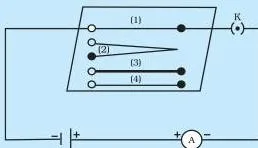
Doubling the length halves the current, so resistance doubles. Using a thicker wire raises the current, so resistance falls. Swapping the material changes the current even when length and area stay the same. This is why resistance depends on length, area and material, while resistivity depends only on the material (NCERT, p. 178).
Q7. A nichrome wire of resistance 8 Ω is stretched so that its length doubles, while its material and area of cross-section stay the same. What is its new resistance?
- (a) 4 Ω
- (b) 16 Ω
- (c) 32 Ω
- (d) 8 Ω
Correct answer: (b) Since \( R \propto l \) (NCERT, p. 178), doubling length doubles resistance: \( 8 \times 2 = 16\ \Omega \), option (b). Option (a) applies the inverse relationship meant for area, halving instead of doubling. Option (c) doubles the value twice, as though both length and area changed to raise resistance. Option (d) wrongly assumes resistance is unaffected by the length change.
Q8. Two nichrome wires are compared: wire B is twice as long and twice as thick as wire A. How do their resistivities compare?
- (a) They are equal, because resistivity depends only on the material, not on length or area
- (b) Wire B has half the resistivity of wire A, since it is thicker
- (c) Wire B has double the resistivity of wire A, since it is longer
- (d) Resistivity cannot be compared without knowing the exact resistance of each wire
Correct answer: (a) Resistivity \( \rho \) is a fixed property of the material at a given temperature and does not change with a wire’s length or area (NCERT, p. 178); both wires are nichrome, so their resistivities match. Option (b) wrongly makes resistivity depend on area — that dependence belongs to resistance, not resistivity. Option (c) makes the same mistake for length.
Option (d) is unnecessary, since resistivity is defined precisely so it does not need a particular wire’s dimensions.
Q9. A wire of resistivity \( 3.14 \times 10^{-6}\ \Omega\,\text{m} \) has length 2 m and diameter 2 mm. What is its resistance? (Take \( \pi = 3.14 \))
- (a) 0.5 Ω
- (b) 1 Ω
- (c) 2 Ω
- (d) 8 Ω
Correct answer: (c)
- Step 1: Radius \( r = \dfrac{2\ \text{mm}}{2} = 1\ \text{mm} = 1 \times 10^{-3}\ \text{m} \).
- Step 2: Area \( A = \pi r^2 = 3.14 \times (1 \times 10^{-3})^2 = 3.14 \times 10^{-6}\ \text{m}^2 \).
\[ R = \rho \frac{l}{A} = \frac{3.14 \times 10^{-6} \times 2}{3.14 \times 10^{-6}} = 2\ \Omega \]
Final answer: \( R = 2\ \Omega \), matching option (c).
Option (a) uses the full diameter, 2 mm, as if it were the radius, making the area four times too large and the resistance a quarter of the true value. Option (b) correctly finds the area but forgets to multiply by the length \( l \) in \( R = \rho l/A \).
Option (d) makes the opposite slip, treating half of the correct radius (0.5 mm) as the radius, shrinking the area to a quarter and pushing resistance up to four times the true value.
Q10. Three resistors of 4 Ω, 12 Ω and 6 Ω are first connected in series, then the same three resistors are connected in parallel, both across a battery. How does the parallel equivalent resistance compare with the series value?
- (a) Both combinations give the same equivalent resistance, since rearranging resistors cannot change the total
- (b) The parallel value is larger than the series value, because resistances still add up in a parallel circuit
- (c) The parallel value equals the single largest resistor, 12 Ω, because current always takes the path of least resistance only
- (d) The parallel value (2 Ω) is far smaller than the series value (22 Ω), because a parallel combination gives current more than one path to flow through
Correct answer: (d)
- Step 1: Series: \( R_s = 4 + 12 + 6 = 22\ \Omega \) (NCERT, p. 183).
- Step 2: Parallel: \( \dfrac{1}{R_p} = \dfrac{1}{4} + \dfrac{1}{12} + \dfrac{1}{6} = \dfrac{3+1+2}{12} = \dfrac{1}{2} \) (NCERT, p. 185).
Final answer: \( R_p = 2\ \Omega \), far below \( R_s = 22\ \Omega \), matching option (d).
Option (a) is the common misconception that resistance stays fixed regardless of arrangement. Option (b) directly contradicts the reciprocal rule, where the parallel combination is always smaller than the smallest individual resistor. Option (c) misunderstands that a parallel circuit divides current across all branches at once, not just the branch with the smallest resistance.
Q11. In a series circuit of three different resistors connected to a battery, which quantity is the same through each resistor?
- (a) Current
- (b) Potential difference
- (c) Resistance
- (d) Power dissipated
Correct answer: (a) Activity 11.4 shows the ammeter reading does not change wherever it sits in a series circuit, so current is the same through every resistor (NCERT, p. 182). Option (b) is wrong because potential difference divides unequally across resistors of different value, as \( V_1, V_2, V_3 \) show. Option (c) is wrong because the resistors were deliberately chosen with different values.
Option (d) is wrong because power, \( I^2R \), differs across resistors with different \( R \) even though the current is the same.
Q12. In a parallel combination of resistors connected across a battery, which quantity is the same for every branch?
- (a) Current
- (b) Potential difference
- (c) Equivalent resistance of the whole combination
- (d) Charge that has flowed since the switch was closed
Correct answer: (b) Activity 11.6 confirms the voltmeter reads the same potential difference across each resistor in a parallel combination (NCERT, p. 185), option (b). Option (a) is wrong because current through each branch depends on that branch’s own resistance and usually differs — the same series-versus-parallel mix-up trips up numerical questions.
Option (c) confuses a property of the whole combination with a property of individual branches. Option (d) is wrong because branches carrying different currents deliver different charge in the same time.
MCQ Set 3: Heating Effect of Current and Electric Power
Joule’s law of heating states \( H = I^2Rt \) (NCERT, p. 188), and electric power is \( P = VI = I^2R = V^2/R \) (NCERT, p. 191). The figure below shows the basic circuit used to derive this — a steady current through a purely resistive circuit, where all the supplied electrical energy is dissipated as heat.
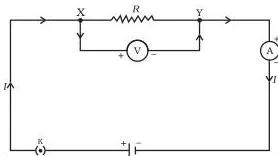
Q13. A 5 Ω resistor carries a current of 2 A for 10 s. How much heat is produced?
- (a) 100 J
- (b) 20 J
- (c) 200 J
- (d) 1000 J
Correct answer: (c)
\[ H = I^2Rt = (2)^2 \times 5 \times 10 = 200\ \text{J} \]
Final answer: \( H = 200\ \text{J} \), matching option (c).
Option (a) uses \( H = IRt \) instead of \( I^2Rt \), forgetting to square the current: \( 2 \times 5 \times 10 = 100 \). Option (b) forgets time altogether, computing only \( I^2R = 20 \). Option (d) squares the product \( IR \) (giving 10 V) and multiplies by time, which is not how Joule’s law works.
Q14. A device draws a current of 2 A when connected to a 220 V line. What is its power?
- (a) 110 W
- (b) 222 W
- (c) 44 W
- (d) 440 W
Correct answer: (d) Power is \( P = VI = 220 \times 2 = 440\ \text{W} \) (NCERT, p. 191), option (d). Option (a) divides instead of multiplying, \( 220/2 \). Option (b) simply adds the two values, \( 220 + 2 \). Option (c) is a decimal-point slip, multiplying \( 220 \times 0.2 \) instead of \( 220 \times 2 \).
Q15. The voltage across a fixed resistor is reduced to half its original value. What happens to the power dissipated in it?
- (a) It falls to one-fourth of the original power
- (b) It falls to one-half of the original power
- (c) It doubles
- (d) It stays unchanged
Correct answer: (a) Since \( P = V^2/R \) (NCERT, p. 191), halving V squares that reduction, so power falls to \( (1/2)^2 = 1/4 \) of the original value. Option (b) is the common mistake of assuming power halves along with voltage, treating a squared relationship as if it were linear.
Options (c) and (d) both ignore the inverse dependence entirely — reducing voltage across a fixed resistance can never increase or preserve power, since less potential difference means less work is done moving each unit of charge.
Q16. One kilowatt-hour (kWh) of electrical energy is…
- (a) the power consumed by an appliance running continuously for 1000 hours
- (b) the energy consumed by a 1000 W appliance running for 1 hour
- (c) just another symbol for 1 kilowatt, since both use the prefix “kilo”
- (d) equal to 1000 joules
Correct answer: (b) The commercial unit of electrical energy equals \( 1000\ \text{W} \times 3600\ \text{s} = 3.6 \times 10^6\ \text{J} \) (NCERT, p. 191), option (b). Option (a) confuses energy (kWh) with power (kW) — power does not depend on running time, energy does.
Option (c) makes the same mix-up, treating a unit of energy and a unit of power as interchangeable just because they share a prefix.
Option (d) badly understates the conversion; 1 kWh equals \( 3.6 \times 10^6 \) joules, not 1000 joules.
Q17. The connecting cord of an electric heater does not glow, while its heating element does. What is the main reason?
- (a) The cord carries a much smaller current than the heating element
- (b) The heating element is wired in parallel with the cord, so the cord carries no current at all
- (c) The cord is made of a low-resistance material such as copper, so it produces far less heat than the high-resistance heating element for the same current
- (d) The cord is also a high-resistance alloy, but it is too thin to visibly glow
Correct answer: (c) Heat depends on resistance through \( H = I^2Rt \); a copper cord has very low resistivity compared with the alloy used in the heating element, so it stays cool while carrying the same current (NCERT, p. 190), option (c).
Option (a) is wrong because the cord and the element are in the same series path and carry the same current.
Option (b) is wrong because a parallel branch carrying no current would mean the heater does not work at all. Option (d) wrongly assumes the cord is made of the same high-resistance alloy as the element.
Assertion-Reason Questions on Electricity
Each item has an Assertion (A) and a Reason (R). Choose the correct relationship between them:
- (a) Both A and R are true, and R is the correct explanation of A.
- (b) Both A and R are true, but R is not the correct explanation of A.
- (c) A is true, but R is false.
- (d) A is false, but R is true.
Q18. Assertion (A): If the length of a metallic wire is doubled, keeping its area of cross-section and material unchanged, its resistance also doubles.
Reason (R): Resistance of a conductor is directly proportional to its length, as given by \( R = \rho l/A \).
Correct answer: (a) Both statements are true, and the reason is exactly why the assertion holds — \( R \propto l \) when \( \rho \) and \( A \) stay fixed (NCERT, p. 178). This item does not fit (b), since R directly explains A. It does not fit (c) or (d) either, because neither statement is false here.
Q19. Assertion (A): Nichrome, rather than pure copper, is preferred for the heating coils of an electric iron.
Reason (R): Copper has a very high melting point and cannot withstand the heat produced inside the coil.
Correct answer: (c) The assertion is true — nichrome is indeed used for heating coils (NCERT, p. 178). But the reason is false: copper is avoided because its resistivity is too low to generate useful heat and it oxidises readily at high temperatures, not because it melts easily.
Since A is true and R is false, the answer is (c), not (a) or (b), which both need R to be true, and not (d), which needs A to be false.
Q20. Assertion (A): In a parallel circuit, if one bulb blows off, the other appliances connected to the same line keep working normally.
Reason (R): The equivalent resistance of resistors connected in parallel is always less than the resistance of the smallest individual resistor.
Correct answer: (b) Both statements are individually true. A parallel circuit does let other appliances keep running if one branch fails (NCERT, p. 187), and the equivalent-resistance rule is also correct (NCERT, p. 185).
But R does not explain A — appliances keep working because each sits on its own independent branch with the full supply voltage across it, not because of the numerical size of the equivalent resistance. That rules out (a); since both statements are true, (c) and (d) are also wrong.
Case Study: Reading a V-I Graph and a Mixed Circuit
A student records current and potential difference readings for a resistor kept at constant room temperature, shown below.
| Current, I (A) | Potential difference, V (V) |
|---|---|
| 0.2 | 1.0 |
| 0.4 | 2.0 |
| 0.6 | 3.0 |
| 0.8 | 4.0 |
Plotting these points gives a straight line through the origin — the same shape as the \( V\text{-}I \) graph obtained from the nichrome-wire activity in the textbook.
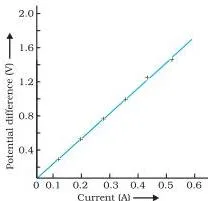
Q21. What does the slope of this \( V\text{-}I \) graph represent?
- (a) The resistivity of the material
- (b) The electric power consumed by the resistor
- (c) The total charge that has flowed through the resistor
- (d) The resistance of the conductor, since slope = \( V/I = R \)
Correct answer: (d) Since Ohm’s law gives \( V/I = R \) (NCERT, p. 175), the slope of a straight-line \( V\text{-}I \) graph is numerically equal to resistance, option (d). Option (a) confuses resistance with resistivity, which needs the wire’s length and area, not just V and I readings.
Option (b) is wrong because power needs V and I multiplied together, not their ratio.
Option (c) is wrong because charge needs current and time, neither of which is the slope of this graph.
Q22. Does the resistor in the table obey Ohm’s law, and what is its resistance?
- (a) Yes — \( V/I \) is a constant 5 Ω for every reading, and the graph is a straight line through the origin
- (b) No — \( V/I \) decreases as the current increases
- (c) Yes, but the resistance is 0.2 Ω, found from \( I/V \)
- (d) No — Ohm’s law only holds for nichrome wires, not other resistors
Correct answer: (a) Checking each pair: \( 1.0/0.2 = 5 \), \( 2.0/0.4 = 5 \), \( 3.0/0.6 = 5 \), \( 4.0/0.8 = 5 \) — the ratio is constant at 5 Ω, so the resistor obeys Ohm’s law (NCERT, p. 175). Option (b) is factually wrong for this data set, since the ratio does not change. Option (c) inverts the correct formula, calculating \( I/V \) instead of \( V/I \).
Option (d) is wrong because Ohm’s law is a general property of metallic conductors at constant temperature, not something unique to nichrome.
Q23. This 5 Ω resistor is now connected in parallel with a second 20 Ω resistor across the same battery. What is the equivalent resistance of the combination?
- (a) 25 Ω
- (b) 4 Ω
- (c) 15 Ω
- (d) 0.25 Ω
Correct answer: (b)
\[ \frac{1}{R_p} = \frac{1}{5} + \frac{1}{20} = \frac{4+1}{20} = \frac{1}{4} \]
Final answer: \( R_p = 4\ \Omega \), matching option (b).
Option (a) adds the two resistances directly, \( 5 + 20 = 25 \), which is the series rule, not the parallel one. Option (c) subtracts one resistance from the other, which has no basis in either combination rule. Option (d) correctly finds \( 1/R_p = 1/4 \) but forgets the final step of taking the reciprocal, leaving the answer as 0.25 Ω instead of inverting it to 4 Ω.
Common Mistakes Students Make in Electricity MCQs
These are the recurring slips behind the distractors used above. Check your own working against this table before moving to the next set.
| Mistake | Correct rule | How to check your answer |
|---|---|---|
| Mixing up series (same current) and parallel (same voltage) rules | Series keeps current the same through every resistor; parallel keeps voltage the same across every branch (NCERT, p. 182, 185) | Ask which quantity the circuit diagram fixes before applying Ohm’s law to each part |
| Forgetting resistivity is a fixed material property, independent of the wire’s length and area | Resistance changes with length and area, \( R = \rho l/A \); resistivity \( \rho \) itself does not (NCERT, p. 178) | Re-read whether the question asks for resistance (dimension-dependent) or resistivity (material-only) |
| Using the full diameter instead of the radius when finding area in \( R = \rho l/A \) | Area of a circular cross-section is \( A = \pi r^2 \), where \( r \) is half the diameter | Halve the given diameter first, then square it, before multiplying by \( \pi \) |
| Assuming power changes in direct proportion to voltage, e.g. thinking doubling voltage doubles power | Power depends on the square of voltage, \( P = V^2/R \): doubling V quadruples P, halving V quarters P | Recompute P from \( V^2/R \) rather than scaling P in direct proportion to V |
| Confusing kilowatt (kW), a unit of power, with kilowatt-hour (kWh), a unit of energy | 1 kWh is the energy used by a 1000 W device in 1 hour, equal to \( 3.6 \times 10^6\ \text{J} \) (NCERT, p. 191) | Check whether the question asks for a rate (power) or a total consumed over time (energy) |
| Adding resistances directly for a parallel combination | Parallel resistors combine by reciprocals, \( 1/R_p = 1/R_1 + 1/R_2 + \dots \) (NCERT, p. 185) | Confirm the equivalent resistance is smaller than the smallest individual resistor |
Series vs Parallel Circuits: Quick Comparison Table
Use this table as a fast recheck once you have attempted the MCQs above.
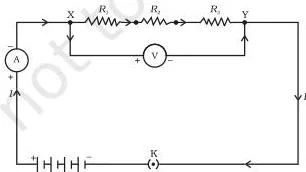
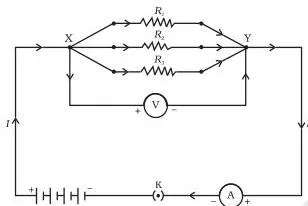
| Property | Series | Parallel |
|---|---|---|
| Current | Same through every resistor (NCERT, p. 182) | Divides across branches; total current is the sum of branch currents (NCERT, p. 185) |
| Voltage | Divides across resistors; total equals the sum of individual drops (NCERT, p. 183) | Same across every branch (NCERT, p. 185) |
| Equivalent resistance | \( R_s = R_1 + R_2 + R_3 \), always greater than the largest resistor | \( 1/R_p = 1/R_1 + 1/R_2 + 1/R_3 \), always smaller than the smallest resistor |
| Effect of one component failing | Breaks the entire circuit; nothing else works (NCERT, p. 187) | Only that branch stops; other appliances keep working normally |
| Typical domestic use | Rarely used for appliances, since they need different currents to work properly | Used for household wiring, so each appliance gets full mains voltage independently (NCERT, p. 187) |
How Electricity Is Asked in the Current CBSE Objective Pattern
Objective papers now mix straightforward recall MCQs with assertion-reason items and case or source-based sets that hand you data and ask you to interpret it. Electricity suits this format well because it is a numerical chapter — a single Ohm’s law or Joule’s law calculation can be rephrased as an assertion-reason pair or dropped into a short data table.
The chapter’s own exercise questions, numbered on pages 23 and 24 of the NCERT textbook, preview what gets converted into objective form. Questions on resistivity given a wire’s diameter, on finding equivalent resistance for named series-parallel combinations, and on comparing power in two circuit arrangements are exactly the calculation types that turn into an MCQ, an assertion-reason item, or a case-based question.
These are practice questions built for revision, not questions taken from any specific board paper.
If you want a wider revision plan around this chapter, the Class 10 Science notes hub links every chapter’s core concepts, and the Class 10 CBSE notes section covers other subjects for the same session. The CBSE notes homepage is a starting point if you are revising more than one class.
If numericals on ionisation and pH are still shaky, the Acids, Bases and Salts notes are worth a pass before you combine both chapters in a mock test.
Answer Key: Electricity Class 10 MCQ Quick Reference
Recheck your attempt here; the full reasoning for each answer sits with its question above.
| Question No. | Correct Option |
|---|---|
| Q1 | (b) |
| Q2 | (a) |
| Q3 | (d) |
| Q4 | (c) |
| Q5 | (a) |
| Q6 | (d) |
| Q7 | (b) |
| Q8 | (a) |
| Q9 | (c) |
| Q10 | (d) |
| Q11 | (a) |
| Q12 | (b) |
| Q13 | (c) |
| Q14 | (d) |
| Q15 | (a) |
| Q16 | (b) |
| Q17 | (c) |
| Q18 | (a) |
| Q19 | (c) |
| Q20 | (b) |
| Q21 | (d) |
| Q22 | (a) |
| Q23 | (b) |
Frequently Asked Questions on Electricity Class 10 MCQs
Are these electricity class 10 mcq questions taken from an actual CBSE board paper?
No. These are practice questions written to match the concepts and question styles used in CBSE Class 10 Science, Chapter 11, Electricity. They are not copied from, and are not claimed to be, any official board paper.
How is resistance affected if a wire’s length is doubled and its area of cross-section is also doubled?
Resistance stays unchanged. In \( R = \rho l/A \) (NCERT, p. 178), doubling both \( l \) and \( A \) doubles the numerator and the denominator by the same factor, so they cancel out and \( R \) is unaffected.
Why does an electric heater draw more current than an electric bulb on the same 220 V line?
A heater coil has a much lower resistance than a bulb filament. Since \( I = V/R \) (NCERT, p. 175), a lower resistance at the same 220 V supply means a proportionally higher current, which is why heaters and irons need higher-rated fuses than lighting circuits.
What is the difference between an assertion-reason question and a normal MCQ in this chapter?
A normal MCQ asks you to pick one correct option among four choices for a single question. An assertion-reason item gives two statements, an Assertion and a Reason, and asks you to judge whether both are true and whether the Reason correctly explains the Assertion, using the four standard choices shown in the assertion-reason section above.
Which Electricity topics are most likely to appear as case-based or data-based questions?
Topics built around numbers translate easily into data sets: V-I readings that test whether Ohm’s law holds, circuit diagrams mixing series and parallel resistors, and situations that compare power or heat produced before and after a change in voltage or resistance.
Why is the equivalent resistance in a parallel circuit always less than the smallest individual resistance?
Because \( 1/R_p = 1/R_1 + 1/R_2 + \dots \) (NCERT, p. 185) adds up several positive fractions, the sum is always larger than any single fraction on its own, so \( R_p \) itself is always smaller than the smallest individual resistor. Adding more parallel branches gives current more paths, which can only reduce total resistance further, never increase it.
Reference: NCERT Class 10 Science textbook, chapter Electricity.
Explore Class 10 Science MCQs
More for this chapter:
Class 10 Science on LearnCBSE:
Related chapters: