
Electricity Class 10 important questions in this set are built directly from Chapter 11 of the NCERT Science textbook — current, potential difference, Ohm’s law, factors affecting resistance, series and parallel combinations of resistors, and the heating effect of current.
This practice set is written fresh for the 2026-27 CBSE academic session; it is original material, not copied textbook text, so use it to test yourself, not to memorise word for word.
Chapter 11 is almost entirely a mix of concept and calculation, and nearly every mark group below pairs one definition-type question with one calculation, because that is exactly how a real answer sheet tests this chapter. Keep the Class 10 Science notes open alongside this page if any definition feels shaky before you attempt the numericals.
What This Electricity Class 10 Important Questions Set Covers
Before the questions, it helps to have the core formulas in one place. Every numerical in this set uses one of these three relationships, so check you can recall each one without looking it up.
| Quantity | Formula | SI Unit |
|---|---|---|
| Electric current | \( I = \dfrac{Q}{t} \) | ampere (A) |
| Ohm’s law | \( V = IR \) | volt (V) for \(V\), ohm (\(\Omega\)) for \(R\) |
| Resistance of a wire | \( R = \rho\dfrac{l}{A} \) | ohm metre (\(\Omega\ m\)) for \(\rho\) |
| Resistors in series | \( R_s = R_1+R_2+R_3 \) | ohm (\(\Omega\)) |
| Resistors in parallel | \( \dfrac{1}{R_p}=\dfrac{1}{R_1}+\dfrac{1}{R_2}+\dfrac{1}{R_3} \) | ohm (\(\Omega\)) |
| Heat produced (Joule’s law) | \( H = I^2Rt \) | joule (J) |
| Electric power | \( P = VI = I^2R = \dfrac{V^2}{R} \) | watt (W) |
Use each marks group below the way a real question paper is structured: read the question, write your own answer first, then check it against the model answer.
1 Mark Important Questions from Electricity (Very Short Answer)
Q1. Define electric current and give its SI unit.
Answer: Electric current is the rate of flow of electric charge through a conductor, given by \( I = \dfrac{Q}{t} \) (NCERT, p. 2). Its SI unit is the ampere (A), where 1 A equals a flow of 1 coulomb of charge per second.
Difficulty: Easy. This definition-plus-unit pattern recurs because it is the fastest way for an examiner to open a paper and check whether a basic term has been learnt correctly.
Q2. State Ohm’s law in one line.
Answer: At constant temperature, the potential difference across the ends of a conductor is directly proportional to the current flowing through it, so \( V = IR \), where \(R\) is the resistance (NCERT, p. 5).
Difficulty: Easy. Ohm’s law is the base formula for almost every numerical in this chapter, so examiners routinely check the statement is known exactly, not just the formula.
Q3. Define resistivity and give its SI unit.
Answer: Resistivity (\(\rho\)) is a property of the material of a conductor; it is the constant of proportionality in \( R = \rho\dfrac{l}{A} \) and does not depend on the length or area of the wire, only on the material and temperature (NCERT, p. 8). Its SI unit is ohm metre (\(\Omega\ m\)).
Difficulty: Moderate. This question checks whether students confuse resistance (depends on size) with resistivity (a fixed material property) — a distinction examiners test often.
Q4. Name the instrument used to measure potential difference and state how it is connected in a circuit.
Answer: A voltmeter measures potential difference. It is always connected in parallel across the two points between which the potential difference is to be measured (NCERT, p. 3).
Difficulty: Easy. This pairs naturally with the ammeter connection rule, so examiners often ask one of the two as a quick recall check.
2 Marks Important Questions from Electricity
Q5. Distinguish how an ammeter and a voltmeter are connected in a circuit.
Answer:
- An ammeter is connected in series in the circuit, so the entire current to be measured passes through it (NCERT, p. 2). An ideal ammeter has very low resistance so it does not change the current it is measuring.
- A voltmeter is connected in parallel across the component whose potential difference is being measured (NCERT, p. 3). It has a high resistance so that only a negligible current is diverted through it.
Difficulty: Moderate. This comparison is a favourite short-answer question because it tests understanding of circuit behaviour, not just definitions.
Q6. A charge of 3 C flows through a conductor in 5 s. Find the current.
Step 1: Write the current formula \( I = \dfrac{Q}{t} \) (NCERT, p. 2).
Step 2: Substitute \( Q = 3\ \text{C} \) and \( t = 5\ \text{s} \).
\[ I = \dfrac{3\ \text{C}}{5\ \text{s}} = 0.6\ \text{A} \]
Final answer: The current is \(0.6\ \text{A}\).
Difficulty: Easy. A single-step \(I = Q/t\) numerical almost always appears somewhere in the 1–2 mark section because it can be answered in under a minute if the formula is known.
Q7. Why are heating-appliance coils made of an alloy such as nichrome rather than a pure metal? Give two reasons.
Answer:
- An alloy generally has higher resistivity than its constituent metals, so a shorter coil can produce more heat for the same current (NCERT, p. 8-9).
- Alloys do not oxidise (burn) easily even at the high temperatures reached during heating, so the coil lasts longer than a pure metal wire would (NCERT, p. 9).
Difficulty: Moderate. This reasoning question repeats across papers because it links a material property (resistivity) to a real-life design choice, which is exactly what the syllabus wants students to connect.
3 Marks Important Questions from Electricity
Q8. State how equivalent resistance is found for resistors in series and calculate it for resistors of 6 Ω, 9 Ω and 15 Ω joined in series to a 15 V battery. Also find the current.
Answer: When resistors are connected end to end, the same current flows through each one, and the total potential difference is the sum of the potential differences across each resistor. Applying Ohm’s law to the whole circuit and to each resistor separately gives \( R_s = R_1+R_2+R_3 \) (NCERT, p. 14).
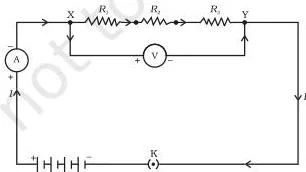
Step 1: Add the three resistances: \( R_s = 6\ \Omega + 9\ \Omega + 15\ \Omega \).
\[ R_s = 30\ \Omega \]
Step 2: Apply Ohm’s law to the whole circuit: \( I = \dfrac{V}{R_s} \).
\[ I = \dfrac{15\ \text{V}}{30\ \Omega} = 0.5\ \text{A} \]
Final answer: Equivalent resistance \( = 30\ \Omega \); current through the circuit \( = 0.5\ \text{A} \).
Difficulty: Moderate. These are original values, not the textbook’s own resistor set, so the working genuinely needs to be redone rather than recalled.
Q9. Explain how the resistance of a conductor depends on its length, area of cross-section and material, then find the resistance of a 2 m wire of diameter 1 mm and resistivity \( 1.7\times10^{-8}\ \Omega\ \text{m} \).
Answer: Resistance is directly proportional to the length of the conductor and inversely proportional to its area of cross-section; a longer wire gives electrons a longer path to travel through, and a thinner wire crowds them into a smaller area, both of which increase opposition to flow.
Resistance also depends on the material through its resistivity (NCERT, p. 8-9): \( R = \rho\dfrac{l}{A} \).
Step 1: Convert the diameter to metres: \( d = 1\ \text{mm} = 1\times10^{-3}\ \text{m} \).
Step 2: Find the area of cross-section using \( A = \dfrac{\pi d^2}{4} \).
\[ A = \dfrac{\pi (1\times10^{-3})^2}{4} = 7.85\times10^{-7}\ \text{m}^2 \]
Step 3: Substitute into \( R = \rho\dfrac{l}{A} \) with \( \rho = 1.7\times10^{-8}\ \Omega\ \text{m} \) and \( l = 2\ \text{m} \).
\[ R = \dfrac{1.7\times10^{-8}\times 2}{7.85\times10^{-7}} \approx 0.043\ \Omega \]
Final answer: The resistance of the wire is approximately \(0.043\ \Omega\).
Difficulty: Challenging. This uses a 1 mm diameter and different length and resistivity from the textbook’s own worked example, so the diameter-to-area conversion has to be done from scratch.
Q10. State Joule’s law of heating with its three proportionalities and calculate the heat produced by a 10 Ω resistor carrying 3 A for 1 minute.
Answer: Joule’s law of heating states that the heat produced in a resistor is directly proportional to the square of the current, directly proportional to the resistance, and directly proportional to the time for which the current flows, giving \( H = I^2Rt \) (NCERT, p. 18-19).
Step 1: Convert time to seconds: \( t = 1\ \text{min} = 60\ \text{s} \).
Step 2: Substitute \( I = 3\ \text{A} \), \( R = 10\ \Omega \), \( t = 60\ \text{s} \) into \( H = I^2Rt \).
\[ H = (3)^2 \times 10 \times 60 = 9\times 10\times 60 = 5400\ \text{J} \]
Final answer: Heat produced \( = 5400\ \text{J} \) (i.e. \(5.4\ \text{kJ}\)).
Difficulty: Moderate. Time given in minutes is a deliberate trap here — the conversion to seconds is exactly where marks are usually lost.
5 Marks Important Questions from Electricity (Numerical Practice)
Q11. A circuit has \(R_1=15\ \Omega\) and \(R_2=25\ \Omega\) in parallel, in series with a second parallel group of \(R_3=10\ \Omega\), \(R_4=30\ \Omega\) and \(R_5=20\ \Omega\), connected to a 20 V battery. Find the total resistance and total current.
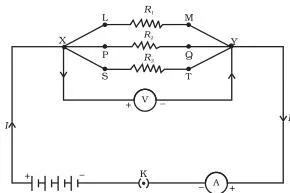
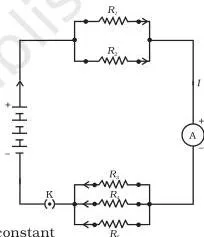
Step 1: Find the equivalent resistance of the first parallel group using \( \dfrac{1}{R’}=\dfrac{1}{R_1}+\dfrac{1}{R_2} \) (NCERT, p. 16-17).
\[ \dfrac{1}{R’} = \dfrac{1}{15}+\dfrac{1}{25} = \dfrac{8}{75} \ \Rightarrow\ R’ = 9.375\ \Omega \]
Step 2: Find the equivalent resistance of the second parallel group using \( \dfrac{1}{R”}=\dfrac{1}{R_3}+\dfrac{1}{R_4}+\dfrac{1}{R_5} \).
\[ \dfrac{1}{R”} = \dfrac{1}{10}+\dfrac{1}{30}+\dfrac{1}{20} = \dfrac{11}{60} \ \Rightarrow\ R” = 5.45\ \Omega \]
Step 3: Since the two groups are in series, add them: \( R = R’+R” \).
\[ R = 9.375\ \Omega + 5.45\ \Omega \approx 14.83\ \Omega \]
Step 4: Apply Ohm’s law to the whole circuit: \( I = \dfrac{V}{R} \).
\[ I = \dfrac{20\ \text{V}}{14.83\ \Omega} \approx 1.35\ \text{A} \]
Final answer: Total resistance \( \approx 14.83\ \Omega \); total current \( \approx 1.35\ \text{A} \).
Difficulty: Challenging. The structure mirrors a two-group series-parallel numerical, but every resistance value here is different from the textbook’s own worked example, so the reciprocal-addition steps must be recalculated in full.
Q12. A bulb rated 100 W at 220 V is used for 6 hours a day for 20 days. Find its resistance, the current it draws, and the cost of running it at Rs 6 per kWh.
Step 1: Find resistance using \( R = \dfrac{V^2}{P} \) (NCERT, p. 21).
\[ R = \dfrac{(220)^2}{100} = \dfrac{48400}{100} = 484\ \Omega \]
Step 2: Find current using \( I = \dfrac{P}{V} \).
\[ I = \dfrac{100\ \text{W}}{220\ \text{V}} \approx 0.45\ \text{A} \]
Step 3: Find total energy consumed: total hours \( = 6\times 20 = 120\ \text{h} \), so energy \( = P\times t \).
\[ \text{Energy} = 100\ \text{W} \times 120\ \text{h} = 12000\ \text{Wh} = 12\ \text{kWh} \]
Step 4: Multiply by the rate to get cost.
\[ \text{Cost} = 12\ \text{kWh} \times \text{Rs } 6\text{/kWh} = \text{Rs } 72 \]
Final answer: Resistance \( = 484\ \Omega \); current \( \approx 0.45\ \text{A} \); cost \( = \text{Rs } 72 \) for 20 days.
Difficulty: Moderate. Energy-cost numericals like this recur every year in some form because they combine power, time and a real electricity tariff in one question.
Q13. Explain three advantages of connecting household appliances in parallel rather than in series, and find the total current drawn when a 60 W and a 100 W lamp are both connected in parallel to a 220 V line.
Answer:
- Each appliance gets the full line voltage of 220 V and works at its own rated current, so a fan and a heater with very different current needs can run on the same line (NCERT, p. 15).
- If one appliance fails or is switched off, the circuit is not broken for the rest — the other appliances keep working, unlike in a series circuit.
- Adding more appliances in parallel reduces the overall resistance and lets each device draw the current it needs without depending on the others (NCERT, p. 15).
Step 1: Find the current drawn by each lamp using \( I = \dfrac{P}{V} \) (NCERT, p. 21).
\[ I_1 = \dfrac{60}{220} \approx 0.27\ \text{A}, \quad I_2 = \dfrac{100}{220} \approx 0.45\ \text{A} \]
Step 2: In a parallel circuit, total current is the sum of branch currents.
\[ I = I_1+I_2 \approx 0.27+0.45 = 0.73\ \text{A} \]
Final answer: Total current drawn from the line \( \approx 0.73\ \text{A} \).
Difficulty: Moderate. This is a common reasoning-plus-numerical combination because it tests whether the parallel-circuit advantage is understood, not just the current formula.
How Examiners Keep Testing the Same Electricity Ideas
Across most question papers on this chapter, three formula families do almost all the work: Ohm’s law (\(V=IR\)), resistor combination (series or parallel), and the heating or power relations (\(H=I^2Rt\), \(P=VI\)).
These are the only three places in the chapter where algebra meets an actual circuit, so a single question can check both understanding of the concept and the ability to calculate correctly. That is why almost every important-questions set, including this one, keeps returning to the same three families with new numbers.
| Formula family | What it tests | Typical marks |
|---|---|---|
| Ohm’s law (\(V=IR\)) | Basic circuit calculation, unit handling | 1–3 |
| Series / parallel resistors | Circuit reasoning plus reciprocal or sum calculation | 3–5 |
| Heating effect / power (\(H=I^2Rt\), \(P=VI\)) | Applying the right formula and converting units correctly | 2–5 |
Along with these, “factors affecting resistance” — length, area of cross-section, and material — is a frequent 1 or 2 mark filler question because it needs a one-line explanation and no calculation, which makes it a quick way to check whether the concept was actually read.
Common Mistakes Students Make in Electricity Numericals
Most marks lost on this chapter are not from not knowing the formula, but from applying it incorrectly at one step. Check your working against this table before the exam.
| Mistake | Correct rule | How to check your answer |
|---|---|---|
| Adding resistances directly in a parallel circuit | Use \( \dfrac{1}{R_p}=\dfrac{1}{R_1}+\dfrac{1}{R_2}+\dots \), not \( R_p=R_1+R_2 \) (NCERT, p. 15-17) | \(R_p\) must always come out smaller than the smallest individual resistor — if it does not, the reciprocal step was skipped |
| Forgetting to convert minutes or hours to seconds before using \(I=\dfrac{Q}{t}\) or \(H=I^2Rt\) | Convert time to seconds first: \(1\ \text{min}=60\ \text{s}\), \(1\ \text{h}=3600\ \text{s}\) (NCERT, p. 18-19) | Re-check the unit of \(t\) written in Step 1 of your working before substituting |
| Using diameter directly in \( R=\rho\dfrac{l}{A} \) instead of converting to area | Find area first using \( A=\dfrac{\pi d^2}{4} \), then substitute (NCERT, p. 8-9) | If the diameter value appears anywhere in your final formula without being squared and divided by 4, the area step was missed |
| Confusing \(P=VI\) with \(H=I^2Rt\) when time is not given | Use \(P=VI\) for power (rate of energy use); use \(H=I^2Rt\) only when a specific time and heat quantity are asked (NCERT, p. 18-21) | Ask whether the question mentions a duration — if not, it is almost always asking for power, not heat |
3-Day Revision Plan for Electricity Before the Exam
Spread this chapter across three sittings rather than trying to revise it all in one go the night before.
| Day | Focus | Textbook pages to revise |
|---|---|---|
| Day 1 | Definitions and formulas — current, potential difference, Ohm’s law, resistivity | Pages 1-9 |
| Day 2 | Every series and parallel resistor numerical, redrawing each circuit diagram by hand | Pages 11-18 |
| Day 3 | Heating-effect and power/energy-cost problems, then re-attempt the common mistakes table above | Pages 18-22 |
On Day 3, time yourself: a well-practised student should be able to finish most of these numericals in under 4 minutes each. If a question takes longer, it usually means a formula was not fully memorised. Once this chapter feels solid, move on to a different topic such as the Acids, Bases and Salts chapter notes so revision does not get repetitive.
You can browse every subject’s notes from the Class 10 CBSE notes hub, or start from the full CBSE notes index if you are planning revision across other classes too.
Frequently Asked Questions on Electricity Important Questions
Why does the equivalent resistance become smaller when resistors are joined in parallel instead of series?
In a parallel circuit, every extra resistor gives the current an additional path, so \( \dfrac{1}{R_p}=\dfrac{1}{R_1}+\dfrac{1}{R_2}+\dots \) makes \(R_p\) smaller than the smallest individual resistance (NCERT, p. 15-17).
In a series circuit, resistances simply add up (\(R_s=R_1+R_2+\dots\)), so the combined resistance is always larger than any single resistor in it (NCERT, p. 14).
How do I know whether a numerical needs \(H=I^2Rt\) or \(P=VI\) when both current and time are given?
If the question asks for heat produced or energy over a stated time, use \(H=I^2Rt\) (NCERT, p. 18-19).
If it asks for power — the rate at which energy is used — you can use \(P=VI\) or \(P=I^2R\) directly, and the time value given is usually needed only in a later part of the question, such as finding total energy or cost.
Why is a fuse wire made of a metal with a low melting point instead of copper?
A fuse must melt and break the circuit as soon as the current exceeds a safe value, protecting the appliance and wiring (NCERT, p. 20). Copper has a high melting point, so it would not melt quickly enough during an overload, which defeats the purpose of the fuse.
What is the practical difference between how an ammeter and a voltmeter are connected in a circuit?
An ammeter is connected in series so that the full circuit current passes through it, while a voltmeter is connected in parallel across the component whose potential difference is being measured (NCERT, p. 2-3).
Why does resistivity stay constant for a material while resistance changes with the wire’s length and thickness?
Resistivity depends only on the material and its temperature, not on the size of the wire (NCERT, p. 8-9). Resistance, given by \(R=\rho\dfrac{l}{A}\), additionally depends on the wire’s length and cross-sectional area, so two wires of the same material can have very different resistances if their dimensions differ.
You can cross-check any definition or figure in this set against the original chapter on the official NCERT textbook portal.
Reference: NCERT Class 10 Science textbook, chapter Electricity.
Explore Class 10 Science Important Questions
- Class 10 Science Important Questions
- Class 10 Important Questions
- CBSE Important Questions for Classes 1 to 12
More for this chapter:
Class 10 Science on LearnCBSE:
Related chapters: