This chapter covers the magnetic field produced by electric currents, the rules that determine its direction, and the force a current-carrying conductor experiences when placed in a magnetic field. You will find the right-hand thumb rule, Fleming’s left-hand rule, and the key relationships between current, magnetic field, and force—all grouped by the sub-topics of the NCERT textbook.
Each relationship is presented with its symbol meanings, guidance on when to apply it, and original worked examples. For detailed explanations and derivations, refer to the Magnetic Effects of Electric Current Class 10 Notes.
Formulas at a Glance
| Purpose (what you are finding) | Formula / Rule |
|---|---|
| Direction of magnetic field around a straight current-carrying conductor | \( \text{Right-hand thumb rule} \) |
| Direction of force on a current-carrying conductor in a perpendicular magnetic field | \( \text{Fleming’s left-hand rule} \) |
| Force on a conductor when current is perpendicular to magnetic field | \( F = B I L \) |
| Magnetic field at the centre of a circular coil with \( n \) turns | \( B_{\text{coil}} = n \times B_{\text{single turn}} \) |
| Magnetic field inside a solenoid (uniform field) | \( B_{\text{solenoid}} \propto n I \) |
| Magnetic field near a straight conductor decreases with distance | \( B \propto \dfrac{I}{r} \) |
All Formulas, Grouped by Topic
Magnetic Field due to a Current through a Straight Conductor
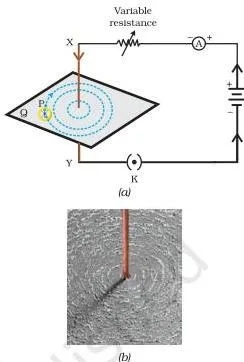
The magnetic field lines around a straight current-carrying wire are concentric circles centred on the wire (NCERT, p. 198).
\[ B \propto \frac{I}{r} \]
Here \( B \) is the magnetic field strength, \( I \) is the current, and \( r \) is the perpendicular distance from the wire. The field increases with current and decreases as the distance from the wire increases.
Right-Hand Thumb Rule
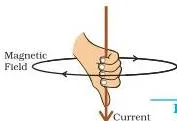
This rule gives the direction of the magnetic field around a current-carrying straight conductor (NCERT, p. 199).
If you hold the conductor in your right hand with the thumb pointing in the direction of current, your fingers curl around the wire in the direction of the magnetic field lines.
Magnetic Field due to a Current through a Circular Loop
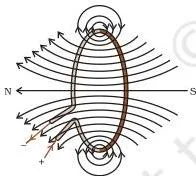
At the centre of a circular loop carrying current, the magnetic field lines are nearly straight and perpendicular to the plane of the loop. For a coil of \( n \) turns, the field is \( n \) times that of a single turn (NCERT, p. 200).
\[ B_{\text{coil}} = n \times B_{\text{single turn}} \]
Magnetic Field due to a Current in a Solenoid
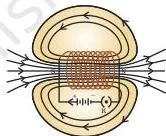
A solenoid is a coil of many circular turns wrapped in the shape of a cylinder. The field inside a long solenoid is uniform (parallel straight lines) and similar to the field of a bar magnet (NCERT, p. 201).
\[ B_{\text{solenoid}} \propto n I \]
Here \( n \) is the number of turns per unit length and \( I \) is the current. One end of the solenoid behaves as a north pole and the other as a south pole.
Force on a Current-Carrying Conductor in a Magnetic Field
A current-carrying conductor placed in a magnetic field experiences a force. The force is largest when the current and the magnetic field are perpendicular to each other (NCERT, p. 202).
\[ F = B I L \]
where \( F \) is the force, \( B \) is the magnetic field strength, \( I \) is the current, and \( L \) is the length of the conductor inside the magnetic field. The direction of the force is given by Fleming’s left-hand rule.
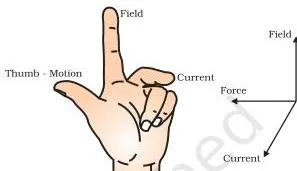
Fleming’s Left-Hand Rule
This rule gives the direction of the force on a current-carrying conductor in a magnetic field (NCERT, p. 202).
Stretch the thumb, forefinger, and middle finger of your left hand so that they are mutually perpendicular. If the forefinger points in the direction of the magnetic field and the middle finger in the direction of the current, then the thumb points in the direction of the force (motion) on the conductor.
What Each Symbol Means
| Symbol | Meaning | SI Unit |
|---|---|---|
| \( B \) | Magnetic field strength (magnetic flux density) | tesla (T) |
| \( I \) | Electric current | ampere (A) |
| \( L \) | Length of the conductor inside the magnetic field | metre (m) |
| \( F \) | Force experienced by the current-carrying conductor | newton (N) |
| \( r \) | Perpendicular distance from the current-carrying wire | metre (m) |
| \( n \) | Number of turns (in a coil or solenoid) | dimensionless (count) |
When to Use Each Formula
| Formula / Rule | When to use it | Condition |
|---|---|---|
| \( B \propto \dfrac{I}{r} \) | Find how the magnetic field around a straight wire changes with current or distance. | Wire is straight and long; \( r \) is the perpendicular distance. |
| Right-hand thumb rule | Find the direction of the magnetic field around a current-carrying conductor. | Conductor is straight; current direction is known. |
| \( B_{\text{coil}} = n \times B_{\text{single turn}} \) | Find the magnetic field at the centre of a circular coil with multiple turns. | All turns carry the same current in the same direction. |
| \( B_{\text{solenoid}} \propto n I \) | Compare the magnetic field inside solenoids with different numbers of turns or currents. | Solenoid is long compared to its diameter; field is uniform inside. |
| \( F = B I L \) | Find the force on a current-carrying conductor placed in a magnetic field. | Current and magnetic field are perpendicular to each other. |
| Fleming’s left-hand rule | Find the direction of force, magnetic field, or current when the other two are known. | All three directions are mutually perpendicular. |
Worked Examples
Example 1: Force on a Current-Carrying Conductor in a Magnetic Field
A straight wire of length 0.25 m carries a current of 3.0 A. It is placed perpendicular to a uniform magnetic field of strength 0.40 T. Calculate the force acting on the wire.
Step 1: Identify the formula.
The current is perpendicular to the magnetic field, so use \( F = B I L \).
Step 2: Substitute the values.
\[ F = (0.40\ \text{T}) \times (3.0\ \text{A}) \times (0.25\ \text{m}) \]
Step 3: Multiply.
\[ F = 0.30\ \text{N} \]
Final answer: The force on the wire is \( 0.30\ \text{N} \).
Example 2: Applying Fleming’s Left-Hand Rule
A horizontal wire carries a current from west to east. A magnetic field is directed vertically upward. In which direction will the wire experience a force?
Step 1: Use Fleming’s left-hand rule.
Point the forefinger upward (direction of magnetic field).
- Step 1: Point the middle finger from west to east (direction of current).
- Step 2: The thumb now points toward the south.
That is the direction of the force on the wire.
Final answer: The force acts toward the south.
Example 3: Magnetic Field at the Centre of a Circular Coil
A circular coil has 50 turns and carries a current of 2.0 A. The magnetic field at its centre due to a single turn is \( 1.5 \times 10^{-5}\ \text{T} \). What is the total magnetic field at the centre of the coil?
- Step 1: Use the relationship \( B_{\text{coil}} = n \times B_{\text{single turn}} \).
- Step 2: Substitute \( n = 50 \) and \( B_{\text{single turn}} = 1.5 \times 10^{-5}\ \text{T} \).
\[ B_{\text{coil}} = 50 \times (1.5 \times 10^{-5}\ \text{T}) \]
Step 3: Multiply.
\[ B_{\text{coil}} = 7.5 \times 10^{-4}\ \text{T} \]
Final answer: The magnetic field at the centre is \( 7.5 \times 10^{-4}\ \text{T} \).
For more practice, try the NCERT Solutions for this chapter.
Common Mistakes to Avoid
| Mistake | Correct Rule | How to Check Your Answer |
|---|---|---|
| Using the right hand for Fleming’s rule. | Fleming’s left-hand rule uses the left hand for force on a current-carrying conductor in a magnetic field. The right-hand thumb rule is for the direction of the magnetic field around a current-carrying wire. | Ask yourself: am I finding the direction of the magnetic field (right hand) or the force on a conductor (left hand)? |
| Confusing the direction of current with the direction of electron flow in Fleming’s rule. | Fleming’s left-hand rule uses the direction of conventional current (positive to negative). Electrons flow opposite to the conventional current direction. | If the problem says “electron beam,” reverse the direction to get the conventional current before applying the rule. |
| Forgetting that \( F = B I L \) requires the current and magnetic field to be perpendicular. | The formula \( F = B I L \) applies only when the angle between the current and the magnetic field is \( 90^\circ \). If they are not perpendicular, the force is smaller. | Check the angle: if the conductor is parallel to the field, the force is zero. If it is at an angle \( \theta \), use \( F = B I L \sin \theta \). |
| Thinking the magnetic field inside a solenoid is zero. | The magnetic field inside a long solenoid is uniform and non-zero (parallel straight lines). It is similar to the field inside a bar magnet. | Recall that the field lines are parallel and equally spaced inside the solenoid, indicating a uniform field. |
Frequently Asked Questions
What is the difference between the right-hand thumb rule and Fleming’s left-hand rule?
The right-hand thumb rule gives the direction of the magnetic field around a current-carrying conductor. Fleming’s left-hand rule gives the direction of the force on a current-carrying conductor placed in a magnetic field. They serve different purposes: one uses the right hand, the other uses the left hand.
Does the formula \( F = B I L \) work for any angle between current and magnetic field?
No. The formula \( F = B I L \) is valid only when the current and the magnetic field are perpendicular to each other. If the angle is \( \theta \), the general formula is \( F = B I L \sin \theta \). The force is zero when the current is parallel to the field.
Why is the magnetic field inside a solenoid uniform?
The field lines inside a long solenoid are parallel and equally spaced because the contributions from each turn of the coil add up in the same direction along the axis. This produces a uniform field, similar to the field inside a bar magnet (NCERT, p. 201).
How does the magnetic field around a straight wire change with distance?
The magnetic field strength is inversely proportional to the perpendicular distance from the wire. Doubling the distance halves the field strength. The field lines are concentric circles centred on the wire, and they become more widely spaced as the distance increases, indicating a weaker field.
Reference: NCERT Class 10 Science textbook, Chapter 12 – Magnetic Effects of Electric Current.
Explore Class 10 Physics Formulas
More for this chapter:
Class 10 Physics on LearnCBSE:
Related chapters:
Official source: download the NCERT textbook free from ncert.nic.in.