This page gathers the metals and non-metals class 10 formulas you need for quick revision of NCERT Science Chapter 3. Here the formulas are chemical: reaction patterns such as metal + oxygen, metal + water and metal + acid, balanced equations for the key reactions, the activity series, electron-transfer equations for ionic compounds, and the equations used to extract metals from their ores.
The formulas below come from the NCERT Class 10 Science textbook for the 2026-27 session. Each is grouped by topic with the meaning of its symbols, when-to-use guidance and worked examples using original numbers. For the detailed explanations behind these reactions, see the Metals and Non-metals Class 10 notes.
Formulas at a Glance
Every equation on this page in one table — find the purpose on the left and the formula on the right.
| Purpose | Formula |
|---|---|
| General pattern: metal + oxygen | \( \text{Metal} + \text{Oxygen} \rightarrow \text{Metal oxide} \) |
| Copper heated in air | \( 2\text{Cu} + \text{O}_2 \rightarrow 2\text{CuO} \) |
| Aluminium heated in air | \( 4\text{Al} + 3\text{O}_2 \rightarrow 2\text{Al}_2\text{O}_3 \) |
| Aluminium oxide with an acid (amphoteric behaviour) | \( \text{Al}_2\text{O}_3 + 6\text{HCl} \rightarrow 2\text{AlCl}_3 + 3\text{H}_2\text{O} \) |
| Aluminium oxide with a base (amphoteric behaviour) | \( \text{Al}_2\text{O}_3 + 2\text{NaOH} \rightarrow 2\text{NaAlO}_2 + \text{H}_2\text{O} \) |
| General pattern: soluble metal oxide + water | \( \text{Metal oxide} + \text{Water} \rightarrow \text{Metal hydroxide} \) |
| Sodium oxide forms an alkali | \( \text{Na}_2\text{O(s)} + \text{H}_2\text{O(l)} \rightarrow 2\text{NaOH(aq)} \) |
| Potassium oxide forms an alkali | \( \text{K}_2\text{O(s)} + \text{H}_2\text{O(l)} \rightarrow 2\text{KOH(aq)} \) |
| General pattern: metal + water | \( \text{Metal} + \text{Water} \rightarrow \text{Metal oxide} + \text{Hydrogen} \) |
| Potassium with cold water | \( 2\text{K(s)} + 2\text{H}_2\text{O(l)} \rightarrow 2\text{KOH(aq)} + \text{H}_2\text{(g)} + \text{heat} \) |
| Sodium with cold water | \( 2\text{Na(s)} + 2\text{H}_2\text{O(l)} \rightarrow 2\text{NaOH(aq)} + \text{H}_2\text{(g)} + \text{heat} \) |
| Calcium with water | \( \text{Ca(s)} + 2\text{H}_2\text{O(l)} \rightarrow \text{Ca(OH)}_2\text{(aq)} + \text{H}_2\text{(g)} \) |
| Aluminium with steam | \( 2\text{Al(s)} + 3\text{H}_2\text{O(g)} \rightarrow \text{Al}_2\text{O}_3\text{(s)} + 3\text{H}_2\text{(g)} \) |
| Iron with steam | \( 3\text{Fe(s)} + 4\text{H}_2\text{O(g)} \rightarrow \text{Fe}_3\text{O}_4\text{(s)} + 4\text{H}_2\text{(g)} \) |
| General pattern: metal + dilute acid | \( \text{Metal} + \text{Dilute acid} \rightarrow \text{Salt} + \text{Hydrogen} \) |
| Aqua regia (dissolves gold) | \( \text{conc. HCl} : \text{conc. HNO}_3 = 3 : 1 \) |
| General pattern: metal displacing a metal | \( \text{Metal A} + \text{Salt solution of B} \rightarrow \text{Salt solution of A} + \text{Metal B} \) |
| Activity series in decreasing reactivity | \( \text{K} \gt \text{Na} \gt \text{Ca} \gt \text{Mg} \gt \text{Al} \gt \text{Zn} \gt \text{Fe} \gt \text{Pb} \gt [\text{H}] \gt \text{Cu} \gt \text{Hg} \gt \text{Ag} \gt \text{Au} \) |
| Ion formation — metal loses electrons | \( \text{Na} \rightarrow \text{Na}^+ + \text{e}^-;\quad \text{Mg} \rightarrow \text{Mg}^{2+} + 2\text{e}^- \) |
| Ion formation — non-metal gains electrons | \( \text{Cl} + \text{e}^- \rightarrow \text{Cl}^- \) |
| Cinnabar roasted in air | \( 2\text{HgS(s)} + 3\text{O}_2\text{(g)} \xrightarrow{\text{Heat}} 2\text{HgO(s)} + 2\text{SO}_2\text{(g)} \) |
| Mercuric oxide decomposed by heating | \( 2\text{HgO(s)} \xrightarrow{\text{Heat}} 2\text{Hg(l)} + \text{O}_2\text{(g)} \) |
| Copper ore heated in air | \( 2\text{Cu}_2\text{S} + 3\text{O}_2\text{(g)} \xrightarrow{\text{Heat}} 2\text{Cu}_2\text{O(s)} + 2\text{SO}_2\text{(g)} \) |
| Final heating step for the copper ore | \( 2\text{Cu}_2\text{O} + \text{Cu}_2\text{S} \xrightarrow{\text{Heat}} 6\text{Cu(s)} + \text{SO}_2\text{(g)} \) |
| Roasting a sulphide ore (zinc) | \( 2\text{ZnS(s)} + 3\text{O}_2\text{(g)} \xrightarrow{\text{Heat}} 2\text{ZnO(s)} + 2\text{SO}_2\text{(g)} \) |
| Calcination of a carbonate ore (zinc) | \( \text{ZnCO}_3\text{(s)} \xrightarrow{\text{Heat}} \text{ZnO(s)} + \text{CO}_2\text{(g)} \) |
| Metal oxide reduced by carbon | \( \text{ZnO(s)} + \text{C(s)} \rightarrow \text{Zn(s)} + \text{CO(g)} \) |
| Metal oxide reduced by aluminium | \( 3\text{MnO}_2\text{(s)} + 4\text{Al(s)} \rightarrow 3\text{Mn(l)} + 2\text{Al}_2\text{O}_3\text{(s)} + \text{Heat} \) |
| Thermit reaction | \( \text{Fe}_2\text{O}_3\text{(s)} + 2\text{Al(s)} \rightarrow 2\text{Fe(l)} + \text{Al}_2\text{O}_3\text{(s)} + \text{Heat} \) |
| Electrolysis — metal deposited at cathode | \( \text{Na}^+ + \text{e}^- \rightarrow \text{Na} \) |
| Electrolysis — chlorine liberated at anode | \( 2\text{Cl}^- \rightarrow \text{Cl}_2 + 2\text{e}^- \) |
All Formulas, Grouped by Topic
The groups below follow the order of the NCERT sections, from chemical properties to metallurgy.
Reaction of Metals with Oxygen
Almost all metals combine with oxygen to form metal oxides, and most metal oxides are basic in nature (NCERT, p. 41).
\[ \text{Metal} + \text{Oxygen} \rightarrow \text{Metal oxide} \]
Copper heated in air forms a black layer of copper(II) oxide:
\[ 2\text{Cu} + \text{O}_2 \rightarrow 2\text{CuO} \]
Aluminium forms aluminium oxide:
\[ 4\text{Al} + 3\text{O}_2 \rightarrow 2\text{Al}_2\text{O}_3 \]
Aluminium oxide and zinc oxide react with both acids and bases to give salt and water. Such oxides are called amphoteric oxides (NCERT, p. 41). Aluminium oxide behaves as:
\[ \text{Al}_2\text{O}_3 + 6\text{HCl} \rightarrow 2\text{AlCl}_3 + 3\text{H}_2\text{O} \]
\[ \text{Al}_2\text{O}_3 + 2\text{NaOH} \rightarrow 2\text{NaAlO}_2 + \text{H}_2\text{O} \]
Most metal oxides are insoluble in water, but some dissolve to give alkalis. Sodium oxide and potassium oxide do this (NCERT, p. 41):
\[ \text{Na}_2\text{O(s)} + \text{H}_2\text{O(l)} \rightarrow 2\text{NaOH(aq)} \]
\[ \text{K}_2\text{O(s)} + \text{H}_2\text{O(l)} \rightarrow 2\text{KOH(aq)} \]
Reaction of Metals with Water
The textbook gives two connected patterns (NCERT, p. 42):
\[ \text{Metal} + \text{Water} \rightarrow \text{Metal oxide} + \text{Hydrogen} \]
\[ \text{Metal oxide} + \text{Water} \rightarrow \text{Metal hydroxide} \]
Potassium and sodium react violently with cold water. The reaction is so exothermic that the hydrogen evolved catches fire:
\[ 2\text{K(s)} + 2\text{H}_2\text{O(l)} \rightarrow 2\text{KOH(aq)} + \text{H}_2\text{(g)} + \text{heat} \]
\[ 2\text{Na(s)} + 2\text{H}_2\text{O(l)} \rightarrow 2\text{NaOH(aq)} + \text{H}_2\text{(g)} + \text{heat} \]
Calcium reacts less violently and starts floating because hydrogen bubbles stick to its surface:
\[ \text{Ca(s)} + 2\text{H}_2\text{O(l)} \rightarrow \text{Ca(OH)}_2\text{(aq)} + \text{H}_2\text{(g)} \]
Aluminium, iron and zinc do not react with cold or hot water; aluminium and iron react with steam:
\[ 2\text{Al(s)} + 3\text{H}_2\text{O(g)} \rightarrow \text{Al}_2\text{O}_3\text{(s)} + 3\text{H}_2\text{(g)} \]
\[ 3\text{Fe(s)} + 4\text{H}_2\text{O(g)} \rightarrow \text{Fe}_3\text{O}_4\text{(s)} + 4\text{H}_2\text{(g)} \]
Figure 3.3 shows the arrangement used in the textbook activity to pass steam over a metal and observe its reaction.
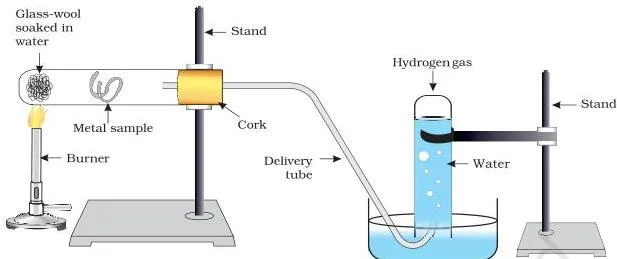
Magnesium reacts with hot water to give magnesium hydroxide and hydrogen. Lead, copper, silver and gold do not react with water at all (NCERT, p. 42).
Reaction of Metals with Acids
Metals react with dilute acids to give a salt and hydrogen gas (NCERT, p. 43):
\[ \text{Metal} + \text{Dilute acid} \rightarrow \text{Salt} + \text{Hydrogen} \]
With dilute hydrochloric acid the rate of bubble formation shows the order \( \text{Mg} \gt \text{Al} \gt \text{Zn} \gt \text{Fe} \); copper does not react with dilute HCl (NCERT, p. 44).
Nitric acid is the exception, and it is a favourite exam point:
- \( \text{HNO}_3 \) is a strong oxidising agent. It oxidises the \( \text{H}_2 \) formed to water and is itself reduced to \( \text{N}_2\text{O} \), \( \text{NO} \) or \( \text{NO}_2 \), so hydrogen gas is not evolved.
- Only magnesium and manganese evolve \( \text{H}_2 \) when they react with very dilute \( \text{HNO}_3 \).
Aqua regia is a freshly prepared mixture of concentrated hydrochloric acid and concentrated nitric acid in the ratio 3 : 1. It can dissolve gold even though neither acid can do so alone (NCERT, p. 44):
\[ \text{conc. HCl} : \text{conc. HNO}_3 = 3 : 1 \]
Displacement Reactions and the Activity Series
A more reactive metal displaces a less reactive metal from its compound in solution or molten form (NCERT, p. 44):
\[ \text{Metal A} + \text{Salt solution of B} \rightarrow \text{Salt solution of A} + \text{Metal B} \]
The activity series lists metals in decreasing order of reactivity (NCERT, p. 45). It is the tool you use to predict displacement, water and acid reactions:
| Metal | Reactivity |
|---|---|
| K | Most reactive |
| Na | |
| Ca | |
| Mg | |
| Al | |
| Zn | Reactivity decreases |
| Fe | |
| Pb | |
| [H] | Reference for acid reactions |
| Cu | |
| Hg | |
| Ag | |
| Au | Least reactive |
Metals above hydrogen in the series can displace hydrogen from dilute acids (NCERT, p. 55).
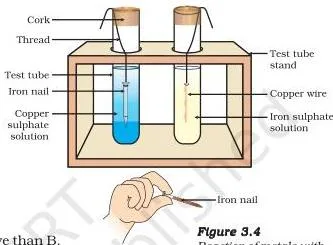
Figure 3.4 shows Activity 3.12: an iron nail in copper sulphate solution and a copper wire in iron sulphate solution. Only the pair in which the added metal is above the metal of the salt reacts.
How Do Metals and Non-metals React?
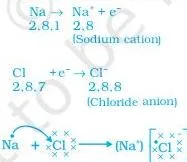
Reactivity is explained as a tendency to attain a completely filled valence shell like the noble gases. Metals lose electrons to form cations; non-metals gain electrons to form anions (NCERT, p. 46).
\[ \text{Na} \rightarrow \text{Na}^+ + \text{e}^- \]
\[ \text{Cl} + \text{e}^- \rightarrow \text{Cl}^- \]
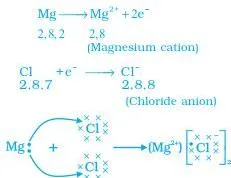
Magnesium transfers two electrons, one to each of two chlorine atoms:
\[ \text{Mg} \rightarrow \text{Mg}^{2+} + 2\text{e}^- \]
\[ 2\text{Cl} + 2\text{e}^- \rightarrow 2\text{Cl}^- \]
Figure 3.5 shows the formation of sodium chloride and Figure 3.6 shows the formation of magnesium chloride by electron transfer.
Compounds formed by electron transfer are called ionic (electrovalent) compounds. They are held by strong electrostatic forces, which is why they are hard solids with high melting points (NCERT, p. 48).
Extraction of Metals from their Ores
The extraction method depends on the metal’s position in the activity series: metals of low, medium and high reactivity each need a different technique. Figure 3.10 summarises the steps involved in extracting a pure metal from its ore.
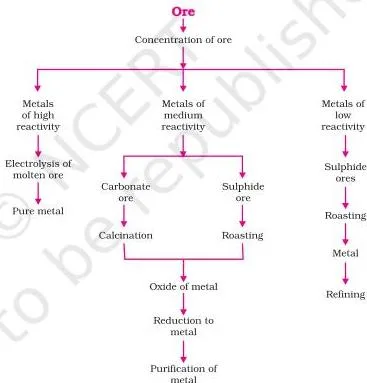
Extracting metals low in the activity series. These unreactive metals need only heating; their oxides are reduced to the metal by heating alone (NCERT, p. 51). Cinnabar (HgS) is first converted to mercuric oxide, which then decomposes:
\[ 2\text{HgS(s)} + 3\text{O}_2\text{(g)} \xrightarrow{\text{Heat}} 2\text{HgO(s)} + 2\text{SO}_2\text{(g)} \]
\[ 2\text{HgO(s)} \xrightarrow{\text{Heat}} 2\text{Hg(l)} + \text{O}_2\text{(g)} \]
Copper, found in nature as \( \text{Cu}_2\text{S} \), is obtained from its ore by heating in air:
\[ 2\text{Cu}_2\text{S} + 3\text{O}_2\text{(g)} \xrightarrow{\text{Heat}} 2\text{Cu}_2\text{O(s)} + 2\text{SO}_2\text{(g)} \]
\[ 2\text{Cu}_2\text{O} + \text{Cu}_2\text{S} \xrightarrow{\text{Heat}} 6\text{Cu(s)} + \text{SO}_2\text{(g)} \]
Extracting metals in the middle of the activity series. These metals (zinc, iron, lead, copper) occur as sulphides or carbonates. It is easier to obtain a metal from its oxide than from its sulphide or carbonate, so the ore is first converted to the oxide (NCERT, p. 51).
Roasting — sulphide ore heated strongly in excess air:
\[ 2\text{ZnS(s)} + 3\text{O}_2\text{(g)} \xrightarrow{\text{Heat}} 2\text{ZnO(s)} + 2\text{SO}_2\text{(g)} \]
Calcination — carbonate ore heated strongly in limited air:
\[ \text{ZnCO}_3\text{(s)} \xrightarrow{\text{Heat}} \text{ZnO(s)} + \text{CO}_2\text{(g)} \]
The oxide is then reduced. Carbon (coke) is the usual reducing agent:
\[ \text{ZnO(s)} + \text{C(s)} \rightarrow \text{Zn(s)} + \text{CO(g)} \]
Highly reactive metals (sodium, calcium, aluminium) can also act as reducing agents and displace the metal from its compound. These displacement reactions are highly exothermic, so the metal is produced in the molten state:
\[ 3\text{MnO}_2\text{(s)} + 4\text{Al(s)} \rightarrow 3\text{Mn(l)} + 2\text{Al}_2\text{O}_3\text{(s)} + \text{Heat} \]
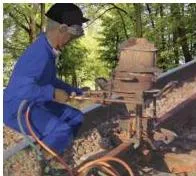
The reaction of iron(III) oxide with aluminium is called the thermit reaction. As Figure 3.11 shows, it is used to join railway tracks and cracked machine parts.
\[ \text{Fe}_2\text{O}_3\text{(s)} + 2\text{Al(s)} \rightarrow 2\text{Fe(l)} + \text{Al}_2\text{O}_3\text{(s)} + \text{Heat} \]
Extracting metals towards the top of the activity series. Carbon cannot reduce the oxides of sodium, magnesium, calcium and aluminium because these metals have more affinity for oxygen than carbon. They are obtained by electrolytic reduction (NCERT, p. 52). Sodium is obtained by electrolysis of molten sodium chloride:
At cathode:
\[ \text{Na}^+ + \text{e}^- \rightarrow \text{Na} \]
At anode:
\[ 2\text{Cl}^- \rightarrow \text{Cl}_2 + 2\text{e}^- \]
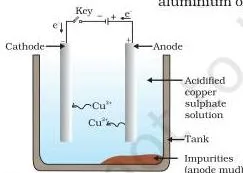
Refining of metals. The most widely used method is electrolytic refining: impure metal as anode, pure metal strip as cathode, and a solution of the metal salt as electrolyte. The insoluble impurities settle as anode mud (NCERT, p. 52). Figure 3.12 shows the setup for copper.
Corrosion and its Prevention
Corrosion changes a metal’s surface when it is exposed to air and moisture (NCERT, p. 53). Remember these three examples:
- Silver becomes black — it reacts with sulphur in the air to form silver sulphide.
- Copper gains a green coat — it reacts with moist carbon dioxide in the air to form basic copper carbonate.
- Iron acquires a brown flaky coating — rust.
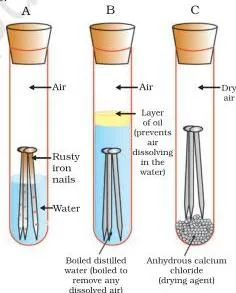
Rusting needs both air and water together. In Activity 3.14 (Figure 3.13), iron nails rust in tube A, where both are present, but not in tube B (boiled water, no air) or tube C (dry air).
Rusting of iron is prevented by painting, oiling, greasing, galvanising (a zinc coating), chrome plating, anodising or making alloys (NCERT, p. 54).
An alloy is a homogeneous mixture of two or more metals, or a metal and a non-metal (NCERT, p. 54).
What Each Symbol Means
Two tables: one for the notation used in the equations, one for the named compounds you must recognise.
| Symbol | What it means | Unit / role |
|---|---|---|
| \( \text{Metal} \) or \( M \) | any metal in the general patterns | element that loses electrons to form a cation |
| \( \text{Metal oxide} \) | the oxide of the metal | basic oxide for most metals; amphoteric for aluminium and zinc |
| \( \text{Metal hydroxide} \) | hydroxide formed from the oxide and water | gives an alkali when soluble |
| \( \text{(s)}, \text{(l)}, \text{(g)}, \text{(aq)} \) | state symbols: solid, liquid, gas, aqueous solution | physical state label — not a measured unit |
| \( \rightarrow \) | gives / forms — products on the right | reaction direction |
| \( \xrightarrow{\text{Heat}} \) | the reaction happens on heating | condition, not a reactant |
| \( \text{e}^- \) | electron | unit negative charge |
| \( \text{Na}^+ \), \( \text{Mg}^{2+} \) | metal cations (positive ions) | formed by loss of one or two electrons |
| \( \text{Cl}^- \) | non-metal anion (negative ion) | formed by gain of an electron |
| \( [\text{H}] \) | position of hydrogen in the activity series | reference line — metals above it displace \( \text{H}_2 \) from dilute acids |
| Formula | Name used in the chapter | Reminder |
|---|---|---|
| \( \text{CuO} \) | copper(II) oxide | black layer formed on hot copper |
| \( \text{Al}_2\text{O}_3 \) | aluminium oxide | amphoteric; forms a protective thin layer |
| \( \text{NaAlO}_2 \) | sodium aluminate | product of \( \text{Al}_2\text{O}_3 + \text{NaOH} \) |
| \( \text{HgS} \) | cinnabar | ore of mercury |
| \( \text{HgO} \) | mercuric oxide | intermediate when cinnabar is roasted |
| \( \text{Cu}_2\text{S} \) | copper ore found in nature | heated in air to obtain copper |
| \( \text{Fe}_3\text{O}_4 \) | iron oxide formed with steam | product of iron + steam |
| \( \text{Fe}_2\text{O}_3 \) | iron(III) oxide | reduced by aluminium in the thermit reaction |
| \( \text{ZnS}, \text{ZnCO}_3 \) | zinc sulphide, zinc carbonate | ores converted to \( \text{ZnO} \) by roasting / calcination |
| \( \text{SO}_2 \) | sulphur dioxide | gas evolved during roasting and heating of sulphide ores |
When to Use Each Formula
Pick the formula by the situation, then check the condition.
| Formula or group | Use it when … | Condition to check |
|---|---|---|
| Metal + oxygen pattern | a metal is burnt or heated in air | the product is a metal oxide; most are basic |
| Copper and aluminium equations | you need the balanced equation for burning copper or aluminium | write the gases as \( \text{O}_2 \), not O |
| Amphoteric oxide equations | the question calls an oxide amphoteric and asks you to show it | applies to \( \text{Al}_2\text{O}_3 \) and \( \text{ZnO} \) — must react with acid and with base |
| Soluble oxide + water | an oxide dissolves in water to give an alkali | only some oxides do this — \( \text{Na}_2\text{O} \), \( \text{K}_2\text{O} \) |
| Metal + water equations | a metal meets water or steam | K/Na/Ca → cold water; Mg → hot water; Al/Zn/Fe → steam; Pb/Cu/Ag/Au → no reaction |
| Metal + dilute acid pattern | a metal is treated with a dilute acid | metal must be above hydrogen; do not use as the default for \( \text{HNO}_3 \) |
| Aqua regia 3 : 1 | you are asked how gold can be dissolved | freshly prepared concentrated acids — 3 parts HCl to 1 part \( \text{HNO}_3 \) |
| Displacement pattern | one metal is added to another metal’s salt solution | only if the added metal is above the metal in the salt |
| Activity series | predicting water, acid and displacement behaviour | order K → Au; metals above H displace \( \text{H}_2 \) from dilute acids |
| Ion-formation equations | showing how NaCl or MgCl₂ forms | metal loses electrons; non-metal gains electrons (octet) |
| Low-series extraction (HgS, Cu₂S) | ore of a very unreactive metal | heating in air alone is enough — no carbon needed |
| Roasting / calcination | sulphide or carbonate ore of a middle-series metal | sulphide → roasting in excess air; carbonate → calcination in limited air |
| Zinc oxide + carbon | reducing a middle-series metal oxide | carbon (coke) is the reducing agent |
| MnO₂ + Al and thermit | aluminium used as a reducing agent | highly exothermic; the metal is produced molten |
| Electrolysis half-equations | metal high in the series — K, Na, Ca, Mg, Al | molten chloride or oxide; metal at cathode, \( \text{Cl}_2 \) at anode |
| Corrosion conditions | explaining rusting or its prevention | both air and water must be present together |
Worked Examples
Equation questions in this chapter come in four types: writing a balanced equation for a named reaction, predicting displacement with the activity series, naming the products of a metal with water or acid, and choosing the extraction method for a given metal. Practise all four on the textbook’s own questions in the Metals and Non-metals NCERT solutions.
Worked Example 1: Burning magnesium in air
Step 1: Identify the formula.
A metal burnt in air follows the pattern metal + oxygen → metal oxide.
\[ 2\text{Mg} + \text{O}_2 \rightarrow 2\text{MgO} \]
Step 2: The ash is magnesium oxide.
Dissolving a metal oxide in water follows metal oxide + water → metal hydroxide.
\[ \text{MgO} + \text{H}_2\text{O} \rightarrow \text{Mg(OH)}_2 \]
Step 3: Most metals give basic oxides, so the solution is basic.
Final answer: \( 2\text{Mg} + \text{O}_2 \rightarrow 2\text{MgO} \), then \( \text{MgO} + \text{H}_2\text{O} \rightarrow \text{Mg(OH)}_2 \); the solution turns red litmus blue (basic).
Worked Example 2: Iron nail in copper sulphate — choosing the direction of displacement
Step 1: Decide which metal is more reactive using the activity series.
Iron is above copper: \( \text{Fe} \gt \text{Pb} \gt [\text{H}] \gt \text{Cu} \).
Step 2: Apply the displacement pattern.
Iron displaces copper from copper(II) sulphate:
\[ \text{Fe} + \text{CuSO}_4 \rightarrow \text{FeSO}_4 + \text{Cu} \]
Step 3: Test the reverse pair.
A copper wire in iron(II) sulphate would require copper to displace iron, but copper is below iron — so no reaction.
Final answer: Only the iron nail in copper(II) sulphate solution reacts: \( \text{Fe} + \text{CuSO}_4 \rightarrow \text{FeSO}_4 + \text{Cu} \). The copper wire in iron(II) sulphate shows no reaction.
Worked Example 3: Obtaining mercury from cinnabar
Step 1: Locate the metal.
Mercury is low in the activity series, so its ore needs only heating — no carbon reducing agent.
Step 2: Roast the ore in air.
Cinnabar is first converted to mercuric oxide:
\[ 2\text{HgS(s)} + 3\text{O}_2\text{(g)} \xrightarrow{\text{Heat}} 2\text{HgO(s)} + 2\text{SO}_2\text{(g)} \]
Step 3: Heat the oxide further — it decomposes to mercury and oxygen:
\[ 2\text{HgO(s)} \xrightarrow{\text{Heat}} 2\text{Hg(l)} + \text{O}_2\text{(g)} \]
Final answer: Mercury is obtained from cinnabar by heating the ore in air in two steps: \( \text{HgS} \rightarrow \text{HgO} \rightarrow \text{Hg} \).
Common Mistakes to Avoid
Six errors that appear when students apply these equations in tests.
| Mistake | Correct rule | How to check your answer |
|---|---|---|
| Writing single atoms for gases — \( \text{Mg} + \text{O} \rightarrow \text{MgO} \) | Oxygen, hydrogen and chlorine exist as diatomic molecules in these reactions — write \( \text{O}_2 \), \( \text{H}_2 \), \( \text{Cl}_2 \) | Count atoms of each element on both sides; fix coefficients, never subscripts |
| Writing salt + \( \text{H}_2 \) for every metal–acid reaction, including nitric acid | \( \text{HNO}_3 \) is a strong oxidising agent; it oxidises the \( \text{H}_2 \) to water and is itself reduced. Only Mg and Mn with very dilute \( \text{HNO}_3 \) give \( \text{H}_2 \) | Read the acid name first — if it is nitric acid, do not write hydrogen gas as a default product |
| Using the cold-water equation for iron or aluminium | Al, Zn and Fe react only with steam; K, Na and Ca react with cold water | Locate the metal in the activity series — above Mg → cold water; Al/Zn/Fe → steam; below H → no reaction |
| Predicting displacement in the wrong direction (copper wire in iron sulphate) | Only the more reactive metal displaces the less reactive one; iron is above copper | Compare both metals in the activity series before writing the equation; if the added metal is lower, write no reaction |
| Confusing roasting with calcination | Roasting = sulphide ore heated in excess air; calcination = carbonate ore heated in limited air | Identify the ore — \( \text{ZnS} \) → roasting; \( \text{ZnCO}_3 \) → calcination; both give \( \text{ZnO} \) |
| Depositing the metal at the anode in electrolysis | The metal cation goes to the cathode (negative electrode); \( \text{Cl}^- \) goes to the anode and forms \( \text{Cl}_2 \) | Remember cation → cathode = metal; anode gives the non-metal |
Frequently Asked Questions
How do I use the activity series to predict whether a metal reacts with water or an acid?
Compare the metal’s position with the reference points. Potassium, sodium and calcium react with cold water; magnesium with hot water; aluminium, zinc and iron with steam. For dilute acids, metals above hydrogen displace hydrogen, and metals below it do not. For a salt solution, the added metal must lie above the metal in the salt for displacement.
The full decreasing order is \( \text{K} \gt \text{Na} \gt \text{Ca} \gt \text{Mg} \gt \text{Al} \gt \text{Zn} \gt \text{Fe} \gt \text{Pb} \gt [\text{H}] \gt \text{Cu} \gt \text{Hg} \gt \text{Ag} \gt \text{Au} \).
Why is hydrogen gas not evolved when a metal reacts with nitric acid?
Nitric acid is a strong oxidising agent. It oxidises the hydrogen produced to water, and is itself reduced to nitrogen oxides such as \( \text{N}_2\text{O} \), \( \text{NO} \) or \( \text{NO}_2 \). Magnesium and manganese are the exceptions — with very dilute \( \text{HNO}_3 \) they do evolve \( \text{H}_2 \).
Why are sulphide and carbonate ores converted into oxides before reduction?
It is easier to obtain a metal from its oxide than from its sulphide or carbonate. Sulphide ores are converted by roasting (heating strongly in excess air) and carbonate ores by calcination (heating strongly in limited air); the oxide is then reduced with carbon or a more reactive metal.
What conditions are necessary for iron to rust?
Both air and water together. In the textbook activity, nails rust only in the test tube containing both air and water; nails in boiled water with an oil layer (no air) and nails in dry air do not rust. Rusting can be prevented by painting, oiling, greasing, galvanising, chrome plating, anodising or making alloys.
Revising another chapter? Browse the chemistry formulas index or jump to the Class 10 chemistry formulas for the other chapter sheets. You can cross-check every equation against the official NCERT Class 10 Science chapter PDF.
Reference: NCERT Class 10 Science textbook, chapter Metals and Non-metals.
Explore Class 10 Chemistry Formulas
More for this chapter:
Class 10 Chemistry on LearnCBSE:
Related chapters:
Official source: download the NCERT textbook free from ncert.nic.in.