This page puts The Human Eye and the Colourful World Class 10 formulas in one scannable sheet: the power of a correcting lens, the lens-power corrections for myopia and hypermetropia, the red-blue wavelength ratio behind scattering, and the key values — near point, far point, eyeball diameter — that the corrections build on.
Each formula is grouped by topic, with the meaning and unit of every symbol, a one-line “when to use it”, and a worked example with original numbers — no chapter summary, so you find the formula fast. The eye’s structure, accommodation, dispersion and atmospheric refraction are explained in full on the chapter’s notes page.
This sheet is part of the Class 10 physics formulas collection.
Formulas at a Glance
These are the five formula entries this chapter actually asks you to use. The derived forms are labelled — each one comes from applying the lens formula to the defect description.
| Purpose | Formula |
|---|---|
| Power of a lens from its focal length | \( P = \frac{1}{f} \) |
| Concave lens power for myopia (derived from the lens formula, object at infinity) | \( P = -\frac{1}{x} \) |
| Convex lens power for hypermetropia (derived from the lens formula, image at the defective near point) | \( P = \frac{1}{N’} – \frac{1}{N} \) |
| Lens formula, applied here to find the correcting lens (from the previous chapter) | \( \frac{1}{f} = \frac{1}{v} – \frac{1}{u} \) |
| Wavelength comparison used in scattering explanations | \( \lambda_{\text{red}} \approx 1.8\,\lambda_{\text{blue}} \) |
All Formulas, Grouped by Topic
Page numbers follow the NCERT Class 10 Science textbook (available at ncert.nic.in). Each group below uses the textbook’s own sub-topic name.
Power of Accommodation
The eye changes its focal length by altering the curvature of the eye lens through the ciliary muscles. This sub-topic has no formula, but its two limits — near point and far point — are the numbers every correction numerical uses (NCERT, p. 162).
| Quantity | Value |
|---|---|
| Near point of a young adult with normal vision (least distance of distinct vision) | about 25 cm (0.25 m) |
| Far point of a normal eye | infinity |
| Diameter of the eyeball | about 2.3 cm |
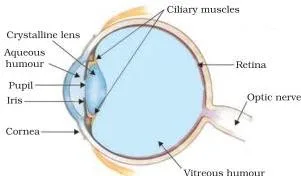
The diagram below shows the parts the formula work refers to: the cornea where most refraction happens, the iris and pupil that control the light entering the eye, the eye lens that changes focal length, and the retina where the image must form.
Defects of Vision and Their Correction
Myopia is corrected with a concave lens and hypermetropia with a convex lens, each of suitable power (NCERT, p. 163). The formulas below are the numerical versions of those corrections.
Power of a lens — used to convert between the power and the focal length of a correcting lens:
\[ P = \frac{1}{f} \]
The focal length must be in metres; the power comes out in dioptres. This is the pattern of NCERT Exercise Q5.
Myopia correction (derived) — for a myopic eye whose far point is at distance \( x \):
\[ P = -\frac{1}{x} \]
It comes from the lens formula with the object at infinity and the image at the far point. NCERT Exercise Q6 follows this pattern.
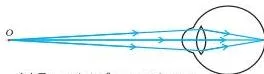
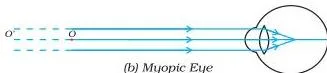
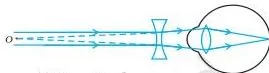
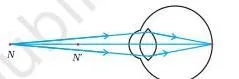
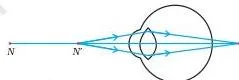
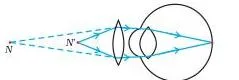
The three parts of Fig. 10.2 show the idea: (a) the far point of a myopic eye lies nearer than infinity, (b) parallel rays from a distant object meet in front of the retina, and (c) a concave lens of suitable power brings the image back onto the retina (NCERT, p. 163).
Hypermetropia correction (derived) — for a hypermetropic eye whose near point is \( N \), with the normal near point \( N’ \):
\[ P = \frac{1}{N’} – \frac{1}{N} \]
It comes from the lens formula with the object at the normal near point and the image at the defective near point. For a normal eye \( N’ = 0.25\ \text{m} \). NCERT Exercise Q7 follows this pattern.
Fig. 10.3 labels exactly these two distances: \( N \) is the near point of the hypermetropic eye and \( N’ \) the near point of a normal eye. Part (b) shows rays from a close object meeting behind the retina; part (c) shows the convex lens supplying the extra power so the image forms on the retina (NCERT, p. 163).
Lens formula (applied from the previous chapter) — the tool both derived formulas come from:
\[ \frac{1}{f} = \frac{1}{v} – \frac{1}{u} \]
The previous chapter on lenses introduces this formula; this chapter applies it to the eye. The sign rules for \( u \) and \( v \) are in the when-to-use section.
Refraction of Light Through a Prism
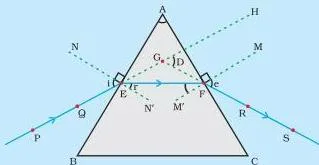
This sub-topic defines the five angles you identify in a prism ray diagram (NCERT, p. 165). The textbook gives no algebraic formula connecting them, so questions here ask you to label and measure, not compute.
- \( \angle A \) — angle of the prism, between its two lateral faces.
- \( \angle i \) — angle of incidence at the first face.
- \( \angle r \) — angle of refraction inside the prism.
- \( \angle e \) — angle of emergence at the second face.
- \( \angle D \) — angle of deviation, between the incident ray and the emergent ray.
At the first face the ray bends towards the normal (air to glass); at the second face it bends away from the normal (glass to air) — the prism’s shape is what makes the emergent ray deviate (NCERT, p. 165).
Dispersion of White Light by a Glass Prism
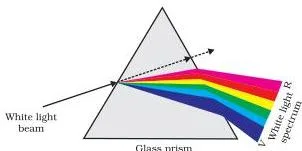
The splitting of white light into its component colours is dispersion. The spectrum’s order, from most deviated to least deviated, is violet, indigo, blue, green, yellow, orange, red — VIBGYOR — because red bends the least and violet the most (NCERT, p. 166). No formula appears in this sub-topic; the exam facts are the sequence and the bending order.
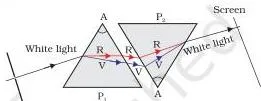
Recombination proves the point: a second identical prism, placed inverted to the first, puts the seven colours back into a single white beam, showing sunlight is made of these colours (NCERT, p. 166).
Atmospheric Refraction
Atmospheric refraction is the refraction of light by the Earth’s atmosphere. Its one quantitative value is the timing of sunrise and sunset:
| Effect | Value (NCERT, p. 168) |
|---|---|
| Advance sunrise | Sun visible about 2 minutes before actual sunrise |
| Delayed sunset | Sun visible about 2 minutes after actual sunset |
Star twinkling and the flattened Sun at the horizon are the same phenomenon (NCERT, p. 168).
Scattering of Light
Wavelength ratio — the one quantitative relation in this sub-topic:
\[ \lambda_{\text{red}} \approx 1.8\,\lambda_{\text{blue}} \]
Red light’s wavelength is about 1.8 times that of blue light. The atmosphere’s fine particles scatter shorter wavelengths (blue) far more strongly than red, which is why the clear sky is blue and why danger signals are red — red is scattered least by fog and smoke (NCERT, p. 169).
What Each Symbol Means
\( N \) and \( N’ \) are the labels NCERT uses in Fig. 10.3 (NCERT, p. 163); the prism angles are the chapter’s symbols from Fig. 10.4.
| Symbol | What it means | Its unit |
|---|---|---|
| \( P \) | power of the correcting lens | dioptre (D) |
| \( f \) | focal length of the lens | metre (m) |
| \( x \) | far-point distance of a myopic eye — the greatest distance it can see clearly | metre (m) |
| \( N \) | near point of a hypermetropic eye — the closest distance it can see clearly | metre (m) |
| \( N’ \) | near point of a normal eye; least distance of distinct vision, about 25 cm | metre (m) |
| \( u \) | object distance from the lens | metre (m) |
| \( v \) | image distance from the lens | metre (m) |
| \( \lambda_{\text{red}}, \lambda_{\text{blue}} \) | wavelengths of red and blue light | metre (m); the ratio 1.8 is dimensionless |
| \( \angle A \) | angle of the prism | degree |
| \( \angle i \) | angle of incidence | degree |
| \( \angle r \) | angle of refraction | degree |
| \( \angle e \) | angle of emergence | degree |
| \( \angle D \) | angle of deviation | degree |
When to Use Each Formula
The lens formula below comes from the previous chapter; the physics formulas hub groups it with the rest of the Class 10 formula sheets. Choose by the data you are given.
| Formula | Use it when | Condition to apply |
|---|---|---|
| \( P = \frac{1}{f} \) | A question gives the focal length of a lens and asks for its power, or gives the power and asks for the focal length (NCERT Exercise Q5). | \( f \) in metres. Positive \( P \) = convex lens, negative \( P \) = concave lens. |
| \( P = -\frac{1}{x} \) | The far point of a myopic eye is given and the question asks for the nature and power of the corrective lens (NCERT Exercise Q6). | \( x \) in metres. The answer is always negative because the lens is concave. |
| \( P = \frac{1}{N’} – \frac{1}{N} \) | The near point of a hypermetropic eye is given and the question asks for the power of the corrective lens (NCERT Exercise Q7). | \( N’ = 0.25\ \text{m} \) for a normal eye; both \( N’ \) and \( N \) in metres. The answer is always positive because the lens is convex. |
| \( \frac{1}{f} = \frac{1}{v} – \frac{1}{u} \) | Any defect-correction numerical where you must decide where the image must fall — at the far point for myopia, at the near point for hypermetropia. | \( u \) is negative for a real object; \( v \) is negative because the corrective lens forms a virtual image on the object side. |
| \( \lambda_{\text{red}} \approx 1.8\,\lambda_{\text{blue}} \) | Explaining why the sky is blue or why the Sun and danger signals look red. | Comparison only — the ratio is dimensionless, so the unit of wavelength cancels. |
Where these formulas appear in the NCERT exercises (p. 170): Q5 (power ↔ focal length), Q6 (myopia far point → concave lens power) and Q7 (hypermetropia near point → convex lens power) are the numericals. Q1–Q4 are concept MCQs and Q8–Q12 are reasoning questions on accommodation, image distance, twinkling, planets and the sky’s colour — none needs a formula.
Worked Examples
Three worked examples with original numbers, following the pattern of NCERT Exercises Q5–Q7. Each shows the sign convention at every substitution. The textbook’s own questions are solved step by step in the NCERT solutions for this chapter.
Example 1: Power of a lens from its focal length
Step 1: Convert the focal length to metres.
For a convex lens, \( f \) is positive: \( f = 40\ \text{cm} = 0.40\ \text{m} \).
Step 2: Select \( P = \frac{1}{f} \), valid for any lens when \( f \) is in metres.
\[ P = \frac{1}{0.40} = +2.5\ \text{D} \]
Final answer: power = +2.5 D. The positive sign tells you it is a converging (convex) lens.
Example 2: Corrective lens for a myopic eye from its far point
- Step 1: Far point \( x = 50\ \text{cm} = 0.50\ \text{m} \).
- Step 2: The distant object is at infinity, so \( u = \infty \) and \( \frac{1}{u} = 0 \).
The concave lens must form the image at the far point, in front of the eye, so \( v = -0.50\ \text{m} \) (virtual image, negative by the Cartesian sign convention).
Step 3: Apply the lens formula \( \frac{1}{f} = \frac{1}{v} – \frac{1}{u} \):
\[ \frac{1}{f} = \frac{1}{-0.50} – 0 = -2.0\ \text{m}^{-1} \]
Step 4: So \( P = \frac{1}{f} = -2.0\ \text{D} \).
The same result comes faster from \( P = -\frac{1}{x} \).
Final answer: a concave lens of power −2.0 D.
Example 3: Corrective lens for a hypermetropic eye from its near point
- Step 1: Defective near point \( N = 50\ \text{cm} = 0.50\ \text{m} \); normal near point \( N’ = 0.25\ \text{m} \).
- Step 2: An object placed at the normal near point must form its image at the person’s own near point.
So \( u = -0.25\ \text{m} \) and \( v = -0.50\ \text{m} \) (real object, virtual image — both negative).
Step 3: Apply the lens formula \( \frac{1}{f} = \frac{1}{v} – \frac{1}{u} \):
\[ \frac{1}{f} = \frac{1}{-0.50} – \frac{1}{-0.25} = -2.0 + 4.0 = +2.0\ \text{m}^{-1} \]
Step 4: So \( P = +2.0\ \text{D} \).
Check with the shortcut \( P = \frac{1}{N’} – \frac{1}{N} \):
\[ P = \frac{1}{0.25} – \frac{1}{0.50} = 4 – 2 = +2.0\ \text{D} \]
Final answer: a convex lens of power +2.0 D.
Common Mistakes to Avoid
Four errors that appear again and again when students apply these formulas.
| Mistake | Correct rule | How to check your answer |
|---|---|---|
| Putting the focal length in centimetres straight into \( P = \frac{1}{f} \) | The dioptre is \( \text{m}^{-1} \), so convert every distance to metres first: 40 cm → 0.40 m. | Spectacle powers sit between about 1 D and 5 D; a power like 40 D means the distance was left in cm. |
| In myopia, treating the far point as the object distance \( u \) | The distant object is at infinity (\( u = \infty \)); the far point is where the image must form, so \( v = -x \). | Your answer must equal \( -\frac{1}{x} \) exactly, with no extra term. |
| For hypermetropia, using \( v = -0.25\ \text{m} \) (the normal near point) instead of the person’s own near point | The image must form at the defective near point \( N \), which lies farther than 25 cm, so \( v = -N \). | With \( N \) farther than 25 cm the power stays positive; if your power comes out zero, you used the same point for \( u \) and \( v \). |
| Quoting the scattering ratio backwards: “blue wavelength = 1.8 times red” | Red has the longer wavelength: \( \lambda_{\text{red}} \approx 1.8\,\lambda_{\text{blue}} \). | Red bends least and is scattered least, so red must be the bigger number. |
Frequently Asked Questions
Why is the power negative for myopia and positive for hypermetropia?
The sign identifies the lens type. A concave lens always has negative power, so the myopia formula \( P = -\frac{1}{x} \) gives a negative answer; a convex lens has positive power, so the hypermetropia formula \( P = \frac{1}{N’} – \frac{1}{N} \) gives a positive answer (NCERT, p. 163). If your sign comes out opposite, re-check which defect you are treating.
What are N and N\’ in Figure 10.3?
\( N \) is the near point of the hypermetropic eye — the closest distance at which that eye can see clearly, farther than the normal 25 cm. \( N’ \) is the near point of a normal eye, 25 cm. Both go into the hypermetropia formula, with \( N’ = 0.25\ \text{m} \) (NCERT, p. 163).
Why must distances be in metres for P = 1/f?
Because the dioptre is defined as the reciprocal of the focal length in metres: \( 1\ \text{D} = 1\ \text{m}^{-1} \). If you substitute \( f = 40\ \text{cm} \) directly, you get 0.025 D, which is wrong — convert to 0.40 m first. The same rule applies to \( x \), \( N \) and \( N’ \) in the derived formulas.
Is there a formula for the angle of deviation through a prism in this chapter?
No. The chapter defines the angle of the prism, angle of incidence, angle of refraction, angle of emergence and angle of deviation from Fig. 10.4, but it gives no algebraic relation between them (NCERT, p. 165). Class 10 questions on the prism in this chapter ask you to label these angles and to recall the dispersion sequence, not to compute deviation.
Reference: NCERT Class 10 Science textbook, chapter The Human Eye and the Colourful World.
Explore Class 10 Physics Formulas
Class 10 Physics on LearnCBSE:
Related chapters: