This chapter covers the formulas for reflection (spherical mirrors) and refraction (lenses, refractive index, and power of a lens). You will use these to calculate image position, size, nature, and the bending of light between media.
Each formula is grouped by topic with its symbol meanings, when-to-use guidance, and original worked examples. For detailed explanations and derivations, see the Light – Reflection and Refraction Class 10 notes.
Formulas at a Glance
| Purpose (what you are finding) | Formula |
|---|---|
| Focal length from radius of curvature | \( f = \dfrac{R}{2} \) |
| Mirror formula (relation between u, v, f) | \( \dfrac{1}{v} + \dfrac{1}{u} = \dfrac{1}{f} \) |
| Magnification for spherical mirrors | \( m = \dfrac{h’}{h} = -\dfrac{v}{u} \) |
| Snell’s law (refraction) | \( \dfrac{\sin i}{\sin r} = n_{21} \) |
| Refractive index (relative speed) | \( n_{21} = \dfrac{v_1}{v_2} \) |
| Absolute refractive index | \( n = \dfrac{c}{v} \) |
| Lens formula | \( \dfrac{1}{v} – \dfrac{1}{u} = \dfrac{1}{f} \) |
| Magnification for lenses | \( m = \dfrac{h’}{h} = \dfrac{v}{u} \) |
| Power of a lens | \( P = \dfrac{1}{f} \) |
All Formulas, Grouped by Topic
Reflection by Spherical Mirrors
\[ f = \frac{R}{2} \]
\[ \frac{1}{v} + \frac{1}{u} = \frac{1}{f} \]
\[ m = \frac{h’}{h} = -\frac{v}{u} \]
Refraction and Refractive Index
\[ \frac{\sin i}{\sin r} = n_{21} \]
\[ n_{21} = \frac{v_1}{v_2} \]
\[ n = \frac{c}{v} \] (absolute refractive index)
Refraction by Lenses
\[ \frac{1}{v} – \frac{1}{u} = \frac{1}{f} \]
\[ m = \frac{h’}{h} = \frac{v}{u} \]
\[ P = \frac{1}{f} \] (power of a lens, SI unit dioptre)
Image Formation Tables
Refer to the NCERT textbook for Tables 9.1, 9.2, 9.4, and 9.5 that summarise image position, size, and nature for concave mirrors, convex mirrors, convex lenses, and concave lenses. These tables are essential for drawing ray diagrams and solving numericals.
What Each Symbol Means
| Symbol | What it means | Unit |
|---|---|---|
| \( R \) | Radius of curvature of spherical mirror | cm or m |
| \( f \) | Focal length (mirror or lens) | cm or m |
| \( u \) | Object distance from pole (mirror) or optical centre (lens) | cm or m |
| \( v \) | Image distance from pole (mirror) or optical centre (lens) | cm or m |
| \( h \) | Height of the object | cm or m |
| \( h’ \) | Height of the image | cm or m |
| \( m \) | Magnification (ratio of image height to object height) | dimensionless |
| \( i \) | Angle of incidence | degrees |
| \( r \) | Angle of refraction | degrees |
| \( n_{21} \) | Refractive index of medium 2 with respect to medium 1 | dimensionless |
| \( n \) | Absolute refractive index of a medium | dimensionless |
| \( c \) | Speed of light in vacuum | \( 3 \times 10^8 \ \text{m/s} \) |
| \( v \) (in refractive index) | Speed of light in the given medium | m/s |
| \( P \) | Power of a lens | dioptre (D) |
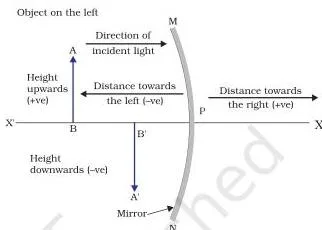
This sign convention applies to all mirror and lens formulas. Distances measured from the pole (mirror) or optical centre (lens) are positive if they are in the direction of incident light (to the right) and negative if opposite. Heights above the principal axis are positive, below are negative.
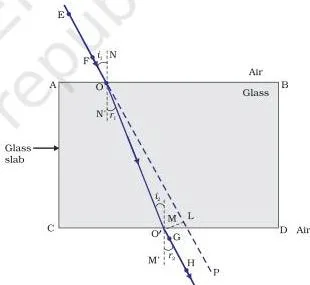
This diagram illustrates Snell’s law: the ratio \( \sin i / \sin r \) is constant for a given pair of media.
When to Use Each Formula
- \( f = R/2 \) – Use when you know the radius of curvature of a spherical mirror and need its focal length. Valid for mirrors with small apertures.
- Mirror formula \( 1/v + 1/u = 1/f \) – Use to find image distance, object distance, or focal length of a concave or convex mirror. Always apply sign convention.
- Magnification \( m = -v/u \) – Use to find the size and nature (real/virtual, inverted/erect) of the image formed by a spherical mirror. Negative m means real image.
- Snell’s law \( \sin i / \sin r = n_{21} \) – Use when light passes from one medium to another and you know one angle and the refractive index.
- Refractive index \( n_{21} = v_1/v_2 \) – Use to relate the speed of light in two media. The absolute refractive index \( n = c/v \) gives the speed in a medium relative to vacuum.
- Lens formula \( 1/v – 1/u = 1/f \) – Use to find image distance, object distance, or focal length of a convex or concave lens. Sign convention: f positive for convex, negative for concave.
- Lens magnification \( m = v/u \) – Use to find image size and nature. Positive m means virtual and erect image.
- Power \( P = 1/f \) – Use to express the converging or diverging ability of a lens. Focal length must be in metres. Convex lens: positive power; concave lens: negative power.
Worked Examples
Example 1: Using the mirror formula
An object is placed 20 cm in front of a concave mirror of focal length 15 cm. Find the position and nature of the image.
Step 1: Identify quantities with sign convention (object on left, so u is negative).
\( u = -20\ \text{cm}, \quad f = -15\ \text{cm} \) Step 2: Apply mirror formula.
\[ \frac{1}{v} + \frac{1}{u} = \frac{1}{f} \]
\[ \frac{1}{v} + \frac{1}{-20} = \frac{1}{-15} \]
\[ \frac{1}{v} = -\frac{1}{15} + \frac{1}{20} = \frac{-4+3}{60} = -\frac{1}{60} \]
\[ v = -60\ \text{cm} \]
Step 3: Interpret the sign.
v negative means the image is in front of the mirror (real).
Answer: The image is real, inverted, and located 60 cm in front of the mirror.
Example 2: Using the lens formula and magnification
A 3.0 cm tall object is placed 30 cm from a convex lens of focal length 20 cm. Find the image position, size, and nature.
Step 1: Assign signs.
For convex lens, f is positive; object distance u is negative.
\( u = -30\ \text{cm}, \quad f = +20\ \text{cm}, \quad h = +3.0\ \text{cm} \) Step 2: Use lens formula.
\[ \frac{1}{v} – \frac{1}{u} = \frac{1}{f} \]
\[ \frac{1}{v} – \frac{1}{-30} = \frac{1}{20} \]
\[ \frac{1}{v} + \frac{1}{30} = \frac{1}{20} \]
\[ \frac{1}{v} = \frac{1}{20} – \frac{1}{30} = \frac{3-2}{60} = \frac{1}{60} \]
\[ v = +60\ \text{cm} \]
Step 3: Find magnification and image height.
\[ m = \frac{v}{u} = \frac{+60}{-30} = -2 \]
\[ h’ = m \times h = -2 \times 3.0 = -6.0\ \text{cm} \]
Step 4: Interpret signs.
v positive means image on the opposite side of the lens (real).
m negative and h’ negative mean image is inverted and enlarged.
Answer: The image is real, inverted, 6.0 cm tall, and located 60 cm from the lens on the opposite side.
Example 3: Finding power and focal length
A lens has a power of +2.5 D. Find its focal length and state whether it is convex or concave.
Step 1: Use the power formula.
\[ P = \frac{1}{f} \]
Step 2: Solve for f in metres.
\[ f = \frac{1}{P} = \frac{1}{2.5} = 0.4\ \text{m} \]
Step 3: Positive power means convex lens.
Answer: Focal length is 0.4 m (40 cm). The lens is convex (converging).
Common Mistakes to Avoid
| Mistake | Correct rule | How to check your answer |
|---|---|---|
| Forgetting sign convention: using u positive when object is on the left. | Object distance u is always negative in the Cartesian sign convention (object on left). | If v comes out with a sign that contradicts the experimental setup, re-check u sign. |
| Confusing mirror formula (+) with lens formula (–). | Mirror: 1/v + 1/u = 1/f; Lens: 1/v – 1/u = 1/f. | Check the formula: for mirrors, the sum of reciprocals; for lenses, the difference. |
| Using focal length in cm directly in power formula without converting to metres. | Always convert f to metres before using P = 1/f. | If f = 50 cm, then f = 0.5 m, so P = 2 D. If you get 0.02 D, you forgot conversion. |
| Assuming magnification negative always means smaller image. | Negative m means real and inverted image; magnitude gives size: |m| < 1 diminished, |m| > 1 enlarged. | Compute |m| and compare to 1. Also note sign: negative for real, positive for virtual. |
| Using the angle of incidence in degrees inside Snell’s law without converting to sine. | Always use sin i and sin r (calculator in degree mode). | If i=30°, sin i = 0.5. If you get something else, check mode. |
Frequently Asked Questions
Why is the focal length of a convex lens positive and that of a concave lens negative?
In the Cartesian sign convention, the focal length of a convex lens is positive because its principal focus is on the opposite side of the lens from the object (real focus). For a concave lens, the principal focus is on the same side as the object (virtual focus), so its focal length is negative.
How do I remember the mirror formula vs lens formula?
Think: for mirrors, light reflects back, so the formula has a plus sign: 1/v + 1/u = 1/f. For lenses, light passes through, so the formula has a minus: 1/v – 1/u = 1/f. The sign convention for f also differs (concave mirror: negative, convex mirror: positive; convex lens: positive, concave lens: negative).
What does a magnification of +1 mean?
Magnification +1 means the image is the same size as the object and is virtual and erect. This is typical for a plane mirror.
Can I use the mirror formula for a plane mirror?
Yes, a plane mirror can be considered as a spherical mirror with infinite radius of curvature (R = ∞), so f = ∞. The mirror formula gives 1/v + 1/u = 0, so v = -u, which matches the property that image distance equals object distance behind the mirror.
For more practice, work through the NCERT solutions for Light – Reflection and Refraction.
Reference: NCERT Class 10 Science textbook, chapter 9 – Light – Reflection and Refraction.
Explore Class 10 Physics Formulas
More for this chapter:
Class 10 Physics on LearnCBSE:
Related chapters:
Official source: download the NCERT textbook free from ncert.nic.in.