This page collects the acids, bases and salts Class 10 formulas from the NCERT chapter — the general reaction patterns of acids and bases, the ionisation equations that explain how acids and bases behave in water, the pH scale, the pH rules for salts, and the equations for chemicals made from common salt.
The formulas are grouped by topic, with a symbol table, when-to-use guidance, worked examples and chapter-specific mistakes. For the activity-by-activity reasoning behind each reaction, see the Acids, Bases and Salts Class 10 notes; this sheet is built for quick revision.
Formulas at a Glance
Every equation on this page in one index. Each one appears again with its conditions in the grouped list below.
| Purpose | Formula |
|---|---|
| Reaction of a metal with an acid — salt and hydrogen gas | \( \text{Acid} + \text{Metal} \rightarrow \text{Salt} + \text{Hydrogen gas} \) |
| Reaction of a base with a metal (zinc example; not all metals react) | \( 2\text{NaOH(aq)} + \text{Zn(s)} \rightarrow \text{Na}_2\text{ZnO}_2\text{(s)} + \text{H}_2\text{(g)} \) |
| Reaction of a metal carbonate with an acid | \( \text{Metal carbonate} + \text{Acid} \rightarrow \text{Salt} + \text{Carbon dioxide} + \text{Water} \) |
| Reaction of a metal hydrogencarbonate with an acid | \( \text{Metal hydrogencarbonate} + \text{Acid} \rightarrow \text{Salt} + \text{Carbon dioxide} + \text{Water} \) |
| Sodium carbonate with hydrochloric acid (example) | \( \text{Na}_2\text{CO}_3\text{(s)} + 2\text{HCl(aq)} \rightarrow 2\text{NaCl(aq)} + \text{H}_2\text{O(l)} + \text{CO}_2\text{(g)} \) |
| Sodium hydrogencarbonate with hydrochloric acid (example) | \( \text{NaHCO}_3\text{(s)} + \text{HCl(aq)} \rightarrow \text{NaCl(aq)} + \text{H}_2\text{O(l)} + \text{CO}_2\text{(g)} \) |
| Testing carbon dioxide — lime water turns milky | \( \text{Ca(OH)}_2\text{(aq)} + \text{CO}_2\text{(g)} \rightarrow \text{CaCO}_3\text{(s)} + \text{H}_2\text{O(l)} \) |
| Excess carbon dioxide — milky solution becomes clear | \( \text{CaCO}_3\text{(s)} + \text{H}_2\text{O(l)} + \text{CO}_2\text{(g)} \rightarrow \text{Ca(HCO}_3\text{)}_2\text{(aq)} \) |
| Neutralisation — general form | \( \text{Acid} + \text{Base} \rightarrow \text{Salt} + \text{Water} \) |
| Neutralisation with general symbols | \( \text{HX} + \text{MOH} \rightarrow \text{MX} + \text{HOH} \) |
| Neutralisation — ionic form | \( \text{H}^+\text{(aq)} + \text{OH}^-\text{(aq)} \rightarrow \text{H}_2\text{O(l)} \) |
| Reaction of a metallic oxide with an acid | \( \text{Metal oxide} + \text{Acid} \rightarrow \text{Salt} + \text{Water} \) |
| Ionisation of an acid in water — HCl example | \( \text{HCl} + \text{H}_2\text{O} \rightarrow \text{H}_3\text{O}^+ + \text{Cl}^- \) |
| Formation of the hydronium ion | \( \text{H}^+ + \text{H}_2\text{O} \rightarrow \text{H}_3\text{O}^+ \) |
| Dissociation of soluble bases in water — NaOH and KOH | \( \text{NaOH(s)} \xrightarrow{\text{H}_2\text{O}} \text{Na}^+\text{(aq)} + \text{OH}^-\text{(aq)} \); \( \text{KOH(s)} \xrightarrow{\text{H}_2\text{O}} \text{K}^+\text{(aq)} + \text{OH}^-\text{(aq)} \) |
| Dissociation of a base giving two hydroxide ions — Mg(OH)₂ | \( \text{Mg(OH)}_2\text{(s)} \xrightarrow{\text{H}_2\text{O}} \text{Mg}^{2+}\text{(aq)} + 2\text{OH}^-\text{(aq)} \) |
| pH scale — classifying a solution as acidic, neutral or basic | \( \text{pH} \lt 7 \) acidic; \( \text{pH} = 7 \) neutral; \( \text{pH} \gt 7 \) basic |
| Salt of a strong acid and a strong base | \( \text{pH} = 7 \) (neutral) |
| Salt of a strong acid and a weak base | \( \text{pH} \lt 7 \) (acidic) |
| Salt of a strong base and a weak acid | \( \text{pH} \gt 7 \) (basic) |
| Chlor-alkali process — electrolysis of brine | \( 2\text{NaCl(aq)} + 2\text{H}_2\text{O(l)} \rightarrow 2\text{NaOH(aq)} + \text{Cl}_2\text{(g)} + \text{H}_2\text{(g)} \) |
| Manufacture of bleaching powder | \( 2\text{Ca(OH)}_2 + 2\text{Cl}_2 \rightarrow \text{Ca(ClO)}_2 + \text{CaCl}_2 + 2\text{H}_2\text{O} \) |
| Manufacture of baking soda (sodium hydrogencarbonate) | \( \text{NaCl} + \text{H}_2\text{O} + \text{CO}_2 + \text{NH}_3 \rightarrow \text{NH}_4\text{Cl} + \text{NaHCO}_3 \) |
| Baking soda on heating — forms sodium carbonate | \( 2\text{NaHCO}_3 \xrightarrow{\text{Heat}} \text{Na}_2\text{CO}_3 + \text{H}_2\text{O} + \text{CO}_2 \) |
| Baking soda with an acid — the reaction that makes cakes rise | \( \text{NaHCO}_3 + \text{H}^+ \rightarrow \text{CO}_2 + \text{H}_2\text{O} + \text{Sodium salt of acid} \) |
| Formation of washing soda — water of crystallisation | \( \text{Na}_2\text{CO}_3 + 10\text{H}_2\text{O} \rightarrow \text{Na}_2\text{CO}_3 \cdot 10\text{H}_2\text{O} \) |
| Plaster of Paris setting with water | \( \text{CaSO}_4 \cdot \frac{1}{2}\text{H}_2\text{O} + 1\frac{1}{2}\text{H}_2\text{O} \rightarrow \text{CaSO}_4 \cdot 2\text{H}_2\text{O} \) |
All Formulas, Grouped by Topic
The equations follow the order of the NCERT chapter. Each group gives the formula, its source pages and the condition that makes it valid.
Reactions of Acids with Metals
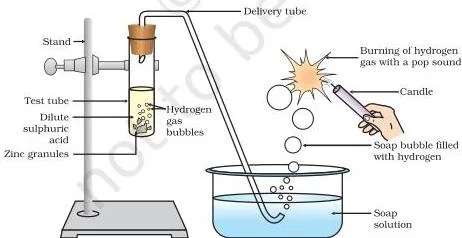
When a metal reacts with a dilute acid, the metal displaces hydrogen atoms from the acid as hydrogen gas and a salt is formed (NCERT, p. 4).
\[ \text{Acid} + \text{Metal} \rightarrow \text{Salt} + \text{Hydrogen gas} \]
This is the equation behind Activity 2.3, where zinc granules react with dilute sulphuric acid and the gas is tested by burning, as in the figure below.
Reactions of Bases with Metals
A few metals react with bases too, giving hydrogen gas and a salt whose negative ion is made of the metal and oxygen (NCERT, p. 4). This type of reaction does not work with all metals.
\[ 2\text{NaOH(aq)} + \text{Zn(s)} \rightarrow \text{Na}_2\text{ZnO}_2\text{(s)} + \text{H}_2\text{(g)} \]
Zinc reacts with sodium hydroxide to give sodium zincate and hydrogen gas.
Reactions of Metal Carbonates and Metal Hydrogencarbonates with Acids
All metal carbonates and metal hydrogencarbonates react with acids to give the corresponding salt, carbon dioxide and water (NCERT, pp. 4–5).
\[ \text{Metal carbonate} + \text{Acid} \rightarrow \text{Salt} + \text{Carbon dioxide} + \text{Water} \]
\[ \text{Metal hydrogencarbonate} + \text{Acid} \rightarrow \text{Salt} + \text{Carbon dioxide} + \text{Water} \]
Two textbook examples with hydrochloric acid:
\[ \text{Na}_2\text{CO}_3\text{(s)} + 2\text{HCl(aq)} \rightarrow 2\text{NaCl(aq)} + \text{H}_2\text{O(l)} + \text{CO}_2\text{(g)} \]
\[ \text{NaHCO}_3\text{(s)} + \text{HCl(aq)} \rightarrow \text{NaCl(aq)} + \text{H}_2\text{O(l)} + \text{CO}_2\text{(g)} \]
Notice the ratio: sodium carbonate needs two molecules of \( \text{HCl} \) for one of \( \text{Na}_2\text{CO}_3 \), while sodium hydrogencarbonate needs only one. The gas in both cases is \( \text{CO}_2 \), which extinguishes a burning candle and turns lime water milky.
Testing for Carbon Dioxide — the Lime-Water Test
Carbon dioxide is confirmed by passing it through lime water (calcium hydroxide solution). A white precipitate of calcium carbonate turns the lime water milky (NCERT, p. 4).
\[ \text{Ca(OH)}_2\text{(aq)} + \text{CO}_2\text{(g)} \rightarrow \text{CaCO}_3\text{(s)} + \text{H}_2\text{O(l)} \]
If excess carbon dioxide is passed, the milkiness disappears because the precipitate changes into soluble calcium hydrogencarbonate (NCERT, p. 5).
\[ \text{CaCO}_3\text{(s)} + \text{H}_2\text{O(l)} + \text{CO}_2\text{(g)} \rightarrow \text{Ca(HCO}_3\text{)}_2\text{(aq)} \]
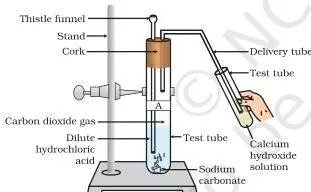
This reaction is also the example of a non-metallic oxide reacting with a base; non-metallic oxides such as \( \text{CO}_2 \) are acidic in nature (NCERT, p. 6).
Neutralisation Reactions
An acid and a base cancel each other’s effect and give a salt and water. This reaction is called neutralisation (NCERT, p. 5).
\[ \text{Acid} + \text{Base} \rightarrow \text{Salt} + \text{Water} \]
\[ \text{HX} + \text{MOH} \rightarrow \text{MX} + \text{HOH} \]
The example from Activity 2.6, where the pink colour of phenolphthalein disappears as \( \text{HCl} \) neutralises \( \text{NaOH} \):
\[ \text{NaOH(aq)} + \text{HCl(aq)} \rightarrow \text{NaCl(aq)} + \text{H}_2\text{O(l)} \]
At the level of the ions that actually react, the net change is (NCERT, p. 8):
\[ \text{H}^+\text{(aq)} + \text{OH}^-\text{(aq)} \rightarrow \text{H}_2\text{O(l)} \]
This is why any acid can neutralise any base: what joins is always \( \text{H}^+ \) from the acid and \( \text{OH}^- \) from the base.
Reaction of a Metallic Oxide with an Acid
A metallic oxide reacts with an acid to give a salt and water, just like a base does. Metallic oxides are therefore called basic oxides (NCERT, p. 5).
\[ \text{Metal oxide} + \text{Acid} \rightarrow \text{Salt} + \text{Water} \]
In Activity 2.7, copper oxide dissolves in dilute hydrochloric acid to give a blue-green solution of copper(II) chloride:
\[ \text{CuO(s)} + 2\text{HCl(aq)} \rightarrow \text{CuCl}_2\text{(aq)} + \text{H}_2\text{O(l)} \]
Acids and Bases in Water Solution
Acids produce hydrogen ions only in the presence of water. Hydrogen ions cannot exist alone; they combine with water molecules to form hydronium ions, \( \text{H}_3\text{O}^+ \) (NCERT, p. 7).
\[ \text{HCl} + \text{H}_2\text{O} \rightarrow \text{H}_3\text{O}^+ + \text{Cl}^- \]
\[ \text{H}^+ + \text{H}_2\text{O} \rightarrow \text{H}_3\text{O}^+ \]
Bases that dissolve in water are called alkalis. They release hydroxide ions, \( \text{OH}^- \) (NCERT, pp. 7–8):
\[ \text{NaOH(s)} \xrightarrow{\text{H}_2\text{O}} \text{Na}^+\text{(aq)} + \text{OH}^-\text{(aq)} \]
\[ \text{KOH(s)} \xrightarrow{\text{H}_2\text{O}} \text{K}^+\text{(aq)} + \text{OH}^-\text{(aq)} \]
\[ \text{Mg(OH)}_2\text{(s)} \xrightarrow{\text{H}_2\text{O}} \text{Mg}^{2+}\text{(aq)} + 2\text{OH}^-\text{(aq)} \]
\( \text{Mg(OH)}_2 \) is a useful example because it shows the ratio: one formula unit of the base gives two hydroxide ions.
The pH Scale
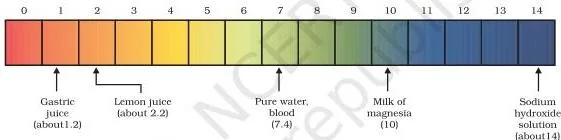
The pH scale measures hydrogen-ion concentration in a solution, generally from 0 (very acidic) to 14 (very alkaline). The p in pH stands for ‘potenz’, the German word for power (NCERT, p. 9). The higher the hydronium-ion concentration, the lower the pH value.

\[ \text{pH} \lt 7 \Rightarrow \text{acidic}; \quad \text{pH} = 7 \Rightarrow \text{neutral}; \quad \text{pH} \gt 7 \Rightarrow \text{basic} \]
A universal indicator (a mixture of several indicators) shows different colours at different concentrations of hydrogen ions; the colour is read against the scale on a pH paper. Figure 2.7 below shows the approximate pH of some common substances.
Three threshold values from this chapter to remember:
- Acid rain: rain water with \( \text{pH} \lt 5.6 \) (NCERT, p. 10)
- Tooth decay: pH in the mouth below 5.5 corrodes tooth enamel (NCERT, p. 11)
- Human body: metabolic activities run best in the pH range 7.0 to 7.8 (NCERT, p. 10)
pH of Salts
The nature of a salt solution depends on the strengths of the acid and the base from which the salt is formed (NCERT, p. 13).
| Parent acid and base | Nature of salt | pH value |
|---|---|---|
| Strong acid + strong base | Neutral | \( = 7 \) |
| Strong acid + weak base | Acidic | \( \lt 7 \) |
| Strong base + weak acid | Basic | \( \gt 7 \) |
For example, sodium chloride comes from \( \text{HCl} \) (strong acid) and \( \text{NaOH} \) (strong base), so a \( \text{NaCl} \) solution is neutral with pH 7.
Chemicals from Common Salt
Sodium chloride is the raw material for sodium hydroxide, bleaching powder, baking soda and washing soda. Each has its own equation and condition.
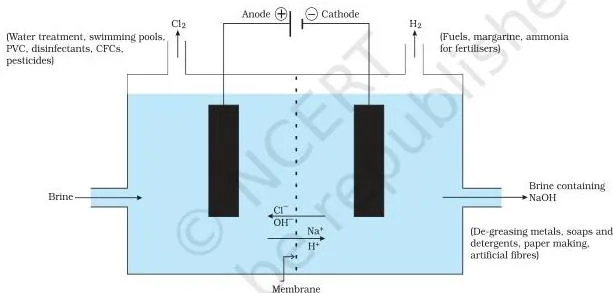
Chlor-alkali process — sodium hydroxide. Passing electricity through brine (aqueous sodium chloride) decomposes it (NCERT, p. 14).
\[ 2\text{NaCl(aq)} + 2\text{H}_2\text{O(l)} \rightarrow 2\text{NaOH(aq)} + \text{Cl}_2\text{(g)} + \text{H}_2\text{(g)} \]
Chlorine gas is given off at the anode and hydrogen gas at the cathode; the sodium hydroxide solution forms near the cathode. The figure below maps the uses of the three products.
Bleaching powder. Chlorine acts on dry slaked lime, \( \text{Ca(OH)}_2 \), to give bleaching powder, \( \text{Ca(ClO)}_2 \) (NCERT, p. 14):
\[ 2\text{Ca(OH)}_2 + 2\text{Cl}_2 \rightarrow \text{Ca(ClO)}_2 + \text{CaCl}_2 + 2\text{H}_2\text{O} \]
Baking soda — sodium hydrogencarbonate. It is made from sodium chloride, water, carbon dioxide and ammonia (NCERT, p. 15):
\[ \text{NaCl} + \text{H}_2\text{O} + \text{CO}_2 + \text{NH}_3 \rightarrow \text{NH}_4\text{Cl} + \text{NaHCO}_3 \]
On heating, baking soda decomposes to sodium carbonate (NCERT, p. 15):
\[ 2\text{NaHCO}_3 \xrightarrow{\text{Heat}} \text{Na}_2\text{CO}_3 + \text{H}_2\text{O} + \text{CO}_2 \]
With any acid, baking soda gives carbon dioxide — this is the reaction that makes cakes and bread rise (NCERT, p. 15):
\[ \text{NaHCO}_3 + \text{H}^+ \rightarrow \text{CO}_2 + \text{H}_2\text{O} + \text{Sodium salt of acid} \]
Baking powder is a mixture of baking soda and tartaric acid, a weak edible acid.
Washing soda — \( \text{Na}_2\text{CO}_3 \cdot 10\text{H}_2\text{O} \). Recrystallisation of sodium carbonate with ten water molecules gives washing soda (NCERT, p. 15):
\[ \text{Na}_2\text{CO}_3 + 10\text{H}_2\text{O} \rightarrow \text{Na}_2\text{CO}_3 \cdot 10\text{H}_2\text{O} \]
Water of Crystallisation and Plaster of Paris
Water of crystallisation is the fixed number of water molecules present in one formula unit of a salt (NCERT, p. 16).
- \( \text{CuSO}_4 \cdot 5\text{H}_2\text{O} \) — hydrated copper sulphate, with five water molecules per formula unit.
- \( \text{CaSO}_4 \cdot 2\text{H}_2\text{O} \) — gypsum, with two water molecules per formula unit.
Heating hydrated copper sulphate removes this water; the blue crystals turn white, and moistening them restores the blue colour. Figure 2.9 shows the water being driven off.
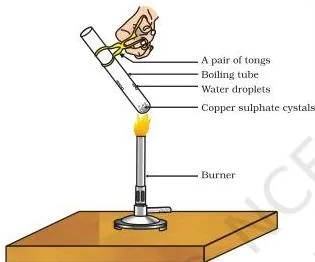
On heating gypsum at 373 K, it loses water and becomes calcium sulphate hemihydrate, \( \text{CaSO}_4 \cdot \frac{1}{2}\text{H}_2\text{O} \) — Plaster of Paris (NCERT, p. 16). When mixed with water, Plaster of Paris sets back into gypsum (NCERT, p. 17):
\[ \text{CaSO}_4 \cdot \frac{1}{2}\text{H}_2\text{O} + 1\frac{1}{2}\text{H}_2\text{O} \rightarrow \text{CaSO}_4 \cdot 2\text{H}_2\text{O} \]
The half water molecule appears because two formula units of \( \text{CaSO}_4 \) share one water molecule.
What Each Symbol Means
Chemical symbols have no SI units, so the third column states what each symbol is or represents in the equation.
| Symbol | What it means | Unit or nature |
|---|---|---|
| \( \text{H}^+\text{(aq)} \) | Hydrogen ion in aqueous solution — the cation that makes a solution acidic | Ion |
| \( \text{H}_3\text{O}^+ \) | Hydronium ion — the form in which hydrogen ions exist in water | Ion |
| \( \text{OH}^-\text{(aq)} \) | Hydroxide ion — the anion that makes a solution basic | Ion |
| \( \text{(aq)}, \text{(s)}, \text{(g)}, \text{(l)} \) | State symbols — aqueous solution, solid, gas, liquid | Physical state |
| \( \text{pH} \) | ‘Potenz’ (German for power) — a measure of hydrogen-ion concentration in solution | Number on the 0–14 scale |
| \( \text{HX} \) | A general acid — hydrogen combined with any anion X | Chemical formula |
| \( \text{MOH} \) | A general base or alkali — metal M combined with hydroxide | Chemical formula |
| \( \text{MX} \) | A general salt — metal of the base combined with the anion of the acid | Chemical formula |
| \( \text{HOH} \) | Water written as H–O–H | Chemical formula |
| \( \xrightarrow{\text{H}_2\text{O}} \) | ‘In the presence of water’ — used for dissolving a substance in water | Reaction condition |
| \( \xrightarrow{\text{Heat}} \) | ‘On heating’ — the reaction needs heat | Reaction condition |
| \( \cdot n\text{H}_2\text{O} \) | Water of crystallisation — n water molecules in one formula unit (5, 2, 10 or ½) | Fixed number per formula unit |
| \( \text{Na}_2\text{ZnO}_2 \) | Sodium zincate — the salt formed when zinc reacts with sodium hydroxide | Chemical formula |
When to Use Each Formula
One line per formula group — the situation that tells you which equation to reach for.
| You need to… | Use this | Condition / check |
|---|---|---|
| Write what happens when a metal is put in a dilute acid | \( \text{Acid} + \text{Metal} \rightarrow \text{Salt} + \text{Hydrogen gas} \) | The gas is hydrogen — it burns with a pop. Metals such as Zn, Mg, Al and Fe follow this pattern. |
| Write what happens when a base attacks a metal | \( 2\text{NaOH} + \text{Zn} \rightarrow \text{Na}_2\text{ZnO}_2 + \text{H}_2 \) | Only some metals react this way; the salt contains the metal and oxygen. |
| Explain effervescence when an acid meets a carbonate or hydrogencarbonate | \( \text{Carbonate/Hydrogencarbonate} + \text{Acid} \rightarrow \text{Salt} + \text{CO}_2 + \text{Water} \) | The gas is \( \text{CO}_2 \) — it extinguishes a burning candle. |
| Confirm that the gas given off is carbon dioxide | \( \text{Ca(OH)}_2 + \text{CO}_2 \rightarrow \text{CaCO}_3 + \text{H}_2\text{O} \) | Lime water turns milky; excess \( \text{CO}_2 \) clears it again. |
| Show how an acid and a base cancel each other (antacids, soil treatment) | \( \text{Acid} + \text{Base} \rightarrow \text{Salt} + \text{Water} \); ionic form \( \text{H}^+ + \text{OH}^- \rightarrow \text{H}_2\text{O} \) | One \( \text{H}^+ \) neutralises one \( \text{OH}^- \); the reaction is called neutralisation. |
| Show that a metallic oxide behaves like a base | \( \text{Metal oxide} + \text{Acid} \rightarrow \text{Salt} + \text{Water} \) | Metallic oxides are basic oxides; non-metallic oxides are acidic. |
| Explain why dry HCl is not acidic or why acids conduct in water | \( \text{HCl} + \text{H}_2\text{O} \rightarrow \text{H}_3\text{O}^+ + \text{Cl}^- \) | \( \text{H}^+ \) forms only in the presence of water; write it as \( \text{H}^+\text{(aq)} \) or \( \text{H}_3\text{O}^+ \). |
| State the ions a base produces in water | \( \text{NaOH} \xrightarrow{\text{H}_2\text{O}} \text{Na}^+ + \text{OH}^- \); \( \text{Mg(OH)}_2 \xrightarrow{\text{H}_2\text{O}} \text{Mg}^{2+} + 2\text{OH}^- \) | Soluble bases (alkalis) release \( \text{OH}^- \); read the ratio from the formula. |
| Classify a solution as acidic, basic or neutral | pH rule: \( \text{pH} \lt 7 \) acidic, \( = 7 \) neutral, \( \gt 7 \) basic | Lower pH means higher \( \text{H}^+\text{(aq)} \) concentration. |
| Predict the nature of a salt solution | Salt pH rules — compare the strengths of the parent acid and base | Identify which parent is strong; the strong parent decides the nature. |
| Write the industrial preparation of NaOH, bleaching powder, baking soda, washing soda or Plaster of Paris | Chlor-alkali, bleaching powder, baking soda, washing soda and Plaster of Paris equations above | Each has a condition: electricity, dry slaked lime, heat, or water. |
Worked Examples
Three original examples showing the formulas in action. For practice on the textbook’s own questions, use the NCERT solutions for this chapter.
Worked Example 1 — Metal + dilute acid: magnesium with sulphuric acid
Step 1: Select the formula.
A metal and an acid react as (NCERT, p. 4):
\[ \text{Acid} + \text{Metal} \rightarrow \text{Salt} + \text{Hydrogen gas} \]
Step 2: Write the word equation.
\[ \text{Magnesium} + \text{Sulphuric acid} \rightarrow \text{Magnesium sulphate} + \text{Hydrogen} \]
Step 3: Replace names with formulae and balance.
\[ \text{Mg(s)} + \text{H}_2\text{SO}_4\text{(aq)} \rightarrow \text{MgSO}_4\text{(aq)} + \text{H}_2\text{(g)} \]
Step 4: Check the count: one Mg, two H, one S and four O on each side — already balanced.
Final answer: \( \text{Mg(s)} + \text{H}_2\text{SO}_4\text{(aq)} \rightarrow \text{MgSO}_4\text{(aq)} + \text{H}_2\text{(g)} \). The gas is hydrogen; tested by bringing a burning candle near it, it burns with a pop.
Worked Example 2 — Neutralisation ratio: how much HCl for double the NaOH?
Step 1: Write the neutralisation equation (NCERT, p. 5).
\[ \text{NaOH(aq)} + \text{HCl(aq)} \rightarrow \text{NaCl(aq)} + \text{H}_2\text{O(l)} \]
Step 2: The same two solutions are used, so their concentrations do not change.
For the same solutions, the volume ratio stays fixed.
Here 25 mL of \( \text{NaOH} \) is neutralised by 15 mL of \( \text{HCl} \), so:
\[ \frac{V(\text{NaOH})}{V(\text{HCl})} = \frac{25}{15} = \frac{5}{3} \]
Step 3: For 50 mL of \( \text{NaOH} \), the \( \text{HCl} \) volume is \( 50 \times \frac{3}{5} = 30 \) mL.
Final answer: 30 mL of the same \( \text{HCl} \) solution will neutralise 50 mL of the \( \text{NaOH} \) solution.
Worked Example 3 — Classifying solutions on the pH scale
Step 1: Apply the pH rule (NCERT, p. 9).
\[ \text{pH} \lt 7 \Rightarrow \text{acidic}; \quad \text{pH} = 7 \Rightarrow \text{neutral}; \quad \text{pH} \gt 7 \Rightarrow \text{basic} \]
Step 2: Five solutions have pH values 2, 6, 7, 9 and 12.
The farther from 7, the stronger the acid or base:
- pH 2 — strongly acidic
- pH 6 — weakly acidic
- pH 7 — neutral
- pH 9 — weakly basic (alkaline)
- pH 12 — strongly basic (alkaline)
Step 3: Hydrogen-ion concentration is higher when pH is lower.
Increasing order of \( \text{H}^+\text{(aq)} \) concentration:
\[ \text{pH}\ 12 \lt \text{pH}\ 9 \lt \text{pH}\ 7 \lt \text{pH}\ 6 \lt \text{pH}\ 2 \]
Final answer: pH 2 is the strongest acid and has the highest \( \text{H}^+ \) ion concentration; pH 12 is the strongest base with the lowest \( \text{H}^+ \) concentration.
Common Mistakes to Avoid
| Mistake | Correct rule | How to check your answer |
|---|---|---|
| Writing \( \text{HCl} \rightarrow \text{H}^+ + \text{Cl}^- \) in water, as if hydrogen ions float free. | In water, \( \text{H}^+ \) immediately combines with \( \text{H}_2\text{O} \): \( \text{HCl} + \text{H}_2\text{O} \rightarrow \text{H}_3\text{O}^+ + \text{Cl}^- \). Write it as \( \text{H}^+\text{(aq)} \) or \( \text{H}_3\text{O}^+ \). | Every hydrogen ion in your equation appears as \( \text{H}^+\text{(aq)} \) or \( \text{H}_3\text{O}^+ \). |
| Thinking a lower pH means fewer hydrogen ions. | Higher hydronium-ion concentration gives a lower pH value; pH 2 is more acidic than pH 6. | Check the direction: pH falls as the solution becomes more acidic. |
| Saying an alkaline solution contains no \( \text{H}^+ \) ions. | Aqueous solutions contain both \( \text{H}^+ \) and \( \text{OH}^- \); a solution is basic when \( \text{OH}^- \) concentration is higher, so pH is greater than 7. | pH greater than 7 means \( \text{OH}^- \) outnumbers \( \text{H}^+ \) — not that \( \text{H}^+ \) is absent. |
| Predicting a salt’s nature from the wrong parent — calling ammonium chloride basic. | A salt of a strong acid and a weak base is acidic (pH less than 7). \( \text{HCl} \) is strong and \( \text{NH}_4\text{OH} \) is weak, so \( \text{NH}_4\text{Cl} \) is acidic. | Identify the stronger parent; it decides the nature of the salt. |
| Leaving carbonate or hydrogencarbonate reactions unbalanced (one \( \text{HCl} \) for \( \text{Na}_2\text{CO}_3 \)). | \( \text{Na}_2\text{CO}_3 + 2\text{HCl} \rightarrow 2\text{NaCl} + \text{H}_2\text{O} + \text{CO}_2 \); \( \text{NaHCO}_3 + \text{HCl} \rightarrow \text{NaCl} + \text{H}_2\text{O} + \text{CO}_2 \). | Count Na, Cl, H, C and O atoms on both sides. |
| Reading \( \text{CaSO}_4 \cdot \frac{1}{2}\text{H}_2\text{O} \) as half a water molecule in every formula unit. | Two formula units of \( \text{CaSO}_4 \) share one water molecule; the formula shows the smallest whole-number ratio. | \( 2 \times \text{CaSO}_4 \cdot \frac{1}{2}\text{H}_2\text{O} = 2\text{CaSO}_4 \cdot \text{H}_2\text{O} \). |
| Adding water to concentrated acid while diluting. | Dissolving an acid in water is highly exothermic; add the acid slowly to water with constant stirring. | The order is always acid into water, never water into acid. |
Frequently Asked Questions
Where can I find all the acids, bases and salts class 10 formulas in one list?
The ‘Formulas at a Glance’ table at the top of this page indexes every equation covered by this sheet. Each equation is repeated in the grouped list with its page reference and conditions, so you can revise the full chapter from the two tables.
Why does dry HCl gas not turn dry litmus paper red?
Hydrogen ions are produced only in the presence of water. Dry \( \text{HCl} \) gas has no \( \text{H}^+ \) ions; in water it ionises as \( \text{HCl} + \text{H}_2\text{O} \rightarrow \text{H}_3\text{O}^+ + \text{Cl}^- \), and the hydronium ions make the litmus turn red.
Does a basic solution contain H⁺ ions too?
Yes. Every aqueous solution contains both \( \text{H}^+ \) and \( \text{OH}^- \) ions. A solution is basic when its \( \text{OH}^- \) concentration is higher than its \( \text{H}^+ \) concentration, which is why its pH is greater than 7.
Why must Plaster of Paris be stored in a moisture-proof container?
Plaster of Paris reacts with water and sets back into gypsum: \( \text{CaSO}_4 \cdot \frac{1}{2}\text{H}_2\text{O} + 1\frac{1}{2}\text{H}_2\text{O} \rightarrow \text{CaSO}_4 \cdot 2\text{H}_2\text{O} \). Moisture in the air makes it harden, so it becomes useless for plastering.
This sheet is part of the Class 10 chemistry formulas collection; you can browse every chapter from the chemistry formulas index.
You can verify these equations against the official NCERT Class 10 Science textbook at ncert.nic.in.
Reference: NCERT Class 10 Science textbook, Chapter 2: Acids, Bases and Salts.
Explore Class 10 Chemistry Formulas
More for this chapter:
- Acids, Bases and Salts Notes
- Acids, Bases and Salts Important Questions
- Acids, Bases and Salts MCQ Questions
Class 10 Chemistry on LearnCBSE:
Related chapters:
Official source: download the NCERT textbook free from ncert.nic.in.