
What This Chapter Tests and How to Use This Page
These acids bases and salts class 10 important questions are grouped by marks so you revise the chapter the way it is actually tested, not in random order.
This set is meant for practice ahead of your school or board exam in the 2026-27 academic session — treat every question here as a rehearsal, not a prediction of what will actually appear on your paper.
The NCERT chapter has four working parts, and every question below maps back to one of them: (1) how acids and bases react with metals, metal carbonates, oxides and each other; (2) what happens when an acid or base is put into water — ionisation, dilution and conductivity; (3) the pH scale and how it measures the strength of a solution; and (4) salts, especially the chemicals made from common salt and the idea of water of crystallisation.
If you can place every question you attempt into one of these four buckets, your revision stops feeling scattered.
For the exact textbook wording of any activity mentioned below, you can always cross-check with the official NCERT Class 10 Science textbook. If you also want a topic-wise recap before attempting these questions, the Class 10 Science study material section and the wider Class 10 subject pages are useful companions to this practice set.
1-Mark Important Questions (Very Short Answer)
Q1. You are given only red litmus paper and three test tubes containing distilled water, an acidic solution and a basic solution. How do you identify each? (Difficulty: easy) Answer: Dip the red litmus paper into each test tube one at a time.
The solution that turns red litmus blue is basic; the solutions that leave red litmus unchanged are either the acid or the distilled water, so a fresh strip is needed for each.
Since red litmus stays red with an acid and also stays red (unchanged) with neutral distilled water, only the colour change to blue can be read off directly — the acid and water are told apart because red litmus never turns blue for either of them, only the base gives that change (NCERT, p. 2).
Why this is asked: it checks whether you know litmus only signals one colour change per paper, forcing you to reason about what “no change” can and cannot tell you.
Q2. Which gas is usually released when a metal reacts with a dilute acid, and how do you test for it? (Difficulty: easy) Answer: Hydrogen gas is released. Pass the gas through soap solution to form gas-filled bubbles, then bring a burning candle near a bubble — it burns with a pop sound, confirming hydrogen (NCERT, p. 3, Activity 2.3).
Why this is asked: the acid-metal reaction and its gas test are used repeatedly across this chapter and the next one on reactions and equations.
Q3. What is the common name of the compound \( \text{Ca(ClO)}_2 \)? (Difficulty: easy) Answer: Bleaching powder (NCERT, p. 17).
Why this is asked: it is a direct one-line recall taken almost verbatim from the textbook’s own end-of-chapter question, so it tests basic factual memory.
Q4. Why does dry HCl gas not turn dry litmus paper red? (Difficulty: moderate) Answer: HCl gas produces \( H^+ \) ions only in the presence of water; the separation of the \( H^+ \) ion from the HCl molecule cannot happen without water. Since dry litmus paper has no water, no ions form and no colour change occurs (NCERT, p. 7, Activity 2.9).
Why this is asked: it is the single fact examiners use most to check whether students confuse “being an acid” with “showing acidic behaviour”, which needs water.
Q5. What is the pH value of a neutral solution, and name one everyday substance close to that value. (Difficulty: easy) Answer: A neutral solution has a pH of exactly 7 (NCERT, p. 9). Tap water is an everyday substance close to this value, which is why it is used as a reference point when testing other solutions (NCERT, p. 10).
Why this is asked: the number 7 anchors the whole pH scale, so examiners check it is memorised correctly before asking anything applied.
2-Mark Important Questions (Short Answer I)
Q1. Why should curd and other sour foods not be stored in brass or copper vessels? (Difficulty: moderate) Answer: Curd and sour foods contain acids (such as lactic acid). An acid reacting with a metal follows the general pattern \( \text{Acid} + \text{Metal} \rightarrow \text{Salt} + \text{Hydrogen gas} \) (NCERT, p. 4).
Brass and copper are metals, so the acid slowly reacts with them to form metal salts.
These salts can be harmful if eaten, which is why sour food is kept away from copper or brass vessels.
Why this is asked: it forces you to apply the general acid-metal reaction rule to an everyday situation instead of just quoting it.
Q2. Write the balanced equation for the reaction of sodium hydrogencarbonate with dilute hydrochloric acid, and explain how the gas formed is tested. (Difficulty: moderate) \[ \text{NaHCO}_3\text{(s)} + \text{HCl(aq)} \rightarrow \text{NaCl(aq)} + \text{H}_2\text{O(l)} + \text{CO}_2\text{(g)} \]
Answer: The gas evolved is carbon dioxide. It is passed through lime water, calcium hydroxide solution, which turns milky because a white precipitate of calcium carbonate forms: \( \text{Ca(OH)}_2\text{(aq)} + \text{CO}_2\text{(g)} \rightarrow \text{CaCO}_3\text{(s)} + \text{H}_2\text{O(l)} \) (NCERT, p. 4-5).
Why this is asked: it links a metal-hydrogencarbonate reaction to a gas test, so examiners can check two skills — balancing and identification — in one question.
Q3. State the safe rule for diluting a concentrated acid, and explain why acid is added to water and not the other way round. (Difficulty: easy) Answer: The rule is to add the acid slowly to water with constant stirring, never water to acid (NCERT, p. 8). Mixing an acid with water is highly exothermic.
If water is added to a concentrated acid instead, the heat released is generated in a small volume of water near the acid surface, which can make the mixture splash out and cause burns, and the local heating may even crack the container.
Why this is asked: it is a safety rule with a chemistry reason attached, which examiners like because it tests understanding, not just memory of a warning.
Q4. How does dilution affect the concentration of hydronium ions, \( H_3O^+ \), in a solution? (Difficulty: moderate) Answer: Dilution decreases the concentration of \( H_3O^+ \) ions per unit volume, because the same number of ions is now spread through a larger volume of water (NCERT, p. 8).
This is exactly why diluting an acid makes it weaker in effect, even though the same amount of acid is still present.
Why this is asked: it checks the difference between the total amount of acid and its concentration, a distinction many students blur.
Q5. Give two uses each of washing soda and baking soda. (Difficulty: easy) Answer:
- Washing soda \( (\text{Na}_2\text{CO}_3\cdot 10\text{H}_2\text{O}) \): used in the glass, soap and paper industries, and for removing permanent hardness of water (NCERT, p. 16).
- Baking soda \( (\text{NaHCO}_3) \): used as an ingredient in antacids to neutralise excess stomach acid, and in baking powder to make cakes and bread rise (NCERT, p. 15).
Why this is asked: the two soda compounds sound similar, so examiners use this question to check you have not mixed up their uses.
3-Mark Important Questions (Short Answer II)
Q1. Define a neutralisation reaction and support it with two original examples and their equations. (Difficulty: moderate)
- Step 1: State the definition: a neutralisation reaction is the reaction between an acid and a base that produces a salt and water (NCERT, p. 5).
- Step 2: Give the general form, then two worked examples.
\[ \text{Acid} + \text{Base} \rightarrow \text{Salt} + \text{Water} \]
\[ \text{NaOH(aq)} + \text{HCl(aq)} \rightarrow \text{NaCl(aq)} + \text{H}_2\text{O(l)} \]
\[ \text{KOH(aq)} + \text{HNO}_3\text{(aq)} \rightarrow \text{KNO}_3\text{(aq)} + \text{H}_2\text{O(l)} \]
Final answer: Both reactions follow the same pattern taught in the chapter — an acid neutralising a base to give a neutral salt and water.
Why this is asked: it checks that you can generalise a rule to substances not used as the textbook’s own example.
Q2. Zinc reacts with both dilute sulphuric acid and sodium hydroxide, releasing hydrogen gas in each case. Explain with equations. (Difficulty: challenging)
Step 1: With the acid, zinc follows the standard metal-acid pattern.
\[ \text{Zn(s)} + \text{H}_2\text{SO}_4\text{(aq)} \rightarrow \text{ZnSO}_4\text{(aq)} + \text{H}_2\text{(g)} \]
Step 2: With the base, zinc still gives off hydrogen, but the salt formed is sodium zincate, not a simple metal salt.
\[ 2\text{NaOH(aq)} + \text{Zn(s)} \rightarrow \text{Na}_2\text{ZnO}_2\text{(s)} + \text{H}_2\text{(g)} \]
Step 3: Note that this dual reactivity is not shown by every metal (NCERT, p. 4) — it is specific to certain metals such as zinc and aluminium.
Final answer: Zinc releases hydrogen gas with dilute sulphuric acid to form zinc sulphate, and with sodium hydroxide to form sodium zincate, showing it reacts with both an acid and a base.
Why this is asked: most students only remember metal + acid; this question checks whether they also know the less common metal + base reaction.
Q3. Describe how you would confirm that the gas evolved when zinc reacts with dilute sulphuric acid is hydrogen. (Difficulty: moderate)
- Step 1: Set up the apparatus as in Fig. 2.1, with zinc granules in dilute sulphuric acid in a test tube.
- Step 2: Pass the gas produced through soap solution — bubbles filled with the gas form on the surface.
- Step 3: Bring a burning candle near a gas-filled bubble; it burns with a pop sound, which is the standard confirmation test for hydrogen (NCERT, p. 3, Activity 2.3).
Final answer: The pop sound on bringing a flame near the soap bubble confirms the gas is hydrogen.
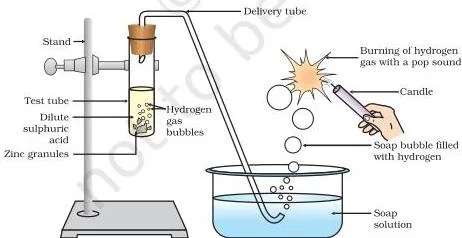
Why this is asked: diagram-based questions on this exact activity appear because it is the chapter’s main hands-on test for a gas.
Q4. Fresh milk has a pH of 6. Explain how this pH changes as milk turns into curd, and why a milkman may add a pinch of baking soda to fresh milk. (Difficulty: moderate)
- Step 1: As milk turns into curd, bacteria convert milk sugar into lactic acid, so the pH of the milk drops further below 6 — it becomes more acidic, not less.
- Step 2: Baking soda \( (\text{NaHCO}_3) \) is a mild, non-corrosive base (NCERT, p. 15).
- Step 3: Adding a pinch of it shifts the milk’s pH from 6 to slightly alkaline, so the bacteria take longer to produce enough acid to reach the pH at which curdling happens — this is why such milk takes longer to set as curd.
Final answer: The pH falls as lactic acid forms during curdling, and baking soda delays this by first pushing the milk’s pH to the alkaline side.
Why this is asked: it is one of the few questions in the chapter that connects pH change directly to a food-preservation habit students may have seen at home.
Q5. Why must Plaster of Paris be stored in a moisture-proof container? (Difficulty: moderate)
- Step 1: Plaster of Paris is calcium sulphate hemihydrate, \( \text{CaSO}_4\cdot\frac{1}{2}\text{H}_2\text{O} \), made by heating gypsum at 373 K (NCERT, p. 16-17).
- Step 2: When Plaster of Paris is mixed with water, it changes back into gypsum, forming a hard solid mass.
\[ \text{CaSO}_4\cdot\frac{1}{2}\text{H}_2\text{O} + 1\frac{1}{2}\text{H}_2\text{O} \rightarrow \text{CaSO}_4\cdot 2\text{H}_2\text{O} \]
Step 3: If stored in a container that lets in moisture, atmospheric water slowly triggers this same reaction inside the container, turning the powder into a useless hard lump.
Final answer: Moisture-proof storage is needed because even small amounts of water convert Plaster of Paris back into solid gypsum before it is used.
Why this is asked: it tests whether students understand the forward-and-reverse relationship between gypsum and Plaster of Paris, not just the name of the compound.
5-Mark Important Questions (Long Answer)
Q1. Describe an activity that proves acids show acidic behaviour only in the presence of water. (Difficulty: challenging)
- Step 1: Take about 1 g of solid sodium chloride in a dry test tube and set up the apparatus shown in Fig. 2.4.
- Step 2: Add concentrated sulphuric acid to the test tube; dry HCl gas is produced and passes out through the delivery tube.
- Step 3: Test this gas first with dry blue litmus paper — there is no colour change. Then test it with wet blue litmus paper — it turns red.
- Step 4: Conclude that dry HCl gas is not acidic by itself; the reaction \( \text{HCl(g)} + \text{H}_2\text{O(l)} \rightarrow \text{H}_3\text{O}^+\text{(aq)} + \text{Cl}^-\text{(aq)} \) shows that hydrogen ions form only once water is present (NCERT, p. 7, Activity 2.9).
Final answer: The dry-versus-wet litmus comparison proves that ionisation, and therefore acidic behaviour, needs water.
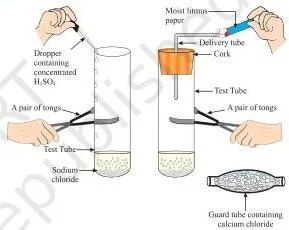
Why this is asked: this activity is the chapter’s central proof for why water matters to acidic behaviour, so it is a natural long-answer target.
Q2. Name the three products of the electrolysis of brine, write the balanced equation, and state one industrial use of each. (Difficulty: challenging)
Step 1: When electricity passes through an aqueous solution of sodium chloride (brine), it decomposes into sodium hydroxide, chlorine gas and hydrogen gas — this is called the chlor-alkali process (NCERT, p. 14).
\[ 2\text{NaCl(aq)} + 2\text{H}_2\text{O(l)} \rightarrow 2\text{NaOH(aq)} + \text{Cl}_2\text{(g)} + \text{H}_2\text{(g)} \]
- Step 1: Chlorine collects at the anode and hydrogen at the cathode, with sodium hydroxide solution forming near the cathode (NCERT, p. 14).
- Step 2: Uses: chlorine gas is used to manufacture bleaching powder (NCERT, p. 14); sodium hydroxide is commonly used in soap-making; hydrogen gas is used as a fuel gas. Figure 2.8 shows further uses of each product.
Final answer: Electrolysis of brine gives sodium hydroxide, chlorine and hydrogen, all of which are used further in industry.
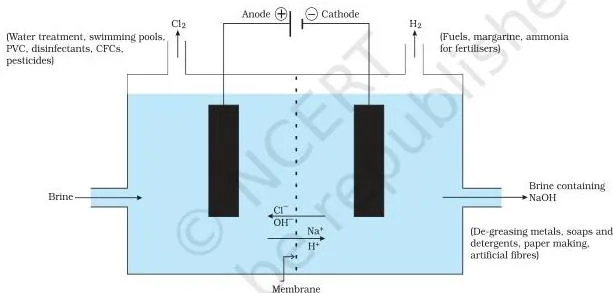
This process is essentially electrolysis, the same idea of current flowing through a conducting liquid that you study in more depth in the Electricity chapter.
Why this is asked: it tests whether you can hold three simultaneous products and their uses in memory instead of just one reaction.
Q3. 15 mL of a NaOH solution is completely neutralised by 12 mL of a given HCl solution. Find the volume of the same HCl solution needed to neutralise 30 mL of the same NaOH solution. (Difficulty: challenging)
- Step 1: Note the given data: \(15\ \text{mL}\) of NaOH is exactly neutralised by \(12\ \text{mL}\) of the HCl solution.
- Step 2: Since the concentrations of both solutions stay fixed, the volume of HCl needed is directly proportional to the volume of NaOH taken.
\[ \frac{\text{Volume of HCl}}{\text{Volume of NaOH}} = \frac{12}{15} \]
Step 3: Let \(x\) be the volume of HCl needed for \(30\ \text{mL}\) of the same NaOH solution.
\[ \frac{x}{30} = \frac{12}{15} \]
Step 4: Solve for \(x\).
\[ x = \frac{12 \times 30}{15} = 24 \]
Final answer: \(24\ \text{mL}\) of the HCl solution is needed to neutralise \(30\ \text{mL}\) of the NaOH solution.
Why this is asked: the chapter’s own exercise uses this direct-proportion idea, so numeric variations of it test whether you understood the method rather than memorised one answer.
Q4. Explain the pH scale from 0 to 14. State the approximate pH condition of saliva, gastric juice and body fluids, and explain why living organisms are sensitive to pH change. (Difficulty: moderate)
- Step 1: The pH scale runs from 0 to 14. A pH value less than 7 means the solution is acidic, a pH of exactly 7 means neutral, and a pH greater than 7 means basic; the higher the concentration of hydronium ions, the lower the pH (NCERT, p. 9, Fig. 2.6).
- Step 2: The human body works within a narrow pH range of 7.0 to 7.8 for its metabolic activities (NCERT, p. 10).
- Step 3: Gastric juice is strongly acidic because the stomach produces hydrochloric acid to help digest food (NCERT, p. 11). Saliva must stay above pH 5.5, since tooth decay begins once the pH in the mouth falls below this value (NCERT, p. 11).
- Step 4: Living organisms are pH-sensitive because their enzymes and metabolic reactions work efficiently only within a narrow optimal pH range; even a small shift outside this range disturbs these processes (NCERT, p. 17, “What you have learnt”).
Final answer: The pH scale measures how acidic or basic a solution is, and body fluids, saliva and gastric juice each need to stay close to their own narrow pH range for the body to function normally.

Why this is asked: pH is the one concept in this chapter that links directly to everyday and biological examples, so it is asked both as a quick 1-mark fact and as a full 5-mark applied answer.
Why the Same Concepts Keep Reappearing in Exams
Some ideas from this chapter show up across different question papers in different forms. That is not because any single question is guaranteed — it means these ideas are central enough to the chapter that examiners keep returning to them from new angles.
| Concept | Typical marks | Why it repeats |
|---|---|---|
| Acid-metal / metal-carbonate equations | 2-3 marks | Balancing the equation tests memory of the pattern, and naming the gas tests understanding of what the reaction actually produces (NCERT, p. 4). |
| pH scale and its everyday application | 1 mark or 5 marks | It connects chemistry to daily life — tooth decay, antacids, soil treatment — so it works both as a quick fact and as a long applied answer (NCERT, p. 9-11). |
| Chlor-alkali products | 3-5 marks | It checks whether you can hold three simultaneous products, their electrode positions and their uses together, not just one fact (NCERT, p. 14). |
| Water of crystallisation | 2-3 marks | It is a commonly confused topic — students forget the dot notation or the exact number of water molecules (NCERT, p. 16). |
A concept reappearing across years shows that it matters to the chapter, not that any exact wording of a question will repeat. This is also why the acid-metal reaction pattern you learn here connects directly to the general reaction types covered in the Chemical Reactions and Equations chapter — the same equation-writing skill is being tested in both places.
Mistakes That Cost Marks in Acids, Bases and Salts
| Mistake | Correct rule | How to check your answer |
|---|---|---|
| Missing state symbols (s), (l), (g), (aq) | Every reactant and product needs a state symbol, even if the reaction itself is written correctly | Re-read the equation and confirm each substance has a physical state label matching what the activity describes |
| Writing a metal oxide as reacting with a base | Metal oxides are basic oxides and react with acids; non-metal oxides are acidic oxides and react with bases (NCERT, p. 5-6) | Check whether the oxide comes from a metal or a non-metal before deciding whether to react it with an acid or a base |
| Saying dry HCl is acidic because it is called an “acid” | Ionisation into \(H^+\) needs water; dry HCl gas does not turn dry litmus red (NCERT, p. 7) | Ask whether water is present in the setup — if not, no ions form and no acidic test will show a change |
| Writing water of crystallisation without the dot, e.g. \(CuSO_4\ 5H_2O\) | The correct notation uses a raised dot: \(CuSO_4\cdot 5H_2O\) (NCERT, p. 16) | Check the formula has a dot between the salt and the water molecules, not just a gap |
| Assuming a higher pH always means “stronger” | A higher pH means more basic, not “stronger”; strength depends on how much a substance ionises, which is a separate idea from where it sits on the pH scale (NCERT, p. 9-10) | Separate the two ideas: concentration/strength (how much it ionises) from pH (where the solution sits on the 0-14 scale) |
One-Day Revision Checklist for Acids, Bases and Salts
- Rewrite the six core equations from memory with state symbols: acid + metal, base + metal, acid + metal carbonate, acid + base, metal oxide + acid, and non-metal oxide + base.
- Redraw the pH scale from 0 to 14 and mark the neutral, acidic and basic zones, with two examples in each zone.
- List the uses of washing soda and baking soda side by side so you stop mixing them up.
| Washing soda \((Na_2CO_3\cdot 10H_2O)\) | Baking soda \((NaHCO_3)\) |
|---|---|
| Used in glass, soap and paper industries | Used as an ingredient in antacids to neutralise excess stomach acid |
| Removes permanent hardness of water | Used in baking powder to make bread and cakes rise |
| Used as a domestic cleaning agent | Used in soda-acid fire extinguishers |
- Revise the naturally occurring acids listed in the chapter so you can name the acid behind any everyday sour taste:
| Natural source | Acid |
|---|---|
| Vinegar | Acetic acid |
| Curd (sour milk) | Lactic acid |
| Orange / lemon | Citric acid |
| Tamarind | Tartaric acid |
| Ant sting / nettle sting | Methanoic acid |
- Attempt the numeric titration problem in the 5-mark section once on your own, without checking the worked steps, then compare your method against the direct-proportion approach shown above.
For a wider spread of subjects while you plan your revision timetable, the full CBSE study material hub lists chapters across other subjects as well.
Frequently Asked Questions on Acids, Bases and Salts (Class 10)
Is dry HCl gas acidic in nature?
No. Dry HCl gas does not show acidic behaviour because it needs water to ionise into \(H^+\) and \(Cl^-\) ions. Only once dissolved in water does it behave as an acid and turn litmus paper red (NCERT, p. 7).
What is the difference in pH between washing soda and baking soda solutions?
Both are basic salts, so both give a pH above 7, but the chapter does not give exact numeric pH values for each — it only states that sodium carbonate (washing soda) and sodium hydrogencarbonate (baking soda) are basic in nature (NCERT, p. 15-16).
Baking soda is described as a mild, non-corrosive base, which is why it is safe to use in food and antacids.
Why does milk turn from pH 6 towards acidic when it becomes curd?
Bacteria in milk convert milk sugar into lactic acid as curd forms, so the pH keeps dropping below 6 rather than rising. This is the same pH-lowering effect described for milk turning into curd in the chapter’s exercises (NCERT, p. 19).
Why is a small amount of baking soda added to milk meant for storage?
Baking soda shifts the milk’s pH from 6 to slightly alkaline. Since bacteria need the pH to fall to a certain acidic level before curdling begins, this shift delays curdling and lets the milk stay fresh a little longer (NCERT, p. 19).
What is water of crystallisation and how is it different in copper sulphate and gypsum?
Water of crystallisation is the fixed number of water molecules present in one formula unit of a salt (NCERT, p. 16). Copper sulphate holds five such molecules, written as \(CuSO_4\cdot 5H_2O\), while gypsum holds two, written as \(CaSO_4\cdot 2H_2O\) (NCERT, p. 16).
Why should concentrated acid be added to water and not water to acid?
Dissolving a concentrated acid in water releases a large amount of heat. Adding water to the acid concentrates this heat in a small volume near the acid, which can make the mixture splash violently and cause burns, and may even crack the container. Adding acid slowly to a larger volume of water spreads out the heat safely (NCERT, p. 8).
Reference: NCERT Class 10 Science textbook, chapter Acids, Bases and Salts.
Explore Class 10 Science Important Questions
- Class 10 Science Important Questions
- Class 10 Important Questions
- CBSE Important Questions for Classes 1 to 12
More for this chapter:
Class 10 Science on LearnCBSE: