
These acids bases and salts class 10 notes cover NCERT Chapter 2 of Class 10 Science — indicators, the reactions acids and bases undergo, the pH scale, and how salts are formed and used.
This chapter builds directly on the acid/base tasting rule you learned in Classes 8 and 9 (sour taste = acid, bitter taste = base) and takes it further: instead of tasting, you now identify acids and bases using indicators, and instead of just naming them, you learn how strong they are and what they turn into.
If a family member complains of acidity after a heavy meal, the remedy — a mild base like baking soda solution, not a strong acid like lemon juice or vinegar — works precisely because a base neutralises excess stomach acid. That single idea, one substance cancelling the effect of another, runs through the whole chapter.
What This Chapter Covers and Why It Matters for Boards
Chapter 2 is one of the highest-scoring chapters in CBSE Class 10 Science because its content is direct: definitions, colour-change tables, balanced equations and a handful of everyday applications. It is also detail-heavy — a lot of chemical formulas, several similar-looking reactions, and easy-to-mix-up terms like baking soda versus washing soda.
Students who revise it section by section, rather than skimming for keywords, tend to answer the reasoning-based questions (why acid is added to water, why dry HCl gas is not acidic) correctly, and these carry marks every year.
How the Chapter Is Organised (Indicators → Reactions → pH → Salts)
The chapter follows its own internal logic, matching CBSE’s section numbers 2.1 to 2.4. Revising in this order helps you connect ideas instead of memorising isolated facts:
- Testing acids and bases — using litmus, synthetic indicators and olfactory (smell-based) indicators.
- Chemical properties and reactions — how acids and bases react with metals, carbonates, oxides and each other.
- The pH scale — measuring how strong an acid or base is, and why living systems are pH-sensitive.
- Salts and their chemistry — salt families, pH of salt solutions, and industrial chemicals made from common salt.
This page follows the same four blocks, then adds worked numericals, a common-mistakes table and an exam-pattern note before the final recap. If you want to revise the previous chapter first, see the notes on Chemical Reactions and Equations, and the chapter that follows this one is covered in the Metals and Non-metals notes.
Testing Acids and Bases: Litmus, Olfactory and Universal Indicators
An indicator is a substance that changes colour (or smell) depending on whether it is placed in an acidic or a basic solution. Litmus, extracted from lichen, is the most common natural indicator and is purple when neither acidic nor basic (NCERT, p. 1). Turmeric is another natural indicator.
Phenolphthalein and methyl orange are synthetic indicators used for the same purpose (NCERT, p. 1–2).
Some substances change smell rather than colour in acidic or basic conditions — these are olfactory indicators, tested using onion, vanilla essence and clove oil (NCERT, p. 2). If a substance’s smell does not change when treated with dilute acid or base, it simply is not an olfactory indicator — not every fragrant substance qualifies.
| Indicator | Colour/behaviour in acid | Colour/behaviour in base |
|---|---|---|
| Litmus (natural) | Turns blue litmus red | Turns red litmus blue |
| Phenolphthalein (synthetic) | Colourless | Pink |
| Methyl orange (synthetic) | Turns red | Turns yellow (orange in neutral solution) |
| Olfactory (onion, vanilla, clove oil) | Smell reduces or is masked | Smell reduces or is masked |
Reactions of Acids and Bases with Metals, Carbonates and Oxides
This is the core reaction block. There are five general patterns worth learning as equations, not just descriptions, because CBSE regularly asks you to write and balance them.
\[ \text{Acid} + \text{Metal} \rightarrow \text{Salt} + \text{Hydrogen gas} \]
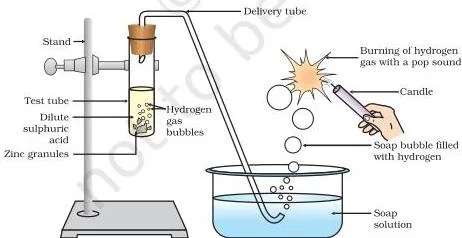
For example, zinc reacts with dilute sulphuric acid (NCERT, p. 3):
\[ \text{Zn(s)} + \text{H}_2\text{SO}_4\text{(aq)} \rightarrow \text{ZnSO}_4\text{(aq)} + \text{H}_2\text{(g)} \]
The hydrogen gas produced is tested by holding a burning splinter near a soap bubble filled with the gas — a pop sound confirms hydrogen. When a base reacts with certain metals such as zinc, hydrogen gas is again evolved, but the salt formed carries a metal-oxo anion (NCERT, p. 4):
\[ 2\text{NaOH(aq)} + \text{Zn(s)} \rightarrow \text{Na}_2\text{ZnO}_2\text{(s)} + \text{H}_2\text{(g)} \]
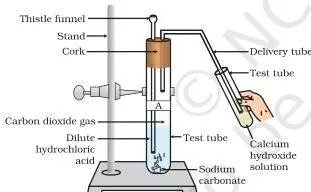
Metal carbonates and metal hydrogencarbonates react with acids to give a salt, carbon dioxide and water (NCERT, p. 4):
\[ \text{Na}_2\text{CO}_3\text{(s)} + 2\text{HCl(aq)} \rightarrow 2\text{NaCl(aq)} + \text{H}_2\text{O(l)} + \text{CO}_2\text{(g)} \]
Carbon dioxide is confirmed by passing it through lime water, which turns milky (NCERT, p. 4–5):
\[ \text{Ca(OH)}_2\text{(aq)} + \text{CO}_2\text{(g)} \rightarrow \text{CaCO}_3\text{(s)} + \text{H}_2\text{O(l)} \]
Here is the exception most students forget: if you keep passing CO2 gas after the milkiness appears, the solution turns clear again, because the insoluble calcium carbonate converts to soluble calcium hydrogencarbonate (NCERT, p. 5):
\[ \text{CaCO}_3\text{(s)} + \text{H}_2\text{O(l)} + \text{CO}_2\text{(g)} \rightarrow \text{Ca(HCO}_3)_2\text{(aq)} \]
An acid reacting with a base gives a salt and water — this is neutralisation (NCERT, p. 5):
\[ \text{Base} + \text{Acid} \rightarrow \text{Salt} + \text{Water} \]
Metal oxides behave like bases and react with acids the same way, which is why they are called basic oxides (NCERT, p. 5):
\[ \text{Metal oxide} + \text{Acid} \rightarrow \text{Salt} + \text{Water} \]
Non-metallic oxides, such as CO2, react with bases the way acids do — the lime-water reaction above is itself an example — so non-metallic oxides are described as acidic oxides (NCERT, p. 6).
Ionisation of Acids and Bases: Why Water Is Necessary
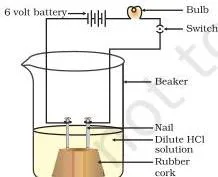
All acids produce hydrogen gas with metals, which suggests hydrogen is common to acids. But glucose and alcohol also contain hydrogen and show no acidic behaviour — so hydrogen alone is not enough. The conduction test settles this: dilute HCl and H2SO4 conduct electricity and light a bulb in the circuit, but glucose and alcohol solutions do not (NCERT, p. 6).
The current is carried by ions — acids form H+(aq) cations along with an anion such as Cl– or SO42-.
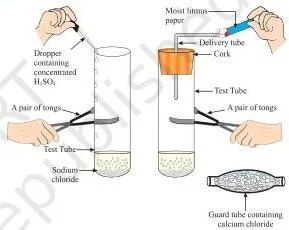
Here is the important edge case: dry HCl gas passed over dry litmus paper causes no colour change at all (NCERT, p. 7). Only when HCl dissolves in water does it ionise and behave as an acid:
\[ \text{HCl} + \text{H}_2\text{O} \rightarrow \text{H}_3\text{O}^+ + \text{Cl}^- \]
A bare H+ ion cannot exist alone in solution — it always combines with a water molecule to form the hydronium ion:
\[ \text{H}^+ + \text{H}_2\text{O} \rightarrow \text{H}_3\text{O}^+ \]
Bases, on dissolving in water, release hydroxide ions (NCERT, p. 7–8), for example \( \text{NaOH(s)} \xrightarrow{\text{H}_2\text{O}} \text{Na}^+\text{(aq)} + \text{OH}^-\text{(aq)} \). A base that is soluble in water is called an alkali — not all bases dissolve in water, so not every base is an alkali.
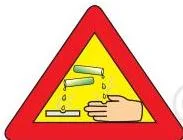
Mixing a concentrated acid or base with water releases a large amount of heat — this is why the rule is to add acid to water slowly with stirring, never water to acid (NCERT, p. 8).
If water is poured into concentrated acid, the sudden local heating can make the mixture splash out and cause burns, and the container can crack from the heat. This is exactly why concentrated acid and base bottles carry a hazard warning label.
The pH Scale: Measuring How Strong an Acid or Base Is
Once you know acids give H+(aq) and bases give OH–(aq), the next question is how much of each. The pH scale answers this — “p” stands for the German word potenz, meaning power, and the scale usually runs from 0 (strongly acidic) to 14 (strongly alkaline), with 7 as neutral (NCERT, p. 9).
A higher concentration of hydronium ions gives a lower pH value — pH and H+ concentration move in opposite directions, which is the single fact behind most pH-ranking questions.
Acids that ionise more fully give more H+ ions at the same concentration and are called strong acids (e.g. HCl); those that ionise only partly are weak acids (e.g. acetic acid). The same logic applies to strong and weak bases.
pH is not just a lab number — it decides whether living systems function normally. The human body works within a pH range of 7.0 to 7.8 (NCERT, p. 10). Rainwater with pH below 5.6 is called acid rain and harms aquatic life when it drains into rivers (NCERT, p. 10).
Tooth decay begins once the pH inside the mouth drops below 5.5, because tooth enamel (calcium hydroxyapatite) starts corroding at that point (NCERT, p. 11). The stomach’s own hydrochloric acid helps digestion; when it is excessive, a mild base called an antacid — commonly milk of magnesia, i.e. magnesium hydroxide — is used to neutralise it (NCERT, p. 11).
A bee sting is acidic, so a mild base such as baking soda gives relief, while nettle-leaf stings inject methanoic acid (NCERT, p. 11).
| Natural source | Acid present |
|---|---|
| Vinegar | Acetic acid |
| Sour milk (curd) | Lactic acid |
| Orange and lemon | Citric acid |
| Tamarind | Tartaric acid |
| Tomato | Oxalic acid |
| Ant sting and nettle sting | Methanoic acid |

Salts, Their Families and the pH of Salt Solutions
A salt is the compound formed when the H+ of an acid is replaced, typically in a neutralisation reaction with a base.
Salts that share the same positive ion (e.g. NaCl and Na2SO4, both sodium salts) or the same negative ion (e.g. NaCl and KCl, both chlorides) are said to belong to the same salt family (NCERT, p. 12–13).
The pH of a salt’s solution depends on the strength of the acid and base that combined to form it (NCERT, p. 13):
- Strong acid + strong base → neutral salt, pH = 7 (e.g. NaCl).
- Strong acid + weak base → acidic salt, pH \( \lt 7 \) (e.g. \( \text{AlCl}_3 \), \( \text{ZnSO}_4 \)).
- Strong base + weak acid → basic salt, pH \( \gt 7 \) (e.g. sodium acetate, \( \text{Na}_2\text{CO}_3 \)).
This rule works because the “weaker” partner in the original acid-base pair leaves behind its character in the salt — a weak base cannot fully cancel a strong acid’s acidity, so a trace of acidity remains, and vice versa.
Chemicals Made from Common Salt: NaOH, Bleaching Powder, Baking Soda, Washing Soda
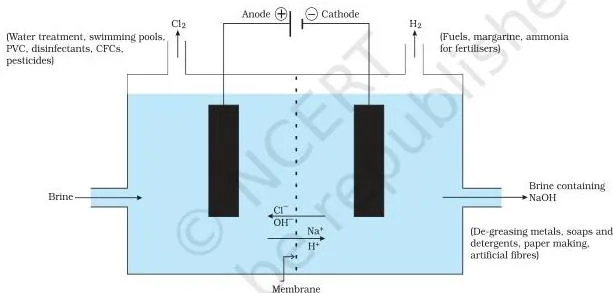
Sodium chloride is the raw material for several everyday chemicals. Passing electricity through its aqueous solution (brine) is called the chlor-alkali process, named after its two main products — chlorine and alkali (NaOH) (NCERT, p. 14):
\[ 2\text{NaCl(aq)} + 2\text{H}_2\text{O(l)} \rightarrow 2\text{NaOH(aq)} + \text{Cl}_2\text{(g)} + \text{H}_2\text{(g)} \]
Chlorine gas is released at the anode and hydrogen at the cathode, with NaOH solution forming near the cathode. Each of the three products has its own uses. Chlorine reacting with dry slaked lime gives bleaching powder (NCERT, p. 14):
\[ 2\text{Ca(OH)}_2 + 2\text{Cl}_2 \rightarrow \text{Ca(ClO)}_2 + \text{CaCl}_2 + 2\text{H}_2\text{O} \]
Bleaching powder is used to bleach cotton, linen and wood pulp, as an oxidising agent in industry, and to disinfect drinking water (NCERT, p. 15).
Baking soda, \( \text{NaHCO}_3 \), is made using sodium chloride, ammonia and carbon dioxide (NCERT, p. 15). On heating it decomposes:
\[ 2\text{NaHCO}_3 \xrightarrow{\text{Heat}} \text{Na}_2\text{CO}_3 + \text{H}_2\text{O} + \text{CO}_2 \]
This gas release is why baking soda mixed with tartaric acid (as baking powder) makes bread and cake rise. It is also used as a mild antacid and in soda-acid fire extinguishers (NCERT, p. 15).
Washing soda, \( \text{Na}_2\text{CO}_3\cdot10\text{H}_2\text{O} \), is obtained by recrystallising sodium carbonate (itself made by heating baking soda) with water (NCERT, p. 15–16). It is used in the glass, soap and paper industries, in manufacturing borax, as a household cleaning agent, and for removing permanent hardness of water (NCERT, p. 16).
| Chemical | Formula | Made from | Main use |
|---|---|---|---|
| Sodium hydroxide | \( \text{NaOH} \) | Electrolysis of NaCl (chlor-alkali process) | Making soap, paper; a strong laboratory base |
| Bleaching powder | \( \text{Ca(ClO)}_2 \) | Chlorine gas + dry slaked lime | Bleaching textiles and disinfecting drinking water |
| Baking soda | \( \text{NaHCO}_3 \) | NaCl + H\(_2\)O + CO\(_2\) + NH\(_3\) | Antacid, baking powder ingredient, fire extinguisher |
| Washing soda | \( \text{Na}_2\text{CO}_3\cdot10\text{H}_2\text{O} \) | Recrystallised sodium carbonate | Glass/soap industry and softening hard water |
Water of Crystallisation: Gypsum, Plaster of Paris and Copper Sulphate
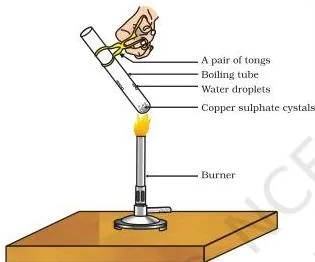
Water of crystallisation is the fixed number of water molecules chemically held in one formula unit of a salt (NCERT, p. 16). Copper sulphate crystals look dry but contain five water molecules per formula unit, \( \text{CuSO}_4\cdot5\text{H}_2\text{O} \). Heating drives this water off and turns the salt white; adding water back restores the blue colour (NCERT, p. 16).
Gypsum, \( \text{CaSO}_4\cdot2\text{H}_2\text{O} \), loses part of its water of crystallisation when heated to 373 K, forming calcium sulphate hemihydrate — Plaster of Paris, \( \text{CaSO}_4\cdot\frac{1}{2}\text{H}_2\text{O} \) (NCERT, p. 16–17). Mixing Plaster of Paris with water reverses this, forming a hard mass of gypsum again:
\[ \text{CaSO}_4\cdot\tfrac{1}{2}\text{H}_2\text{O} + 1\tfrac{1}{2}\text{H}_2\text{O} \rightarrow \text{CaSO}_4\cdot2\text{H}_2\text{O} \]
The fraction \( \frac{1}{2} \) appears because two formula units of \( \text{CaSO}_4 \) share one water molecule between them (NCERT, p. 17) — it is not that a molecule literally splits in half.
Because this reverse reaction happens on contact with moisture in the air, Plaster of Paris must be stored in an airtight, moisture-proof container; otherwise it slowly sets into gypsum before you ever use it. This exact reasoning is what CBSE expects for the frequently asked storage question (Exercise Q13, NCERT p. 19).
Reaction and Equation Reference Table (Formulas at a Glance)
| Reaction type | Equation | What it shows |
|---|---|---|
| Acid + metal | \( \text{Zn(s)} + \text{H}_2\text{SO}_4\text{(aq)} \rightarrow \text{ZnSO}_4\text{(aq)} + \text{H}_2\text{(g)} \) | Acids displace hydrogen from metals |
| Base + metal | \( 2\text{NaOH(aq)} + \text{Zn(s)} \rightarrow \text{Na}_2\text{ZnO}_2\text{(s)} + \text{H}_2\text{(g)} \) | Some bases also release hydrogen with metals |
| Carbonate + acid | \( \text{Na}_2\text{CO}_3\text{(s)} + 2\text{HCl(aq)} \rightarrow 2\text{NaCl(aq)} + \text{H}_2\text{O(l)} + \text{CO}_2\text{(g)} \) | Carbonates give salt, CO\(_2\) and water |
| Neutralisation | \( \text{NaOH(aq)} + \text{HCl(aq)} \rightarrow \text{NaCl(aq)} + \text{H}_2\text{O(l)} \) | Acid and base cancel each other |
| Metal oxide + acid | \( \text{Metal oxide} + \text{Acid} \rightarrow \text{Salt} + \text{Water} \) | Metal oxides behave as basic oxides |
| Ionisation of HCl | \( \text{HCl} + \text{H}_2\text{O} \rightarrow \text{H}_3\text{O}^+ + \text{Cl}^- \) | Acidic behaviour needs water |
| Chlor-alkali process | \( 2\text{NaCl(aq)} + 2\text{H}_2\text{O(l)} \rightarrow 2\text{NaOH(aq)} + \text{Cl}_2\text{(g)} + \text{H}_2\text{(g)} \) | Source of NaOH, Cl\(_2\) and H\(_2\) |
| Bleaching powder formation | \( 2\text{Ca(OH)}_2 + 2\text{Cl}_2 \rightarrow \text{Ca(ClO)}_2 + \text{CaCl}_2 + 2\text{H}_2\text{O} \) | Chlorine + slaked lime gives bleaching powder |
| Baking soda decomposition | \( 2\text{NaHCO}_3 \xrightarrow{\text{Heat}} \text{Na}_2\text{CO}_3 + \text{H}_2\text{O} + \text{CO}_2 \) | Releases CO\(_2\), used in baking and fire extinguishers |
| Plaster of Paris + water | \( \text{CaSO}_4\cdot\tfrac{1}{2}\text{H}_2\text{O} + 1\tfrac{1}{2}\text{H}_2\text{O} \rightarrow \text{CaSO}_4\cdot2\text{H}_2\text{O} \) | POP sets back into gypsum on contact with water |
Worked Problems: Titration, pH Ranking and Metal-Acid Reactions
Problem 1: Scaling a neutralisation volume
- Step 1: 15 mL of a NaOH solution is completely neutralised by 12 mL of a given HCl solution. Since both solutions keep the same concentration throughout, the ratio of NaOH to HCl needed for neutralisation stays fixed at \( 15:12 \).
- Step 2: For 25 mL of the same NaOH solution, let the required volume of HCl be \( x \) mL. Set up the proportion using the same ratio.
\[ \frac{15}{12} = \frac{25}{x} \]
Step 3: Cross-multiply and solve for \( x \).
\[ x = \frac{12 \times 25}{15} = 20 \]
Final answer: 20 mL of the HCl solution is needed to neutralise 25 mL of the NaOH solution.
Problem 2: Ranking solutions by pH and H\(^+\) concentration
- Step 1: Five solutions have pH values 2, 6, 7, 9 and 13. Classify each using the rule: pH 7 is neutral, values further below 7 are more strongly acidic, and values further above 7 are more strongly alkaline.
- Step 2: pH 2 → strongly acidic; pH 6 → weakly acidic; pH 7 → neutral; pH 9 → weakly alkaline; pH 13 → strongly alkaline.
- Step 3: Since a lower pH means a higher H\(_3\)O\(^+\) concentration, arranging the solutions in increasing order of hydrogen-ion concentration means arranging pH in decreasing order.
Final answer: Increasing order of H\(^+\) concentration: pH 13 \( \lt \) pH 9 \( \lt \) pH 7 \( \lt \) pH 6 \( \lt \) pH 2.
Problem 3: Magnesium ribbon in HCl versus acetic acid
- Step 1: Equal-length magnesium ribbons are dropped into 1 M HCl (test tube A) and 1 M \( \text{CH}_3\text{COOH} \) (test tube B), same concentration and volume in both.
- Step 2: HCl is a strong acid and ionises almost completely, releasing a large number of H\(^+\) ions per mole. Acetic acid is a weak acid and ionises only partially at the same concentration, giving fewer H\(^+\) ions.
- Step 3: Since the rate of the metal-acid reaction depends on how many H\(^+\) ions are available to react with the metal surface, more H\(^+\) ions means faster fizzing (faster hydrogen gas release).
Final answer: Test tube A (HCl) fizzes more vigorously, because HCl is a strong acid and produces more H\(^+\) ions than the weak acid CH\(_3\)COOH at the same concentration.
Common Mistakes Students Make in This Chapter
| Mistake | Correct rule | How to check your answer |
|---|---|---|
| Writing “water added to acid” while describing dilution | Acid must always be added slowly to water, never water to acid, to avoid dangerous splashing from the heat released (NCERT, p. 8) | Reread your sentence — it should say “acid added to water”, with water as the larger, starting quantity |
| Treating dry HCl gas as acidic | Only H\(^+\)(aq)/H\(_3\)O\(^+\) formed in water shows acidic behaviour; dry gas alone does not ionise (NCERT, p. 7) | Ask whether the substance is dissolved in water; if not, it cannot turn litmus red |
| Stopping the answer at “lime water turns milky” | Passing excess CO\(_2\) forms soluble Ca(HCO\(_3\))\(_2\), and the milky solution turns clear again (NCERT, p. 5) | Check if the question says “excess” gas — if so, add the second equation and the clearing effect |
| Confusing baking soda with washing soda | Baking soda is NaHCO\(_3\); washing soda is Na\(_2\)CO\(_3\)\(\cdot\)10H\(_2\)O — different formulas and different main uses (NCERT, p. 15–16) | Check the formula for 10H\(_2\)O — its presence means washing soda, not baking soda |
| Naming the wrong gas at each electrode in the chlor-alkali process | Chlorine forms at the anode, hydrogen at the cathode, and NaOH solution collects near the cathode (NCERT, p. 14) | Match each product to its electrode before writing the final equation |
| Leaving out state symbols in equations | Every formula needs (s), (l), (g) or (aq); CBSE marking schemes deduct marks for missing state symbols (NCERT, p. 4–6) | Reread the equation — every substance should have a bracketed state written after it |
Exam Notes: How CBSE Frames Questions from This Chapter
The chapter’s own end-of-chapter exercises (NCERT, p. 18–19) reveal a clear pattern that repeats in board papers:
| Question type | Example questions | What a full-marks answer needs |
|---|---|---|
| MCQs on pH ranges | Exercise Q1, Q9 | The correct option plus one line linking the pH value to H\(^+\) or OH\(^-\) concentration |
| Reasoning (‘why’) questions | Exercise Q4 (acid to water), Q8 (dry HCl) | A cause-effect sentence — e.g. “acidic behaviour needs water because ionisation only occurs in aqueous solution”, not just a restated fact |
| Equation-writing questions | Exercise Q5 (metal + acid reactions) | A fully balanced equation with correct state symbols for every species |
| Applied/case-based questions | Exercise Q11–Q12 (milk pH and curdling), Q13 (Plaster of Paris storage) | Connecting the chemistry (lactic acid formation, water of crystallisation) directly to the everyday scenario asked |
One habit worth noting specifically: CBSE marking schemes routinely deduct marks for equations that are correctly balanced but missing state symbols — (s), (l), (g), (aq). Always add them, even under time pressure. If you want to cross-check any definition against the original textbook wording, the official NCERT Class 10 Science Chapter 2 PDF is the source text this chapter is based on.
Quick Recap Before the Exam
- Acids turn blue litmus red; bases turn red litmus blue; phenolphthalein is pink in base and colourless in acid.
- Acid + metal → salt + hydrogen gas; test hydrogen with a burning splinter (pop sound).
- Metal carbonate/hydrogencarbonate + acid → salt + CO\(_2\) + water; CO\(_2\) turns lime water milky, and excess CO\(_2\) clears it again.
- Every neutralisation follows: Acid + Base → Salt + Water.
- Acidic behaviour comes from H\(^+\)(aq)/H\(_3\)O\(^+\); basic behaviour comes from OH\(^-\)(aq) — both need water.
- Dry HCl gas is not acidic; only its aqueous solution is. Always add acid to water, never the reverse.
- Remember the pH order: lower pH = more acidic = more H\(^+\); pH 7 is neutral; higher pH = more alkaline.
- Strong acid + strong base → neutral salt; strong acid + weak base → acidic salt; strong base + weak acid → basic salt.
- Chlor-alkali process gives NaOH, Cl\(_2\) and H\(_2\) from brine; bleaching powder, baking soda and washing soda are all made from common salt.
- Water of crystallisation is fixed per formula unit — CuSO\(_4\)\(\cdot\)5H\(_2\)O, gypsum CaSO\(_4\)\(\cdot\)2H\(_2\)O, Plaster of Paris CaSO\(_4\)\(\cdot\)½H\(_2\)O.
- Store Plaster of Paris in a moisture-proof container — it sets into gypsum on contact with air moisture.
For revising other Class 10 Science chapters alongside this one, browse the full Class 10 Science notes index, or go to the Class 10 CBSE subject list for other subjects.
Frequently Asked Questions on Acids, Bases and Salts
Why does dry HCl gas not turn dry litmus paper red?
Dry HCl gas does not ionise into H\(^+\) and Cl\(^-\) ions on its own. Acidic behaviour only appears once HCl dissolves in water and forms hydronium ions, \( \text{H}_3\text{O}^+ \); dry litmus paper has no water present to allow this ionisation, so no colour change occurs.
Why must acid always be added to water and not water to acid?
Dissolving a concentrated acid in water releases a large amount of heat. Adding acid slowly to a larger volume of water lets that heat spread out safely. Adding water to concentrated acid instead can cause sudden local boiling, splashing hot acid out of the container and causing burns.
What is the difference between baking soda and washing soda?
Baking soda is sodium hydrogencarbonate, \( \text{NaHCO}_3 \), used as a mild antacid and in baking powder and fire extinguishers. Washing soda is sodium carbonate decahydrate, \( \text{Na}_2\text{CO}_3\cdot10\text{H}_2\text{O} \), used in the glass, soap and paper industries and for removing permanent hardness of water.
They are different compounds with different formulas, though washing soda can be made by recrystallising sodium carbonate obtained by heating baking soda.
Why does passing excess carbon dioxide into lime water turn it clear again after making it milky?
The initial milkiness is insoluble calcium carbonate, \( \text{CaCO}_3 \), formed when CO\(_2\) reacts with lime water. If more CO\(_2\) keeps passing through, it reacts further with the calcium carbonate and water to form calcium hydrogencarbonate, \( \text{Ca(HCO}_3)_2 \), which is soluble — so the solution clears up again.
What is water of crystallisation and how many water molecules does copper sulphate hold?
Water of crystallisation is the fixed number of water molecules chemically bound inside one formula unit of a salt. Copper sulphate holds five such water molecules, written as \( \text{CuSO}_4\cdot5\text{H}_2\text{O} \); heating removes this water and turns the blue crystals white.
Why should Plaster of Paris be stored in a moisture-proof container?
Plaster of Paris, \( \text{CaSO}_4\cdot\frac{1}{2}\text{H}_2\text{O} \), absorbs water readily and sets into gypsum, \( \text{CaSO}_4\cdot2\text{H}_2\text{O} \), the moment it contacts moisture — even moisture from humid air. Storing it in an airtight, moisture-proof container prevents it from setting inside the container before it is actually used.
Reference: NCERT Class 10 Science textbook, chapter Acids, Bases and Salts.
Explore Class 10 Science Notes
More for this chapter:
- Acids, Bases and Salts Formulas
- Acids, Bases and Salts Important Questions
- Acids, Bases and Salts MCQ Questions
Class 10 Science on LearnCBSE:
Related chapters: