This acids bases and salts class 10 mcq set covers indicators, the reactions of acids and bases with metals and carbonates, the pH scale, and the industrial chemicals made from common salt, for the 2026-27 academic session.
Every question below is followed by a full explanation that tells you why the correct option works and why each of the other three options is wrong. These are practice questions written to test NCERT concepts from the chapter Acids, Bases and Salts — they are not official CBSE or board question papers.
You will find three question formats here: straight multiple-choice questions, assertion-reason items in the standard four-option format, and one data-based case set built on an original table of pH readings. Reference: NCERT Class 10 Science textbook, chapter Acids, Bases and Salts.
Acids Bases and Salts Class 10 MCQ: What This Set Covers
Before you start, it helps to see the topics laid out. This acids bases and salts class 10 mcq practice set is built directly from the chapter’s activities, not from generic chemistry trivia.
- Colour changes given by natural and synthetic indicators (litmus, turmeric, phenolphthalein)
- Reactions of acids and bases with metals, metal carbonates and metal oxides
- Why acids and bases need water to show their ionic behaviour
- Reading and interpreting the pH scale correctly
- Salts, the chlor-alkali process, bleaching powder, baking soda and washing soda
- Water of crystallisation, including Plaster of Paris
Two things make this set different from a plain quiz. First, every wrong option is explained, not just marked incorrect. Second, the distractors come from real mix-ups students make with this chapter — such as thinking only acids release hydrogen gas with metals, or that a higher pH always means a weaker acid.
MCQs on Indicators and Reactions of Acids and Bases with Metals
Acids turn blue litmus red, and bases turn red litmus blue (NCERT, p. 18). This idea is the base for the first set of questions, along with metal-acid and metal-carbonate reactions from Activities 2.3 to 2.5.
Q1. A student dips a strip of red litmus paper into a solution of sodium hydroxide. What will be observed, and why?
(a) No colour change, because red litmus only reacts with acids
(b) The red litmus paper turns blue, because sodium hydroxide is a base
(c) The red litmus paper turns colourless, because bases bleach litmus
(d) The paper turns green, indicating a neutral solution Correct answer: (b) Bases change the colour of red litmus to blue, which is exactly what happens with sodium hydroxide (NCERT, p. 18).
Option (a) is wrong because red litmus does react with bases — that is its whole purpose as an indicator. Option (c) invents a bleaching action that litmus paper does not have.
Option (d) invents a colour (green) that is never produced by litmus; litmus only shows red or blue depending on the medium.
Q2. In Activity 2.2, vanilla essence and clove oil are separately added to dilute HCl and dilute NaOH, and then their smell is checked. Which property is being used to identify these as indicators?
(a) A change in colour when mixed with acid or base
(b) A change in odour (smell) when mixed with acid or base
(c) A change in the boiling point of the mixture
(d) The formation of a gas that pops with a burning splint Correct answer: (b) Substances whose odour changes in acidic or basic media are called olfactory indicators, and vanilla essence and clove oil are tested for exactly this property.
Option (a) describes a colour indicator like litmus, not an olfactory one. Option (c) is never mentioned in the activity — boiling point has nothing to do with identifying an indicator.
Option (d) describes the pop-sound test for hydrogen gas from a metal-acid reaction, a completely different activity.
Q3. In the setup shown below, zinc granules are added to dilute sulphuric acid and the gas evolved is passed through soap solution, forming gas-filled bubbles. When a burning candle is brought near a bubble, what happens and why?
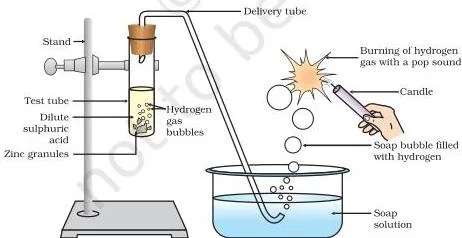
(a) The bubble bursts with a pop sound because the gas is hydrogen, which burns explosively
(b) Nothing happens because the gas is carbon dioxide
(c) The candle flame goes out because the gas is oxygen
(d) A white precipitate forms in the soap solution Correct answer: (a) Zinc reacts with dilute sulphuric acid to displace hydrogen gas, and this gas gives a characteristic pop sound when a burning splint is brought near it (NCERT, p. 19).
Option (b) is wrong because carbon dioxide comes from carbonates reacting with acids, not from a metal-acid reaction.
Option (c) is wrong because no oxygen is produced here, and oxygen would make a flame brighter, not extinguish it. Option (d) confuses this test with the lime-water test used for carbon dioxide, which is a separate reaction entirely.
Q4. Granulated zinc is added to sodium hydroxide solution and warmed. Which statement about this reaction is correct?
(a) No reaction occurs because bases never react with metals
(b) Hydrogen gas is released along with sodium zincate, showing that some metals react with bases too
(c) Only oxygen gas is released, since NaOH is a strong base
(d) A precipitate of zinc hydroxide forms and no gas is released Correct answer: (b) Zinc reacts with sodium hydroxide to give sodium zincate and hydrogen gas: \( 2NaOH(aq) + Zn(s) \rightarrow Na_2ZnO_2(s) + H_2(g) \).
This is exactly why option (a) is wrong — assuming only acids liberate hydrogen with metals is a common trap. Option (c) is wrong because no oxygen forms in this reaction.
Option (d) invents a precipitate that this reaction does not produce; the actual products are a soluble zincate salt and hydrogen gas.
Q5. Dilute HCl is added separately to sodium carbonate and sodium hydrogencarbonate, and the gas produced in each case is passed through lime water. What is observed, and what happens if excess gas is passed through?
(a) The lime water turns milky at first, then turns colourless again on passing excess gas, because soluble calcium hydrogencarbonate forms
(b) The lime water stays clear throughout because carbon dioxide has no reaction with lime water
(c) The lime water turns blue permanently
(d) A yellow precipitate forms that does not dissolve further Correct answer: (a) Carbon dioxide reacts with lime water to first form a white precipitate of calcium carbonate, turning it milky; passing excess \(CO_2\) converts this into soluble calcium hydrogencarbonate, clearing the milkiness (NCERT, p. 20).
Option (b) ignores the well-known lime-water test for \(CO_2\). Option (c) invents a colour change that never occurs with lime water.
Option (d) invents a yellow precipitate, but the actual precipitate formed (calcium carbonate) is white, not yellow.
MCQs on Neutralisation, Ions in Solution and the pH Scale
This section tests why acids and bases need water to behave as acids and bases, and how to read the pH scale without falling into common traps.
Q6. Dry HCl gas is passed over dry blue litmus paper, and separately over moist blue litmus paper, as shown below. What is observed, and why?
(a) Dry litmus turns red immediately because HCl is always acidic
(b) Dry litmus paper shows no change, but moist litmus turns red, because \(H^+\) ions form only in the presence of water
(c) Both papers turn red equally fast
(d) Both papers stay unchanged, because HCl gas has no acidic properties at all Correct answer: (b) Hydrogen ions separate from HCl molecules only in the presence of water, forming \( H_3O^+ \); dry HCl gas has no free \(H^+\) ions to turn dry litmus red (NCERT, p. 23).
Option (a) wrongly assumes acidic behaviour needs no water. Option (c) is wrong because only the moist paper reacts.
Option (d) is wrong too — HCl is very much acidic once dissolved in water; it simply cannot show this behaviour in its dry gaseous form.
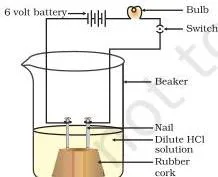
Q7. In Activity 2.8, a bulb connected to a battery glows when dilute HCl or dilute \(H_2SO_4\) is used, but stays off with glucose or alcohol solutions, even though these also contain hydrogen atoms. What explains this difference?
(a) Glucose and alcohol are solids, so they cannot conduct at all
(b) Acids contain more hydrogen atoms per molecule than glucose or alcohol
(c) Acids ionise in water to release \(H^+\) ions that carry current, while glucose and alcohol do not ionise
(d) The battery voltage is too low to affect glucose or alcohol Correct answer: (c) Electric current flows through the acidic solution because it produces ions; glucose and alcohol solutions do not conduct because they contain hydrogen but do not ionise into charged particles (NCERT, p. 22).
Option (a) is factually wrong — glucose and alcohol are tested here as solutions, not solids.
Option (b) is a false comparison; the number of hydrogen atoms is not what matters, ionisation is. Option (d) is irrelevant since the same battery and setup are used for both acids and the non-ionising solutions.
Q8. While preparing a dilute acid solution in the lab, a student is told to always add acid to water, never water to acid. What is the correct reason for this rule?
(a) Mixing acid with water is a highly exothermic process, and adding water to concentrated acid can make the heat generated splash the mixture out and cause burns
(b) Water evaporates faster when added to acid, wasting the acid
(c) Acids react chemically with water only when added slowly
(d) The order has no real safety reason, it is only a lab convention Correct answer: (a) Dissolving concentrated acid in water releases a large amount of heat; adding water to concentrated acid instead can cause sudden local heating that makes the mixture splash out and even crack the glass container (NCERT, p. 24).
Option (b) invents an evaporation-based reason with no basis in the chapter.
Option (c) wrongly suggests a chemical reaction occurs with water only under specific ordering — the heat release, not a special reaction, is the real hazard. Option (d) dismisses a genuine safety rule as mere convention, which understates the real risk of burns and container breakage.
Q9. The general neutralisation reaction is written as Acid + Base → Salt + Water. In ionic terms, what actually combines to form water in this reaction?
(a) \( Na^+ \) and \( Cl^- \) ions combine
(b) \( H^+(aq) \) and \( OH^-(aq) \) ions combine to form \( H_2O(l) \)
(c) Two \(H^+\) ions combine directly
(d) The metal ion reacts with the acid radical Correct answer: (b) Since acids produce \(H^+(aq)\) ions and bases produce \(OH^-(aq)\) ions, neutralisation is really the combination \( H^+(aq) + OH^-(aq) \rightarrow H_2O(l) \) (NCERT, p. 21).
Option (a) describes ions that form the salt (like NaCl), not the water. Option (c) is chemically impossible — two \(H^+\) ions do not combine to form water on their own.
Option (d) describes how the salt forms, again mixing up salt formation with water formation.
Q10. A student reads pH values and says, “Solution A has pH 9, and Solution B has pH 4, so A is a weaker acid than B.” What is wrong with this statement?
(a) Solution A is not an acid at all — a pH above 7 means it is basic, so calling it a “weaker acid” makes no sense
(b) Solution A is indeed a weaker acid, since higher pH always means a weaker acid
(c) Both solutions must be strong acids because pH only measures temperature
(d) Solution A has more \(H^+\) ions than Solution B because its pH number is higher Correct answer: (a) A pH value above 7 represents a basic solution, not a weak acid, so comparing “strength as an acid” for Solution A is meaningless (NCERT, p. 25).
Option (b) repeats exactly the misconception the question is testing — pH above 7 does not describe acid strength at all. Option (c) is baseless; pH has nothing to do with temperature.
Option (d) reverses the actual relationship: a higher pH value means a lower \(H^+\) ion concentration, not a higher one.
MCQs on Salts, Common Salt Chemicals and Water of Crystallisation
Common salt is the raw material for several everyday chemicals. The table below is a quick reference for the reaction types covered across this chapter, and the questions that follow test the industrial chemicals made from salt.
| Reaction Type | General Word Equation | Everyday Use Linked to It |
|---|---|---|
| Metal + Acid | Acid + Metal → Salt + Hydrogen gas | Hydrogen released is tested with a burning splint, a standard lab test for acids |
| Metal + Base (exception) | Zn + NaOH → Sodium zincate + Hydrogen gas | Shows some metals, like zinc, react with both acids and bases |
| Metal carbonate/hydrogencarbonate + Acid | Salt + Carbon dioxide + Water | \(CO_2\) evolved turns lime water milky, the standard test for carbonates |
| Metal oxide + Acid | Salt + Water | Confirms that metal oxides behave as basic oxides |
| Non-metal oxide + Base | Salt + Water | Basis of the lime-water test for carbon dioxide gas |
| Acid + Base (neutralisation) | Salt + Water | Common salt (NaCl), the table salt used directly in food |
Q11. Electricity is passed through concentrated aqueous sodium chloride (brine) in the chlor-alkali process, shown below. Where do the products actually form?
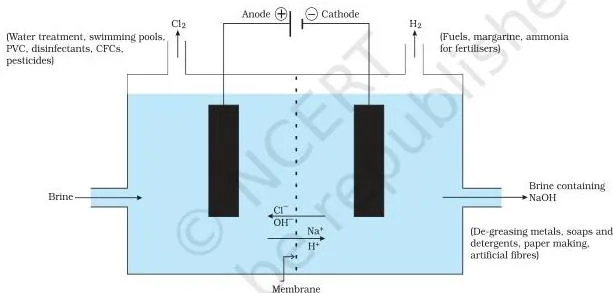
(a) Chlorine gas at the cathode, hydrogen at the anode, with NaOH forming near the anode
(b) Chlorine gas at the anode, hydrogen at the cathode, with sodium hydroxide solution forming near the cathode
(c) Both chlorine and hydrogen are released only at the cathode
(d) Sodium hydroxide escapes as a gas from the anode Correct answer: (b) In the chlor-alkali process, chlorine gas is given off at the anode, hydrogen gas at the cathode, and sodium hydroxide solution forms near the cathode (NCERT, p. 30).
Option (a) swaps the electrodes, a very common error. Option (c) wrongly places both gases at the same electrode, which is not how electrolysis of brine works.
Option (d) is wrong because sodium hydroxide remains dissolved in the solution; it is not released as a gas at all.
Q12. Bleaching powder is manufactured by passing chlorine gas over dry slaked lime. What is its chemical formula as given in the chapter?
(a) \( CaCl_2 \)
(b) \( Ca(ClO)_2 \)
(c) \( CaOCl \)
(d) \( CaCO_3 \) Correct answer: (b) Bleaching powder is represented as \( Ca(ClO)_2 \), even though its actual composition is more complex (NCERT, p. 30). Option (a), calcium chloride, is actually a by-product of the same reaction, not bleaching powder itself, which trips up many students.
Option (c) is not a formula used anywhere in the chapter.
Option (d), calcium carbonate, is limestone/chalk/marble, an entirely different compound used earlier in the carbonate reactions.
Q13. Which statement correctly distinguishes baking soda from washing soda?
(a) Baking soda is \( Na_2CO_3 \cdot 10H_2O \) and washing soda is \( NaHCO_3 \)
(b) Baking soda (\(NaHCO_3\)) is a mild, non-corrosive base used in cooking and antacids; washing soda (\(Na_2CO_3 \cdot 10H_2O\)) is used for cleaning and removing the hardness of water
(c) Both are exactly the same compound sold under different brand names
(d) Washing soda is made by mixing baking soda with tartaric acid Correct answer: (b) Sodium hydrogencarbonate (baking soda) is a mild base used in cooking, antacids and fire extinguishers, while sodium carbonate decahydrate (washing soda) is used in industries and for removing permanent hardness of water (NCERT, p. 31).
Option (a) swaps the two formulas, exactly the mix-up this question targets. Option (c) is wrong — they are two different compounds with different formulas and uses.
Option (d) actually describes baking powder, which is baking soda mixed with tartaric acid, not washing soda.
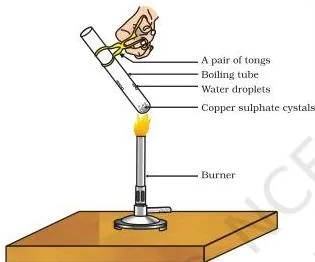
Q14. Plaster of Paris (\(CaSO_4 \cdot \frac{1}{2}H_2O\)), shown being formed from gypsum below, must be stored in a moisture-proof container. Why?
(a) Moisture in the air dissolves it completely and it disappears
(b) Moisture in the air reacts with it and slowly converts it back into gypsum (\(CaSO_4 \cdot 2H_2O\)), forming a hard solid mass inside the container
(c) Moisture makes the powder toxic and unsafe to use
(d) Moisture causes it to evaporate away entirely Correct answer: (b) Plaster of Paris changes back to gypsum on mixing with water, giving a hard solid mass; the half water molecule in its formula is why two formula units of \(CaSO_4\) share one water molecule (NCERT, p. 32-33).
Option (a) invents dissolving behaviour that is not described anywhere in the chapter. Option (c) invents a toxicity claim with no grounding.
Option (d) is wrong because the compound absorbs moisture and hardens, it does not evaporate.
Common Mistakes to Avoid in This Chapter
| Mistake | Correct rule | How to check your answer |
|---|---|---|
| Thinking dry HCl gas and its aqueous solution behave the same way | \(H^+\) ions form only when HCl dissolves in water; dry HCl gas does not turn dry litmus red | Ask: is water present? If not, no ionisation, no acidic test result |
| Believing a higher pH always means a weaker acid or base | pH above 7 means basic, not “weak acid”; strength depends on degree of ionisation, not on the pH number alone | Check first whether pH is above or below 7 before comparing strength |
| Mixing up baking soda and washing soda formulas | Baking soda is \(NaHCO_3\) (mild, used in cooking/antacids); washing soda is \(Na_2CO_3 \cdot 10H_2O\) (used for cleaning, hardness removal) | Recall the use — cooking/antacid points to baking soda, water-softening points to washing soda |
| Assuming only acids release hydrogen gas with metals | Zinc reacts with both dilute acids and with sodium hydroxide to release hydrogen gas | Check which metal and which base — this exception applies to zinc reacting with NaOH |
| Swapping bleaching powder’s formula with calcium chloride | Bleaching powder is \(Ca(ClO)_2\); calcium chloride (\(CaCl_2\)) is a different by-product formed alongside it | Match the formula to “bleaching” use — \(Ca(ClO)_2\) is the oxidising, bleaching compound |
Natural Indicators vs Synthetic Indicators
The chapter separates indicators into natural substances and lab-made (synthetic) ones. This table compares what the grounding text actually confirms about their colour behaviour.
| Indicator | Type | Behaviour in Acid | Behaviour in Base |
|---|---|---|---|
| Litmus (from lichen) | Natural | Blue litmus turns red | Red litmus turns blue |
| Turmeric (curry stain) | Natural | Stays yellow | Turns reddish-brown with a basic substance like soap, and returns to yellow on washing with plenty of water |
| Phenolphthalein | Synthetic | Turns colourless when acid is added | Gives a pink colour in a basic solution like NaOH |
| Methyl orange | Synthetic | Tested in Activity 2.1 alongside the others | Exact shade is recorded by the student during the activity; the chapter does not print a fixed colour key |
Assertion and Reason Questions on Acids, Bases and Salts
Use the standard options for every item: (a) both A and R are true, and R correctly explains A; (b) both A and R are true, but R does not correctly explain A; (c) A is true, R is false; (d) A is false, R is true.
Q15. Assertion (A): When a metal reacts with an acid, hydrogen gas is liberated.
Reason (R): The presence of hydrogen gas is tested by bringing a burning splint near it, which produces a pop sound.
(a) Both A and R are true, and R correctly explains A
(b) Both A and R are true, but R does not correctly explain A
(c) A is true, R is false
(d) A is false, R is true Correct answer: (b) Both statements are individually correct — metals do liberate hydrogen with acids, and the pop-sound test does confirm hydrogen (NCERT, p. 19).
But the reason only describes how to test for hydrogen after it forms; it does not explain why the metal-acid reaction produces hydrogen in the first place. That is why (a) is wrong.
Option (c) wrongly calls the reason false when it is a genuine, correct test. Option (d) wrongly calls the assertion false, when metal-acid reactions releasing hydrogen is exactly what Activity 2.3 demonstrates.
Q16. Assertion (A): Dry HCl gas does not turn dry blue litmus paper red.
Reason (R): Hydrogen ions (\(H^+\)) are formed only in the presence of water.
(a) Both A and R are true, and R correctly explains A
(b) Both A and R are true, but R does not correctly explain A
(c) A is true, R is false
(d) A is false, R is true Correct answer: (a) Activity 2.9 shows exactly this: dry HCl gas does not affect dry litmus, but the moment water is present, \(H^+\) ions separate and the acidic test succeeds (NCERT, p. 23).
Here the reason is the direct cause of the assertion, so (a) fits. Option (b) wrongly denies this direct connection.
Option (c) wrongly calls the reason false, when it is the core explanation given in the text. Option (d) wrongly calls the assertion false, when it is exactly what the activity demonstrates.
Q17. Assertion (A): A strong acid always has a higher concentration than a weak acid.
Reason (R): The strength of an acid depends on its degree of ionisation, not on its concentration.
(a) Both A and R are true, and R correctly explains A
(b) Both A and R are true, but R does not correctly explain A
(c) A is true, R is false
(d) A is false, R is true Correct answer: (d) The assertion is false: strength and concentration are separate ideas — a strong acid can be made dilute and still be classed as strong because it ionises fully (NCERT, p. 26).
The reason correctly states this distinction, so (d) is right. Option (a) and (b) both wrongly treat the assertion as true.
Option (c) wrongly calls the reason false when it is the exact rule stated in the chapter.
Q18. Assertion (A): Baking soda is commonly used in antacid preparations.
Reason (R): Baking soda (sodium hydrogencarbonate) is a mild, non-corrosive base that neutralises excess acid in the stomach.
(a) Both A and R are true, and R correctly explains A
(b) Both A and R are true, but R does not correctly explain A
(c) A is true, R is false
(d) A is false, R is true Correct answer: (a) Sodium hydrogencarbonate is indeed an ingredient in antacids, and being alkaline it neutralises excess stomach acid and relieves pain (NCERT, p. 27, p. 31).
The reason is precisely why baking soda works as an antacid, so (a) is correct. Option (b) wrongly separates the reason from the assertion when they are directly linked.
Options (c) and (d) both misclassify true statements as false.
Case-Based Question: Reading pH Values of Unknown Solutions
A school lab tests four unknown solutions with pH paper, shown below, and records the following original readings (these are not the textbook’s own examples).
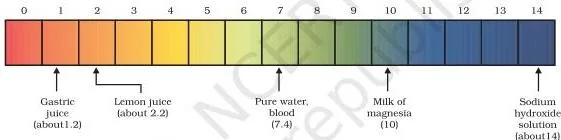
| Solution | pH Value |
|---|---|
| P | 2.5 |
| Q | 6.8 |
| R | 9.2 |
| S | 13.0 |
Q19. Which solution has the highest concentration of hydrogen ions?
(a) P
(b) Q
(c) R
(d) S Correct answer: (a) Higher hydronium ion concentration means a lower pH value (NCERT, p. 25), and P has the lowest pH (2.5) of the four. Option (b) has a near-neutral pH, meaning low \(H^+\) concentration.
Options (c) and (d) are on the basic side, meaning they have more \(OH^-\) ions and fewer \(H^+\) ions, not more.
Q20. Which two solutions, when mixed in the right amounts, are most likely to undergo a clear neutralisation reaction?
(a) P and S
(b) Q and R
(c) P and Q
(d) R and S Correct answer: (a) P (pH 2.5) is clearly acidic and S (pH 13.0) is clearly basic, so mixing them fits the acid + base → salt + water pattern (NCERT, p. 21).
Option (b) pairs two solutions that are both close to neutral, giving little acidic or basic strength to react with.
Option (c) pairs two acidic-side solutions with each other, so there is no base to neutralise the acid. Option (d) pairs two basic solutions, again leaving no acid present for a neutralisation reaction.
Q21. Which solution most resembles a mild antacid-type base, similar to milk of magnesia mentioned in the chapter?
(a) P
(b) Q
(c) R
(d) S Correct answer: (c) R has a mildly basic pH of 9.2, in line with mild, non-corrosive bases like milk of magnesia used to relieve indigestion (NCERT, p. 27). Option (a) is acidic, the opposite of what an antacid needs to be.
Option (b) is nearly neutral and too weak to neutralise excess stomach acid effectively.
Option (d), pH 13.0, is far too strongly basic and corrosive to be used as a mild antacid.
Q22. If Solution Q (pH 6.8) is diluted further with distilled water, what happens to its pH?
(a) It decreases further, becoming more acidic
(b) It rises slightly toward 7, moving closer to neutral, because dilution lowers the concentration of \(H^+\) ions
(c) It jumps immediately and exactly to pH 7
(d) It becomes strongly basic, crossing above pH 9 Correct answer: (b) Mixing an acid with water decreases the concentration of ions per unit volume (NCERT, p. 24), so a weakly acidic solution like Q moves gradually toward neutral on dilution.
Option (a) reverses the actual effect of dilution. Option (c) overstates the effect — dilution shifts pH gradually, not instantly to an exact value.
Option (d) is a serious overstatement; simple dilution with water cannot turn an acidic solution strongly basic.
How CBSE is Testing This Chapter in Recent Question Patterns
Recent CBSE question papers on Class 10 Science tend to mix plain recall MCQs with reasoning-based formats, including assertion-reason pairs and short case or data-based sets. For Acids, Bases and Salts, this often means a question no longer just asks for a definition — it expects a student to apply the pH scale, or a general reaction equation, to a fresh situation.
Sub-topics that suit this competency style include the pH scale (interpreting values rather than just stating the range), the nature of salts formed from strong or weak acids and bases, and neutralisation reactions applied to everyday contexts like antacids or soil treatment.
This does not mean any specific question shown here will appear in an actual paper — treat this only as a pattern observation to guide your revision.
For the reaction and conductivity concepts revised in this chapter, it also helps to revisit related ideas covered in the Chemical Reactions and Equations chapter, since acid-metal and acid-carbonate reactions are themselves types of chemical reactions, and the Electricity chapter, which explains how ions carry current in a circuit, the same idea used to test whether acids and bases conduct electricity in this chapter.
Answer Key for the Acids, Bases and Salts MCQ Set
Use this table only as a quick self-check index — the full reasoning for each question is in the explanations above.
| Question No. | Correct Answer | Concept Tested |
|---|---|---|
| Q1 | (b) | Litmus colour change with a base |
| Q2 | (b) | Definition of an olfactory indicator |
| Q3 | (a) | Hydrogen gas test with zinc and dilute sulphuric acid |
| Q4 | (b) | Zinc reacting with a base to release hydrogen |
| Q5 | (a) | Carbonate + acid, lime-water test with excess \(CO_2\) |
| Q6 | (b) | Dry HCl gas vs aqueous HCl behaviour |
| Q7 | (c) | Why glucose/alcohol do not conduct electricity |
| Q8 | (a) | Safe dilution: acid added to water |
| Q9 | (b) | Ionic form of the neutralisation reaction |
| Q10 | (a) | pH above 7 means basic, not “weak acid” |
| Q11 | (b) | Chlor-alkali process electrode products |
| Q12 | (b) | Chemical formula of bleaching powder |
| Q13 | (b) | Baking soda vs washing soda |
| Q14 | (b) | Why Plaster of Paris needs moisture-proof storage |
| Q15 (A-R) | (b) | Hydrogen test does not explain why it forms |
| Q16 (A-R) | (a) | Water is required for HCl to ionise |
| Q17 (A-R) | (d) | Acid strength vs concentration |
| Q18 (A-R) | (a) | Baking soda as a mild antacid base |
| Q19 (Case) | (a) | Lower pH means higher \(H^+\) concentration |
| Q20 (Case) | (a) | Pairing an acid with a base for neutralisation |
| Q21 (Case) | (c) | Identifying a mild antacid-type base |
| Q22 (Case) | (b) | Effect of dilution on a weakly acidic solution |
FAQs on Acids, Bases and Salts MCQs
What is the difference between a natural indicator and an olfactory indicator in this chapter?
A natural indicator, like litmus or turmeric, shows a colour change in acidic or basic solutions. An olfactory indicator, like vanilla essence or clove oil tested in Activity 2.2, is identified instead by a change in its smell when mixed with an acid or a base.
Why does dry HCl gas not turn dry litmus paper red?
Hydrogen ions separate from HCl molecules only in the presence of water. Without water, there are no free \(H^+\) ions to react with the litmus paper, so dry HCl gas shows no acidic behaviour on dry litmus (NCERT, p. 23).
Why must an acid always be added to water, and not water to the acid, during dilution?
Dissolving a concentrated acid in water is highly exothermic. Adding water to concentrated acid instead can cause the heat generated to make the mixture splash out suddenly, which can cause burns and even crack the container (NCERT, p. 24).
What is the difference between baking soda and washing soda?
Baking soda is sodium hydrogencarbonate (\(NaHCO_3\)), a mild base used in cooking, antacids and fire extinguishers. Washing soda is sodium carbonate decahydrate (\(Na_2CO_3 \cdot 10H_2O\)), used in industries and for removing the permanent hardness of water (NCERT, p. 31).
Why is Plaster of Paris stored in a moisture-proof container?
Plaster of Paris (\(CaSO_4 \cdot \frac{1}{2}H_2O\)) reacts with moisture in the air and slowly converts back to gypsum (\(CaSO_4 \cdot 2H_2O\)), hardening inside the container if it is not sealed against moisture (NCERT, p. 32-33).
How does the pH scale explain tooth decay and the use of antacids?
Tooth decay starts when the pH inside the mouth falls below 5.5, since acids from bacteria corrode the tooth enamel below this point.
In the stomach, excess hydrochloric acid causes indigestion, and mild bases called antacids, such as milk of magnesia, neutralise this excess acid to relieve the pain (NCERT, p. 27).
For more chapter-wise practice material, you can also browse the Class 10 Science chapter resources, the wider Class 10 CBSE study material hub, or the full CBSE notes section for other subjects. To check any reaction or definition directly against the source, the official NCERT Class 10 Science textbook chapter on Acids, Bases and Salts is available on the NCERT website.
Reference: NCERT Class 10 Science textbook, chapter Acids, Bases and Salts.
Explore Class 10 Science MCQs
More for this chapter:
- Acids, Bases and Salts Notes
- Acids, Bases and Salts Formulas
- Acids, Bases and Salts Important Questions
Class 10 Science on LearnCBSE: