This page collects the carbon and its compounds class 10 formulas you need for a quick revision: the general molecular formulae of the alkane, alkene and alkyne homologous series, the functional groups, and the balanced chemical equations for the reactions this chapter covers (NCERT Class 10 Science, Chapter 4, 2026-27 session).
The formula inventory below is drawn only from this chapter’s NCERT content. Every formula is grouped by topic, with the meaning of each symbol, guidance on when to use it, and three worked examples using original numbers. The concepts behind these formulas are explained on the Carbon and Its Compounds Class 10 Notes page.
This sheet is part of the Class 10 Chemistry Formulas collection, and you can verify each reaction in the official NCERT textbook at ncert.nic.in.
Formulas at a Glance
Use this table as the quick index; each formula is explained in the sections that follow.
| Purpose | Formula |
|---|---|
| General formula of an alkane (single bonds only; derived from the first six alkanes) | \( \mathrm{C}_n\mathrm{H}_{2n+2},\ n=1,2,3,\dots \) |
| General formula of an alkene (one double bond) | \( \mathrm{C}_n\mathrm{H}_{2n},\ n=2,3,4,\dots \) |
| General formula of an alkyne (one triple bond; derived by extending the pattern) | \( \mathrm{C}_n\mathrm{H}_{2n-2},\ n=2,3,4,\dots \) |
| Difference between successive members of a homologous series | \( -\mathrm{CH}_2- \), so the molecular mass rises by 14 u |
| Combustion of carbon | \( \mathrm{C} + \mathrm{O}_2 \rightarrow \mathrm{CO}_2 + \text{heat and light} \) |
| Combustion of methane (balanced form) | \( \mathrm{CH}_4 + 2\mathrm{O}_2 \rightarrow \mathrm{CO}_2 + 2\mathrm{H}_2\mathrm{O} + \text{heat and light} \) |
| Combustion of ethanol (balanced form) | \( \mathrm{C}_2\mathrm{H}_5\mathrm{OH} + 3\mathrm{O}_2 \rightarrow 2\mathrm{CO}_2 + 3\mathrm{H}_2\mathrm{O} + \text{heat and light} \) |
| Oxidation of ethanol to ethanoic acid | \( \mathrm{C}_2\mathrm{H}_5\mathrm{OH} \rightarrow \mathrm{CH}_3\mathrm{COOH} \) (alkaline \( \mathrm{KMnO}_4 \) or acidified \( \mathrm{K}_2\mathrm{Cr}_2\mathrm{O}_7 \), with heat) |
| Addition of hydrogen to an unsaturated hydrocarbon (hydrogenation) | \( \mathrm{C}_2\mathrm{H}_4 + \mathrm{H}_2 \xrightarrow[\text{Nickel catalyst}]{} \mathrm{C}_2\mathrm{H}_6 \) |
| Substitution of chlorine in methane | \( \mathrm{CH}_4 + \mathrm{Cl}_2 \xrightarrow{\text{sunlight}} \mathrm{CH}_3\mathrm{Cl} + \mathrm{HCl} \) |
| Ethanol reacts with sodium | \( 2\mathrm{Na} + 2\mathrm{C}_2\mathrm{H}_5\mathrm{OH} \rightarrow 2\mathrm{C}_2\mathrm{H}_5\mathrm{ONa} + \mathrm{H}_2 \) |
| Dehydration of ethanol to ethene | \( \mathrm{C}_2\mathrm{H}_5\mathrm{OH} \xrightarrow[\text{hot conc. } \mathrm{H}_2\mathrm{SO}_4,\ 443\ \text{K}]{} \mathrm{CH}_2=\mathrm{CH}_2 + \mathrm{H}_2\mathrm{O} \) |
| Esterification (acid + alcohol) | \( \mathrm{CH}_3\mathrm{COOH} + \mathrm{C}_2\mathrm{H}_5\mathrm{OH} \rightleftharpoons \mathrm{CH}_3\mathrm{COOC}_2\mathrm{H}_5 + \mathrm{H}_2\mathrm{O} \) |
| Saponification (ester + alkali) | \( \mathrm{CH}_3\mathrm{COOC}_2\mathrm{H}_5 + \mathrm{NaOH} \rightarrow \mathrm{C}_2\mathrm{H}_5\mathrm{OH} + \mathrm{CH}_3\mathrm{COONa} \) |
| Ethanoic acid with a base | \( \mathrm{NaOH} + \mathrm{CH}_3\mathrm{COOH} \rightarrow \mathrm{CH}_3\mathrm{COONa} + \mathrm{H}_2\mathrm{O} \) |
| Ethanoic acid with sodium carbonate | \( 2\mathrm{CH}_3\mathrm{COOH} + \mathrm{Na}_2\mathrm{CO}_3 \rightarrow 2\mathrm{CH}_3\mathrm{COONa} + \mathrm{H}_2\mathrm{O} + \mathrm{CO}_2 \) |
| Ethanoic acid with sodium hydrogencarbonate | \( \mathrm{CH}_3\mathrm{COOH} + \mathrm{NaHCO}_3 \rightarrow \mathrm{CH}_3\mathrm{COONa} + \mathrm{H}_2\mathrm{O} + \mathrm{CO}_2 \) |
| Functional groups (full table below) | \( -\mathrm{Cl},\ -\mathrm{Br},\ -\mathrm{OH},\ -\mathrm{CHO},\ -\mathrm{CO}-,\ -\mathrm{COOH} \) |
Three notes on the table: the methane and ethanol combustion equations appear in balanced form because the textbook gives them unbalanced and asks you to balance them (NCERT, p. 12); the alkane and alkyne general formulae are derived by extending the pattern the textbook states; and esterification is reversible and needs an acid catalyst (NCERT, p. 16).
Carbon and Its Compounds Class 10 Formulas, Grouped by Topic
The Covalent Bond: Single, Double and Triple Bonds
A covalent bond is formed by sharing a pair of electrons between two atoms, so that both atoms achieve a completely filled outermost shell (NCERT, p. 3). The bond type decides how the molecule is written — one, two or three lines between the atoms.
| Bond type | Shared electron pairs | Example in this chapter |
|---|---|---|
| Single bond | 1 pair (drawn as one line) | \( \mathrm{H}_2 \), Figure 4.2 |
| Double bond | 2 pairs (drawn as two lines) | \( \mathrm{O}_2 \), Figure 4.3 |
| Triple bond | 3 pairs (drawn as three lines) | \( \mathrm{N}_2 \), Figure 4.4 |
The figures below show the three bond types exactly as they are drawn: a single line for one shared pair, a double line for two shared pairs, and a triple line for three shared pairs.
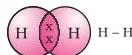
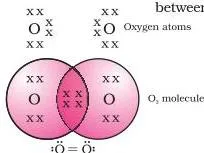
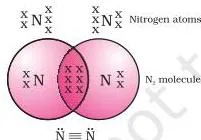
The simplest carbon molecule is methane, \( \mathrm{CH}_4 \): carbon is tetravalent, so it shares its four valence electrons with four hydrogen atoms, giving four single C–H bonds (NCERT, p. 4). Figure 4.5 shows the electron dot structure of methane.
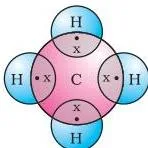
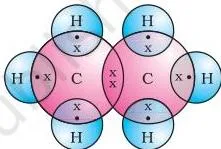
In ethane, \( \mathrm{C}_2\mathrm{H}_6 \), the two carbons share one pair (a C–C single bond) and hydrogen fills the remaining valencies — seven covalent bonds in all, counting the six C–H bonds (NCERT, p. 20).
Homologous Series: General Formulae
A homologous series is a family of compounds in which the same functional group is attached to carbon chains of different lengths (NCERT, p. 9). Successive members differ by a \( -\mathrm{CH}_2- \) unit, so each step adds \( 12\ \mathrm{u} + 2(1\ \mathrm{u}) = 14\ \mathrm{u} \) to the molecular mass (NCERT, p. 9).
\[ \text{Alkanes: } \mathrm{C}_n\mathrm{H}_{2n+2} \quad (n = 1, 2, 3, \dots) \]
\[ \text{Alkenes: } \mathrm{C}_n\mathrm{H}_{2n} \quad (n = 2, 3, 4, \dots) \]
\[ \text{Alkynes: } \mathrm{C}_n\mathrm{H}_{2n-2} \quad (n = 2, 3, 4, \dots) \]
Hydrocarbons containing only single bonds are alkanes; those with one or more double bonds are alkenes; those with one or more triple bonds are alkynes (NCERT, p. 8). The alkene formula is the one printed in the textbook for ethene onwards (NCERT, p. 10).
The alkane and alkyne formulae are derived by extending the same pattern — the first six alkanes give the alkane rule, and ethyne, \( \mathrm{C}_2\mathrm{H}_2 \), starts the alkyne rule (NCERT, p. 8).
| Carbon atoms | Name | Formula |
|---|---|---|
| 1 | Methane | \( \mathrm{CH}_4 \) |
| 2 | Ethane | \( \mathrm{C}_2\mathrm{H}_6 \) |
| 3 | Propane | \( \mathrm{C}_3\mathrm{H}_8 \) |
| 4 | Butane | \( \mathrm{C}_4\mathrm{H}_{10} \) |
| 5 | Pentane | \( \mathrm{C}_5\mathrm{H}_{12} \) |
| 6 | Hexane | \( \mathrm{C}_6\mathrm{H}_{14} \) |
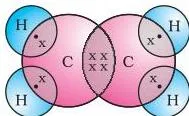
The electron dot structure of ethane (Figure 4.6c) and the structure of ethene (Figure 4.7) show how the two series begin: ethane has a C–C single bond, while ethene has a C=C double bond.
Functional Groups and Nomenclature
A functional group is the heteroatom or group attached to the carbon chain that gives a compound its characteristic properties, regardless of chain length (NCERT, p. 8). The group is attached by replacing one hydrogen atom of the chain.
| Class of compound | Functional group | Prefix / suffix | Three-carbon example |
|---|---|---|---|
| Haloalkane | \( -\mathrm{Cl} \) or \( -\mathrm{Br} \) | prefix chloro- / bromo- | Chloropropane, Bromopropane |
| Alcohol | \( -\mathrm{OH} \) | suffix -ol | Propanol |
| Aldehyde | \( -\mathrm{CHO} \) | suffix -al | Propanal |
| Ketone | \( -\mathrm{CO}- \) | suffix -one | Propanone |
| Carboxylic acid | \( -\mathrm{COOH} \) | suffix -oic acid | Propanoic acid |
| Alkene | \( \mathrm{C}=\mathrm{C} \) | suffix -ene | Propene |
| Alkyne | \( \mathrm{C}\equiv\mathrm{C} \) | suffix -yne | Propyne |
Naming rule: when the functional-group suffix starts with a vowel, delete the final ‘e’ of the chain name before adding the suffix — propane − e + one = propanone (NCERT, p. 11).
Structural Isomers and Ring Compounds
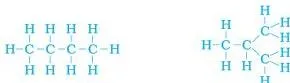
Structural isomers have the same molecular formula but different structures. Butane, \( \mathrm{C}_4\mathrm{H}_{10} \), has two possible carbon skeletons, and Figure 4.8(b) shows the two complete molecules built from them (NCERT, p. 8).
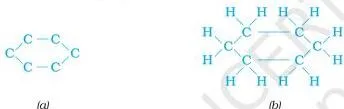
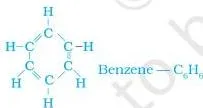
Chains can also close into rings: cyclohexane, \( \mathrm{C}_6\mathrm{H}_{12} \), and benzene, \( \mathrm{C}_6\mathrm{H}_6 \), are the ring examples in this chapter (NCERT, p. 8). Cyclohexane appears in Figure 4.9 first as a carbon skeleton and then as the complete molecule; benzene’s ring structure is in Figure 4.10.
Combustion and Oxidation Reactions
Carbon in all its allotropic forms burns in oxygen to give carbon dioxide along with heat and light, and most carbon compounds behave the same way (NCERT, p. 12).
\[ \mathrm{C} + \mathrm{O}_2 \rightarrow \mathrm{CO}_2 + \text{heat and light} \]
\[ \mathrm{CH}_4 + 2\mathrm{O}_2 \rightarrow \mathrm{CO}_2 + 2\mathrm{H}_2\mathrm{O} + \text{heat and light} \]
\[ \mathrm{C}_2\mathrm{H}_5\mathrm{OH} + 3\mathrm{O}_2 \rightarrow 2\mathrm{CO}_2 + 3\mathrm{H}_2\mathrm{O} + \text{heat and light} \]
The textbook gives the last two equations unbalanced and asks you to balance them (NCERT, p. 12). With a limited supply of air, incomplete combustion gives a sooty flame and soot — carbon — which is why blocked air holes blacken the bottoms of cooking vessels (NCERT, p. 13).
Oxidation of ethanol: converting ethanol to ethanoic acid adds oxygen to the molecule, so it is an oxidation reaction (NCERT, p. 14).
\[ \mathrm{CH}_3\mathrm{CH}_2\mathrm{OH} \xrightarrow[\text{alkaline } \mathrm{KMnO}_4 + \text{heat, or acidified } \mathrm{K}_2\mathrm{Cr}_2\mathrm{O}_7 + \text{heat}]{} \mathrm{CH}_3\mathrm{COOH} \]
Alkaline potassium permanganate and acidified potassium dichromate are the oxidising agents that add oxygen to the starting material (NCERT, p. 14).
Addition and Substitution Reactions
Addition reaction (hydrogenation): unsaturated hydrocarbons add hydrogen in the presence of a nickel or palladium catalyst to become saturated. This reaction is used to hydrogenate vegetable oils (NCERT, p. 14).
\[ \mathrm{C}_2\mathrm{H}_4 + \mathrm{H}_2 \xrightarrow[\text{Nickel catalyst}]{} \mathrm{C}_2\mathrm{H}_6 \]
Substitution reaction: in sunlight, chlorine replaces the hydrogen atoms of a saturated hydrocarbon one by one (NCERT, p. 14).
\[ \mathrm{CH}_4 + \mathrm{Cl}_2 \xrightarrow{\text{sunlight}} \mathrm{CH}_3\mathrm{Cl} + \mathrm{HCl} \]
Reactions of Ethanol
With sodium, alcohols evolve hydrogen. With ethanol the other product is sodium ethoxide (NCERT, p. 15).
\[ 2\mathrm{Na} + 2\mathrm{CH}_3\mathrm{CH}_2\mathrm{OH} \rightarrow 2\mathrm{CH}_3\mathrm{CH}_2\mathrm{ONa} + \mathrm{H}_2 \]
Heating ethanol at 443 K with excess hot concentrated sulphuric acid dehydrates it to ethene; the acid acts as a dehydrating agent (NCERT, p. 15).
\[ \mathrm{CH}_3\mathrm{CH}_2\mathrm{OH} \xrightarrow[\text{hot conc. } \mathrm{H}_2\mathrm{SO}_4,\ 443\ \text{K}]{} \mathrm{CH}_2=\mathrm{CH}_2 + \mathrm{H}_2\mathrm{O} \]
Reactions of Ethanoic Acid
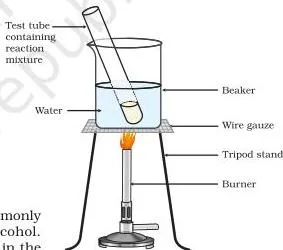
Esterification: ethanoic acid reacts with ethanol in the presence of an acid catalyst to give a sweet-smelling ester and water (NCERT, p. 16). Figure 4.11 shows the laboratory set-up for ester formation.
\[ \mathrm{CH}_3\mathrm{COOH} + \mathrm{C}_2\mathrm{H}_5\mathrm{OH} \rightleftharpoons \mathrm{CH}_3\mathrm{COOC}_2\mathrm{H}_5 + \mathrm{H}_2\mathrm{O} \]
Saponification: an ester reacts with sodium hydroxide to give back an alcohol and the sodium salt of the carboxylic acid. Soaps are sodium or potassium salts of long-chain carboxylic acids (NCERT, p. 17).
\[ \mathrm{CH}_3\mathrm{COOC}_2\mathrm{H}_5 + \mathrm{NaOH} \rightarrow \mathrm{C}_2\mathrm{H}_5\mathrm{OH} + \mathrm{CH}_3\mathrm{COONa} \]
Ethanoic acid also reacts with a base, a carbonate and a hydrogencarbonate (NCERT, p. 17):
\[ \mathrm{NaOH} + \mathrm{CH}_3\mathrm{COOH} \rightarrow \mathrm{CH}_3\mathrm{COONa} + \mathrm{H}_2\mathrm{O} \]
\[ 2\mathrm{CH}_3\mathrm{COOH} + \mathrm{Na}_2\mathrm{CO}_3 \rightarrow 2\mathrm{CH}_3\mathrm{COONa} + \mathrm{H}_2\mathrm{O} + \mathrm{CO}_2 \]
\[ \mathrm{CH}_3\mathrm{COOH} + \mathrm{NaHCO}_3 \rightarrow \mathrm{CH}_3\mathrm{COONa} + \mathrm{H}_2\mathrm{O} + \mathrm{CO}_2 \]
The last two reactions release carbon dioxide — the brisk effervescence used to identify a carboxylic acid.
What Each Symbol Means
The table gives the meaning of every symbol used in this chapter’s formulas, with the unit or nature of each quantity.
| Symbol | What it means | Unit / nature |
|---|---|---|
| \( n \) | number of carbon atoms in the chain | a count (positive integer) |
| \( \mathrm{C}_n\mathrm{H}_{2n+2} \) | molecular formula pattern of an alkane (all single bonds) | formula pattern |
| \( \mathrm{C}_n\mathrm{H}_{2n} \) | molecular formula pattern of an alkene (one double bond); valid for \( n \geq 2 \) | formula pattern |
| \( \mathrm{C}_n\mathrm{H}_{2n-2} \) | molecular formula pattern of an alkyne (one triple bond); valid for \( n \geq 2 \) | formula pattern |
| \( -\mathrm{CH}_2- \) | the unit added between successive members of a homologous series | adds 14 u to the molecular mass |
| \( \mathrm{R} \) | an alkyl group or hydrocarbon chain attached to a functional group | group symbol for a carbon chain |
| \( 12\ \mathrm{u},\ 1\ \mathrm{u} \) | atomic masses of carbon and hydrogen | atomic mass unit (u) |
| single / double / triple bond | one / two / three shared pairs of electrons | bond multiplicity |
| \( -\mathrm{Cl}, -\mathrm{Br}, -\mathrm{OH}, -\mathrm{CHO}, -\mathrm{CO}-, -\mathrm{COOH} \) | functional groups attached to the carbon chain | structural groups |
| \( \rightleftharpoons \) | reversible reaction (esterification) | reaction arrow |
When to Use Each Formula
Reach for each formula in the situation named — the condition that must hold is stated in the same row.
| Formula / reaction | Use it when… |
|---|---|
| \( \mathrm{C}_n\mathrm{H}_{2n+2} \) | you know only the number of carbon atoms and the compound is saturated (single bonds only). |
| \( \mathrm{C}_n\mathrm{H}_{2n} \) | the compound has one C=C double bond (an alkene). |
| \( \mathrm{C}_n\mathrm{H}_{2n-2} \) | the compound has one C≡C triple bond (an alkyne). |
| \( -\mathrm{CH}_2- \) (14 u) | checking whether two compounds belong to the same homologous series. |
| Combustion equations | a carbon compound burns in sufficient oxygen; the products are CO₂ and H₂O. |
| Oxidation of ethanol | converting an alcohol to a carboxylic acid; an oxidising agent, not air, is needed. |
| Hydrogenation | adding H₂ across a C=C bond with a nickel catalyst, as in hydrogenating vegetable oils. |
| Substitution | a saturated alkane and chlorine react in sunlight; H atoms are replaced one by one. |
| Ethanol + Na | showing the hydrogen of the \( -\mathrm{OH} \) group; hydrogen gas is evolved. |
| Dehydration | making an alkene from an alcohol with hot conc. \( \mathrm{H}_2\mathrm{SO}_4 \) at 443 K. |
| Esterification | making a sweet-smelling ester from an acid and an alcohol with an acid catalyst. |
| Saponification | converting an ester to an alcohol plus the sodium salt of the acid (soap formation). |
| Acid + carbonate / hydrogencarbonate | identifying a carboxylic acid by the brisk effervescence of CO₂. |
Worked Examples
Three examples show how to apply the formulas, with substitution written out step by step. All numbers here are original.
Example 1: Find the molecular formula and molecular mass of the alkane with 8 carbon atoms
Step 1: Identify the series.
‘Alkane’ means only single bonds, so use \( \mathrm{C}_n\mathrm{H}_{2n+2} \).
\[ \mathrm{C}_n\mathrm{H}_{2n+2} \quad \text{with} \quad n = 8 \]
Step 2: Substitute \( n = 8 \): hydrogen atoms \( = 2(8) + 2 = 18 \), so the formula is \( \mathrm{C}_8\mathrm{H}_{18} \).
\[ \text{Molecular mass} = 8(12\ \mathrm{u}) + 18(1\ \mathrm{u}) = 96\ \mathrm{u} + 18\ \mathrm{u} = 114\ \mathrm{u} \]
Step 3: Check with the homologous-series rule: the member one step down is \( \mathrm{C}_7\mathrm{H}_{16} \), mass 100 u; the difference is \( 114 – 100 = 14\ \mathrm{u} \).
Final answer: \( \mathrm{C}_8\mathrm{H}_{18} \), molecular mass 114 u.
Example 2: Identify the alkene whose molecular mass is 56 u
Step 1: ‘Alkene’ means one double bond, so use \( \mathrm{C}_n\mathrm{H}_{2n} \).
\[ 12n + 2n = 56 \Rightarrow 14n = 56 \Rightarrow n = 4 \]
Step 2: With \( n = 4 \), the formula is \( \mathrm{C}_4\mathrm{H}_8 \) (butene).
Step 3: Check: \( 4(12) + 8(1) = 48 + 8 = 56\ \mathrm{u} \), and \( \mathrm{C}_4\mathrm{H}_8 \) is the fourth member of the alkene series.
Final answer: \( \mathrm{C}_4\mathrm{H}_8 \), butene, molecular mass 56 u.
Example 3: Balance the complete combustion of propane
Step 1: Write the skeleton equation.
Complete combustion of a hydrocarbon gives CO₂ and H₂O.
\[ \mathrm{C}_3\mathrm{H}_8 + \mathrm{O}_2 \rightarrow \mathrm{CO}_2 + \mathrm{H}_2\mathrm{O} \]
Step 2: Balance carbon with 3 CO₂, then hydrogen with 4 H₂O.
\[ \mathrm{C}_3\mathrm{H}_8 + \mathrm{O}_2 \rightarrow 3\mathrm{CO}_2 + 4\mathrm{H}_2\mathrm{O} \]
Step 3: Count oxygen on the right: \( 3 \times 2 + 4 = 10 \), so put 5 O₂ on the left.
\[ \mathrm{C}_3\mathrm{H}_8 + 5\mathrm{O}_2 \rightarrow 3\mathrm{CO}_2 + 4\mathrm{H}_2\mathrm{O} \]
Check: left side — 3 C, 8 H, 10 O; right side — 3 C, 8 H, 10 O.
Final answer: \( \mathrm{C}_3\mathrm{H}_8 + 5\mathrm{O}_2 \rightarrow 3\mathrm{CO}_2 + 4\mathrm{H}_2\mathrm{O} \) — 1 mol propane needs 5 mol O₂ and gives 3 mol CO₂ and 4 mol H₂O.
The end-of-chapter exercises test exactly these formulas: Q1 counts the seven covalent bonds of ethane, Q6 asks for a homologous series definition, Q13 picks the hydrocarbons that undergo addition (the unsaturated ones), and Q14 asks for a test distinguishing saturated from unsaturated hydrocarbons.
Common Mistakes to Avoid
These are the application errors specific to this chapter’s formulas, with a quick check for each.
| Mistake | Correct rule | How to check your answer |
|---|---|---|
| Writing propene as \( \mathrm{C}_3\mathrm{H}_8 \), using the alkane formula for an alkene. | A compound with a C=C double bond uses the alkene formula: propene is \( \mathrm{C}_3\mathrm{H}_6 \). | Count H atoms: in an alkane, hydrogen count = twice the carbon count plus 2; in an alkene it is exactly twice the carbon count. |
| Using \( \mathrm{C}_n\mathrm{H}_{2n} \) for \( n = 1 \) and writing \( \mathrm{CH}_2 \) as an alkene. | The first alkene is ethene (\( n = 2 \)); the triple-bond series starts at ethyne (\( n = 2 \)). | Ask: can a single carbon atom form a double bond with itself? No — so \( n = 1 \) is impossible. |
| Balancing a combustion equation by changing subscripts, e.g. writing \( \mathrm{C}_3\mathrm{H}_8\mathrm{O} \) for the fuel. | Change only the coefficients in front of formulas; the molecular formula of the fuel stays fixed. | Count atoms of each element on both sides; balance C, then H, then O last. |
| Confusing sodium ethoxide with sodium ethanoate. | Ethanol + Na gives sodium ethoxide, \( \mathrm{C}_2\mathrm{H}_5\mathrm{ONa} \), and hydrogen. Ethanoic acid + NaOH gives sodium ethanoate, \( \mathrm{CH}_3\mathrm{COONa} \), and water. | Identify the starting compound: an alcohol gives an ethoxide; an acid gives an ethanoate. |
| Using the same reaction for saturated and unsaturated hydrocarbons. | Unsaturated compounds (C=C or C≡C) undergo addition; saturated alkanes undergo substitution, e.g. with chlorine in sunlight. | Look at the bond: a multiple bond present means addition; all single bonds means substitution. |
Frequently Asked Questions
What do the general formulae of alkanes, alkenes and alkynes mean?
They are the molecular patterns of the three hydrocarbon families. Alkanes (all single bonds) follow \( \mathrm{C}_n\mathrm{H}_{2n+2} \) for \( n = 1, 2, 3, \dots \); alkenes (one double bond) follow \( \mathrm{C}_n\mathrm{H}_{2n} \) for \( n = 2, 3, 4, \dots \); alkynes (one triple bond) follow \( \mathrm{C}_n\mathrm{H}_{2n-2} \) for \( n = 2, 3, 4, \dots \) (NCERT, p. 10).
Why do successive members of a homologous series differ by 14 u?
Each successive member adds one \( -\mathrm{CH}_2- \) unit. Carbon has atomic mass 12 u and hydrogen 1 u, so the added unit has mass \( 12 + 2(1) = 14\ \mathrm{u} \) (NCERT, p. 9). This is also why melting and boiling points rise gradually along a series.
Why is ethanol to ethanoic acid an oxidation, and which reagents are used?
The reaction adds oxygen to the molecule, which is the definition of oxidation. It needs an oxidising agent, not combustion: alkaline potassium permanganate (\( \mathrm{KMnO}_4 \)) or acidified potassium dichromate (\( \mathrm{K}_2\mathrm{Cr}_2\mathrm{O}_7 \)), with heat (NCERT, p. 14).
How can you experimentally distinguish an alcohol from a carboxylic acid?
Add sodium carbonate or sodium hydrogencarbonate to each. A carboxylic acid gives brisk effervescence of carbon dioxide — acid + carbonate gives a salt, water and CO₂ — while this chapter sets that test for distinguishing it from an alcohol (NCERT, p. 17).
For practice on the textbook’s own questions, use the Carbon and Its Compounds Class 10 NCERT Solutions, and browse the Chemistry formulas archive for other chapters.
Reference: NCERT Class 10 Science textbook, chapter Carbon and its Compounds.
Explore Class 10 Chemistry Formulas
More for this chapter:
Class 10 Chemistry on LearnCBSE:
Related chapters:
Official source: download the NCERT textbook free from ncert.nic.in.