
This page collects the Nuclei class 12 formulas from the NCERT Class 12 Physics chapter: atomic masses and nuclear composition, nuclear size, mass–energy equivalence, mass defect and binding energy, the Q-value of nuclear processes, fission and fusion reactions, and the radioactive decay quantities.
Formulas are grouped by the textbook topic they belong to, so you can find the one you need without re-reading the chapter.
Each entry gives the formula, the meaning of every symbol, its SI unit, and when to use it. Three worked examples with original numbers show the formulas being applied, and a common-mistakes table shows what to check in your own answer. For the full explanations and derivations, find this chapter’s notes in the Class 12 physics formulas collection.
Formulas at a Glance
Every formula on this sheet in one table — purpose on the left, formula on the right. Conditions and symbol meanings follow.
| Purpose (what you are finding) | Formula |
|---|---|
| Atomic mass unit | \( 1\ \text{u} = \frac{1}{12}\, m({}^{12}\text{C}) = 1.660539 \times 10^{-27}\ \text{kg} \) |
| Proton mass | \( m_p = 1.00727\ \text{u} = 1.67262 \times 10^{-27}\ \text{kg} \) |
| Neutron mass | \( m_n = 1.00866\ \text{u} = 1.6749 \times 10^{-27}\ \text{kg} \) |
| Mass number from proton and neutron numbers | \( A = Z + N \) |
| Nuclear radius from mass number | \( R = R_0 A^{1/3},\quad R_0 = 1.2\ \text{fm} \) |
| Mass–energy equivalence | \( E = mc^2 \) |
| Mass defect of a nucleus | \( \Delta M = [Zm_p + (A-Z)m_n] – M \) |
| Binding energy from mass defect | \( E_b = \Delta M c^2 \) |
| Binding energy per nucleon | \( E_{bn} = E_b / A \) |
| Energy equivalent of one atomic mass unit | \( 1\ \text{u} = 931.5\ \text{MeV}/c^2 \) |
| Q-value of a nuclear process | \( Q = (\Sigma m_{\text{initial}} – \Sigma m_{\text{final}})c^2 \) |
| Neutron-induced fission of uranium-235 | \( {}^1_0\text{n} + {}^{235}_{92}\text{U} \rightarrow {}^{144}_{56}\text{Ba} + {}^{89}_{36}\text{Kr} + 3{}^1_0\text{n} \) |
| Net fusion of four hydrogen nuclei | \( 4\ {}^1_1\text{H} + 2e^- \rightarrow {}^4_2\text{He} + 2\nu + 6\gamma + 26.7\ \text{MeV} \) |
| Half-life (from the decay-law definitions in the summary table) | \( T_{1/2} = \frac{0.693}{\lambda},\ \lambda \neq 0 \) |
| Mean life (from the decay-law definitions in the summary table) | \( \tau = \frac{1}{\lambda} \) |
| Activity of a sample (from the decay law) | \( R = \lambda N \) |
All Formulas, Grouped by Topic
Atomic Masses and Composition of Nucleus
Nuclear masses are measured in atomic mass units: one u is one-twelfth of the mass of a \( {}^{12}\text{C} \) atom (NCERT, p. 307).
\[ 1\ \text{u} = \frac{1}{12}\, m({}^{12}\text{C}) = 1.660539 \times 10^{-27}\ \text{kg} \]
The proton and neutron masses you will need in binding-energy problems are (NCERT, pp. 307–308):
\[ m_p = 1.00727\ \text{u} = 1.67262 \times 10^{-27}\ \text{kg} \qquad m_n = 1.00866\ \text{u} = 1.6749 \times 10^{-27}\ \text{kg} \]
A nucleus is fixed by two numbers and a notation (NCERT, p. 308):
\[ Z = \text{atomic number} = \text{number of protons}, \qquad N = \text{neutron number}, \qquad A = Z + N = \text{mass number} \]
\[ \text{nuclide notation: } {}^{A}_{Z}\text{X} \]
In \( {}^{197}_{79}\text{Au} \), \(Z = 79\) and \(N = 197 – 79 = 118\). Isotopes share \(Z\), isobars share \(A\), and isotones share \(N\). Most elements are mixtures of isotopes, so the listed atomic mass is a weighted average of the isotope masses — for chlorine, \( (75.4 \times 34.98 + 24.6 \times 36.98)/100 = 35.47\ \text{u} \) (NCERT, p. 307).
Size of the Nucleus
A nucleus of mass number \(A\) behaves like a sphere of radius (NCERT, p. 309):
\[ R = R_0 A^{1/3}, \qquad R_0 = 1.2\ \text{fm} = 1.2 \times 10^{-15}\ \text{m} \]
Since volume is proportional to \(R^3\), it is proportional to \(A\). So nuclear density is the same for all nuclei — about \( 2.3 \times 10^{17}\ \text{kg m}^{-3} \), against \( 10^3\ \text{kg m}^{-3} \) for water.
Mass–Energy and Nuclear Binding Energy
Mass is a form of energy (Einstein’s relation, NCERT, p. 310):
\[ E = mc^2 \]
The measured mass \(M\) of a nucleus is always less than the sum of its nucleon masses. The shortfall is the mass defect (NCERT, p. 311):
\[ \Delta M = [Zm_p + (A – Z)m_n] – M \]
Its energy equivalent is the binding energy — the energy you must supply to separate the nucleus into its nucleons:
\[ E_b = \Delta M c^2 \]
For comparing nuclei, use the binding energy per nucleon (NCERT, p. 312):
\[ E_{bn} = \frac{E_b}{A} \]
In numerical work, a mass defect in u converts directly to energy: \( 1\ \text{u} = 931.5\ \text{MeV}/c^2 \) (NCERT, p. 311). Why is the nucleus lighter than its parts? Binding energy contributes a negative mass to the nucleus, so the bound system carries less mass than the separated nucleons.
The shape of the binding-energy curve decides where nuclear energy comes from (NCERT, p. 312):
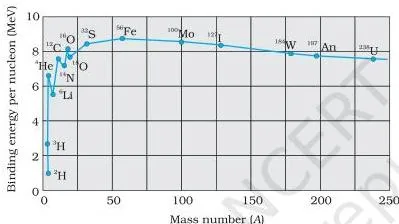
- For middle-mass nuclei (\( 30 \lt A \lt 170 \)), \(E_{bn}\) is nearly constant at about 8.75 MeV per nucleon, with a maximum near \(A = 56\); at \(A = 238\) it has fallen to about 7.6 MeV.
- \(E_{bn}\) is lower for both the lightest nuclei (\( A \lt 30 \)) and the heaviest (\( A \gt 170 \)).
Those lower ends explain fission and fusion: splitting a heavy nucleus, or fusing two light ones, moves nucleons toward the higher middle of the curve, and the surplus binding energy is released.
Nuclear Force
The force that binds nucleons is neither Coulomb nor gravitational, and it has no simple mathematical form (NCERT, p. 313). Its working properties:
- It is much stronger than the Coulomb repulsion between protons.
- It is short-ranged — it falls to zero beyond a few femtometres, which is why binding energy per nucleon saturates.
- It is charge-independent: neutron–neutron, proton–neutron and proton–proton forces are roughly the same.
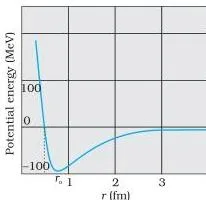
The curve in Fig. 13.2 has a minimum at \( r_0 \approx 0.8\ \text{fm} \). For separations greater than \( r_0 \) the force is attractive; for separations less than \( r_0 \) it is strongly repulsive — the “hard core” that stops nucleons from collapsing into one another.
Radioactive Decay Quantities
Radioactivity is the transformation of an unstable nucleus by \(\alpha\), \(\beta\) or \(\gamma\) emission (NCERT, p. 314). The chapter’s summary table defines four quantities you will use (NCERT, p. 319):
| Quantity | Symbol | Dimensions | Unit | Meaning |
|---|---|---|---|---|
| Disintegration or decay constant | \( \lambda \) | \( [T^{-1}] \) | \( \text{s}^{-1} \) | the rate at which the sample disintegrates |
| Half-life | \( T_{1/2} \) | \( [T] \) | s | time for one-half of the initial number of nuclei to decay |
| Mean life | \( \tau \) | \( [T] \) | s | time at which the number of nuclei has fallen to \(e^{-1}\) of its initial value |
| Activity of a radioactive sample | \( R \) | \( [T^{-1}] \) | Bq | measure of the activity of a radioactive source |
Working from those definitions, the decay law and its consequences are:
\[ N = N_0 e^{-\lambda t}, \qquad T_{1/2} = \frac{\ln 2}{\lambda} = \frac{0.693}{\lambda}, \qquad \tau = \frac{1}{\lambda}, \qquad R = \lambda N \]
Nuclear Fission
In fission, a heavy nucleus struck by a neutron splits into two intermediate-mass fragments. A standard reaction (NCERT, p. 315):
\[ {}^1_0\text{n} + {}^{235}_{92}\text{U} \rightarrow {}^{236}_{92}\text{U} \rightarrow {}^{144}_{56}\text{Ba} + {}^{89}_{36}\text{Kr} + 3{}^1_0\text{n} \]
Other fragment pairs are possible, such as \( {}^{133}_{51}\text{Sb} + {}^{99}_{41}\text{Nb} + 4{}^1_0\text{n} \) or \( {}^{140}_{54}\text{Xe} + {}^{94}_{38}\text{Sr} + 2{}^1_0\text{n} \). The fragments are radioactive and reach stable nuclei by successive \(\beta\)-emissions.
The energy released is of order 200 MeV per fission. The estimate from the binding-energy curve: \(E_{bn} \approx 7.6\ \text{MeV}\) for \(A = 240\) and \(\approx 8.5\ \text{MeV}\) for two \(A = 120\) fragments gives a gain of about \(240 \times 0.9 \approx 216\ \text{MeV}\) (NCERT, p. 315).
Nuclear Fusion
Two light nuclei fuse into a larger, more tightly bound nucleus. The basic reactions (NCERT, p. 315):
\[ {}^1_1\text{H} + {}^1_1\text{H} \rightarrow {}^2_1\text{H} + e^+ + \nu + 0.42\ \text{MeV} \]
\[ {}^2_1\text{H} + {}^2_1\text{H} \rightarrow {}^3_2\text{He} + n + 3.27\ \text{MeV} \]
\[ {}^2_1\text{H} + {}^2_1\text{H} \rightarrow {}^3_1\text{H} + {}^1_1\text{H} + 4.03\ \text{MeV} \]
In stars these run as the proton–proton cycle. The net effect is four hydrogen nuclei converted into one helium nucleus with 26.7 MeV released (NCERT, p. 316):
\[ 4\ {}^1_1\text{H} + 2e^- \rightarrow {}^4_2\text{He} + 2\nu + 6\gamma + 26.7\ \text{MeV} \]
Fusion needs enough kinetic energy to overcome the Coulomb barrier between the two positive nuclei. For two protons the barrier is about 400 keV, so \( \frac{3}{2}kT \approx 400\ \text{keV} \), giving \( T \sim 3 \times 10^9\ \text{K} \).
The sun’s core is at \( 1.5 \times 10^7\ \text{K} \) — far below that estimate — because the reactions run on the fastest protons, whose energies lie well above the average (NCERT, pp. 315–316).
Q-Value of a Nuclear Process
The Q-value is the energy released or absorbed in a decay or reaction. By conservation of mass-energy it has two equivalent forms (NCERT, p. 319):
\[ Q = (\text{final kinetic energy}) – (\text{initial kinetic energy}) \]
\[ Q = (\Sigma m_{\text{initial}} – \Sigma m_{\text{final}})c^2 \]
Positive \(Q\) means mass was lost and energy released (exothermic); negative \(Q\) means energy must be supplied (endothermic).
What Each Symbol Means
All symbols used in this chapter’s formulas, with units. Where a symbol does double duty, the context tells you which meaning applies.
| Symbol | What it means | Unit |
|---|---|---|
| \(u\) | atomic mass unit, \(1/12\) of the mass of a \(^{12}\text{C}\) atom | \(1\ \text{u} = 1.660539 \times 10^{-27}\ \text{kg}\) |
| \(m_p,\ m_n,\ m_e\) | masses of the proton, neutron and electron | kg (also u) |
| \(Z\) | atomic number — number of protons in the nucleus | dimensionless (a count) |
| \(N\) | neutron number — number of neutrons; in radioactivity problems, also the number of undecayed nuclei | dimensionless (a count) |
| \(A\) | mass number — total number of protons and neutrons | dimensionless (a count) |
| \(X\) | chemical symbol of the nuclide | — |
| \(M\) | mass of the nucleus | kg (usually given in u) |
| \(\Delta M\) | mass defect — how much the nuclear mass falls short of the sum of its nucleons | u, or MeV/\(c^2\) |
| \(E_b\) | binding energy of the nucleus | MeV |
| \(E_{bn}\) | binding energy per nucleon | MeV per nucleon |
| \(R\) | radius of a nucleus in the size law; also the symbol for activity in radioactivity | fm for radius; Bq for activity |
| \(R_0\) | constant in the radius law | 1.2 fm |
| \(c\) | speed of light in vacuum | \(3 \times 10^8\ \text{m/s}\) |
| \(E\) | energy equivalent of mass \(m\) | J or MeV |
| \(Q\) | energy released or absorbed in a nuclear process | MeV |
| \(\lambda\) | decay constant | \(\text{s}^{-1}\) |
| \(T_{1/2}\) | half-life | s |
| \(\tau\) | mean life | s |
| \(N_0\) | number of nuclei present at time \(t = 0\) | dimensionless (a count) |
When to Use Each Formula
Which formula to reach for, and the condition that must hold for it to apply.
| Formula | Reach for it when… |
|---|---|
| \( A = Z + N \) | you know two of a nuclide’s three numbers and need the third. |
| \( R = R_0 A^{1/3} \) | you need a nuclear radius, or the ratio of two radii — the \(A^{1/3}\) dependence is all you need for the ratio. |
| \( E = mc^2 \) | any mass is converted to energy, or you must state the energy equivalent of a given mass. |
| \( \Delta M = [Zm_p + (A-Z)m_n] – M \) | you have the actual nuclear mass and the nucleon masses and need the mass defect. \(M\) must be the nuclear mass, not the atomic mass. |
| \( E_b = \Delta M c^2 \) | you have a mass defect and need the energy needed to break the nucleus apart; convert u to MeV with \(1\ \text{u} = 931.5\ \text{MeV}/c^2\). |
| \( E_{bn} = E_b/A \) | you are comparing how tightly bound two nuclei are, or explaining why fission and fusion release energy. |
| \( Q = (\Sigma m_{\text{initial}} – \Sigma m_{\text{final}})c^2 \) | you must decide whether a reaction is exothermic or endothermic and find how much energy is released or absorbed. |
| \( T_{1/2},\ \tau,\ R = \lambda N \) | radioactivity problems: how long until half the sample decays, the average lifetime, or the current decay rate. The half-life relation needs \(\lambda \neq 0\). |
| Fission and fusion reactions | a reaction is given or asked in terms of nuclides — check that the number of protons and the number of neutrons each balance on both sides. |
Worked Examples
Three original problems: applying the radius law, computing binding energy from a nuclear mass, and finding the Q-value of a reaction. For more practice, browse the physics formulas collection.
Example 1: Nuclear radius and ratio of radii
- Step 1: Choose the radius law (NCERT, p. 309): \( R = R_0 A^{1/3} \), with \(R_0 = 1.2\ \text{fm}\).
- Step 2: For \(A = 216\), \( R = 1.2 \times (216)^{1/3}\ \text{fm} = 1.2 \times 6\ \text{fm} \), since \(6^3 = 216\).
So \(R = 7.2\ \text{fm}\).
\[ \frac{R_{216}}{R_{27}} = \left(\frac{216}{27}\right)^{1/3} = 8^{1/3} = 2 \]
Final answer: \(R = 7.2\ \text{fm}\) for \(A = 216\), and the \(A = 216\) nucleus has twice the radius of the \(A = 27\) nucleus.
Example 2: Binding energy and binding energy per nucleon
Step 1: For helium \({}^4_2\text{He}\), \(Z = 2\), \(A = 4\).
Subtract the two electrons from the atomic mass to get the nuclear mass: \(M = 4.002603 – 2(0.000548) = 4.001507\ \text{u}\).
- Step 1: Mass of the separated nucleons: \( 2m_p + 2m_n = 2(1.00727) + 2(1.00866) = 4.03186\ \text{u}\).
- Step 2: Mass defect: \( \Delta M = 4.03186 – 4.001507 = 0.030353\ \text{u}\).
\[ E_b = \Delta M c^2 = 0.030353 \times 931.5 = 28.3\ \text{MeV} \]
Step 4: Per nucleon: \( E_{bn} = E_b/A = 28.3/4 = 7.1\ \text{MeV per nucleon}\).
Final answer: \(E_b \approx 28.3\ \text{MeV}\); \(E_{bn} \approx 7.1\ \text{MeV per nucleon}\).
Example 3: Q-value of a reaction
- Step 1: Choose the Q-value formula (NCERT, p. 319): \( Q = (\Sigma m_{\text{initial}} – \Sigma m_{\text{final}})c^2 \).
- Step 2: Mass decrease: \( \Sigma m_{\text{initial}} – \Sigma m_{\text{final}} = 5.0300 – 5.0200 = 0.0100\ \text{u}\).
\[ Q = 0.0100 \times 931.5 = 9.3\ \text{MeV} \]
Step 3: Interpret the sign: \(Q \gt 0\), so energy is released — the reaction is exothermic.
Final answer: \(Q \approx 9.3\ \text{MeV}\), released; the reaction is exothermic.
Common Mistakes to Avoid
Chapter-specific traps in applying these formulas, with the corrected rule and a quick self-check.
| Mistake | Correct rule | How to check your answer |
|---|---|---|
| Putting the atomic mass (which includes electrons) into the mass-defect formula | \(M\) in \(\Delta M\) is the nuclear mass — subtract \(Z m_e\) from the atomic mass first. | The nuclear mass must be smaller than the atomic mass by roughly \(Z \times 0.00055\ \text{u}\). |
| Swapping \(Z\) and \(A\) | \(Z\) counts protons, \(A\) counts all nucleons; neutrons come from \(N = A – Z\). | For \( {}^{235}_{92}\text{U} \): \(Z = 92\), \(N = 143\) — the neutron count is never 92 here. |
| Confusing the two meanings of \(R\) | \(R = R_0 A^{1/3}\) is a radius in fm; activity \(R = \lambda N\) is a rate in Bq. | Radius answers come out as a few fm; activity answers as decays per second. |
| Multiplying a mass in kg by 931.5 | \(1\ \text{u} = 931.5\ \text{MeV}/c^2\) applies only to masses in u. A mass in kg must go through \(E = mc^2\) in joules. | Sanity scale: 1 u of mass defect gives about 931.5 MeV; helium-4 gives about 28 MeV total. |
| Getting the sign of \(Q\) backwards | \(Q = (\Sigma m_{\text{initial}} – \Sigma m_{\text{final}})c^2\) — positive \(Q\) when mass decreases, i.e. energy released. | Products lighter than reactants → exothermic → \(Q \gt 0\). |
Frequently Asked Questions
Which Nuclei class 12 formulas should I memorise first?
Priority list: the radius law \(R = R_0 A^{1/3}\), the mass-defect and binding-energy set \(\Delta M = [Zm_p + (A-Z)m_n] – M\), \(E_b = \Delta M c^2\), \(E_{bn} = E_b/A\), the conversion \(1\ \text{u} = 931.5\ \text{MeV}/c^2\), and the Q-value definition. Then add the fission and fusion reactions and the decay quantities \(T_{1/2}\), \(\tau\) and \(R\).
Why is the mass of a nucleus less than the sum of its constituents?
The binding energy contributes a negative mass to the nucleus (mass defect, NCERT, p. 311). Forming a nucleus releases \(E_b\), and breaking it apart requires supplying \(E_b\) again — so the bound nucleus is lighter than its separated nucleons by \(\Delta M = E_b/c^2\).
Why do both fission and fusion release energy?
The binding-energy curve (Fig. 13.1) peaks around \(A = 56\) at about 8.75 MeV per nucleon. Fission splits a heavy nucleus (\(A \gt 170\), lower \(E_{bn}\)) into middle-mass fragments, and fusion joins two light nuclei (\(A \lt 30\), lower \(E_{bn}\)) into a heavier one — both move nucleons to higher binding energy per nucleon, and the surplus appears as released energy.
What is the difference between half-life and mean life?
Half-life \(T_{1/2}\) is the time for one-half of the initial nuclei to decay; mean life \(\tau\) is the time at which the number has fallen to \(e^{-1}\) of its initial value. They relate through the decay constant: \(\tau = 1/\lambda\) and \(T_{1/2} = 0.693/\lambda\), so \(T_{1/2} \approx 0.693\ \tau\).
All formulas and constants in this sheet follow the rationalised NCERT Class 12 Physics Part II textbook; check any value against the official NCERT textbook portal.
Reference: NCERT Class 12 Physics textbook, chapter Nuclei.
Explore Class 12 Physics Formulas
More for this chapter:
Class 12 Physics on LearnCBSE:
Related chapters: