Here are the Atoms Class 12 formulas from NCERT Physics Chapter 12, grouped by topic so you can find any result in seconds.
The sheet covers Rutherford’s alpha-particle scattering relations, the energy and radius of electron orbits in hydrogen, Bohr’s postulates, the spectral-line frequencies of the hydrogen atom, and the de Broglie standing-wave condition. Each formula is followed by its symbols, units and when-to-use guidance, plus three original worked examples; the derivations live on the Class 12 Physics formulas hub.
Formulas at a Glance
Use this table for a quick lookup. The grouped list below it carries the same formulas with their conditions and page references.
| Purpose (what you are finding) | Formula |
|---|---|
| Force between an alpha particle and a nucleus | \( F = \frac{1}{4\pi\epsilon_0}\frac{(2e)(Ze)}{r^2} \) |
| Distance of closest approach of an alpha particle | \( d = \frac{2Ze^2}{4\pi\epsilon_0 K} \) |
| Alpha-particle kinetic energy at closest approach (rearranged form) | \( K = \frac{2Ze^2}{4\pi\epsilon_0 d} \) |
| Condition for a stable circular electron orbit | \( \frac{1}{4\pi\epsilon_0}\frac{e^2}{r^2} = \frac{mv^2}{r} \) |
| Orbit radius for a given electron speed | \( r = \frac{e^2}{4\pi\epsilon_0 m v^2} \) |
| Kinetic energy of the orbital electron | \( K = \frac{e^2}{8\pi\epsilon_0 r} \) |
| Electrostatic potential energy of the orbital electron | \( U = -\frac{e^2}{4\pi\epsilon_0 r} \) |
| Total energy of the electron in hydrogen | \( E = -\frac{e^2}{8\pi\epsilon_0 r} \) |
| Classical frequency of revolution | \( \nu = \frac{v}{2\pi r} \) |
| Angular momentum quantisation (Bohr’s second postulate) | \( L = \frac{nh}{2\pi} \) |
| Photon energy in a transition (Bohr’s third postulate) | \( h\nu = E_i – E_f \) |
| Radius of the nth allowed orbit | \( r_n = \left(\frac{n^2}{m}\right)\left(\frac{h}{2\pi}\right)^2\frac{4\pi\epsilon_0}{e^2} \) |
| Energy of the nth stationary state | \( E_n = -\frac{me^4}{8n^2\epsilon_0^2 h^2} \) |
| Energy of the nth state in joules | \( E_n = -\frac{2.18\times10^{-18}}{n^2}\ \text{J} \) |
| Energy of the nth state in electron volts | \( E_n = -\frac{13.6}{n^2}\ \text{eV} \) |
| Frequency of a spectral line (transition \( n_i \rightarrow n_f \)) | \( h\nu_{if} = E_{n_i} – E_{n_f} \) |
| Standing-wave condition on an orbit (de Broglie) | \( 2\pi r_n = n\lambda \) |
| De Broglie wavelength of the orbital electron (Chapter 11 result) | \( \lambda = \frac{h}{mv_n} \) |
| Quantised angular momentum (derived from the standing-wave condition) | \( mv_n r_n = \frac{nh}{2\pi} \) |
All Atoms Class 12 Formulas, Grouped by Topic
Every equation below is quoted from the NCERT Physics Part II chapter Atoms. You can verify any value in the chapter PDF (leph204.pdf) on the NCERT website.
Alpha-Particle Scattering and Rutherford’s Nuclear Model
In the Geiger–Marsden experiment, 5.5 MeV alpha particles (charge \( 2e \)) were fired at a thin gold foil (\( Z = 79 \)). Rutherford explained the observed scattering with the Coulomb repulsion between the alpha particle and the concentrated positive charge of the nucleus (NCERT, p. 5).
\[ F = \frac{1}{4\pi\epsilon_0}\frac{(2e)(Ze)}{r^2} \qquad (12.1) \]
Here \( r \) is the centre-to-centre distance between the alpha particle and the nucleus, and the force acts along the line joining them (NCERT, p. 5).
At the distance of closest approach the alpha particle is momentarily at rest, so its initial kinetic energy \( K \) is fully converted to electrical potential energy (NCERT, p. 5):
\[ K = \frac{2Ze^2}{4\pi\epsilon_0 d} \]
\[ d = \frac{2Ze^2}{4\pi\epsilon_0 K} \]
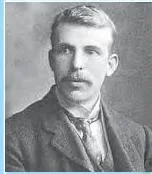
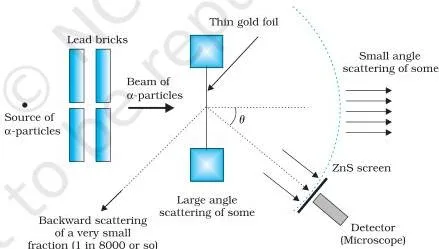
The two figures above show the real set-up and its schematic arrangement. Lead collimation forms a narrow beam, the gold foil is about \( 2.1\times10^{-7} \) m thick, and scattered alphas are counted as brief light flashes on a zinc sulphide screen (NCERT, p. 3).
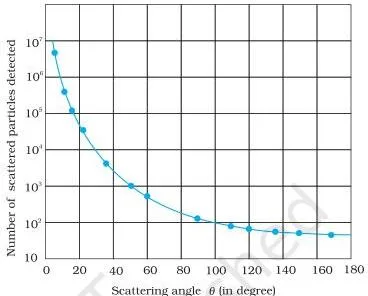
The graph above compares Geiger and Marsden’s data points with the solid curve predicted by Rutherford’s nuclear model. The close agreement was the key evidence for the nuclear atom (NCERT, p. 4).
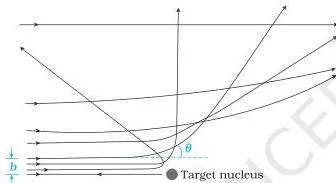
The trajectory of an alpha particle is fixed by the impact parameter \( b \), the perpendicular distance of its initial velocity line from the nucleus (NCERT, p. 5):
- Small \( b \) — the alpha passes close to the nucleus and scatters through a large angle.
- Head-on collision (minimum \( b \)) — the alpha rebounds, \( \theta \cong \pi \).
- Large \( b \) — the alpha goes nearly undeviated, \( \theta \cong 0 \).
Only about 0.14% of the incident alphas scatter by more than 1° and about 1 in 8000 by more than 90° — direct evidence that the mass and positive charge of the atom sit in a tiny volume (NCERT, pp. 3, 5).
The scattering data placed the nucleus at \( 10^{-15} \) to \( 10^{-14} \) m while the atom is about \( 10^{-10} \) m, so an atom is mostly empty space (NCERT, p. 3).
Electron Orbits
In the classical picture, the Coulomb attraction of the proton supplies the centripetal force that keeps the electron in a circular orbit (NCERT, p. 6):
\[ \frac{1}{4\pi\epsilon_0}\frac{e^2}{r^2} = \frac{mv^2}{r} \qquad (12.2) \]
\[ r = \frac{e^2}{4\pi\epsilon_0 m v^2} \qquad (12.3) \]
Substituting the radius into the kinetic and potential energy expressions gives the total energy of the electron in hydrogen (NCERT, p. 6):
\[ K = \frac{1}{2}mv^2 = \frac{e^2}{8\pi\epsilon_0 r} \]
\[ U = -\frac{e^2}{4\pi\epsilon_0 r} \]
\[ E = K + U = -\frac{e^2}{8\pi\epsilon_0 r} \qquad (12.4) \]
The negative total energy means the electron is bound to the nucleus; if \( E \) were positive, the electron would not follow a closed orbit (NCERT, p. 6).
The classical frequency of revolution of the electron is used only in the argument that the Rutherford model fails (NCERT, p. 8):
\[ \nu = \frac{v}{2\pi r} \]
An accelerating electron would radiate, spiral inward and emit a continuous spectrum — not the sharp line spectrum actually seen.
Bohr Model of the Hydrogen Atom
Bohr kept the classical circular orbit but added three postulates (NCERT, p. 8): electrons occupy stable stationary states without radiating; the allowed orbits are fixed by quantised angular momentum; and a transition between states emits a photon whose energy equals the energy difference between the levels.
\[ L = \frac{nh}{2\pi}, \qquad n = 1, 2, 3, \dots \qquad (12.5) \]
\[ h\nu = E_i – E_f, \qquad E_i \gt E_f \qquad (12.6) \]
Using the quantisation condition in the classical energy expression gives the allowed radii and energies of hydrogen (NCERT, p. 9):
\[ r_n = \left(\frac{n^2}{m}\right)\left(\frac{h}{2\pi}\right)^2\frac{4\pi\epsilon_0}{e^2} \qquad (12.7) \]
\[ E_n = -\frac{me^4}{8n^2\epsilon_0^2 h^2} \qquad (12.8) \]
Substituting the constants gives the numerical forms (NCERT, pp. 9–10):
\[ E_n = -\frac{2.18\times10^{-18}}{n^2}\ \text{J} \qquad (12.9) \]
\[ E_n = -\frac{13.6}{n^2}\ \text{eV} \qquad (12.10) \]
Since \( 1\ \text{eV} = 1.6\times10^{-19}\ \text{J} \), the energy formula becomes the eV form. The \( n = 1 \) orbit is the Bohr radius \( a_0 = 5.3\times10^{-11} \) m and the electron speed there is \( 2.2\times10^6 \) m/s (NCERT, p. 7).
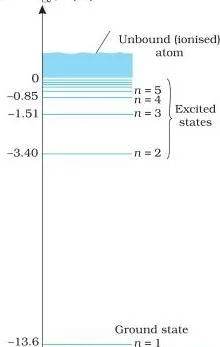
The energy level diagram shows the allowed states as horizontal lines: \( E_1 = -13.6 \) eV, \( E_2 = -3.40 \) eV, \( E_3 = -1.51 \) eV, converging toward \( E = 0 \) at \( n = \infty \). Exciting hydrogen from the ground state needs 10.2 eV (to \( n = 2 \)) or 12.09 eV (to \( n = 3 \)); freeing the electron completely needs 13.6 eV (NCERT, p. 11).
The Line Spectra of the Hydrogen Atom
An electron falling from level \( n_i \) to \( n_f \) (\( n_f \lt n_i \)) emits a photon whose frequency satisfies (NCERT, p. 11):
\[ h\nu_{if} = E_{n_i} – E_{n_f} \qquad (12.11) \]
Because both quantum numbers are integers, the emitted frequencies are discrete — that is why the hydrogen spectrum is a set of bright lines. Absorption is the mirror process: the atom takes in a photon only when its energy exactly matches the level difference (NCERT, p. 11).
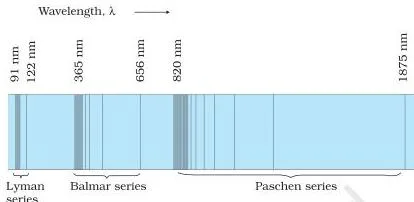
The emission spectrum above shows bright lines at specific wavelengths, the pattern that Bohr’s energy formula \( E_n = -13.6/n^2 \) eV was built to explain (NCERT, p. 8).
De Broglie’s Explanation of Bohr’s Second Postulate
De Broglie treated the orbiting electron as a wave. A standing wave can persist on the circular orbit only if a whole number of wavelengths fits the circumference (NCERT, p. 13):
\[ 2\pi r_n = n\lambda, \qquad n = 1, 2, 3, \dots \qquad (12.12) \]
Using the de Broglie wavelength \( \lambda = h/p \) (Chapter 11) with the non-relativistic momentum \( p = mv_n \) gives:
\[ 2\pi r_n = \frac{nh}{mv_n} \qquad \Rightarrow \qquad mv_n r_n = \frac{nh}{2\pi} \]
This is exactly Bohr’s quantisation condition \( L = nh/2\pi \) — the discrete orbits are the resonant standing waves (NCERT, p. 13). You can revise the wave theory result in the physics formulas collection.
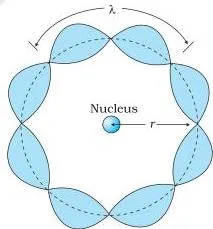
The diagram above shows the \( n = 4 \) case, where \( 2\pi r_n = 4\lambda \). Waves that do not fit the circumference interfere with themselves and die out (NCERT, p. 13).
What Each Symbol Means
| Symbol | What it means | Value in this chapter | Unit |
|---|---|---|---|
| \( F \) | Coulomb force between the alpha particle and the nucleus | — | N |
| \( e \) | Magnitude of charge on a proton or electron | \( 1.6\times10^{-19} \) | C |
| \( 2e \) | Charge of an alpha particle | \( 3.2\times10^{-19} \) | C |
| \( Z \) | Atomic number of the target nucleus | 79 for gold | dimensionless |
| \( r \) | Separation between the alpha particle and the nucleus, or the electron orbit radius | — | m |
| \( \epsilon_0 \) | Permittivity of free space | \( \frac{1}{4\pi\epsilon_0} = 9.0\times10^9 \ \) N m²/C² | C² N⁻¹ m⁻² |
| \( b \) | Impact parameter: perpendicular distance of the alpha’s initial velocity line from the nucleus | — | m |
| \( \theta \) | Scattering angle | — | dimensionless (degree or radian) |
| \( d \) | Distance of closest approach of the alpha particle | — | m |
| \( K \) | Kinetic energy (of the alpha particle or the orbital electron) | — | J (or eV) |
| \( m \) | Mass of the electron | \( 9.1\times10^{-31} \) | kg |
| \( v \) | Speed of the electron in its orbit | \( 2.2\times10^6 \) m/s for \( n = 1 \) | m/s |
| \( U \) | Electrostatic potential energy of the electron | — | J (or eV) |
| \( E \) | Total energy of the electron | — | J (or eV) |
| \( \nu \) | Frequency of the emitted photon, or frequency of revolution | — | Hz |
| \( h \) | Planck constant | \( 6.6\times10^{-34} \) | J s |
| \( L \) | Angular momentum of the orbiting electron | — | kg m²/s (same dimensions as J s) |
| \( n \) | Principal quantum number of the orbit or level | 1, 2, 3, … | dimensionless integer |
| \( r_n \) | Radius of the nth allowed orbit | \( r_n = n^2 a_0 \), \( a_0 = 5.3\times10^{-11} \) m | m |
| \( E_n \) | Energy of the nth stationary state | \( E_1 = -13.6 \) eV | eV or J |
| \( E_i, E_f \) | Energies of the initial and final states in a transition | — | eV or J |
| \( n_i, n_f \) | Quantum numbers of the initial and final states | \( n_f \lt n_i \) for emission | dimensionless integers |
| \( \lambda \) | De Broglie wavelength of the electron | — | m |
| \( p \) | Magnitude of the electron’s momentum | — | kg m/s |
| \( a_0 \) | Bohr radius (n = 1 orbit of hydrogen) | \( 5.3\times10^{-11} \) | m |
When to Use Each Formula
| Formula | Use it when… | Condition to check |
|---|---|---|
| \( F = \frac{1}{4\pi\epsilon_0}\frac{(2e)(Ze)}{r^2} \) | analysing alpha-particle scattering by a nucleus — the Coulomb repulsion that deflects the alpha. | the target nucleus is much heavier than the alpha (gold is about 50× heavier), so it stays at rest. |
| \( d = \frac{2Ze^2}{4\pi\epsilon_0 K} \) | an alpha particle collides head-on with a nucleus and you need the closest distance it reaches. | put \( K \) in joules; \( d \) is an upper limit on the nuclear size. |
| \( \frac{1}{4\pi\epsilon_0}\frac{e^2}{r^2} = \frac{mv^2}{r} \), \( r = \frac{e^2}{4\pi\epsilon_0 m v^2} \) | finding the classical orbit radius from the electron speed (or speed from radius) in hydrogen. | single electron (hydrogen); classical model only. |
| \( K = \frac{e^2}{8\pi\epsilon_0 r} \), \( U = -\frac{e^2}{4\pi\epsilon_0 r} \), \( E = -\frac{e^2}{8\pi\epsilon_0 r} \) | getting the kinetic, potential or total energy of the electron in a hydrogen orbit of radius \( r \). | total energy is negative — the electron is bound. |
| \( L = \frac{nh}{2\pi} \) | deciding which orbits are allowed (Bohr’s second postulate). | \( n \) a positive integer. |
| \( h\nu = E_i – E_f \) | a transition between two states emits a photon; find its energy or frequency. | \( E_i \gt E_f \); the frequency is positive. |
| \( r_n = \left(\frac{n^2}{m}\right)\left(\frac{h}{2\pi}\right)^2\frac{4\pi\epsilon_0}{e^2} \) | finding the radius of the nth orbit of hydrogen. | reduces to \( r_n = n^2 \times 5.3\times10^{-11} \) m — radius grows as \( n^2 \). |
| \( E_n = -\frac{me^4}{8n^2\epsilon_0^2 h^2} = -\frac{13.6}{n^2} \) eV | finding the energy of a level, an excitation energy or the ionisation energy of hydrogen. | hydrogen only; ionisation energy from the ground state is 13.6 eV. |
| \( h\nu_{if} = E_{n_i} – E_{n_f} \) | finding the frequency of a spectral line for the jump \( n_i \rightarrow n_f \). | for emission \( n_f \lt n_i \); reverse the difference for absorption. |
| \( 2\pi r_n = n\lambda \), \( mv_n r_n = \frac{nh}{2\pi} \) | explaining why only discrete orbits exist — standing de Broglie waves on the orbit. | a whole number of wavelengths must fit the circumference. |
Worked Examples
Worked Example 1: Energy of the n = 4 State and Excitation from the Ground State
Step 1: Select the energy formula.
The energy of the nth hydrogen state is \( E_n = -13.6/n^2 \) eV (Eq. 12.10).
Step 2: Put \( n = 4 \): \( E_4 = -13.6/16 = -0.85 \) eV.
Step 3: The ground state is \( E_1 = -13.6 \) eV.
The excitation energy is the higher level minus the lower level: \( E_4 – E_1 = -0.85 – (-13.6) = 12.75 \) eV.
Final answer: The n = 4 state has energy \( -0.85 \) eV, and exciting hydrogen from the ground state to this level requires \( 12.75 \) eV.
Worked Example 2: Distance of Closest Approach for a 5.0 MeV Alpha Particle
Step 1: For a head-on collision, energy conservation applies: the initial kinetic energy becomes electrical potential energy at the turning point, so use \( d = \frac{2Ze^2}{4\pi\epsilon_0 K} \).
Take the target as gold, \( Z = 79 \).
Step 2: Convert the kinetic energy to joules: \( K = 5.0 \ \text{MeV} = 5.0 \times 10^6 \times 1.6 \times 10^{-19} = 8.0 \times 10^{-13} \) J.
(Using \( 1/4\pi\epsilon_0 = 9.0 \times 10^9 \) N m²/C².)
\[ d = \frac{2(9.0\times10^9)(1.6\times10^{-19})^2(79)}{8.0\times10^{-13}} = 4.55\times10^{-14}\ \text{m} \]
Step 4: Interpret the result.
Since \( 1 \ \text{fm} = 10^{-15} \) m, \( d = 45.5 \) fm, which is larger than the gold nucleus (about 6 fm).
The alpha particle reverses without touching the nucleus.
Final answer: \( d = 4.55 \times 10^{-14} \) m, about 45.5 fm.
Worked Example 3: Frequency of the Photon for the n = 4 to n = 2 Transition
Step 1: Select the transition formula \( h\nu = E_i – E_f \) with the initial state above the final state.
Step 2: Find the level energies: \( E_4 = -13.6/16 = -0.85 \) eV and \( E_2 = -13.6/4 = -3.40 \) eV.
Step 3: Compute the photon energy: \( \Delta E = E_4 – E_2 = -0.85 – (-3.40) = 2.55 \) eV \( = 2.55 \times 1.6 \times 10^{-19} = 4.08 \times 10^{-19} \) J.
\[ \nu = \frac{\Delta E}{h} = \frac{4.08\times10^{-19}}{6.6\times10^{-34}} = 6.2\times10^{14}\ \text{Hz} \]
Final answer: The emitted photon has energy \( 2.55 \) eV and frequency \( 6.2 \times 10^{14} \) Hz.
Common Mistakes to Avoid
| Mistake | Correct rule | How to check your answer |
|---|---|---|
| Writing the hydrogen energy as positive: \( E_n = +13.6/n^2 \) eV. | Keep the minus sign: \( E_n = -13.6/n^2 \) eV. A negative \( E \) means the electron is bound to the proton. | Compute the excitation energy \( E_2 – E_1 \); it must come out +10.2 eV. |
| Writing the transition as \( h\nu = E_f – E_i \), which gives a negative frequency. | The photon energy is the difference \( E_i – E_f \) with \( E_i \gt E_f \); frequency is positive. | Any frequency or photon energy you calculate for emission must be positive. |
| Feeding kinetic energy in eV directly into \( d = \frac{2Ze^2}{4\pi\epsilon_0 K} \). | Convert to joules first: \( 1 \ \text{eV} = 1.6\times10^{-19} \) J. | For a 5.0 MeV alpha on gold (\( Z = 79 \)), \( d \approx 4.55\times10^{-14} \) m — about 45.5 fm. |
| Assuming \( r_n = n \times 5.3\times10^{-11} \) m. | The radius scales as \( n^2 \): \( r_n = n^2 \times 5.3\times10^{-11} \) m. | \( r_2 = 4 \times 5.3\times10^{-11} = 2.12\times10^{-10} \) m. |
| Equating the classical revolution frequency \( v/2\pi r \) with the frequency of the emitted spectral line. | Emission frequency comes from \( (E_i – E_f)/h \); the two are different quantities. | For \( n = 1 \), \( v/2\pi r \approx 6.6\times10^{15} \) Hz, but transition frequencies are set by energy differences. |
| Reading the distance of closest approach as the nuclear radius itself. | \( d \) is an upper limit on the nuclear size — the alpha stops outside the nucleus. | For gold, \( d \approx 30 \) fm at 7.7 MeV while the nucleus is about 6 fm. |
Frequently Asked Questions
Why is the total energy of the electron in hydrogen negative?
The negative sign in \( E_n = -13.6/n^2 \) eV marks a bound state: the electron cannot escape without energy being supplied. The zero of the scale is \( n = \infty \), where the electron is completely removed and at rest (NCERT, p. 10). Removing the electron from the ground state therefore needs 13.6 eV.
What is the ionisation energy of hydrogen?
13.6 eV — the minimum energy needed to free the electron from the ground state (\( n = 1 \)). This prediction of the Bohr model agrees with the experimental value (NCERT, p. 11).
How do the radius and energy of hydrogen orbits change with n?
The radius grows as \( n^2 \) (the n = 1 radius is the Bohr radius \( 5.3\times10^{-11} \) m, so n = 2 gives \( 2.12\times10^{-10} \) m) while the energy magnitude shrinks as \( 1/n^2 \). The excited states therefore crowd closer together as n increases (NCERT, pp. 9–11).
Why does the Bohr model work for hydrogen but not helium?
Bohr’s model includes only the Coulomb force between the nucleus and a single electron. In a helium atom each electron also feels the force from the other electron, and those electron–electron forces are comparable in size to the electron–nucleus force (NCERT, p. 13).
Reference: NCERT Class 12 Physics textbook, chapter Atoms.
Explore Class 12 Physics Formulas
More for this chapter:
Class 12 Physics on LearnCBSE:
Related chapters:
Official source: download the NCERT textbook free from ncert.nic.in.