
This page gives the electrostatic potential and capacitance class 12 formulas you need for quick revision of NCERT Physics Chapter 2. It covers electrostatic potential \( V \), potential due to point charges, dipoles and charge systems, potential energy of charge configurations, capacitance of the parallel plate capacitor, series and parallel combinations, and the energy stored in a capacitor.
Every formula is grouped by NCERT sub-topic with the meaning and SI unit of each symbol, a line on when to use it, worked examples with original numbers, and the common slips to avoid. For formulas of other chapters, browse the Class 12 Physics formulas index, or search the full Physics formulas archive.
Formulas at a Glance
This table is the index to the whole sheet: every formula below, with the condition it carries. Symbol meanings and when-to-use details follow in the next sections.
| Purpose (what you are finding) | Formula |
|---|---|
| Potential difference from work per unit charge | \( V_P – V_R = \dfrac{U_P – U_R}{q} \) |
| Potential due to a point charge | \( V(r) = \dfrac{1}{4\pi\varepsilon_0}\dfrac{Q}{r} \) |
| Potential due to an electric dipole, for \( r \gg a \) | \( V = \dfrac{1}{4\pi\varepsilon_0}\dfrac{\mathbf{p}\cdot\hat{\mathbf{r}}}{r^2} \) |
| Potential on the dipole axis | \( V = \pm \dfrac{1}{4\pi\varepsilon_0}\dfrac{p}{r^2} \) |
| Potential due to a system of charges (superposition) | \( V = \dfrac{1}{4\pi\varepsilon_0}\left(\dfrac{q_1}{r_{1P}} + \dfrac{q_2}{r_{2P}} + \dots + \dfrac{q_n}{r_{nP}}\right) \) |
| Potential due to a charged spherical shell (outside and at surface) | \( V = \dfrac{1}{4\pi\varepsilon_0}\dfrac{q}{r}\ (r \geq R) \), \( V = \dfrac{1}{4\pi\varepsilon_0}\dfrac{q}{R}\ (r \leq R) \) |
| Electric field magnitude from potential | \( |\mathbf{E}| = -\dfrac{\delta V}{\delta l} \) |
| Potential energy of two point charges | \( U = \dfrac{1}{4\pi\varepsilon_0}\dfrac{q_1 q_2}{r_{12}} \) |
| Potential energy of a charge in an external field | \( U = qV(\mathbf{r}) \) |
| Potential energy of a dipole in a uniform field | \( U(\theta) = -pE\cos\theta = -\mathbf{p}\cdot\mathbf{E} \) |
| Electric field just outside a charged conductor | \( \mathbf{E} = \dfrac{\sigma}{\varepsilon_0}\hat{\mathbf{n}} \) |
| Polarisation of a dielectric | \( \mathbf{P} = \varepsilon_0 \chi_e \mathbf{E} \) |
| Definition of capacitance | \( C = \dfrac{Q}{V} \) |
| Parallel plate capacitor (vacuum between plates) | \( C = \dfrac{\varepsilon_0 A}{d} \) |
| Parallel plate capacitor with dielectric filling the gap | \( C = \dfrac{\varepsilon_0 K A}{d} = \dfrac{\varepsilon A}{d} \) |
| Dielectric constant of a substance | \( K = \dfrac{\varepsilon}{\varepsilon_0} = \dfrac{C}{C_0} \) |
| Effective capacitance of capacitors in series | \( \dfrac{1}{C} = \dfrac{1}{C_1} + \dfrac{1}{C_2} + \dots + \dfrac{1}{C_n} \) |
| Effective capacitance of capacitors in parallel | \( C = C_1 + C_2 + \dots + C_n \) |
| Energy stored in a capacitor | \( U = \dfrac{Q^2}{2C} = \dfrac{1}{2}CV^2 = \dfrac{1}{2}QV \) |
| Energy density of an electric field | \( u = \dfrac{1}{2}\varepsilon_0 E^2 \) |
All Formulas, Grouped by Topic
Electrostatic Potential
Potential is work done per unit positive charge. Only the potential difference between two points is physically significant; the value of \( V \) itself can be shifted by any constant (NCERT, p. 47).
Potential energy difference equals work done by the external force:
\[ \Delta U = U_P – U_R = W_{RP} \]
Potential difference in terms of potential energy:
\[ V_P – V_R = \frac{U_P – U_R}{q} \]
With the reference at infinity, \( U_P = W_{\infty P} \), so the potential at a point is the work done per unit positive charge in bringing it from infinity to that point (NCERT, p. 48).
Potential Due to a Point Charge
For a point charge \( Q \) placed at the origin, the potential at distance \( r \) is (NCERT, p. 48):
\[ V(r) = \frac{1}{4\pi\varepsilon_0}\frac{Q}{r} \]
The formula holds for either sign of \( Q \): for \( Q \lt 0 \), \( V \lt 0 \). The setup it describes is shown below — a unit positive test charge brought from infinity to \( P \) along a radial path.
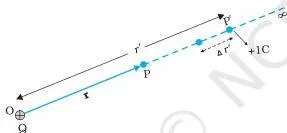
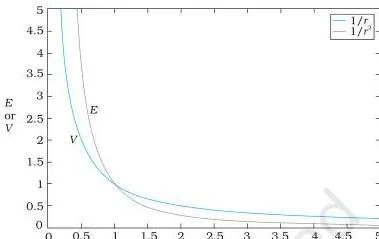
Figure 2.4 compares how the two quantities fall off with distance: the potential as \( 1/r \) (blue curve) and the field as \( 1/r^2 \) (black curve), so \( V \) decreases more slowly than \( E \) (NCERT, p. 49).
Potential Due to an Electric Dipole
A dipole of charges \( +q \) and \( -q \) separated by \( 2a \) has dipole moment \( \mathbf{p} \) of magnitude \( 2qa \) pointing from \( -q \) to \( +q \). The exact potential is the sum of the two point-charge potentials (NCERT, p. 50):
\[ V = \frac{1}{4\pi\varepsilon_0}\left( \frac{q}{r_1} – \frac{q}{r_2} \right) \]
Far-field form, valid for \( r \gg a \):
\[ V = \frac{1}{4\pi\varepsilon_0}\frac{\mathbf{p}\cdot\hat{\mathbf{r}}}{r^2} \]
On the dipole axis (\( \theta = 0, \pi \)): \( V = \pm \dfrac{1}{4\pi\varepsilon_0}\dfrac{p}{r^2} \), and in the equatorial plane (\( \theta = \pi/2 \)): \( V = 0 \). The dipole potential falls as \( 1/r^2 \), not as \( 1/r \) like a single charge.
Potential Due to a System of Charges
Potentials add as scalars (superposition principle), so for charges \( q_1, q_2, \dots, q_n \) (NCERT, p. 51):
\[ V = \frac{1}{4\pi\varepsilon_0}\left( \frac{q_1}{r_{1P}} + \frac{q_2}{r_{2P}} + \dots + \frac{q_n}{r_{nP}} \right) \]
Uniformly charged spherical shell: outside the shell the potential behaves as if the total charge \( q \) were at the centre, and inside it is constant (NCERT, p. 52):
\[ V = \frac{1}{4\pi\varepsilon_0}\frac{q}{r} \ (r \geq R); \quad V = \frac{1}{4\pi\varepsilon_0}\frac{q}{R} \ (r \leq R) \]
Equipotential Surfaces and Relation Between Field and Potential
An equipotential surface has constant potential everywhere on it. The electric field at any point is normal (perpendicular) to the equipotential surface through that point (NCERT, p. 54). For a uniform field along the x-axis, the equipotential surfaces are planes parallel to the y–z plane, as in Figure 2.10.

Field magnitude from potential: the field points in the direction in which the potential decreases steepest, and its magnitude is the potential drop per unit distance normal to the equipotential surface (NCERT, p. 55):
\[ |\mathbf{E}| = -\frac{\delta V}{\delta l} \]
Potential Energy of a System of Charges
The potential energy of two point charges equals the work done in assembling them from infinity (NCERT, p. 56):
\[ U = \frac{1}{4\pi\varepsilon_0}\frac{q_1 q_2}{r_{12}} \]
For like charges \( U \gt 0 \) (repulsive, work must be done to bring them close); for unlike charges \( U \lt 0 \). For three charges (NCERT, p. 56):
\[ U = \frac{1}{4\pi\varepsilon_0}\left( \frac{q_1 q_2}{r_{12}} + \frac{q_1 q_3}{r_{13}} + \frac{q_2 q_3}{r_{23}} \right) \]
The result is independent of the order in which the charges are brought in, because the electrostatic force is conservative.
Potential Energy of a Charge in an External Field
Here \( V(\mathbf{r}) \) is the potential due to external sources, not due to the charge itself. A charge \( q \) placed at \( \mathbf{r} \) in this external field has (NCERT, p. 58):
\[ U = qV(\mathbf{r}) \]
Two charges in an external field (NCERT, p. 59):
\[ U = q_1 V(\mathbf{r}_1) + q_2 V(\mathbf{r}_2) + \frac{1}{4\pi\varepsilon_0}\frac{q_1 q_2}{r_{12}} \]
Useful conversion from the same section: \( 1\ \text{eV} = 1.6 \times 10^{-19}\ \text{J} \), with \( 1\ \text{keV} = 10^3\ \text{eV} \), \( 1\ \text{MeV} = 10^6\ \text{eV} \) (NCERT, p. 58).
Potential Energy of a Dipole in an External Field
A dipole in a uniform field experiences zero net force but a torque that tends to rotate it (NCERT, p. 60):
\[ \boldsymbol{\tau} = \mathbf{p} \times \mathbf{E} \]
The work done in rotating the dipole is stored as potential energy. Taking \( U = 0 \) at \( \theta = \pi/2 \):
\[ U(\theta) = -pE\cos\theta = -\mathbf{p}\cdot\mathbf{E} \]
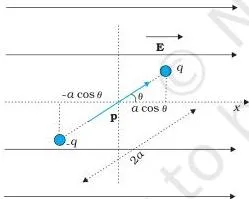
The energy is minimum (most stable) when the dipole is aligned with the field, \( \theta = 0 \), and maximum when it is anti-aligned, \( \theta = \pi \).
Electrostatics of Conductors
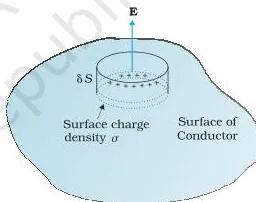
In the static situation the field inside a conductor is zero, the potential is constant throughout the conductor, and any excess charge resides only on its surface (NCERT, p. 62). Just outside the surface (NCERT, p. 63):
\[ \mathbf{E} = \frac{\sigma}{\varepsilon_0}\hat{\mathbf{n}} \]
where \( \sigma \) is the surface charge density and \( \hat{\mathbf{n}} \) is the outward unit normal. Figure 2.18 shows the shielding result: the field inside a charge-free cavity of a conductor is zero whatever the charge or field outside, which is why sensitive instruments inside a conductor are protected (NCERT, p. 64).
Dielectrics and Polarisation
A dielectric develops a net dipole moment per unit volume called the polarisation \( \mathbf{P} \). For linear isotropic dielectrics (NCERT, p. 66):
\[ \mathbf{P} = \varepsilon_0 \chi_e \mathbf{E} \]
where \( \chi_e \) is the electric susceptibility of the medium. The induced surface charges of the polarised dielectric produce a field that opposes the external field, so the net field inside the dielectric is reduced — but not cancelled to zero as in a conductor (NCERT, p. 67).
Capacitors and Capacitance
A capacitor is a system of two conductors carrying charges \( +Q \) and \( -Q \), with potential difference \( V \) between them. The ratio \( Q/V \) is a constant called the capacitance (NCERT, p. 67):
\[ C = \frac{Q}{V} \]
\( C \) depends only on the geometry (shape, size, separation) and on the dielectric between the conductors, not on \( Q \) or \( V \). The SI unit is the farad: \( 1\ \text{F} = 1\ \text{C V}^{-1} \); common submultiples are \( 1\ \mu\text{F} = 10^{-6}\ \text{F} \), \( 1\ \text{nF} = 10^{-9}\ \text{F} \), \( 1\ \text{pF} = 10^{-12}\ \text{F} \) (NCERT, p. 67–68).
The Parallel Plate Capacitor
For two large plates of area \( A \), separation \( d \) (with \( d^2 \ll A \)), the field is confined between the plates and is uniform (NCERT, p. 68):
\[ E = \frac{\sigma}{\varepsilon_0} = \frac{Q}{\varepsilon_0 A}; \quad V = Ed = \frac{Qd}{\varepsilon_0 A} \]
Capacitance of a parallel plate capacitor (vacuum):
\[ C = \frac{\varepsilon_0 A}{d} \]
Effect of Dielectric on Capacitance
With a dielectric fully filling the gap, the induced surface charge density \( \sigma_p \) weakens the field inside, so the potential difference drops for the same free charge \( Q \) (NCERT, p. 70):
\[ E = \frac{\sigma – \sigma_p}{\varepsilon_0}; \quad V = \frac{Qd}{A\varepsilon_0 K} \]
Capacitance with dielectric:
\[ C = \frac{\varepsilon_0 K A}{d} = \frac{\varepsilon A}{d} \]
The permittivity of the medium is \( \varepsilon = \varepsilon_0 K \) and the dimensionless dielectric constant is \( K = \varepsilon/\varepsilon_0 = C/C_0 \), with \( K \gt 1 \) (NCERT, p. 70).
Combination of Capacitors
Series combination: the same charge \( Q \) sits on each capacitor and the potential differences add (NCERT, p. 72):
\[ \frac{1}{C} = \frac{1}{C_1} + \frac{1}{C_2} + \dots + \frac{1}{C_n} \]
Parallel combination: the same potential difference \( V \) appears across each capacitor and the charges add (NCERT, p. 72):
\[ C = C_1 + C_2 + \dots + C_n \]
Quick check: a series combination has a smaller equivalent capacitance than the smallest individual; a parallel combination has a larger equivalent than the largest.
Energy Stored in a Capacitor
The work done in charging a capacitor is stored as electrostatic potential energy, expressible in three equivalent forms (NCERT, p. 74):
\[ U = \frac{Q^2}{2C} = \frac{1}{2}CV^2 = \frac{1}{2}QV \]
Energy density of the electric field (energy per unit volume), a result that holds for any charge configuration (NCERT, p. 74):
\[ u = \frac{1}{2}\varepsilon_0 E^2 \]
What Each Symbol Means
| Symbol | What it means | Unit |
|---|---|---|
| \( V \) | Electrostatic potential | volt (V) |
| \( V_P – V_R \) | Potential difference between two points | volt (V) |
| \( U \) | Electrostatic potential energy | joule (J) |
| \( q \) | Charge moved (test charge or charge in an external field) | coulomb (C) |
| \( Q \) | Source charge, or charge on one plate of a capacitor | coulomb (C) |
| \( r \) | Distance from a charge, or between charges | metre (m) |
| \( r_{12},\ r_{1P} \) | Distance between charges, or from charge \( q_1 \) to the field point \( P \) | metre (m) |
| \( \varepsilon_0 \) | Permittivity of free space | \( \text{F m}^{-1} \) or \( \text{C}^2\text{N}^{-1}\text{m}^{-2} \) |
| \( \frac{1}{4\pi\varepsilon_0} \) | Coulomb’s law constant | \( 9 \times 10^9\ \text{N m}^2\text{C}^{-2} \) |
| \( \mathbf{p} \) | Electric dipole moment (magnitude \( 2qa \), from \( -q \) to \( +q \)) | C m |
| \( \theta \) | Angle between the dipole axis and \( \mathbf{r} \) (or between \( \mathbf{p} \) and \( \mathbf{E} \)) | degree or radian |
| \( \mathbf{E} \) | Electric field | V m⁻¹ (or N C⁻¹) |
| \( \sigma \) | Surface charge density | C m⁻² |
| \( \sigma_p \) | Induced surface charge density of a polarised dielectric | C m⁻² |
| \( \hat{\mathbf{n}} \) | Unit vector along the outward normal to a surface | dimensionless |
| \( \mathbf{P} \) | Polarisation (dipole moment per unit volume) | C m⁻² |
| \( \chi_e \) | Electric susceptibility of the dielectric | dimensionless |
| \( C \) | Capacitance | farad (F) |
| \( A \) | Area of each plate | m² |
| \( d \) | Separation between the plates | metre (m) |
| \( K \) | Dielectric constant (\( K = C/C_0 \), \( K \gt 1 \)) | dimensionless |
| \( \varepsilon \) | Permittivity of the medium (\( \varepsilon = \varepsilon_0 K \)) | F m⁻¹ |
| \( V_0,\ C_0 \) | Potential difference and capacitance with vacuum between the plates | V, F |
| \( u \) | Energy density of the electric field | J m⁻³ |
When to Use Each Formula
| Formula | Reach for it when… | Valid when |
|---|---|---|
| \( V(r) = \dfrac{1}{4\pi\varepsilon_0}\dfrac{Q}{r} \) | You need the potential of one isolated point charge at a distance \( r \) | Potential at infinity taken as zero; any sign of \( Q \) |
| \( V = \dfrac{1}{4\pi\varepsilon_0}\dfrac{\mathbf{p}\cdot\hat{\mathbf{r}}}{r^2} \) | The source is a dipole and you are far from it | \( r \gg a \) (exact for an ideal point dipole at the origin) |
| \( V = \dfrac{1}{4\pi\varepsilon_0}\sum\dfrac{q_i}{r_{iP}} \) | Several point charges contribute; add the potentials as scalars | Any static charge configuration |
| Spherical shell: \( \dfrac{q}{4\pi\varepsilon_0 r} \), \( \dfrac{q}{4\pi\varepsilon_0 R} \) | The charge is uniformly spread on a conducting shell | Outside form for \( r \geq R \); inside and surface value is constant |
| \( |\mathbf{E}| = -\dfrac{\delta V}{\delta l} \) | The potential distribution is known and you need the field magnitude or direction | Potential varies smoothly in space; field points to steepest decrease |
| \( U = \dfrac{1}{4\pi\varepsilon_0}\dfrac{q_1 q_2}{r_{12}} \) | You assemble two charges from infinity, or want the mutual energy of a pair | Any signs of \( q_1, q_2 \); sign of \( U \) tells repulsion/attraction |
| \( U = qV(\mathbf{r}) \) | A small charge sits in a known external potential \( V \) | \( V \) is produced by external sources, not by \( q \) itself |
| \( \boldsymbol{\tau} = \mathbf{p} \times \mathbf{E} \), \( U = -\mathbf{p}\cdot\mathbf{E} \) | A dipole is placed in a uniform field; torque or orientation energy is needed | Uniform external field; \( U = 0 \) chosen at \( \theta = \pi/2 \) |
| \( \mathbf{E} = \dfrac{\sigma}{\varepsilon_0}\hat{\mathbf{n}} \) | Field just outside a charged conductor’s surface | Static situation; \( \sigma \) is the local surface charge density |
| \( C = \dfrac{Q}{V} \) | Definition-level problem: find charge from voltage or vice versa | Any capacitor; \( Q \) is the charge on one conductor, \( V \) the potential difference |
| \( C = \dfrac{\varepsilon_0 A}{d} \) | Parallel plate capacitor with vacuum between the plates | \( d^2 \ll A \) (fringing ignored) |
| \( C = \dfrac{\varepsilon_0 K A}{d} \) | Dielectric fully fills the space between the plates | Linear isotropic dielectric; \( K = C/C_0 \) |
| Series: \( \dfrac{1}{C} = \sum \dfrac{1}{C_i} \) | Capacitors connected end to end; same charge on each | Any number \( n \) of capacitors |
| Parallel: \( C = \sum C_i \) | Capacitors connected across the same two points; same voltage on each | Any number \( n \) of capacitors |
| \( U = \dfrac{Q^2}{2C} = \dfrac{1}{2}CV^2 = \dfrac{1}{2}QV \) | Energy stored in a charged capacitor | Pick the form containing the two quantities you know |
| \( u = \dfrac{1}{2}\varepsilon_0 E^2 \) | Energy per unit volume stored in an electric field | Any configuration; not limited to parallel plates |
Worked Examples
These examples use original numbers; the formulas are the NCERT chapter’s own. You can verify any derivation against the official NCERT Class 12 Physics textbooks for this chapter on ncert.nic.in.
Worked Example 1: Potential and work for a single point charge
Step 1: A charge \( Q = +2.0\ \mu\text{C} \) sits at the origin.
Find the potential at a point 8 cm from it.
Formula to use: \( V(r) = \dfrac{1}{4\pi\varepsilon_0}\dfrac{Q}{r} \), valid for a single point charge with potential zero at infinity.
\[ V = (9 \times 10^{9}\ \text{N m}^2\text{C}^{-2}) \times \frac{2.0 \times 10^{-6}\ \text{C}}{0.08\ \text{m}} = 2.25 \times 10^{5}\ \text{V} \]
Step 2: Work needed to bring \( q = +3.0 \times 10^{-9}\ \text{C} \) from infinity to that point is \( W = qV \).
\[ W = (3.0 \times 10^{-9}\ \text{C}) \times (2.25 \times 10^{5}\ \text{V}) = 6.75 \times 10^{-4}\ \text{J} \]
Final answer: \( V = 2.25 \times 10^{5}\ \text{V} \) and \( W = 6.75 \times 10^{-4}\ \text{J} \). The work is path-independent because the electrostatic force is conservative.
Worked Example 2: Locating the zero-potential point between two charges
Step 1: Charges \( q_1 = +4.0\ \mu\text{C} \) and \( q_2 = -1.0\ \mu\text{C} \) are 12 cm apart.
Find the point(s) on the line joining them where the potential is zero.
Formula to use: \( V = \dfrac{1}{4\pi\varepsilon_0}\left(\dfrac{q_1}{r_1} + \dfrac{q_2}{r_2}\right) \) — scalar addition with signs.
Step 2 (between the charges): Take \( x \) as the distance from \( q_1 \); then \( r_1 = x \), \( r_2 = 12 – x \) (in cm).
Set \( V = 0 \):
\[ \frac{4.0}{x} – \frac{1.0}{12 – x} = 0 \Rightarrow 4.0(12 – x) = x \Rightarrow x = 9.6\ \text{cm} \]
Step 3 (beyond the negative charge): Now \( r_1 = x \), \( r_2 = x – 12 \):
\[ \frac{4.0}{x} – \frac{1.0}{x – 12} = 0 \Rightarrow 4.0(x – 12) = x \Rightarrow x = 16\ \text{cm} \]
Final answer: \( V = 0 \) at 9.6 cm and at 16 cm from the positive charge, both measured on the side of the negative charge. There is no zero-potential point on the other side of \( q_1 \).
Worked Example 3: Energy stored in a capacitor in three equivalent forms
Step 1: A \( 5.0\ \mu\text{F} \) capacitor is charged to \( 40\ \text{V} \).
First find the charge.
\[ Q = CV = (5.0 \times 10^{-6}\ \text{F})(40\ \text{V}) = 2.0 \times 10^{-4}\ \text{C} \]
Step 2: Use \( U = \frac{1}{2}CV^2 \):
\[ U = \frac{1}{2}(5.0 \times 10^{-6}\ \text{F})(40\ \text{V})^2 = 4.0 \times 10^{-3}\ \text{J} \]
Step 3 (check with the other two forms):
\[ U = \frac{1}{2}QV = \frac{1}{2}(2.0 \times 10^{-4})(40) = 4.0 \times 10^{-3}\ \text{J}; \quad U = \frac{Q^2}{2C} = \frac{(2.0 \times 10^{-4})^2}{2(5.0 \times 10^{-6})} = 4.0 \times 10^{-3}\ \text{J} \]
Final answer: The stored energy is \( U = 4.0 \times 10^{-3}\ \text{J} \). All three energy formulas agree, so any one of them can be used as an answer check.
Common Mistakes to Avoid
| Mistake | Correct rule | How to check your answer |
|---|---|---|
| Using \( V = \frac{1}{4\pi\varepsilon_0}\frac{Q}{r} \) with the magnitude of charge only, ignoring the sign of \( Q \) | \( V \) carries the sign of \( Q \): \( Q \lt 0 \) gives \( V \lt 0 \) | For a negative source charge the field pulls a positive test charge in, so bringing it from infinity needs negative external work — potential must come out negative |
| Applying the dipole far-field formula \( V = \frac{\mathbf{p}\cdot\hat{\mathbf{r}}}{4\pi\varepsilon_0 r^2} \) at small \( r \) | The form holds for \( r \gg a \) (exact only for an ideal point dipole); for nearby points sum the two charges exactly: \( V = \frac{q}{4\pi\varepsilon_0}\left(\frac{1}{r_1} – \frac{1}{r_2}\right) \) | Compare \( r \) with \( 2a \); if they are comparable, use the two-charge sum |
| Swapping the series and parallel combination formulas | Series: \( \frac{1}{C} = \sum \frac{1}{C_i} \), equivalent smaller than the smallest; Parallel: \( C = \sum C_i \), larger than the largest | Two equal capacitors in series give \( C/2 \); in parallel they give \( 2C \) |
| Reading \( V \) in \( C = Q/V \) as the potential of a single plate | \( V \) is the potential difference between the two conductors, \( V_1 – V_2 \) | For a parallel plate capacitor, check consistency with \( V = Ed \) |
Frequently Asked Questions
Why do we take the potential at infinity as zero?
Only potential differences are physically significant; adding the same constant to \( V \) at every point leaves every difference unchanged. So the zero of potential is a free choice, and infinity is simply the most convenient reference. With that choice the point-charge formula comes out in its cleanest form, \( V = Q/4\pi\varepsilon_0 r \) (NCERT, p. 47).
Is the potential due to a dipole really zero in the equatorial plane?
Yes. In the equatorial plane \( \theta = \pi/2 \), so \( \cos\theta = 0 \) and the far-field formula gives \( V = 0 \). Physically, every point of that plane is equidistant from \( +q \) and \( -q \), so the two point-charge potentials cancel exactly (NCERT, p. 50).
Why does inserting a dielectric increase the capacitance?
The dielectric polarises, producing induced surface charges \( \pm \sigma_p \) that create a field opposing the external field. For the same free charge \( Q \) on the plates, the potential difference \( V \) is reduced, so \( C = Q/V \) increases by the factor \( K \), giving \( C = KC_0 \) (NCERT, p. 70).
What happens to the energy when a charged capacitor is connected to an identical uncharged one?
Charge is conserved, but energy is not. If a charged capacitor of capacitance \( C \) is connected to an identical uncharged one, the common potential becomes \( V/2 \) and the total stored energy is half the original. The missing half is lost as heat and electromagnetic radiation during the transient current that flows while the charges redistribute (NCERT, p. 75).
Reference: NCERT Class 12 Physics textbook, chapter Electrostatic Potential and Capacitance.
Explore Class 12 Physics Formulas
More for this chapter:
Class 12 Physics on LearnCBSE:
Related chapters:
Official source: download the NCERT textbook free from ncert.nic.in.