This formula sheet covers the key equations from NCERT Class 12 Physics Chapter 6: Electromagnetic Induction. You will find the expressions for magnetic flux, Faraday’s law of induction, motional emf, self and mutual inductance, energy stored in an inductor, and the alternating emf generated by a rotating coil.
Each formula is grouped by the sub-topic where it appears in the textbook, with its symbols, SI units, and a short explanation of when to use it.
For a step-by-step explanation of the concepts and derivations, refer to the Electromagnetic Induction Class 12 Notes page. This sheet is designed for quick revision — check the table below to locate any formula at a glance.
Formulas at a Glance
| Purpose (what you are finding) | Formula |
|---|---|
| Magnetic flux through a plane area | \( \Phi_B = BA \cos \theta \) |
| Magnetic flux for a non‑uniform field (sum over area elements) | \( \Phi_B = \sum_i \mathbf{B}_i \cdot \mathrm{d}\mathbf{A}_i \) |
| Faraday’s law – induced emf (single turn) | \( \varepsilon = -\frac{\mathrm{d}\Phi_B}{\mathrm{d}t} \) |
| Faraday’s law – induced emf (\(N\) turns) | \( \varepsilon = -N\frac{\mathrm{d}\Phi_B}{\mathrm{d}t} \) |
| Motional emf (rod of length \(l\) moving perpendicular to \(\mathbf{B}\)) | \( \varepsilon = Blv \) |
| Motional emf in a rotating rod (one end at centre) | \( \varepsilon = \frac{1}{2} B \omega R^2 \) |
| Mutual inductance – induced emf in coil 1 due to current change in coil 2 | \( \varepsilon_1 = -M \frac{\mathrm{d}I_2}{\mathrm{d}t} \) |
| Mutual inductance of two coaxial solenoids (inner radius \(r_1\), length \(l\)) | \( M = \mu_0 n_1 n_2 \pi r_1^2 l \) |
| Mutual inductance of two concentric coils (small radius \(r_1 \ll r_2\)) | \( M = \frac{\mu_0 \pi r_1^2}{2r_2} \) |
| Self‑induced emf | \( \varepsilon = -L \frac{\mathrm{d}I}{\mathrm{d}t} \) |
| Self‑inductance of a long solenoid | \( L = \mu_0 n^2 A l \) |
| Self‑inductance with a magnetic core (relative permeability \(\mu_r\)) | \( L = \mu_r \mu_0 n^2 A l \) |
| Magnetic energy stored in an inductor | \( U = \frac{1}{2} L I^2 \) |
| Magnetic energy density | \( u_B = \frac{B^2}{2\mu_0} \) |
| AC generator – instantaneous emf | \( \varepsilon = NBA\omega \sin \omega t \) |
| AC generator – frequency form | \( \varepsilon = NBA (2\pi\nu) \sin (2\pi\nu t) \) |
All Formulas, Grouped by Topic
Magnetic Flux
Magnetic flux through a plane area \(A\) placed in a uniform magnetic field \(B\) is (NCERT, p. 4):
\[ \Phi_B = \mathbf{B} \cdot \mathbf{A} = BA\cos\theta \tag{6.1} \]
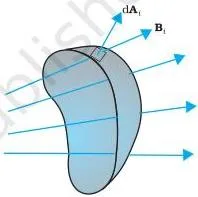
For a non‑uniform field, the flux is the sum over infinitesimal area elements:
\[ \Phi_B = \sum_i \mathbf{B}_i \cdot \mathrm{d}\mathbf{A}_i \tag{6.2} \]
Faraday’s Law of Induction
The magnitude of the induced emf in a circuit equals the time rate of change of magnetic flux through it (NCERT, p. 5).
\[ \varepsilon = -\frac{\mathrm{d}\Phi_B}{\mathrm{d}t} \tag{6.3} \]
For a closely wound coil of \(N\) turns, each turn experiences the same flux change:
\[ \varepsilon = -N\frac{\mathrm{d}\Phi_B}{\mathrm{d}t} \tag{6.4} \]
The negative sign expresses Lenz’s law: the induced emf opposes the change in flux.
Motional Electromotive Force
When a straight conductor of length \(l\) moves with speed \(v\) perpendicular to a uniform magnetic field \(B\), the motional emf across its ends is (NCERT, p. 10):
\[ \varepsilon = Blv \tag{6.5} \]
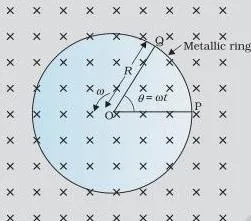
For a rod rotating about one end with angular speed \(\omega\) in a uniform perpendicular field, the emf between the centre and the rim is:
\[ \varepsilon = \frac{1}{2} B\omega R^2 \]
Mutual Inductance
If the current in coil 2 changes, the induced emf in coil 1 is (NCERT, p. 13):
\[ \varepsilon_1 = -M\frac{\mathrm{d}I_2}{\mathrm{d}t} \]
For two long coaxial solenoids (inner radius \(r_1\), outer radius \(r_2\), length \(l\) with \(l \gg r_2\)), the mutual inductance is (NCERT, p. 13):
\[ M = \mu_0 n_1 n_2 \pi r_1^2 l \tag{6.9} \]
For two concentric circular coils with \(r_1 \ll r_2\), the mutual inductance is (NCERT, p. 14):
\[ M = \frac{\mu_0 \pi r_1^2}{2r_2} \]
In general, mutual inductance is symmetric: \(M_{12} = M_{21} = M\).
Self‑Inductance
The self‑induced emf when the current in a coil changes is (NCERT, p. 15):
\[ \varepsilon = -L\frac{\mathrm{d}I}{\mathrm{d}t} \tag{6.14} \]
The self‑inductance of a long solenoid of cross‑sectional area \(A\), length \(l\), and \(n\) turns per unit length is (NCERT, p. 15):
\[ L = \mu_0 n^2 A l \tag{6.15} \]
If the solenoid is filled with a material of relative permeability \(\mu_r\):
\[ L = \mu_r \mu_0 n^2 A l \tag{6.16} \]
Energy Stored in an Inductor
The work done to build up the current \(I\) in an inductor is stored as magnetic energy (NCERT, p. 16):
\[ U = \frac{1}{2} L I^2 \tag{6.17} \]
The magnetic energy per unit volume (energy density) in a magnetic field \(B\) is:
\[ u_B = \frac{B^2}{2\mu_0} \tag{6.18} \]
AC Generator
When a coil of \(N\) turns and area \(A\) rotates with angular speed \(\omega\) in a uniform magnetic field \(B\), the instantaneous emf is (NCERT, p. 18):
\[ \varepsilon = NBA\omega \sin \omega t \tag{6.19} \]
Equivalently, with frequency \(\nu\) (\(\omega = 2\pi\nu\)):
\[ \varepsilon = NBA(2\pi\nu)\sin(2\pi\nu t) \tag{6.21} \]
What Each Symbol Means
| Symbol | Meaning | SI Unit |
|---|---|---|
| \(\Phi_B\) | Magnetic flux | weber (Wb) or T m² |
| \(\mathbf{B}\) | Magnetic field (vector) | tesla (T) |
| \(A\) | Area of the surface | m² |
| \(\theta\) | Angle between \(\mathbf{B}\) and the area vector \(\mathbf{A}\) | radian (dimensionless) |
| \(\varepsilon\) | Induced electromotive force (emf) | volt (V) |
| \(N\) | Number of turns in the coil | dimensionless (count) |
| \(t\) | Time | s |
| \(l\) | Length of conductor (or length of solenoid) | m |
| \(v\) | Speed of the conductor | m/s |
| \(R\) | Radius of rotation (or resistance) | m (or Ω) |
| \(\omega\) | Angular speed | rad/s |
| \(M\) | Mutual inductance | henry (H) |
| \(L\) | Self‑inductance | henry (H) |
| \(I\) | Electric current | A |
| \(n\) | Number of turns per unit length | m⁻¹ |
| \(\mu_0\) | Permeability of free space | N/A² = T m/A |
| \(\mu_r\) | Relative permeability of the core material | dimensionless |
| \(U\) | Magnetic energy stored | J |
| \(u_B\) | Magnetic energy density | J/m³ |
| \(\nu\) | Frequency of rotation | Hz (s⁻¹) |
When to Use Each Formula
| Formula | When to use it | Condition |
|---|---|---|
| \(\Phi_B = BA\cos\theta\) | To find the magnetic flux through a flat surface in a uniform field. | Field must be uniform over the surface. |
| \(\varepsilon = -N\,d\Phi_B/dt\) | To calculate the emf induced in a coil when the magnetic flux through it changes with time. | Valid for any flux change; the time derivative must exist. |
| \(\varepsilon = Blv\) | When a straight conductor moves perpendicular to a uniform magnetic field. | \(\mathbf{v} \perp \mathbf{B}\) and \(\mathbf{l} \perp \mathbf{B}\); field is constant. |
| \(\varepsilon = \frac{1}{2}B\omega R^2\) | For a rod rotating about one end in a uniform perpendicular field – find emf between centre and rim. | Field is uniform, axis of rotation is parallel to \(\mathbf{B}\). |
| \(\varepsilon_1 = -M\,dI_2/dt\) | To find the induced emf in one coil due to a changing current in a nearby coil. | The mutual inductance \(M\) is constant (geometry fixed). |
| \(M = \mu_0 n_1 n_2 \pi r_1^2 l\) | To calculate mutual inductance of two long coaxial solenoids (inner one fully inside outer). | \(l \gg r_2\) (edge effects negligible); air core. |
| \(M = \frac{\mu_0 \pi r_1^2}{2r_2}\) | For two concentric circular coils with \(r_1 \ll r_2\), to find mutual inductance. | Field of the larger coil is taken as uniform over the small coil. |
| \(\varepsilon = -L\,dI/dt\) | To find the back emf in a single coil when its own current changes. | Self‑inductance \(L\) is constant (geometry unchanged). |
| \(L = \mu_0 n^2 A l\) | To calculate the self‑inductance of a long air‑core solenoid. | Solenoid is long (\(l \gg \sqrt{A}\)); field is uniform inside. |
| \(U = \frac{1}{2} L I^2\) | To find the magnetic energy stored in an inductor carrying a steady current. | Valid for any inductor with constant \(L\). |
| \(u_B = B^2/(2\mu_0)\) | To compute the energy per unit volume stored in a magnetic field (in vacuum). | Applies to any point in a magnetic field in free space. |
| \(\varepsilon = NBA\omega \sin \omega t\) | To find the instantaneous emf generated by an ac generator (rotating coil). | \(\theta = 0\) at \(t=0\); uniform field; constant angular speed. |
Worked Examples
Example 1: Motional emf in a moving rod
Situation: A metal rod of length 0.80 m slides on a U‑shaped rail at 4.0 m/s in a uniform magnetic field of 0.30 T directed perpendicular to the plane of the rails. Find the induced emf across the rod.
Step 1: Identify the formula.
The rod moves perpendicular to the field, so use \(\varepsilon = Blv\).
Step 2: Substitute the values: \(B = 0.30\,\text{T}\), \(l = 0.80\,\text{m}\), \(v = 4.0\,\text{m/s}\).
\[ \varepsilon = (0.30)(0.80)(4.0) = 0.96\,\text{V} \]
Answer: \(\varepsilon = 0.96\) V.
Example 2: Self‑induced emf in a solenoid
Situation: A solenoid has 500 turns, length 0.25 m, and cross‑sectional area 4.0 × 10⁻⁴ m². The current through it decreases uniformly from 3.0 A to 1.0 A in 0.20 s. Calculate the magnitude of the self‑induced emf.
- Step 1: Find the number of turns per unit length: \(n = N/l = 500/0.25 = 2000\) m⁻¹.
- Step 2: Compute self‑inductance using \(L = \mu_0 n^2 A l\).
\[ L = (4\pi\times10^{-7})(2000^2)(4.0\times10^{-4})(0.25) \]
\[ L = 4\pi\times10^{-7} \times 4\times10^{6} \times 1.0\times10^{-4} = 4\pi\times10^{-5} \approx 1.26\times10^{-4}\ \text{H} \]
- Step 1: Rate of change of current: \(\Delta I/\Delta t = (1.0-3.0)/0.20 = -10\ \text{A/s}\).
- Step 2: Use \(|\varepsilon| = L\,|dI/dt|\) (we want magnitude).
\[ |\varepsilon| = (1.26\times10^{-4})(10) = 1.26\times10^{-3}\ \text{V} \]
Answer: The induced emf is about 1.3 mV.
Example 3: AC generator emf
Situation: A 200‑turn coil of area 0.050 m² rotates at 60 Hz in a uniform magnetic field of 0.20 T. What is the peak emf generated?
Step 1: The peak emf is \(\varepsilon_0 = NBA\omega\).
Here \(\omega = 2\pi\nu = 2\pi(60) = 120\pi\) rad/s.
Step 2: Substitute: \(N=200\), \(B=0.20\,\text{T}\), \(A=0.050\,\text{m}^2\).
\[ \varepsilon_0 = 200 \times 0.20 \times 0.050 \times 120\pi \]
\[ \varepsilon_0 = 200 \times 0.20 \times 0.050 \times 120 \times 3.1416 \approx 754\,\text{V} \]
Answer: The peak emf is approximately 754 V.
Common Mistakes to Avoid
| Mistake | Correct rule | How to check your answer |
|---|---|---|
| Forgetting the negative sign in Faraday’s law and Lenz’s law. | The negative sign is a reminder that the induced emf opposes the change in flux. When calculating magnitude only, you may drop the sign, but in direction problems it matters. | Verify that the direction you predict for the induced current (using Lenz’s law) agrees with the sign you used. |
| Using the wrong angle \(\theta\) in \(\Phi_B = BA\cos\theta\). | \(\theta\) is the angle between the magnetic field vector and the area vector (normal to the surface). It is not the angle between the field and the plane of the surface. | If the field is perpendicular to the plane, \(\theta = 0\), not 90°. |
| Omitting the number of turns \(N\) in Faraday’s law for a coil. | For a coil with \(N\) turns, the total induced emf is \(\varepsilon = -N\,d\Phi_B/dt\). | If the problem gives a coil of \(N\) turns, always multiply by \(N\). |
| Confusing \(L\) (self‑inductance) with \(M\) (mutual inductance). | \(L\) relates the induced emf in a coil to its own current change; \(M\) relates the induced emf in one coil to the current change in another coil. | Check whether the current that changes flows in the same coil (use \(L\)) or in a different coil (use \(M\)). |
| Using \(U = \frac{1}{2}LI^2\) for a coil with changing current – the formula holds only for steady current (the energy stored depends only on the instantaneous current). | The formula is valid at any instant because it gives the energy associated with the current \(I\) at that moment, regardless of whether \(I\) is changing. | If \(I\) is time‑varying, the energy is still \(\frac{1}{2}LI(t)^2\). |
Frequently Asked Questions
What is the difference between self‑inductance and mutual inductance?
Self‑inductance \(L\) is the property of a single coil by which a change in its own current induces an emf in the same coil. Mutual inductance \(M\) is the property of a pair of coils: a change in current in one coil induces an emf in the other coil. Both are measured in henry (H).
How do I apply Lenz’s law to find the direction of induced current?
Lenz’s law states that the induced current flows in a direction that opposes the change in magnetic flux that produced it. For example, if the magnetic flux through a loop is increasing, the induced current creates a magnetic field opposite to the external field, trying to reduce the increase.
If the flux is decreasing, the induced current tries to sustain the flux. Use the right‑hand rule to relate the current direction to the magnetic field it produces.
What is motional emf, and when can I use the formula \(\varepsilon = Blv\)?
Motional emf is the emf induced across a conductor moving through a magnetic field. The formula \(\varepsilon = Blv\) applies when the conductor of length \(l\) moves with speed \(v\) perpendicular to both its length and the uniform magnetic field \(B\).
If any of these directions are not perpendicular, you must use the component of \(v\) or \(B\) that is mutually perpendicular.
Why does the energy stored in an inductor have the form \(\frac{1}{2}LI^2\)?
The energy arises from the work done against the back emf while building up the current. Integrating the power \(\varepsilon I = L I\,dI/dt\) from zero to \(I\) gives \(\frac{1}{2}LI^2\). It is analogous to the kinetic energy \(\frac{1}{2}mv^2\) in mechanics, with \(L\) playing the role of inertia.
Reference: NCERT Class 12 Physics textbook, chapter “Electromagnetic Induction”.
For more practice, see the NCERT Solutions for this chapter.
Explore Class 12 Physics Formulas
More for this chapter:
Class 12 Physics on LearnCBSE:
Related chapters:
Official source: download the NCERT textbook free from ncert.nic.in.