This sheet collects the moving charges and magnetism class 12 formulas from NCERT Physics Chapter 4 — the Lorentz force, force on a conductor, circular and helical motion in a magnetic field, Biot-Savart law, Ampere’s circuital law, fields of a loop and a solenoid, force between parallel currents, torque on a loop, and the moving coil galvanometer.
Each formula is grouped by sub-topic with the meaning and unit of every symbol, a when-to-use note, and three worked examples using original numbers. The Class 12 physics formulas hub organises the other chapters, and the main physics formulas index lists sheets for every class — keep them open together while you revise.
Moving Charges and Magnetism Class 12 Formulas at a Glance
The table is a quick index: every formula on this page appears here, and again in the grouped list below.
| Purpose | Formula |
|---|---|
| Total force on a moving charge in combined electric and magnetic fields (Lorentz force) | \(\mathbf{F} = q(\mathbf{E} + \mathbf{v} \times \mathbf{B})\) |
| Magnitude of the magnetic force on a moving charge | \(F = qvB\sin\theta\) |
| Force on a straight current-carrying conductor in a uniform external field | \(\mathbf{F} = I\,\mathbf{l} \times \mathbf{B}\) |
| Magnitude of the force on a conductor | \(F = IlB\sin\theta\) |
| Radius of the circular path when velocity is perpendicular to the field | \(r = \dfrac{mv}{qB}\) |
| Angular frequency of the circular motion | \(\omega = \dfrac{qB}{m}\) |
| Cyclotron frequency (from the angular frequency) | \(\nu_c = \dfrac{qB}{2\pi m}\) |
| Period of one revolution (from the angular frequency) | \(T = \dfrac{2\pi m}{qB}\) |
| Pitch of the helix when velocity has a component along the field | \(p = \dfrac{2\pi m v_{\parallel}}{qB}\) |
| Biot-Savart law, vector form | \(d\mathbf{B} = \dfrac{\mu_0}{4\pi}\,\dfrac{I\,d\mathbf{l} \times \mathbf{r}}{r^3}\) |
| Biot-Savart law, magnitude form | \(dB = \dfrac{\mu_0}{4\pi}\,\dfrac{I\,dl\sin\theta}{r^2}\) |
| Exact value of the vacuum permeability constant | \(\dfrac{\mu_0}{4\pi} = 10^{-7}\ \text{T m A}^{-1}\) |
| Field on the axis of a circular loop, at distance \(x\) from the centre | \(B = \dfrac{\mu_0 I R^2}{2(x^2 + R^2)^{3/2}}\) |
| Field at the centre of a circular loop; for \(N\) turns multiply by \(N\) | \(B_0 = \dfrac{\mu_0 I}{2R}\) |
| Ampere’s circuital law, integral form | \(\oint \mathbf{B} \cdot d\mathbf{l} = \mu_0 I\) |
| Ampere’s law when \(\mathbf{B}\) is constant and tangential on the loop | \(BL = \mu_0 I_e\) |
| Field of a long straight wire at a point outside the wire | \(B = \dfrac{\mu_0 I}{2\pi r}\) |
| Field of a long straight wire at a point inside the wire | \(B = \dfrac{\mu_0 I}{2\pi a^2}\,r\) |
| Field inside a long solenoid | \(B = \mu_0 n I\) |
| Force on a length \(L\) of one wire due to a parallel current in another | \(F = \dfrac{\mu_0 I_a I_b}{2\pi d}\,L\) |
| Force per unit length between two parallel currents | \(f = \dfrac{\mu_0 I_a I_b}{2\pi d}\) |
| Magnetic moment of a planar loop with \(N\) turns | \(\mathbf{m} = NI\mathbf{A}\) |
| Torque on a current loop in a uniform field, vector form | \(\boldsymbol{\tau} = \mathbf{m} \times \mathbf{B}\) |
| Torque magnitude using the magnetic moment | \(\tau = mB\sin\theta = NIAB\sin\theta\) |
| Steady deflection of a moving coil galvanometer | \(\phi = \dfrac{NAB}{k}\,I\) |
| Current sensitivity of a galvanometer | \(\dfrac{\phi}{I} = \dfrac{NAB}{k}\) |
| Voltage sensitivity of a galvanometer | \(\dfrac{\phi}{V} = \dfrac{NAB}{kR}\) |
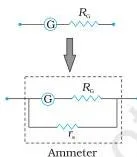
| Resistance of a galvanometer with a shunt in parallel (ammeter combination) | \(R_p = \dfrac{R_G r_s}{R_G + r_s}\) |
| Dipole field of a loop on its axis, far from the loop | \(B = \dfrac{\mu_0}{4\pi}\,\dfrac{2m}{x^3}\) |
| Dipole field of a loop in its plane, far from the loop | \(B = \dfrac{\mu_0}{4\pi}\,\dfrac{m}{x^3}\) |
All Formulas, Grouped by Topic
Lorentz Force and Force on a Current-Carrying Conductor
The total force on a charge \(q\) moving with velocity \(\mathbf{v}\) where electric and magnetic fields both act is the Lorentz force (NCERT, p. 109):
\[ \mathbf{F} = q[\mathbf{E}(\mathbf{r}) + \mathbf{v} \times \mathbf{B}(\mathbf{r})] \]
The magnetic part alone has magnitude \(F = qvB\sin\theta\), where \(\theta\) is the angle between \(\mathbf{v}\) and \(\mathbf{B}\). It is zero for a stationary charge and zero when \(\mathbf{v}\) is parallel or anti-parallel to \(\mathbf{B}\); being perpendicular to \(\mathbf{v}\), it does no work.
For a straight conductor of length \(l\) and current \(I\) in a uniform external field (NCERT, p. 110):
\[ \mathbf{F} = I\,\mathbf{l} \times \mathbf{B}, \qquad F = IlB\sin\theta \]
Here \(\mathbf{l}\) is a vector of magnitude \(l\) directed along the current, and \(\mathbf{B}\) is the external field, not the field the wire itself produces.
Motion of a Charged Particle in a Uniform Magnetic Field
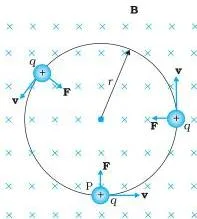
When \(\mathbf{v}\) is perpendicular to \(\mathbf{B}\), the magnetic force acts as the centripetal force. Equating \(mv^2/r\) with \(qvB\) gives the radius (NCERT, p. 112):
\[ r = \frac{mv}{qB} \]
The angular frequency and cyclotron frequency (NCERT Eq. 4.6a and the chapter summary):
\[ \omega = 2\pi\nu_c = \frac{qB}{m}, \qquad \nu_c = \frac{qB}{2\pi m} \]
Both are independent of speed and radius — the property that makes a cyclotron work. The period of one revolution is \(T = 2\pi m/qB\).
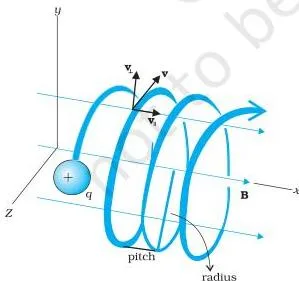
If the velocity has a component \(v_{\parallel}\) along \(\mathbf{B}\), that component is not affected by the field, and the particle moves in a helix. The distance advanced along the field in one revolution is the pitch (NCERT, p. 112):
\[ p = v_{\parallel} T = \frac{2\pi m v_{\parallel}}{qB} \]
Biot-Savart Law
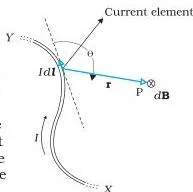
The magnetic field \(d\mathbf{B}\) of an infinitesimal current element \(I\,d\mathbf{l}\) at a point distance \(r\) away, in vacuum (NCERT, p. 113):
\[ d\mathbf{B} = \frac{\mu_0}{4\pi}\,\frac{I\,d\mathbf{l}\times \mathbf{r}}{r^3}, \qquad |d\mathbf{B}| = \frac{\mu_0}{4\pi}\,\frac{I\,dl\sin\theta}{r^2} \]
The proportionality constant is exact (NCERT, p. 114):
\[ \frac{\mu_0}{4\pi} = 10^{-7}\ \text{T m A}^{-1} \]
Because of the \(\sin\theta\) factor, the field is zero at points on the line of the element (\(\theta = 0\)) and is perpendicular to the plane containing the element and the field point. The total field is the vector sum over the whole conductor.
Magnetic Field of a Circular Current Loop
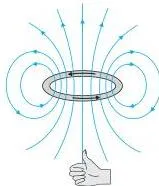
For a loop of radius \(R\) carrying current \(I\), the field on its axis at distance \(x\) from the centre (NCERT, p. 116):
\[ B = \frac{\mu_0 I R^2}{2(x^2 + R^2)^{3/2}} \]
At the centre, \(x = 0\):
\[ B_0 = \frac{\mu_0 I}{2R} \]
For \(N\) closely wound turns, multiply by \(N\): \(B_0 = \mu_0 N I/2R\) (used in NCERT Example 4.6). Direction on the axis follows the right-hand thumb rule — curl your fingers along the current; the thumb points along \(\mathbf{B}\).
Ampere’s Circuital Law
The line integral of \(\mathbf{B}\) around any closed loop equals \(\mu_0\) times the current passing through the surface bounded by the loop (NCERT, p. 117). It holds for steady currents:
\[ \oint \mathbf{B}\cdot d\mathbf{l} = \mu_0 I \]
When an amperian loop can be chosen so that \(\mathbf{B}\) is constant and tangential along length \(L\), the law reduces to \(BL = \mu_0 I_e\), with \(I_e\) the net current enclosed and its sign fixed by the right-hand rule.
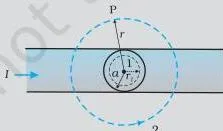
Applied to a long straight wire of cross-section radius \(a\) (NCERT, p. 120):
\[ B = \frac{\mu_0 I}{2\pi r}\quad (r \gt a), \qquad B = \frac{\mu_0 I}{2\pi a^2}\,r\quad (r \lt a) \]
Outside the wire \(B \propto 1/r\); inside it \(B \propto r\). Ampere’s law is not independent of the Biot-Savart law — it is related to it as Gauss’s law is to Coulomb’s law.
The Solenoid
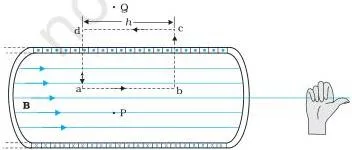
A long solenoid (length much larger than radius) with \(n\) turns per unit length carrying current \(I\) produces a uniform field inside, parallel to the axis; the field outside is taken as zero (NCERT, p. 121):
\[ B = \mu_0 n I \]
Force Between Two Parallel Currents
Conductor \(a\) sets up a field \(B_a = \mu_0 I_a/2\pi d\) at the position of conductor \(b\). The force on length \(L\) of \(b\) and the force per unit length (NCERT, pp. 122–123):
\[ F_{ba} = \frac{\mu_0 I_a I_b}{2\pi d}\,L, \qquad f = \frac{\mu_0 I_a I_b}{2\pi d} \]
Parallel currents attract; anti-parallel currents repel — the opposite of the electrostatic rule for like charges. This expression defines the ampere: the steady current in two parallel conductors 1 m apart in vacuum produces \(2 \times 10^{-7}\ \text{N m}^{-1}\) on each.
Torque on a Current Loop and Magnetic Moment
A rectangular loop of area \(A\) carrying current \(I\) in a uniform field feels no net force but a torque. With \(\theta\) the angle between the normal to the loop and \(\mathbf{B}\) (NCERT, p. 124):
\[ \tau = IAB\sin\theta \]
The magnetic moment of an \(N\)-turn planar loop (NCERT, p. 126):
\[ \mathbf{m} = NI\mathbf{A}, \qquad \boldsymbol{\tau} = \mathbf{m} \times \mathbf{B} \]
So \(\tau = mB\sin\theta = NIAB\sin\theta\). The torque vanishes when \(\mathbf{m}\) is parallel or anti-parallel to \(\mathbf{B}\); the parallel orientation is stable, the anti-parallel one unstable. The unit of \(\mathbf{m}\) is A m² (also written J/T).
Circular Current Loop as a Magnetic Dipole
Far from the loop the field resembles that of an electric dipole. On the axis, for \(x \gg R\) (NCERT, p. 128):
\[ B = \frac{\mu_0}{4\pi}\,\frac{2m}{x^3} \]
In the plane of the loop, for \(x \gg R\):
\[ B = \frac{\mu_0}{4\pi}\,\frac{m}{x^3} \]
Both results become exact for a point magnetic dipole.
The Moving Coil Galvanometer
In a radial magnetic field the deflecting torque \(NIAB\) is balanced by the spring torque \(k\phi\) (NCERT, p. 129):
\[ k\phi = NIAB, \qquad \phi = \frac{NAB}{k}\,I \]
Current sensitivity and voltage sensitivity (NCERT, p. 130):
\[ \frac{\phi}{I} = \frac{NAB}{k}, \qquad \frac{\phi}{V} = \frac{NAB}{kR} \]
Doubling \(N\) doubles the current sensitivity but not the voltage sensitivity, because the coil resistance also doubles. To measure current, a small shunt resistance \(r_s\) is put in parallel, making the combination \(R_G r_s/(R_G + r_s) \approx r_s\); to measure voltage, a large resistance is put in series.
What Each Symbol Means
All quantities are in SI units. Where the chapter’s table gives dimensions, they are included so you can check an answer by dimensional analysis (NCERT, p. 134).
| Symbol | What it means | Unit |
|---|---|---|
| \(\mathbf{F}\) | force on a charge, a conductor, or between currents | N |
| \(q\) | electric charge | C |
| \(\mathbf{E}\) | electric field | N C⁻¹ or V m⁻¹ |
| \(\mathbf{v}\) | velocity of the moving charge | m s⁻¹ |
| \(\mathbf{B}\) | magnetic field (external field in force formulas; produced field in Biot-Savart and Ampere formulas) | T (tesla); 1 T = 1 N s C⁻¹ m⁻¹; 1 gauss = 10⁻⁴ T; dimensions [M T⁻² A⁻¹] |
| \(I\) | electric current | A |
| \(\mathbf{l}\) | vector along a conductor, magnitude = length, direction = current direction | m |
| \(\theta\) | angle between \(\mathbf{v}\) and \(\mathbf{B}\), or between \(\mathbf{l}\) and \(\mathbf{B}\) | rad (dimensionless) |
| \(m\) | mass of the moving particle | kg |
| \(r\) | radius of the circular path; also the distance from a long straight wire | m |
| \(\omega\) | angular frequency of revolution | rad s⁻¹ |
| \(\nu_c\) | cyclotron frequency | Hz (s⁻¹) |
| \(T\) | time for one revolution | s |
| \(v_{\parallel}\) | component of velocity parallel to \(\mathbf{B}\) | m s⁻¹ |
| \(p\) | pitch of the helix | m |
| \(d\mathbf{l}\) | infinitesimal element of the conductor along the current | m |
| \(d\mathbf{B}\) | magnetic field contributed by a current element | T |
| \(R\) | radius of a circular loop (or solenoid) | m |
| \(x\) | distance along the axis from the centre of the loop | m |
| \(N\) | number of turns | count (dimensionless) |
| \(n\) | number of turns per unit length of a solenoid | m⁻¹ |
| \(a\) | radius of the wire’s circular cross-section | m |
| \(d\) | separation between two parallel conductors | m |
| \(L\) | length of a conductor segment | m |
| \(\mathbf{A}\) | area vector of the loop; direction by the right-hand thumb rule | m² |
| \(A\) | area enclosed by the loop | m² |
| \(\mathbf{m}\) | magnetic moment | A m² (also J/T); dimensions [L² A] |
| \(\tau\) | torque on the current loop | N m |
| \(\phi\) | steady angular deflection of the galvanometer coil | rad |
| \(k\) | torsion constant of the spring | N m rad⁻¹; dimensions [M L² T⁻²] |
| \(R_G\) | resistance of the galvanometer coil | \(\Omega\) |
| \(r_s\) | shunt resistance in parallel with the galvanometer | \(\Omega\) |
| \(R\) | in voltage sensitivity, the total series resistance of the voltmeter | \(\Omega\) |
| \(I_e\) | net current enclosed by an amperian loop | A |
| \(\mu_0\) | permeability of free space | T m A⁻¹; \(\mu_0 = 4\pi \times 10^{-7}\) T m A⁻¹; dimensions [M L T⁻² A⁻²] |
When to Use Each Formula
| Formula | Reach for it when | Remember |
|---|---|---|
| Lorentz force \(\mathbf{F} = q(\mathbf{E} + \mathbf{v} \times \mathbf{B})\) | a charge moves where both electric and magnetic fields act, or the problem asks for the total force | magnetic force is zero if \(\mathbf{v} \parallel \mathbf{B}\) or if \(v = 0\) |
| \(F = qvB\sin\theta\), \(F = IlB\sin\theta\) | you need only the magnitude of the magnetic force on a charge or on a straight wire | maximum when velocity (or wire) is perpendicular to \(\mathbf{B}\) |
| \(r = mv/qB\), \(\nu_c\), \(T\) | circular path in a uniform field, cyclotron frequency, or time of one revolution | use the component of \(\mathbf{v}\) perpendicular to \(\mathbf{B}\) |
| \(p = 2\pi m v_{\parallel}/qB\) | helical path, when the velocity has a component along the field | use \(v_{\parallel}\), not the total speed |
| Biot-Savart law | field of a current element; the starting point when you must integrate over a wire | valid in vacuum, for steady currents |
| Loop axis and centre formulas | field of a circular coil at an axial point or at its centre | centre is \(x = 0\); multiply by \(N\) for a coil |
| \(\oint \mathbf{B}\cdot d\mathbf{l} = \mu_0 I\) and \(BL = \mu_0 I_e\) | high-symmetry field problems such as a straight wire or solenoid | steady currents only; choose the loop along the field lines |
| Straight-wire fields | field at a distance from a long straight wire, inside or outside it | outside: \(1/r\); inside: proportional to \(r\) |
| \(B = \mu_0 n I\) | uniform field inside a long solenoid | solenoid length must be much larger than its radius |
| Parallel-wire force | force between two long parallel currents | same direction attract; opposite directions repel |
| \(\mathbf{m} = NI\mathbf{A}\), \(\boldsymbol{\tau} = \mathbf{m} \times \mathbf{B}\) | magnetic moment of a loop, torque on it, or its equilibrium orientation | torque is zero at \(\theta = 0\) and \(180^\circ\) |
| Galvanometer formulas | deflection of a moving coil galvanometer, or current and voltage sensitivity | radial field makes \(\sin\theta = 1\) |
Worked Examples
Example 1: Radius and cyclotron frequency of a proton in a magnetic field
Step 1: Identify the formula.
The proton enters perpendicular to \(\mathbf{B}\), so its path is circular.
Use \(r = mv/qB\) (NCERT Eq. 4.5).
\[ r = \frac{mv}{qB} = \frac{(1.67 \times 10^{-27}\ \text{kg})(2.0 \times 10^{6}\ \text{m s}^{-1})}{(1.6 \times 10^{-19}\ \text{C})(0.05\ \text{T})} \]
\[ r = \frac{3.34 \times 10^{-21}}{8.0 \times 10^{-21}} = 0.42\ \text{m} \]
Step 2: The frequency of revolution is the cyclotron frequency \(\nu_c = qB/2\pi m\).
\[ \nu_c = \frac{(1.6 \times 10^{-19})(0.05)}{2\pi (1.67 \times 10^{-27})} \approx 7.6 \times 10^{5}\ \text{Hz} \]
Final answer: \(r \approx 0.42\) m and \(\nu_c \approx 7.6 \times 10^{5}\) Hz. Check: \(v = 2\pi \nu_c r \approx 2.0 \times 10^{6}\) m s⁻¹, matching the given speed.
Example 2: Finding the current in a solenoid from the required field
Step 1: The field inside a long solenoid is uniform and given by \(B = \mu_0 n I\) (NCERT Eq. 4.16).
Here \(n = 1000\) turns per metre.
Rearrange for \(I\):
\[ I = \frac{B}{\mu_0 n} = \frac{6.28 \times 10^{-3}}{(4\pi \times 10^{-7})(1000)} \]
\[ I = \frac{6.28 \times 10^{-3}}{1.26 \times 10^{-3}} \approx 5.0\ \text{A} \]
Final answer: \(I \approx 5.0\) A. Check: \(\mu_0 n I = 4\pi \times 10^{-7} \times 1000 \times 5 \approx 6.28 \times 10^{-3}\) T, the required field.
Example 3: Torque on a coil using the magnetic moment
Step 1: The torque is \(\boldsymbol{\tau} = \mathbf{m} \times \mathbf{B}\), with magnitude \(\tau = mB\sin\theta\).
First find the magnetic moment using \(\mathbf{m} = NI\mathbf{A}\) (NCERT Eq. 4.24).
\[ m = NIA = 50 \times 3.0 \times (4.0 \times 10^{-3}) = 0.60\ \text{A m}^2 \]
Step 2: Here \(\theta = 60^\circ\) is the angle between the normal to the coil (the direction of \(\mathbf{m}\)) and \(\mathbf{B}\).
\[ \tau = mB\sin\theta = 0.60 \times 0.20 \times \sin 60^\circ = 0.60 \times 0.20 \times 0.866 \approx 0.10\ \text{N m} \]
Final answer: torque magnitude \(0.10\) N m, directed along \(\mathbf{m} \times \mathbf{B}\); it rotates the coil toward the stable orientation \(\theta = 0\). Check: at \(\theta = 90^\circ\) the torque would be \(mB = 0.12\) N m, so \(0.10\) N m at \(60^\circ\) is consistent with \(\sin 60^\circ\).
For practice, work through the NCERT exercises of this chapter (4.1 to 4.13) — each one maps directly onto one of the formula groups above.
Common Mistakes to Avoid
| Mistake | Correct rule | How to check your answer |
|---|---|---|
| Using the outside-wire formula \(B = \mu_0 I/2\pi r\) at a point inside the conductor | Inside the wire (\(r \lt a\)) use \(B = \dfrac{\mu_0 I}{2\pi a^2}r\); the \(1/r\) form is only for \(r \gt a\) | At \(r = a\) the two forms must agree and both give \(\mu_0 I/2\pi a\) |
| Mixing up the two right-hand rules | Straight wire: thumb along the current, fingers curl along \(\mathbf{B}\). Loop: fingers curl along the current, thumb along \(\mathbf{B}\) and \(\mathbf{m}\) | For a loop the field at the centre is perpendicular to the plane of the loop |
| Substituting length in cm or field in gauss without converting | Convert everything to SI first: cm to m, and 1 G = 10⁻⁴ T | Lab-scale fields usually come out in the range 10⁻⁴ to 10⁻² T; if not, re-check units |
| Dropping the \(N\) turns factor | Fields and torques of coils scale with the number of turns: \(B = \mu_0 N I/2R\), \(\tau = NIAB\sin\theta\) | Double the turns and the field must double |
| Using the plane-angle instead of \(\theta\) in the torque formula | \(\theta\) is the angle between the area vector (normal to the loop) and \(\mathbf{B}\); torque is maximum when the plane of the loop is parallel to \(\mathbf{B}\) | At \(\theta = 90^\circ\), torque is \(NIAB\); at \(\theta = 0\), it is zero |
| Assuming a magnetic field can speed a particle up | The magnetic force is always perpendicular to \(\mathbf{v}\), so it does no work and kinetic energy stays constant | Only an electric field \(q\mathbf{E}\) can change a particle’s speed |
| Using the positive-charge force direction for an electron | The right-hand rule gives the direction of \(q\mathbf{v} \times \mathbf{B}\); reverse it for a negative charge | \(\mathbf{v}\) along +x and \(\mathbf{B}\) along +y: proton feels +z, electron feels −z |
Frequently Asked Questions
Why is the cyclotron frequency independent of speed?
Because \(\omega = v/r\) and \(r = mv/qB\) together give \(\omega = qB/m\). A faster particle moves on a proportionally larger circle and still takes the same time per revolution. This is why a cyclotron can keep accelerating particles with a fixed-frequency alternating field.
In which cases is the magnetic force zero?
Three cases: a charge at rest (\(v = 0\)); velocity parallel or anti-parallel to \(\mathbf{B}\) (\(\theta = 0\) or \(180^\circ\)); and, in the Biot-Savart law, a field point lying on the line of the current element, where \(\sin\theta = 0\) gives \(dB = 0\).
Why do parallel currents attract while like charges repel?
Wire \(a\) produces \(B_a = \mu_0 I_a/2\pi d\) at wire \(b\). The force on \(b\) is \(I_b L B_a\), and the direction from \(\mathbf{l} \times \mathbf{B}\) points toward wire \(a\) when the currents run the same way. Reversing one current reverses the cross product, turning the force into a repulsion.
What is the difference between the two right-hand rules in this chapter?
For a straight wire, the thumb points along the current and the fingers show the circular direction of \(\mathbf{B}\). For a circular loop, the fingers follow the current and the thumb shows \(\mathbf{B}\) on the axis — the same thumb direction gives the magnetic moment \(\mathbf{m}\). Using the wrong rule reverses the predicted field direction.
All formulas above are quoted from the Rationalised NCERT Class 12 Physics Part I textbook, Chapter 4. To confirm the exact wording or derivation of any formula, check the official PDF on the NCERT portal (ncert.nic.in).
Reference: NCERT Class 12 Physics textbook, chapter Moving Charges and Magnetism.
Explore Class 12 Physics Formulas
More for this chapter:
Class 12 Physics on LearnCBSE:
Related chapters:
Official source: download the NCERT textbook free from ncert.nic.in.