
These nuclei class 12 notes condense the entire chapter — composition and size of the nucleus, the atomic mass unit, mass defect and binding energy, the nuclear force, radioactivity, and finally fission and fusion — into one page you can revise from alone.
The chapter (NCERT, p. 1) answers three questions you should be able to repeat in an exam: what is the nucleus made of, how big is it, and why can it release enormous energy?
Work through the page in order: the six-concept map first, then the definitions table and formula sheet, the two worked examples, the common-mistakes list, and finish with the exam notes before a test. Every other chapter of the syllabus sits in the Class 12 Physics notes, with all subjects together in the Class 12 notes hub.
What to revise in the Nuclei chapter: the full map
Six building blocks carry the whole chapter. Revise them in this order, because each concept builds on the one before it.
- Atomic mass unit and composition of the nucleus — protons, neutrons, and the Z/N/A notation (NCERT, p. 1–4).
- Nuclear size and constant density — the rule \( R = R_0 A^{1/3} \) (p. 4–5).
- Mass–energy equivalence, mass defect and binding energy — \( E = mc^2 \) in action (p. 5–8).
- The nuclear force and its saturation (p. 8–9).
- Radioactivity — alpha, beta and gamma decay (p. 9).
- Fission, fusion and thermonuclear energy (p. 9–13).
Composition of the nucleus: protons, neutrons and the atomic mass unit
Atomic masses are too small to measure in kilograms — a single carbon-12 atom has mass \( 1.992647 \times 10^{-26}\ \text{kg} \) — so the chapter defines a dedicated unit (NCERT, p. 1).
\[ 1u = \frac{\text{mass of one }{}^{12}\text{C atom}}{12} = \frac{1.992647 \times 10^{-26}}{12} = 1.660539 \times 10^{-27}\ \text{kg} \]
Masses measured on this scale are close to whole-number multiples of the hydrogen atom’s mass, but not exactly — chlorine’s atomic mass (35.46 u) is the weighted average of its two isotopes, 34.98 u and 36.98 u, present with relative abundances 75.4% and 24.6% (p. 1–2).
The three species of the same element
- Isotopes — same atomic number Z, different neutron number N. Hydrogen has three: proton 1H, deuterium 2H and tritium 3H (p. 2–3).
- Isobars — same mass number A, e.g. 3H and 3He (p. 4).
- Isotones — same neutron number N, e.g. 198Hg and 197Au (p. 4).
Proton and neutron masses
In 1932 James Chadwick found that when beryllium is bombarded with alpha-particles, a neutral radiation is emitted that can knock protons out of light nuclei. Conservation of energy and momentum ruled out photons, so he proposed a new neutral particle — the neutron (NCERT, p. 3).
\[ m_p = 1.00727\ \text{u} = 1.67262 \times 10^{-27}\ \text{kg} \qquad m_n = 1.00866\ \text{u} = 1.6749 \times 10^{-27}\ \text{kg} \]
Chadwick won the 1935 Nobel Prize for this. A free neutron is unstable — it decays into a proton, an electron and an antineutrino with a mean life of about 1000 s — but it is stable inside the nucleus (p. 3).
The Z, N, A notation you use everywhere
- Z = atomic number = number of protons.
- N = neutron number = number of neutrons.
- A = mass number = Z + N = total nucleons (a proton or neutron is a nucleon).
A nuclear species, or nuclide, is written \( {}^{A}_{Z}\text{X} \). Gold \( {}^{197}_{79}\text{Au} \) holds 197 nucleons: 79 protons and 118 neutrons (NCERT, p. 3–4).
Nuclear size and density: the \( R = R_0 A^{1/3} \) rule
In Rutherford’s setup, Geiger and Marsden found that a 5.5 MeV alpha-particle can approach a gold nucleus only to about \( 4.0 \times 10^{-14}\ \text{m} \) before Coulomb repulsion turns it back. Since the positive charge sits inside the nucleus, the nucleus must be smaller than that distance (NCERT, p. 4). This builds directly on the scattering experiment you studied in the Atoms chapter.
Fast-electron scattering experiments give the precise law for nuclear radius (p. 4):
\[ R = R_0 A^{1/3} \qquad R_0 = 1.2\ \text{fm} = 1.2 \times 10^{-15}\ \text{m} \]
Because volume \( \propto R^3 \propto A \) while mass \( \propto A \), the density comes out independent of A — every nucleus is like a drop of liquid of constant density. Nuclear matter density is about \( 2.3 \times 10^{17}\ \text{kg m}^{-3} \), compared with water’s \( 10^{3}\ \text{kg m}^{-3} \) (p. 4–5).
Matter in neutron stars is compressed to about this same density, so a neutron star resembles one enormous nucleus (p. 5).
Mass defect, binding energy and \( E = mc^2 \)
Einstein’s relation \( E = mc^2 \) treats mass as a form of energy (NCERT, p. 5). The striking result: a nucleus always weighs less than the sum of its parts.
Why oxygen-16 is 0.13691 u lighter
For \( {}^{16}_{8}\text{O} \), the expected nuclear mass is 8 protons + 8 neutrons = \( 8(1.00727) + 8(1.00866) = 16.12744\ \text{u} \). Mass spectroscopy gives the atomic mass as 15.99493 u; subtract 8 electrons (\( 8 \times 0.00055\ \text{u} \)) and the nuclear mass is 15.99053 u. The gap is the mass defect (p. 5–6):
\[ \Delta M = [Zm_p + (A – Z)m_n] – M = 16.12744 – 15.99053 = 0.13691\ \text{u} \]
Binding energy: \( E_b = \Delta M c^2 = 0.13691 \times 931.5 = 127.5\ \text{MeV} \) — the energy you must supply to break O-16 into 8 protons and 8 neutrons (p. 6).
The conversion \( 1\ \text{u} = 931.5\ \text{MeV}/c^2 \) comes from multiplying \( 1.660539 \times 10^{-27}\ \text{kg} \) by \( c^2 \) and changing units (p. 6). A more useful measure than total \( E_b \) is the binding energy per nucleon \( E_{bn} = E_b/A \) — the average energy needed to strip one nucleon out (p. 7).
Reading the binding energy per nucleon curve
Plot \( E_{bn} \) against mass number A and you get the chapter’s most-examined graph. Two features matter (NCERT, p. 7):
- Flat plateau for 30 < A < 170: \( E_{bn} \) is nearly constant, with a maximum of about 8.75 MeV at A = 56 (iron) and 7.6 MeV at A = 238.
- Lower on both edges: light nuclei (A < 30) and heavy nuclei (A > 170) are less tightly bound.
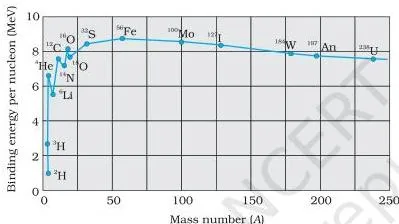
The graph answers two exam questions at once. First, why the force binds at all: a few MeV per nucleon is far more than any atomic binding, so the force is both attractive and strong (p. 7). Second, why the plateau is flat: the nuclear force is short-ranged, so a nucleon feels only its neighbours — the saturation property (p. 8).
The two energy consequences follow from the curve’s shape (p. 7–8):
- Fission: a heavy nucleus (A ≈ 240) splitting into two A ≈ 120 fragments gains about 0.9 MeV per nucleon — roughly 216 MeV in total — because the fragments are more tightly bound.
- Fusion: two light nuclei (A ≤ 10) joining into a heavier one also end more tightly bound, releasing energy — this is the sun’s source of power.
The tiny peaks at 4He and 16O hint at an atom-like shell structure inside nuclei (p. 15).
Nuclear force: short-range, strong and charge-independent
A binding force entirely different from Coulomb’s is needed, because the repulsion between the positively charged protons in a nucleus would otherwise blow it apart (NCERT, p. 8). Three experimental facts describe it (p. 8–9):
- Much stronger than the Coulomb and gravitational forces — it dominates the proton–proton repulsion inside the nucleus.
- Short-ranged — it falls to zero beyond a few femtometres. The potential energy between two nucleons has a minimum at \( r_0 \approx 0.8\ \text{fm} \): attractive beyond 0.8 fm, strongly repulsive closer (Figure 13.2).
- Charge-independent — neutron–neutron, proton–neutron and proton–proton nuclear forces are roughly equal.
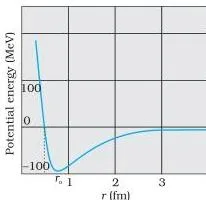
There is no simple formula for the nuclear force like Coulomb’s law or Newton’s law of gravitation (p. 9). The short range is also the reason binding energy per nucleon saturates — a nucleon inside a large nucleus feels only its nearby neighbours, so adding more nucleons does not deepen the average binding (p. 8).
Radioactivity: comparing alpha, beta and gamma decay
Becquerel discovered radioactivity in 1896 by accident: uranium-potassium sulphate that had been illuminated blackened a photographic plate even through black paper and a silver sheet (NCERT, p. 9). Radioactive decay is a nuclear phenomenon — an unstable nucleus transforms by emitting one of three radiations.
| Property | Alpha (α) | Beta (β) | Gamma (γ) |
|---|---|---|---|
| Nature | Helium nucleus \( {}^{4}_{2}\text{He} \) | Electron (β⁻) or positron (β⁺) | High-energy photon (hundreds of keV or more) |
| Charge | +2e | −e for electron, +e for positron | Zero |
| Mass | About 4 u — the heaviest of the three | Same as electron — the lightest of the three | Zero rest mass |
| Penetration | Least — stopped by a sheet of paper or thin metal | Intermediate — stopped by thin metal | Greatest — needs thick lead or concrete |
Why are most nuclei stable? A stable light nucleus needs a neutron-to-proton ratio near 1:1; a heavy nucleus needs about 3:2, because extra neutrons spread out the proton repulsion. Only about 10% of known isotopes are stable (p. 15).
Fission and fusion: where nuclear energy comes from
Nuclear reactions release about a million times more energy than chemical ones: fission of 1 kg of uranium gives about \( 10^{14}\ \text{J} \), while burning 1 kg of coal gives only \( 10^{7}\ \text{J} \) (NCERT, p. 9).
Fission of uranium-235
A neutron absorbed by 235U forms 236U, which splits into two intermediate-mass fragments (p. 10):
\[ {}^1_0\text{n} + {}^{235}_{92}\text{U} \rightarrow {}^{236}_{92}\text{U} \rightarrow {}^{144}_{56}\text{Ba} + {}^{89}_{36}\text{Kr} + 3{}^1_0\text{n} \]
Other fragment pairs include \( {}^{133}_{51}\text{Sb} + {}^{99}_{41}\text{Nb} + 4n \) and \( {}^{140}_{54}\text{Xe} + {}^{94}_{38}\text{Sr} + 2n \). The fragments are radioactive and emit beta particles in succession to reach stable end products (p. 10).
The energy released — the Q-value — is about 200 MeV per fissioning nucleus, estimated from the binding curve: \( E_{bn} \) rises from 7.6 MeV (A = 240) to 8.5 MeV (A = 120), a gain of about 0.9 MeV over 240 nucleons ≈ 216 MeV (p. 10–11).
Fusion and the proton–proton cycle
Two light nuclei must overcome the Coulomb barrier before the short-range nuclear force can act. For two protons the barrier is about 400 keV, which corresponds to an average temperature \( T \sim 3 \times 10^{9}\ \text{K} \) (p. 11).
\[ {}^1_1\text{H} + {}^1_1\text{H} \rightarrow {}^2_1\text{H} + e^+ + \nu + 0.42\ \text{MeV} \]
\[ {}^2_1\text{H} + {}^2_1\text{H} \rightarrow {}^3_2\text{He} + n + 3.27\ \text{MeV} \qquad {}^2_1\text{H} + {}^2_1\text{H} \rightarrow {}^3_1\text{H} + {}^1_1\text{H} + 4.03\ \text{MeV} \]
The sun burns hydrogen into helium through the multi-step proton–proton cycle (p. 11). Adding the steps \( 2\text{(i)} + 2\text{(ii)} + 2\text{(iii)} + \text{(iv)} \) gives the net reaction:
\[ 4{}^1_1\text{H} + 2e^- \rightarrow {}^{4}_{2}\text{He} + 2\nu + 6\gamma + 26.7\ \text{MeV} \]
Fusion achieved by raising temperature is called thermonuclear fusion. The sun’s core is only \( 1.5 \times 10^{7}\ \text{K} \), far below the average-energy requirement — fusion works there because protons in the high-energy tail of the distribution fuse (p. 11).
The sun is about \( 5 \times 10^{9} \) years old and has hydrogen for another 5 billion years; when that runs out it will cool, collapse, and expand into a red giant (p. 12). Controlled fusion needs a plasma confined at about \( 10^{8}\ \text{K} \), a problem several countries including India are working on (p. 12).
Nuclei definitions table: every term you must know cold
Memorise these in one pass — each definition is quoted from the chapter (NCERT, p. 1, 3–6, 9, 13).
| Term | Meaning | Example |
|---|---|---|
| Atomic mass unit (u) | 1/12 of the mass of one carbon-12 atom = \( 1.660539 \times 10^{-27}\ \text{kg} \) | \( m_p = 1.00727\ \text{u} \) |
| Isotope | Same Z, different N | 1H, 2H, 3H |
| Isobar | Same A | 3H and 3He |
| Isotone | Same N | 198Hg and 197Au |
| Nucleon | A proton or a neutron | 197Au has 197 nucleons |
| Nuclide | A nuclear species written \( {}^{A}_{Z}\text{X} \) | \( {}^{197}_{79}\text{Au} \) |
| Atomic number Z | Number of protons | Gold: Z = 79 |
| Neutron number N | Number of neutrons | Gold: N = 118 |
| Mass number A | Z + N, the total nucleons | Gold: A = 197 |
| Mass defect ΔM | Sum of constituent masses minus the nuclear mass | O-16: 0.13691 u |
| Binding energy E_b | Energy needed to separate a nucleus into nucleons = \( \Delta M c^2 \) | O-16: 127.5 MeV |
| Binding energy per nucleon E_bn | \( E_b / A \), the average energy per nucleon | ≈ 8.75 MeV at A = 56 |
| Radioactivity | Spontaneous decay of an unstable nucleus emitting α, β or γ | Uranium salts |
Nuclei formula sheet: every equation with symbols, units and constants
All chapter formulas in one place. The constants in the box below are printed in the exercise data on p. 16 of the textbook, so you never need to memorise their values.
| Formula | Symbol meanings | Units |
|---|---|---|
| \( 1u = 1.660539 \times 10^{-27}\ \text{kg} \) | u = atomic mass unit | kg |
| \( m_p = 1.00727\ \text{u} \), \( m_n = 1.00866\ \text{u} \) | proton, neutron mass | u (or kg) |
| \( A = Z + N \) | Z protons, N neutrons | dimensionless |
| \( R = R_0 A^{1/3} \) | R nuclear radius, \( R_0 = 1.2\ \text{fm} \), 1 fm = 10⁻¹⁵ m | m (fm) |
| \( E = mc^2 \) | c = \( 3 \times 10^{8}\ \text{m/s} \) | J |
| \( \Delta M = [Zm_p + (A – Z)m_n] – M \) | M = nuclear mass | u (or kg) |
| \( E_b = \Delta M c^2 \) | binding energy | J or MeV |
| \( 1u = 931.5\ \text{MeV}/c^2 \) | mass–energy conversion | MeV/c² |
| \( E_{bn} = E_b / A \) | binding per nucleon | MeV/nucleon |
| \( Q = (\text{sum of initial masses} – \text{sum of final masses})c^2 \) | Q-value = energy released | MeV |
| Constant (given in the exam data box) | Value |
|---|---|
| elementary charge e | \( 1.6 \times 10^{-19}\ \text{C} \) |
| Avogadro number N | \( 6.023 \times 10^{23}\ \) per mole |
| 1 MeV | \( 1.6 \times 10^{-13}\ \text{J} \) |
| 1u → energy | \( 931.5\ \text{MeV}/c^2 \) |
| 1 year | \( 3.154 \times 10^{7}\ \text{s} \) |
| mass of H atom | \( 1.007825\ \text{u} \) |
Two memory devices worth having
- A = Z + N — keep the alphabetical order A-Z-N in your head: A is the total of Z protons before N neutrons. Example: \( {}^{56}_{26}\text{Fe} \) has 26 protons and 30 neutrons, totalling 56.
- 1u = 931.5 MeV/c² — treat 931.5 like a year: “9-3-1-5”. Every mass defect in u gets multiplied by 931.5 to become MeV. Two practice numericals fix it permanently.
Worked examples: stepwise solutions with original numbers
Two board-style numericals solved fully so you can copy the method. The method line comes first, then every substitution with units.
Worked example 1: nuclear density of a nucleus with mass number 216
Method: radius from \( R = R_0 A^{1/3} \), mass in kg via 1u, then density = mass ÷ volume.
Step 1: Radius with \( R_0 = 1.2\ \text{fm} \) and A = 216.
\[ R = 1.2 \times 216^{1/3} = 1.2 \times 6 = 7.2\ \text{fm} = 7.2 \times 10^{-15}\ \text{m} \]
Step 2: Convert the nuclear mass 215.9 u to kilograms.
\[ m = 215.9 \times 1.660539 \times 10^{-27} = 3.585 \times 10^{-25}\ \text{kg} \]
Step 3: Volume of the sphere, \( V = \frac{4\pi}{3}R^3 \).
\[ V = \frac{4\pi}{3} \times (7.2 \times 10^{-15})^3 = 1.56 \times 10^{-42}\ \text{m}^3 \]
Step 4: Density = mass ÷ volume.
\[ \rho = \frac{3.585 \times 10^{-25}}{1.56 \times 10^{-42}} = 2.3 \times 10^{17}\ \text{kg m}^{-3} \]
Final answer: \( \rho \approx 2.3 \times 10^{17}\ \text{kg m}^{-3} \) — the same value as iron (A = 56), which is the whole point: nuclear density is independent of A (NCERT, p. 4).
Worked example 2: binding energy per nucleon of carbon-12
Method: mass defect method — find ΔM in u, convert with 1u = 931.5 MeV/c², divide by A.
Step 1: Write ΔM for \( {}^{12}_{6}\text{C} \) with Z = 6, (A − Z) = 6, \( m_p = 1.00727\ \text{u} \), \( m_n = 1.00866\ \text{u} \), M = 11.99671 u.
\[ \Delta M = [6(1.00727) + 6(1.00866)] – 11.99671 = 6.04362 + 6.05196 – 11.99671 = 0.09887\ \text{u} \]
Step 2: Convert the defect to MeV.
\[ E_b = 0.09887 \times 931.5 = 92.1\ \text{MeV} \]
Step 3: Divide by A = 12 to get the per-nucleon value.
\[ E_{bn} = \frac{92.1}{12} = 7.7\ \text{MeV per nucleon} \]
Final answer: the carbon-12 nucleus has binding energy 92.1 MeV, i.e. 7.7 MeV per nucleon. Note that the bare nucleus mass goes into ΔM, not the atomic mass (p. 6).
Common mistakes in Nuclei and the corrections
These are the slips that cost real marks. Each row gives the wrong idea, the correct rule, and a way to self-check (NCERT, p. 3–9).
| Students write | Correct rule | How to check your answer |
|---|---|---|
| “Isotopes have the same mass number A.” | Isotopes share atomic number Z and differ in neutrons; isobars share A (p. 3–4). | Compare Z and N of both nuclides — isotopes have equal Z. |
| “A nucleus with A = 56 has 56 protons.” | A = Z + N, so \( {}^{56}_{26}\text{Fe} \) has 26 protons and 30 neutrons (p. 3). | Read the proton count from Z, never from A. |
| “I put the atomic mass straight into ΔM.” | ΔM needs the nuclear mass — subtract \( Z \times m_e \) from the atomic mass first (p. 6). | Check the mass you substituted is for the bare nucleus. |
| “Binding energy equals binding energy per nucleon.” | E_b grows with A; \( E_{bn} = E_b/A \) is the per-nucleon figure plotted on the curve (p. 7). | Look at the units: MeV versus MeV/nucleon. |
| “The nuclear force is stronger between a proton and a neutron.” | The nuclear force is charge-independent — nn, pn and pp bonds are roughly equal (p. 9). | Remember protons additionally feel Coulomb repulsion. |
| “Nuclear density increases with mass number.” | \( R \propto A^{1/3} \) makes volume \( \propto A \), so density is independent of A, ≈ \( 2.3 \times 10^{17}\ \text{kg m}^{-3} \) (p. 4). | Compute density for two very different A values — you get the same answer. |
Exam notes: the steps that earn the mark in boards
Written from an examiner’s viewpoint — the pattern of what marks are awarded for, not a question prediction.
- Mass-defect numerics: the mark sequence is — write \( \Delta M \) formula → substitute the correct masses in u → convert with 931.5 → divide by A for the per-nucleon value. The constants box on p. 16 supplies \( 1u = 931.5\ \text{MeV}/c^2 \), so use the printed value.
- Binding-energy-curve questions: state the flat plateau 30 < A < 170, the maximum ≈ 8.75 MeV at A = 56, then explain fission (heavy → two middle) and fusion (light → heavier) as both moving toward the curve’s peak (p. 7–8).
- Radius/density questions: quoting \( R = R_0 A^{1/3} \) with \( R_0 = 1.2\ \text{fm} \) and concluding that density is constant earns the conceptual mark (p. 4).
- Radioactivity: know the three decay products — helium nucleus, electron/positron, high-energy photon — and that decay is a nuclear phenomenon of an unstable nucleus (p. 9).
- The conservation trap (Example 13.4, p. 12–13): a nuclear reaction is not balanced like a chemical equation — elements may be transmuted. What is conserved is the number of protons and the number of neutrons separately, and the difference in binding energies appears as released energy. The same mass–energy interconversion happens in chemical reactions but is about a million times smaller. Writing “proton number and neutron number are separately conserved” is the mark.
The discipline of quoting a formula, then its meaning, then its units is the same habit the Semiconductors chapter rewards. Every constant used above can be verified against the official NCERT Class 12 Physics Part II textbook page for Nuclei if you want to double-check a value. For revision notes of every class, browse all CBSE notes on this site.
One-page revision summary of Nuclei
Scan this the night before the exam — one row per big idea (NCERT, p. 13–15).
| Big idea | Key fact to quote |
|---|---|
| Composition | Z protons, N neutrons, A = Z + N; nuclide \( {}^{A}_{Z}\text{X} \) |
| Mass unit | 1u = \( 1.660539 \times 10^{-27}\ \text{kg} \) |
| Isotopes / isobars / isotones | Same Z / same A / same N, one example each |
| Size | \( R = R_0 A^{1/3} \), \( R_0 = 1.2\ \text{fm} \) |
| Density | Constant ≈ \( 2.3 \times 10^{17}\ \text{kg m}^{-3} \) |
| Mass defect / binding energy | \( \Delta M = [Zm_p + (A-Z)m_n] – M \); \( E_b = \Delta M c^2 \); 1u = 931.5 MeV/c² |
| Binding energy curve | Plateau ~8 MeV for 30 < A < 170; max ≈ 8.75 MeV at A = 56 |
| Nuclear force | Short-range, strong, charge-independent, no simple formula |
| Radioactivity | α (helium nucleus), β (e⁻/e⁺), γ (high-energy photon) |
| Fission | Heavy nucleus splits, ~200 MeV per \( {}^{235}\text{U} \) nucleus |
| Fusion | 4 protons → \( {}^{4}\text{He} \) + 2ν + 6γ + 26.7 MeV |
Frequently asked questions about Nuclei
Why is the binding energy per nucleon nearly constant for nuclei with mass number between 30 and 170?
Because the nuclear force is short-ranged. A nucleon deep inside a nucleus feels only its nearest neighbours within a few femtometres, so adding more nucleons does not change the binding of the interior ones. This saturation keeps \( E_{bn} \) flat near 8 MeV across the middle-mass range (NCERT, p. 7–8).
What is the difference between isotopes, isobars and isotones with examples?
Isotopes share atomic number Z and differ in neutrons — e.g. 1H, 2H (deuterium), 3H (tritium). Isobars share mass number A — e.g. 3H and 3He. Isotones share neutron number N — e.g. 198Hg and 197Au (p. 3–4).
Why is nuclear density almost the same for every nucleus regardless of its mass number?
Because \( R = R_0 A^{1/3} \), volume \( \propto R^3 \propto A \), while mass is also \( \propto A \) since each nucleon has nearly the same mass. Density = mass ÷ volume \( \propto A/A \) = constant, about \( 2.3 \times 10^{17}\ \text{kg m}^{-3} \) (p. 4).
How can fission and fusion both release energy when they are opposite processes?
Both move nuclei toward the peak of the binding-energy curve. A heavy nucleus (A ≈ 240) splitting into two A ≈ 120 pieces raises binding per nucleon from 7.6 to 8.5 MeV, releasing about 0.9 MeV per nucleon. Light nuclei (A ≤ 10) fusing into a heavier one also end more tightly bound. In both cases the final nuclei have higher \( E_{bn} \), so energy comes out (p. 7–8, 10).
What exactly is mass defect and how is 1u = 931.5 MeV/c² used?
Mass defect \( \Delta M = [Zm_p + (A-Z)m_n] – M \) is the difference between the total mass of the separated nucleons and the measured nuclear mass, which is always smaller. That missing mass appears as binding energy \( E_b = \Delta M c^2 \). In problems, multiply ΔM in u by 931.5 to get MeV directly — e.g.
O-16’s ΔM = 0.13691 u gives \( 0.13691 \times 931.5 = 127.5\ \text{MeV} \) (p. 6).
Reference: NCERT Class 12 Physics Part II textbook, chapter Nuclei.
Explore Class 12 Physics Notes
More for this chapter:
Class 12 Physics on LearnCBSE:
Related chapters: