
These human eye and colourful world class 10 notes start where the previous chapter left off. You have already studied how convex and concave lenses refract light and form images of different sizes and positions.
The human eye is a natural optical instrument built on the same idea — it has a lens system that refracts incoming light and forms a real image on a screen inside the eye.
This chapter has four parts: how the eye focuses light using accommodation, what goes wrong in myopia, hypermetropia and presbyopia and how spectacle lenses correct each one, how a glass prism bends and splits white light into colours, and how the atmosphere itself acts on light to cause twinkling stars, an early sunrise, a blue sky and red danger signals.
If your lens sign convention is rusty, keep the Class 10 Light — Reflection and Refraction notes open alongside this page, because this chapter reuses that convention directly in its numericals.
Chapter Map: Eye Structure, Vision Defects, Prism Effects and Sky Colour
Before going into detail, it helps to see how the chapter is laid out page by page in the NCERT book, so you know how much time to give each part while revising.
| Block | What it covers | NCERT pages |
|---|---|---|
| 1. Eye structure and accommodation | Cornea, iris, pupil, retina, ciliary muscles, near point, far point | pp. 1-2 |
| 2. Vision defects and correction | Myopia, hypermetropia, presbyopia, corrective lenses, bifocals | pp. 2-4 |
| 3. Prism and dispersion | Angle of deviation, VIBGYOR, Newton’s two-prism experiment, rainbow | pp. 5-7 |
| 4. Atmospheric optics | Twinkling of stars, advance sunrise and delayed sunset, Tyndall effect, blue sky | pp. 8-9 |
For a full topic list across the year, the Class 10 Science notes page links every chapter in this order.
Cornea, Iris, Pupil, Retina: Parts of the Eye and What Accommodation Means
The human eye works like a camera that keeps adjusting itself. Light first enters through the cornea, a thin transparent membrane bulging out at the front of the eyeball. Most of the actual bending of light happens right here, at the cornea’s outer surface, and not at the eye lens (NCERT, p. 1).
The eyeball itself is roughly spherical, about 2.3 cm across (NCERT, p. 1).
Behind the cornea sits the iris, a muscular, coloured diaphragm that controls the size of the pupil — the opening through which light enters further into the eye. Behind the pupil lies the eye lens, which fine-tunes the focusing the cornea has already mostly done.
Light finally lands on the retina, a screen packed with light-sensitive cells that convert light into electrical signals. These signals travel to the brain along the optic nerve, and the brain turns them into the image you actually perceive.
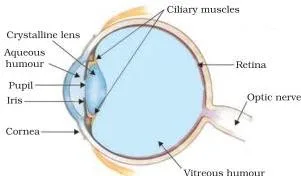
The eye lens itself is soft and flexible. Ciliary muscles attached to it make it thinner for distant objects and thicker, with more curvature, for near objects. This ability of the eye lens to change its focal length is called accommodation (NCERT, p. 2). It is why your eyes can shift focus from a book to a distant object almost instantly.
Accommodation has limits. The closest distance at which an object can be seen clearly without strain is the near point, or least distance of distinct vision — about 25 cm for a young adult with normal vision. The farthest point up to which a normal eye can see clearly is the far point, which is infinity (NCERT, p. 2).
A normal eye, therefore, sees clearly anywhere between 25 cm and infinity.
One condition worth separating from the rest here is cataract: a clouding of the eye lens itself, usually with age. It is a structural fault in the lens material, not a refractive error like myopia or hypermetropia, and it is treated with cataract surgery (NCERT, p. 2) rather than a stronger spectacle lens.
Myopia, Hypermetropia and Presbyopia: Cause, Image Position and Correction Compared
These three refractive defects are exactly where students lose marks by mixing up which lens corrects which problem. Keep this table in front of you while revising.
| Defect | What is blurred | Where the image forms | Cause | Corrective lens |
|---|---|---|---|---|
| Myopia (near-sightedness) | Distant objects | In front of the retina | Excessive curvature of the eye lens, or an elongated eyeball | Concave lens of suitable power |
| Hypermetropia (far-sightedness) | Nearby objects | Behind the retina | Focal length of the eye lens too long, or eyeball too small | Convex lens of suitable power |
| Presbyopia | Nearby objects, with age | Behind the retina, like hypermetropia | Ciliary muscles weaken and the eye lens loses flexibility with age | Convex lens, often as bifocals |
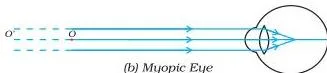
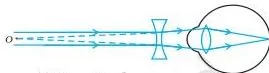
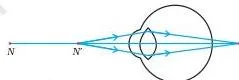
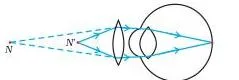
Why these specific lenses? A concave lens is diverging — it spreads out the rays slightly before they enter the eye, so the excess bending power of a myopic eye now lands the image exactly on the retina instead of in front of it (NCERT, p. 3).
A convex lens is converging — it adds the extra bending power a hypermetropic eye lacks, so rays from a near object are focused on the retina instead of behind it (NCERT, p. 3).
In presbyopia, ageing weakens the ciliary muscles and the eye lens becomes less flexible, so the near point moves further away from 25 cm even though the person may see distant objects fine (NCERT, p. 3).
Someone with both myopia and hypermetropia often needs a bifocal lens: the upper portion is concave, for distant vision, and the lower portion is convex, for near vision (NCERT, p. 3).
Refraction Through a Prism: Angle of Deviation and Dispersion into VIBGYOR
A prism has two triangular ends and three rectangular side faces set at an angle to each other, unlike a rectangular glass slab whose two refracting surfaces are parallel. Because a slab’s faces are parallel, light entering and leaving it comes out travelling in its original direction, only shifted sideways.
A prism’s slanted faces do not allow this — the emergent ray bends by a net angle from the incident ray’s direction, called the angle of deviation, \(D\) (NCERT, p. 5).
Activity 10.1 traces this with pins: at the first face, light goes from air into glass and bends towards the normal; at the second face, it goes from glass back into air and bends away from the normal (NCERT, p. 5).
The two bends do not cancel because the faces are inclined, and that mismatch is exactly what produces the angle of deviation.
Now pass a narrow beam of white sunlight through a slit onto a prism (Activity 10.2). Instead of a single beam, a band of seven colours appears on the screen — Violet, Indigo, Blue, Green, Yellow, Orange, Red, remembered as VIBGYOR (NCERT, p. 6). This band is called a spectrum, and splitting white light into it is called dispersion.
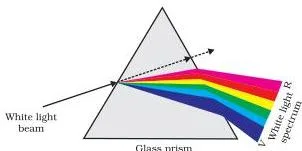
Each colour bends by a slightly different amount as it refracts. Red bends the least, violet bends the most (NCERT, p. 6), so every colour follows a marginally different path through the prism and separates out instead of overlapping back into white.
Isaac Newton settled the question of where the colours come from using a second prism. After splitting white light with one prism, he placed an identical prism upside down right after it. Instead of splitting the colours further, the second prism recombined them and white light emerged on the other side (NCERT, p. 6).
This proved sunlight itself is made of seven colours — the first prism only separated what was already there, it did not create colour. The chapter also defines any light producing a spectrum like sunlight’s as white light (NCERT, p. 6).
How a Rainbow Forms in Water Droplets
A rainbow is a natural spectrum seen in the sky, usually after rain, and it always forms in a direction opposite the Sun (NCERT, p. 6). Saying “a rainbow is caused by refraction” and stopping there misses half the mechanism.
Inside a single water droplet, three things happen in sequence: sunlight first refracts as it enters the curved surface of the drop, then reflects once off the drop’s inner back surface, and finally refracts again as it exits — bending and separating into colours the whole way (NCERT, p. 6-7).
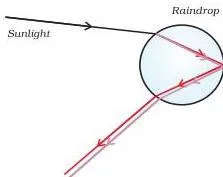
You do not need actual rainfall for this effect. The textbook points out that you can see a similar spectrum through the spray of a waterfall or a garden fountain on a sunny day, as long as the Sun is behind you (NCERT, p. 7).
Why Stars Twinkle but Planets Don’t, and Why the Sun Rises Early / Sets Late
Atmospheric refraction is refraction of light by the shifting layers of Earth’s atmosphere, and it explains three separate observations that examiners like to test together.
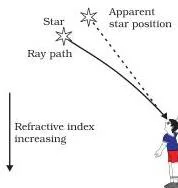
Air near the ground is warmer and less dense than air higher up, so its refractive index is slightly lower, and these layers keep changing. Light passing through them bends by a slightly different amount from one moment to the next.
You can see a small-scale version of this as shimmer above a fire or a hot road; starlight shows the same effect on a much larger scale (NCERT, p. 8).
A star is so far away that it behaves like a point source of light. As the air layers between it and your eye keep shifting, the star’s apparent position changes very slightly and the amount of light reaching your eye keeps fluctuating — sometimes brighter, sometimes fainter. That flicker is twinkling (NCERT, p. 8).
Planets are much closer to Earth, so instead of behaving like a single point, a planet acts like a large collection of point sources bunched together. Their many small brightness fluctuations happen at slightly different times and average out to a steady glow, so planets do not twinkle (NCERT, p. 8).
The same bending of light by the atmosphere explains why the Sun becomes visible about two minutes before it has actually crossed the horizon at sunrise, and stays visible for about two minutes after it has actually gone below the horizon at sunset (NCERT, p. 8).
The atmosphere bends the Sun’s rays over the Earth’s curve, so you see it slightly earlier and slightly later than its true position. The same effect flattens the Sun’s disc when it is close to the horizon.
Tyndall Effect and Why the Sky Is Blue, Not Violet
Scattering happens when light strikes fine particles in a medium and gets redirected in many directions instead of travelling straight through.
You met this in Class 9 as the Tyndall effect, and it shows up here in the atmosphere: a beam of sunlight becomes a visible bright path when it passes through smoke, a dusty room, or mist droplets in a forest canopy (NCERT, p. 9).
Whether scattered light looks blue, white, or another colour depends on particle size. Molecules of air are far smaller than the wavelength of visible light, and such fine particles scatter shorter wavelengths — the blue end of the spectrum — much more strongly than longer wavelengths at the red end. Red light’s wavelength is roughly 1.8 times that of blue light (NCERT, p. 9).
That is why the clear daytime sky looks blue: sunlight passing through the atmosphere gets its blue component scattered across the whole sky, and that scattered blue light is what reaches your eyes from every direction, not just from the Sun’s disc.
A natural follow-up question is why the sky isn’t violet, since violet has an even shorter wavelength than blue and should scatter even more strongly.
NCERT does not work this out at Class 10 level, and the honest short version is that it depends on how much violet sunlight actually contains compared to blue, and how sensitive the human eye is to violet compared to blue.
Treat this as a reasonable simplification for a board answer rather than something you are expected to derive from the scattering rule alone.
Two practical facts follow directly from the scattering rule. An astronaut above the atmosphere sees a dark sky rather than a blue one, because there is no air left to scatter sunlight into their eyes — scattering, not the Sun’s own light, is what colours our sky (NCERT, p. 9).
Red is used for danger and stop signals because it scatters the least among visible colours, so it stays visible over the longest distance even through fog or smoke (NCERT, p. 9).
Definitions to Get Exactly Right
- Power of accommodation: the ability of the eye lens to change its focal length, using the ciliary muscles, so objects at different distances get focused on the retina.
- Near point (least distance of distinct vision): the closest distance, about 25 cm for a young adult, at which an object can be seen clearly without eye strain.
- Far point: the farthest distance at which the eye can see an object clearly; infinity for a normal eye.
- Myopia: a defect in which distant objects appear blurred because their image forms in front of the retina.
- Hypermetropia: a defect in which nearby objects appear blurred because their image forms behind the retina.
- Presbyopia: age-related loss of the eye’s power of accommodation, mainly from weakening ciliary muscles.
- Dispersion: the splitting of white light into its component colours by a prism, because each colour bends by a different amount.
- Spectrum: the band of colours produced when white light is dispersed.
- Angle of deviation: the angle between the direction of the incident ray and the direction of the emergent ray after passing through a prism.
- Scattering: the redirection of light in many directions when it strikes fine particles in a medium.
- Tyndall effect: scattering of light by colloidal-sized particles that makes the path of a light beam visible.
Lens Power Formula Used to Correct Eye Defects
The chapter’s exercises expect you to calculate lens power, but the power formula itself is not restated in this chapter’s text on page 10 — it carries over from the previous chapter on refraction and lenses, so you need to recall it, not relook it up here.
| Quantity | Relation | Unit |
|---|---|---|
| Power of a lens | \( P = \dfrac{1}{f} \) | dioptre (D), with \(f\) in metres |
| Lens formula | \( \dfrac{1}{f} = \dfrac{1}{v} – \dfrac{1}{u} \) | \(v\), \(u\), \(f\) all in the same unit (cm or m) |
Two sign rules decide whether your final power comes out correct. A concave lens, used for myopia, has negative focal length and therefore negative power. A convex lens, used for hypermetropia or presbyopia, has positive focal length and positive power.
This follows from the sign convention you used in the lens chapter: a concave lens forms a virtual image on the same side as the object, which forces \(f\) to come out negative when you substitute correctly.
For a hypermetropia numerical, work with the eye’s own optics directly. The corrective lens must take an object placed at the normal near point (25 cm) and form a virtual image of it at the person’s own, more distant near point — that virtual image then sits within reach of the person’s weakened eye.
So you apply \( \dfrac{1}{f} = \dfrac{1}{v} – \dfrac{1}{u} \) with \(u = -25\ \text{cm}\) (object at the normal near point) and \(v\) equal to the negative of the person’s own near point. If you want to check this convention against the original textbook wording, the official NCERT PDF for this chapter is on the NCERT website.
Worked Examples: Calculating Lens Power for Myopia and Hypermetropia
Example 1: Correcting a myopic eye with far point 5 m
- Step 1: A myopic eye cannot see beyond its far point. Here the far point is 5 m in front of the eye, so the corrective lens must take parallel rays from a very distant object and bend them just enough to form a virtual image at 5 m, which the eye can then focus.
- Step 2: Apply the lens formula with the object at infinity, so \( \frac{1}{u} = 0 \), and the image at \(v = -5\ \text{m}\) (virtual image, same side as the object, hence negative by sign convention).
\[ \frac{1}{f} = \frac{1}{v} – \frac{1}{u} = \frac{1}{-5} – 0 = -\frac{1}{5} \]
Step 3: So \( f = -5\ \text{m} \).
The negative sign confirms the lens must be concave, exactly what myopia needs.
\[ P = \frac{1}{f} = \frac{1}{-5\ \text{m}} = -0.2\ \text{D} \]
Final answer: A concave lens of focal length \(5\ \text{m}\) and power \(-0.2\ \text{D}\) is needed.
Example 2: Correcting a hypermetropic eye with near point 75 cm
- Step 1: This person’s near point is 75 cm, but they need to read comfortably from the normal near point, 25 cm. The corrective lens must form a virtual image of an object placed at 25 cm at a distance of 75 cm, where the eye can focus it.
- Step 2: Take \(u = -25\ \text{cm}\) (object at the normal near point) and \(v = -75\ \text{cm}\) (virtual image at the person’s own near point, same side as the object).
\[ \frac{1}{f} = \frac{1}{v} – \frac{1}{u} = \frac{1}{-75} – \frac{1}{-25} = -\frac{1}{75} + \frac{1}{25} \]
\[ \frac{1}{f} = -\frac{1}{75} + \frac{3}{75} = \frac{2}{75} \]
Step 3: So \( f = \frac{75}{2} = 37.5\ \text{cm} = 0.375\ \text{m} \).
The positive sign confirms a convex lens, exactly what hypermetropia needs.
\[ P = \frac{1}{f} = \frac{1}{0.375\ \text{m}} \approx +2.67\ \text{D} \]
Final answer: A convex lens of focal length \(37.5\ \text{cm}\) (\(0.375\ \text{m}\)) and power approximately \(+2.67\ \text{D}\) is needed.
What Activities 10.1 and 10.2 Actually Show You
Activity 10.1 (tracing pins through a prism) is really about the direction of bending, not colour. Its takeaway: light bends towards the normal going from air into the denser glass at the first face, and away from the normal going from glass back into air at the second face.
Because the two faces are inclined rather than parallel, these two bends add up instead of cancelling, producing a net angle of deviation between the incident ray and the final emergent ray (NCERT, p. 5).
Activity 10.2 (sunlight through a slit and a prism) is about colour. Its takeaway: a narrow beam of white sunlight, once passed through a prism, spreads into a VIBGYOR band on the screen — direct evidence that white light is made up of seven colours (NCERT, p. 6).
You may not always see seven crisp, separated stripes, but the colours remain optically distinct, because each one is bending by its own angle even where the bands appear to blend into one another.
Mistakes Students Repeatedly Make in This Chapter
| Mistake | Correct rule | How to check your answer |
|---|---|---|
| Using a convex lens for myopia or a concave lens for hypermetropia | Myopia (near-sighted) needs a diverging lens — concave. Hypermetropia (far-sighted) needs a converging lens — convex. | Check the sign of the calculated power: negative D means concave (myopia), positive D means convex (hypermetropia). |
| Dropping the negative sign on a concave lens’s power | A concave lens has negative focal length, so \(P = 1/f\) must also come out negative. | If your numerical answer for a myopia question is positive, recheck the sign you assigned to \(v\) or \(f\) before dividing. |
| Treating dispersion and scattering as the same idea | Dispersion splits white light into VIBGYOR inside a prism because each colour bends by a different amount. Scattering redirects light in many directions when it strikes fine particles in a medium such as air. | Ask whether the question involves a prism or raindrop separating colours (dispersion), or particles in a medium spreading light sideways (scattering). |
| Saying planets twinkle exactly like stars | Stars are effectively point sources, so light fluctuations from them are visible as twinkling. Planets are extended sources whose many point-like fluctuations average out. | If the source is very far away and star-like, expect twinkling; if it is closer and extended, like a planet, expect steady light. |
| Calling 25 cm the far point instead of the near point | Near point = 25 cm, the closest distance of clear vision. Far point = infinity for a normal eye, the farthest distance of clear vision. | A near point answer should be a small distance in cm; a far point answer for a normal eye should read “infinity”. |
How CBSE Usually Tests This Chapter
The chapter’s own exercise set on page 10, together with the shorter question box on page 4, gives a fairly reliable picture of how this chapter usually gets tested.
| Question type | Example numbers (NCERT exercises) | What a full-marks answer needs |
|---|---|---|
| MCQ / 1-mark direct concept | Q1-Q4 (page 10): accommodation, image location on retina, near point value, ciliary muscles | The exact term or value (25 cm, “accommodation”, “retina”, “ciliary muscles”) — precise wording, not a vague description |
| Numerical (2-3 marks) | Q5, Q6, Q7 (page 10) | Correct sign given to \(u\) and \(v\), the working shown line by line, and the final focal length and power with correct sign and unit |
| Diagram-based | Q7 (page 10) explicitly asks for a diagram of hypermetropia correction | A labelled ray diagram showing the defective eye, the corrected path through a convex lens, and the image falling on the retina |
| Reasoning / short answer (2-3 marks) | Q8, Q9, Q10, Q11, Q12 (page 10) | The specific mechanism — atmospheric refraction, point source versus extended source, or absence of atmosphere — not just the single word “refraction” or “scattering” |
The “Think it over” box on eye donation (NCERT, p. 4) is not a physics question, but it is exactly the kind of material used for a value-based question.
An exam may ask what a student can do to help corneally blind patients, and the specific, checkable fact worth keeping ready is that donated eyes must be removed within 4-6 hours of death, and that one pair of donated eyes can restore vision to up to four corneally blind people.
This is far more useful in an answer than a general line about “donating organs”. For more chapters covering value-based and numerical questions in this style, see the Class 10 Electricity notes, the next chapter after this one.
Quick Recap Before You Close the Book
- Near point of a normal eye: 25 cm. Far point of a normal eye: infinity.
- Myopia → distant objects blurred, image in front of retina → concave lens.
- Hypermetropia → near objects blurred, image behind retina → convex lens.
- Presbyopia → near point recedes with age → convex lens or bifocals.
- Dispersion order: VIBGYOR; red deviates least, violet deviates most.
- Rainbow needs three steps inside a droplet: refraction, internal reflection, refraction again.
- Twinkling comes from atmospheric refraction acting on a point source (star); planets, being extended sources, do not twinkle.
- The Sun is visible about 2 minutes before actual sunrise and about 2 minutes after actual sunset.
- Blue sky: fine air molecules scatter shorter wavelengths (blue) more strongly than longer wavelengths (red).
- Red is used for danger signals because it scatters the least and stays visible over distance.
Browse the full set of subject notes for the year on the Class 10 hub page if you are revising other subjects alongside Science.
Frequently Asked Questions on the Human Eye and Colourful World
Why do stars twinkle but the Moon does not?
Stars are extremely far away and behave like point sources of light, so the continuous bending of starlight by shifting air layers makes their apparent position and brightness fluctuate — that fluctuation is twinkling.
The Moon is close and large enough to behave like an extended source made of many point-like patches of light; the small fluctuations from each patch average out, so the Moon’s light looks steady (NCERT, p. 8).
What is the exact difference between the near point and the far point of the eye?
The near point is the closest distance at which an object can be seen clearly without straining the eye — about 25 cm for a young adult with normal vision. The far point is the farthest distance at which the eye can see clearly, which is infinity for a normal eye (NCERT, p. 2).
A normal eye can focus on anything between these two limits.
Why is a concave lens used for myopia and not a convex lens?
In myopia, the eye already bends light too much, or the eyeball is too long, so the image forms in front of the retina instead of on it.
A concave lens is diverging — it spreads the incoming rays out slightly before they reach the eye, reducing the eye’s excess bending power just enough to push the image back onto the retina (NCERT, p. 3). A convex lens would add more converging power, which would make the defect worse, not better.
Why does the sky look dark to an astronaut in space instead of blue?
The sky looks blue because air molecules scatter the blue component of sunlight in all directions, and that scattered light reaches our eyes from every part of the sky.
Above the atmosphere, there is no air left to scatter sunlight, so there is no scattered light reaching an astronaut’s eyes from the space around the Sun — the sky simply looks dark (NCERT, p. 9).
Why do we see a rainbow only with the Sun behind us?
A rainbow forms when sunlight refracts, reflects once inside a raindrop, and refracts again on its way out, sending separated colours back towards the observer at a specific angle from the original sunlight direction.
This geometry only works when the droplets are in front of you and the Sun is behind you, which is also why you can see the same effect in a waterfall’s spray or a fountain, again only with the Sun at your back (NCERT, p. 6-7).
Why are red lights used as danger signals instead of blue or violet?
Red light has the longest wavelength among visible colours and scatters the least when passing through fog, smoke or haze. A red signal therefore stays visible over a longer distance than a blue or violet one, which scatter more and get lost faster in hazy conditions (NCERT, p. 9). That is why red is chosen for danger and stop signals.
Reference: NCERT Class 10 Science textbook, chapter The Human Eye and the Colourful World.
Explore Class 10 Science Notes
Class 10 Science on LearnCBSE:
Related chapters: