
The Application of Integrals Class 12 chapter (Chapter 8) of the NCERT Mathematics Part II textbook is a compact one: the official PDF runs eight pages, and it is available on this page.
Below the download you will find a plain-language map of what the chapter teaches — the strip method, the two area formulas, and the symmetry and sign rules that decide most of the marks.
The official Application of Integrals Class 12 chapter PDF from NCERT comes straight from the NCERT server — open it to see the chapter exactly as printed in the 2026-27 reprint of Mathematics Part II, with every figure and every exercise question in place. You can also reach the chapter through the official NCERT website, where every Class 12 textbook PDF is published.
| What the chapter holds | Count | Where it is used |
|---|---|---|
| Printed pages | 8 | |
| Sections in the chapter | 2 | |
| Figures with NCERT captions | 5 | |
| Exercise questions | 4 | answered in our NCERT Solutions |
| Official NCERT PDF | Download the chapter PDF | the chapter exactly as NCERT publishes it |
Chapter at a Glance
The table below sums up the chapter’s size at a glance — its sections, figures, worked examples and exercise questions, as printed in the book.
What This Chapter Covers: From Geometry to Strips
This section is a map. If you know where each idea sits in the chapter, the exercises stop feeling random.
| Part of the chapter | What it contains |
|---|---|
| 8.1 Introduction | Why elementary geometry formulas (triangles, rectangles, trapezia, circles) fail for regions enclosed by curves, and why Integral Calculus is needed. The declared scope is standard forms only: lines, circles, parabolas and ellipses. |
| 8.2 Area under Simple Curves | The elementary strip idea, the two area formulas, the remark on negative area, and Examples 1 and 2 (circle and ellipse, each with a horizontal-strip alternative). |
| Exercise 8.1 | Four questions — two ellipse areas followed by two MCQs. |
| Miscellaneous Examples | Examples 3 and 4: a line crossing the x-axis, and y = cos x between 0 and 2π. |
| Miscellaneous Exercise on Chapter 8 | Five questions on polynomials, |x + 3|, sin x, x³ and x|x|. |
| Summary | The two area formulas compressed into two lines. |
| Historical Note | Background reading on how integral calculus developed: the method of exhaustion, Eudoxus, Archimedes, Newton, Leibnitz and Cauchy. |
The chapter introduces no new integration technique. It takes the definite integral as a limit of a sum from the previous chapter and puts it to work on one job — area.
The Historical Note at the end explains that the idea of adding infinitely many small pieces goes back to the ancient Greek method of exhaustion, refined by Eudoxus and Archimedes, and later formalised by Newton, Leibnitz and Cauchy.
The Strip Method: How the Area Is Found
Every area problem in this chapter starts from one idea: slice the region into thin strips, add the strip areas, and let the width shrink to zero. That limit is the definite integral you studied in the previous chapter — this chapter is that one idea applied to standard curves.
The elementary area dA = y dx
The book starts with a curve y = f(x), the x-axis, and the ordinates x = a and x = b. Imagine the area under the curve as many very thin vertical strips (Fig 8.1). One arbitrary strip at some x between a and b has height y = f(x) and width dx, so its area is dA = y dx.
This single strip is the elementary area.
The total area A is the sum of the elementary areas across the whole region:
\[ A = \int_a^b dA = \int_a^b y\,dx = \int_a^b f(x)\,dx \]
Why does the sum become an integral? Because as the strips get thinner, the top of each strip hugs the curve more closely, and the sum of strip areas approaches the true area — exactly the limit-of-a-sum definition of the definite integral.
Vertical strips vs horizontal strips
If the curve is written as a function of x, \( y = f(x) \), and the cut lines are vertical ordinates, vertical strips are natural.
If the curve is easier to write as a function of y, \( x = g(y) \), and the cut lines are horizontal (like y = c and y = d), rotate the picture: the strips run horizontally, each of height dy and length x, so dA = x dy (Fig 8.2).
| Vertical strips | Horizontal strips | |
|---|---|---|
| Curve written as | \( y = f(x) \) | \( x = g(y) \) |
| Strip area | \( dA = y\,dx \) | \( dA = x\,dy \) |
| Integration variable | x | y |
| Limits | x from a to b | y from c to d |
| Area formula | \( A = \int_a^b f(x)\,dx \) | \( A = \int_c^d g(y)\,dy \) |
| Natural when | Boundaries are vertical ordinates | Boundaries are horizontal lines |
The two formulas are the same idea with x and y swapped. In the Summary the book writes the horizontal-strip curve as \( x = \phi(y) \) instead of \( g(y) \) — same meaning, different letter.
Curve below the x-axis: the sign trap
If the curve lies below the x-axis from a to b, every strip height y = f(x) is negative, so the integral comes out negative (Fig 8.3). Area cannot be negative, so the book’s rule is plain: take the absolute value, \( \left|\int_a^b f(x)\,dx\right| \).
When part of the region is above the axis and part below (Fig 8.4), one integral is not enough. Split the region at the crossing point and add: \( A = |A_1| + A_2 \), where \( A_1 \) is the below-axis piece (negative, so modded) and \( A_2 \) the above-axis piece.
Symmetry: the shortcut for circle and ellipse
The circle \( x^2 + y^2 = a^2 \) and the ellipse are symmetric about both axes, so the whole area is exactly four times the first-quadrant piece (Fig 8.5). Example 1 uses this for the circle:
\[ A = 4\int_0^a y\,dx = 4\int_0^a \sqrt{a^2 – x^2}\,dx = \pi a^2 \]
Because the first-quadrant region AOBA lies above the axis, y is taken as the positive root — the book says this explicitly, twice. Example 2 repeats the move for the ellipse and gets \( \pi ab \).
Splitting at x-axis crossings
When a line or curve cuts the x-axis inside the interval, each side must be integrated separately. Example 3’s line y = 3x + 2 crosses the axis at \( x = -\frac{2}{3} \); the book integrates from x = −1 to the crossing (modulus) and from the crossing to x = 1, giving \( \frac{1}{6} + \frac{25}{6} = \frac{13}{3} \).
Example 4, \( y = \cos x \) from 0 to \( 2\pi \), is the same rule with three lobes: above the axis on \( (0, \frac{\pi}{2}) \), below on \( (\frac{\pi}{2}, \frac{3\pi}{2}) \), above again on \( (\frac{3\pi}{2}, 2\pi) \). The three pieces give 1 + 2 + 1 = 4. Integrating straight across would give 0 — that is why the modulus exists.
Formulas This Chapter Depends On
The whole chapter runs on five formulas. Each row states what every symbol means, so you can solve with the table open.
| Formula | What each symbol means |
|---|---|
| \( A = \int_a^b f(x)\,dx \) | Area between y = f(x), the x-axis and ordinates x = a, x = b; vertical strips; curve above the axis. |
| \( A = \int_c^d g(y)\,dy \) | Area between x = g(y), the y-axis and lines y = c, y = d; horizontal strips. |
| \( \int \sqrt{a^2 – x^2}\,dx = \frac{x}{2}\sqrt{a^2 – x^2} + \frac{a^2}{2}\sin^{-1}\frac{x}{a} \) | The standard integral used inside Examples 1 and 2; a is the semi-axis of the circle or ellipse. |
| \( 4\int_0^a \sqrt{a^2 – x^2}\,dx = \pi a^2 \) | Whole area of a circle of radius a; the factor 4 is the symmetry shortcut. |
| \( 4\int_0^a \frac{b}{a}\sqrt{a^2 – x^2}\,dx = \pi ab \) | Whole area of the ellipse \( \frac{x^2}{a^2} + \frac{y^2}{b^2} = 1 \). |
Two things to notice. First, area comes out in square units. Second, a definite integral can be negative, but an area never is — a negative or zero result always means a below-axis piece that needs a split and a modulus.
Worked Examples with Fresh Numbers
These three problems use the chapter’s exact methods with numbers the book does not use, so you practise the procedure instead of memorising an answer.
Worked Example 1: area enclosed by an ellipse, using symmetry
Step 1 — identify the region and its symmetry.
The ellipse is \( \frac{x^2}{25} + \frac{y^2}{9} = 1 \), so \( a^2 = 25 \) (hence \( a = 5 \)) and \( b^2 = 9 \) (hence \( b = 3 \)).
The ellipse is symmetric about both axes, so the whole area is four times the first-quadrant region AOBA, exactly as in the book’s Example 2.
Step 2 — write the first-quadrant curve and the integral.
In the first quadrant, \( y = \frac{b}{a}\sqrt{a^2 – x^2} = \frac{3}{5}\sqrt{25 – x^2} \), and x runs from 0 to a = 5.
Vertical strips give \[ A = 4\int_0^5 \frac{3}{5}\sqrt{25 – x^2}\,dx = \frac{12}{5}\int_0^5 \sqrt{25 – x^2}\,dx \]
Step 3 — apply the standard integral.
With \( a^2 = 25 \), \[ \frac{12}{5}\left[\frac{x}{2}\sqrt{25 – x^2} + \frac{25}{2}\sin^{-1}\frac{x}{5}\right]_0^5 = \frac{12}{5}\left(0 + \frac{25}{2}\cdot\frac{\pi}{2} – 0\right) = \frac{12}{5}\cdot\frac{25\pi}{4} \]
Final answer: \( A = 15\pi \) square units. The result is positive, and it matches \( \pi ab = \pi(5)(3) = 15\pi \), the book’s ellipse result.
Worked Example 2: a line that crosses the x-axis
Step 1 — locate the crossing.
The line \( y = 2x + 1 \), the x-axis, and the ordinates x = −1 and x = 2 bound the region.
The line meets the x-axis where \( 2x + 1 = 0 \), i.e.
\( x = -\frac{1}{2} \).
It lies below the axis on \( (-1, -\frac{1}{2}) \) and above it on \( (-\frac{1}{2}, 2) \), so split there.
Step 2 — write the split integral with moduli.
\[ A = \left|\int_{-1}^{-1/2}(2x + 1)\,dx\right| + \int_{-1/2}^{2}(2x + 1)\,dx \]
Step 3 — integrate each piece.
Since \( \int(2x + 1)\,dx = x^2 + x \), \[ \left[x^2 + x\right]_{-1}^{-1/2} = \left(\frac{1}{4} – \frac{1}{2}\right) – (1 – 1) = -\frac{1}{4}, \quad \text{so this piece is } \frac{1}{4} \]
\[ \left[x^2 + x\right]_{-1/2}^{2} = (4 + 2) – \left(\frac{1}{4} – \frac{1}{2}\right) = 6 + \frac{1}{4} = \frac{25}{4} \]
Step 4 — add the pieces.
\( \frac{1}{4} + \frac{25}{4} = \frac{26}{4} = \frac{13}{2} \).
Final answer: \( A = \frac{13}{2} \) square units. The answer is positive, which confirms the modulus was applied to the below-axis piece.
Worked Example 3: a parabola solved with horizontal strips
Step 1 — choose horizontal strips.
The region is bounded by the parabola \( y^2 = 6x \), the y-axis and the horizontal line y = 2.
Because a boundary line is horizontal and the curve solves easily for x, use horizontal strips.
Here \( x = g(y) = \frac{y^2}{6} \), and y runs from c = 0 to d = 2.
Step 2 — write the integral.
\[ A = \int_0^2 x\,dy = \int_0^2 \frac{y^2}{6}\,dy \]
Step 3 — integrate with respect to y.
\[ A = \frac{1}{6}\left[\frac{y^3}{3}\right]_0^2 = \frac{1}{6}\cdot\frac{8}{3} = \frac{4}{9} \]
Final answer: \( A = \frac{4}{9} \) square units. Note that the y-limits 0 and 2 belong to horizontal strips — writing x-limits here is the classic error.
What the Chapter’s Figures Show
None of the chapter’s key figures is decoration — each one encodes a step of the method. Here is what to look for in each.
The opening figure: the region the whole chapter measures
This opening figure lifts the picture from the previous chapter: the shaded region is the object every question in this chapter measures. Its area is the definite integral of f(x) from a to b, computed as the limit of a sum — the definition you already met in the Integrals chapter.
Fig 8.1: vertical strips and the elementary area
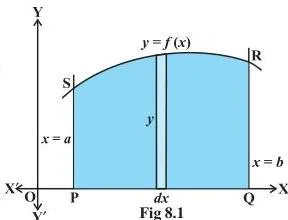
The curve is sliced into very thin vertical strips. One arbitrary strip at position x has height y = f(x) and width dx; its area \( dA = y\,dx \) is the elementary area. The whole shaded region is the accumulation of these strips — which is what the integral symbol says.
Fig 8.2: horizontal strips, the same idea turned on its side
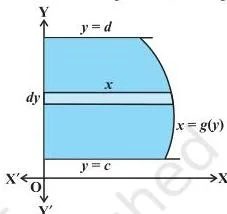
When the curve is written as \( x = g(y) \), the strips run horizontally. Each strip has height dy and length x, so \( dA = x\,dy \), and the area is \( \int_c^d g(y)\,dy \). Reach for this version whenever the region’s straight boundaries are horizontal lines.
Fig 8.3: below the x-axis — where the minus sign comes from
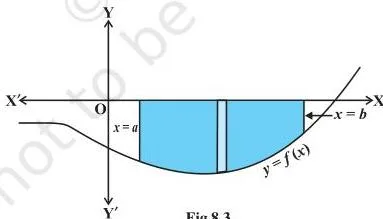
If the curve sits below the axis, \( f(x) \) is negative on the whole interval. Every elementary strip then has negative height, so the definite integral comes out negative. The book’s Remark after the strip formulas is the rule: take the absolute value of the integral — the area is only its numerical value.
The book also shows the mixed case in Fig 8.4, where the answer is \( |A_1| + A_2 \).
Fig 8.5: why the circle’s area is four first-quadrant pieces
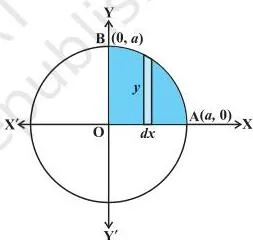
For the circle and ellipse, symmetry about both axes means the whole area is four times the region AOBA in the first quadrant. This figure is the visual justification for writing \( 4\int_0^a y\,dx \). It also carries the book’s sign reminder: because AOBA is in the first quadrant, \( y = +\sqrt{a^2 – x^2} \), the positive root.
The book’s alternative horizontal-strip versions (Figs 8.6 and 8.8) and the diagrams for the miscellaneous examples (Figs 8.9 and 8.10) apply the same two ideas.
Definitions: Elementary Area and Area Under a Curve
Three terms carry the whole chapter. Each assumes a specific setup, and getting the setup right is half the question.
- Elementary area — the area of a single thin strip at an arbitrary position inside the region: \( dA = y\,dx \) for a vertical strip under \( y = f(x) \), or \( dA = x\,dy \) for a horizontal strip beside \( x = g(y) \). It is the building block; the strips together fill the whole region.
- Area under a curve (vertical form) — the region bounded by \( y = f(x) \), the x-axis and the ordinates \( x = a \) and \( x = b \). When the curve stays above the axis, its area is \( A = \int_a^b f(x)\,dx \).
- Area bounded by a curve and horizontal lines — for \( x = g(y) \), the y-axis and the lines \( y = c \) and \( y = d \), the same idea uses horizontal strips: \( A = \int_c^d g(y)\,dy \).
The book switches notation deliberately: f(x) when the curve is a function of x, g(y) when it is a function of y. Same curve, two names — the letter simply matches the integration variable.
And the absolute-value rule from the Remark always applies: if any part of the region lies below the x-axis, split at the crossing and write \( A = |A_1| + A_2 \).
Common Mistakes in Application of Integrals
The problems in this chapter are short; the mistakes are characteristic. Here they are, named before you make them.
| Mistake | Correct rule | How to check your answer |
|---|---|---|
| “The integral is zero, so the area is zero” | Below-axis pieces contribute \( |\text{integral}| \); add the lobes | \( y = \cos x \) from 0 to \( 2\pi \): integral 0, true area 4 (Example 4) |
| Forgetting the symmetry factor | For circle and ellipse, whole area = 4 × first-quadrant piece (Examples 1, 2) | If your circle answer looks like \( \frac{\pi a^2}{4} \), you stopped at one quadrant |
| Taking the negative square root in the first quadrant | First quadrant means y is positive | The book says it twice: “y is taken as positive” |
| Mixing up strips and limits | Vertical strips → x-limits; horizontal strips → y-limits | Exercise 8.1 Q4 (\( y^2 = 4x \), line y = 3) is the horizontal-strip case: \( A = \int_0^3 x\,dy \) |
| Splitting at x = 0 instead of the actual root | Split where f(x) = 0 | Example 3 splits at \( x = -\frac{2}{3} \), not at 0 |
| Reporting a negative area | Area is never negative — a negative or zero result means a missing split or modulus | The final number must be positive |
The Miscellaneous Exercise sets two traps for exactly this signed-area error. Q2, on \( y = |x + 3| \), only works if you split at the corner x = −3.
Q5, on \( y = x|x| \), carries a hint that rewrites it as \( x^2 \) for x positive and \( -x^2 \) for x negative — an integral written straight across cancels to zero, and only splitting with moduli gives the true area.
What the Chapter Expects You to Know
The introduction sets a deliberate limit: only the standard forms — lines, circles, ellipses and parabolas. Every exercise falls inside that scope. Three procedures recur: the symmetry reduction to one quadrant, the split-and-modulus rule at x-axis crossings, and the horizontal-strip route when a boundary line is horizontal.
| Question | What it tests |
|---|---|
| Exercise 8.1 Q1 | Full ellipse \( \frac{x^2}{16} + \frac{y^2}{9} = 1 \): the symmetry method of Example 2 with a = 4, b = 3 |
| Exercise 8.1 Q2 | A second ellipse (a = 2, b = 3): checks the same result when the semi-axes differ |
| Exercise 8.1 Q3 (MCQ) | First quadrant of the circle \( x^2 + y^2 = 4 \): identify \( a^2 \) and take a quarter of \( \pi a^2 \) |
| Exercise 8.1 Q4 (MCQ) | Horizontal strips: the curve is \( x = \frac{y^2}{4} \), integrated from y = 0 to y = 3 |
| Misc Ex Q1 (i) and (ii) | Straight vertical strips on \( y = x^2 \) and \( y = x^4 \) between fixed ordinates |
| Misc Ex Q2 | The modulus curve \( y = |x + 3| \) — split at the corner x = −3 |
| Misc Ex Q3 | \( y = \sin x \) from 0 to \( 2\pi \) — the same lobe-by-lobe rule as Example 4 |
| Misc Ex Q4 (MCQ) | The signed region of \( y = x^3 \) from x = −2 to x = 1; its negative options are the trap |
| Misc Ex Q5 (MCQ) | \( y = x|x| \): the hint shows the two pieces; integral and area differ by the modulus rule |
The four MCQs all reward setup choice over heavy algebra — each can be recognised by its shape (ellipse, circle, parabola, modulus) and answered by choosing strips and symmetry in the first line of working. One standing caution: textbook contents and the examinable syllabus are not always identical, so check the current official syllabus before the exam.
Revising This Chapter: The Method in Five Steps
Distilled from the chapter’s Summary, here is the whole method as a five-step routine. Every exercise in the book fits the same template.
- Draw the region and name its boundaries — the curve, the axis, and the ordinates or horizontal lines.
- Choose the strips — vertical (\( dA = y\,dx \)) if the curve is \( y = f(x) \) and the cuts are vertical; horizontal (\( dA = x\,dy \)) if the curve is \( x = g(y) \) and the cuts are horizontal.
- Write the definite integral with the right limits — x from a to b for vertical strips; y from c to d for horizontal strips.
- Split at every x-axis crossing under the region and take the modulus of each negative piece — below the axis the integral is negative, so \( A = |A_1| + A_2 \).
- Apply symmetry (×4 for circle and ellipse), use the standard \( \sqrt{a^2 – x^2} \) integral, and check the final area is positive.
Two results are worth memorising because they recur constantly: the area of a circle of radius a is \( \pi a^2 \), and the area of the ellipse \( \frac{x^2}{a^2} + \frac{y^2}{b^2} = 1 \) is \( \pi ab \). Both come straight from Examples 1 and 2.
Related Resources
Move through the rest of the book without a fresh search:
- NCERT Class 12 Mathematics notes — all the chapters of the book collected on one page.
- Integrals chapter notes — the previous chapter, where the definite integral as a limit of a sum is defined; this chapter applies that idea.
- Class 12 notes hub — mathematics and every other Class 12 subject.
- Matrices chapter notes — another chapter from the same book.
- CBSE notes home — the full notes library across classes.
Sources and Data Verification
- Book and edition: the chapter described here is Application of Integrals from NCERT Mathematics Part II for Class 12, in the 2026-27 reprint; the official PDF is published on ncert.nic.in.
- Scope of this page: it covers this single chapter of Part II. It does not cover the rest of Part II or Part I; those chapters have their own pages linked above.
- Maintenance: the page is kept current for the academic session in progress, using the NCERT information available to us.
- Authorities: NCERT settles textbooks, their editions and the official PDFs; CBSE settles the curriculum, the syllabus and the examinations. Where a chapter’s contents and the examinable syllabus differ, the current official CBSE syllabus is the authority.
Reference: NCERT Class 12 Mathematics Part II textbook, Application of Integrals, official edition on ncert.nic.in.
FAQs: Application of Integrals Class 12
Why is the area under a curve equal to a definite integral?
Because the area is built from thin strips. The chapter slices the region under \( y = f(x) \) into strips of height y and width dx, so the elementary strip has area \( dA = y\,dx \).
Adding the strips across x = a to x = b is exactly the sum that, in the limit of thinner strips, defines the definite integral \( \int_a^b f(x)\,dx \) — this is the “limit of a sum” definition from the previous chapter.
What is the formula for the area enclosed by an ellipse?
For the ellipse \( \frac{x^2}{a^2} + \frac{y^2}{b^2} = 1 \), the area is \( \pi ab \). The book’s Example 2 takes the first-quadrant region, where \( y = \frac{b}{a}\sqrt{a^2 – x^2} \), and multiplies by four because the ellipse is symmetric about both axes: \( A = 4\int_0^a \frac{b}{a}\sqrt{a^2 – x^2}\,dx = \pi ab \).
When a = b this reduces to the circle’s \( \pi a^2 \).
When do I take the absolute value of a definite integral while finding area?
Whenever the curve lies below the x-axis. There \( f(x) \) is negative, every strip height is negative, and the integral comes out negative; the area is its absolute value — the book’s Remark after the strip formulas. If part of the region is above and part below, split at the crossing and add: \( A = |A_1| + A_2 \).
Example 4, \( y = \cos x \) from 0 to \( 2\pi \), is the standard case: the integral alone is 0, yet the area is 4.
How do I choose between integrating with respect to x and with respect to y?
Look at how the curve and the cutting lines are written. If the curve is \( y = f(x) \) and the boundaries are vertical ordinates, use vertical strips: \( A = \int_a^b f(x)\,dx \), integrated in x.
If the curve is \( x = g(y) \) and the boundaries are horizontal lines — as in Exercise 8.1 Q4, \( y^2 = 4x \) cut by y = 3 — use horizontal strips: \( A = \int_c^d g(y)\,dy \), integrated in y. The rule of thumb: integrate along the variable the strips run.
Is the area under y = sin x from 0 to 2π equal to zero?
No — the definite integral is zero, but the area is 4. The curve \( y = \sin x \) is positive on (0, π) and negative on (π, 2π); each lobe has area 2, so the total area is 2 + 2 = 4. This is the Miscellaneous Exercise’s echo of Example 4: identical sign logic, same answer.
Explore Class 12 Mathematics Books
Class 12 Mathematics on LearnCBSE:
Related chapters: