
This page is about Vector Algebra, Chapter 10 of the NCERT Class 12 Mathematics Part II textbook — the chapter that teaches you to do arithmetic with quantities that carry a direction.
The official Vector Algebra Class 12 chapter PDF is published by NCERT. The download is right below, followed by a section-by-section explanation of what the chapter contains.
Download the Vector Algebra Class 12 NCERT chapter PDF
Opening the official NCERT page for Mathematics Part II gives you the printed chapter exactly as the book sets it: sections 10.1 to 10.6, four exercises plus the Miscellaneous Exercise, the Summary, and the Historical Note.
This is the same Vector Algebra Class 12 NCERT chapter PDF your school uses, hosted by NCERT on ncert.nic.in — open it to follow along with the section references below.
| What the chapter holds | Count | Where it is used |
|---|---|---|
| Printed pages | 39 | |
| Sections in the chapter | 12 | |
| Figures with NCERT captions | 13 | |
| Worked examples | 3 | solved step by step in our NCERT Solutions |
| Exercise questions | 54 | answered in our NCERT Solutions |
| Official NCERT PDF | Download the chapter PDF | the chapter exactly as NCERT publishes it |
What is inside the Vector Algebra chapter
The table above gives the chapter’s contents at a glance. The list below is the order in which the book teaches, and each step is built on the one before it.
- 10.1 Introduction — separates scalars (magnitude only) from vectors (magnitude and direction).
- 10.2 Some Basic Concepts — directed line segments, the position vector, magnitude, direction cosines.
- 10.3 Types of Vectors — zero, unit, coinitial, collinear, equal, negative, and free vectors.
- 10.4 Addition of Vectors — triangle law, parallelogram law, and their properties.
- 10.5 Multiplication of a Vector by a Scalar — scaling, components, the vector joining two points, the section formula.
- 10.6 Product of Two Vectors — scalar (dot) product, projection, vector (cross) product.
- Exercises 10.1–10.4 and the Miscellaneous Exercise — practice at every stage.
- Summary and Historical Note — the chapter’s key results, and the story of Hamilton, Gibbs and Heaviside.
What this chapter covers, and why the order matters
Vector algebra class 12 builds one tool on another, and the book never skips a step. It opens with an everyday comparison — your height is a single number (a scalar), while the force behind a footballer’s pass is an amount plus a direction (a vector).
From there the order is always the same: represent a vector (Section 10.2), classify vectors (10.3), add them (10.4), multiply them by scalars and switch to coordinates (10.5), and finally multiply two vectors together (10.6). Every later idea — the section formula, projection, areas — is a combination of these five operations.
One historical aside from the chapter’s closing note: the word vector comes from the Latin vectus, meaning “to carry”. The modern form of vector analysis was shaped by Hamilton’s quaternions and, in the 1880s, by Gibbs and Heaviside, who separated the scalar and vector parts of that idea into what you study today.
Key concepts in Vector Algebra
A vector is a quantity that carries a direction as well as a size. This chapter is about doing arithmetic with those directed quantities — adding them, scaling them, and multiplying them — while keeping track of both the size and the direction.
Position vector and direction cosines
Given a point P(x, y, z) and the origin O, the position vector \( \overrightarrow{OP} \) (often written \( \vec{r} \)) fixes P’s location relative to O. Its magnitude is the distance formula from Class XI:
\[ |\vec{r}| = \sqrt{x^2 + y^2 + z^2} \]
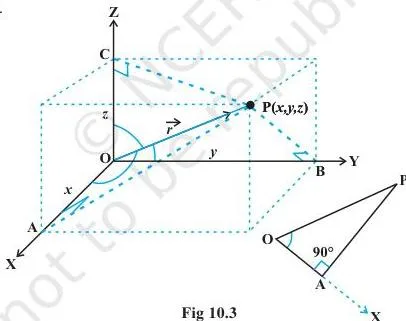
Read Fig 10.3 through the right-angled triangle OAP: OP has length r, OA has length x, so \( \cos \alpha = x/r \). Similarly \( \cos \beta = y/r \) and \( \cos \gamma = z/r \). The cosines \( l, m, n \) are the direction cosines, and the components x, y, z are the direction ratios.
NCERT’s note here: \( l^2 + m^2 + n^2 = 1 \), but \( a^2 + b^2 + c^2 \neq 1 \) in general.
Worked example (original numbers): find the direction cosines of \( \vec{a} = 2\hat{i} – 3\hat{j} + 6\hat{k} \).
- Step 1: magnitude \( r = \sqrt{4 + 9 + 36} = 7 \).
- Step 2: divide each direction ratio by r:
\[ l = \frac{2}{7}, \quad m = -\frac{3}{7}, \quad n = \frac{6}{7} \]
Check: \( l^2 + m^2 + n^2 = \frac{4 + 9 + 36}{49} = 1 \).
Types of vectors and what equal really means
The vocabulary in Section 10.3 is what the true/false questions test, and each type is one line:
- Zero vector \( \vec{0} \): initial and terminal points coincide; it has no definite direction.
- Unit vector \( \hat{a} \): magnitude 1, in the direction of \( \vec{a} \).
- Coinitial vectors: the same initial point.
- Collinear vectors: parallel to the same line (magnitudes and directions may differ).
- Equal vectors: same magnitude and same direction, regardless of where they start.
- Negative of a vector: same magnitude, opposite direction — \( \overrightarrow{BA} = -\overrightarrow{AB} \).
- Free vectors: vectors that may be shifted parallel without change; the remark in 10.3 says this chapter uses only these.
Equal is not the same as collinear. NCERT’s Example 5 makes the point: \( \vec{a} = 2\hat{i} + \hat{j} \) and \( \vec{b} = \hat{i} + 2\hat{j} \) both have magnitude \( \sqrt{5} \), yet they are not equal because their components differ. Exercise 10.1 Q5 tests this — two collinear vectors of the same magnitude are not automatically equal unless they also point the same way.
Adding vectors: triangle and parallelogram laws
Addition is built from displacement. Walking A → B then B → C lands you exactly where walking A → C would: \( \overrightarrow{AC} = \overrightarrow{AB} + \overrightarrow{BC} \). That is the triangle law.
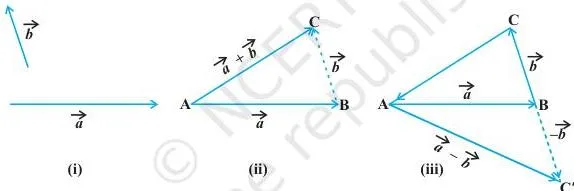
Read Fig 10.8 as an instruction: shift \( \vec{b} \) without rotating it until its tail touches the head of \( \vec{a} \); the third side of the triangle is the sum. The same figure shows subtraction — reverse \( \vec{b} \) first, then add: \( \vec{a} – \vec{b} = \vec{a} + (-\vec{b}) \).
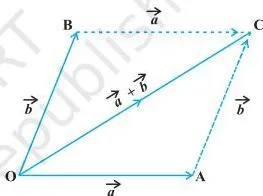
The parallelogram law says the same thing another way: with \( \vec{a} \) and \( \vec{b} \) as adjacent sides, the diagonal through the common point is \( \vec{a} + \vec{b} \). Since the opposite side of the parallelogram equals \( \vec{b} \), the two laws agree (Section 10.4).
Two consequences students use constantly: taking the three sides of a triangle in order gives \( \overrightarrow{AB} + \overrightarrow{BC} + \overrightarrow{CA} = \vec{0} \), and the zero vector is the additive identity — \( \vec{a} + \vec{0} = \vec{a} \). Addition is commutative and associative, which is why \( \vec{a} + \vec{b} + \vec{c} \) can be written without brackets.
Scalar multiplication, unit vectors and collinearity
Multiplying a vector by a scalar \( \lambda \) changes its length, not its line. The result \( \lambda\vec{a} \) is collinear with \( \vec{a} \), points the same way when \( \lambda \) is positive and the opposite way when \( \lambda \) is negative, and has magnitude \( |\lambda| |\vec{a}| \).
The unit vector in the direction of \( \vec{a} \) is \( \hat{a} = \vec{a}/|\vec{a}| \) — divide the vector by its own length (Section 10.5). For any scalar k, \( k\vec{0} = \vec{0} \).
Collinearity test: \( \vec{a} \) and \( \vec{b} \) are collinear exactly when \( \vec{b} = \lambda\vec{a} \) for some nonzero scalar \( \lambda \). In components, \( b_1 = \lambda a_1, b_2 = \lambda a_2, b_3 = \lambda a_3 \).
The ratio form \( b_1/a_1 = b_2/a_2 = b_3/a_3 \) works only when no component of \( \vec{a} \) is zero — if a component is zero, use the \( \lambda \) form directly (Remarks, Section 10.5.1).
Worked example (original numbers): \( \vec{a} = 3\hat{i} – 6\hat{j} + 2\hat{k} \) has magnitude \( \sqrt{9 + 36 + 4} = 7 \).
\[ \hat{a} = \frac{3\hat{i} – 6\hat{j} + 2\hat{k}}{7} \]
Step 2: a vector of magnitude 14 in the same direction is \( 14\hat{a} = 6\hat{i} – 12\hat{j} + 4\hat{k} \).
Final answer: \( \hat{a} = \frac{3}{7}\hat{i} – \frac{6}{7}\hat{j} + \frac{2}{7}\hat{k} \); magnitude-14 copy \( = 6\hat{i} – 12\hat{j} + 4\hat{k} \).
Component form: the algebra of vectors
Coordinates let you replace drawing with arithmetic. The unit vectors along the axes are \( \hat{i}, \hat{j}, \hat{k} \), and every position vector is \( \vec{r} = x\hat{i} + y\hat{j} + z\hat{k} \). Here x, y, z are the scalar components and \( x\hat{i}, y\hat{j}, z\hat{k} \) the vector components.
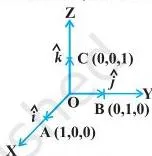
Read Fig 10.14 as a staircase: \( x\hat{i} \) along the x-axis, then \( y\hat{j} \), then \( z\hat{k} \) — the vector is the sum of the three legs. The length formula is Pythagoras applied twice: \( |\vec{r}| = \sqrt{x^2 + y^2 + z^2} \).
With components, all operations become entry-by-entry arithmetic (Section 10.5.1):
- sum: \( (a_1 + b_1)\hat{i} + (a_2 + b_2)\hat{j} + (a_3 + b_3)\hat{k} \)
- difference: \( (a_1 – b_1)\hat{i} + (a_2 – b_2)\hat{j} + (a_3 – b_3)\hat{k} \)
- equality: \( a_1 = b_1 \), \( a_2 = b_2 \), \( a_3 = b_3 \) all at once
- scalar multiple: \( (\lambda a_1)\hat{i} + (\lambda a_2)\hat{j} + (\lambda a_3)\hat{k} \)
Worked example (original numbers): \( \vec{a} = 3\hat{i} – \hat{j} + 2\hat{k} \), \( \vec{b} = -\hat{i} + 4\hat{j} – \hat{k} \).
\[ \vec{a} + \vec{b} = (3 – 1)\hat{i} + (-1 + 4)\hat{j} + (2 – 1)\hat{k} = 2\hat{i} + 3\hat{j} + \hat{k} \]
Final answer: \( |\vec{a} + \vec{b}| = \sqrt{4 + 9 + 1} = \sqrt{14} \).
Vector joining two points and the section formula
To get the vector from \( P_1(x_1, y_1, z_1) \) to \( P_2(x_2, y_2, z_2) \), subtract position vectors — that is the triangle law applied in triangle \( OP_1P_2 \):
\[ \overrightarrow{P_1P_2} = \overrightarrow{OP_2} – \overrightarrow{OP_1} = (x_2 – x_1)\hat{i} + (y_2 – y_1)\hat{j} + (z_2 – z_1)\hat{k} \]
The section formula answers: where is R, the point that cuts PQ in the ratio m:n? With \( \vec{a} \) and \( \vec{b} \) as the position vectors of P and Q:
- internal: \( \vec{r} = \dfrac{m\vec{b} + n\vec{a}}{m + n} \)
- external: \( \vec{r} = \dfrac{m\vec{b} – n\vec{a}}{m – n} \)
- midpoint (m = n): \( \vec{r} = \dfrac{\vec{a} + \vec{b}}{2} \)
The sign discipline: internal keeps a plus in the numerator; external swaps it for a minus, and the same minus appears in the denominator \( m – n \). NCERT’s Summary writes the internal form as \( (n\vec{a} + m\vec{b})/(m + n) \) — same value, so follow whichever convention your teacher used; just fix which vector carries m.
Worked example (original numbers): P has position vector \( \vec{a} = 2\hat{i} + \hat{j} – \hat{k} \), Q has \( \vec{b} = \hat{i} – 3\hat{j} + 4\hat{k} \).
R divides PQ in the ratio 2:3.
Internal (m = 2, n = 3): \( \vec{r} = \frac{2\vec{b} + 3\vec{a}}{5} = \frac{8\hat{i} – 3\hat{j} + 5\hat{k}}{5} \).
External (m = 2, n = 3):
\[ \vec{r} = \frac{2\vec{b} – 3\vec{a}}{2 – 3} = \frac{-4\hat{i} – 9\hat{j} + 11\hat{k}}{-1} = 4\hat{i} + 9\hat{j} – 11\hat{k} \]
Final answer: internal \( \frac{1}{5}(8\hat{i} – 3\hat{j} + 5\hat{k}) \); external \( 4\hat{i} + 9\hat{j} – 11\hat{k} \).
Scalar (dot) product and projection
The dot product is a real number that measures how much two vectors pull along the same line. Definition 2 in Section 10.6.1:
\[ \vec{a} \cdot \vec{b} = |\vec{a}| |\vec{b}| \cos \theta, \quad 0 \le \theta \le \pi \]
If either vector is the zero vector, \( \theta \) is not defined and the dot product is set to 0. The observations in Section 10.6.1 that drive half the exercise questions:
- \( \vec{a} \cdot \vec{b} = 0 \) exactly when the vectors are perpendicular;
- \( \vec{a} \cdot \vec{a} = |\vec{a}|^2 \);
- \( \hat{i}\cdot\hat{i} = \hat{j}\cdot\hat{j} = \hat{k}\cdot\hat{k} = 1 \) and all cross terms like \( \hat{i}\cdot\hat{j} \) are 0;
- \( \cos \theta = \dfrac{\vec{a} \cdot \vec{b}}{|\vec{a}| |\vec{b}|} \);
- component form: \( \vec{a} \cdot \vec{b} = a_1b_1 + a_2b_2 + a_3b_3 \).
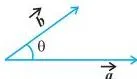
Fig 10.19 defines what “angle between vectors” means: slide the vectors (they are free vectors) until their tails meet, and take the smaller angle \( \theta \) from 0 to \( \pi \).
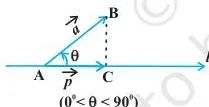
Fig 10.20 walks through the four possible cases of \( \theta \). When \( \theta \) is acute, the projection \( \overrightarrow{AC} \) points along the line; when \( \theta \) is obtuse, \( \cos\theta \) is negative and the projection points the other way; when \( \theta \) is right, the projection is the zero vector.
Projection of \( \vec{a} \) on \( \vec{b} \): divide the dot product by the magnitude of the second vector (Observation 2, Section 10.6.2):
\[ \frac{\vec{a} \cdot \vec{b}}{|\vec{b}|} \]
This is also why the scalar components \( a_1, a_2, a_3 \) are exactly the projections of \( \vec{a} \) along the three axes.
Worked example (original numbers): \( \vec{a} = 4\hat{i} + \hat{j} – 2\hat{k} \), \( \vec{b} = 2\hat{i} + 2\hat{j} + \hat{k} \).
\[ \vec{a} \cdot \vec{b} = 4(2) + 1(2) + (-2)(1) = 8 + 2 – 2 = 8; \quad |\vec{b}| = \sqrt{4 + 4 + 1} = 3 \]
Final answer: projection of \( \vec{a} \) on \( \vec{b} = \frac{8}{3} \).
The chapter also proves, as Examples 19 and 20, the two inequalities \( |\vec{a}\cdot\vec{b}| \le |\vec{a}| |\vec{b}| \) (Cauchy–Schwarz) and \( |\vec{a} + \vec{b}| \le |\vec{a}| + |\vec{b}| \) (triangle inequality) — both fall straight out of \( |\cos\theta| \le 1 \).
Vector (cross) product and areas
The cross product is a vector, perpendicular to both inputs, whose size encodes area. Definition 3 in Section 10.6.3:
\[ \vec{a} \times \vec{b} = |\vec{a}| |\vec{b}| \sin\theta \, \hat{n} \]
where \( \hat{n} \) is a unit vector perpendicular to both \( \vec{a} \) and \( \vec{b} \), chosen so that \( \vec{a}, \vec{b}, \hat{n} \) form a right handed system. The facts that shape the exercise answers:
- \( \vec{a} \times \vec{b} = \vec{0} \) exactly when the vectors are parallel (so \( \vec{a} \times \vec{a} = \vec{0} \));
- \( \hat{i}\times\hat{j} = \hat{k} \), \( \hat{j}\times\hat{k} = \hat{i} \), \( \hat{k}\times\hat{i} = \hat{j} \);
- the product is not commutative: \( \vec{a} \times \vec{b} = -\vec{b} \times \vec{a} \), because reversing the order reverses \( \hat{n} \);
- component form: \( \vec{a} \times \vec{b} = \begin{vmatrix} \hat{i} & \hat{j} & \hat{k} \\ a_1 & a_2 & a_3 \\ b_1 & b_2 & b_3 \end{vmatrix} \) — expand carefully; the middle (\( \hat{j} \)) term takes a minus sign.
Memory aid for the unit-vector cycle: follow the cycle \( \hat{i} \rightarrow \hat{j} \rightarrow \hat{k} \rightarrow \hat{i} \). Forward, \( \hat{i}\times\hat{j} = \hat{k} \); backward, \( \hat{j}\times\hat{i} = -\hat{k} \). Any pair taken against the cycle picks up a minus.
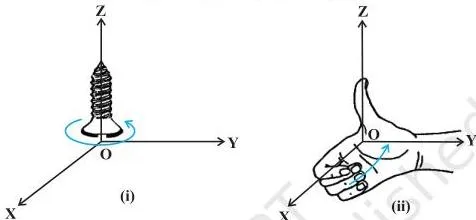
Fig 10.22 is the right-hand rule in pictures. Curl the fingers of your right hand from the first vector to the second; your stretched thumb shows where \( \hat{n} \) points. Curl from \( \vec{b} \) to \( \vec{a} \) instead, and the thumb flips — that is why the two products point in opposite directions.
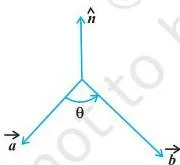
Fig 10.25 draws the reason. With \( \vec{a} \) and \( \vec{b} \) lying in the plane of the paper, \( \vec{a} \times \vec{b} \) points out of the paper while \( \vec{b} \times \vec{a} \) points into it — the two unit normals are negatives, \( \hat{n}_1 = -\hat{n} \).
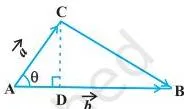
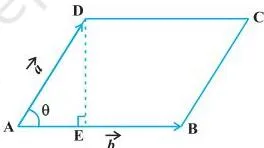
Areas (Observations 8 and 9): if \( \vec{a} \) and \( \vec{b} \) are adjacent sides of a triangle, its area is \( \frac{1}{2}|\vec{a} \times \vec{b}| \); for a parallelogram it is \( |\vec{a} \times \vec{b}| \). The figures below show why — the perpendicular height is \( |\vec{a}|\sin\theta \).
Worked example (original numbers): \( \vec{a} = \hat{i} + 2\hat{j} + 3\hat{k} \), \( \vec{b} = 2\hat{i} – \hat{j} + \hat{k} \).
\[ \vec{a} \times \vec{b} = \begin{vmatrix} \hat{i} & \hat{j} & \hat{k} \\ 1 & 2 & 3 \\ 2 & -1 & 1 \end{vmatrix} = \hat{i}(2(1) – 3(-1)) – \hat{j}(1(1) – 3(2)) + \hat{k}(1(-1) – 2(2)) \]
\[ = 5\hat{i} + 5\hat{j} – 5\hat{k} \]
- Step 1: \( |\vec{a} \times \vec{b}| = \sqrt{25 + 25 + 25} = 5\sqrt{3} \).
- Step 2: a unit vector perpendicular to both is \( \frac{5\hat{i} + 5\hat{j} – 5\hat{k}}{5\sqrt{3}} = \frac{\hat{i} + \hat{j} – \hat{k}}{\sqrt{3}} \).
Final answer: unit normal \( \pm\frac{1}{\sqrt{3}}(\hat{i} + \hat{j} – \hat{k}) \); parallelogram area \( 5\sqrt{3} \); triangle area \( \frac{5\sqrt{3}}{2} \).
There are two normals to any plane — the negative of this one is also perpendicular, and it comes from computing \( \vec{b} \times \vec{a} \).
| Question | Dot product \( \vec{a}\cdot\vec{b} \) | Cross product \( \vec{a}\times\vec{b} \) |
|---|---|---|
| Result | a scalar (a real number) | a vector (perpendicular to both inputs) |
| Formula | \( |\vec{a}| |\vec{b}| \cos\theta \) | \( |\vec{a}| |\vec{b}| \sin\theta \, \hat{n} \) |
| Commutative? | yes: \( \vec{a}\cdot\vec{b} = \vec{b}\cdot\vec{a} \) | no: \( \vec{a}\times\vec{b} = -\vec{b}\times\vec{a} \) |
| Zero condition | 0 when perpendicular (\( \theta = 90^\circ \)) | \( \vec{0} \) when parallel (\( \theta = 0^\circ \) or \( 180^\circ \)) |
| Geometric meaning | how much the vectors pull together | area of the parallelogram they span |
Vector Algebra formulas: the ones to know
One place to find every formula the chapter builds, with the symbols spelled out. Use it to revise; each formula is developed in the section named.
| Formula | What the symbols mean | Where it comes from |
|---|---|---|
| \( |\vec{r}| = \sqrt{x^2 + y^2 + z^2} \) | magnitude of \( \vec{r} = x\hat{i} + y\hat{j} + z\hat{k} \) | Section 10.2, distance formula |
| \( \hat{a} = \dfrac{\vec{a}}{|\vec{a}|} \) | unit vector in the direction of \( \vec{a} \), with \( \vec{a} \neq \vec{0} \) | Section 10.5 |
| \( \overrightarrow{P_1P_2} = (x_2 – x_1)\hat{i} + (y_2 – y_1)\hat{j} + (z_2 – z_1)\hat{k} \) | vector from \( P_1 \) to \( P_2 \) | Section 10.5.2 |
| \( \vec{r} = \dfrac{m\vec{b} + n\vec{a}}{m + n} \), \( \dfrac{m\vec{b} – n\vec{a}}{m – n} \), \( \dfrac{\vec{a} + \vec{b}}{2} \) | internal, external and midpoint division of PQ in the ratio m:n; \( \vec{a}, \vec{b} \) are the position vectors of P, Q | Section 10.5.3 |
| \( \vec{a}\cdot\vec{b} = |\vec{a}| |\vec{b}| \cos\theta = a_1b_1 + a_2b_2 + a_3b_3 \) | dot product; \( \theta \) between 0 and \( \pi \) | Section 10.6.1 |
| \( \cos\theta = \dfrac{\vec{a}\cdot\vec{b}}{|\vec{a}| |\vec{b}|} \) | angle between two nonzero vectors | Section 10.6.1, Observation 6 |
| projection of \( \vec{a} \) on \( \vec{b} \) \( = \dfrac{\vec{a}\cdot\vec{b}}{|\vec{b}|} \) | dot product divided by the magnitude of the second vector | Section 10.6.2 |
| \( \vec{a}\times\vec{b} = |\vec{a}| |\vec{b}| \sin\theta \, \hat{n} \) | vector product; \( \hat{n} \) is the unit normal, right handed with \( \vec{a}, \vec{b} \) | Section 10.6.3 |
| \( \vec{a}\times\vec{b} = \begin{vmatrix} \hat{i} & \hat{j} & \hat{k} \\ a_1 & a_2 & a_3 \\ b_1 & b_2 & b_3 \end{vmatrix} \) | cross product in component form | Section 10.6.3 |
| triangle area \( = \frac{1}{2}|\vec{a}\times\vec{b}| \); parallelogram area \( = |\vec{a}\times\vec{b}| \) | \( \vec{a}, \vec{b} \) are adjacent sides | Section 10.6.3, Observations 8–9 |
| \( l^2 + m^2 + n^2 = 1 \) | direction cosines of any vector | Section 10.2, Note |
How to read the figures in Vector Algebra
Every diagram in this chapter draws the same handful of ideas — a directed segment, a chain of vectors, a normal that flips. These three are the ones students misread.
Fig 10.1 shows how a plain line becomes a vector: the arrowhead chooses one of the two directions. What is drawn is a directed line segment, \( \overrightarrow{AB} \) — its length is the magnitude and the arrow is the direction. This single picture is the definition of every vector in the chapter.
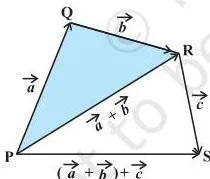
Fig 10.11 proves associativity visually. The three vectors sit as a chain \( \overrightarrow{PQ}, \overrightarrow{QR}, \overrightarrow{RS} \). Bracketed on the left, \( (\vec{a} + \vec{b}) + \vec{c} \) reaches \( \overrightarrow{PS} \); bracketed on the right, \( \vec{a} + (\vec{b} + \vec{c}) \) reaches the same \( \overrightarrow{PS} \). That is why brackets can be dropped.
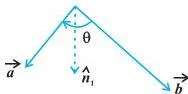
Fig 10.25 is the one that looks puzzling until you decide the plane of the paper. With \( \vec{a} \) and \( \vec{b} \) lying in the paper, the right-hand rule sends \( \vec{a}\times\vec{b} \) out of the page and \( \vec{b}\times\vec{a} \) into it.
The two normals are exact opposites, \( \hat{n}_1 = -\hat{n} \), which is the whole reason the cross product is not commutative.
Definitions you should be able to write
Definition questions ask you to write these in words, not memorise them word-perfect. Each one below is the chapter’s own definition in plain language, with the section where it appears.
- Vector — a quantity that has magnitude and direction (Definition 1, Section 10.2).
- Position vector — the vector \( \overrightarrow{OP} \) from the origin to point P; its length is the distance OP (Section 10.2).
- Magnitude (length) — the distance between the initial and terminal points, written \( |\vec{a}| \) (Section 10.2).
- Direction angles and direction cosines — the angles \( \alpha, \beta, \gamma \) a vector makes with the positive axes, and their cosines l, m, n (Section 10.2).
- Zero (null) vector — a vector whose initial and terminal points coincide; it has no definite direction (Section 10.3).
- Unit vector — a vector of magnitude 1, written \( \hat{a} \) in the direction of \( \vec{a} \) (Section 10.3).
- Coinitial vectors — two or more vectors with the same initial point (Section 10.3).
- Collinear vectors — vectors parallel to the same line (Section 10.3).
- Equal vectors — same magnitude and same direction, wherever they start (Section 10.3).
- Negative of a vector — same magnitude, opposite direction (Section 10.3).
- Free vectors — vectors that may be shifted parallel without change; the chapter deals only with these (Remark, Section 10.3).
- Scalar product — \( \vec{a}\cdot\vec{b} = |\vec{a}| |\vec{b}| \cos\theta \) (Definition 2, Section 10.6.1).
- Projection — the component of one vector along a line or another vector, \( \vec{a}\cdot\hat{b} = \dfrac{\vec{a}\cdot\vec{b}}{|\vec{b}|} \) (Section 10.6.2).
- Vector product — \( \vec{a}\times\vec{b} = |\vec{a}| |\vec{b}| \sin\theta \, \hat{n} \), a vector perpendicular to both, right handed with them (Definition 3, Section 10.6.3).
Two distinctions to write cleanly: equal vectors need the same magnitude and the same direction — collinearity alone is not enough — and the zero vector, having zero magnitude, cannot be assigned a definite direction.
Common mistakes in Vector Algebra
Most marks lost in this chapter are sign slips and vocabulary slips, not hard algebra. The table names each trap before you step in it, with the correction the chapter itself implies.
| Mistake | Correct rule | How to check your answer |
|---|---|---|
| Assuming equal magnitude means equal vectors | Equality needs same magnitude and same direction (Example 5, Section 10.3) | Compare components: equal vectors agree in every component |
| Writing \( |\vec{a}| \lt 0 \) | Magnitude is a length — never negative | \( |\vec{a}| = 0 \) only for the zero vector (Section 10.2) |
| Dividing collinearity ratios \( b_1/a_1 = b_2/a_2 \) when \( a_1 = 0 \) | Use \( \vec{b} = \lambda\vec{a} \) instead — the ratio form fails on zero components (Remarks, 10.5.1) | Check \( b_1 = \lambda a_1 \) separately for each component |
| Mixing m and n, or dropping the sign, in the external section formula | Internal \( \frac{m\vec{b} + n\vec{a}}{m + n} \); external \( \frac{m\vec{b} – n\vec{a}}{m – n} \) (Section 10.5.3, Example 11) | m multiplies the vector named first in the ratio; the external form has minus in numerator AND denominator |
| Projection written as \( \vec{a}\cdot\vec{b} \) alone | Projection of \( \vec{a} \) on \( \vec{b} \) is \( \frac{\vec{a}\cdot\vec{b}}{|\vec{b}|} \) (Observation 2, 10.6.2) | Projection is a length — dividing by \( |\vec{b}| \) is what makes it so |
| Treating \( \vec{a}\times\vec{b} \) as commutative | \( \vec{a}\times\vec{b} = -\vec{b}\times\vec{a} \) (Observation 6, 10.6.3) | Re-check the sign of \( \hat{n} \) with the right hand; watch the minus on the \( \hat{j} \) term when expanding the determinant |
| Reading \( \vec{a}\times\vec{b} = \vec{0} \) as “one vector is zero” | It means the vectors are parallel; similarly \( \vec{a}\cdot\vec{b} = 0 \) means perpendicular (Exercises 10.3 Q14, 10.4 Q8) | Test with \( \vec{a} = 2\hat{i}, \vec{b} = 4\hat{i} \): the cross product is \( \vec{0} \) but neither vector is zero |
| Believing \( \overrightarrow{AB} + \overrightarrow{BC} + \overrightarrow{CA} = \vec{0} \) proves a triangle | It holds for collinear points too (Note after Example 21) | Check lengths: for collinear points, one length equals the sum of the other two |
How to revise Vector Algebra: exam notes
Each exercise set trains one specific skill, so revise by exercise. The map below tells you what each set is for.
- Exercise 10.1 — recognising scalars and vectors, naming coinitial/equal/collinear vectors from a figure, and the true/false questions that trap loose definitions.
- Exercise 10.2 — magnitudes, unit vectors, sums, components, collinearity, direction cosines, and the section formula in question 15.
- Exercise 10.3 — dot product, angle between vectors, projection, perpendicularity, and unit-vector identities.
- Exercise 10.4 — cross product, a unit vector perpendicular to two vectors, areas of a triangle and a parallelogram, and two MCQs.
- Miscellaneous Exercise — the long questions: all unit vectors in the XY-plane, a displacement word problem, collinearity with ratios, and finding a vector perpendicular to two given vectors with an extra dot-product condition.
Five question shapes repeat across the sets, so practise each till it is automatic: find a magnitude or a unit vector; find the angle via \( \cos\theta \); find a projection; prove perpendicularity, collinearity or a right-angled triangle; find an area with a cross product.
A full-marks answer to a “find” question states the result as asked — magnitude, direction, or both — and for an area, writes the area formula before substituting.
Textbook contents and the examinable syllabus are not always identical — check the current official CBSE syllabus for what is expected this year.
Vector Algebra: the chapter’s key results at a glance
Built from the chapter’s closing Summary in plainer words — a night-before list, no derivations.
- Position vector of \( P(x, y, z) \): \( \vec{r} = x\hat{i} + y\hat{j} + z\hat{k} \), magnitude \( \sqrt{x^2 + y^2 + z^2} \).
- Scalar components are the direction ratios, and they are also the projections of the vector along the axes.
- With r the magnitude and a, b, c the direction ratios, \( l = a/r \), \( m = b/r \), \( n = c/r \).
- The sum of the three sides of a triangle taken in order is \( \vec{0} \).
- The sum of two coinitial vectors is the diagonal, through their common point, of the parallelogram those vectors span.
- Multiplying by scalar \( \lambda \) changes length by \( |\lambda| \) and keeps the direction, or reverses it when \( \lambda \lt 0 \).
- \( \hat{a} = \vec{a}/|\vec{a}| \) is the unit vector along \( \vec{a} \).
- Section 10.5.3: internal division \( (m\vec{b} + n\vec{a})/(m + n) \), external \( (m\vec{b} – n\vec{a})/(m – n) \).
- \( \vec{a}\cdot\vec{b} = |\vec{a}| |\vec{b}| \cos\theta \); \( \cos\theta = \frac{\vec{a}\cdot\vec{b}}{|\vec{a}| |\vec{b}|} \).
- \( \vec{a}\times\vec{b} = |\vec{a}| |\vec{b}| \sin\theta \, \hat{n} \), with \( \vec{a}, \vec{b}, \hat{n} \) right handed.
- Component operations: sum, scalar multiple, dot product \( a_1b_1 + a_2b_2 + a_3b_3 \), cross product as a determinant.
Related resources for Class 12 Mathematics
This listing is maintained for the 2026-27 academic session using the NCERT textbook information available to us. NCERT remains the authority for confirming the latest edition.
From here you can move to the Class 12 Mathematics notes for the full set of chapters, or step back to the Class 12 hub for every subject.
In this book Vector Algebra sits between Differential Equations, the chapter that precedes it, and Three Dimensional Geometry, the direct sequel that reuses the \( \hat{i}, \hat{j}, \hat{k} \) notation and the direction cosines from this chapter.
For the calculus tools behind many of these operations, work through Continuity and Differentiability, or browse the full index of revision notes for anything else.
Reference: NCERT Class 12 Mathematics Part II textbook, chapter 10, official edition on ncert.nic.in.
Sources and data verification
- The chapter described is Vector Algebra, Chapter 10 of the NCERT Class 12 Mathematics Part II textbook, in the current NCERT edition published on ncert.nic.in.
- This page covers that single chapter of that one book only — it is not a listing of the full CBSE scheme of subjects.
- The page is maintained for the current academic session using the NCERT information available to us.
- NCERT settles textbooks, editions and PDFs; CBSE settles curriculum, syllabus and examinations. For the chapter text and the official PDF, NCERT is the authority; for what is examinable this session, check the official CBSE syllabus.
Frequently asked questions about Vector Algebra Class 12
What is the difference between a scalar and a vector in Class 12 maths?
A scalar is a quantity that has only magnitude — one real number — like height 1.6 m, mass, time, speed or work. A vector has magnitude and direction, like displacement, velocity, force or weight. The chapter’s opening example contrasts “what is your height?” (scalar answer 1.6 m) with “how should a footballer hit the ball?” (force: magnitude plus direction).
In component form a vector is written \( x\hat{i} + y\hat{j} + z\hat{k} \); a scalar is just a number. Section 10.1.
How do you find the unit vector in the direction of a given vector?
Divide the vector by its own magnitude: \( \hat{a} = \vec{a}/|\vec{a}| \). For \( \vec{a} = 3\hat{i} – 6\hat{j} + 2\hat{k} \), the magnitude is \( \sqrt{9 + 36 + 4} = 7 \), so \( \hat{a} = \frac{3}{7}\hat{i} – \frac{6}{7}\hat{j} + \frac{2}{7}\hat{k} \). The unit vector has magnitude 1 and points exactly along \( \vec{a} \).
To get a vector of some other length k in that direction, multiply \( \hat{a} \) by k. Section 10.5.
Why is the cross product not commutative?
Because the product’s direction depends on the order of multiplication. \( \vec{a}\times\vec{b} = |\vec{a}| |\vec{b}| \sin\theta \, \hat{n} \), where \( \hat{n} \) is chosen so that \( \vec{a}, \vec{b}, \hat{n} \) form a right handed system.
When you swap to \( \vec{b}\times\vec{a} \), the right-hand rule sends \( \hat{n} \) the other way — Fig 10.25 shows it pointing above the paper in one case and below it in the other, so \( \hat{n}_1 = -\hat{n} \). Hence \( \vec{a}\times\vec{b} = -\vec{b}\times\vec{a} \). The dot product has no direction, so it is commutative.
Section 10.6.3.
When do you use the minus sign in the section formula for vectors?
Internal division keeps a plus: \( \vec{r} = (m\vec{b} + n\vec{a})/(m + n) \). External division brings the minus: \( \vec{r} = (m\vec{b} – n\vec{a})/(m – n) \) — minus in the numerator and minus in the denominator, with \( \vec{a} \) the position vector of P and \( \vec{b} \) of Q.
So with P at \( 2\hat{i} + \hat{j} – \hat{k} \) and Q at \( \hat{i} – 3\hat{j} + 4\hat{k} \), dividing in the ratio 2:3 internally gives \( \frac{1}{5}(8\hat{i} – 3\hat{j} + 5\hat{k}) \), and externally gives \( 4\hat{i} + 9\hat{j} – 11\hat{k} \). The external denominator \( m – n \) is where students drop the sign. Section 10.5.3.
How do you find the area of a triangle using vectors?
Take two sides as vectors from the same vertex — say \( \overrightarrow{AB} \) and \( \overrightarrow{AC} \) — then area \( = \frac{1}{2}|\overrightarrow{AB}\times\overrightarrow{AC}| \). The cross product’s magnitude gives the area of the parallelogram those two vectors span, and the triangle is exactly half of it; NCERT Observation 8 shows this via base \( \times \) height \( = |\vec{b}| |\vec{a}|\sin\theta \).
If the question gives adjacent sides of a parallelogram, its area is \( |\vec{a}\times\vec{b}| \) with no half. Compute the cross product as a determinant, take its magnitude, and halve only for a triangle. Section 10.6.3.
What is the projection of vector a on vector b and how is it calculated?
The projection is the length of the shadow \( \vec{a} \) casts along the direction of \( \vec{b} \). It is calculated as \( \frac{\vec{a}\cdot\vec{b}}{|\vec{b}|} \) — the dot product divided by the magnitude of \( \vec{b} \), or equivalently \( \vec{a}\cdot\hat{b} \).
Example: \( \vec{a} = 4\hat{i} + \hat{j} – 2\hat{k} \), \( \vec{b} = 2\hat{i} + 2\hat{j} + \hat{k} \); the dot product is 8 and \( |\vec{b}| = 3 \), so the projection is \( 8/3 \). If the angle is obtuse the projection is negative, and the projection of a vector perpendicular to \( \vec{b} \) is zero. Section 10.6.2.
Explore Class 12 Mathematics Books
Class 12 Mathematics on LearnCBSE:
Related chapters: