
Three Dimensional Geometry Class 12 is Chapter 11 of the NCERT Class 12 Mathematics book — the fifth chapter of Mathematics Part II, building directly on the Vector Algebra chapter.
The official chapter PDF is on this page, just below, and underneath it is a complete walkthrough of what the chapter teaches: direction cosines and direction ratios, the vector and cartesian equations of a line, the angle between two lines, and the shortest distance between skew and parallel lines. This page is written for the current NCERT edition.
Download Three Dimensional Geometry Class 12 Chapter PDF
Here is the official file, exactly as NCERT publishes it — same section numbers, same figures, same exercise questions. Open the NCERT Class 12 Maths Three Dimensional Geometry Chapter 11 PDF from the NCERT textbook portal if you want the printed chapter in front of you while you work through this guide, or to carry it on your phone.
| What the chapter holds | Count | Where it is used |
|---|---|---|
| Printed pages | 17 | |
| Sections in the chapter | 9 | |
| Figures with NCERT captions | 6 | |
| Exercise questions | 20 | answered in our NCERT Solutions |
| Official NCERT PDF | Download the chapter PDF | the chapter exactly as NCERT publishes it |
Chapter at a Glance
The table below shows how much the chapter holds — its sections, figures, worked examples and exercise questions — counted straight from the NCERT source. Leave the counting to the table and scroll on to what each section teaches.
In reading order the chapter moves through direction cosines and direction ratios (11.2), the equation of a line in space (11.3), the angle between two lines (11.4) and the shortest distance between two lines (11.5), closing with two exercises, a miscellaneous exercise and the chapter’s own summary.
What Three Dimensional Geometry Class 12 Covers
This chapter takes the vector algebra you studied in the previous chapter and uses it to describe lines in three-dimensional space. Its working rule is consistent: every result first appears as a vector equation, and is then rewritten in cartesian form — the two forms describe the same line, so learning to translate between them is half the chapter.
- 11.2 Direction cosines and direction ratios — defines the three direction angles a line makes with the axes, introduces direction cosines \(l, m, n\) and direction ratios \(a, b, c\), and finds the direction cosines of the line joining two given points. This is the chapter’s vocabulary; everything else uses it.
- 11.3 Equation of a line in space — builds the vector equation \(\vec{r} = \vec{a} + \lambda\vec{b}\) for a line through a point with position vector \(\vec{a}\) and parallel to \(\vec{b}\), derives the parametric equations \(x = x_1 + \lambda a\), \(y = y_1 + \lambda b\), \(z = z_1 + \lambda c\), and from them the cartesian equation \(\frac{x – x_1}{a} = \frac{y – y_1}{b} = \frac{z – z_1}{c}\).
- 11.4 Angle between two lines — the angle between the lines is the angle between their direction vectors, so the dot product gives a cosine formula; the section also states the perpendicular and parallel tests.
- 11.5 Shortest distance between two lines — distinguishes intersecting, parallel and skew lines, then gives one distance formula for skew lines (using the cross product \(\vec{b}_1 \times \vec{b}_2\)) and a simpler one for parallel lines.
Students often memorise the cartesian forms and miss that they are the same statements as the vector forms. When you read section 11.3, watch how the book derives the cartesian equation by eliminating the parameter \(\lambda\) — that one derivation unlocks every conversion question in the exercises.
Key Concepts in Three Dimensional Geometry Class 12
Direction cosines measure how a line leans towards the three axes; direction ratios are any proportional triplet, which is why a line has infinitely many sets of direction ratios. Everything in this chapter is one of three problems built on those ideas: describing a line, finding the angle between two lines, and measuring the shortest distance between two lines.
Direction cosines and direction ratios
For a directed line (a line with a chosen direction) making angles \(\alpha, \beta, \gamma\) with the positive \(x, y, z\)-axes, the direction cosines are \(\cos\alpha, \cos\beta, \cos\gamma\), written \(l, m, n\) (NCERT 11.2). Because they are the components of a unit vector along the line, they always satisfy \[ l^2 + m^2 + n^2 = 1 \]
If you reverse the direction of the line, each direction angle is replaced by its supplement (\(\pi – \alpha\), and so on), so the signs of \(l, m, n\) all flip. A line therefore has two sets of direction cosines; taking it as a directed line fixes one set.
For a line that does not pass through the origin, the book’s remark is to draw a parallel line through the origin and read its direction cosines — parallel lines have the same set.
Any three numbers \(a, b, c\) proportional to \(l, m, n\) are direction ratios of the line. The conversion between the two sets is \[ l = \pm \frac{a}{\sqrt{a^2 + b^2 + c^2}}, \quad m = \pm \frac{b}{\sqrt{a^2 + b^2 + c^2}}, \quad n = \pm \frac{c}{\sqrt{a^2 + b^2 + c^2}} \]
The \(\pm\) is one sign taken for all three at once. Multiplying a direction-ratio set by any nonzero constant gives another valid set, so every line has infinitely many sets of direction ratios.
Direction cosines of a line joining two points
Since exactly one line passes through two points, its direction cosines are fixed by their coordinates. For \(P(x_1, y_1, z_1)\) and \(Q(x_2, y_2, z_2)\) they are (NCERT 11.2.1) \[ \frac{x_2 – x_1}{PQ}, \quad \frac{y_2 – y_1}{PQ}, \quad \frac{z_2 – z_1}{PQ}, \quad \text{where } PQ = \sqrt{(x_2 – x_1)^2 + (y_2 – y_1)^2 + (z_2 – z_1)^2} \]
Why the differences? Because \(x_2 – x_1\) is the run of the segment along the \(x\)-axis, and dividing it by the segment’s length \(PQ\) turns that run into \(\cos\alpha\). The same idea gives \(\cos\beta\) and \(\cos\gamma\). The direction ratios of the segment are simply \(x_2 – x_1, y_2 – y_1, z_2 – z_1\), or all three reversed.
This formula is also the standard collinearity test the exercises use: find the direction ratios of AB and BC; if they are proportional and B is common to both segments, the three points are collinear.
Equation of a line in space
A line is fixed by a point on it and a direction. If the point has position vector \(\vec{a}\) and the direction is the vector \(\vec{b}\), then any point P on the line has position vector \[ \vec{r} = \vec{a} + \lambda\vec{b} \]
because \(\overrightarrow{AP}\) is just a scalar multiple of \(\vec{b}\) (NCERT 11.3.1).
Writing \(\vec{r} = x\hat{i} + y\hat{j} + z\hat{k}\) and comparing components gives the parametric equations \(x = x_1 + \lambda a\), \(y = y_1 + \lambda b\), \(z = z_1 + \lambda c\); eliminating \(\lambda\) gives the cartesian form \[ \frac{x – x_1}{a} = \frac{y – y_1}{b} = \frac{z – z_1}{c} \]
Convention: if a direction ratio is zero, the corresponding fraction is replaced by setting its numerator to zero — a line parallel to the \(x\)-axis has \(y = y_1\) and \(z = z_1\), for example.
Example with fresh coordinates:
Step 1: Line through \((-1, 3, 4)\) parallel to \(2\hat{i} – \hat{j} + 3\hat{k}\).
So \(\vec{a} = -\hat{i} + 3\hat{j} + 4\hat{k}\) and \(\vec{b} = 2\hat{i} – \hat{j} + 3\hat{k}\).
- Step 1: Vector equation: \(\vec{r} = -\hat{i} + 3\hat{j} + 4\hat{k} + \lambda(2\hat{i} – \hat{j} + 3\hat{k})\).
- Step 2: Components: \(x = -1 + 2\lambda\), \(y = 3 – \lambda\), \(z = 4 + 3\lambda\).
\[ \frac{x + 1}{2} = \frac{y – 3}{-1} = \frac{z – 4}{3} \]
Cartesian form: \(\frac{x + 1}{2} = \frac{y – 3}{-1} = \frac{z – 4}{3}\).
Angle between two lines
The angle between two lines is the angle between their direction vectors, because the lines are just those vectors anchored at different points. For direction ratios \((a_1, b_1, c_1)\) and \((a_2, b_2, c_2)\), the acute angle \(\theta\) satisfies (NCERT 11.4) \[ \cos\theta = \left| \frac{a_1 a_2 + b_1 b_2 + c_1 c_2}{\sqrt{a_1^2 + b_1^2 + c_1^2}\sqrt{a_2^2 + b_2^2 + c_2^2}} \right| \]
The absolute value forces the acute angle; without it the same formula could return the obtuse supplement. The same statement in vector form is \(\cos\theta = \frac{|\vec{b}_1 \cdot \vec{b}_2|}{|\vec{b}_1||\vec{b}_2|}\), and in direction cosines it becomes \(\cos\theta = |l_1 l_2 + m_1 m_2 + n_1 n_2|\).
Two lines are perpendicular when the numerator is zero — that is, \(a_1a_2 + b_1b_2 + c_1c_2 = 0\) — and parallel when the direction ratios are proportional, \(a_1/a_2 = b_1/b_2 = c_1/c_2\).
Apply both tests to original pairs. The lines \(\frac{x-1}{2} = \frac{y-2}{4} = \frac{z-3}{6}\) and \(\frac{x-5}{1} = \frac{y+1}{2} = \frac{z}{3}\) have ratios \((2, 4, 6) = 2(1, 2, 3)\), so they are parallel. The lines \(\frac{x-1}{1} = \frac{y-2}{2} = \frac{z-3}{2}\) and \(\frac{x-4}{4} = \frac{y-3}{-3} = \frac{z-1}{1}\) have dot product \(1 \cdot 4 + 2(-3) + 2(1) = 0\), so they are perpendicular.
Shortest distance between two lines
If two lines intersect, their shortest distance is zero. If they are parallel, it is the length of the perpendicular from a point on one line to the other. But some lines in space are neither parallel nor intersecting — the book calls these skew lines, and they are not coplanar.
For skew lines \(\vec{r} = \vec{a}_1 + \lambda\vec{b}_1\) and \(\vec{r} = \vec{a}_2 + \mu\vec{b}_2\), the shortest segment is perpendicular to both lines. Its direction is \(\vec{b}_1 \times \vec{b}_2\), and the distance is the projection of \(\vec{a}_2 – \vec{a}_1\) onto it (NCERT 11.5.1):
\[ d = \left| \frac{(\vec{b}_1 \times \vec{b}_2) \cdot (\vec{a}_2 – \vec{a}_1)}{|\vec{b}_1 \times \vec{b}_2|} \right| \]
For parallel lines \(\vec{r} = \vec{a}_1 + \lambda\vec{b}\) and \(\vec{r} = \vec{a}_2 + \mu\vec{b}\), the formula is simpler (NCERT 11.5.2):
\[ d = \frac{|\vec{b} \times (\vec{a}_2 – \vec{a}_1)|}{|\vec{b}|} \]
| Situation | Formula | What tells you to use it |
|---|---|---|
| Skew lines (not parallel, not intersecting) | \(d = \left| \frac{(\vec{b}_1 \times \vec{b}_2) \cdot (\vec{a}_2 – \vec{a}_1)}{|\vec{b}_1 \times \vec{b}_2|} \right|\) | \(\vec{b}_1\) not proportional to \(\vec{b}_2\), and the lines never meet |
| Parallel lines | \(d = \frac{|\vec{b} \times (\vec{a}_2 – \vec{a}_1)|}{|\vec{b}|}\) | \(\vec{b}_1\) proportional to \(\vec{b}_2\) — one shared direction vector \(\vec{b}\) |
Worked example with a new pair of skew lines:
Step 1: Identify the vectors.
For \(L_1: \vec{r} = (2\hat{i} + \hat{j} – \hat{k}) + \lambda(\hat{i} + 2\hat{j} + \hat{k})\), \(\vec{a}_1 = 2\hat{i} + \hat{j} – \hat{k}\) and \(\vec{b}_1 = \hat{i} + 2\hat{j} + \hat{k}\).
For \(L_2: \vec{r} = (\hat{i} + 3\hat{j} + 2\hat{k}) + \mu(2\hat{i} – \hat{j} + 2\hat{k})\), \(\vec{a}_2 = \hat{i} + 3\hat{j} + 2\hat{k}\) and \(\vec{b}_2 = 2\hat{i} – \hat{j} + 2\hat{k}\).
The direction vectors are not proportional, so this is the skew case.
- Step 1: \(\vec{a}_2 – \vec{a}_1 = -\hat{i} + 2\hat{j} + 3\hat{k}\).
- Step 2: Cross product: \(\vec{b}_1 \times \vec{b}_2 = 5\hat{i} – 5\hat{k}\), so \(|\vec{b}_1 \times \vec{b}_2| = \sqrt{25 + 25} = 5\sqrt{2}\).
- Step 3: Dot product: \((5\hat{i} – 5\hat{k}) \cdot (-\hat{i} + 2\hat{j} + 3\hat{k}) = -5 – 15 = -20\).
\[ d = \frac{|-20|}{5\sqrt{2}} = \frac{20}{5\sqrt{2}} = \frac{4}{\sqrt{2}} = 2\sqrt{2} \text{ units} \]
Final answer: the shortest distance between the two lines is \(2\sqrt{2}\) units.
| What you need | Formula | Symbols | Exercises that use it |
|---|---|---|---|
| Direction cosines identity | \(l^2 + m^2 + n^2 = 1\) | \(l, m, n\) — direction cosines | Exercise 11.1 |
| Convert direction ratios to direction cosines | \(l = \pm \frac{a}{\sqrt{a^2 + b^2 + c^2}}\), \(m\) and \(n\) analogous | \(a, b, c\) — direction ratios | Exercise 11.1 |
| Direction cosines of a segment | \(\frac{x_2 – x_1}{PQ}, \frac{y_2 – y_1}{PQ}, \frac{z_2 – z_1}{PQ}\) | \(P, Q\) — endpoints; \(PQ\) — distance between them | Exercise 11.1 |
| Line through point \(A\) parallel to \(\vec{b}\) | \(\vec{r} = \vec{a} + \lambda\vec{b}\) | \(\vec{a}\) — position vector of \(A\); \(\lambda\) — real parameter | Exercise 11.2, Q4–Q7 |
| Cartesian equation of a line | \(\frac{x – x_1}{a} = \frac{y – y_1}{b} = \frac{z – z_1}{c}\) | \((x_1, y_1, z_1)\) — fixed point; \(a, b, c\) — direction ratios | Exercise 11.2, Q4–Q7 |
| Angle between two lines | \(\cos\theta = \left| \frac{a_1a_2 + b_1b_2 + c_1c_2}{\sqrt{a_1^2 + b_1^2 + c_1^2}\sqrt{a_2^2 + b_2^2 + c_2^2}} \right|\) | \((a_1, b_1, c_1)\), \((a_2, b_2, c_2)\) — direction ratios of the two lines | Exercise 11.2, Q8–Q11 |
| Perpendicular test | \(a_1a_2 + b_1b_2 + c_1c_2 = 0\) | Same direction ratios | Exercise 11.2, Q1–Q2, Q10–Q11 |
| Parallel test | \(\frac{a_1}{a_2} = \frac{b_1}{b_2} = \frac{c_1}{c_2}\) | Same direction ratios | Exercise 11.2, Q3 |
| Skew-line distance | \(d = \left| \frac{(\vec{b}_1 \times \vec{b}_2) \cdot (\vec{a}_2 – \vec{a}_1)}{|\vec{b}_1 \times \vec{b}_2|} \right|\) | \(\vec{a}_1, \vec{a}_2\) — position vectors of points on the lines; \(\vec{b}_1, \vec{b}_2\) — direction vectors | Exercise 11.2, Q12–Q15 |
| Parallel-line distance | \(d = \frac{|\vec{b} \times (\vec{a}_2 – \vec{a}_1)|}{|\vec{b}|}\) | \(\vec{b}\) — common direction; \(\vec{a}_1, \vec{a}_2\) — position vectors on the lines | Chapter Example 10 |
Reading the Chapter’s Figures (Fig 11.2 to 11.6)
These diagrams are not decoration — each one is the visual proof of a formula in this chapter. Keep your own book open and follow each figure as you read.
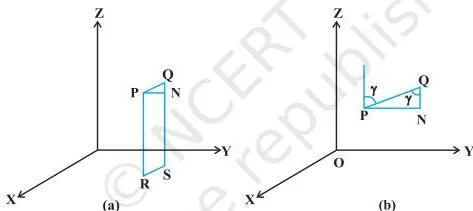
Fig 11.2 (a) drops perpendiculars from P and Q to the XY-plane, landing at R and S. From P a perpendicular PN meets QS, and in the right triangle PNQ the angle \(PQN\) equals \(\gamma\), the angle the line makes with the \(z\)-axis.
So \(\cos\gamma = NQ/PQ = (z_2 – z_1)/PQ\), and the same reading gives \(\cos\alpha = (x_2 – x_1)/PQ\) and \(\cos\beta = (y_2 – y_1)/PQ\). This one picture is the derivation behind the two-point direction-cosine formula.
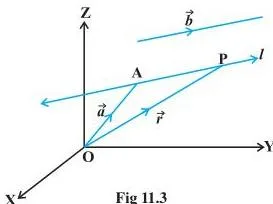
Fig 11.3 is the meaning of \(\vec{r} = \vec{a} + \lambda\vec{b}\). The point A is fixed; as \(\lambda\) takes different real values, the point P slides along the line, and \(\overrightarrow{AP}\) is always parallel to \(\vec{b}\).
Every position on the line is reached by exactly one value of \(\lambda\) — that is why the vector equation describes the whole line, not just one point of it.
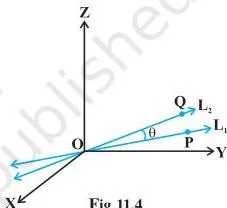
Fig 11.4 explains why the angle between two lines is computed with a dot product. The lines have direction ratios \(a_1, b_1, c_1\) and \(a_2, b_2, c_2\), which are exactly the components of the vectors OP and OQ.
The angle between the lines is the angle \(\theta\) between these two vectors, and the cosine formula for the angle between two vectors gives the result, absolute value included.
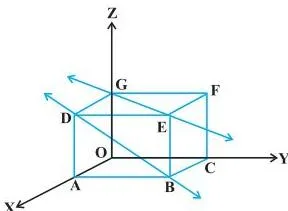
Fig 11.5 gives the book’s working definition of skew lines inside a room of size \(1 \times 3 \times 2\) units. The line GE runs diagonally across the ceiling; the line DB drops from the corner directly above A and runs diagonally down one wall.
The two lines are not parallel and they never meet — they lie in different planes, the ceiling and the wall.
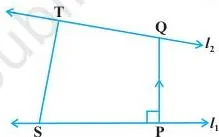
Fig 11.6 is the geometry of the skew-distance formula. S lies on \(l_1\) and T lies on \(l_2\), with position vectors \(\vec{a}_1\) and \(\vec{a}_2\).
The shortest segment \(\vec{PQ}\) is perpendicular to both lines, so its direction is \(\vec{b}_1 \times \vec{b}_2\), and the unit vector along it is \(\hat{n} = (\vec{b}_1 \times \vec{b}_2)/|\vec{b}_1 \times \vec{b}_2|\).
The distance \(d\) is the projection of \(\vec{ST} = \vec{a}_2 – \vec{a}_1\) onto \(\hat{n}\) — exactly the dot product in the formula.
The parallel-line distance (Fig 11.7) uses the same idea in a single plane: drop a perpendicular from a point on one parallel line to the other, and its length is \(|\vec{b} \times (\vec{a}_2 – \vec{a}_1)|/|\vec{b}|\).
Definitions You Need: Direction Cosines, Skew Lines and the Rest
This chapter runs on a small set of definitions — every formula above is one of these ideas restated. Learn the words and the formulas stop being separate facts.
- Direction angles — the angles \(\alpha, \beta, \gamma\) that a directed line makes with the positive \(x, y, z\)-axes (NCERT 11.2).
- Direction cosines — \(\cos\alpha, \cos\beta, \cos\gamma\), written \(l, m, n\); they satisfy \(l^2 + m^2 + n^2 = 1\).
- Directed line — a line with one of its two directions chosen; fixing a direction gives a unique set of direction cosines.
- Direction ratios — any three numbers \(a, b, c\) proportional to the direction cosines; every line has infinitely many sets.
- Direction cosines of a line through two points — \(\frac{x_2 – x_1}{PQ}, \frac{y_2 – y_1}{PQ}, \frac{z_2 – z_1}{PQ}\), with \(PQ\) the distance between the points.
- Skew lines — lines in space that are neither parallel nor intersecting; they are non-coplanar and lie in different planes (NCERT 11.5).
- Angle between skew lines — the angle between two intersecting lines drawn from any point (preferably the origin) parallel to the skew lines.
- Shortest distance between two lines — the smallest length joining a point on one line to a point on the other; for skew lines it is the segment perpendicular to both.
One remark saves many marks: if the line does not pass through the origin, draw a parallel line through the origin and read its direction cosines; if you reverse the direction of the line, the direction angles become their supplements and the signs of all three cosines flip.
Common Mistakes Students Make in This Chapter
Most lost marks here come from signs and from choosing the wrong formula — not from hard algebra. Name each trap before you fall into it.
| Mistake | Correct rule | How to check your answer |
|---|---|---|
| Dropping the \(\pm\) when converting direction ratios into direction cosines | Take the positive sign for all three or the negative sign for all three — one sign, used together | Whatever set you keep must satisfy \(l^2 + m^2 + n^2 = 1\) |
| Reporting the obtuse angle between two lines | The absolute value in the cosine formula deliberately forces the acute angle | If your \(\theta \gt 90^\circ\), the absolute value was missed |
| Using the skew-line formula on parallel lines | Parallel lines have \(\vec{b}_1 \times \vec{b}_2 = \vec{0}\); use the parallel-line formula instead | If \(|\vec{b}_1 \times \vec{b}_2| = 0\), you are in the parallel case |
| Sign slip in \(\vec{a}_2 – \vec{a}_1\) | Subtract the first position vector from the second, in that order | Recompute \(\vec{a}_2 – \vec{a}_1\) component by component before substituting |
| Getting confused by a zero direction ratio | A zero denominator means the corresponding numerator is set to zero | A line parallel to the x-axis has \(y = y_1\) and \(z = z_1\) fixed, in any vertical position |
| Treating direction ratios as direction cosines | They are proportional, not equal; they match only when the direction vector has length 1 | For genuine direction cosines, the squares always add to 1 |
Exam Notes: What the Exercises Test
Treat the two exercises as the chapter’s practice ladder: each block drills one skill. If you are weak in one place, go straight to the block that trains it.
- Exercise 11.1 — direction cosines and direction ratios. Q1 gives the three angles and asks for the cosines; Q2 finds cosines for a line equally inclined to all three axes; Q3 converts given direction ratios into direction cosines; Q4 applies the proportional-ratios collinearity test; Q5 finds the direction cosines of all three sides of a triangle, which means running the two-point formula once per side.
- Exercise 11.2 — line equations, angles and distance. Q1–Q3 check perpendicularity and parallelism using the two tests; Q4–Q7 build vector and cartesian equations and translate between the two forms; Q8–Q11 find angles between pairs of lines, including Q10, which solves for an unknown ratio \(p\) from a right-angle condition; Q12–Q15 are all shortest-distance problems, and Q15 gives the lines with parameters \(t\) and \(s\), so you must first rewrite each equation as \(\vec{r} = \vec{a} + \lambda\vec{b}\) and read off \(\vec{a}\) and \(\vec{b}\).
- Miscellaneous Exercise — mixed review. It combines everything: an angle from abstract ratios \(a, b, c\) and \(b-c, c-a, a-b\); a line parallel to the x-axis through the origin; an unknown \(k\) from a perpendicular condition; a skew distance; and a line perpendicular to two given lines — its direction vector is the cross product of the two given directions.
For a full-marks answer, name the test you are using (“by the perpendicular test…”), and for distance problems state first which case the lines are — parallel or skew — before substituting into the matching formula. One honest caveat: textbook contents and the examinable syllabus are not always identical, so check the current official CBSE syllabus for what is examinable this session.
Revision Summary for the Chapter’s Results
The chapter’s own Summary condenses to three problems rather than nine formulas: direction, lines, distance.
- Direction. Direction cosines are the cosines of the angles with the positive axes and satisfy \(l^2 + m^2 + n^2 = 1\). For a segment joining \(P(x_1, y_1, z_1)\) and \(Q(x_2, y_2, z_2)\) they are \(\frac{x_2 – x_1}{PQ}, \frac{y_2 – y_1}{PQ}, \frac{z_2 – z_1}{PQ}\). Direction ratios are any proportional triplet; convert with \(l = \pm \frac{a}{\sqrt{a^2 + b^2 + c^2}}\) and its partners.
- Lines. A line through a point with position vector \(\vec{a}\), parallel to \(\vec{b}\): vector form \(\vec{r} = \vec{a} + \lambda\vec{b}\); parametric form \(x = x_1 + \lambda a\), \(y = y_1 + \lambda b\), \(z = z_1 + \lambda c\); cartesian form \(\frac{x – x_1}{a} = \frac{y – y_1}{b} = \frac{z – z_1}{c}\).
- Distance and angle. The acute angle between lines is \(\cos\theta = |l_1l_2 + m_1m_2 + n_1n_2|\) in direction cosines, or the fraction form in direction ratios. Perpendicular when \(a_1a_2 + b_1b_2 + c_1c_2 = 0\); parallel when the ratios are proportional. Skew lines are neither parallel nor intersecting; their distance is \(\left| \frac{(\vec{b}_1 \times \vec{b}_2) \cdot (\vec{a}_2 – \vec{a}_1)}{|\vec{b}_1 \times \vec{b}_2|} \right|\), and parallel lines use \(\frac{|\vec{b} \times (\vec{a}_2 – \vec{a}_1)|}{|\vec{b}|}\).
If you can say what each formula’s symbols stand for and when to use it, you know the chapter.
Related Resources for Class 12 Maths
This listing is maintained for the 2026-27 academic session using the NCERT textbook information available to us. NCERT remains the authority for confirming the latest edition.
If you are revising the book in order, these pages sit next to this chapter.
- The Class 12 Maths notes hub lists the study pages for this book.
- The previous chapter, Vector Algebra, supplies every vector tool this chapter uses — cross products, dot products and position vectors.
- The next chapter in Mathematics Part II is Linear Programming; if you are also revising other units, the Class 12 hub and the CBSE notes home organise all of it.
- Other Class 12 chapters you may switch between include Application of Derivatives — a Part I chapter, but a common revision neighbour.
The official NCERT textbook portal publishes the current edition of Class 12 Mathematics Part II; the chapter file there is the version this page follows.
Reference: NCERT Class 12 Mathematics Part II textbook, chapter 11 (Three Dimensional Geometry), official edition on ncert.nic.in.
Sources and Data Verification
The figures, formulas and section references on this page describe the NCERT Class 12 Mathematics textbook, Mathematics Part II, Chapter 11 (Three Dimensional Geometry), in the current NCERT edition as published on ncert.nic.in.
This page covers that single chapter only. It is not a listing of the whole Class 12 Mathematics syllabus and does not describe the CBSE subject scheme.
This page is maintained for the current academic session using the NCERT information available to us. NCERT PDFs are re-issued from time to time, so pagination may shift slightly between printings; the section numbers used here match the current edition.
NCERT settles textbooks, editions and official PDFs; CBSE settles the curriculum, the syllabus and examinations. For the examinable scope of this chapter, check the current official CBSE syllabus — textbook contents and the examinable syllabus are not always identical.
FAQs on Three Dimensional Geometry Class 12
What is the difference between direction cosines and direction ratios?
Direction cosines are the cosines of the angles a directed line makes with the three positive axes, and they always satisfy \(l^2 + m^2 + n^2 = 1\). Direction ratios are any three numbers proportional to the direction cosines.
A line has two sets of direction cosines, one for each direction, but infinitely many sets of direction ratios, because you can multiply one set by any nonzero constant.
How do you find the direction cosines of a line joining two points?
Subtract the coordinates in the order Q minus P to get \(x_2 – x_1\), \(y_2 – y_1\), \(z_2 – z_1\), then divide each difference by the distance \(PQ = \sqrt{(x_2 – x_1)^2 + (y_2 – y_1)^2 + (z_2 – z_1)^2}\). The three quotients are the direction cosines; reversing the order of the points flips all three signs.
What are skew lines and how are skew lines different from parallel lines?
Skew lines are lines in space that are neither parallel nor intersecting — they do not meet and are not coplanar. Parallel lines share one direction and always lie in a common plane. In vector form, parallel lines have direction vectors proportional to each other; skew lines do not, yet the lines still never meet.
How do you find the angle between two lines given in cartesian form?
Read the direction ratios from the denominators of the line equations — line 1 gives \((a_1, b_1, c_1)\) and line 2 gives \((a_2, b_2, c_2)\) — and substitute into \[ \cos\theta = \left| \frac{a_1a_2 + b_1b_2 + c_1c_2}{\sqrt{a_1^2 + b_1^2 + c_1^2}\sqrt{a_2^2 + b_2^2 + c_2^2}} \right| \]
The absolute value gives the acute angle, and the answer is \(\theta = \cos^{-1}(\ldots)\).
When do you use the skew line distance formula instead of the parallel line formula?
Decide what the two lines are first. If their direction vectors are proportional, the lines are parallel — use \(d = \frac{|\vec{b} \times (\vec{a}_2 – \vec{a}_1)|}{|\vec{b}|}\).
If they are not proportional and do not intersect, they are skew — use \(d = \left| \frac{(\vec{b}_1 \times \vec{b}_2) \cdot (\vec{a}_2 – \vec{a}_1)}{|\vec{b}_1 \times \vec{b}_2|} \right|\). A zero value of \(|\vec{b}_1 \times \vec{b}_2|\) tells you the lines were parallel all along.
How do you convert a vector equation of a line into cartesian form?
Write \(\vec{r} = x\hat{i} + y\hat{j} + z\hat{k}\) and \(\vec{a} = x_1\hat{i} + y_1\hat{j} + z_1\hat{k}\), match them against \(\vec{r} = \vec{a} + \lambda\vec{b}\), and equate components: \(x = x_1 + \lambda a\), \(y = y_1 + \lambda b\), \(z = z_1 + \lambda c\).
Eliminate \(\lambda\) to get \(\frac{x – x_1}{a} = \frac{y – y_1}{b} = \frac{z – z_1}{c}\).
Explore Class 12 Mathematics Books
Class 12 Mathematics on LearnCBSE:
Related chapters: