
This is the NCERT inverse trigonometric functions class 12 chapter — Chapter 2 of the Mathematics Part I textbook — and the official chapter PDF is right here.
On this page the same chapter is unpacked section by section: why each trigonometric function needs a restricted domain, what the principal value branches and ranges are, how to read the six graph pairs, and the properties every exercise relies on.
Keep the PDF, or your printed copy, open and follow along — every term used below is the term NCERT uses in the book.
Download the NCERT Class 12 Maths Chapter 2 Inverse Trigonometric Functions PDF
The NCERT Class 12 Maths Chapter 2 Inverse Trigonometric Functions PDF is hosted on the official NCERT website as part of the Mathematics Part I textbook; open it to read the chapter exactly as printed — the introduction, the Basic Concepts section, the properties with their examples, the three exercise sets, the Summary and the Historical Note.
The explanation on this page follows the same section order, so you can move between the file and this page while you revise.
| What the chapter holds | Count | Where it is used |
|---|---|---|
| Printed pages | 16 | |
| Sections in the chapter | 3 | |
| Figures with NCERT captions | 13 | |
| Tables | 2 | |
| Worked examples | 1 | solved step by step in our NCERT Solutions |
| Exercise questions | 26 | answered in our NCERT Solutions |
| Official NCERT PDF | Download the chapter PDF | the chapter exactly as NCERT publishes it |
Inverse Trigonometric Functions Class 12: Chapter 2 at a Glance
A table on this page summarises what the chapter holds — its sections, figures, worked examples and exercise questions — so you can see the size of the file before you open it.
What This Chapter Covers and Why It Matters
The chapter answers one problem the trigonometric functions raise: on their natural domains they have no inverses. A function is invertible only when it is one-one and onto — the condition established in Chapter 1 — and a periodic function like sine is not one-one, because infinitely many angles share the same sine value.
Section 2.1 sets the plan: restrict the domains and ranges so the inverses exist, study their behaviour through their graphs, then derive the elementary properties.
These inverse functions matter beyond this book. Their role in calculus is to define many standard integrals, and the chapter notes their concepts are used in science and engineering.
The chapter is built in two blocks: Section 2.2 introduces the basic concepts — restricted intervals, branches, principal value branches and the graphs — and closes with Exercise 2.1; Section 2.3 proves the properties and ends with Exercise 2.2, followed by Miscellaneous Examples, a Miscellaneous Exercise, the Summary and a Historical Note.
The Historical Note traces trigonometry’s beginnings to ancient India — with contributions from Aryabhata, Brahmagupta, Bhaskara I and Bhaskara II — and records that the notation \( \sin^{-1} x \) was suggested by the astronomer John Herschel in 1813.
Key Concepts: Domains, Branches and Principal Values
This section is about the three ideas every exercise in the chapter depends on: why the domain of each trigonometric function has to be restricted, what a branch is, and what the principal value actually means.
Why the domain has to be restricted first
An inverse function exists only when the original function is one-one and onto. Over all real numbers, sine is not one-one — its values repeat every \(2\pi\) — so \(y = \sin x\) cannot be inverted as it stands.
Restrict sine to \( \left[ -\frac{\pi}{2}, \frac{\pi}{2} \right] \): on that interval each output in \([-1, 1]\) comes from exactly one input, so sine becomes one-one and onto, and an inverse with that interval as its range can be defined. That restricted interval becomes the range of the inverse function \( \sin^{-1} \).
Each of the six functions gets the same treatment with its own chosen interval — cosine uses \( [0, \pi] \), tangent uses \( \left( -\frac{\pi}{2}, \frac{\pi}{2} \right) \), and so on (Section 2.2).
The six principal value branches and their ranges
Each inverse function could legally use several intervals as its range; every such interval gives one branch of the function, and the branch the book standardises on is the principal value branch. The following table lists all six inverse functions with their domains and principal value branch ranges, exactly as given in the chapter’s Summary.
| Function | Domain | Range (principal value branch) |
|---|---|---|
| \( y = \sin^{-1} x \) | \([-1, 1]\) | \( \left[ -\frac{\pi}{2}, \frac{\pi}{2} \right] \) |
| \( y = \cos^{-1} x \) | \([-1, 1]\) | \( [0, \pi] \) |
| \( y = \cosec^{-1} x \) | \( \mathbf{R} – (-1, 1) \) | \( \left[ -\frac{\pi}{2}, \frac{\pi}{2} \right] – \{0\} \) |
| \( y = \sec^{-1} x \) | \( \mathbf{R} – (-1, 1) \) | \( [0, \pi] – \left\{ \frac{\pi}{2} \right\} \) |
| \( y = \tan^{-1} x \) | \( \mathbf{R} \) | \( \left( -\frac{\pi}{2}, \frac{\pi}{2} \right) \) |
| \( y = \cot^{-1} x \) | \( \mathbf{R} \) | \( (0, \pi) \) |
Three details in this table cause most of the mistakes in the chapter:
- Sine, tangent and cosecant use the interval around zero: \( \left[ -\frac{\pi}{2}, \frac{\pi}{2} \right] \), closed for sine and cosecant, open for tangent.
- Cosine, cotangent and secant use the interval around \( \frac{\pi}{2} \): \( [0, \pi] \), closed for cosine, open for cotangent.
- Two ranges lose a point because the original function is not defined there: \( \sec^{-1} \) cannot return \( \frac{\pi}{2} \), and \( \cosec^{-1} \) cannot return \(0\). Both accept inputs only of size at least 1.
NCERT adds three notes right next to this table (Section 2.2):
- \( \sin^{-1} x \) is not \( (\sin x)^{-1} \); in fact \( (\sin x)^{-1} = \frac{1}{\sin x} \), and similarly for the other functions.
- Whenever no branch is mentioned, the principal value branch is meant.
- A value of an inverse trigonometric function that lies in the principal branch range is called its principal value.
The two identities that confuse students
The pair \( \sin(\sin^{-1} x) = x \) and \( \sin^{-1}(\sin x) = x \) looks symmetric, but the conditions are different.
- \( \sin(\sin^{-1} x) = x \) holds for \( x \in [-1, 1] \), the domain of \( \sin^{-1} \).
- \( \sin^{-1}(\sin x) = x \) holds only for \( x \in \left[ -\frac{\pi}{2}, \frac{\pi}{2} \right] \). Outside that interval, simplify the angle first.
Here is the same test with a different angle:
Step 1: Check the input angle against the principal interval.
Here \( \frac{3\pi}{4} \notin \left[ -\frac{\pi}{2}, \frac{\pi}{2} \right] \), so the identity \( \sin^{-1}(\sin x) = x \) cannot be applied directly.
Step 2: Reduce the angle using \( \sin(\pi – x) = \sin x \).
\[ \sin \frac{3\pi}{4} = \sin\left( \pi – \frac{3\pi}{4} \right) = \sin \frac{\pi}{4} \]
Step 3: Now \( \frac{\pi}{4} \) lies inside the principal interval, so the inverse cancels cleanly.
\[ \sin^{-1}\left( \sin \frac{3\pi}{4} \right) = \sin^{-1}\left( \sin \frac{\pi}{4} \right) = \frac{\pi}{4} \]
Final answer: \( \sin^{-1}\left( \sin \frac{3\pi}{4} \right) = \frac{\pi}{4} \), not \( \frac{3\pi}{4} \).
Similar results follow for the other five functions within their suitable domains — for example \( \cos^{-1}(\cos x) = x \) for \( x \in [0, \pi] \) and \( \tan^{-1}(\tan x) = x \) for \( x \in \left( -\frac{\pi}{2}, \frac{\pi}{2} \right) \) (Section 2.3).
How to Read the Graph Pairs in Figures 2.1 to 2.6

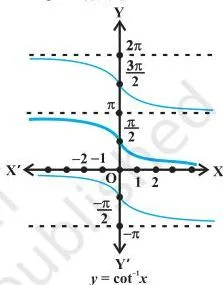
The visual idea of the whole chapter is one sentence: the graph of an inverse function is built from the graph of the original by interchanging the x- and y-axes — point \((a, b)\) on \(y = \sin x\) becomes \((b, a)\) on \(y = \sin^{-1} x\).
NCERT describes this as the mirror image, or reflection, of the original across the line \(y = x\) (Section 2.2, Remarks).
In every inverse graph below, the dark portion is the principal value branch; read its vertical span and you are reading the range from the table above.
Fig 2.1: sine and arc sine
Fig 2.1 (i) is the repeating wave of \(y = \sin x\); Fig 2.1 (ii) is its inverse \(y = \sin^{-1} x\), where the axes have been swapped and the dark arc is the principal branch with range \( \left[ -\frac{\pi}{2}, \frac{\pi}{2} \right] \). NCERT’s Fig 2.1 (iii) draws both graphs on the same axes so the mirror relationship across \(y = x\) is visible.
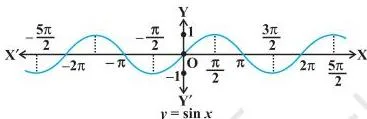
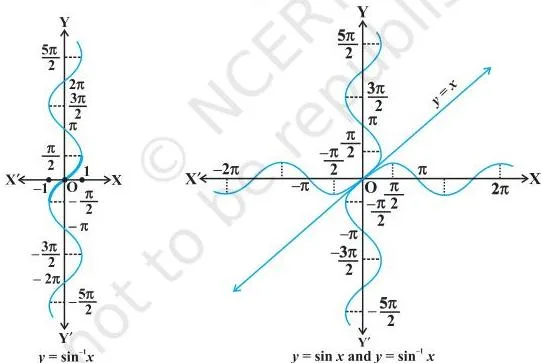
Fig 2.2: cosine and arc cosine
Fig 2.2 (i) shows \(y = \cos x\) and Fig 2.2 (ii) shows \(y = \cos^{-1} x\). The same reflection idea applies; this time the dark principal branch runs from \(0\) to \(\pi\), matching the range of \( \cos^{-1} \).
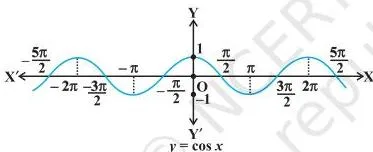
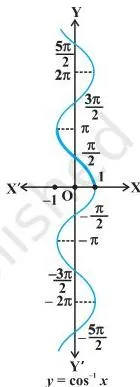
Fig 2.3: cosecant and arc cosecant
Fig 2.3 (i) is \(y = \cosec x\), the reciprocal of sine; Fig 2.3 (ii) is \(y = \cosec^{-1} x\). The dark principal branch covers \( \left[ -\frac{\pi}{2}, \frac{\pi}{2} \right] \) but skips \(0\), because cosecant is not defined at \(0\).
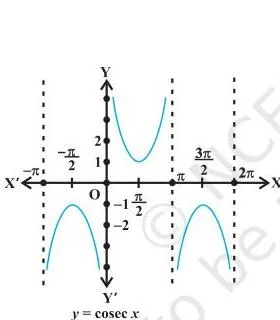
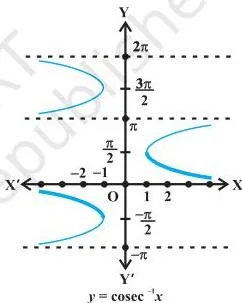
Fig 2.4: secant and arc secant
Fig 2.4 (i) is \(y = \sec x\), the reciprocal of cosine; Fig 2.4 (ii) is \(y = \sec^{-1} x\), with dark principal branch \( [0, \pi] \) skipping \( \frac{\pi}{2} \). Both \( \sec^{-1} \) and \( \cosec^{-1} \) accept only inputs outside \((-1, 1)\).
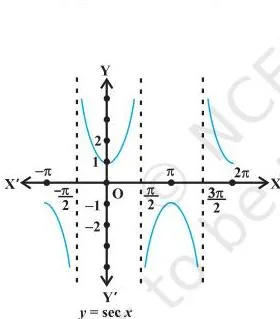
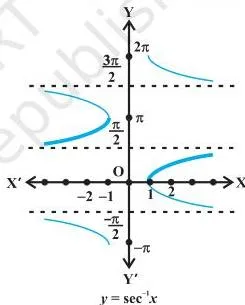
Fig 2.5: tangent and arc tangent
Fig 2.5 (i) is \(y = \tan x\); Fig 2.5 (ii) is \(y = \tan^{-1} x\), whose dark principal branch is the open interval \( \left( -\frac{\pi}{2}, \frac{\pi}{2} \right) \).
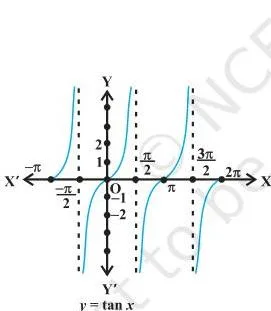
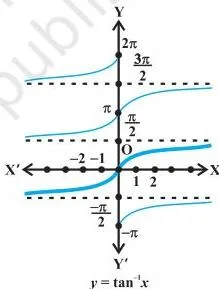
Fig 2.6: cotangent and arc cotangent
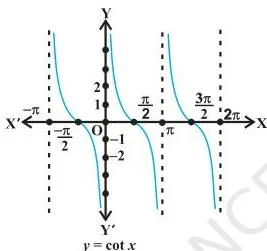
Fig 2.6 (i) is \(y = \cot x\); Fig 2.6 (ii) is \(y = \cot^{-1} x\), with dark principal branch the open interval \( (0, \pi) \).
Definitions You Must Know for This Chapter
This section collects the terms the chapter uses repeatedly, so a question never sends you hunting back through earlier pages. Each entry names the NCERT section that introduces it.
- Inverse of a function — if \(f: X \to Y\) is one-one and onto, its inverse \(g: Y \to X\) sends each output back to the unique input that produced it; the domain of \(g\) is the range of \(f\), and vice versa (Section 2.2).
- Branch — any valid choice of range for an inverse function. For example, \( \sin^{-1} \) may use \( \left[ -\frac{3\pi}{2}, -\frac{\pi}{2} \right] \), \( \left[ -\frac{\pi}{2}, \frac{\pi}{2} \right] \) or \( \left[ \frac{\pi}{2}, \frac{3\pi}{2} \right] \) as its range; each choice is one branch.
- Principal value branch — the standard branch, the one always meant when no branch is named: \( \sin^{-1} : [-1, 1] \to \left[ -\frac{\pi}{2}, \frac{\pi}{2} \right] \), \( \cos^{-1} : [-1, 1] \to [0, \pi] \), and the other four as in the table above.
- Principal value — the value of the inverse function that lies inside the principal branch range.
- Arc sine function — another name for \( \sin^{-1} \); the “arc” is the angle whose sine is the input \(x\).
- Composition identities — \( \sin(\sin^{-1} x) = x \) on \([-1, 1]\) and \( \sin^{-1}(\sin x) = x \) on \( \left[ -\frac{\pi}{2}, \frac{\pi}{2} \right] \), with the same pattern for the other five functions on their suitable domains (Section 2.3).
- Notation warning — \( \sin^{-1} x \) means the inverse sine function, never \( \frac{1}{\sin x} \).
Mistakes Students Make with Inverse Trigonometric Functions
Most errors in this chapter come from ignoring the range of the principal branch or mixing up notation. The table below names each mistake, the correct rule, and a quick way to check your answer.
| Mistake | Correct rule | How to check your answer |
|---|---|---|
| Treating \( \sin^{-1} x \) as \( \frac{1}{\sin x} \) | \( \sin^{-1} x \) is the angle whose sine is \(x\); \( (\sin x)^{-1} = \frac{1}{\sin x} \) is a reciprocal | The value of \( \sin^{-1} x \) is an angle in radians; \( \frac{1}{\sin x} \) is a number |
| Using \( \sin^{-1}(\sin x) = x \) for every \(x\) | Holds only for \( x \in \left[ -\frac{\pi}{2}, \frac{\pi}{2} \right] \); otherwise reduce first, e.g. \( \sin^{-1}\left( \sin \frac{3\pi}{4} \right) = \frac{\pi}{4} \) | Is your final angle inside the principal interval? |
| Choosing a principal value outside the branch range | The value must lie in the branch range; \( \cot^{-1}\left( -\frac{1}{\sqrt{3}} \right) = \frac{2\pi}{3} \) because \( (0, \pi) \) is the range of \( \cot^{-1} \) | Place your answer on the range interval from the table; outside it means it is wrong |
| Ignoring the \(x\)-interval conditions on properties | Properties carry conditions; \( \sin^{-1}\left( 2x\sqrt{1-x^2} \right) = 2\sin^{-1} x \) only for \( -\frac{1}{\sqrt{2}} \leq x \leq \frac{1}{\sqrt{2}} \), and equals \( 2\cos^{-1} x \) on \( \frac{1}{\sqrt{2}} \leq x \leq 1 \) (NCERT Example 3) | Copy the interval printed with the property next to your working and test your \(x\) against it |
| Forgetting the excluded points in \( \sec^{-1} \) and \( \cosec^{-1} \) | \( \sec^{-1} \)’s range is \( [0, \pi] \) minus \( \frac{\pi}{2} \); \( \cosec^{-1} \)’s range is \( \left[ -\frac{\pi}{2}, \frac{\pi}{2} \right] \) minus \(0\); both have domain \( \mathbf{R} – (-1, 1) \) | Never hand in \( \frac{\pi}{2} \) for \( \sec^{-1} \) or \(0\) for \( \cosec^{-1} \); each input’s size must be at least 1 |
The third mistake deserves a full working, because the negative sign traps students:
- Step 1: Let \( y = \cot^{-1}\left( -\frac{1}{\sqrt{3}} \right) \), so \( \cot y = -\frac{1}{\sqrt{3}} \).
- Step 2: The range of \( \cot^{-1} \) is \( (0, \pi) \), so \(y\) must lie strictly between \(0\) and \(\pi\).
\[ \cot\left( \frac{2\pi}{3} \right) = -\frac{1}{\sqrt{3}}, \quad \text{and} \quad \frac{2\pi}{3} \in (0, \pi) \]
Final answer: the principal value is \( \frac{2\pi}{3} \), not \( -\frac{\pi}{3} \), which falls outside the branch range.
How the Exercises Are Organised and What Each One Practises
Each set in the chapter practises a different skill, so know which one to turn to while revising.
| Exercise | What it practises | Where it gets harder |
|---|---|---|
| Exercise 2.1 | Principal values: questions 1–10 ask for the principal value of each of the six inverse functions; questions 11–12 add principal values together; questions 13–14 are multiple-choice questions on ranges and values | Knowing every range from the table is the whole game — a value that fits \( \sin^{-1} \) may not fit \( \cot^{-1} \) |
| Exercise 2.2 | Properties: questions 1–2 prove the triple-angle identities; questions 3–7 write \( \tan^{-1} \) expressions in simplest form; questions 8–12 evaluate compound expressions like \( \sin^{-1}\left( \sin \frac{2\pi}{3} \right) \); questions 13–15 are multiple-choice questions | Every substitution (such as \( x = \sin \theta \) or \( x = \sec \theta \)) must respect the interval printed with the question |
| Miscellaneous Exercise | Mixed: questions 1–2 find values such as \( \cos^{-1}\left( \cos \frac{13\pi}{6} \right) \); questions 3–10 prove identities; questions 11–12 solve equations; questions 13–14 are multiple-choice questions | Angle reduction and the choice of substitution are used together, so this set is a thorough revision test |
Textbook contents and the examinable syllabus are not always identical — check the current official syllabus to see what is examinable from this chapter.
Quick Recap of the Whole Chapter
A night-before version of the chapter’s own Summary, in fresh words:
- Work in angles, not reciprocals. \( y = \sin^{-1} x \Rightarrow \sin y = x \), and \( x = \sin y \Rightarrow y = \sin^{-1} x \). The notation \( \sin^{-1} x \) never means \( \frac{1}{\sin x} \).
- Domains: \( \sin^{-1} \) and \( \cos^{-1} \) take inputs in \([-1, 1]\); \( \sec^{-1} \) and \( \cosec^{-1} \) take inputs outside \((-1, 1)\); \( \tan^{-1} \) and \( \cot^{-1} \) take every real number.
- Ranges: \( \left[ -\frac{\pi}{2}, \frac{\pi}{2} \right] \), \( [0, \pi] \), \( \left( -\frac{\pi}{2}, \frac{\pi}{2} \right) \), \( (0, \pi) \), and the two point-excluded ranges from the table.
- Composition: \( \sin(\sin^{-1} x) = x \) on \([-1, 1]\); \( \sin^{-1}(\sin x) = x \) only on \( \left[ -\frac{\pi}{2}, \frac{\pi}{2} \right] \).
Memory hook: pair each function with its “co-” partner and the interval shifts. Sine, tangent and cosecant live on the interval around zero; cosine, cotangent and secant live on the interval around \( \frac{\pi}{2} \). Two ranges are open at both ends — tangent and cotangent — and two lose a single point — secant loses \( \frac{\pi}{2} \), cosecant loses \(0\).
Check every answer in this chapter against those four details.
Related Class 12 Maths Chapters and Book Pages
Chapter 2 sits inside the Class 12 Mathematics Part I book. Chapter 1, Relations and Functions, supplies the invertibility condition this chapter uses, and the later Integrals chapter builds directly on these functions, since inverse trigonometric functions define many standard integrals.
Move next to the Class 12 Mathematics notes, the Class 12 hub for all subjects, the Integrals chapter where this chapter’s functions reappear, or the next chapter in the book, Matrices. You can also browse the CBSE notes home page for other classes.
Sources and Data Verification
Reference: NCERT Class 12 Mathematics Part I textbook, chapter 2, official edition on ncert.nic.in.
- The figures and chapter contents described on this page come from the NCERT Mathematics Part I textbook in its current 2026-27 reprint, published on the official NCERT website.
- This page describes Chapter 2, Inverse Trigonometric Functions, of Mathematics Part I. It does not describe Mathematics Part II, other books, or other subjects.
- This page is maintained for the 2026-27 academic session.
- NCERT settles textbook editions and PDFs; CBSE settles the curriculum, syllabus and examinations.
Frequently Asked Questions
These are the questions that come up most when students first meet this chapter.
What is a principal value branch in inverse trigonometric functions?
An inverse trigonometric function can be defined with several different ranges; each range gives one branch of the function, and the branch NCERT uses as the standard one is the principal value branch. For sine it is \( \left[ -\frac{\pi}{2}, \frac{\pi}{2} \right] \), for cosine \( [0, \pi] \), for tangent \( \left( -\frac{\pi}{2}, \frac{\pi}{2} \right) \), and so on.
Whenever no branch is named, NCERT means the principal value branch (Section 2.2).
Why is sin inverse x not equal to 1 by sin x?
Because they answer different questions. \( \sin^{-1} x \) is the arc sine function — the angle whose sine is \(x\) — while \( (\sin x)^{-1} = \frac{1}{\sin x} \) is the reciprocal of the sine value (Section 2.2, Note 1). For example, \( \sin^{-1}\left( \frac{1}{2} \right) \) is an angle, \( \frac{\pi}{6} \), whereas \( \frac{1}{\sin x} \) is just a number. The superscript \(-1\) here means inverse function, not reciprocal.
Why is sin inverse of sin 3 pi by 5 equal to 2 pi by 5?
Because \( \frac{3\pi}{5} \) lies outside the principal interval \( \left[ -\frac{\pi}{2}, \frac{\pi}{2} \right] \), so the identity \( \sin^{-1}(\sin x) = x \) does not apply to it directly.
Instead the chapter reduces the angle first: \( \sin\left( \frac{3\pi}{5} \right) = \sin\left( \pi – \frac{3\pi}{5} \right) = \sin\left( \frac{2\pi}{5} \right) \), and \( \frac{2\pi}{5} \) does lie in the principal interval, so the value is \( \frac{2\pi}{5} \) (NCERT Example 6). The same angle-reduction trick handles the \( \frac{7\pi}{6} \) and \( \frac{13\pi}{6} \) used in the exercises.
How do you find the principal value of an inverse trigonometric function?
Work in three steps. First, write the expression as \(y\), for example \( y = \cot^{-1}\left( -\frac{1}{\sqrt{3}} \right) \). Second, convert it to the direct trigonometric equation \( \cot y = -\frac{1}{\sqrt{3}} \).
Third, find the angle \(y\) inside the principal branch range that satisfies it — for \( \cot^{-1} \) that range is \( (0, \pi) \), and \( \cot\left( \frac{2\pi}{3} \right) = -\frac{1}{\sqrt{3}} \), so the principal value is \( \frac{2\pi}{3} \). The step that always saves marks: confirm the final angle lies in the range from the domain-range table.
Which exercises in Class 12 Maths Chapter 2 practise principal values?
Exercise 2.1 is the principal-value set: questions 1–10 ask for the principal value of each of the six inverse functions, and questions 11–12 combine principal values in sums, with two multiple-choice questions on ranges and values at the end.
Later exercises revisit the idea in disguise — Exercise 2.2 questions 10–12 and Miscellaneous Exercise questions 1–2 ask for values like \( \sin^{-1}\left( \sin \frac{2\pi}{3} \right) \) or \( \cos^{-1}\left( \cos \frac{13\pi}{6} \right) \), which still come down to finding the right principal value.
Explore Class 12 Mathematics Books
Class 12 Mathematics on LearnCBSE:
Related chapters: