
This page is the compact revision version of the Matrices chapter — NCERT Class 12 Mathematics Part I, Chapter 3. It compresses the whole chapter into the definitions, rules, worked examples and exam pointers you need the night before a test, and cross-references the NCERT pages so you can verify anything against the official textbook (NCERT).
After reading these matrices class 12 notes you will be able to state the order of any matrix and count its elements, perform addition, scalar multiplication and the row-times-column product, transpose a matrix, classify symmetric and skew symmetric matrices, and say exactly when a matrix has an inverse.
Inline page references such as (NCERT, p. 35) point to the textbook lines each rule comes from.
What Is a Matrix? Order, Notation and Elements
A matrix is an ordered rectangular array of numbers or functions; the numbers (or functions) inside it are its elements or entries (NCERT, p. 35). The word “ordered” matters: the position of each entry defines the matrix, so the same numbers in a different layout form a different matrix.
The chapter opens with a real dataset to show why matrices exist. Radha has 15 notebooks and 6 pens, Fauzia has 10 notebooks and 2 pens, Simran has 13 notebooks and 5 pens. This can be laid out in a rectangle, exactly like a table:
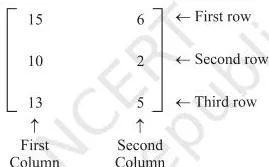
The horizontal lines of entries are rows and the vertical lines are columns. The same facts can also be arranged the other way, with each item a row and each person a column:
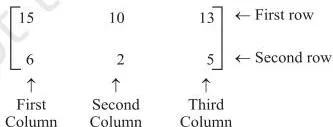
Switching rows and columns like this is exactly the transpose operation you will meet later — so this opening example quietly previews a whole topic.
A matrix with m rows and n columns is a matrix of order \( m \times n \) (read “m by n”), written \( A = [a_{ij}]_{m \times n} \) (NCERT, p. 37). Here \( a_{ij} \) is the element lying in the i-th row and j-th column. The number of elements in an \( m \times n \) matrix is \( mn \).
- A \( 3 \times 2 \) matrix has \( 3 \times 2 = 6 \) elements.
- A \( 3 \times 3 \) matrix has \( 9 \) elements; a \( 2 \times 3 \) matrix has \( 6 \).
- A point \( (x, y) \) can be stored as a column \( \begin{bmatrix} x \ y \end{bmatrix} \); the four vertices of a quadrilateral fit neatly into a \( 2 \times 4 \) matrix.
This last point is why matrices represent geometry — and why reflection, rotation and magnification of figures can be written as matrix operations, which the later chapters build on.
The Seven Types of Matrices You Must Know
There are seven classified types, each fixed by one defining condition (NCERT, p. 40–41). Scan them from the table below.
| Type | Defining condition | Example |
|---|---|---|
| Column matrix | Exactly one column: \( m \times 1 \) | \( \begin{bmatrix} 0 \ \sqrt{3} \ -1 \ \frac{1}{2} \end{bmatrix}_{4 \times 1} \) |
| Row matrix | Exactly one row: \( 1 \times n \) | \( \begin{bmatrix} -\frac{1}{2} & \sqrt{5} & 2 & 3 \end{bmatrix}_{1 \times 4} \) |
| Square matrix | Number of rows = number of columns (\( m = n \)) | \( \begin{bmatrix} 3 & -1 & 0 \ \frac{3}{2} & 3\sqrt{2} & 1 \ 4 & 3 & -1 \end{bmatrix} \), order 3 |
| Diagonal matrix | Square, all non-diagonal entries zero | \( \begin{bmatrix} -1 & 0 \ 0 & 2 \end{bmatrix} \) |
| Scalar matrix | Diagonal with all diagonal entries equal to a constant \( k \) | \( \begin{bmatrix} -1 & 0 \ 0 & -1 \end{bmatrix} \) (\( k = -1 \)) |
| Identity matrix | Diagonal with all diagonal entries 1 (written \( I_n \)) | \( \begin{bmatrix} 1 & 0 \ 0 & 1 \end{bmatrix} \), order 2 |
| Zero (null) matrix | All entries zero (written \( O \)) | \( \begin{bmatrix} 0 & 0 & 0 \ 0 & 0 & 0 \end{bmatrix} \) |
The types nest inside each other: an identity matrix is a scalar matrix with \( k = 1 \); every scalar matrix is diagonal; every diagonal matrix is square. So square is the widest class and identity is the narrowest.
Memory device for the seven types: take the first letters — Column, Row, Square, Diagonal, Scalar, Identity, Zero — and remember “Careful Raju Solves Difficult Sums In Zero time”. The letters C-R-S-D-S-I-Z map one-to-one onto the list in order.
Equality of Matrices: Both Conditions Are Compulsory
Two matrices \( A = [a_{ij}] \) and \( B = [b_{ij}] \) are equal if and only if BOTH hold (NCERT, p. 41, Definition 2):
- They have the same order.
- Every corresponding element is equal: \( a_{ij} = b_{ij} \) for all \( i, j \).
The same elements in a different arrangement are NOT equal. For instance \( \begin{bmatrix} 2 & 3 \ 0 & 1 \end{bmatrix} = \begin{bmatrix} 2 & 3 \ 0 & 1 \end{bmatrix} \), but \( \begin{bmatrix} 3 & 2 \ 0 & 1 \end{bmatrix} \neq \begin{bmatrix} 2 & 3 \ 0 & 1 \end{bmatrix} \).
The real skill: when two equal matrices contain unknowns, equating corresponding elements produces ordinary linear equations. Solve them and you have the values — this is the entire method behind Exercise 3.1 Q6–Q7.
Adding and Scaling Matrices
The sum \( A + B \) is defined only when A and B have the same order; the result is the matrix of corresponding sums, \( c_{ij} = a_{ij} + b_{ij} \) (NCERT, p. 44).
The chapter motivates this with a factory that produces sport shoes in three price categories for boys and girls — adding the matrices of two factories gives the combined production, cell by cell.
Scalar multiplication scales every entry: \( kA = [k(a_{ij})] \). The negative of A is \( -A = (-1)A \), and the difference is \( A – B = A + (-1)B \) (NCERT, p. 46).
Why the same-order rule for addition? Addition is entry-wise — to pair \( a_{ij} \) with \( b_{ij} \), both matrices must share the same shape.
| Property of addition | Statement |
|---|---|
| Commutative | \( A + B = B + A \) |
| Associative | \( (A + B) + C = A + (B + C) \) |
| Additive identity | \( A + O = O + A = A \) |
| Additive inverse | \( A + (-A) = (-A) + A = O \) |
| Scalar distributive law | \( k(A + B) = kA + kB \) |
| Scalar sum law | \( (k + l)A = kA + lA \) |
These all follow because matrix addition is just real-number addition applied entry by entry (NCERT, p. 47–48).
Multiplying Matrices: The Row-times-Column Rule
Compatibility condition: the product \( AB \) is defined only when the number of columns of A equals the number of rows of B. If \( A \) is \( m \times n \) and \( B \) is \( n \times p \), then \( AB \) is \( m \times p \) (NCERT, p. 51).
Each entry \( c_{ik} \) of the product is the sum of products of the i-th row of A with the k-th column of B:
\[ c_{ik} = a_{i1}b_{1k} + a_{i2}b_{2k} + \dots + a_{in}b_{nk} = \sum_{j=1}^{n} a_{ij}b_{jk} \]
WHY row-times-column? The chapter’s pen-and-book example explains it: costs are multiplied by quantities and summed — the total cost is a sum of products, exactly what each entry computes.
Three warnings that cost marks in exams:
- Not commutative: \( AB \) need not equal \( BA \) — even when both are defined. If A is \( 2 \times 3 \) and B is \( 3 \times 2 \), then AB is \( 2 \times 2 \) while BA is \( 3 \times 3 \).
- Zero product surprise: \( AB = O \) does NOT force \( A = O \) or \( B = O \). A non-zero matrix multiplied by a non-zero matrix can give the zero matrix.
- No cancellation law: from \( AB = AC \) you cannot conclude \( B = C \).
The three properties that DO hold (NCERT, p. 54–57): associativity \( (AB)C = A(BC) \); distributivity \( A(B + C) = AB + AC \) and \( (A + B)C = AC + BC \); and the multiplicative identity \( IA = AI = A \) for a square matrix A.
Matrix multiplication differs sharply from number multiplication. Keep this comparison in mind — it is where most errors come from:
| Property | Real numbers | Matrices |
|---|---|---|
| Commutativity | \( ab = ba \) always | \( AB \neq BA \) in general (only special pairs, e.g. same-order diagonal matrices, commute) |
| Zero product | \( ab = 0 \Rightarrow a = 0 \) or \( b = 0 \) | \( AB = O \) does NOT mean \( A = O \) or \( B = O \) |
| Cancellation | \( ab = ac \), \( a \neq 0 \), implies \( b = c \) | \( AB = AC \) does NOT imply \( B = C \) |
| Identity | \( 1 \cdot a = a \) | \( IA = AI = A \), with I of the same order |
| When defined | Product of any two numbers defined | \( AB \) defined only when columns of A = rows of B |
Transpose of a Matrix: Flipping Rows and Columns
The transpose of \( A = [a_{ij}]_{m \times n} \), written \( A’ \) or \( A^T \), is the matrix obtained by interchanging rows and columns: \( A’ = [a_{ji}]_{n \times m} \) (NCERT, p. 61). So a \( 3 \times 2 \) matrix becomes \( 2 \times 3 \), and the \( (i, j) \) entry of \( A’ \) is \( a_{ji} \).
Example: if \( A = \begin{bmatrix} 3 & 5 \ \sqrt{3} & 1 \ 0 & -\frac{1}{5} \end{bmatrix}_{3 \times 2} \), then \( A’ = \begin{bmatrix} 3 & \sqrt{3} & 0 \ 5 & 1 & -\frac{1}{5} \end{bmatrix}_{2 \times 3} \).
Four properties hold for matrices of suitable orders (NCERT, p. 62):
- \( (A’)’ = A \) — transposing twice restores the original.
- \( (kA)’ = kA’ \) — the scalar passes straight through.
- \( (A + B)’ = A’ + B’ \) — transpose distributes over addition.
- \( (AB)’ = B’A’ \) — the order of the product REVERSES.
Memory device for the reversal rule: \((AB)’ = B’A’\) works like undoing a coat — the last button you fastened (B) is the first you undo, so B’s transpose comes first. Say it aloud as “B-prime A-prime”: the letters swap order exactly as the frames of a film play backwards.
Symmetric and Skew Symmetric Matrices
A square matrix A is symmetric if \( A’ = A \), i.e. \( a_{ij} = a_{ji} \) for all i, j — the matrix is a mirror image across its main diagonal (NCERT, p. 64). For example \( \begin{bmatrix} 1 & 2 \ 2 & 3 \end{bmatrix} \) is symmetric.
A square matrix A is skew symmetric if \( A’ = -A \), i.e. \( a_{ji} = -a_{ij} \). Put \( j = i \): then \( a_{ii} = -a_{ii} \), so \( 2a_{ii} = 0 \) and hence every diagonal element of a skew symmetric matrix is zero (NCERT, p. 64).
This zero-diagonal fact is a quick check in exams — a skew symmetric matrix always looks like \( \begin{bmatrix} 0 & 2 \ -2 & 0 \end{bmatrix} \).
Two theorems complete this section. Theorem 1 (NCERT, p. 64): for any square matrix A, \( A + A’ \) is symmetric and \( A – A’ \) is skew symmetric. Theorem 2 (NCERT, p. 65): any square matrix can be written as the sum of a symmetric and a skew symmetric matrix via \[ A = \frac{1}{2}(A + A’) + \frac{1}{2}(A – A’) \]
This decomposition is a favourite exam question, so a fresh worked instance appears below in the worked examples.
Invertible Matrices: When Does A⁻¹ Exist?
If A is a square matrix of order m and there exists a square matrix B of the same order such that \( AB = BA = I \), then B is called the inverse of A, written \( A^{-1} \), and A is said to be invertible (NCERT, p. 68).
- Rectangular matrices are never invertible: for both BA and AB to be defined and equal to I, A and B must be square of the same order.
- Inverse is unique: if it exists, there is only one (NCERT, p. 69, Theorem 3).
- Reversal of a product: \( (AB)^{-1} = B^{-1}A^{-1} \) for invertible A and B of the same order — same reverse-order intuition as the transpose rule (NCERT, p. 69).
The actual computation of \( A^{-1} \) arrives in the next chapter on Determinants; here you only need the definition and its consequences.
Definitions Table: Every Term in One Place
| Term | Meaning | Example |
|---|---|---|
| Matrix | Ordered rectangular array of numbers or functions | \( \begin{bmatrix} 1 & 2 \ 3 & 4 \end{bmatrix} \) |
| Order | m rows and n columns, written \( m \times n \) | \( \begin{bmatrix} 1 \ 2 \end{bmatrix} \) is \( 2 \times 1 \) |
| Element \( a_{ij} \) | Entry in the i-th row and j-th column | In \( a_{23} \): row 2, column 3 |
| Diagonal | Entries \( a_{11}, a_{22}, \dots \) of a square matrix | Diagonal of \( \begin{bmatrix} 1 & 0 \ 0 & 2 \end{bmatrix} \) is 1, 2 |
| Transpose \( A’ \) | Rows and columns interchanged | \( A_{3 \times 2} \) gives \( A’_{2 \times 3} \) |
| Symmetric matrix | Square matrix with \( A’ = A \) | \( \begin{bmatrix} 1 & 2 \ 2 & 3 \end{bmatrix} \) |
| Skew symmetric matrix | Square matrix with \( A’ = -A \); diagonal all zero | \( \begin{bmatrix} 0 & 2 \ -2 & 0 \end{bmatrix} \) |
| Inverse matrix | B with \( AB = BA = I \), written \( A^{-1} \) | \( A = \begin{bmatrix} 2 & 3 \ 1 & 2 \end{bmatrix} \), \( A^{-1} = \begin{bmatrix} 2 & -3 \ -1 & 2 \end{bmatrix} \) |
Formula Box: The Rules to Memorise
All the chapter’s algebraic rules in one box, with conditions stated. Verify each line against the NCERT chapter summary (NCERT, p. 73–74).
| Rule | Condition / symbol meaning |
|---|---|
| Number of elements \( = mn \) | For an \( m \times n \) matrix |
| \( kA = [k(a_{ij})] \) | Every entry scaled by scalar k |
| \( A – B = A + (-1)B \) | Same order; subtract entry-wise |
| \( c_{ik} = \sum_{j=1}^{n} a_{ij}b_{jk} \) | A \( m \times n \), B \( n \times p \) → AB \( m \times p \) |
| \( (A’)’ = A \), \( (kA)’ = kA’ \), \( (A + B)’ = A’ + B’ \) | Transpose properties (i)–(iii) |
| \( (AB)’ = B’A’ \) | Order reverses on the product |
| \( A \) symmetric \( \Leftrightarrow A’ = A \) | Square matrix |
| \( A \) skew symmetric \( \Leftrightarrow A’ = -A \) | Square matrix; diagonal entries all 0 |
| \( A = \frac{1}{2}(A + A’) + \frac{1}{2}(A – A’) \) | Any square matrix splits into symmetric + skew symmetric |
| \( AB = BA = I \Rightarrow B = A^{-1} \) | A invertible; inverse unique |
| \( (AB)^{-1} = B^{-1}A^{-1} \) | A, B invertible of same order |
Worked Examples: Step-by-Step with Fresh Numbers
Example A: Construct a 2 × 3 matrix from a general element
Method: Write the general \( 2 \times 3 \) skeleton, then substitute each \( (i, j) \) pair into the given formula \( a_{ij} = 2i + j \).
- Step 1: General form: \( A = \begin{bmatrix} a_{11} & a_{12} & a_{13} \ a_{21} & a_{22} & a_{23} \end{bmatrix} \).
- Step 2: Substitute \( (i, j) \) into \( a_{ij} = 2i + j \):
\[ a_{11} = 2(1) + 1 = 3, \quad a_{12} = 2(1) + 2 = 4, \quad a_{13} = 2(1) + 3 = 5 \]
\[ a_{21} = 2(2) + 1 = 5, \quad a_{22} = 2(2) + 2 = 6, \quad a_{23} = 2(2) + 3 = 7 \]
Final answer: \( A = \begin{bmatrix} 3 & 4 & 5 \ 5 & 6 & 7 \end{bmatrix} \).
Example B: Multiply a 2 × 3 matrix by a 3 × 2 matrix
Method: Check compatibility, then compute each entry \( c_{ik} \) as the sum of products of row i of A with column k of B.
Step 1: Let \( A = \begin{bmatrix} 2 & 1 & 0 \ 3 & 4 & 1 \end{bmatrix}_{2 \times 3} \) and \( B = \begin{bmatrix} 1 & 2 \ 0 & 3 \ 2 & 1 \end{bmatrix}_{3 \times 2} \).
A has 3 columns and B has 3 rows, so \( AB \) is defined and has order \( 2 \times 2 \).
Step 2: Compute each entry of \( AB \):
\[ c_{11} = 2(1) + 1(0) + 0(2) = 2 + 0 + 0 = 2 \]
\[ c_{12} = 2(2) + 1(3) + 0(1) = 4 + 3 + 0 = 7 \]
\[ c_{21} = 3(1) + 4(0) + 1(2) = 3 + 0 + 2 = 5 \]
\[ c_{22} = 3(2) + 4(3) + 1(1) = 6 + 12 + 1 = 19 \]
Final answer: \( AB = \begin{bmatrix} 2 & 7 \ 5 & 19 \end{bmatrix} \).
Example C: Express a matrix as the sum of a symmetric and a skew symmetric matrix
Method: Use Theorem 2: \( A = \frac{1}{2}(A + A’) + \frac{1}{2}(A – A’) \).
Name the symmetric part P and the skew part Q, then check P + Q = A.
Step 1: Let \( A = \begin{bmatrix} 1 & 3 \ 2 & 4 \end{bmatrix} \).
Transpose: \( A’ = \begin{bmatrix} 1 & 2 \ 3 & 4 \end{bmatrix} \).
Step 2: Symmetric part: \( P = \frac{1}{2}(A + A’) = \frac{1}{2}\begin{bmatrix} 2 & 5 \ 5 & 8 \end{bmatrix} = \begin{bmatrix} 1 & \frac{5}{2} \ \frac{5}{2} & 4 \end{bmatrix} \).
Check \( P’ = P \) — symmetric.
Step 3: Skew part: \( Q = \frac{1}{2}(A – A’) = \frac{1}{2}\begin{bmatrix} 0 & 1 \ -1 & 0 \end{bmatrix} = \begin{bmatrix} 0 & \frac{1}{2} \ -\frac{1}{2} & 0 \end{bmatrix} \).
Check \( Q’ = -Q \) and the diagonal is all zeros — skew symmetric.
Step 4: Verify: \( P + Q = \begin{bmatrix} 1 + 0 & \frac{5}{2} + \frac{1}{2} \ \frac{5}{2} – \frac{1}{2} & 4 + 0 \end{bmatrix} = \begin{bmatrix} 1 & 3 \ 2 & 4 \end{bmatrix} = A \).
Final answer: \( A = P + Q \) with \( P = \begin{bmatrix} 1 & \frac{5}{2} \ \frac{5}{2} & 4 \end{bmatrix} \) symmetric and \( Q = \begin{bmatrix} 0 & \frac{1}{2} \ -\frac{1}{2} & 0 \end{bmatrix} \) skew symmetric.
Common Mistakes and Corrections
Every mark-losing error below comes with the correct rule and a way to catch it. Use the third column as a self-check.
| Mistake | Correct rule | How to check your answer |
|---|---|---|
| Adding matrices of different orders, e.g. \( 2 \times 2 + 2 \times 3 \) | \( A + B \) defined only when A and B share the same order; add corresponding entries | Compare m and n of both matrices before writing any sum |
| Assuming \( AB = BA \), or that AB defined means BA defined | Multiplication is not commutative; AB needs cols(A) = rows(B), BA needs cols(B) = rows(A) | Check compatibility of both orders before comparing |
| Concluding \( AB = O \Rightarrow A = O \) or \( B = O \) | The product of two non-zero matrices can be the zero matrix | Test with \( A = \begin{bmatrix} 0 & -1 \ 0 & 2 \end{bmatrix} \), \( B = \begin{bmatrix} 3 & 5 \ 0 & 0 \end{bmatrix} \): AB = O |
| Writing \( (AB)’ = A’B’ \) | \( (AB)’ = B’A’ \) — transpose reverses the order | Transpose the product once by hand and compare |
| Cancelling \( AB = AC \) to get \( B = C \) | No cancellation law applies to matrices | Remember the zero-divisor example above |
| Forgetting the diagonal of a skew symmetric matrix is zero | For skew symmetric, \( a_{ii} = -a_{ii} \Rightarrow a_{ii} = 0 \) for every diagonal entry | Check \( A’ = -A \) entry by entry; diagonal must vanish |
| Using \( (AB)^{-1} = A^{-1}B^{-1} \) | \( (AB)^{-1} = B^{-1}A^{-1} \) — reverse order, same as the transpose rule | Multiply \( B^{-1}A^{-1} \) by AB and confirm you get I |
Exam Notes: What CBSE Looks For
These are the recurring question shapes in this chapter, written from an examiner’s mindset — no promises, just the patterns and the step that earns the mark.
- Construct a matrix from a general element formula (Exercise 3.1 Q4–Q5 style). Write the \( m \times n \) skeleton first, then substitute each \( (i, j) \). The line showing the general formula before substitution is what earns the mark.
- Use equality of matrices to solve for unknowns (Exercise 3.1 Q6–Q7 style). State “corresponding elements are equal”, list the linear equations, then solve — the equations list is the graded step.
- Find an unknown matrix X in an equation like \( 2A + 3X = 5B \) (Example 8 method). Isolate X step by step: add the additive inverse of \( 2A \), use the additive identity, then divide by the scalar 3.
- Verify \( (AB)’ = B’A’ \) (Exercise 3.3 Q5 style). Compute AB and transpose it, then compute \( B’A’ \) separately and compare. The order of B and A in the transpose is the graded step.
- Express a matrix as the sum of a symmetric and a skew symmetric matrix (Exercise 3.3 Q10 style). Set \( P = \frac{1}{2}(A + A’) \), \( Q = \frac{1}{2}(A – A’) \), show \( P’ = P \) and \( Q’ = -Q \), then add back to check.
- Order-restriction multiple-choice items (Exercise 3.2 Q21–22 style). Write the order of every matrix in the expression first, then apply the compatibility rule to decide which products are defined.
For every multiplication, the one line that earns credit is the compatibility condition (columns of A = rows of B) stated before computing. For every construction problem, the general-element line is the one that earns credit.
Matrices Class 12 Notes: Revision Summary
The entire chapter on one screen — topic, key rule and a one-line reminder for the night before the exam.
| Topic | Key rule | Quick reminder |
|---|---|---|
| Order and element count | \( m \times n \) matrix has \( mn \) elements | Element \( a_{ij} \) = i-th row, j-th column |
| Seven types | Column, row, square, diagonal, scalar, identity, zero | Identity ⇒ scalar ⇒ diagonal ⇒ square |
| Equality | Same order AND all elements equal | Equate pairs → solve linear equations |
| Addition | Same order; add corresponding entries: \( c_{ij} = a_{ij} + b_{ij} \) | A + O = A; A + (−A) = O |
| Scalar multiplication | Multiply every entry by k: \( kA = [k a_{ij}] \) | −A = (−1)A; A − B = A + (−1)B |
| Product | cols(A) = rows(B); \( c_{ik} = \sum a_{ij}b_{jk} \) | AB is \( m \times p \) when A is \( m \times n \), B is \( n \times p \) |
| Non-commutativity | \( AB \neq BA \) generally | Check both product orders first |
| Transpose | Swap rows and columns: \( A’ = [a_{ji}] \) | \( (AB)’ = B’A’ \) — order reverses |
| Symmetric / skew symmetric | \( A’ = A \); \( A’ = -A \) | Skew symmetric diagonal is all zero |
| Decomposition | \( A = \frac{1}{2}(A + A’) + \frac{1}{2}(A – A’) \) | P symmetric + Q skew symmetric |
| Inverse | \( AB = BA = I \Rightarrow B = A^{-1} \) | Square only; inverse unique; \( (AB)^{-1} = B^{-1}A^{-1} \) |
From here, move on to the full Class 12 Mathematics notes set, or revise the Inverse Trigonometric Functions chapter that precedes this one. For the complete study collection, browse all Class 12 notes and the master CBSE notes directory.
Frequently Asked Questions
When is the product AB of two matrices not defined?
AB is not defined when the number of columns of A differs from the number of rows of B. Each entry of AB is a sum of products across a row of A and down a column of B, so the row length of A must equal the column height of B.
Why is AB not always equal to BA for matrices?
Because multiplication pairs the rows of the first matrix with the columns of the second, and swapping the roles changes which entries get combined. AB may be defined when BA is not — a \( 2 \times 3 \) times \( 3 \times 2 \) gives \( 2 \times 2 \), while the reverse gives \( 3 \times 3 \). Even when both are defined they can differ.
How do I check whether two matrices are equal?
Two conditions must both hold: the matrices must have the same order, and every corresponding element must be equal. If either condition fails, the matrices are not equal.
What is the order of the transpose of a 3 × 2 matrix?
The transpose is \( 2 \times 3 \). Transposing interchanges rows and columns, so an \( m \times n \) matrix becomes \( n \times m \).
How do I express a matrix as the sum of a symmetric and a skew symmetric matrix?
Compute \( A’ \), then set \( P = \frac{1}{2}(A + A’) \) (symmetric) and \( Q = \frac{1}{2}(A – A’) \) (skew symmetric). Check \( P’ = P \) and \( Q’ = -Q \), then confirm \( P + Q = A \).
Why are all diagonal elements of a skew symmetric matrix zero?
For a skew symmetric matrix, \( a_{ji} = -a_{ij} \). Putting \( j = i \) gives \( a_{ii} = -a_{ii} \), so \( 2a_{ii} = 0 \) and therefore \( a_{ii} = 0 \) for every diagonal entry (NCERT, p. 64).
Reference: NCERT Class 12 Mathematics Part I textbook, chapter 3 (Matrices).
Explore Class 12 Mathematics Notes
More for this chapter:
Class 12 Mathematics on LearnCBSE:
Related chapters: