
This is the official NCERT Class 12 Mathematics Part I chapter 1 — Relations and Functions, 17 printed pages from the 2026-27 reprint. The official Relations and Functions Class 12 PDF from ncert.nic.in is right below; after it comes a plain-language walkthrough of what the chapter teaches.
Download the Relations and Functions Class 12 PDF
Open the official Relations and Functions Class 12 PDF from the NCERT Class 12 Mathematics Part I page on ncert.nic.in — this is NCERT’s own file, released free of charge and identical to NCERT’s printed edition, not a third-party scan.
Keep the PDF open in one tab and this page in another. Every term below is named the way the book names it, so you can follow along section by section.
| What the chapter holds | Count | Where it is used |
|---|---|---|
| Printed pages | 17 | |
| Sections in the chapter | 4 | |
| Figures with NCERT captions | 3 | |
| Exercise questions | 28 | answered in our NCERT Solutions |
| Official NCERT PDF | Download the chapter PDF | the chapter exactly as NCERT publishes it |
What is inside NCERT Chapter 1: Relations and Functions
The chapter opens with a short recall of relations and functions from Class XI, then moves through the teaching sections that follow: 1.2 Types of Relations, 1.3 Types of Functions, and 1.4 Composition of Functions and Invertible Function.
Section 1.2 is followed by Exercise 1.1 and Section 1.3 by Exercise 1.2. The chapter then closes with a Miscellaneous Exercise, a Summary, and a Historical Note on how the word ‘function’ travelled from Descartes to Dirichlet.
How the chapter is built: from relations to invertible functions
This chapter extends one Class XI idea: a function is a special kind of relation. Everything else is built on top of that.
- Section 1.2 types the relations. A relation in a set A is a subset of \( A \times A \), and the section names the properties a subset can have.
- Equivalence relations matter most. A relation that is reflexive, symmetric and transitive splits its set into disjoint boxes called equivalence classes.
- Section 1.3 types the functions. Functions are relations with extra discipline, and the section sorts them as one-one, onto or bijective.
- Section 1.4 combines them. Composition joins two functions, and a function is invertible exactly when it is bijective.
That last equivalence is the point of the chapter: after this, finding an inverse is just ‘prove bijective, then solve \( y = f(x) \) for x’. Chapter 2 (Inverse Trigonometric Functions) is where that idea is put to work.
Key ideas in Section 1.2: the five relations you must recognise
Section 1.2 gives names to the properties a relation can have, because most of the proof work in this chapter is ‘check these three properties’ in a fixed order.
A relation R in a set A is a subset of \( A \times A \). Two extreme cases come first: the empty relation, \( R = \emptyset \), relates nothing to nothing, and the universal relation, \( R = A \times A \), relates everything to everything. NCERT calls these two the trivial relations (Definitions 1 and 2).
The book’s Example 1 shows both extremes with one story: inside a boys’ school, the relation ‘is sister of’ is empty, while ‘height differs by less than 3 metres’ is universal.
| Relation | Defining condition | Plain meaning | Quick test |
|---|---|---|---|
| Empty | \( R = \emptyset \subset A \times A \) | No element is related to any element | R has no pairs at all |
| Universal | \( R = A \times A \) | Every element is related to every element | Every possible pair is in R |
| Reflexive | \( (a,a) \in R \) for every \( a \in A \) | Each element is related to itself | All diagonal pairs are present |
| Symmetric | \( (a,b) \in R \Rightarrow (b,a) \in R \) | Pairs come in both directions | Reverse every pair and re-check |
| Transitive | \( (a,b),(b,c) \in R \Rightarrow (a,c) \in R \) | Two-step chains close up | Follow each chain to its end |
The conditions are Definitions 3(i)-(iii) in the book; the ‘quick test’ column is the line you actually write in a proof.
To test any relation, run the checks step by step in this fixed order:
- Reflexive: check \( (a,a) \) for every \( a \in A \) — one pair is not enough.
- Symmetric: for each \( (a,b) \in R \), check \( (b,a) \in R \).
- Transitive: for every two pairs \( (a,b) \) and \( (b,c) \) in R, check \( (a,c) \in R \). A relation with no two-step chains passes this vacuously.
- Classify: all three pass → equivalence relation; otherwise name which property fails first.
Small sets make the definitions visible. On \( A = \{1,2,3\} \), the relation \( R = \{(1,1),(2,2),(3,3)\} \) is reflexive; it is also symmetric and transitive, but only vacuously, because there is nothing to reverse or chain.
Add one pair: \( R = \{(1,1),(2,2),(3,3),(1,2)\} \) is reflexive and transitive but not symmetric, since \( (1,2) \) is present without \( (2,1) \). And \( R’ = \{(1,2)\} \) alone is transitive (vacuously) but neither reflexive nor symmetric.
Equivalence relations: when a relation sorts a set into classes
An equivalence relation is the chapter’s core idea: a relation that behaves like ‘equals’ carves a set into tidy, non-overlapping boxes.
Definition 4: a relation is an equivalence relation when it is reflexive, symmetric and transitive. The integers with ‘2 divides a − b’ is the book’s pilot example: every even integer is related to 0, every odd integer to 1, and nothing crosses between the two sets.
Those two sets are the equivalence classes \( [0] \) (the evens) and \( [1] \) (the odds). The same relation ‘3 divides a − b’ cuts \( \mathbb{Z} \) into three classes: multiples of 3, numbers one more than a multiple, numbers two more than a multiple.
An equivalence relation divides its set X into subsets that satisfy three conditions, which the book states for any equivalence relation:
- all elements of one class are related to each other;
- no element of one class is related to any element of another class;
- the classes are disjoint and their union is all of X.
The reverse also holds: choose any partition of X and you get an equivalence relation — ‘belongs to the same part as’. The book demonstrates this by subdividing the integers according to remainders on division by 3.
One trap catches everyone once: under modulo 2, the classes \( [0], [2], [4], \dots \) are all the same class, because every even number is related to 0. A class may be named by any of its members.
Worked example: let \( A = \{2,3,4,5,6,7,8,9,10,11\} \) and let R relate a to b when a − b is divisible by 4.
Show R is an equivalence relation and list its classes.
Step 1 — reflexive: for any \( a \in A \), \( a – a = 0 \), and 4 divides 0.
So \( (a,a) \in R \) for every a.
Step 2 — symmetric: if \( (a,b) \in R \), then \( a – b = 4k \) for some integer k.
Then \( b – a = -4k \), also divisible by 4, so \( (b,a) \in R \).
Step 3 — transitive: if \( (a,b) \in R \) and \( (b,c) \in R \), then \( a – c = (a-b) + (b-c) \), a sum of two multiples of 4, hence a multiple of 4.
So \( (a,c) \in R \).
Step 4 — classes: group A by the remainder each number leaves on division by 4: \( [2] = \{2,6,10\} \), \( [3] = \{3,7,11\} \), \( [4] = \{4,8\} \), \( [5] = \{5,9\} \).
Every element lands in exactly one class.
Final answer: R is an equivalence relation with exactly four equivalence classes, listed above.
Key ideas in Section 1.3: one-one, onto and bijective functions
Section 1.3 asks one question about a function: does it crush two inputs together (many-one), or leave some outputs empty (not onto)?
Definition 5 — one-one (injective): distinct elements of the domain have distinct images, i.e., \( f(x_1) = f(x_2) \Rightarrow x_1 = x_2 \). Otherwise it is many-one. Definition 6 — onto (surjective): every element of the co-domain is the image of some element of the domain, equivalently range = co-domain. Definition 7 — bijective: one-one and onto.
The standard one-one proof assumes \( f(x_1) = f(x_2) \) and forces \( x_1 = x_2 \). The standard onto proof takes any y in the co-domain and solves \( f(x) = y \).
One-one test on \( f(x) = 3x – 2 \), with \( f: \mathbb{R} \to \mathbb{R} \): assume \( f(x_1) = f(x_2) \).
\[ 3x_1 – 2 = 3x_2 – 2 \Rightarrow 3x_1 = 3x_2 \Rightarrow x_1 = x_2 \]
Onto test: for any \( y \in \mathbb{R} \), choose \( x = \frac{y+2}{3} \); then \( f(x) = 3 \cdot \frac{y+2}{3} – 2 = y \).
So f is onto as well.
Conclusion: f is bijective.
A function collapses inputs when two different inputs give the same output: \( f(x) = x^2 – x \) on \( \mathbb{R} \) has \( f(0) = 0 = f(1) \), so it is many-one. It is not onto either, since \( x^2 – x = (x – \frac{1}{2})^2 – \frac{1}{4} \) stays above \( -\frac{1}{4} \), so no real x gives \( y = -1 \).
The book’s Examples 13 and 14 prove a small gem: for a finite set X, a one-one map \( f: X \to X \) must be onto, and an onto map must be one-one. The remark attached calls this the characteristic property of a finite set.
It fails for infinite sets: \( f(x) = 2x \) from \( \mathbb{N} \) to \( \mathbb{N} \) is one-one yet never reaches an odd number.
Fig 1.2 (below) is the picture version of these definitions; the figure walkthrough reads all four diagrams for you.
Key ideas in Section 1.4: composition of functions and the inverse
Composition is just ‘do f first, then g’ — and it is not commutative, which is the surprise of this whole section.
Definition 8: for \( f: A \to B \) and \( g: B \to C \), the composition \( gof: A \to C \) is \( gof(x) = g(f(x)) \). Read \( gof \) as ‘g of f’: f acts, then g acts on the result.
Original numbers — order matters: take \( f(x) = 2x + 1 \) and \( g(x) = x^2 \).
\[ gof(x) = g(f(x)) = g(2x+1) = (2x+1)^2 = 4x^2 + 4x + 1 \]
\[ fog(x) = f(g(x)) = f(x^2) = 2x^2 + 1 \]
Check with a number: \( gof(1) = 9 \) but \( fog(1) = 3 \).
Conclusion: \( gof \neq fog \) in general; only special pairs commute.
Definition 9: f is invertible when a function g exists with \( gof = I_X \) and \( fog = I_Y \). The function g is the inverse, written \( f^{-1} \). The book immediately states the practical fact: f is invertible if and only if f is one-one and onto.
So the proof route never changes: prove bijective, then solve \( y = f(x) \) for x and rename the result \( f^{-1}(y) \).
Worked example — inverse of \( f(x) = 3x – 2 \), with \( f: \mathbb{R} \to \mathbb{R} \): the bijectivity proof is the one done above, so we go straight to solving.
\[ y = 3x – 2 \Rightarrow 3x = y + 2 \Rightarrow x = \frac{y+2}{3} \]
So the inverse is \( f^{-1}(y) = \frac{y+2}{3} \).
Verify: \( gof(x) = g(3x-2) = \frac{(3x-2)+2}{3} = x \), and \( fog(y) = f\left(\frac{y+2}{3}\right) = 3\left(\frac{y+2}{3}\right) – 2 = y \).
Final answer: \( f^{-1}(y) = \frac{y+2}{3} \), and both compositions return the identity.
Do not confuse \( f^{-1} \) with a reciprocal: \( f^{-1}(x) \) is the inverse function, not \( \frac{1}{f(x)} \). The two are equal only for very special functions.
Reading the diagrams: what Fig 1.2 and Fig 1.3 show
The figures in this chapter are worth learning to read, because the definitions are all visible in the arrows.
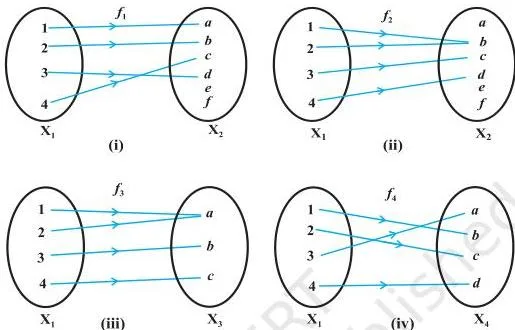
Fig 1.2 puts all four cases side by side. In (i), each element of the domain shoots its own arrow and two co-domain elements, marked e and f, receive nothing: f₁ is one-one but not onto.
In (ii), elements 1 and 2 of the domain both land on b: f₂ is many-one. In (iii), every co-domain element is hit but two inputs share an output: f₃ is onto but not one-one. In (iv), every arrow is separate and every element is hit: f₄ is bijective.
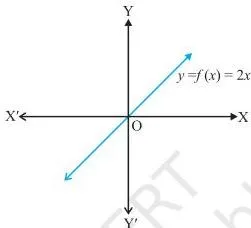
Fig 1.3 is the graph that accompanies Example 9, the function \( f(x) = 2x \) from \( \mathbb{R} \) to \( \mathbb{R} \). The graph is a straight line through the origin with slope 2.
Read the two properties off the picture: any horizontal line cuts the graph exactly once, so no two x-values share a y-value (one-one); and every horizontal line at every height y cuts it somewhere, so every real is reached (onto). This is the same proof the example does by algebra.
All definitions in this chapter, side by side
Here is the chapter’s whole vocabulary in one table — every term the chapter formally defines, each reduced to a single check.
| Term | Plain meaning | The one check to run |
|---|---|---|
| Empty relation | No element related to any element, \( R = \emptyset \) | R has zero pairs |
| Universal relation | Every element related to every element, \( R = A \times A \) | R contains all pairs |
| Trivial relations | The empty and universal relations together | R is \( \emptyset \) or \( A \times A \) |
| Reflexive | Every element related to itself | \( (a,a) \) present for every a |
| Symmetric | Pairs travel both ways | Each \( (a,b) \) has its \( (b,a) \) |
| Transitive | Two-step chains close | Every \( (a,b),(b,c) \) has \( (a,c) \) |
| Equivalence relation | Reflexive + symmetric + transitive | All three checks pass |
| Equivalence class [a] | All elements related to a | Collect every b with \( (a,b) \in R \) |
| Partition | Disjoint classes covering the set | Classes disjoint, union = X |
| One-one (injective) | Distinct inputs give distinct outputs | \( f(x_1)=f(x_2) \Rightarrow x_1=x_2 \) |
| Onto (surjective) | Every co-domain element is hit | Range = co-domain |
| Bijective | One-one and onto | Both proofs pass |
| Composition gof | Apply f, then g | \( gof(x) = g(f(x)) \) |
| Invertible function | A partner g undoes f | \( gof = I_X \) and \( fog = I_Y \) |
| Inverse \( f^{-1} \) | The function that undoes f | \( f^{-1}(y) = x \) exactly when \( f(x) = y \) |
Common mistakes in relations and functions (and the fix)
The definitions look simpler than they are, and marks disappear on small skipped checks. Here are the five characteristic mistakes, named before you make them.
| Mistake | Correct rule | How to check your answer |
|---|---|---|
| Checking reflexivity with one diagonal pair | Reflexivity needs \( (a,a) \) for every element of A | List all elements of A and tick off each diagonal pair |
| Forgetting a transitivity chain | Transitivity applies to any two-step chain, even when a = b = c; a relation with no chains is vacuously transitive | Trace every two-step path and confirm the end pair exists |
| Assuming symmetry implies reflexivity | Symmetry needs no diagonal pairs; the relation \( \{(1,2),(2,1)\} \) is symmetric without \( (1,1) \) | Test each property separately — none forces another |
| Reading gof left to right | gof applies f first, then g | Substitute into the inside: \( gof(x) = g(f(x)) \) |
| Using ‘one-one ⇔ onto’ on infinite sets | The rule holds only for finite X, with \( f: X \to X \) | Check finiteness first; \( f(x) = 2x \) on \( \mathbb{N} \) is one-one but not onto |
The subtle part of mistake 2: a chain does not need three different elements. Pairs like \( (1,1), (1,2) \) form a chain that must close to \( (1,2) \), so diagonal pairs do real work in transitivity checks.
Using this chapter for the board exam
One caveat first: textbook contents and the examinable syllabus are not always identical. Check the current official CBSE syllabus at cbseacademic.nic.in before deciding what to revise.
The proof work in this chapter is repetitive once you see it. Equivalence relations always use the same three-part workflow — reflexive, symmetric, transitive, in that order. Bijectivity always means one-one first, then onto by solving for x.
The exercises are built on a small set of patterns, so knowing which question tests which skill saves time:
- Exercise 1.1, Questions 7-14 — equivalence-class proofs. The relations in order: same number of pages; |a − b| even (same parity); difference a multiple of 4; same distance from the origin; similar triangles; same number of sides; parallel lines. Each answer ends by naming the classes.
- Exercise 1.1, Question 10 — the break from the pattern: construct relations with exactly one named property missing, such as symmetric but not reflexive.
- Exercise 1.2, Questions 3-5 — one-one/onto checks on three named functions: the greatest integer function, the modulus function and the signum function.
- Exercise 1.2, Question 9 — decide whether a case-defined function on \( \mathbb{N} \) is bijective, the classic ‘is it bijective?’ decision.
No formula list is needed for this chapter; the definitions are the content. Revise by re-proving three things from memory: an equivalence relation, a bijectivity proof, and an inverse.
Main takeaways from Chapter 1
These are the points the book itself lists as the chapter’s outcome, in shorter form:
- Empty relation \( R = \emptyset \) and universal relation \( R = A \times A \) are the two extremes.
- Reflexive, symmetric and transitive each mean one specific check; an equivalence relation is all three together.
- An equivalence relation partitions its set into equivalence classes \( [a] \), and every partition gives back an equivalence relation.
- A function is one-one if \( f(x_1) = f(x_2) \Rightarrow x_1 = x_2 \); onto if range = co-domain; bijective if both.
- For a finite set X, one-one and onto are equivalent for \( f: X \to X \); for infinite sets they are not.
Related NCERT pages for Class 12 Maths
If the book is open, the next pages you will want are the ones around this chapter. The NCERT Class 12 Maths Part I book page covers every chapter of this book, and the Class 12 hub collects all subjects.
Chapter 2, Inverse Trigonometric Functions, is where the invertibility idea from Section 1.4 is used directly. The main CBSE notes index is the quickest way to jump anywhere else.
Reference: NCERT Class 12 Mathematics Part I textbook, chapter 1, official edition on ncert.nic.in.
Sources and data verification
- This page describes Chapter 1 (Relations and Functions) of the NCERT Mathematics Part I textbook for Class XII, Reprint 2026-27.
- It covers that one chapter of that one book only — not the whole Class 12 Mathematics syllabus, and not the Part II chapters.
- The academic session this page is maintained for is 2026-27.
- NCERT settles textbook editions and official chapter PDFs. CBSE settles the curriculum and examinations, so what is examinable is decided by the current official CBSE syllabus.
Frequently asked questions about Relations and Functions Class 12
What is the difference between a one-one, an onto and a bijective function?
One-one (injective) means different inputs give different outputs; onto (surjective) means every element of the co-domain is hit; bijective means both at once. Example: \( f(x) = 3x \) on \( \mathbb{R} \) is bijective, while \( f(x) = x^2 \) on \( \mathbb{R} \) is neither — \( f(-1) = f(1) \), and negative numbers are never reached.
How do I check whether a relation is an equivalence relation?
Check the three properties in a fixed order: reflexive (\( (a,a) \) for every element), symmetric (every pair reversed), transitive (every two-step chain closed). All three must pass. Example: ‘a − b divisible by 4’ on \( \{2,3,\dots,11\} \) passes all three and gives the classes \( \{2,6,10\}, \{3,7,11\}, \{4,8\}, \{5,9\} \).
Why is gof not equal to fog in general?
Because the order of application is part of the definition: \( gof \) does f first and g second, \( fog \) does the reverse. With \( f(x) = 2x+1 \) and \( g(x) = x^2 \), you get \( gof(x) = (2x+1)^2 \) but \( fog(x) = 2x^2 + 1 \); at \( x = 1 \) these are 9 and 3.
How do I find the inverse of a function?
First prove the function is bijective — one-one and onto — because only bijective functions are invertible. Then solve \( y = f(x) \) for x. For \( f(x) = 3x – 2 \): \( y = 3x – 2 \Rightarrow x = \frac{y+2}{3} \), so \( f^{-1}(y) = \frac{y+2}{3} \). It is never \( 1/f(x) \).
Is a one-one function from a finite set to itself always onto?
Yes. For a finite set X, one-one and onto are equivalent for \( f: X \to X \) — the book proves both directions for \( \{1,2,3\} \) and states the result for any finite set. The rule fails for infinite sets: \( f(x) = 2x \) on \( \mathbb{N} \) is one-one but misses every odd number.
Is the empty relation symmetric and transitive?
Yes — vacuously. With no pairs in R, there is nothing to reverse and no chain to close, so both checks pass automatically. It is reflexive only when the set itself is empty; on a non-empty set, \( (a,a) \) is missing. On \( \{1,2\} \), \( R = \emptyset \) is symmetric and transitive but not reflexive.
Explore Class 12 Mathematics Books
Class 12 Mathematics on LearnCBSE:
Related chapters: