
Continuity and Differentiability Class 12 is Chapter 5 of the NCERT Mathematics Part I textbook, printed across pages 103–146 of the current NCERT edition. This page carries the official NCERT chapter PDF below, then a section-by-section map, plain-language explanations of every idea the chapter builds, and the formula tables you need for revision.
A student who wants the book gets it immediately; a student who wants to understand the chapter gets the teaching underneath.
Download the Continuity and Differentiability Class 12 NCERT PDF
This is the official chapter file that NCERT publishes for Class 12 Mathematics Part I, Chapter 5 — the same lemh105 PDF your school uses.
Open the NCERT Class 12 Maths Continuity and Differentiability Chapter 5 PDF from ncert.nic.in to read the printed chapter in full — the opening examples, all tables, every figure and the closing Summary appear in this one file.
| What the chapter holds | Count | Where it is used |
|---|---|---|
| Printed pages | 43 | |
| Sections in the chapter | 8 | |
| Figures with NCERT captions | 9 | |
| Tables | 4 | |
| Worked examples | 3 | solved step by step in our NCERT Solutions |
| Exercise questions | 104 | answered in our NCERT Solutions |
| Official NCERT PDF | Download the chapter PDF | the chapter exactly as NCERT publishes it |
What is inside the Continuity and Differentiability chapter
The table below counts what the chapter actually holds — sections, figures, worked examples and exercise questions — taken directly from the NCERT chapter itself.
What this chapter covers, section by section
This chapter continues the Class XI study of differentiation and builds seven numbered topics, each ending in its own exercise block. Use this map to jump straight to the section you are stuck on; the explanations all come in the next section.
| Section | Pages | What it adds |
|---|---|---|
| 5.1 Introduction | p 103 | Continuation of Class XI differentiation; introduces continuity, differentiability, inverse trigonometric, exponential and logarithmic functions. |
| 5.2 Continuity | pp 105–113 | Definition of continuity at a point, continuity on an interval, and finding points of discontinuity. |
| 5.2.1 Algebra of continuous functions | pp 113–116 | Theorem 1 (sum, difference, product, quotient of continuous functions), continuity of polynomials, rational functions, sin, cos, tan, and of compositions (Theorem 2). |
| Exercise 5.1 | pp 116–118 | Continuity problems, finding all points of discontinuity, and solving for constants that make piecewise functions continuous. |
| 5.3 Differentiability | pp 118–125 | Derivative definition, Table 5.3 standard derivatives, Theorem 3 (differentiable ⇒ continuous), then 5.3.1 composite functions, 5.3.2 implicit functions, 5.3.3 inverse trigonometric derivatives. |
| Exercises 5.2 and 5.3 | pp 122–125 | Chain rule practice, proofs of non-differentiability, implicit differentiation and inverse trig forms. |
| 5.4 Exponential and Logarithmic Functions | pp 125–130 | Definitions 3 and 4, base e, the two log properties, and Theorem 5: derivatives of \( e^x \) and \( \log x \). |
| Exercise 5.4 | p 130 | Derivatives of expressions built from \( e^x \) and \( \log x \). |
| 5.5 Logarithmic Differentiation | pp 130–134 | The method for \( y = [u(x)]^{v(x)} \), and \( \frac{d}{dx}(a^x) = a^x \log a \). |
| Exercise 5.5 | pp 130–134 | Logarithmic differentiation on products of many factors and on \( u(x)^{v(x)} \) forms. |
| 5.6 Derivatives of Functions in Parametric Forms | pp 134–137 | The formula \( \frac{dy}{dx} = \frac{g'(t)}{f'(t)} \) when \( x = f(t) \), \( y = g(t) \). |
| Exercise 5.6 | pp 134–137 | Parametric derivatives found without eliminating the parameter. |
| 5.7 Second Order Derivative | pp 137–139 | Definition of \( \frac{d^2y}{dx^2} \), its notations, and verifying differential relations. |
| Exercise 5.7 | pp 137–139 | Finding second derivatives and proving relations such as \( \frac{d^2y}{dx^2} + y = 0 \). |
| Miscellaneous Examples and Exercise on Chapter 5 | pp 140–146 | A mixed set that draws on every technique in the chapter. |
| Summary | p 146 | The chapter’s own one-page recap of continuity, the chain rule and logarithmic differentiation. |
Key concepts explained: continuity, differentiability and the chain rule
The whole chapter is two definitions (continuity, differentiability), one theorem that connects them, and a stack of differentiation rules layered onto the Class XI toolbox. Each idea below gets a plain-sentence runway first, then the mathematics.
Continuity at a point
Continuity asks one question: does the graph pass through this point without a break? If drawing the curve forces you to lift your pen, the function is not continuous there (NCERT, p. 105).
Definition 1: \( f \) is continuous at \( c \) when \( \lim_{x \to c} f(x) = f(c) \). In long form, the left hand limit, the right hand limit and the function’s value at \( c \) must all exist and be equal (NCERT, p. 106).
A function fails in exactly two ways: the rule jumps (left and right limits differ), or the function’s value at the point disagrees with the limit both sides approach.
Continuity on a set
A function is called simply continuous when the point check works at every point of its domain. Endpoints behave specially (NCERT, p. 108).
Definition 2: \( f \) is continuous if it is continuous at every point of its domain. On a closed interval \( [a, b] \), continuity at \( a \) means \( \lim_{x \to a^+} f(x) = f(a) \) and continuity at \( b \) means \( \lim_{x \to b^-} f(x) = f(b) \) — only one-sided limits exist there.
A function whose domain is a single point is automatically continuous.
Algebra of continuous functions
Once two functions are known to be continuous, you can build new continuous functions from them — this is how the chapter proves whole families of functions are continuous. Theorem 1 says that if \( f \) and \( g \) are continuous at \( c \), then so are \( f+g \), \( f-g \), \( f\cdot g \), and \( f/g \) wherever \( g(c) \neq 0 \) (NCERT, pp. 113–114).
- Every polynomial function is continuous (Example 14, p 113).
- Every rational function is continuous on its domain, i.e. where its denominator is non-zero (Example 16, p 115).
- \( \sin x \) and \( \cos x \) are continuous everywhere; \( \tan x = \frac{\sin x}{\cos x} \) is continuous wherever \( \cos x \neq 0 \), i.e. \( x \neq (2n+1)\frac{\pi}{2} \) (Examples 17–18, pp 115–116).
- Compositions of continuous functions are continuous: if \( g \) is continuous at \( c \) and \( f \) at \( g(c) \), then \( f \circ g \) is continuous at \( c \) (Theorem 2, Examples 19–20, p 116).
Differentiability and its link to continuity
Differentiability asks for the slope: does the graph have one well-defined tangent at the point? The derivative is that slope, defined as \( f'(c) = \lim_{h \to 0} \frac{f(c+h) – f(c)}{h} \) (NCERT, pp. 118–119).
Theorem 3 is the key link: if \( f \) is differentiable at \( c \), then it is continuous at \( c \) (NCERT, p. 120). The reason: a point with a tangent cannot have a break.
The converse is false — \( f(x) = |x| \) is continuous at 0, but its left difference quotient is \( -1 \) and its right difference quotient is \( +1 \), so the derivative limit does not exist (NCERT, p. 120).
Chain rule for composite functions
The chain rule is the workhorse of this chapter: nearly everything you differentiate from here on is a function inside a function. Theorem 4: if \( f = v \circ u \), with \( t = u(x) \), then \( \frac{df}{dx} = \frac{dv}{dt} \cdot \frac{dt}{dx} \) (NCERT, p. 121).
For a composite of three functions, \( \frac{df}{dx} = \frac{dw}{ds} \cdot \frac{ds}{dt} \cdot \frac{dt}{dx} \).
Worked example (original numbers): differentiate \( y = (3x^2 + 1)^4 \).
Step 1: put \( t = 3x^2 + 1 \).
Then \( y = t^4 \).
Step 2: \( \frac{dy}{dt} = 4t^3 \) and \( \frac{dt}{dx} = 6x \).
\[ \frac{dy}{dx} = 4(3x^2 + 1)^3 \cdot 6x = 24x(3x^2 + 1)^3 \]
Final answer: \( \frac{dy}{dx} = 24x(3x^2 + 1)^3 \).
Implicit functions
When \( y \) is tangled inside the equation — like \( y + \sin y = \cos x \) — you cannot rewrite it as \( y = f(x) \). You still find \( \frac{dy}{dx} \) by differentiating every term with respect to \( x \) and treating \( y \) as a function of \( x \) (chain rule at work).
For the chapter’s own example \( y + \sin y = \cos x \), differentiating both sides gives \( \frac{dy}{dx} + \cos y \cdot \frac{dy}{dx} = -\sin x \), hence \( \frac{dy}{dx} = \frac{-\sin x}{1 + \cos y} \), valid where \( 1 + \cos y \neq 0 \), i.e. \( y \neq (2n+1)\pi \) (Example 23, p 124).
Worked example (original numbers): find \( \frac{dy}{dx} \) for \( x^2 + y^3 = 7 \).
- Step 1: differentiate both sides: \( \frac{d}{dx}(x^2) + \frac{d}{dx}(y^3) = \frac{d}{dx}(7) \).
- Step 2: \( 2x + 3y^2 \cdot \frac{dy}{dx} = 0 \).
\[ \frac{dy}{dx} = -\frac{2x}{3y^2} \]
Final answer: \( \frac{dy}{dx} = -\frac{2x}{3y^2} \), for \( y \neq 0 \).
Derivatives of inverse trigonometric functions
These three formulas are the new entries in your derivative table — and each carries a domain warning (NCERT, pp. 124–125).
- \( \frac{d}{dx}(\sin^{-1} x) = \frac{1}{\sqrt{1 – x^2}} \), valid only for \( x \in (-1, 1) \).
- \( \frac{d}{dx}(\cos^{-1} x) = \frac{-1}{\sqrt{1 – x^2}} \), valid only for \( x \in (-1, 1) \).
- \( \frac{d}{dx}(\tan^{-1} x) = \frac{1}{1 + x^2} \), valid for all real \( x \).
Why the open interval for \( \sin^{-1} x \)? The derivation divides by \( \cos y \), and \( \cos y = 0 \) at the endpoints \( y = \pm \frac{\pi}{2} \), i.e. \( x = \pm 1 \); the denominator \( \sqrt{1 – x^2} \) vanishes there (NCERT, p. 124).
Exponential and logarithmic functions
A new class of functions enters here: exponentials grow faster than any polynomial, and logarithms are their inverses. Definition 3 gives the exponential function with positive base \( b \gt 1 \) as \( y = f(x) = b^x \) (NCERT, p. 126); using the number \( e \) as base gives the natural exponential \( y = e^x \).
Definition 4 states that \( \log_b a = x \) if \( b^x = a \) (NCERT, p. 127).
Two properties matter for the exercises: the change of base rule \( \log_a p = \frac{\log_b p}{\log_b a} \), and \( \log_b (pq) = \log_b p + \log_b q \) (NCERT, pp. 128–129). Also note the chapter convention: from here on, \( \log x \) means the natural logarithm, base \( e \) (NCERT, p. 127).
Theorem 5: \( \frac{d}{dx}(e^x) = e^x \) and \( \frac{d}{dx}(\log x) = \frac{1}{x} \) (NCERT, p. 129). The exponential function is the one function that does not change when differentiated.
Logarithmic differentiation
For \( y = [u(x)]^{v(x)} \), the variable appears in both base and exponent, so the power rule and the exponential rule both fail. Taking logs converts the exponent into a product: \( \log y = v(x) \log[u(x)] \) (NCERT, p. 130). Then differentiate with the chain and product rules:
\[ \frac{1}{y}\frac{dy}{dx} = v'(x)\log[u(x)] + \frac{v(x)\, u'(x)}{u(x)} \]
The method also yields \( \frac{d}{dx}(a^x) = a^x \log a \) for a positive constant \( a \) (Example 28, p 132). Critical condition: both \( f(x) \) and \( u(x) \) must be positive, because logarithms of non-positive numbers are undefined (NCERT, pp. 130–131).
Worked example (original numbers): differentiate \( y = x^{\sin x} \) — the function \( x \) raised to the power \( \sin x \) — by logarithmic differentiation, and evaluate at \( x = 2 \).
- Step 1: for \( x \gt 0 \), take logs: \( \log y = \sin x\, \log x \).
- Step 2: differentiate both sides: \( \frac{1}{y}\frac{dy}{dx} = \cos x\, \log x + \frac{\sin x}{x} \).
\[ \frac{dy}{dx} = x^{\sin x}\left(\cos x\, \log x + \frac{\sin x}{x}\right) \]
Step 3: at \( x = 2 \):
\[ \frac{dy}{dx}\Big|_{x=2} = 2^{\sin 2}\left(\frac{\sin 2}{2} + \cos 2\, \log 2\right) \]
Final answer: \( 2^{\sin 2}\left(\frac{\sin 2}{2} + \cos 2\, \log 2 \right) \) — a numerical value if you substitute \( \sin 2 \approx 0.909 \), \( \cos 2 \approx -0.416 \), \( \log 2 \approx 0.693 \).
Derivatives of functions in parametric forms
Sometimes \( x \) and \( y \) are both given in terms of a third variable \( t \). You do not eliminate \( t \) — you divide two derivatives (NCERT, p. 135).
If \( x = f(t) \) and \( y = g(t) \), then \( \frac{dy}{dx} = \frac{g'(t)}{f'(t)} \), provided \( f'(t) \neq 0 \). The answer may legitimately stay in terms of the parameter \( t \) — the chapter’s own Example 33 ends with \( \tan \frac{\theta}{2} \) without eliminating \( \theta \) (NCERT, pp. 135–137).
Second order derivative
The second derivative is the derivative of the derivative — it measures how the slope itself changes. If \( y = f(x) \), then \( \frac{d^2y}{dx^2} = \frac{d}{dx}\left(\frac{dy}{dx}\right) \), also written \( f”(x) \), \( y” \), \( D^2 y \) or \( y_2 \) (NCERT, pp. 137–138).
Examples 35–38 drill the verification style: find \( y_1 \), find \( y_2 \), then substitute into the given relation (such as \( (1 – x^2)\frac{d^2y}{dx^2} – x\frac{dy}{dx} = 0 \) for \( y = \sin^{-1} x \)) and show it becomes an identity (NCERT, pp. 138–139).
Figures in the chapter and what they show
These are the original NCERT figures from the chapter. Each one shows a different way a function behaves at a point — a jump, a hole, an asymptote, a staircase — and each is faster to see than to read about.
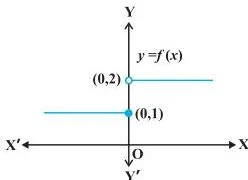
This is the chapter’s opening example: the left hand limit at 0 is 1, the right hand limit is 2, and because the two do not coincide the graph cannot be drawn in one stroke — you must lift the pen at 0 (NCERT, pp. 105–106).
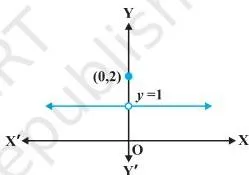
A different failure mode: both one-sided limits equal 1, but \( f(0) = 2 \) does not match the common limit — the curve breaks at one isolated point (NCERT, pp. 105–106).
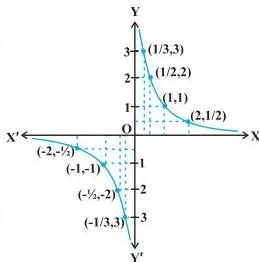
As \( x \) approaches 0 from the right, \( \frac{1}{x} \) takes values 10, 100, 1000 and grows without bound; from the left it falls without bound. The symbols \( +\infty \) and \( -\infty \) are not real numbers, so the right and left limits of \( \frac{1}{x} \) at 0 do not exist as real numbers — and therefore the limit at 0 does not exist (NCERT, pp. 109–110).
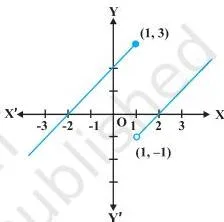
The left hand limit at 1 is \( 1 + 2 = 3 \); the right hand limit is \( 1 – 2 = -1 \). They differ, so \( x = 1 \) is the only point of discontinuity (NCERT, p. 111).
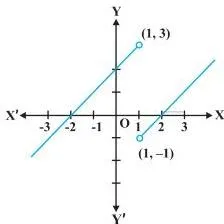
Adding the point \( (1, 0) \) does not repair the break: the two arms still do not meet it, so \( f \) remains discontinuous at 1 even though the function is now defined there (NCERT, p. 111).
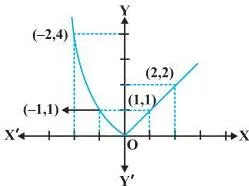
Here the rule changes at 0, yet the function is continuous: the left arm \( x^2 \) approaches 0 and the right arm \( x \) also approaches 0, matching \( f(0) = 0 \). A function may change its formula and still be continuous (NCERT, p. 112).
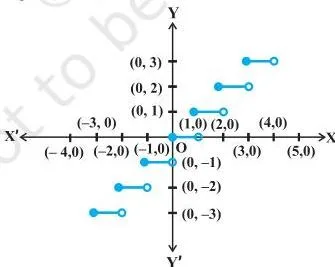
The greatest integer function is continuous at every non-integer — values near a non-integer \( c \) all equal \( [c] \). At an integer, the left hand limit is \( c – 1 \) and the right hand limit is \( c \); the two can never be equal, so every integer is a point of discontinuity (NCERT, pp. 112–113).
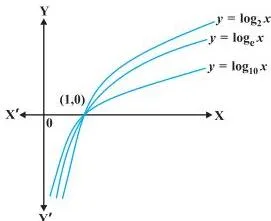
Every logarithm to a base \( b \gt 1 \) passes through \( (1, 0) \), is defined only for positive \( x \), increases slowly for large \( x \), and approaches the \( y \)-axis without meeting it as \( x \) nears 0 (NCERT, pp. 127–128).
The text’s companion Fig 5.11 shows \( y = e^x \) and \( y = \ln x \) — the graphs of \( e^x \) and \( \log x \) are mirror images of each other across the line \( y = x \) (NCERT, p. 128).
Key definitions in the chapter
The chapter formally defines four things, and the exact wording matters for definition-based questions. Meaning first, then the formal condition, then where it is printed.
| Definition | Plain meaning | Where |
|---|---|---|
| Definition 1 — continuity at \( c \): \( \lim_{x \to c} f(x) = f(c) \) | The left hand limit, right hand limit and the value of the function at \( c \) all exist and are equal. | NCERT, p. 106 |
| Definition 2 — continuity of a function | Continuous at every point of its domain; on a closed interval the endpoints use one-sided limits only. | NCERT, p. 108 |
| Definition 3 — exponential function with positive base \( b \gt 1 \) | The function \( y = f(x) = b^x \). | NCERT, p. 126 |
| Definition 4 — logarithm to base \( b \) | \( \log_b a = x \) means \( b^x = a \). | NCERT, p. 127 |
| Point of discontinuity | A point \( c \) at which \( f \) is not continuous. | NCERT, p. 106 |
| Differentiable at a point / on an interval | Both one-sided difference quotients exist, are finite and equal; on an interval, at every point of it. | NCERT, pp. 119–120 |
| Second order derivative | \( \frac{d^2y}{dx^2} = \frac{d}{dx}\left(\frac{dy}{dx}\right) \), also \( f”(x) \), \( y” \), \( D^2 y \), \( y_2 \). | NCERT, pp. 137–138 |
| Chapter convention on logs | \( \log x \) in this chapter means natural logarithm, base \( e \). | NCERT, p. 127 |
Derivative formulas used in this chapter
These are the formulas the chapter builds and its exercises drill. The table gives each function, its derivative and the domain on which the formula is valid.
| Function | Derivative | Valid where |
|---|---|---|
| \( x^n \) | \( n x^{n-1} \) | As in the power rule (Table 5.3, p 119) |
| \( \sin x \) | \( \cos x \) | All real \( x \) (p 119) |
| \( \cos x \) | \( -\sin x \) | All real \( x \) (p 119) |
| \( \tan x \) | \( \sec^2 x \) | \( x \neq (2n+1)\frac{\pi}{2} \) (p 119) |
| \( \sin^{-1} x \) | \( \frac{1}{\sqrt{1 – x^2}} \) | \( x \in (-1, 1) \) (p 125) |
| \( \cos^{-1} x \) | \( \frac{-1}{\sqrt{1 – x^2}} \) | \( x \in (-1, 1) \) (p 125) |
| \( \tan^{-1} x \) | \( \frac{1}{1 + x^2} \) | All real \( x \) (p 125) |
| \( e^x \) | \( e^x \) | All real \( x \) (Theorem 5, p 129) |
| \( \log x \) | \( \frac{1}{x} \) | \( x \gt 0 \) (Theorem 5, p 129) |
| \( a^x \) (constant \( a \gt 0 \)) | \( a^x \log a \) | All real \( x \) (Example 28, p 132) |
The rules that combine these formulas:
- Chain rule: \( \frac{df}{dx} = \frac{dv}{dt} \cdot \frac{dt}{dx} \) for \( f = v(u(x)) \) (p 121).
- Product rule \( (uv)’ = u’v + uv’ \) and quotient rule \( \left(\frac{u}{v}\right)’ = \frac{u’v – uv’}{v^2} \), carried over from Class XI (p 119).
- Logarithmic differentiation for \( [u(x)]^{v(x)} \): \( \frac{dy}{dx} = y\left[v'(x)\log u(x) + \frac{v(x)u'(x)}{u(x)}\right] \) (p 130).
- Parametric form: \( \frac{dy}{dx} = \frac{g'(t)}{f'(t)} \) when \( x = f(t) \), \( y = g(t) \), provided \( f'(t) \neq 0 \) (p 135).
- Second order derivative: \( \frac{d^2y}{dx^2} = \frac{d}{dx}\left(\frac{dy}{dx}\right) \) (p 138).
Common mistakes students make in this chapter
Most marks are lost on domain conditions and on the direction of one theorem — not on the differentiating itself. Each trap below comes with the correction and a quick way to verify your work.
| Mistake | Correct rule | How to check your answer |
|---|---|---|
| Assuming every continuous function is differentiable. | Differentiable at \( c \) implies continuous at \( c \) (Theorem 3); the converse is false — \( f(x) = |x| \) at \( x = 0 \) (NCERT, p. 120). | Test \( |x| \) at 0: difference quotient is \( -1 \) from the left and \( +1 \) from the right — not equal, so not differentiable. |
| Writing \( \lim_{x \to 0} \frac{1}{x} = \infty \) as if infinity were an answer. | \( +\infty \) and \( -\infty \) are not real numbers; the one-sided limits at 0 do not exist as real numbers, so the limit at 0 does not exist (NCERT, pp. 109–110). | If values grow without bound on one side and fall without bound on the other, say the limit does not exist — do not write a symbol as the answer. |
| Using logarithmic differentiation without checking signs. | Both \( f(x) \) and \( u(x) \) must be positive, because logarithms of non-positive numbers are undefined (NCERT, pp. 130–131). | Before taking logs, write the restriction, e.g. \( x \gt 0 \) or the given interval, in the first line of the solution. |
| Applying \( \frac{d}{dx}(\sin^{-1} x) \) at \( x = \pm 1 \). | The derivative \( \frac{1}{\sqrt{1 – x^2}} \) is defined only on the open interval \( (-1, 1) \) (NCERT, p. 124). | At \( x = \pm 1 \) the denominator becomes 0 — if your answer divides by zero, the point is outside the domain. |
| Dropping one factor of the chain rule. | \( \frac{df}{dx} = \frac{dv}{dt} \cdot \frac{dt}{dx} \) — a product of two derivatives; forgetting either breaks the answer (NCERT, p. 121). | Differentiate the inner function separately and write it down; then multiply. Re-check by expanding the function and differentiating directly. |
| Dividing by \( \frac{dx}{dt} \) without checking it is non-zero in parametric form. | \( \frac{dy}{dx} = \frac{g'(t)}{f'(t)} \) requires \( f'(t) \neq 0 \); the answer may stay in terms of \( t \) (NCERT, pp. 135–137). | State \( f'(t) \neq 0 \) before dividing; if the question gives a range for \( t \), check it keeps \( f'(t) \) away from 0. |
| Confusing \( \frac{d^2y}{dx^2} \) with \( \left(\frac{dy}{dx}\right)^2 \). | The second derivative is \( \frac{d}{dx} \) applied to \( \frac{dy}{dx} \) — a new differentiation, not a square (NCERT, p. 137). | Differentiate your \( \frac{dy}{dx} \) again once; if you squared it instead, the answer will not satisfy the verification relations. |
| Using the power rule on \( e^x \). | The power rule \( x^n \to n x^{n-1} \) is for a variable base; \( \frac{d}{dx}(e^x) = e^x \), unchanged (NCERT, p. 129). | If your derivative of \( e^x \) contains \( x \) in the exponent of the base, you used the wrong rule. |
How to practise: what each NCERT exercise block trains
This is a technique-heavy chapter, and each exercise block exists to drill one technique. No guarantee applies to which questions appear in any exam, and textbook contents and the examinable syllabus are not always identical — check the current official syllabus before deciding what to skip.
| Exercise block | Pages | Technique it trains |
|---|---|---|
| Exercise 5.1 | pp 116–118 | Continuity at a point, finding all points of discontinuity, and finding the constants \( k, \lambda, a, b \) that make piecewise functions continuous. |
| Exercise 5.2 | pp 122–123 | The chain rule on composites, plus proofs that \( |x – 1| \) and the greatest integer function are not differentiable. |
| Exercise 5.3 | pp 124–125 | Implicit differentiation, including inverse trigonometric forms such as \( \sin^{-1}\left(\frac{2x}{1 + x^2}\right) \) in disguise. |
| Exercise 5.4 | p 130 | Derivatives of expressions built from \( e^x \) and \( \log x \), including nested ones like \( \log(\log x) \). |
| Exercise 5.5 | pp 130–134 | Logarithmic differentiation, e.g. \( (\log x)^{\cos x} \); Q17 compares product rule, expansion and log differentiation on the same function. |
| Exercise 5.6 | pp 134–137 | Parametric derivatives computed without eliminating the parameter. |
| Exercise 5.7 | pp 137–139 | Second order derivatives and verifying relations such as \( y = Ae^{mx} + Be^{nx} \) satisfying \( y_2 – (m+n)y_1 + mny = 0 \). |
| Miscellaneous Exercise | pp 140–146 | A mixed set on everything above; Q20 asks whether a function can be continuous everywhere yet fail differentiability at exactly two points — combine shifted copies of \( |x| \) to build one. |
A sensible revision order:
- Learn the two definitions and the statement of Theorem 3 (differentiable ⇒ continuous).
- Memorise the standard derivative table (p 119) and the inverse trigonometric block (pp 124–125).
- Work one exercise block per technique: 5.2 for the chain rule, 5.3 for implicit, 5.4–5.5 for exponentials and log differentiation, 5.6 for parametric, 5.7 for second order.
- Attempt the Miscellaneous Exercise only after the per-rule blocks are done.
One-page summary of the Continuity and Differentiability chapter
The chapter’s own Summary (NCERT, p. 146), restated in plainer words:
- A function is continuous at a point in its domain when the limit at that point equals the function’s value; a function is continuous when this holds throughout its domain.
- Sum, difference, product and quotient (where the denominator is non-zero) of continuous functions are continuous.
- Every differentiable function is continuous, but the converse is not true — \( |x| \) at \( x = 0 \).
- The chain rule \( \frac{df}{dx} = \frac{dv}{dt} \cdot \frac{dt}{dx} \) differentiates composite functions.
- Standard derivatives in their appropriate domains: \( \sin^{-1} x \), \( \cos^{-1} x \), \( \tan^{-1} x \), \( e^x \) and \( \log x \).
- Logarithmic differentiation handles functions of the form \( [u(x)]^{v(x)} \); both \( f(x) \) and \( u(x) \) must be positive for the method to make sense.
Related NCERT resources for Class 12 Maths
This listing is maintained for the 2026-27 academic session using the NCERT textbook information available to us. NCERT remains the authority for confirming the latest edition.
This chapter sits inside Class 12 NCERT books for Mathematics Part I. Open the Mathematics Part I book page to reach the previous chapter, Determinants, and the next chapter, Application of Derivatives, from the same book. The Class 12 NCERT books hub lists every subject book for this class.
For the exam-side material, use the Class 12 Maths notes hub, the Class 12 hub, and all revision notes on this site. The chapter that follows is covered in the Application of Derivatives notes, and later chapters in the Vector Algebra notes.
Sources and data verification
The contents, figures and exercise descriptions on this page are drawn from the NCERT Mathematics Part I textbook for Class XII, Chapter 5, as published on ncert.nic.in; section titles and figure numbers match the printed chapter. This page covers Chapter 5 of Mathematics Part I only — it does not cover Mathematics Part II or other subjects.
NCERT settles textbook editions, chapter contents and official PDFs; CBSE settles the curriculum, the syllabus and the examinations. Textbook contents and the examinable syllabus are not always identical, so check the current official syllabus. This listing is maintained for the session named at the top of the page.
Reference: NCERT Class 12 Mathematics Part I textbook, chapter 5, official edition on ncert.nic.in.
Continuity and Differentiability Class 12: common questions
Can a function be continuous at a point but not differentiable at that point?
Yes. The standard example is \( f(x) = |x| \) at \( x = 0 \): both one-sided limits at 0 equal 0, matching \( f(0) \), so the function is continuous; but the left difference quotient is \( -1 \) and the right difference quotient is \( +1 \), so the derivative limit does not exist (NCERT, p. 120). This is exactly why the converse of Theorem 3 — differentiable ⇒ continuous — is false.
Why is the derivative of sin inverse x valid only between minus 1 and 1?
Because the formula is \( \frac{1}{\sqrt{1 – x^2}} \), and at \( x = \pm 1 \) the square root becomes 0, so the derivative is undefined at the endpoints. The derivation also divides by \( \cos y \) where \( y = \sin^{-1} x \), and \( \cos y = 0 \) exactly when \( y = \pm \frac{\pi}{2} \), i.e. \( x = \pm 1 \). Hence the domain is the open interval \( (-1, 1) \) (NCERT, p. 124).
When should I use logarithmic differentiation?
Use it for functions of the form \( y = [u(x)]^{v(x)} \), where the variable appears in both the base and the exponent, because neither the power rule nor the exponential rule applies. It is also convenient for products and quotients of many factors.
Both \( f(x) \) and \( u(x) \) must be positive, since logarithms of non-positive numbers are undefined (NCERT, pp. 130–131).
How do I find dy/dx when x and y are given in parametric form?
Differentiate \( x = f(t) \) and \( y = g(t) \) separately with respect to \( t \), then divide: \( \frac{dy}{dx} = \frac{g'(t)}{f'(t)} \), provided \( f'(t) \neq 0 \) (NCERT, p. 135). The answer may stay in terms of the parameter \( t \) — you do not need to eliminate it.
What does the second order derivative mean — is it the square of the first derivative?
No. \( \frac{d^2y}{dx^2} \) is \( \frac{d}{dx} \) applied to \( \frac{dy}{dx} \): you differentiate the first derivative once more. It is also written \( f”(x) \), \( y” \), \( D^2y \) or \( y_2 \) (NCERT, p. 137). It measures how the slope itself changes, and it is never the square of \( \frac{dy}{dx} \).
Is infinity a real number, and what is the limit of 1/x at 0?
No — \( +\infty \) and \( -\infty \) are not real numbers. As \( x \to 0^+ \), \( \frac{1}{x} \) grows without bound; as \( x \to 0^- \), it falls without bound. The one-sided limits therefore do not exist as real numbers, so the limit of \( \frac{1}{x} \) at 0 does not exist (NCERT, pp. 109–110).
Explore Class 12 Mathematics Books
Class 12 Mathematics on LearnCBSE:
Related chapters: