
These haloalkanes and haloarenes class 12 notes cover the entire chapter in a revision-friendly format. The saturated unit on Haloalkanes and Haloarenes is long, so this page distills it to the essentials: classification, IUPAC naming, preparation, physical properties, SN1/SN2 mechanisms, stereochemistry, and polyhalogen compounds, with NCERT page references.
Use this as your night-before checklist. If a concept is unclear, the tables and worked examples here will get you exam-ready quickly.
Haloalkanes and Haloarenes Class 12 Notes: How the Chapter Fits Together
Revise the chapter in this teaching order. Each idea builds on the last, so skipping ahead causes confusion.
- Classification and naming — learn the five families and the IUPAC rules. This is the foundation.
- The C–X bond — understand its polarity and strength; this explains leaving groups and reactivity.
- Preparation — know the four routes to haloalkanes and the two to haloarenes, with conditions.
- Physical properties — boiling point, density, solubility patterns.
- Reactions — nucleophilic substitution (SN2/SN1), elimination, and reaction with metals.
- Haloarene reactivity — why aryl halides are less reactive and the o,p-directing paradox.
- Polyhalogen compounds — uses and environmental effects.
The chapter’s own objectives (NCERT p. 159) are to name compounds by IUPAC rules, describe preparation and reactions, correlate structure with reactivity, use stereochemistry as a mechanistic tool, appreciate organometallic applications, and know the environmental effects of polyhalogens.
Classification of Haloalkanes and Haloarenes: The Five Families
Halo compounds are first split by the number of halogen atoms, then by the hybridisation of the carbon bearing the halogen.
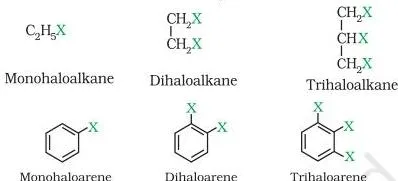
- Alkyl halides (R–X) — halogen on an \( sp^3 \) carbon of an alkyl group. Classified as primary (1°), secondary (2°), or tertiary (3°) by the carbon the halogen is attached to.
- Allylic halides — halogen on an \( sp^3 \) carbon adjacent to a C=C double bond.
- Benzylic halides — halogen on an \( sp^3 \) carbon attached to an aromatic ring.
- Vinylic halides — halogen on an \( sp^2 \) carbon of a C=C double bond.
- Aryl halides — halogen directly on the \( sp^2 \) carbon of an aromatic ring.
Three quick checks for classification:
- Is the halogen on an \( sp^3 \) or \( sp^2 \) carbon?
- If \( sp^3 \): is it next to a C=C (allylic) or attached to a ring (benzylic)? Otherwise it is alkyl (1°/2°/3°).
- If \( sp^2 \): is it on the C=C (vinylic) or on the ring (aryl)?
IUPAC Nomenclature: Rules That Always Work
In the IUPAC system, alkyl halides are named as halosubstituted hydrocarbons. The common name is just the alkyl group name followed by “halide.” For mono-substituted benzene derivatives, common and IUPAC names are the same (e.g., bromobenzene). For dihalides, the common system uses o, m, p, while IUPAC uses numerals 1,2; 1,3; 1,4 (NCERT, p. 161).
The rule: choose the longest chain, number it to give the first substituent the lowest locant, and name the halogens as prefixes in alphabetical order.

gem vs vic Dihalides
gem-dihalides (geminal) have both halogens on the same carbon; vic-dihalides (vicinal) have them on adjacent carbons (NCERT, p. 161).
| Common name | Class | IUPAC name |
|---|---|---|
| Ethylidene chloride | gem-dihalide | 1,1-Dichloroethane |
| Ethylene dichloride | vic-dihalide | 1,2-Dichloroethane |
Table 6.1: Common vs IUPAC Names of some Halides
| Structure | Common name | IUPAC name |
|---|---|---|
| \( CH_3CH_2CH(Cl)CH_3 \) | sec-Butyl chloride | 2-Chlorobutane |
| \( CH_2=CHCl \) | Vinyl chloride | Chloroethene |
| \( CH_2=CHCH_2Br \) | Allyl bromide | 3-Bromopropene |
| \( C_6H_5CH_2Cl \) | Benzyl chloride | Chlorophenylmethane |
| \( CH_2Cl_2 \) | Methylene chloride | Dichloromethane |
| \( CHCl_3 \) | Chloroform | Trichloromethane |
| \( CCl_4 \) | Carbon tetrachloride | Tetrachloromethane |
We’ll apply these rules in the Worked Examples section below.
Definitions You Must Know at a Glance
| Term | Meaning | Example |
|---|---|---|
| Haloalkane | Hydrocarbon with halogen on an \( sp^3 \) carbon of an alkyl group | \( CH_3CH_2Br \) |
| Haloarene | Hydrocarbon with halogen on an \( sp^2 \) carbon of an aryl ring | \( C_6H_5Cl \) |
| Allylic halide | Halogen on \( sp^3 \) carbon next to C=C | \( CH_2=CHCH_2Br \) |
| Benzylic halide | Halogen on \( sp^3 \) carbon attached to a ring | \( C_6H_5CH_2Cl \) |
| Vinylic halide | Halogen on \( sp^2 \) carbon of C=C | \( CH_2=CHCl \) |
| gem-dihalide | Both halogens on the same carbon | \( CH_3CHCl_2 \) |
| vic-dihalide | Halogens on adjacent carbons | \( ClCH_2CH_2Cl \) |
| Ambident nucleophile | Nucleophile with two different nucleophilic centres | \( CN^- \), \( NO_2^- \) |
| Grignard reagent | Organometallic \( RMgX \) made in dry ether | \( CH_3CH_2MgBr \) |
| Enantiomers | Non-superimposable mirror-image molecules | (+)/(-) butan-2-ol |
| Racemic mixture | 50:50 mix of enantiomers, zero net rotation | (±) butan-2-ol |
| Zaitsev rule | Major alkene is the one with more alkyl groups on doubly bonded carbons | pent-2-ene over pent-1-ene |
| Optical activity | Ability to rotate plane-polarised light | (+) / (–) isomers |
The stereochemical terms are grounded in NCERT pp. 174-177, the ambident nucleophile concept in NCERT p. 170, and the Zaitsev rule in NCERT p. 179.
The C–X Bond: Polarity, Length, and Dipole Moment
Halogens are more electronegative than carbon, so the C–X bond is polarised: carbon gets a partial positive charge, halogen a partial negative charge (NCERT, p. 163). This polarisation drives substitution, elimination, and reaction with metals.
| Bond | Bond length (pm) | Bond enthalpy (kJ/mol) | Dipole moment (Debye) |
|---|---|---|---|
| \( CH_3-F \) | 139 | 452 | 1.847 |
| \( CH_3-Cl \) | 178 | 351 | 1.860 |
| \( CH_3-Br \) | 193 | 293 | 1.830 |
| \( CH_3-I \) | 214 | 234 | 1.636 |
Trend: bond length increases and bond enthalpy decreases down the group, so the C–I bond is the weakest, making \( I^- \) the best leaving group. Surprise: \( CH_3Cl \) has the highest dipole moment (1.860 D), not \( CH_3F \) — a common confusion because fluorine’s high electronegativity is offset by its small size and short bond.
Preparation of Haloalkanes: Four Routes You Must Know
Route 1: From Alcohols
Three reagent families replace the –OH group (NCERT, p. 163-164):
- Concentrated halogen acids: 1°/2° alcohols need \( ZnCl_2 \) catalyst; tertiary alcohols react with conc. HCl at room temperature. HBr (48%) is used for bromides. Order of reactivity: \( 3° \gt 2° \gt 1° \).
- Phosphorus halides (\( PX_3 \), red P + \( X_2 \)): \( PBr_3 \) and \( PI_3 \) are generated in situ from red P with \( Br_2 \) / \( I_2 \).
- Thionyl chloride (\( SOCl_2 \)): preferred because the by-products \( SO_2 \) and HCl are gases and escape, leaving a pure product.
These methods fail for phenols because their C–O bond has partial double-bond character and is harder to break (NCERT, p. 164).
Route 2: Free Radical Halogenation of Alkanes
Treating an alkane with \( Cl_2 \) in UV light gives a complex mixture of isomeric mono- and polyhaloalkanes, so the yield of a single compound is low (NCERT, p. 164). For example, \( (CH_3)_2CHCH_2CH_3 \) has four different types of hydrogen, giving four different monochloro products.
Route 3: From Alkenes
- Addition of HX: follows Markovnikov’s rule. \( CH_3CH=CH_2 + HI \) gives \( CH_3CH(I)CH_3 \) as major (NCERT, p. 165).
- Addition of \( Br_2 \) in \( CCl_4 \): gives a colourless vic-dibromide. The discharge of the reddish-brown colour is a test for a double bond.
Route 4: Halogen Exchange
- Finkelstein reaction: \( R–X + NaI \rightarrow R–I + NaX \) in dry acetone. The precipitated NaBr/NaCl drives the forward reaction by Le Chatelier’s principle (NCERT, p. 165).
- Swarts reaction: heating an alkyl chloride/bromide with \( AgF \), \( Hg_2F_2 \), \( CoF_2 \), or \( SbF_3 \) to make fluorides (NCERT, p. 165).
Preparation of Haloarenes: Electrophilic Substitution and Sandmeyer
There are two practical routes to aryl halides.
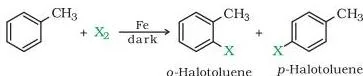
Route 1: Electrophilic Substitution
Arenes react with \( Cl_2 \) or \( Br_2 \) in the presence of Fe or FeCl₃ (Lewis acid) to give aryl chlorides/bromides (NCERT, p. 166). The o- and p-isomers are easily separated because of their large difference in melting points. Iodination is reversible and needs an oxidising agent (\( HNO_3 \) or \( HIO_4 \)) to destroy the HI formed.
Fluoro compounds cannot be made this way because fluorine is too reactive.
Route 2: Sandmeyer’s Reaction
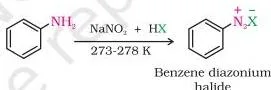
A primary aromatic amine in cold aqueous mineral acid + \( NaNO_2 \) gives a diazonium salt. Mixing the fresh diazonium salt with cuprous chloride or cuprous bromide replaces the \( –N_2^+ \) group with –Cl or –Br. For iodine, no cuprous salt is needed — just shake with KI (NCERT, p. 166).
Physical Properties: Boiling Point, Density, Solubility
Pure alkyl halides are colourless; bromides and iodides develop colour on exposure to light (NCERT, p. 167).
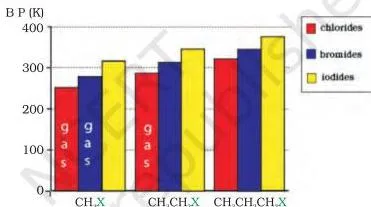
- Boiling point vs hydrocarbon: haloalkanes have higher b.p. because of stronger dipole-dipole and van der Waals forces.
- For the same alkyl group: order \( RI \gt RBr \gt RCl \gt RF \). Memory device: “I Bring Cake For Friends.”
- Branching lowers b.p.: 1-bromobutane 375 K, 2-bromobutane 364 K, 2-bromo-2-methylpropane 346 K (NCERT, p. 168).
- Dihalobenzenes: nearly equal b.p., but the p-isomer has the highest m.p. because its symmetry packs better into the crystal lattice.
- Density: bromo, iodo, and polychloro derivatives are heavier than water (NCERT, p. 169).
- Solubility: very slight in water because energy is needed to break water’s hydrogen bonds; readily soluble in organic solvents.
| Compound | Density (g/mL) | Compound | Density (g/mL) |
|---|---|---|---|
| n-\( C_3H_7Cl \) | 0.89 | \( CH_2Cl_2 \) | 1.336 |
| n-\( C_3H_7Br \) | 1.335 | \( CHCl_3 \) | 1.489 |
| n-\( C_3H_7I \) | 1.747 | \( CCl_4 \) | 1.595 |
Nucleophilic Substitution: SN2 and SN1 Mechanisms
The general reaction is \( Nu^- + R–X \rightarrow R–Nu + X^- \) (NCERT, p. 169). Here is the nucleophile → product table from NCERT Table 6.4 (p. 170):
| Reagent | Nucleophile | Product |
|---|---|---|
| NaOH (KOH) | \( HO^- \) | \( ROH \) (Alcohol) |
| \( H_2O \) | \( H_2O \) | \( ROH \) (Alcohol) |
| NaOR’ | \( R’O^- \) | \( ROR’ \) (Ether) |
| NaI | \( I^- \) | \( RI \) (Alkyl iodide) |
| \( NH_3 \) | \( NH_3 \) | \( RNH_2 \) (Primary amine) |
| KCN | \( \overset{\ominus}{C} \equiv N: \) | \( RCN \) (Nitrile) |
| AgCN | \( Ag–C \equiv N: \) | \( RNC \) (Isocyanide) |
| \( KNO_2 \) | \( O=N-\overset{\ominus}{O} \) | \( R–O–N=O \) (Alkyl nitrite) |
| \( AgNO_2 \) | \( Ag–O–N=O \) | \( R–NO_2 \) (Nitroalkane) |
| LiAlH₄ | \( H^- \) | \( RH \) (Hydrocarbon) |
Ambident nucleophiles (NCERT, p. 170): cyanide and nitrite each have two nucleophilic centres. KCN is ionic, so attack is through carbon (the C–C bond is more stable than C–N), giving a cyanide. AgCN is mainly covalent, so nitrogen donates the pair, giving an isocyanide. Memory aid: “K → Karbon; Ag → Amino (nitrogen)” — the metal dictates which atom attacks.
SN2 Mechanism: Substitution Nucleophilic Bimolecular

- One step, bimolecular: the nucleophile attacks as the leaving group departs.
- Second-order kinetics: rate = k[alkyl halide][nucleophile].
- Backside attack leads to inversion of configuration — like an umbrella turning inside out.
- Transition state: carbon is simultaneously bonded to five atoms.
- Reactivity: \( 1° \gt 2° \gt 3° \). Methyl halides are fastest because of only three small H atoms.
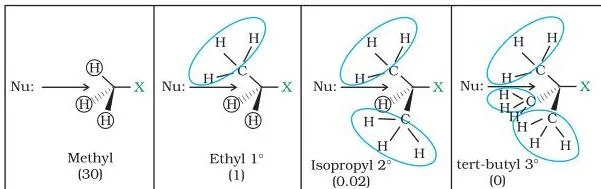
Bulky groups on or near the carbon hinder the approaching nucleophile, giving the order methyl > primary > secondary > tertiary (NCERT, p. 172).
SN1 Mechanism: Substitution Nucleophilic Unimolecular
- Two steps: slow cleavage of C–Br gives a carbocation, then fast attack by the nucleophile.
- First-order kinetics: rate = k[alkyl halide] only.
- Carbocation intermediate: \( sp^2 \) planar and achiral, so attack can occur from either side.
- Runs in polar protic solvents (water, alcohol, acetic acid).
- Reactivity: \( 3° \gt 2° \gt 1° \). Allylic and benzylic halides are fast because their carbocations are resonance-stabilised.
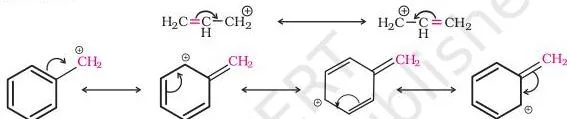
For a given alkyl group, both mechanisms follow \( R–I \gt R–Br \gt R–Cl \gt \gt R–F \) because iodide is the best leaving group (NCERT, p. 174).
SN1 vs SN2 — Comparison Table to Memorise
| Feature | SN1 | SN2 |
|---|---|---|
| Number of steps | Two | One |
| Kinetics | First order | Second order |
| Intermediate | Carbocation (planar) | None (transition state) |
| Stereochemistry | Racemisation | Inversion |
| Solvent | Polar protic | Polar aprotic |
| Substrate order | \( 3° \gt 2° \gt 1° \) | \( 1° \gt 2° \gt 3° \) |
Stereochemistry: Optical Activity, Inversion, Retention, Racemisation
The stereochemical outcome of a reaction tells you the mechanism.
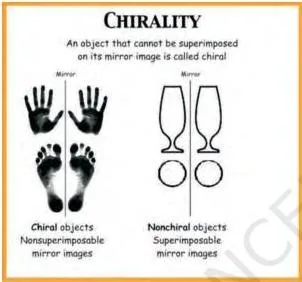
Optical activity (NCERT, p. 175): plane-polarised light is rotated by solutions of certain compounds, measured with a polarimeter. Dextrorotatory (+) rotates right; laevorotatory (–) rotates left.
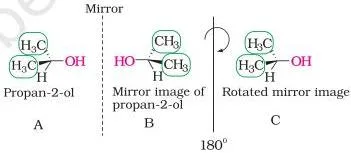
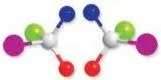
Chirality: an object is chiral if it is non-superimposable on its mirror image, like left and right hands. A molecule with a carbon bearing four different groups — an asymmetric carbon — is chiral (NCERT, p. 175-176). Propan-2-ol is achiral because the central carbon has two identical methyl groups; butan-2-ol is chiral.
Enantiomers: non-superimposable mirror images. They have identical melting points, boiling points, and refractive indices, differing only in the direction of optical rotation (NCERT, p. 177). A 50:50 mixture is a racemic mixture with zero net rotation.
Reaction outcomes (NCERT, p. 178-179):
- SN2 of chiral halides → inversion: (–)-2-bromooctane + NaOH gives (+)-octan-2-ol.
- SN1 of chiral halides → racemisation: the planar carbocation can be attacked from either side; hydrolysis of optically active 2-bromobutane gives (±)-butan-2-ol.
- Retention: when no bond to the stereocentre breaks, as in (–)-2-methylbutan-1-ol + conc. HCl.
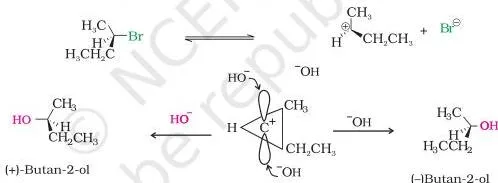
Important: the sign of rotation is NOT related to absolute configuration. Two compounds with the same configuration can have different signs of rotation (NCERT, p. 178).
Elimination: Zaitsev’s Rule and the Race with Substitution
Define the α-carbon (bearing the halogen) and β-carbon (adjacent to it, NCERT p. 179). A haloalkane with a β-hydrogen, heated with alcoholic KOH, eliminates H from the β-carbon and X from the α-carbon to form an alkene — a β-elimination.
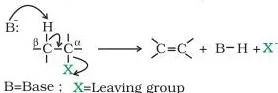
Zaitsev’s rule (NCERT, p. 179): the preferred alkene has the greater number of alkyl groups attached to the doubly bonded carbons. Example: 2-bromopentane gives pent-2-ene (81%) as major and pent-1-ene (19%) as minor.
Substitution vs Elimination
- Aqueous KOH: favours substitution (alcohol product).
- Alcoholic KOH: favours elimination (alkene product).
- Primary halides: prefer SN2.
- Tertiary halides: prefer SN1 or elimination.
- Bulky base/nucleophile: prefers to abstract a proton (elimination) for steric reasons.
Reaction with Metals: Grignard, Wurtz, Fittig, Wurtz-Fittig
Most organic chlorides, bromides, and iodides react with certain metals to give organometallic compounds (NCERT, p. 180).
Grignard Reagents
\( R–X + Mg \xrightarrow{\text{dry ether}} RMgX \). The C–Mg bond is covalent but highly polar (carbon \( \delta^- \), magnesium \( \delta^+ \)); the Mg–X bond is essentially ionic. Grignard reagents react with any proton source (water, alcohols, amines) to give the hydrocarbon RH, so moisture must be excluded. This reaction also converts a halide to a hydrocarbon (NCERT, p. 180).
Wurtz, Fittig, Wurtz-Fittig


- Wurtz reaction: \( 2RX + 2Na \xrightarrow{\text{dry ether}} R–R + 2NaX \). Doubles the carbon count.
- Wurtz-Fittig reaction: alkyl halide + aryl halide + Na in dry ether gives an alkylarene.
- Fittig reaction: two aryl halides + Na in dry ether gives a biaryl.
Examiners award the mark for naming the reaction and quoting “dry ether.”
Why Haloarenes Are Less Reactive: The Four Reasons
Aryl halides are extremely less reactive towards nucleophilic substitution. List these in order in the exam (NCERT, p. 181):
- Resonance effect: the halogen’s lone pairs conjugate with the ring \( \pi \)-system, giving the C–Cl bond partial double-bond character, making cleavage hard.
- Hybridisation difference: the \( sp^2 \) carbon (more s-character) is more electronegative and holds the electron pair tighter; the C–Cl bond in haloarenes is 169 pm vs 177 pm in haloalkanes — a shorter, stronger bond.
- Instability of phenyl cation: the phenyl cation is not stabilised by resonance, ruling out the SN1 mechanism.
- Repulsion: the electron-rich ring repels the electron-rich nucleophile.

Exception: chlorobenzene + aqueous NaOH at 623 K and 300 atm gives phenol (NCERT, p. 182).
The Nitro Group Activation Effect
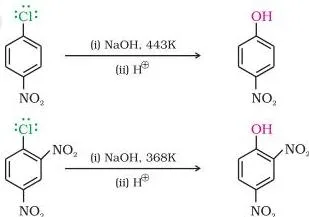
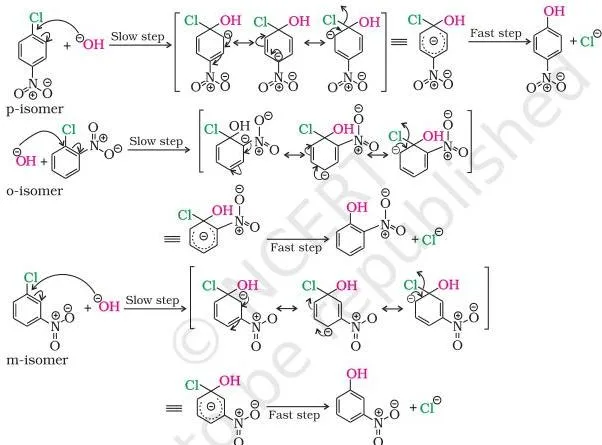
An electron-withdrawing –NO₂ group at the ortho and para positions increases reactivity because the carbanion intermediate is stabilised by resonance, with negative charge accommodated on the carbon bearing –NO₂. A meta –NO₂ group has no effect because no resonating structure carries the negative charge on the carbon bearing the –NO₂ group (NCERT, p. 183).
Electrophilic Substitution in Haloarenes: o,p-Directing Yet Deactivating
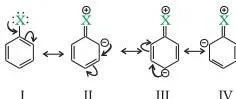
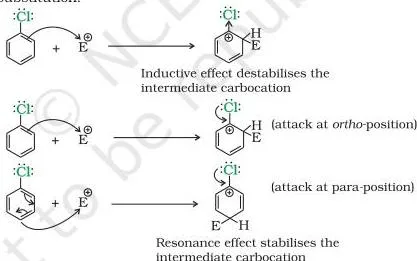
Haloarenes undergo halogenation, nitration, sulphonation, and Friedel-Crafts reactions — but more slowly and under more drastic conditions than benzene (NCERT, p. 184).
The paradox explained (Example 6.9, NCERT p. 185): the halogen’s –I effect withdraws electrons and deactivates the ring (controlling reactivity), while its resonance effect increases electron density at ortho and para positions (controlling orientation). The inductive effect is stronger than resonance, so the ring is net-deactivated, but deactivation is less for o/p attack because resonance opposes the inductive effect there.
Polyhalogen Compounds: Uses and Environmental Cost
| Compound | Uses | Health / Environmental Effects |
|---|---|---|
| Dichloromethane (\( CH_2Cl_2 \)) | Solvent, paint remover, aerosol propellant, drug process solvent | Harms the central nervous system; impairs hearing and vision |
| Chloroform (\( CHCl_3 \)) | Solvent for fats/alkaloids/iodine, feedstock for freon R-22; formerly an anaesthetic | Slowly oxidised by air in light to poisonous phosgene (\( 2CHCl_3 + O_2 \xrightarrow{\text{light}} 2COCl_2 + 2HCl \)); stored in closed dark bottles |
| Iodoform (\( CHI_3 \)) | Formerly an antiseptic (action due to liberated free iodine) | Objectionable smell; replaced by other iodine formulations |
| Carbon tetrachloride (\( CCl_4 \)) | Refrigerant feedstock, former cleaning fluid and fire extinguisher | Liver cancer risk, CNS damage, depletes the ozone layer |
| Freons (e.g., Freon 12, \( CCl_2F_2 \)) | Aerosol propellants, refrigeration, air conditioning | Extremely stable; diffuses to stratosphere and upsets ozone balance |
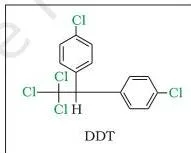
| DDT | First chlorinated organic insecticide (Paul Muller, 1948 Nobel Prize) | Fat-soluble, not metabolised rapidly, builds up in fatty tissue (biomagnification); insect resistance; banned in the US in 1973 |
Real-life application: Freon 12 is made from tetrachloromethane by the Swarts reaction. The 1987 Montreal Protocol phased out ozone-depleting CFCs — connecting the ozone chemistry here to global policy.
All Important Reactions at a Glance
| Reaction | Reagents and Conditions | Product |
|---|---|---|
| Alcohol → alkyl chloride | \( SOCl_2 \) | \( RCl + SO_2 + HCl \) |
| Alcohol → alkyl iodide | \( NaI + H_3PO_4 \) | \( RI \) |
| Alkene + HX | Markovnikov’s rule | More substituted alkyl halide |
| Alkene + \( Br_2/CCl_4 \) | Room temperature | vic-dibromide (colourless) |
| Alkyl chloride + NaI | Dry acetone (Finkelstein) | Alkyl iodide |
| Alkyl chloride + AgF | (Swarts) | Alkyl fluoride |
| Benzene + \( Cl_2 \) | Fe/\( FeCl_3 \) | Chlorobenzene |
| Primary amine → aryl halide | \( NaNO_2 \)/acid then \( CuCl \)/\( CuBr \) (Sandmeyer) | Aryl chloride / bromide |
| R–X + KCN | aq. ethanol | \( RCN \) (nitrile) |
| R–X + AgCN | \( RNC \) (isocyanide) | |
| R–X + \( KNO_2 \) | \( R–O–N=O \) (nitrite) | |
| R–X + \( AgNO_2 \) | \( R–NO_2 \) (nitroalkane) | |
| R–X + alcoholic KOH | Heat (β-elimination) | Alkene (Zaitsev major) |
| R–X + Mg | Dry ether (Grignard) | \( RMgX \) |
| 2R–X + 2Na | Dry ether (Wurtz) | \( R–R \) |
| RX + ArX + 2Na | Dry ether (Wurtz-Fittig) | Alkylarene |
| 2ArX + 2Na | Dry ether (Fittig) | \( Ar–Ar \) |
| Chlorobenzene + NaOH | 623 K, 300 atm | Phenol |
| Chloroform + \( O_2 \) | Light | Phosgene (\( COCl_2 \)) |
Worked Examples: Naming, Reactivity Order, and Zaitsev Products
Example A: IUPAC Naming and Classification
Problem: Name and classify \( CH_3–CHBr–CH_2–CH(CH_3)–CH_3 \).
Step 1: Find the longest chain.
Five carbons → pentane.
Step 2: Number from the end giving the first substituent the lowest locant.
Br at C2 and methyl at C4 gives 2-bromo-4-methylpentane (not 4-bromo-2-methylpentane).
- Step 1: List substituents alphabetically — bromo before methyl.
- Step 2: Classify the carbon bearing the halogen.
C2 is bonded to two carbon atoms, so it is a secondary (2°) alkyl halide.
Final answer: 2-bromo-4-methylpentane, a secondary alkyl halide.
Example B: SN2 Reactivity Order
Problem: Arrange bromomethane, 1-bromopropane, 2-bromopropane, and 2-bromo-2-methylpropane in increasing SN2 reactivity.
- Step 1: Recall that SN2 rate depends on steric hindrance around the electrophilic carbon — less crowding, faster reaction.
- Step 2: Rank by crowding: the most substituted carbon (tertiary) is most hindered.
Final answer: 2-bromo-2-methylpropane < 2-bromopropane < 1-bromopropane < bromomethane. The reverse order holds for SN1 because carbocation stability (3° > 2° > 1° > methyl) controls the rate (NCERT, p. 172-174).
Example C: Zaitsev Product
Problem: Predict the major alkene when 2-bromo-2-methylbutane is heated with alcoholic KOH.
- Step 1: Identify the β-carbons: one —CH₂— group and three equivalent —CH₃ groups.
- Step 2: Draw the two possible alkenes: 2-methylbut-2-ene (trisubstituted) and 2-methylbut-1-ene (disubstituted).
- Step 3: Apply Zaitsev’s rule: the more substituted alkene is the major product.
Final answer: 2-methylbut-2-ene is the major product (NCERT, p. 179).
Common Mistakes Students Make (with Corrections)
| Mistake | Correct Rule | How to Check Your Answer |
|---|---|---|
| “KCN and AgCN give the same product” | KCN gives R–CN (through carbon, C–C bond more stable); AgCN gives R–NC (covalent, nitrogen donates the pair) | Check the metal: ionic K → carbon attack; covalent Ag → nitrogen attack |
| “Tertiary halides react fastest in SN2” | SN2 order is 1° > 2° > 3°; 3° is fastest in SN1 | Ask: is the rate controlled by sterics (SN2) or carbocation stability (SN1)? |
| “Aqueous and alcoholic KOH both give alcohol” | Aqueous KOH → substitution (alcohol); alcoholic KOH → elimination (alkene) | Identify the solvent: water favours substitution, ethanol favours elimination |
| “p-dichlorobenzene has the lowest melting point” | The p-isomer has the highest m.p. because symmetry packs better in the crystal lattice | Symmetry usually raises m.p. for solid isomers |
| “CH₃F has the highest dipole moment” | CH₃Cl has the highest (1.860 D) | Check the table: high electronegativity doesn’t always mean high dipole |
| “Both halogens on the same carbon are vicinal” | Same carbon is geminal (1,1-); adjacent carbons are vicinal (1,2-) | Count the carbons bearing the halogens |
| “Chlorobenzene is easily hydrolysed by NaOH” | It needs 623 K and 300 atm because aryl halides are extremely less reactive | Look for extreme conditions in the equation |
| “A meta –NO₂ group activates chlorobenzene” | Only o/p –NO₂ stabilises the carbanion; meta has no effect | Draw the resonance: can the negative charge sit on the carbon bearing –NO₂? |
Exam Notes: Where the Marks Are in This Chapter
These patterns come from the NCERT exercise set for this unit (NCERT pp. 189-191). They are observation, not prediction.
| Question Type | What Earns the Mark |
|---|---|
| Naming and classifying halides (e.g., Ex. 6.1) | Correct locant and correct carbon class (e.g., “2-chlorobutane is 2° because the halogen is on a secondary carbon”) |
| Writing structures from IUPAC names (Ex. 6.3) | Check the locants and parent chain carefully |
| Why-questions (Intext 6.2; Ex. 6.12) | Give the chemical reason: \( H_2SO_4 \) oxidises HI to \( I_2 \); Grignard must be anhydrous because water protonates RMgX to RH |
| Ordering SN1/SN2 reactivity (Ex. 6.9, 6.16) | Justify every position with steric hindrance for SN2 and carbocation stability for SN1 |
| Conversions (Ex. 6.11, 6.19) | Name every reagent and condition in each step (e.g., ethanol → but-1-yne, chlorobenzene → p-nitrophenol) |
| Writing a mechanism (Ex. 6.15) | Show nucleophilic attack by cyanide through carbon and loss of bromide |
Haloalkanes and Haloarenes Class 12 Notes: Night-Before Recap
- Classification: five families; alkyl/allylic/benzylic are \( sp^3 \), vinylic/aryl are \( sp^2 \).
- Preparation: alkyl halides from alcohols, alkanes (free radical), alkenes (Markovnikov), halogen exchange (Finkelstein/Swarts); aryl halides by electrophilic substitution and Sandmeyer.
- SN1 vs SN2: kinetics, reactivity order, stereochemistry (SN2 inversion, SN1 racemisation).
- Haloarenes: four reasons for low nucleophilic reactivity; o,p-directing yet deactivating in electrophilic substitution.
- Polyhalogens: dichloromethane, chloroform (phosgene risk), iodoform, CCl₄, freons (ozone), DDT (biomagnification).
FAQ: Questions Students Ask While Revising
Why is sulphuric acid not used in the reaction of alcohols with KI?
\( H_2SO_4 \) converts KI to HI, which it then oxidises to \( I_2 \). Since iodine is lost, the desired alkyl iodide is not formed (NCERT, p. 191).
Why does KCN form alkyl cyanides while AgCN forms isocyanides?
KCN is ionic, so the cyanide ion attacks through carbon (the C–C bond is more stable than C–N), giving \( R–CN \). AgCN is mainly covalent, so nitrogen is free to donate its electron pair, giving \( R–NC \) (NCERT, p. 170).
Why does p-dichlorobenzene have a higher melting point than o- and m-dichlorobenzene?
The p-isomer is symmetric, so it packs more efficiently into the crystal lattice, requiring more energy (a higher melting point) to break the lattice (NCERT, p. 168).
Why must Grignard reagents be prepared and used in dry ether?
Grignard reagents react with any proton source — even water, alcohols, and amines — to give the hydrocarbon RH. Any trace of moisture destroys the reagent, so dry ether is essential (NCERT, p. 180).
Why are aryl halides less reactive than alkyl halides towards nucleophilic substitution?
For four reasons: resonance gives the C–X bond partial double-bond character; the \( sp^2 \) carbon holds the bond tighter (169 pm vs 177 pm); the phenyl cation is not resonance-stabilised, ruling out SN1; and the electron-rich ring repels the nucleophile (NCERT, p. 181).
Why does SN2 show inversion of configuration while SN1 shows racemisation?
SN2 is a one-step backside attack, so the nucleophile attaches on the side opposite to the leaving group, giving inversion. SN1 proceeds through a planar \( sp^2 \) carbocation, which can be attacked from either side, giving a racemic mixture (NCERT, p. 178-179).
Reference: NCERT Class 12 Chemistry textbook, chapter Haloalkanes and Haloarenes.
Explore Class 12 Chemistry Notes
Class 12 Chemistry on LearnCBSE:
Related chapters:
Official source: download the NCERT textbook free from ncert.nic.in.