
These chemical kinetics class 12 notes compress the entire chapter into revision form: rate of reaction, rate law and order, integrated rate equations, half-life, the Arrhenius equation, catalysts and collision theory. Every formula is given with its symbols, units and a fully worked numerical, so you can revise the chapter in one sitting without the textbook open.
The page follows the order in which a teacher would build the chapter — rate first, then order, then integrated laws, then temperature effects. NCERT diagrams appear where exams expect you to read them, and the worked examples use fresh numbers so you actually solve the problems rather than recall them.
These notes cover Chapter 3 of the rationalised NCERT Class 12 Chemistry Part I textbook and are valid for the current CBSE session. Reference: NCERT Class 12 Chemistry Part I textbook, chapter 3 Chemical Kinetics.
For the rest of the syllabus, start from the Class 12 Chemistry notes hub or jump to the adjacent chapters: Solutions Class 12 notes, Electrochemistry Class 12 notes and the d and f block elements notes.
Chemical Kinetics: Why the Speed of a Reaction Matters
Chemical kinetics is the branch of chemistry that studies reaction rates and the mechanisms behind them. The word comes from the Greek kinesis, meaning movement — kinetics asks how fast a reaction moves from reactants to products.
Thermodynamics and kinetics answer different questions. Thermodynamics tells whether a reaction is feasible (ΔG < 0 at constant temperature and pressure); kinetics tells how quickly it actually happens. The classic case is diamond converting to graphite: thermodynamics says it should happen, but the rate is so slow that the change is undetectable — which is why people say diamond is forever.
Three factors control the rate of a reaction:
- concentration of reactants (partial pressure for gases),
- temperature,
- catalyst.
All three act through the same quantity — the rate constant \(k\) — which is why the rest of the chapter keeps returning to it.
Rate of a Reaction: Average Rate vs Instantaneous Rate
For a reaction \(R \rightarrow P\), with \([R]\) and \([P]\) as molar concentrations, the rate is the change in concentration per unit time. The reactant term carries a minus sign because \([R]\) decreases:
\[ \text{Average rate} = -\frac{\Delta [R]}{\Delta t} = +\frac{\Delta [P]}{\Delta t} \]
The minus sign simply converts the negative \(\Delta[R]\) into a positive rate. Units follow from the definition: concentration per time, so \( \text{mol L}^{-1}\text{s}^{-1} \) for solutions and \( \text{atm s}^{-1} \) for gases.
The average rate is a chord across a time interval. The instantaneous rate is the limit as \(\Delta t \rightarrow 0\) — the slope of the tangent to the concentration–time curve at a chosen instant:
\[ r_{\text{inst}} = -\frac{d[R]}{dt} = \frac{d[P]}{dt} \]
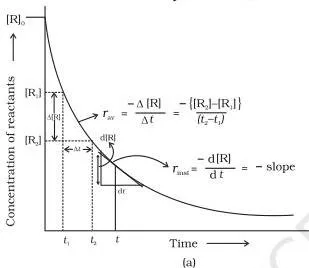
The graph above makes the difference visual. The average rate between two times is the slope of the straight chord joining them; the instantaneous rate at one time is the slope of the tangent touching the curve at that point — exactly the tangent method NCERT applies to butyl chloride hydrolysis in Fig. 3.2.
When coefficients are not 1, each term is divided by its stoichiometric coefficient. For \(2\text{HI} \rightarrow \text{H}_2 + \text{I}_2\), HI is consumed twice as fast as H₂ forms, so:
\[ \text{Rate} = -\frac{1}{2}\frac{\Delta[\text{HI}]}{\Delta t} = \frac{\Delta[\text{H}_2]}{\Delta t} = \frac{\Delta[\text{I}_2]}{\Delta t} \]
Skipping that factor of \( \frac{1}{2} \) is the most common early mistake in the chapter.
Rate Law and Rate Constant: Order Comes From Experiments
The rate law (also called the rate expression or differential rate equation) writes the rate in terms of reactant concentrations, each raised to a power:
\[ \text{Rate} = k[A]^x[B]^y \]
Here \(k\) is the rate constant, the proportionality factor. The powers \(x\) and \(y\) are not the stoichiometric coefficients \(a\) and \(b\); they come from experiments. For \(2\text{NO}(g) + \text{O}_2(g) \rightarrow 2\text{NO}_2(g)\), the measured pattern is:
| Experiment | [NO] / mol L⁻¹ | [O₂] / mol L⁻¹ | Initial rate / mol L⁻¹ s⁻¹ |
|---|---|---|---|
| 1 | 0.30 | 0.30 | 0.096 |
| 2 | 0.60 | 0.30 | 0.384 |
| 3 | 0.30 | 0.60 | 0.192 |
| 4 | 0.60 | 0.60 | 0.768 |
Compare experiments 1 and 2: [NO] doubles and the rate quadruples, so rate ∝ [NO]². Compare 1 and 3: [O₂] doubles and the rate doubles, so rate ∝ [O₂]. Hence the rate law is Rate = \(k[\text{NO}]^2[\text{O}_2]\) (NCERT, p. 67).
Other reactions show why the balanced equation cannot be trusted. For CHCl₃ + Cl₂ → CCl₄ + HCl, the experimental rate is \(k[\text{CHCl}_3][\text{Cl}_2]^{1/2}\), and for ester hydrolysis it is \(k[\text{ester}][\text{H}_2\text{O}]^0\).
The rule is stated plainly in the chapter: the rate law cannot be predicted from the balanced chemical equation — it must be determined experimentally (NCERT, p. 68).
Order of a Reaction and Units of the Rate Constant
The order of a reaction with respect to a reactant is the power of its concentration in the rate law; the overall order is the sum of the powers. For Rate = \(k[A]^x[B]^y\), overall order = \(x + y\). Order can be 0, 1, 2, 3 or even a fraction.
Example (a): Rate = \(k[A][B]^{1/2}\) → overall order = \(1 + \frac{1}{2} = \frac{3}{2}\), that is, one and a half order.
Example (b): Rate = \(k[A]^{3/2}[B]^{-1}\) → overall order = \(\frac{3}{2} + (-1) = \frac{1}{2}\), a half order.
Negative order explained: a negative exponent means that reactant slows the reaction down — the rate falls as its concentration rises. In example (b), doubling [B] changes the rate by a factor of \(2^{-1} = \frac{1}{2}\), so the reaction runs at half speed. Negatively ordered species are often products or foreign ions that block active sites or interfere with the reaction path.
Units of \(k\) follow from \(k = \text{rate}/[A]^n\). Since rate is \( \text{mol L}^{-1}\text{s}^{-1} \) and the denominator is \((\text{mol L}^{-1})^n\):
| Order | Units of rate constant \(k\) |
|---|---|
| 0 | \( \text{mol L}^{-1}\text{s}^{-1} \) |
| 1 | \( \text{s}^{-1} \) |
| 2 | \( \text{L mol}^{-1}\text{s}^{-1} \) (or \( \text{mol}^{-1}\text{L s}^{-1} \)) |
Memory device for units of \(k\): for any order \(n\), the units of the rate constant are \((\text{mol L}^{-1})^{1-n}\,\text{s}^{-1}\). Just subtract the order from 1. Zero order gives \((\text{mol L}^{-1})^1\text{s}^{-1}\); first order gives \((\text{mol L}^{-1})^0\text{s}^{-1} = \text{s}^{-1}\); second order gives \((\text{mol L}^{-1})^{-1}\text{s}^{-1} = \text{L mol}^{-1}\text{s}^{-1}\).
If the examiner hands you a unit, read it backwards: \( \text{s}^{-1} \) always means first order.
Molecularity and the Rate Determining Step
Molecularity is a property of a single step, not of the whole equation. It counts the reacting species (atoms, ions or molecules) that must collide simultaneously in an elementary reaction:
- unimolecular — one species, e.g. NH₄NO₂ → N₂ + 2H₂O;
- bimolecular — two species, e.g. 2HI → H₂ + I₂;
- termolecular — three species, e.g. 2NO + O₂ → 2NO₂.
Molecularity can never be zero, fractional or more than three — the probability that four molecules collide at the same instant is vanishingly small.
Reactions that finish in one step are elementary; those that pass through a sequence of steps (a mechanism) are complex reactions. The iodide-catalysed decomposition of H₂O₂ runs through two bimolecular steps with an IO⁻ intermediate, and the slow first step fixes the rate:
\[ \text{H}_2\text{O}_2 + \text{I}^- \rightarrow \text{H}_2\text{O} + \text{IO}^- \quad (\text{slow}) \]
\[ \text{H}_2\text{O}_2 + \text{IO}^- \rightarrow \text{H}_2\text{O} + \text{I}^- + \text{O}_2 \quad (\text{fast}) \]
The slowest elementary step is the rate determining step. Fresh analogy: think of a single-lane bridge. Trucks may queue for kilometres on both sides, but the number crossing per minute is fixed by the bridge’s narrow lane, not by the length of the queue. In a reaction, fast steps pile up intermediates, but the slow lane sets the overall rate.
| Point of comparison | Order of a reaction | Molecularity |
|---|---|---|
| How is it found? | Experimental — from rate data | Theoretical — from the mechanism |
| Possible values | 0, 1, 2, 3 and fractions | Only whole numbers 1, 2, 3 |
| Where it applies | Elementary and complex reactions | Only elementary steps |
| For a complex reaction | Set by the slowest step | Molecularity of the slowest step equals the overall order |
This table is the entire order-versus-molecularity question (NCERT, p. 70): order can be zero or fractional while molecularity cannot; molecularity has no meaning for a complex reaction as a whole; and the slowest step’s molecularity matches the overall order.
Integrated Rate Equations: Zero and First Order Reactions
Instantaneous rates force you to draw tangents, which is clumsy with real data. Integrated rate equations instead give a direct relation between concentration and time — and a straight-line test for the order.
Zero order. Rate = \(-\frac{d[R]}{dt} = k[R]^0 = k\). Rearranging gives \(d[R] = -k\,dt\), and integrating:
\[ [R] = -kt + [R]_0 \]
This is a straight line: plotting [R] against t gives slope \(-k\) and intercept \([R]_0\), and \(k = \frac{[R]_0 – [R]}{t}\). Zero order means the rate is constant — the concentration does not control it. Examples: decomposition of NH₃ on hot platinum at high pressure, and thermal decomposition of HI on a gold surface.
First order. Rate = \(-\frac{d[R]}{dt} = k[R]\). Separate variables, integrate, and fix the constant using \(t = 0\), \([R] = [R]_0\):
\[ \ln [R] = -kt + \ln [R]_0 \]
\[ k = \frac{2.303}{t} \log \frac{[R]_0}{[R]} \quad \text{and} \quad [R] = [R]_0 e^{-kt} \]
The linear test: \(\ln[R]\) vs t gives slope \(-k\), while \(\log([R]_0/[R])\) vs t gives slope \(k/2.303\). First order kinetics appear in the hydrogenation of ethene and in every radioactive decay, such as \(^{226}\text{Ra} \rightarrow ^{4}\text{He} + ^{222}\text{Rn}\).
![Straight line graph of ln[R] against time with a negative slope equal to minus the rate constant, the graphical test that identifies a first order reaction](https://www.learncbse.net/images/chemical-kinetics-fig-3-4-a-plot-between-ln-r-and-t-for-a-first-order-reaction.webp "Chemical Kinetics Class 12 Notes: Rate, Order, Half-Life")
The negative slope is the whole exam point: slope = \(-k\), so the steeper the line, the larger the rate constant.
First Order Gas Reactions: Rate Constant From Total Pressure
For a gas reaction A(g) → B(g) + C(g) you cannot easily measure [A], but you can measure total pressure. Let \(p_i\) be the initial pressure of A and \(p_t\) the total pressure at time t. If \(x\) atm of A reacts, B and C each add \(x\) atm:
\[ p_t = (p_i – x) + x + x = p_i + x \quad \Rightarrow \quad x = p_t – p_i \]
\[ p_A = p_i – x = p_i – (p_t – p_i) = 2p_i – p_t \]
\[ k = \frac{2.303}{t} \log \frac{p_i}{2p_i – p_t} \]
The \(2p_i\) is the classic trap. The total pressure rises by \(x\) while \(p_A\) falls by \(x\), so the two effects combine to give \(2p_i – p_t\) (NCERT, p. 75).
This form assumes one mole of reactant producing two moles of product; the NCERT example with \(2\text{N}_2\text{O}_5 \rightarrow 2\text{N}_2\text{O}_4 + \text{O}_2\) uses the adjusted relation \(p_A = 1.5 – 2p_t\) instead.
Half-Life of a Reaction and Pseudo First Order Reactions
Half-life, \(t_{1/2}\), is the time for the reactant concentration to fall to half its initial value. The two formulas are:
\[ \text{Zero order: } t_{1/2} = \frac{[R]_0}{2k} \qquad \text{First order: } t_{1/2} = \frac{0.693}{k} \]
The first order result comes from substituting \([R] = [R]_0/2\) into \(k = \frac{2.303}{t}\log\frac{[R]_0}{[R]}\):
\[ t_{1/2} = \frac{2.303}{k} \log 2 = \frac{2.303 \times 0.301}{k} = \frac{0.693}{k} \]
Because \([R]_0\) cancels, the half-life of a first order reaction is independent of the initial concentration — every successive half-life takes the same time. A zero order half-life, by contrast, depends directly on \([R]_0\).
A famous consequence: for a first order reaction, 99.9% completion takes exactly 10 half-lives. The time for 99.9% completion is \(t = 6.909/k\), and \(\frac{6.909}{0.693} = 10\).
Pseudo first order reactions. Some reactions are truly second order but behave as first order because one reactant is in huge excess. Hydrolysis of ethyl acetate is second order in reality, but water is taken in large excess: 0.01 mol of ester reacts with 10 mol of water, so water falls only from 10 mol to 9.99 mol.
Its concentration barely changes, so it is folded into k and the rate law becomes rate = \(k[\text{ester}]\). Inversion of cane sugar is another pseudo first order reaction.
| Property | Zero order | First order |
|---|---|---|
| Differential rate law | rate = \(k\) | rate = \(k[R]\) |
| Half-life | \([R]_0/(2k)\) — depends on \([R]_0\) | \(0.693/k\) — constant |
| Units of k | \( \text{mol L}^{-1}\text{s}^{-1} \) | \( \text{s}^{-1} \) |
Arrhenius Equation: How Temperature Changes the Rate
First, an empirical rule: for many reactions, a rise of 10 °C roughly doubles the rate constant. The N₂O₅ data in the chapter make this vivid — half-life 12 min at 50 °C, 5 h at 25 °C and 10 days at 0 °C (NCERT, p. 78).
The Arrhenius equation states this dependence precisely:
\[ k = A e^{-E_a/RT} \]
Here \(A\) is the frequency factor (also called the Arrhenius factor or pre-exponential factor) and carries the same units as \(k\); \(E_a\) is the activation energy in J mol⁻¹; \(R = 8.314\ \text{J K}^{-1}\text{mol}^{-1}\); and \(T\) must be in kelvin. The factor \(e^{-E_a/RT}\) is the fraction of molecules with kinetic energy at least \(E_a\).
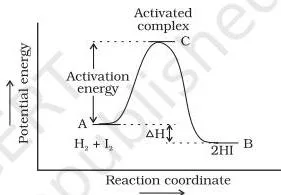
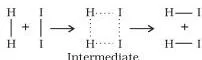
For \(H_2 + I_2 \rightarrow 2HI\), the reaction passes through an unstable intermediate — the activated complex — which exists only briefly before splitting into the two HI molecules. The energy needed to form this complex is the activation energy \(E_a\).
Taking natural logarithms gives the straight-line form:
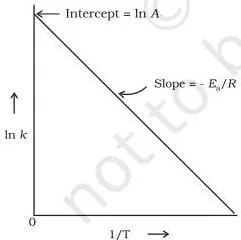
\[ \ln k = -\frac{E_a}{RT} + \ln A \]
Plot \(\ln k\) against \(1/T\) and you get a line with slope \(-E_a/R\) and intercept \(\ln A\). Between two temperatures \(T_1\) and \(T_2\), the practical two-temperature form is:
\[ \log \frac{k_2}{k_1} = \frac{E_a}{2.303R} \left[ \frac{T_2 – T_1}{T_1 T_2} \right] \]
Why food goes in the refrigerator: lowering the temperature lowers k, so spoilage reactions slow down. The Maxwell-Boltzmann curve below shows why — far fewer molecules clear the \(E_a\) barrier at low temperature, so the reactive fraction collapses.
How to Read the Energy Profile and the Maxwell Boltzmann Curves
Fig. 3.7 plots potential energy against reaction coordinate — the energy profile of the journey from reactants to products:
- reactants sit at the left edge;
- the curve rises to a peak — the activated complex;
- \(E_a\) is the rise from the reactants up to that peak;
- the drop from the peak to the products is energy released as the complex decomposes;
- the net position of products relative to reactants reflects the enthalpy change of the reaction.
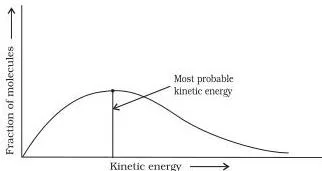
The Maxwell-Boltzmann distribution curve shows how molecules share kinetic energy. The peak is the most probable kinetic energy — the energy of the largest fraction of molecules. The area under the curve is constant because total probability is always one. Mark \(E_a\) on the curve: only molecules to the right of \(E_a\) can react.
Raise the temperature and the peak moves to higher energy while the curve broadens to the right. That broadening pushes far more molecules past \(E_a\) — the shaded reactive area roughly doubles for a 10 K rise, which doubles the rate. This is the molecular picture behind the empirical doubling rule.
Catalyst and Collision Theory: The Last Two Factors
A catalyst is a substance that increases the rate of a reaction without itself undergoing any permanent chemical change — MnO₂ speeds up the decomposition of KClO₃. If an added substance slows a reaction, it is an inhibitor; the word catalyst must not be used for a rate-lowering substance.
By the intermediate complex theory, the catalyst forms temporary bonds with the reactants to make an intermediate complex that decomposes to products, regenerating the catalyst. It works by providing an alternate pathway with a lower activation energy, as Fig. 3.11 shows:
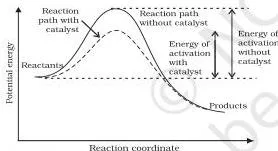
Three exam facts about catalysts: a catalyst does not alter Gibbs energy ΔG, so it cannot drive a non-spontaneous reaction; it does not change the equilibrium constant; and it only helps equilibrium be reached faster because it speeds up the forward and backward reactions equally.
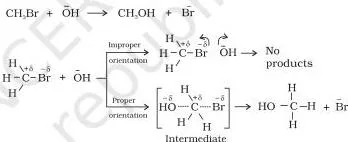
Collision theory. Molecules must collide to react. The number of collisions per second per unit volume is the collision frequency \(Z\). Not every collision reacts — only effective collisions, ones with sufficient kinetic energy (threshold energy = \(E_a\) plus the energy the molecules already possess) and proper orientation. The steric factor \(P\) accounts for orientation:
\[ \text{Rate} = P Z_{AB} e^{-E_a/RT} \]
\(P\), \(Z\) and the exponential together fix the rate. The theory’s drawback: it treats molecules as hard spheres and ignores their internal structure — which is why it works well for simple species but deviates for complex molecules.
Key Terms in Chemical Kinetics: Definitions With Examples
Every examinable term in one lookup table — meaning first, example second.
| Term | Meaning | Example from the chapter |
|---|---|---|
| Rate of reaction | Change in concentration of a reactant or product per unit time | \(R \rightarrow P\), rate = \(-\Delta[R]/\Delta t\) |
| Average rate | Rate over a finite time interval — the chord slope | Butyl chloride hydrolysis, \(1.90 \times 10^{-4}\ \text{mol L}^{-1}\text{s}^{-1}\) |
| Instantaneous rate | Rate at a single instant — the tangent slope as \(\Delta t \rightarrow 0\) | \(r_{\text{inst}} = -d[R]/dt\) |
| Rate law | Expression linking rate to concentrations raised to experimental powers | Rate = \(k[\text{NO}]^2[\text{O}_2]\) |
| Rate constant | Proportionality constant \(k\) in the rate law | \(k = 2.3 \times 10^{-5}\ \text{L mol}^{-1}\text{s}^{-1}\) |
| Order of a reaction | Sum of the concentration powers in the rate law | Rate = \(k[A]^{1/2}[B]^{3/2}\) → order 2 |
| Molecularity | Number of species colliding simultaneously in an elementary step | 2HI → H₂ + I₂ is bimolecular |
| Elementary reaction | A reaction that completes in one step | NH₄NO₂ → N₂ + 2H₂O |
| Complex reaction | A reaction running through several elementary steps | I⁻-catalysed H₂O₂ decomposition |
| Rate determining step | The slowest step that fixes the overall rate | First step of the H₂O₂ + I⁻ mechanism |
| Half-life | Time for the concentration to fall to half its initial value | \(t_{1/2} = 0.693/k\) |
| Pseudo first order | Higher-order reaction that behaves as first order because one reactant is in excess | Ethyl acetate hydrolysis in water |
| Activation energy | Minimum energy needed to form the activated complex | \(E_a = 209\ \text{kJ mol}^{-1}\) for 2HI |
| Activated complex | Unstable, short-lived intermediate at the energy peak | The H₂⋯I₂ complex before 2HI forms |
| Frequency factor (A) | Pre-exponential Arrhenius constant, same units as k | \(A = 1.61\ \text{s}^{-1}\) in NCERT Example 3.9 |
| Threshold energy | Energy a colliding pair needs for an effective collision | \(E_a\) + energy already possessed by the species |
| Collision frequency (Z) | Collisions per second per unit volume | \(Z_{AB}\) for reactants A and B |
| Effective collision | Collision with enough energy and the proper orientation | Methanol formation from bromoethane |
| Steric factor (P) | Orientation factor that corrects the collision rate | \(0 \lt P \leq 1\) in Rate = \(PZ_{AB}e^{-E_a/RT}\) |
Chemical Kinetics Formula Sheet: Equations and Units
Two grouped tables cover every numerical in the chapter, with symbols and units beside each formula. To verify any equation against the printed page, open the official NCERT chapter PDF of Class 12 Chemistry Part I; the rationalised textbook set is listed on the official NCERT portal.
| Quantity | Formula | Symbols and units |
|---|---|---|
| Average rate | \(-\Delta[R]/\Delta t = +\Delta[P]/\Delta t\) | [R], [P] in mol L⁻¹; t in s → \( \text{mol L}^{-1}\text{s}^{-1} \) |
| Instantaneous rate | \(-d[R]/dt = d[P]/dt\) | Same units; gases: \( \text{atm s}^{-1} \) |
| Rate law | \(k[A]^x[B]^y\) | x, y experimental; k by order |
| Units of k | \((\text{mol L}^{-1})^{1-n}\text{s}^{-1}\) | n = overall order |
| Quantity | Formula | Symbols and units |
|---|---|---|
| Zero order integrated | \([R] = -kt + [R]_0\) | Plot [R] vs t: slope \(-k\) |
| Zero order k | \(([R]_0 – [R])/t\) | \( \text{mol L}^{-1}\text{s}^{-1} \) |
| First order integrated | \(\ln[R] = -kt + \ln[R]_0\); \([R] = [R]_0e^{-kt}\) | Plot ln[R] vs t: slope \(-k\) |
| First order k | \(\frac{2.303}{t}\log\frac{[R]_0}{[R]}\) | \( \text{s}^{-1} \) |
| Gas pressure form | \(\frac{2.303}{t}\log\frac{p_i}{2p_i – p_t}\) | Pressures in atm; for A → B + C |
| Zero order half-life | \([R]_0/(2k)\) | Depends on \([R]_0\) |
| First order half-life | \(0.693/k\) | Independent of \([R]_0\) |
| Arrhenius equation | \(k = Ae^{-E_a/RT}\) | \(E_a\) in J mol⁻¹; R = 8.314 J K⁻¹ mol⁻¹; T in kelvin |
| Arrhenius ln form | \(\ln k = -E_a/RT + \ln A\) | Plot ln k vs 1/T: slope \(-E_a/R\), intercept \(\ln A\) |
| Two-temperature form | \(\log\frac{k_2}{k_1} = \frac{E_a}{2.303R}\left[\frac{T_2 – T_1}{T_1T_2}\right]\) | T in kelvin |
| Collision theory | Rate = \(PZ_{AB}e^{-E_a/RT}\) | P steric factor; Z collision frequency |
Worked Examples: Chemical Kinetics Numericals Solved Step by Step
Four question types cover nearly every numerical in this chapter. Each solution names the method first, then works in numbered steps with units throughout.
Worked Example 1: Average rate with stoichiometric coefficients (2A → 3B + C)
Method: divide every concentration term by its stoichiometric coefficient.
Given: [A] falls from 0.40 mol L⁻¹ to 0.25 mol L⁻¹ in 50 min.
Step 1: \(\Delta[A] = 0.25 – 0.40 = -0.15\ \text{mol L}^{-1}\).
\[ \text{Rate} = -\frac{1}{2}\frac{\Delta[A]}{\Delta t} = -\frac{1}{2}\left(\frac{-0.15}{50}\right) = 1.5 \times 10^{-3}\ \text{mol L}^{-1}\text{min}^{-1} \]
Step 2: From the equation, 3 mol of B form for every 2 mol of A consumed, so the rate of formation of B is 3 times the reaction rate.
\[ \frac{d[B]}{dt} = 3 \times 1.5 \times 10^{-3} = 4.5 \times 10^{-3}\ \text{mol L}^{-1}\text{min}^{-1} \]
Final answer: rate of reaction = \(1.5 \times 10^{-3}\ \text{mol L}^{-1}\text{min}^{-1}\); rate of formation of B = \(4.5 \times 10^{-3}\ \text{mol L}^{-1}\text{min}^{-1}\).
Worked Example 2: First order rate constant from two concentrations
Method: first order integrated equation \(k = \frac{2.303}{t}\log\frac{[R]_0}{[R]}\).
Given: [R]₀ = 0.80 mol L⁻¹ falls to [R] = 0.20 mol L⁻¹ in 90 min.
Step 1: substitute:
\[ k = \frac{2.303}{90} \log \frac{0.80}{0.20} = \frac{2.303}{90} \log 4 = \frac{2.303 \times 0.6021}{90} = 0.0154\ \text{min}^{-1} \]
Step 2: convert to seconds by dividing by 60.
\[ k = \frac{0.0154}{60} = 2.57 \times 10^{-4}\ \text{s}^{-1} \]
Final answer: \(k = 0.0154\ \text{min}^{-1} = 2.57 \times 10^{-4}\ \text{s}^{-1}\).
Worked Example 3: Activation energy from rate constants at two temperatures
Method: two-temperature Arrhenius form \(\log\frac{k_2}{k_1} = \frac{E_a}{2.303R}\left[\frac{T_2 – T_1}{T_1T_2}\right]\).
Given: \(k_1 = 3.0 \times 10^{-4}\ \text{s}^{-1}\) at \(T_1 = 400\ \text{K}\); \(k_2 = 9.0 \times 10^{-4}\ \text{s}^{-1}\) at \(T_2 = 450\ \text{K}\); \(R = 8.314\ \text{J K}^{-1}\text{mol}^{-1}\).
Step 1: find the log ratio:
\[ \log \frac{k_2}{k_1} = \log \frac{9.0 \times 10^{-4}}{3.0 \times 10^{-4}} = \log 3 = 0.4771 \]
Step 2: rearrange and substitute:
\[ E_a = 2.303 \times 8.314 \times 0.4771 \times \frac{400 \times 450}{450 – 400} = 19.15 \times 0.4771 \times 3600 \]
\[ E_a = 3.29 \times 10^4\ \text{J mol}^{-1} \]
Final answer: \(E_a \approx 3.29 \times 10^4\ \text{J mol}^{-1} \approx 32.9\ \text{kJ mol}^{-1}\).
Worked Example 4: Half-life and fraction remaining
Method: \(t_{1/2} = \frac{0.693}{k}\), then count half-lives.
Given: \(t_{1/2} = 40\ \text{min}\).
Step 1: find k:
\[ k = \frac{0.693}{40} = 1.73 \times 10^{-2}\ \text{min}^{-1} \]
Step 2: 120 min = 3 × 40 min = 3 half-lives.
Each half-life halves the amount: 1 → 1/2 → 1/4 → 1/8.
Final answer: \(k = 1.73 \times 10^{-2}\ \text{min}^{-1}\); after 120 min one-eighth of the reactant remains.
Common Mistakes in Chemical Kinetics: Error and Correction
The slips that actually cost marks, each with the correction and a way to check it.
| Students write | Correct is | Because / how to check |
|---|---|---|
| Rate = \(-\Delta[\text{HI}]/\Delta t\) for 2HI → H₂ + I₂ | Rate = \(-\frac{1}{2}\Delta[\text{HI}]/\Delta t\) | HI is consumed twice as fast as H₂ forms; divide each term by its coefficient. |
| Order read from the balanced equation | Order comes only from experimental rate data | CHCl₃ + Cl₂ looks 1:1 but the rate law is \(k[\text{CHCl}_3][\text{Cl}_2]^{1/2}\) — the equation gives no information (NCERT, p. 68). |
| \(k\) in \( \text{s}^{-1} \) for a second order reaction | Second order \(k\) has units \( \text{L mol}^{-1}\text{s}^{-1} \) | Use \((\text{mol L}^{-1})^{1-n}\text{s}^{-1}\) with n = 2; the unit itself identifies the order. |
| \(p_i – p_t\) in the gas pressure formula | \(2p_i – p_t\) | \(p_t\) rose by the product pressure while \(p_A\) fell; check that \(p_A\) comes out less than \(p_i\) (NCERT, p. 75). |
| Temperature left in Celsius in Arrhenius | Kelvin only: K = °C + 273.15 | \(E_a/RT\) requires absolute temperature; a wrong T changes \(E_a\) by a large factor. |
| Dropping 2.303 when using log | \(\ln x = 2.303 \log x\) | The first order equation printed with log carries \(2.303/t\); with ln it does not. |
| Molecularity can be zero or fractional | Molecularity is a whole number from 1 to 3 | It counts real molecules colliding at once; zero means no reaction and a fraction is meaningless (NCERT, p. 70). |
| A negative exponent is impossible | Negative order means the rate falls as that concentration rises | Rate = \(k[A]^{3/2}[B]^{-1}\) gives an overall order of 1/2; the negative sign sits on one reactant only. |
Exam Notes: Where the Marks Are in Chemical Kinetics
Observed patterns, written with an examiner’s mindset — these are the steps that earn the marks:
- Stating the order from a given rate expression — sum the exponents. This is the cheapest mark in the chapter and the most frequently attempted.
- Identifying the order from the unit of k — \( \text{s}^{-1} \) means first order; \( \text{L mol}^{-1}\text{s}^{-1} \) means second order.
- Deriving the integrated first order equation — the integration steps (separate variables, integrate, fix the constant with t = 0) are what earn credit, not just the final formula.
- Computing \(t_{1/2}\) from k — the quotient \(0.693/k\) earns the mark; writing the formula alone does not.
- The two-temperature Arrhenius calculation — converting both temperatures to kelvin before substitution and keeping units on \(E_a\) earns full credit.
- Gas-phase pressure numericals — writing \(p_A = 2p_i – p_t\) before substituting earns the setup mark.
Mark-earning behaviours that examiners reward: writing the rate expression with the stoichiometric factor included earns the rate-expression mark; converting temperature to kelvin before substitution changes the answer; stating the unit of k after a calculation earns the units mark.
The textbook prints the answers to its intext questions at the end of the chapter (NCERT, p. 88) — use them to self-check before moving to the exercises. This page deliberately stops short of NCERT exercise solutions; those belong on a separate solutions page.
Chemical Kinetics Class 12 Notes: One Page Revision Recap
The whole chapter in five blocks:
- Rate — average vs instantaneous; divide by stoichiometric coefficients; units \( \text{mol L}^{-1}\text{s}^{-1} \).
- Order and rate law — exponents are experimental; units of \(k\) = \((\text{mol L}^{-1})^{1-n}\text{s}^{-1}\).
- Integrated equations and plots — zero order: \([R] = -kt + [R]_0\); first order: \(\ln[R] = -kt + \ln[R]_0\).
- Half-life — \(t_{1/2} = 0.693/k\) for first order (constant); pseudo first order when a reactant is in excess.
- Arrhenius and collision theory — \(k = Ae^{-E_a/RT}\); a catalyst lowers \(E_a\); Rate = \(PZ_{AB}e^{-E_a/RT}\).
The classic zero versus first order comparison (spirit of NCERT Table 3.4, p. 77):
| Zero order | First order | |
|---|---|---|
| Differential rate law | \(d[R]/dt = -k\) | \(d[R]/dt = -k[R]\) |
| Integrated rate law | \([R] = -kt + [R]_0\) | \([R] = [R]_0e^{-kt}\) or \(kt = \ln([R]_0/[R])\) |
| Straight-line plot | [R] vs t, slope \(-k\) | ln[R] vs t, slope \(-k\) |
| Half-life | \([R]_0/(2k)\) | \(0.693/k\) |
| Units of k | \( \text{mol L}^{-1}\text{s}^{-1} \) | \( \text{s}^{-1} \) |
| Example | NH₃ on hot Pt at high pressure | Hydrogenation of ethene; Ra-226 decay |
Constants to carry into the exam: 0.693 (half-life), 2.303 (ln ↔ log), R = 8.314 J K⁻¹ mol⁻¹.
For numeric practice, the four worked examples above cover average rate, first order k, activation energy and half-life — re-solve them without looking before the exam. This page is part of the Class 12 notes collection on the CBSE notes hub, which organises every class and subject for quick revision.
FAQs on Chemical Kinetics Class 12
Why can’t the order of a reaction be predicted from the balanced chemical equation?
The balanced equation shows stoichiometric coefficients, which describe the overall change — not how the reaction actually happens. Most reactions proceed through several elementary steps, and the rate is fixed by the slowest step, not by the overall equation. The CHCl₃ + Cl₂ example proves it: the equation looks 1:1, but the experimental rate law is \(k[\text{CHCl}_3][\text{Cl}_2]^{1/2}\).
The rate law must be found from experiment.
What is the difference between order of a reaction and molecularity?
Order is the sum of the concentration powers in the experimental rate law; it can be 0, 1, 2, 3 or a fraction and applies to any reaction. Molecularity is the number of species that must collide simultaneously in one elementary step; it is only a whole number from 1 to 3 and is defined only for elementary reactions.
For a complex reaction, the order equals the molecularity of its slowest step.
Why is the half-life of a first order reaction independent of the initial concentration?
Substitute \([R] = [R]_0/2\) into \(k = \frac{2.303}{t}\log\frac{[R]_0}{[R]}\). The \([R]_0\) cancels, leaving \(t_{1/2} = \frac{2.303}{k}\log 2 = \frac{0.693}{k}\). Since no \([R]_0\) survives in the formula, the starting concentration does not matter — every successive half-life takes the same time.
What is a pseudo first order reaction, and why does water not appear in its rate law?
A pseudo first order reaction is really a higher-order reaction that obeys first order kinetics because one reactant is present in such large excess that its concentration barely changes. In ethyl acetate hydrolysis, 0.01 mol of ester reacts with 10 mol of water; water falls only from 10 mol to 9.99 mol, so it is effectively constant and gets absorbed into k.
The rate law then reads rate = \(k[\text{ester}]\).
Why does a catalyst increase the rate of a reaction without changing the equilibrium constant?
A catalyst provides an alternate reaction path with a lower activation energy, so a larger fraction of collisions clears the barrier and k rises. But it speeds the forward and backward reactions equally and does not alter ΔG, so the equilibrium position — the equilibrium constant — stays the same. Equilibrium is simply reached sooner.
How do you find the activation energy and the frequency factor from an Arrhenius plot of ln k versus 1/T?
From \(\ln k = -\frac{E_a}{RT} + \ln A\), plotting ln k against 1/T gives a straight line. Its slope is \(-E_a/R\), so \(E_a = -\text{slope} \times R\); its intercept is \(\ln A\), so \(A = e^{\text{intercept}}\). With R = 8.314 J K⁻¹ mol⁻¹ and T in kelvin, \(E_a\) comes out in J mol⁻¹.
Reference: NCERT Class 12 Chemistry Part I textbook, chapter 3 Chemical Kinetics.
Explore Class 12 Chemistry Notes
More for this chapter:
Class 12 Chemistry on LearnCBSE:
Related chapters: