
This page carries Chapter 6, Evolution, of the NCERT Class 12 Biology textbook — about 17 printed pages that open at NCERT page 109 — and the official Evolution Class 12 chapter PDF is right here. The chapter is the story of how life arose and diversified on earth, from the Big Bang to modern humans.
Open the file to read it exactly as published; the rest of this page explains what is inside it, section by section.
| What the chapter holds | Count | Where it is used |
|---|---|---|
| Printed pages | 17 | |
| Sections in the chapter | 9 | |
| Figures with NCERT captions | 13 | |
| Tables | 1 | |
| Exercise questions | 10 | answered in our NCERT Solutions |
| Official NCERT PDF | Download the chapter PDF | the chapter exactly as NCERT publishes it |
NCERT Class 12 Biology Chapter 6 Evolution PDF
Open the official NCERT Class 12 Biology Chapter 6 Evolution PDF to read the full chapter exactly as published — it runs about 17 printed pages from NCERT page 109 and holds the full chapter text with every figure, the closing summary and the end-of-chapter exercises.
This is the official edition hosted on ncert.nic.in, the same source as the printed book. What follows is a map of the chapter, then each concept explained with its page references, then revision tables.
Chapter 6 Evolution at a Glance
The table below shows the chapter’s key statistics at a glance.
The chapter’s main sections, in order, are:
- 6.1 Origin of Life (p. 109) — the universe, the Big Bang, and the first experiments on how life began.
- 6.2 Evolution of Life Forms – A Theory (p. 111) — special creation versus Darwin’s natural selection.
- 6.3 What are the Evidences for Evolution? (p. 112) — fossils, embryos, anatomy, biochemistry and breeding.
- 6.4 What is Adaptive Radiation? (p. 115) — Darwin’s finches and Australian marsupials.
- 6.5 Biological Evolution (p. 117) — why fast-dividing microbes evolve quickly.
- 6.6 Mechanism of Evolution (p. 118) — Darwin’s gradual variation versus de Vries’ mutations.
- 6.7 Hardy-Weinberg Principle (p. 119) — the algebra of allele frequencies and what disturbs equilibrium.
- 6.8 A Brief Account of Evolution (p. 120) — the geological timeline of life.
- 6.9 Origin and Evolution of Man (p. 123) — hominids, brain sizes and Homo sapiens.
The chapter closes with a SUMMARY and an EXERCISES set on the final pages (pp. 125–126). Its only table, Figure 6.7, pairs placental mammals with their Australian marsupial counterparts.
What the Evolution Chapter Covers, Section by Section
This chapter is one long story told in a deliberate order. It opens with the universe, narrows to earth, then to the first life, and only then asks how life diversified. Once you see that logic, the sections stop feeling like a list.
The book starts with the Big Bang — a universe about 13.8 billion years old — moves to an earth formed roughly 4.5 billion years back, and places the origin of life about four billion years ago (NCERT, pp. 109–111). The opening pages fix the setting before any biology begins.
From there each idea supplies what the next one needs. Darwin’s theory of natural selection comes first, the five lines of evidence next, then adaptive radiation as a pattern, the mechanism of variation and speciation, the Hardy-Weinberg principle that measures change, a geological account of life, and finally the human story.
Key Concepts in Evolution, Explained
This is the story of how life arose and diversified on earth, told in the order the book builds it. Each idea below keeps its page numbers so you can follow along with a finger on the book.
Origin of Life: From the Big Bang to Miller’s Flask
To explain where life came from, the chapter first places earth in cosmic time. When you look at stars you are looking back in time, because starlight begins its journey millions of years before it reaches your eyes (NCERT, pp. 109–110).
The Big Bang theory describes the universe’s origin as one huge explosion. The universe expanded, cooled, and hydrogen and helium formed; gases condensed under gravitation into galaxies. Earth formed about 4.5 billion years back in the solar system of the Milky Way galaxy (NCERT, p. 110).
Early earth had no atmosphere. Water vapour, methane, carbon dioxide and ammonia escaped from the molten mass; as the surface cooled, rain filled the depressions and formed oceans. Life appeared roughly 500 million years after earth formed — about four billion years ago (NCERT, pp. 110–111).
The book then clears away two old ideas. Panspermia held that life arrived from outer space as spores. Spontaneous generation held that life came from decaying matter; Louis Pasteur’s experiments with sterilised flasks showed that life comes only from pre-existing life, and the theory was dismissed (NCERT, p. 111).
The accepted view is chemical evolution, proposed by Oparin of Russia and Haldane of England: the first life could have come from pre-existing non-living organic molecules such as RNA and protein, with diverse organic molecules forming from inorganic constituents first (NCERT, p. 111).
In 1953 S.L. Miller tested this in the laboratory — the setup is Figure 6.1. He passed an electric discharge through a closed flask of methane, hydrogen, ammonia and water vapour at 800°C and obtained amino acids. Later experiments produced sugars, nitrogen bases, pigments and fats, and meteorite analysis revealed similar compounds (NCERT, pp. 111–112).
Note the boundary of the evidence: Miller demonstrated chemical evolution, not the origin of the first cell. The first non-cellular forms of life may have appeared about 3 billion years ago, as giant molecules like RNA and protein; the first cellular forms possibly only about 2000 million years ago (NCERT, p. 112).
Darwin’s Theory: Natural Selection and Reproductive Fitness
Darwin’s idea is that nature ‘selects’ which individuals leave more offspring, and over generations this shifts what a population looks like. The chapter introduces it by first knocking down what came before.
The theory of special creation claimed all species were created as such, diversity never changed, and earth was about 4000 years old. Nineteenth-century findings challenged all three claims (NCERT, pp. 111–112).
On his voyage around the world in H.M.S. Beagle, Darwin concluded that living forms share similarities with each other and with forms that existed millions of years ago, that extinctions had happened, and that evolution was gradual. Alfred Wallace reached similar conclusions independently in the Malay Archipelago (NCERT, p. 112).
The mechanism: populations carry built-in variation in characteristics. Individuals that survive better under natural conditions outbreed the less-endowed, leaving more progeny. That is fitness — and for Darwin fitness means reproductive fitness. Nature selects the better-fit; he called this natural selection (NCERT, p. 112).
Darwin was likely influenced by Thomas Malthus’s work on populations. The factual observations behind natural selection are:
- natural resources are limited;
- population sizes stay stable except for seasonal fluctuation;
- no two individuals are alike, even when they look similar;
- most variations are inherited (NCERT, p. 118).
Because populations would grow exponentially if everyone reproduced maximally, while real populations stay limited, there is competition for resources. Only some survive and grow at the cost of others (NCERT, p. 118).
The chapter leaves one question open: is evolution a process or the result of a process? The book says we are still not clear whether to treat evolution and natural selection as processes or as end results of unknown processes (NCERT, p. 118).
Evidence for Evolution: Fossils, Embryos, Anatomy, Biochemistry and Breeding
Evolution is a theory, but it rests on evidence from five directions. The chapter takes them one by one.
Paleontological evidence comes from fossils — the remains of hard parts of life-forms found in rocks. Different-aged rock sediments hold fossils of different life-forms, some similar to modern organisms, as the dinosaur family tree (Figure 6.2) shows. Fossils demonstrate that certain forms, like dinosaurs, were restricted to particular geological time-spans (NCERT, pp. 112–113).
The chapter asks you to recall radioactive dating, the method used to calculate fossil ages.
Embryological support was proposed by Ernst Haeckel, who noticed that vertebrate embryos develop a row of vestigial gill slits behind the head — functional only in fish. Karl Ernst von Baer later showed that embryos never pass through the adult stages of other animals, correcting Haeckel’s overclaim (NCERT, p. 113).
Comparative anatomy compares body structures. When the same structure is built for different functions, the organs are homologous, the pattern is divergent evolution, and the inference is common ancestry. When different structures serve the same function, they are analogous, the result of convergent evolution (NCERT, pp. 114–115).
| Organ pair | Type | One-line reason |
|---|---|---|
| Forelimbs of whale, bat, cheetah, human | Homologous | Same bones (humerus, radius, ulna, carpals, metacarpals, phalanges) adapted for swimming, flying, running and grasping. |
| Vertebrate hearts or brains | Homologous | Same underlying organ structure shared across vertebrates. |
| Bougainvillea thorn, Cucurbita tendril | Homologous | Both are modified stems serving different jobs — defence versus support. |
| Wing of butterfly, wing of bird | Analogous | Different anatomy, same function — flight. |
| Eye of octopus, eye of mammals | Analogous | Different construction, same function — vision. |
| Flippers of penguin and dolphin | Analogous | Different ancestry, same swimming function. |
| Sweet potato and potato | Analogous | Root modification versus stem modification; both store food. |
The first three rows point to a shared ancestor’s structure; the last four point to a shared habitat selecting the same function.
Biochemical evidence: similarities in the proteins and genes that perform a given function across diverse organisms point to shared ancestry (NCERT, p. 115).
Artificial selection offers a time-lapse argument: man has bred dogs and crops into distinct breeds within hundreds of years, so nature had millions of years to do the same (NCERT, p. 115).
The peppered moth is the chapter’s observed example of natural selection in action. In 1850s England, before industrialisation, more white-winged moths than dark (melanised) moths were collected from trees; by 1920, after industrialisation, the proportion was reversed in the same area.
Predators pick out any moth whose colour contrasts with the trunk behind it: pale lichen-covered trunks hid white moths, soot-darkened trunks hid melanised ones (NCERT, pp. 115–116).
In rural areas where industrialisation never happened, counts of melanic moths stayed low. Importantly, no variant is completely wiped out — only proportions changed. The same logic explains antibiotic and pesticide resistance appearing within months or years; these are examples of evolution by anthropogenic action (NCERT, p. 116).
The chapter adds a caution that kills a popular misconception: evolution is not a directed, deterministic process — it is a stochastic process based on chance events in nature and chance mutations in organisms (NCERT, p. 116).
Adaptive Radiation: Darwin’s Finches and Australian Marsupials
Adaptive radiation is one ancestor diversifying into many forms to fill different habitats within one area. The chapter gives two famous cases.
Adaptive radiation means one ancestral form, in a single geographical area, splitting into different species that spread into the different habitats around that starting point (NCERT, pp. 116–117).
Darwin’s finches, on the Galapagos Islands, all evolved on the islands themselves; from original seed-eating features, forms with altered beaks arose that became insectivorous and vegetarian — Figure 6.5 (NCERT, pp. 116–117).
Australian marsupials: many marsupials, each different from the other, evolved from one ancestral stock, all within the island continent — Figure 6.6 (NCERT, p. 117). The chapter then pairs each placental mammal with its marsupial look-alike:
| Placental mammals | Australian marsupials |
|---|---|
| Mole | Marsupial mole |
| Anteater | Numbat (anteater) |
| Mouse | Marsupial mouse |
| Lemur | Spotted cuscus |
| Flying squirrel | Flying phalanger |
| Bobcat | Tasmanian tiger cat |
| Wolf | Tasmanian wolf |
Figure 6.7 carries this table, and it shows the chapter’s nuance: when more than one adaptive radiation appears to have occurred in an isolated area, the similar-looking results can be called convergent evolution (NCERT, p. 117).
Mechanism of Evolution: Mutation, Saltation and Speciation
Darwin described variation but could not say where it came from. The chapter contrasts his gradual view with a sudden, mutational one.
Lamarck, before Darwin, argued that evolution was driven by use and disuse of organs — giraffes stretched their necks to reach leaves and passed the acquired length to offspring. The book is blunt: nobody believes this conjecture any more (NCERT, p. 118).
Hugo de Vries, working on the evening primrose, proposed mutations — large differences arising suddenly in a population. He believed mutation causes evolution, not the minor heritable variations Darwin discussed. Mutations are random and directionless; Darwinian variations are small and directional.
Darwin saw evolution as gradual; de Vries believed a single-step large mutation caused speciation — a process he called saltation (NCERT, p. 119).
| Aspect | Darwinian variation | de Vries mutation |
|---|---|---|
| Size and direction | Small, directional | Large, random and directionless |
| Role in evolution | Gradual change over generations | Speciation in one step (saltation) |
Studies in population genetics later brought clarity to the debate (NCERT, p. 119).
Hardy-Weinberg Principle: The Genetic Equilibrium
The Hardy-Weinberg principle is a yardstick: it states what allele frequencies would look like if evolution were not happening. Any deviation from it is evidence that evolution is happening.
The principle says allele frequencies in a population remain constant from generation to generation; the gene pool stays constant. This is called genetic equilibrium (NCERT, pp. 119–120). In a diploid, let \(p\) be the frequency of allele A and \(q\) the frequency of allele a.
The genotype frequencies follow directly: AA appears with frequency \(p^2\), aa with \(q^2\), and Aa with \(2pq\), so the three together must sum to 1:
\[ p^2 + 2pq + q^2 = 1 \]
This is simply the binomial expansion of \((p + q)^2\), since the sum of all allelic frequencies is 1 (NCERT, p. 120).
Worked example (own numbers): a population of 500 diploid plants has 180 plants showing the recessive phenotype at a locus. Assuming Hardy-Weinberg equilibrium, find \(p\), \(q\), and the expected numbers of AA, Aa and aa plants.
Step 1: The recessive phenotype is aa, so its genotype frequency is \(q^2\).
Count the proportion: \(q^2 = \frac{180}{500} = 0.36\).
Step 2: Take the square root: \(q = \sqrt{0.36} = 0.6\).
Since \(p + q = 1\), \(p = 1 – 0.6 = 0.4\).
\[ AA = p^2 \times 500 = 0.16 \times 500 = 80 \]
\[ Aa = 2pq \times 500 = 2 \times 0.4 \times 0.6 \times 500 = 240 \]
\[ aa = q^2 \times 500 = 0.36 \times 500 = 180 \]
Step 3: Check the arithmetic: \(80 + 240 + 180 = 500\), the entire population.
Final answer: \(q = 0.6\), \(p = 0.4\); expected counts are AA = 80, Aa = 240 and aa = 180.
The calculation assumes equilibrium — random mating, and none of the disturbing factors acting at that locus. If measured genotype frequencies differ from these expected values, the direction of the difference indicates the extent of evolutionary change (NCERT, p. 120).
Five factors disturb Hardy-Weinberg equilibrium:
- Gene migration or gene flow — alleles moving between populations change frequencies in both the old and the new population.
- Genetic drift — a chance change in allele frequency, unrelated to fitness.
- Mutation — new alleles arise randomly and alter frequencies.
- Genetic recombination — reshuffling of alleles during gamete formation changes genotype combinations.
- Natural selection — better-fit individuals leave more progeny and shift allele frequencies (NCERT, p. 120).
When a small drifted population settles elsewhere, the drifted population becomes the founders of the new population — the founder effect (NCERT, p. 120).
Selection itself takes three forms, shown in Figure 6.8: stabilising (more individuals acquire the mean character value), directional (more individuals acquire a value other than the mean) and disruptive (more individuals acquire peripheral values at both ends of the distribution) (NCERT, p. 120).
A Brief Account: Life’s Timeline on Earth
This section compresses billions of years into a sequence of ‘firsts’. Its dates are the ones to memorise.
About 2000 million years ago the first cellular forms of life appeared. Some of these cells could release oxygen by splitting water, in a reaction similar to the light reaction of photosynthesis. Single-celled organisms slowly became multicellular (NCERT, p. 121).
The dates then accelerate: invertebrates were formed and active by 500 mya, jawless fish evolved around 350 mya, and seaweeds with a few plants existed around 320 mya. Plants were the first organisms to invade land (NCERT, pp. 121–122).
Fish with stout, strong fins could move onto land and back into water about 350 mya. These lobefins — the Coelacanth, thought extinct until one was caught in South Africa in 1938, is a living example — evolved into the first amphibians, ancestors of today’s frogs and salamanders (NCERT, p. 122).
Amphibians evolved into reptiles, which lay thick-shelled eggs that do not dry up in the sun. Reptiles then dominated for about 200 million years. Giant pteridophytes fell to form coal deposits; some land reptiles returned to water — Ichthyosaurus, about 200 mya — while the dinosaurs ruled the land. Tyrannosaurus rex stood about 20 feet tall.
About 65 mya the dinosaurs suddenly disappeared; the book notes the reason is uncertain, and the truth may live in between (NCERT, p. 123).
The first mammals were small, shrew-like and viviparous, protecting their unborn young inside the mother’s body. Continental drift explains why South American mammals were overridden by North American fauna when the continents joined, while Australian pouched mammals survived through lack of competition. Some mammals live wholly in water — whales, dolphins, seals and sea cows (NCERT, pp. 123–124).
Origin and Evolution of Man: Hominids to Homo sapiens
The human story in the book is a fossil sequence, each stage with a brain size and a lifestyle. The progression below is the table to learn.
| Stage | When | Key features | Brain size |
|---|---|---|---|
| Dryopithecus and Ramapithecus | about 15 mya | Hairy, walked like gorillas and chimpanzees; Ramapithecus more man-like, Dryopithecus more ape-like | not stated |
| Upright hominids (Ethiopia, Tanzania) | 3–4 mya | Walked upright in eastern Africa; probably not taller than 4 feet | not stated |
| Australopithecines | about 2 mya | East African grasslands; hunted with stone weapons but ate fruit | not stated |
| Homo habilis | not stated in the chapter | First human-like being (hominid); probably did not eat meat | 650–800 cc |
| Homo erectus | about 1.5 mya | Fossils found in Java in 1891; probably ate meat | about 900 cc |
| Neanderthal man | 1,00,000–40,000 years ago | Near east and central Asia; used hides, buried the dead | 1400 cc |
| Homo sapiens | arose in Africa; modern form during the ice age 75,000–10,000 years ago | Moved across continents; developed into distinct races | — |
Beyond the sequence, the chapter adds the cultural markers: pre-historic cave art from about 18,000 years ago — the Bhimbetka rock shelter in Raisen district, Madhya Pradesh, is named — and agriculture from around 10,000 years back, when human settlements began (NCERT, p. 125).
The Chapter’s Figures, Explained
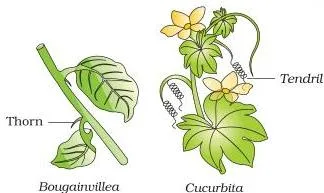
The diagrams in this chapter carry the evidence, and several exercise questions ask you to reason from these ideas. Reading them is faster than re-reading the text.
Figure 6.1: Reading Miller’s Experiment
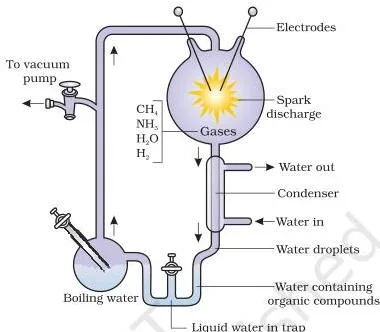
What to notice: the gases circulate through the closed apparatus, the spark supplies the energy, and the chamber at the bottom collects the products — among them amino acids. The experiment proved that organic molecules can form from inorganic gases under early-earth conditions; it did not produce a living cell (NCERT, p. 112).
Figure 6.2: A Family Tree of Dinosaurs
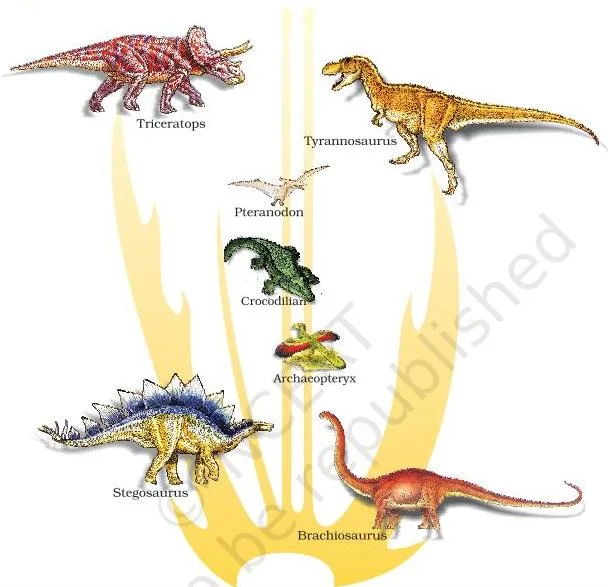
This diagram is paleontological evidence in one picture: a branching tree runs from extinct dinosaurs to living crocodiles and birds. The tree shape means shared ancestry — groups alive today descend from ancestors that no longer exist, while side branches died out (NCERT, p. 114).
Figure 6.3: Homologous Organs in Plants and Animals
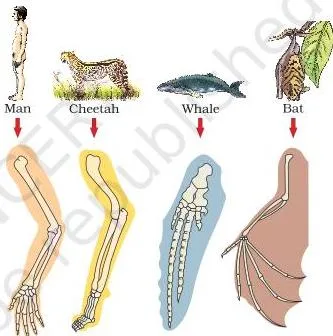
Part (a) pairs the thorn of Bougainvillea with the tendril of Cucurbita — both are modified stems with different jobs. Part (b) lines up the forelimbs of a whale, bat, cheetah and human: each has humerus, radius, ulna, carpals, metacarpals and phalanges, yet one swims, one flies, one runs and one grasps.
Same structure, different functions — that is homology and divergent evolution from a common ancestor (NCERT, pp. 114–115).
Figure 6.4: White-Winged and Dark-Winged Moths on Tree Trunks
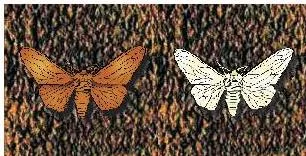
The unpolluted panel shows a pale, lichen-covered trunk: the white moth is hidden, the dark moth stands out. The polluted panel shows a soot-darkened trunk, and the advantage reverses. Predators spot a moth against a contrasting background, so the proportions flipped between the 1850s and the 1920s — yet no variant was completely wiped out (NCERT, p. 116).
Figures 6.5 and 6.6: Finches and Marsupials — Adaptive Radiation in Two Pictures

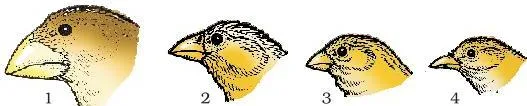
Each beak shape matches a diet. From one original seed-eating stock on the islands, insectivorous and vegetarian finches with altered beaks arose — evolution radiating from a single point into different habitats (NCERT, pp. 116–117).
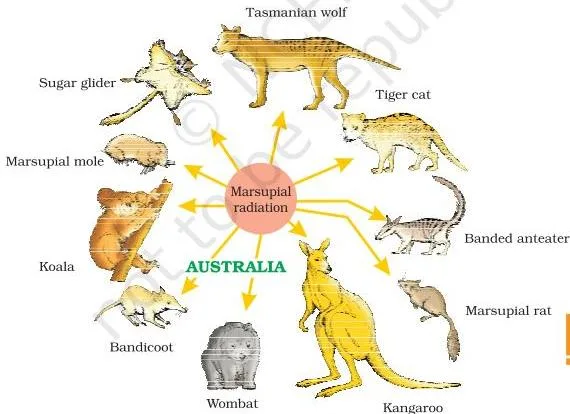
Many distinct marsupials — each different from the other — evolved from one ancestral stock, all within the Australian island continent. Pair this image with Figure 6.5 and you have the chapter’s two named examples of adaptive radiation (NCERT, p. 117).
The chapter’s third adaptive-radiation visual, Figure 6.7, is a comparison table rather than a picture — you saw it in the adaptive radiation section above, pairing the placental mole, anteater, mouse, lemur, flying squirrel, bobcat and wolf with their marsupial counterparts.
Figure 6.8: Three Ways Natural Selection Acts on Traits
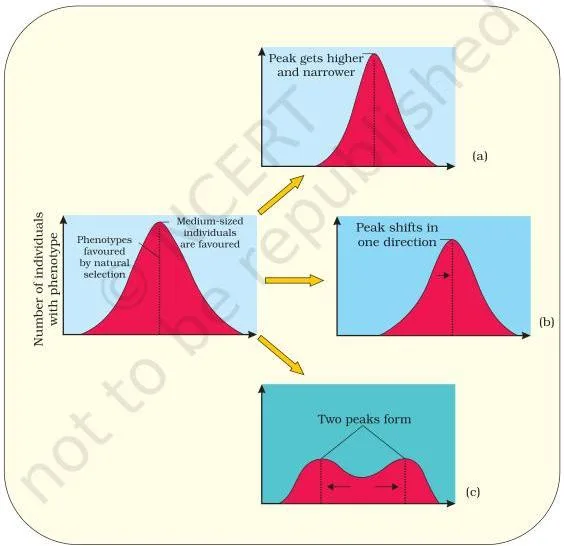
Read each curve the same way: the horizontal axis is the trait value, and the curve shows how many individuals carry each value. (a) Stabilising — more individuals acquire the mean character value, so the middle is favoured. (b) Directional — more individuals acquire a value other than the mean, so the curve shifts to one end.
(c) Disruptive — more individuals acquire peripheral values at both ends, and the curve splits into two humps. Practise naming each from the shape alone (NCERT, p. 120).
Figures 6.9 and 6.10: Plant and Vertebrate Histories Through Geological Periods
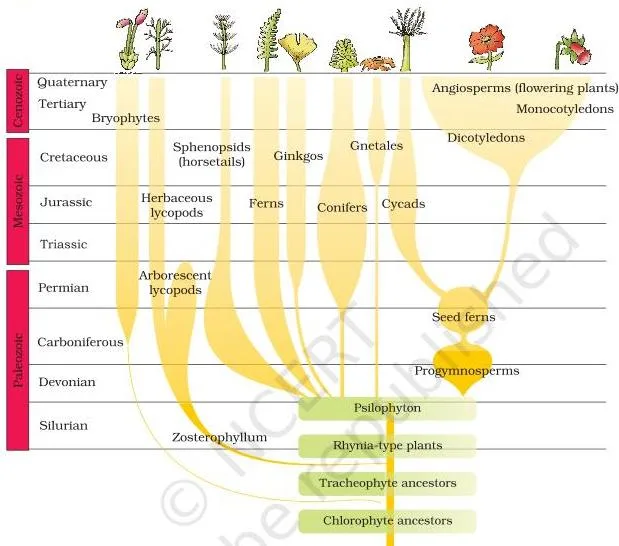
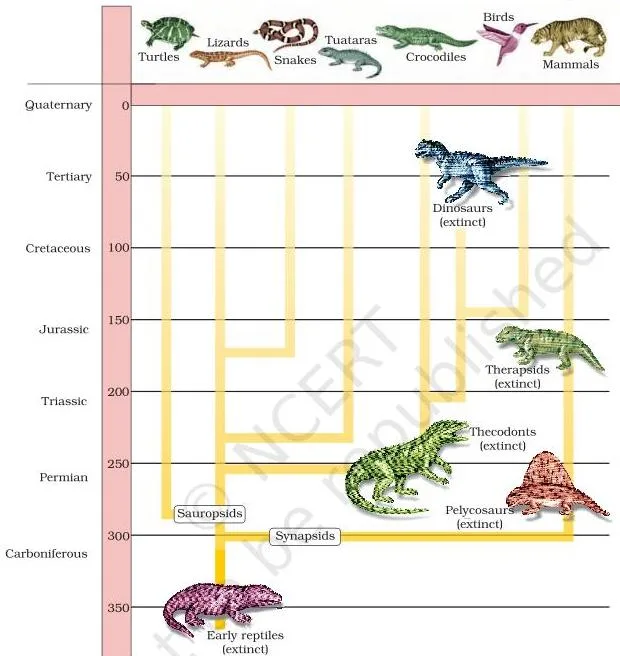
These two sketches are the chapter’s own summary pictures for the geological account (section 6.8). The plant sketch widens like a tree from simple early forms to the range of modern forms; the vertebrate sketch runs through the sequence the text narrates — invertebrates by 500 mya, jawless fish around 350 mya, lobefins, amphibians, reptiles, then birds and mammals (NCERT, pp. 122–123).
Figure 6.11: Skulls of Adult Modern Human, Baby Chimpanzee and Adult Chimpanzee

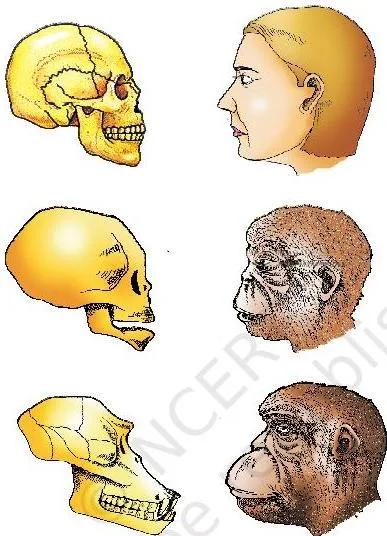
Look at the shapes, not the labels: the adult human skull and the baby chimpanzee skull resemble each other more than the adult chimpanzee skull does.
The chapter connects this to the embryological debate — features present in early developmental stages are not the same as the adult stages of other animals, a correction that goes back to von Baer (NCERT, p. 125).
Definitions: Terms to Know From the Chapter
A quick lookup for the chapter’s key terms, in plain words, with the NCERT page where each appears.
| Term | Plain meaning | NCERT page |
|---|---|---|
| Evolution | The study of the history of life forms on earth | p. 109 |
| Big Bang theory | Origin of the universe from a single huge explosion, followed by expansion and cooling | p. 110 |
| Panspermia | The idea that life arrived from outer space as spores | p. 111 |
| Spontaneous generation | The belief that life arose from decaying and rotting matter; dismissed by Pasteur | p. 111 |
| Chemical evolution | The formation of diverse organic molecules from inorganic constituents before life appeared | p. 111 |
| Fossils | Remains of the hard parts of life-forms found in rocks | p. 112 |
| Reproductive fitness | The ability of an individual to leave more progeny | pp. 111–112 |
| Natural selection | Better-fit individuals survive and leave more progeny; the mechanism of evolution | pp. 111–112 |
| Homologous organs | Same anatomical structure, different function, indicating common ancestry | p. 114 |
| Divergent evolution | Same structure developing along different directions due to different needs | p. 114 |
| Analogous organs | Different structure, similar function, indicating convergent evolution | p. 115 |
| Convergent evolution | Different structures evolving for the same function | p. 115 |
| Adaptive radiation | Different species evolving in a geographical area from one starting point that radiates into other habitats | p. 116 |
| Branching descent | Lineages splitting from common ancestors | p. 117 |
| Saltation | A single-step large mutation that de Vries believed causes speciation | p. 119 |
| Genetic equilibrium | Allele frequencies in a gene pool remaining constant across generations | p. 120 |
| Gene flow | Gene migration between populations, changing frequencies in both | p. 120 |
| Genetic drift | A change in allele frequency that occurs by chance | p. 120 |
| Founder effect | A drifted population becoming the founders of a new population | p. 120 |
| Stabilising selection | More individuals acquire the mean character value | p. 120 |
| Directional selection | More individuals acquire a value other than the mean | p. 120 |
| Disruptive selection | More individuals acquire peripheral values at both ends of the distribution | p. 120 |
Common Mistakes in Evolution and Their Corrections
Most lost marks in this chapter come from a small set of confusions. The chapter has no Points to Ponder section, so these corrections are drawn from the book’s own clarifications.
| Mistake | Correct rule | How to check your answer |
|---|---|---|
| Mixing homologous with analogous organs | Homologous: same structure, different function (forelimbs; Bougainvillea thorn and Cucurbita tendril). Analogous: different structure, same function (butterfly and bird wings; sweet potato and potato). | Ask: do the organs share the same underlying parts? Same parts + different jobs = homologous. |
| Mixing divergent with convergent evolution | Divergent follows homology — same structure develops along different directions. Convergent follows analogy — different structures evolve for the same function. | Name the organ pair first; homology pairs with divergent, analogy with convergent. |
| Saying Darwin proposed mutations | Darwin’s variations are small, directional and gradual. Hugo de Vries proposed mutations — large, random, single-step changes he called saltation. | Read the phrase: gradual + directional = Darwin; sudden + random = de Vries (NCERT, p. 119). |
| Thinking evolution is directed | The chapter states evolution is a stochastic process based on chance events in nature and chance mutations — not deterministic. | Remember the chapter’s own correction near the anthropogenic evolution examples (NCERT, p. 116). |
| Confusing adaptive radiation with convergent evolution | One ancestor radiating into many habitats in one area is adaptive radiation. When more than one radiation occurs in an isolated area, the similar-looking results are called convergent evolution. | Ask how many ancestral starting points the story has: one = adaptive radiation (NCERT, p. 117). |
| Assuming the peppered moth story wiped out one variant | The book says no variant is completely wiped out — only the proportions changed between the 1850s and 1920s. | Look for ‘proportion reversed’, not ‘variant replaced’ (NCERT, p. 116). |
| Wrong brain sizes or order in human evolution | Homo habilis 650–800 cc, Homo erectus about 900 cc, Neanderthal 1400 cc; Ramapithecus more man-like, Dryopithecus more ape-like. | Recite the three brain sizes in order, then attach the diets — habilis did not eat meat, erectus probably did (NCERT, pp. 124–125). |
| Misstating Miller’s setup | Miller used methane, hydrogen, ammonia and water vapour with an electric discharge at 800°C; amino acids formed — not cells. | Recite the four gases, the 800°C, the spark, and the product (NCERT, pp. 111–112). |
How to Practise This Chapter for Exams
Textbook contents and the examinable syllabus are not always identical — check the current official syllabus before you decide what to revise. The mapping below simply shows where each end-of-chapter exercise lives in the chapter.
| Exercise | What it draws on | Section and NCERT page |
|---|---|---|
| Q1: Antibiotic resistance in bacteria | Natural selection and evolution by anthropogenic action | Section 6.3, pp. 115–116 |
| Q2: New fossil discoveries or controversies | Paleontological evidence and fossil dating | Section 6.3, pp. 112–113 |
| Q3: Define the term species | The chapter poses this as your own attempt; the Hardy-Weinberg discussion of changing gene frequencies is the closest supporting content | Section 6.7, pp. 119–121 |
| Q4: Components of human evolution | Brain size, skeletal structure, dietary preference of each hominid | Section 6.9, pp. 123–125 |
| Q5: Self-consciousness in animals | The chapter’s closing idea — human evolution with language skills and self-consciousness | Section 6.9, pp. 124–125 |
| Q6: Modern animals linked to ancient fossils | Paleontological evidence and living links such as the Coelacanth | Sections 6.3 and 6.8, pp. 112–113 and 120–124 |
| Q7: Practise drawing animals and plants | Observational practice based on the chapter’s figures | The whole chapter |
| Q8: One example of adaptive radiation | The definition applied to finches or marsupials | Section 6.4, pp. 116–117 |
| Q9: Is human evolution adaptive radiation? | The definition applied critically; the book poses it as an open question | Sections 6.4 and 6.9, pp. 116 and 123–125 |
| Q10: Trace horse evolution | The chapter mentions horse evolution as a ‘special story’ for higher classes; the stages must be researched from other sources | Section 6.8, p. 124 |
Practice strategies the chapter itself demands:
- Build the human evolution table — stage, time, brain size, diet, skeletal structure — which is exactly what Q4 asks for.
- Classify every organ pair in Figure 6.3 and the text examples as homologous or analogous, with a reason.
- Redo the Hardy-Weinberg worked example above with your own population numbers until the steps are automatic.
- Read the three curves of Figure 6.8 until you can name stabilising, directional and disruptive from the shape alone.
- Retell the peppered moth story in two sentences — before, after, and the chapter’s ‘no variant is completely wiped out’ correction.
Quick Recap: Life’s Story From the First Cells to Modern Humans
The chapter’s closing summary, in our words: most scientists believe chemical evolution — biomolecules forming before cells — came first. Everything after that is a reasoned reconstruction built on Darwin’s idea of organic evolution by natural selection.
Earth’s diversity has kept changing over millions of years; variation gives individuals different fitness, and habitat fragmentation with genetic drift can sharpen those differences into new species. Branching descent explains why homology exists, and comparative anatomy, fossils and comparative biochemistry provide the evidence.
The human story draws special interest because it runs parallel to the evolution of the brain and language (NCERT, p. 125).
| Event | Time (chapter’s own dates) |
|---|---|
| Universe formed (Big Bang) | about 13.8 billion years ago |
| Earth formed | about 4.5 billion years ago |
| Life appeared | about 4 billion years ago |
| First non-cellular forms of life | possibly about 3 billion years ago |
| First cellular forms | about 2000 million years ago |
| Invertebrates active | by 500 mya |
| Jawless fish | around 350 mya |
| Lobefins move onto land | about 350 mya |
| Seaweeds and a few plants | around 320 mya |
| Reptiles dominate; Ichthyosaurus returns to water | about 200 mya |
| Dinosaurs disappear | about 65 mya |
| Dryopithecus and Ramapithecus | about 15 mya |
| Upright hominids in eastern Africa | 3–4 mya |
| Australopithecines | about 2 mya |
| Homo erectus | about 1.5 mya |
| Neanderthal man | 1,00,000–40,000 years ago |
| Modern Homo sapiens (ice age) | 75,000–10,000 years ago |
| Pre-historic cave art (Bhimbetka) | about 18,000 years ago |
| Agriculture begins | around 10,000 years back |
The hominid brain sizes to recall: Homo habilis 650–800 cc, Homo erectus about 900 cc, Neanderthal 1400 cc.
Related Chapters and Resources
This listing is maintained for the 2026-27 academic session using the NCERT textbook information available to us. NCERT remains the authority for confirming the latest edition.
Evolution sits between the genetics and the applied-biology halves of the Class 12 Biology book. The previous chapter, NCERT Class 12 Biology Chapter 5, Molecular Basis of Inheritance, supplies the DNA and RNA background that this chapter’s biochemical evidence relies on; the next chapter, NCERT Class 12 Biology Chapter 7, Human Health and Disease, moves on to applied biology.
For revision, work from the Class 12 Biology notes hub or the wider Class 12 notes hub, and return to the CBSE notes home for other subjects.
You can verify this chapter, or check later editions, against the full textbook on NCERT’s official textbook portal. The complete NCERT textbook remains the authoritative source for everything in this chapter.
Sources and data verification
- The page describes Chapter 6 (Evolution) of the NCERT Class 12 Biology textbook, official edition on ncert.nic.in; section and figure page numbers refer to that printed edition, in which the chapter opens at page 109.
- It covers this one chapter of the Class 12 Biology book; other chapters of the same book, and other subjects, are not described here.
- NCERT settles textbooks, editions and PDFs; CBSE settles the curriculum, syllabus and examinations. Textbook contents and the examinable syllabus are not always identical — check the current official syllabus.
- The listing is maintained for the current academic session using the NCERT information available to us.
Reference: NCERT Class 12 Biology textbook, chapter 6, official edition on ncert.nic.in.
Frequently Asked Questions about Evolution Class 12
What is the Hardy-Weinberg principle in Evolution class 12?
The Hardy-Weinberg principle states that allele frequencies in a population remain constant from generation to generation when the gene pool stays in genetic equilibrium. For a diploid, if \(p\) is the frequency of allele A and \(q\) of allele a, the genotype frequencies are \(p^2\) (AA), \(2pq\) (Aa) and \(q^2\) (aa), with \(p^2 + 2pq + q^2 = 1\).
Any change in these frequencies signals evolution; the five disturbing factors are gene flow, genetic drift, mutation, genetic recombination and natural selection (NCERT, pp. 119–120).
Who proposed chemical evolution and how did Miller’s experiment support it?
Oparin and Haldane proposed that the first life came from pre-existing non-living organic molecules such as RNA and protein, with chemical evolution — the formation of diverse organic molecules from inorganic constituents — happening first. In 1953, S.L.
Miller created an electric discharge in a closed flask of methane, hydrogen, ammonia and water vapour at 800°C and obtained amino acids; later experiments produced sugars, nitrogen bases, pigments and fats. The evidence supports chemical evolution, not the origin of the first cell (NCERT, pp. 111–112).
Why did peppered moths change colour after industrialisation?
Before industrialisation, tree trunks were covered with pale lichens, so white-winged moths were camouflaged and dark (melanised) moths were picked out by predators. After industrialisation, soot darkened the trunks and the advantage reversed, because predators spot a moth against a contrasting background.
Collections from the 1850s and 1920s show the proportions reversed in the same area, while rural areas kept low counts of melanic moths; no variant was completely wiped out (NCERT, pp. 115–116).
What is the difference between homologous organs and analogous organs?
Homologous organs share the same anatomical structure but perform different functions — the forelimbs of whales, bats, cheetahs and humans all have humerus, radius, ulna, carpals, metacarpals and phalanges — and indicate divergent evolution from a common ancestor.
Analogous organs have different structures but the same function — butterfly and bird wings, octopus and mammal eyes, penguin and dolphin flippers, sweet potato and potato — and result from convergent evolution (NCERT, pp. 114–115).
What are the stages of human evolution according to NCERT?
About 15 mya there were Dryopithecus (more ape-like) and Ramapithecus (more man-like). Upright-walking hominids appeared in eastern Africa 3–4 mya; Australopithecines lived about 2 mya, hunting with stone weapons but eating fruit.
Homo habilis, the first hominid, had a brain of 650–800 cc and probably did not eat meat; Homo erectus (about 1.5 mya) had a brain around 900 cc and ate meat; the Neanderthal had a 1400 cc brain and lived 1,00,000–40,000 years ago. Modern Homo sapiens arose during the ice age, 75,000–10,000 years ago (NCERT, pp. 124–125).
Can human evolution be called adaptive radiation?
Adaptive radiation is the evolution of different species in a given geographical area starting from one point and radiating to other habitats. By that definition the question is genuinely open — humans are one species, while adaptive radiation describes one ancestral form radiating into many — so the chapter poses it as an exercise rather than settling it.
Your answer should weigh the definition against the fact that Homo sapiens spread from Africa across continents and developed into distinct races, then state a reasoned conclusion (NCERT, pp. 116 and 124–125).
Explore Class 12 Biology Books
Class 12 Biology on LearnCBSE:
Related chapters: