
This page covers NCERT Class 12 Biology Chapter 10, Biotechnology and its Applications, which runs from textbook page 176 to page 186 in the official edition.
The chapter takes the recombinant DNA tools you met in Chapter 9 and shows what they are used for — pest-resistant crops, human insulin, gene therapy, transgenic animals and the ethical rules around them. The official Biotechnology and its Applications Class 12 Chapter 10 PDF is linked below; the rest of the page explains what each section teaches.
Download the Biotechnology and its Applications Class 12 PDF
If you want to read the chapter exactly as the board publishes it — with all its diagrams, the four sections and the closing exercise set — download the Biotechnology and its Applications Class 12 Chapter 10 PDF straight from ncert.nic.in, the only source that guarantees the current official edition. All Class 12 chapters are also listed on NCERT’s official textbook portal.
| What the chapter holds | Count | Where it is used |
|---|---|---|
| Printed pages | 11 | |
| Sections in the chapter | 7 | |
| Figures with NCERT captions | 5 | |
| Exercise questions | 13 | answered in our NCERT Solutions |
| Official NCERT PDF | Download the chapter PDF | the chapter exactly as NCERT publishes it |
Biotechnology and its Applications Class 12: chapter at a glance
The chapter is built as four numbered sections: 10.1 Biotechnological Applications in Agriculture; 10.2 Biotechnological Applications in Medicine, with subsections 10.2.1 Genetically Engineered Insulin, 10.2.2 Gene Therapy and 10.2.3 Molecular Diagnosis; 10.3 Transgenic Animals; and 10.4 Ethical Issues. A Summary and a set of Exercises close the chapter, which runs from textbook page 176 to page 186.
What this chapter covers: food production, health and ethics
One point first: this chapter is not about the tools of biotechnology but about what those tools are used for. It assumes you already know polymerase chain reaction, vectors and recombinant DNA methods from Chapter 9 — see the revision notes on biotechnology: principles and processes if you need a refresher — and moves straight to products.
Biotechnology, as the book defines it, deals with industrial-scale production of biopharmaceuticals and biologicals using genetically modified microbes, fungi, plants and animals (NCERT, p. 176). Its reach extends to therapeutics, diagnostics, genetically modified crops, processed food, bioremediation, waste treatment and energy production. The chapter names three critical research areas that every biotech product depends on:
- the best catalyst, usually an improved organism — a microbe or a pure enzyme;
- optimal conditions, engineered for the catalyst to act;
- downstream processing technologies to purify the protein or organic compound.
After this framing, the chapter moves through four application blocks:
- Agriculture (10.1) — tissue culture, GM crops, Bt cotton and RNA interference;
- Medicine (10.2) — recombinant insulin, gene therapy and molecular diagnosis;
- Transgenic animals (10.3) — the five reasons they are produced;
- Ethical issues (10.4) — GEAC, patents and biopiracy.
Key concepts in 10.1: tissue culture, Bt cotton and RNA interference
Section 10.1 starts from a practical problem: how to feed a growing population. The chapter lists three possible routes — agro-chemical based agriculture, organic agriculture and genetically engineered crop-based agriculture. The Green Revolution tripled food supply, but agrochemicals are too expensive for many farmers, and conventional breeding cannot push yields higher (NCERT, p. 176).
Tissue culture offered the first breakthrough. Any part of a plant removed and grown in a test tube on sterile nutrient medium is an explant; the capacity of a cell or explant to regenerate a whole plant is totipotency (NCERT, p. 177).
The medium supplies a carbon source such as sucrose, plus inorganic salts, vitamins, amino acids and growth regulators such as auxins and cytokinins.
Growing thousands of plants from one explant is micro-propagation, and every plant produced is a somaclone — genetically identical to the original plant. Tomato, banana and apple are already produced commercially this way (NCERT, p. 177). Two further techniques matter:
- Virus-free plants: even in an infected plant, the apical and axillary meristem stays virus-free, so culturing the meristem in vitro gives healthy plants. Banana, sugarcane and potato have been recovered this way (NCERT, p. 178).
- Somatic hybrids: scientists digest away plant cell walls to obtain naked protoplasts, then fuse protoplasts from two varieties, each carrying a desirable trait. The new plant is a somatic hybrid; the process is somatic hybridisation. Tomato fused with potato gave pomato, which lacked the right combination of traits for commercial use (NCERT, p. 178).
Genetically Modified Organisms (GMOs) are plants, bacteria, fungi and animals whose genes have been altered by manipulation (NCERT, p. 179). The chapter lists five advantages of GM plants:
- more tolerance to abiotic stresses — cold, drought, salt, heat;
- less reliance on chemical pesticides, through pest-resistant crops;
- reduced post-harvest losses;
- more efficient mineral use, delaying exhaustion of soil fertility;
- better nutritional value — golden rice is a Vitamin A enriched rice.
GM plants can also be tailor-made for industry, supplying starches, fuels and pharmaceuticals. The first detailed application is pest resistance using Bt toxin, from the bacterium Bacillus thuringiensis. Its gene, cloned into crops such as Bt cotton, Bt corn, rice, tomato, potato and soyabean, acts as a bio-pesticide.
This mechanism is the chapter’s most tested idea. B. thuringiensis forms protein crystals during a particular growth phase, and the crystals contain an inactive protoxin — which is exactly why the toxin does not kill the bacterium that produces it.
When an insect ingests the crystals, the alkaline pH of the insect’s gut solubilises them and converts the protoxin into its active form. The activated toxin binds to midgut epithelial cells, creates pores, and the cell swelling and lysis kill the insect (NCERT, p. 179).
Most Bt toxins are insect-group specific, so the gene choice depends on the crop and pest. The toxin is coded by cry genes: cryIAc and cryIIAb control cotton bollworms, while cryIAb controls the corn borer (NCERT, p. 180).
The last agricultural tool is RNA interference (RNAi), deployed against the nematode Meloidogyne incognita, which infects tobacco roots and cuts yield. RNAi is a natural cellular defence found in all eukaryotes: a complementary double-stranded RNA binds to a specific mRNA and silences it, preventing translation (NCERT, p. 180).
Using Agrobacterium vectors, researchers introduced nematode-specific genes into the host plant so it produced both sense and anti-sense RNA. The two strands paired into dsRNA, triggered RNAi, and silenced the nematode’s own mRNA — so the parasite could not survive in the transgenic host (NCERT, p. 181).
Key concepts in 10.2: recombinant insulin, gene therapy and molecular diagnosis
Section 10.2 opens with a core claim: recombinant DNA processes enabled mass production of safe and more effective therapeutic drugs. Recombinant therapeutics do not induce the unwanted immune responses typical of products from non-human sources. About 30 recombinant therapeutics are approved for human use worldwide, and 12 are marketed in India (NCERT, p. 181).
Recombinant insulin. Earlier, insulin for diabetics came from the pancreas of slaughtered cattle and pigs, and some patients developed allergies or other reactions to the foreign protein.
Human insulin is a prohormone: it is made with an extra stretch called the C peptide, removed during maturation to leave the active hormone — two chains, A and B, linked by disulphide bridges (NCERT, p. 181).
The challenge for recombinant production was assembling the mature form. In 1983, the American company Eli Lilly made two DNA sequences for the A and B chains, introduced them into plasmids of E. coli, produced the chains separately, and joined them with disulphide bonds into functional human insulin (NCERT, p. 182). Figure 10.3 shows this maturation and is read in the walkthrough below.
Gene therapy is a collection of methods that corrects a gene defect diagnosed in a child or embryo, by delivering a normal gene into the person’s cells and tissues to take over from the non-functional gene.
The first clinical gene therapy, in 1990, treated a four-year-old girl with adenosine deaminase (ADA) deficiency, an enzyme defect that cripples the immune system (NCERT, p. 182).
This is where students mix up the available treatments, so here is the comparison table the chapter’s logic supports:
| Aspect | Enzyme replacement therapy | Gene therapy (lymphocyte version) |
|---|---|---|
| How it works | Functional ADA enzyme is given to the patient by injection. | The patient’s lymphocytes are grown in culture; a functional ADA cDNA is inserted into them using a retroviral vector, and the cells are returned to the patient. |
| Why it is not fully curative | The defective gene remains, so injections must be repeated. | Engineered lymphocytes are not immortal, so the patient needs periodic infusions of fresh engineered cells. |
| When a permanent cure is possible | Not applicable. | If the gene is introduced into cells at early embryonic stages, the correction could be permanent. |
Molecular diagnosis. Conventional serum and urine tests cannot detect infection early; by the time symptoms appear, the pathogen concentration is already high. Three techniques serve early diagnosis (NCERT, p. 182):
- PCR amplifies the pathogen’s nucleic acid, so a very low concentration of bacteria or virus becomes detectable before symptoms show. It is used to detect HIV in suspected AIDS patients and gene mutations in suspected cancer patients.
- Radioactive probe and autoradiography: a single-stranded DNA or RNA probe tagged with a radioactive molecule hybridises to complementary DNA in a clone of cells. The probe will not match the mutated gene, so that clone does not appear on the photographic film.
- ELISA detects infection through antigen-antibody interaction — either the pathogen’s antigens or the antibodies made against the pathogen.
Transgenic animals: the five uses the chapter lists
Transgenic animals are animals whose DNA has been manipulated to possess and express an extra, foreign gene (NCERT, p. 183). Transgenic rats, rabbits, pigs, sheep, cows and fish have all been produced, yet over 95 per cent of existing transgenic animals are mice. The chapter lists five reasons for producing them:
- Normal physiology and development — studying how genes are regulated and how they affect normal body function, for example insulin-like growth factor.
- Study of disease — animals designed as models for human diseases so new treatments can be investigated; models exist for cancer, cystic fibrosis, rheumatoid arthritis and Alzheimer’s.
- Biological products — animals engineered to make medicines such as human alpha-1-antitrypsin for emphysema, with similar attempts under way for phenylketonuria and cystic fibrosis. In 1997 the first transgenic cow, Rosie, produced human protein-enriched milk at 2.4 grams per litre (NCERT, p. 184).
- Vaccine safety — transgenic mice can test vaccine safety before human use; they already test the polio vaccine and may replace monkeys for batch safety testing.
- Chemical safety testing — animals carrying genes that make them extra sensitive to toxins give toxicity results faster than normal animals.
Ethical issues in the chapter: GEAC, patents and biopiracy
The chapter’s warning is blunt: manipulation of living organisms cannot go on without regulation, and releasing genetically modified organisms into an ecosystem can have unpredictable results (NCERT, p. 184).

The book uses this closing image to make the same point in a single frame: the current interest in manipulating microbes, plants and animals has raised serious ethical questions (NCERT, p. 186). The rest of Section 10.4 is about the rules that grew out of those questions.
GEAC, the Genetic Engineering Approval Committee, is the Indian Government body that decides whether GM research is valid and whether GM organisms are safe to introduce for public services (NCERT, p. 184).
The section then turns to patents. Anger has grown because companies take out patents on genetic materials, plants and biological resources that farmers and indigenous people developed and used over generations. The chapter’s case study is rice.
India grows an estimated 200,000 varieties of rice, including 27 documented varieties of Basmati, grown for centuries and mentioned in ancient texts, folklore and poetry. In 1997 an American company obtained US patent rights on Basmati rice, selling a variety derived from Indian farmer varieties crossed with semi-dwarf lines and claimed as a new invention.
Because the patent extended to functional equivalents, other people selling Basmati could be restricted (NCERT, p. 185). Attempts were also made to patent uses and products based on Indian traditional medicines such as turmeric and neem.
Biopiracy is the use of bio-resources by multinational companies and other organisations without proper authorisation from the countries and people concerned, and without compensatory payment (NCERT, p. 185).
The chapter closes the section with an institutional response: the Indian Parliament cleared the second amendment of the Indian Patents Bill, which takes such issues into consideration, including patent terms for emergency provisions and research and development initiatives.
Figure walkthrough: reading Figures 10.1, 10.2 and 10.3
This figure walkthrough reads each numbered diagram left to right, the way a teacher would point at the page in your book.
Reading Figure 10.1: bollworm damage versus a protected boll
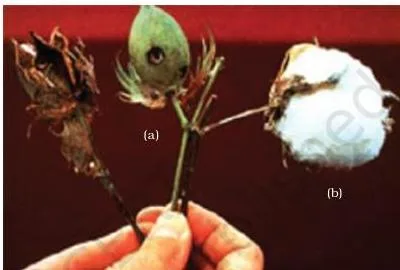
Figure 10.1 is a two-panel comparison. Panel (a) shows a cotton boll destroyed by bollworm feeding. Panel (b) shows a fully mature boll from a protected plant.
Between the two panels sits the point of Section 10.1: a Bt plant carries a cry gene, the bollworm ingests the protoxin, the insect’s alkaline gut activates it, and the pest dies before it can destroy the boll (NCERT, p. 180).
Reading Figure 10.2: RNAi protecting transgenic roots

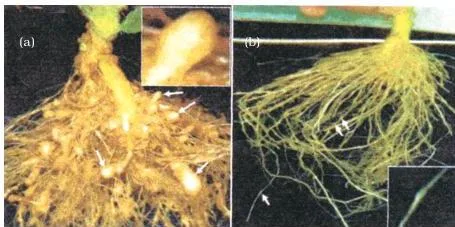
Figure 10.2 takes two photographs five days after deliberate nematode infection. Panel (a) shows the roots of a control plant, damaged by the parasite. Panel (b) shows the roots of a transgenic plant that generates dsRNA against the nematode’s mRNA; RNA interference silenced that mRNA, so the parasite could not survive and the roots remain healthy (NCERT, p. 181).
Reading Figure 10.3: where the C peptide is removed
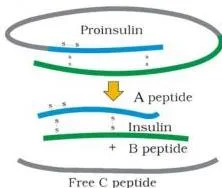
Figure 10.3 shows the maturation of pro-insulin into insulin. The prohormone is one chain with three parts: the stretch that becomes chain B, the extra C peptide, and the stretch that becomes chain A. During maturation the C peptide is removed, and the remaining A and B chains are linked by disulphide bridges into the active hormone.
That is exactly what Eli Lilly reproduced in E. coli in 1983 — producing the chains separately and joining them with disulphide bonds (NCERT, p. 182).
Key terms and definitions: a quick lookup table
The terms below are the ones that keep appearing in questions on this chapter, defined in plain words with the textbook page where each appears.
| Term | Plain definition | NCERT page |
|---|---|---|
| Explant | Any part of a plant removed and grown in a test tube on sterile nutrient medium. | p. 177 |
| Totipotency | The capacity of a cell or explant to regenerate a whole plant. | p. 177 |
| Micro-propagation | Producing thousands of plants from one explant through tissue culture. | p. 177 |
| Somaclones | Plants produced by micro-propagation that are genetically identical to the original plant. | p. 178 |
| Somatic hybridisation | Fusing protoplasts from two different plant varieties and growing the hybrid into a new plant. | pp. 178-179 |
| Genetically Modified Organisms (GMO) | Plants, bacteria, fungi or animals whose genes have been altered by manipulation. | p. 179 |
| Protoxin | The inactive form of Bt toxin, activated only in the insect’s alkaline gut. | p. 179 |
| cry genes | Bt toxin genes; cryIAc and cryIIAb control cotton bollworms, cryIAb controls the corn borer. | p. 180 |
| RNA interference (RNAi) | Silencing of a specific mRNA by a complementary dsRNA that binds and blocks its translation. | p. 180 |
| Prohormone / C peptide | Insulin’s inactive precursor; the extra C peptide stretch is removed during maturation. | pp. 181-182 |
| Gene therapy | Inserting a normal gene into a person’s cells and tissues to correct a gene defect. | p. 182 |
| Transgenic animals | Animals whose DNA is manipulated to possess and express an extra foreign gene. | p. 183 |
| GEAC | Genetic Engineering Approval Committee; the Indian body that vets GM research and GM organisms for public use. | p. 184 |
| Biopiracy | Using bio-resources without authorisation from the countries and people concerned and without compensation. | p. 185 |
Common mistakes students make in this chapter
A few points in this chapter invite confident wrong answers. The table names the mistake, gives the correct rule, and tells you how to check yourself.
| Mistake | Correct rule | How to check your answer |
|---|---|---|
| “Bt toxin kills the bacterium that produces it.” | The toxin is stored as an inactive protoxin and is activated only when the insect’s alkaline gut solubilises the crystals (NCERT, p. 179). | Exercise 4 asks exactly this — the correct option is “toxin is inactive”. |
| “Gene therapy permanently cures ADA deficiency.” | The lymphocyte version is not permanent: engineered lymphocytes are not immortal, so the patient needs periodic infusions (NCERT, pp. 182-183). | The chapter reserves “permanent cure” for gene insertion at early embryonic stages. |
| “Pomato is a genetically modified crop.” | Pomato is a somatic hybrid made by protoplast fusion between tomato and potato; no recombinant gene is transferred (NCERT, pp. 178-179). | Ask: was DNA from another organism introduced? Protoplast fusion is not genetic modification. |
| “cryIAb protects cotton.” | cryIAc and cryIIAb control cotton bollworms; cryIAb controls the corn borer (NCERT, p. 180). | Two cry genes for cotton, one for corn — match the crop named in the question. |
| “PCR detects the pathogen.” | PCR amplifies the pathogen’s nucleic acid, making a very low concentration detectable before symptoms appear (NCERT, p. 182). | Describe PCR as amplification first, detection second. |
Exam notes: revising this chapter without a formula sheet
The most useful observation about this chapter is that it contains no formulas and no numerical problems. Revision means learning mechanism sequences and definitions, not equations.
The chapter’s exercise set shows the question shapes it produces (NCERT, pp. 186-187):
- one multiple-choice question — why Bt crystals do not kill the bacterium (exercise 4);
- definition-and-example questions — transgenic bacteria, Cry proteins, gene therapy, micropropagation (exercises 5, 7, 8);
- reasoning questions — virus-free plants and the advantages of GM crops (exercises 1, 2, 6);
- open research tasks — removing oil from seeds, golden rice, blood proteases and nucleases, orally active protein pharmaceuticals (exercises 10 to 13).
Try the chapter’s own in-text question: could insulin be orally administered to diabetic patients, and why or why not (NCERT, p. 181)? It tests whether you can connect a protein drug’s structure to how it survives the body.
Here is a mnemonic for the cry genes: cotton takes two, corn takes one. cryIAc and cryIIAb are the two genes that control cotton bollworms; cryIAb, the single gene, controls the corn borer.
Remember that the chapter assumes the Chapter 9 toolbox — PCR, ELISA, vectors, recombinant DNA methods — so questions may borrow any of those techniques. Textbook contents and the examinable syllabus are not always identical, so check the current official CBSE syllabus before deciding what to study.
Recap: what to remember from this chapter
This recap follows the order of the chapter’s own Summary (NCERT, p. 186).
- Agriculture: GM crops raise yield, cut post-harvest losses, tolerate stresses and improve nutrition; Bt cotton and RNA interference are the two mechanisms you should be able to retell in sequence.
- Medicine: recombinant therapeutics match human proteins, so they avoid the immune responses animal products trigger — human insulin made in bacteria, gene therapy for ADA deficiency, and PCR and ELISA for early diagnosis.
- Transgenic animals: used as disease models, producers of biological products, and test subjects for vaccine and chemical safety.
- Ethics: genetic manipulation needs regulation through bodies such as GEAC, and the Basmati rice patent shows the danger of biopiracy.
Related resources
This listing is maintained for the 2026-27 academic session using the NCERT textbook information available to us. NCERT remains the authority for confirming the latest edition.
- Class 12 Biology NCERT book page — every chapter of the book, each with its official PDF and a section-by-section explanation.
- Class 12 hub — the NCERT books indexed for Class 12.
- Chapter 9, Biotechnology: Principles and Processes — the previous chapter, whose tools this chapter’s applications depend on.
- Chapter 11 — the next chapter in the Class 12 Biology book.
- Class 12 Biology notes on organisms and populations — revision notes for a later chapter in the same book.
- Class 12 Biology notes — revision notes for this subject.
- Class 12 hub notes — revision notes across Class 12 subjects.
- CBSE notes home — revision notes for other classes and subjects.
Sources and data verification
Reference: NCERT Class 12 Biology textbook, chapter 10, official edition on ncert.nic.in.
This page describes the NCERT Class 12 Biology textbook, Chapter 10 (Biotechnology and its Applications), as published on ncert.nic.in, and is maintained for the current academic session. Page numbers and figure captions refer to that edition.
NCERT settles textbook editions, chapter contents and official PDFs; CBSE settles the examinable curriculum and syllabus. Textbook contents and the examinable syllabus are not always identical, so students should check the current official syllabus before planning their study.
FAQs on Biotechnology and its Applications
Why does Bt toxin not kill the bacterium that produces it?
The toxin is stored as an inactive protoxin and is activated only when an insect’s alkaline gut solubilises the crystals, so the bacterium is never exposed to the active toxin (NCERT, p. 179).
Why is gene therapy for ADA deficiency not a one-time permanent cure?
In the first clinical gene therapy, the patient’s lymphocytes were engineered and returned to her, but those cells are not immortal. The patient needs periodic infusions of fresh engineered lymphocytes; a permanent cure would require gene insertion at early embryonic stages (NCERT, pp. 182-183).
Why is recombinant human insulin better than insulin from cattle and pigs?
Animal insulin is a foreign protein and caused some patients to develop allergies or other reactions. Recombinant human insulin is identical to the natural human molecule, so it does not trigger those unwanted immune responses (NCERT, pp. 181-182).
Which part of a virus-infected plant is used to make virus-free plants, and why?
The meristem — apical and axillary — remains virus-free even in an infected plant. Culturing the meristem in vitro therefore yields virus-free plants, as achieved for banana, sugarcane and potato (NCERT, p. 178).
What is GEAC and what does it do?
GEAC is the Genetic Engineering Approval Committee, set up by the Indian Government. It decides whether GM research is valid and whether GM organisms are safe to introduce for public services (NCERT, p. 184).
Why is the Basmati rice patent described as an example of biopiracy?
In 1997 an American company patented a Basmati variety derived from Indian farmer varieties, claimed it as a new invention, and restricted others from selling Basmati. Using India’s bio-resources without authorisation or compensation is exactly what biopiracy means (NCERT, p. 185).
Explore Class 12 Biology Books
- Previous: Biotechnology : Principles and Processes
- Next: Organisms and Populations
Class 12 Biology on LearnCBSE:
Related chapters: