
This page collects the Introduction to Three Dimensional Geometry Class 11 formulas you need for revision: the mutually perpendicular coordinate axes and coordinate planes, the eight octants and their sign patterns, the coordinates of a point in space, and the distance between two points — with its distance-from-origin special case and the centroid of a triangle.
Each formula is grouped by topic, with the meaning and unit of every symbol, a when-to-use line, original worked examples and chapter-specific mistakes. If you need the derivations and full explanations, they sit with the other quick-revision sheets in the Class 11 maths formulas collection.
Formulas at a Glance
Every formula on this page in one table. The meanings of the symbols are in the next section.
| Purpose | Formula |
|---|---|
| Distance between two points | \( PQ = \sqrt{(x_2-x_1)^2 + (y_2-y_1)^2 + (z_2-z_1)^2} \) |
| Squared distance (used in locus problems) | \( PQ^2 = (x_2-x_1)^2 + (y_2-y_1)^2 + (z_2-z_1)^2 \) |
| Distance of a point from the origin (special case with P = O) | \( OQ = \sqrt{x_2^2 + y_2^2 + z_2^2} \) |
| Point on the x-axis, y-axis or z-axis | \( (x,0,0),\quad (0,y,0),\quad (0,0,z) \) |
| Point in the XY-, YZ- or ZX-plane (from the definition of coordinates) | \( (x,y,0),\quad (0,y,z),\quad (x,0,z) \) |
| Signs of coordinates in octants I to VIII | \( (+,+,+),\ (-,+,+),\ (-,-,+),\ (+,-,+),\ (+,+,-),\ (-,+,-),\ (-,-,-),\ (+,-,-) \) |
| Collinearity of three points (application of the distance formula) | \( PQ + QR = PR \) |
| Right-angled triangle test (application) | \( a^2 + b^2 = c^2 \) |
| Equation of points equidistant from two fixed points (application) | \( PA = PB \) |
| Centroid of a triangle (from the chapter’s worked example) | \( G = \left( \frac{x_1+x_2+x_3}{3},\ \frac{y_1+y_2+y_3}{3},\ \frac{z_1+z_2+z_3}{3} \right) \) |
All Formulas, Grouped by Topic
Every formula here is grounded in the NCERT chapter, and the groups below follow the textbook’s own sub-topics (NCERT, sections 11.2–11.4 and the chapter Summary).
Coordinate Axes and Coordinate Planes
Space is described from a fixed point O, called the origin, through three mutually perpendicular lines: the x-axis (X’OX), the y-axis (Y’OY) and the z-axis (Z’OZ). Pairs of axes determine the three coordinate planes — the XY-plane, the YZ-plane and the ZX-plane (NCERT, p. 210).
The figure above is the everyday version of the coordinate system: the floor and two adjacent walls are three mutually perpendicular planes, so fixing the tip of a hanging bulb needs three distances — from two walls and from the floor (NCERT, p. 209). That is why a point in space needs three coordinates.
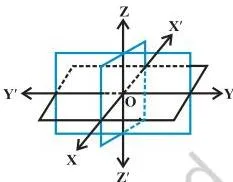
Fig 11.1 shows the abstract picture: the three planes cut one another at right angles at O, and the lines along which they meet are the axes (NCERT, p. 210). The coordinate planes divide space into eight parts, called octants.
- XY-plane: contains the x and y axes; any point in it has z = 0.
- YZ-plane: contains the y and z axes; any point in it has x = 0.
- ZX-plane: contains the z and x axes; any point in it has y = 0.
Coordinates of a Point in Space
For a point P(x, y, z), the coordinates are the perpendicular distances of P from the three coordinate planes: x from the YZ-plane, y from the ZX-plane and z from the XY-plane (NCERT, p. 211). Every point of space corresponds to exactly one ordered triplet (x, y, z), and every triplet gives exactly one point (NCERT, p. 210).
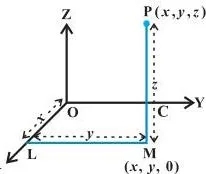
Fig 11.2 shows how the coordinates are read off: a perpendicular PM is dropped to the XY-plane at M, then ML is dropped to the x-axis at L. The segments OL, LM and MP give x, y and z respectively (NCERT, p. 210).
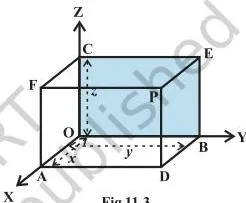
Equivalently, as in Fig 11.3, draw through P three planes parallel to the coordinate planes; they meet the axes at A, B and C with OA = x, OB = y and OC = z (NCERT, p. 211). Both constructions give the same triplet.
Coordinates of the origin and of points on the axes (NCERT, p. 216):
\[ O(0,0,0);\quad (x,0,0);\quad (0,y,0);\quad (0,0,z) \]
Points in the coordinate planes, from the definition of coordinates as plane distances (NCERT, p. 211):
\[ (x,y,0);\quad (0,y,z);\quad (x,0,z) \]
In the XY-plane the distance from the XY-plane is zero, so z = 0; in the YZ-plane x = 0; in the ZX-plane y = 0.
Signs of Coordinates in the Eight Octants
The signs of x, y and z decide the octant. Octant I is the region where all three coordinates are positive; crossing a coordinate plane flips the sign of one coordinate, which gives 2 × 2 × 2 = 8 octants (NCERT, p. 210).
| Octant | Signs of (x, y, z) |
|---|---|
| I | \( (+,+,+) \) |
| II | \( (-,+,+) \) |
| III | \( (-,-,+) \) |
| IV | \( (+,-,+) \) |
| V | \( (+,+,-) \) |
| VI | \( (-,+,-) \) |
| VII | \( (-,-,-) \) |
| VIII | \( (+,-,-) \) |
The octants are named XOYZ, X’OYZ, X’OY’Z, XOY’Z, XOYZ’, X’OYZ’, X’OY’Z’, XOY’Z’ in the order I to VIII (NCERT, p. 210). The sign pattern is the main thing to remember; check it against NCERT’s Table 11.1 (p. 211).
Distance between Two Points
The distance formula is Pythagoras’ theorem applied twice. A rectangular box is drawn with PQ as one diagonal; a right triangle in the horizontal plane gives one horizontal length, and a second right triangle then gives the full diagonal (NCERT, p. 212).
\[ PQ = \sqrt{(x_2-x_1)^2 + (y_2-y_1)^2 + (z_2-z_1)^2} \]
The squared form is what the derivation produces directly (NCERT, p. 212):
\[ PQ^2 = (x_2-x_1)^2 + (y_2-y_1)^2 + (z_2-z_1)^2 \]
Use the squared form when a problem states a condition on squared distances, as in \( PA^2 + PB^2 = 2k^2 \) (NCERT, Example 6, p. 213).
When P is the origin, \( x_1 = y_1 = z_1 = 0 \), and the formula becomes the distance of a point Q from O (NCERT, p. 212):
\[ OQ = \sqrt{x_2^2 + y_2^2 + z_2^2} \]
Applications of the Distance Formula
Collinearity test. Three points P, Q, R are collinear when the longest of the three distances equals the sum of the other two:
\[ PQ + QR = PR \]
The chapter shows this for P(-2, 3, 5), Q(1, 2, 3) and R(7, 0, -1), where \( PQ + QR = PR \) exactly (NCERT, Example 4, p. 213).
Right-angle test. A triangle with side lengths a, b and c is right-angled when the square of the longest side equals the sum of the squares of the other two:
\[ a^2 + b^2 = c^2 \]
This is the converse of Pythagoras’ theorem, applied after computing the three side lengths (NCERT, Example 5, p. 213).
Equal distances. To find the equation of the set of points equidistant from two fixed points A and B, write \( PA = PB \), square both sides and simplify:
\[ PA = PB \]
The result is a linear equation in x, y and z, as in the chapter’s Example 8 (NCERT, p. 215).
Centroid of a Triangle
The centroid G is the mean of the three vertices, so each coordinate of G is the average of the corresponding coordinates of A, B and C. The chapter uses this form in its worked example (NCERT, Example 9, p. 215).
\[ G = \left( \frac{x_1+x_2+x_3}{3},\ \frac{y_1+y_2+y_3}{3},\ \frac{z_1+z_2+z_3}{3} \right) \]
where A(x₁, y₁, z₁), B(x₂, y₂, z₂) and C(x₃, y₃, z₃) are the vertices.
What Each Symbol Means
Meanings and units of every symbol used on this sheet. Coordinates and distances are lengths in the same chosen unit on all three axes.
| Symbol | What it means | Unit / nature |
|---|---|---|
| \( (x,y,z) \) | Coordinates of a point P in space: perpendicular distances from the YZ-, ZX- and XY-planes respectively | Length |
| \( x_1, y_1, z_1 \) | Coordinates of the first point P | Length |
| \( x_2, y_2, z_2 \) | Coordinates of the second point Q | Length |
| \( O \) | Origin of the coordinate system, with coordinates \( (0,0,0) \) | Coordinates are lengths |
| \( PQ, PA, PB, OQ \) | Distances between the named pairs of points | Length (same unit as the coordinates) |
| \( G \) | Centroid of triangle ABC | Coordinates are lengths |
| \( (x,0,0), (0,y,0), (0,0,z) \) | Point on the x-axis, y-axis or z-axis; the zero entries are exact zeros | The one varying coordinate is a length |
| \( a, b, c \) | Side lengths of a triangle, with c the longest side (right-angle test) | Length |
| Octant | One of the eight regions into which the three coordinate planes divide space | Count (dimensionless) |
| \( XY, YZ, ZX \) planes | The three coordinate planes, each determined by a pair of axes | Geometric plane (no unit) |
When to Use Each Formula
Guidance on when each formula is used, with the conditions that must hold for it to apply.
| Formula | When to use it |
|---|---|
| \( PQ = \sqrt{(x_2-x_1)^2 + (y_2-y_1)^2 + (z_2-z_1)^2} \) | Whenever two points are given and you need the distance between them — valid for any two points in space without restriction. |
| \( PQ^2 = (x_2-x_1)^2 + (y_2-y_1)^2 + (z_2-z_1)^2 \) | A condition is stated in squared distances, e.g. \( PA^2 + PB^2 = k^2 \); squaring avoids the square root. |
| \( OQ = \sqrt{x_2^2 + y_2^2 + z_2^2} \) | One of the two points is the origin \( O(0,0,0) \). It is the distance formula with \( x_1 = y_1 = z_1 = 0 \). |
| \( (x,0,0), (0,y,0), (0,0,z) \) | Writing the coordinates of a point on the x-, y- or z-axis: the two coordinates not named by the axis are zero. |
| \( (x,y,0), (0,y,z), (x,0,z) \) | A point lies in one of the coordinate planes: the coordinate that measures the distance from that plane is zero. |
| Octant sign patterns | Naming the octant of a given point: compare the signs of its coordinates with the table. |
| \( PQ + QR = PR \) | Deciding whether three points are collinear: compute the three distances, then check whether the largest equals the sum of the other two. |
| \( a^2 + b^2 = c^2 \) | Checking whether a triangle formed by three points is right-angled: compare the square of the longest side with the sum of the squares of the other two. |
| \( PA = PB \) | Finding the equation of the set of points equidistant from two fixed points A and B: set the distances equal, square, simplify. |
| Centroid formula | All three vertices of a triangle are known and you need G, or G and two vertices are known and you need the third vertex. |
Worked Examples
Three worked examples using original numbers (not the textbook’s values) show how to select and apply the formulas.
Worked Example 1: Distance between two points using the distance formula
Step 1: Identify the two points.
Take \( P(2, -1, 3) \) and \( Q(4, 3, -1) \), so \( (x_1, y_1, z_1) = (2, -1, 3) \) and \( (x_2, y_2, z_2) = (4, 3, -1) \).
Step 2: Use the distance formula:
\[ PQ = \sqrt{(x_2-x_1)^2 + (y_2-y_1)^2 + (z_2-z_1)^2} \]
Step 3: Substitute each pair of coordinates, keeping the brackets:
\[ PQ = \sqrt{(4-2)^2 + (3-(-1))^2 + (-1-3)^2} = \sqrt{2^2 + 4^2 + (-4)^2} \]
\[ = \sqrt{4 + 16 + 16} = \sqrt{36} = 6 \]
Final answer: \( PQ = 6 \) units.
Quick check: distance of Q from the origin — \( OQ = \sqrt{4^2 + 3^2 + (-1)^2} = \sqrt{26} \approx 5.10 \) units.
Worked Example 2: Finding the third vertex from the centroid
Step 1: Let the centroid of triangle ABC be \( G(-1, 2, -3) \), with \( A(2, -3, 4) \), \( B(-4, 5, -6) \) and \( C(x, y, z) \).
The centroid is the mean of the three vertices:
\[ G = \left( \frac{x_1+x_2+x_3}{3},\ \frac{y_1+y_2+y_3}{3},\ \frac{z_1+z_2+z_3}{3} \right) \]
- Step 1: Equate the x-coordinate: \( (x + 2 – 4)/3 = -1 \), so \( x – 2 = -3 \) and \( x = -1 \).
- Step 2: Equate the y-coordinate: \( (y – 3 + 5)/3 = 2 \), so \( y + 2 = 6 \) and \( y = 4 \).
- Step 3: Equate the z-coordinate: \( (z + 4 – 6)/3 = -3 \), so \( z – 2 = -9 \) and \( z = -7 \).
Final answer: \( C(-1, 4, -7) \). Check: \( (-1+2-4)/3 = -1 \), \( (4-3+5)/3 = 2 \), \( (-7+4-6)/3 = -3 \).
Worked Example 3: Equation of points equidistant from two fixed points
Step 1: Let \( P(x, y, z) \) be a point with \( PA = PB \), where \( A(1, 2, -1) \) and \( B(3, -2, 5) \).
Write the equal-distance condition using the distance formula:
\[ \sqrt{(x-1)^2 + (y-2)^2 + (z+1)^2} = \sqrt{(x-3)^2 + (y+2)^2 + (z-5)^2} \]
Step 2: Both sides are non-negative, so squaring is safe.
Square both sides and expand:
\[ (x-1)^2 + (y-2)^2 + (z+1)^2 = (x-3)^2 + (y+2)^2 + (z-5)^2 \]
\[ x^2-2x+1 + y^2-4y+4 + z^2+2z+1 = x^2-6x+9 + y^2+4y+4 + z^2-10z+25 \]
Step 3: Cancel \( x^2, y^2, z^2 \) and collect terms:
\[ -2x – 4y + 2z + 6 = -6x + 4y – 10z + 38 \]
\[ 4x – 8y + 12z – 32 = 0 \]
Step 4: Divide by 4 to simplify:
\[ x – 2y + 3z – 8 = 0 \]
Final answer: \( x – 2y + 3z – 8 = 0 \). Check: the midpoint of AB, \( (2, 0, 2) \), satisfies \( 2 – 0 + 6 – 8 = 0 \).
Practice the same formulas on the textbook’s own questions in Exercises 11.1 and 11.2 and the Miscellaneous Exercise. The maths formulas index lists every Class 11 chapter’s formula sheet.
Common Mistakes to Avoid
Chapter-specific common mistakes in applying these formulas, each with the correction and a check you can run on your own answer.
| Mistake | Correct rule | How to check your answer |
|---|---|---|
| Using the 2D distance formula and leaving out the z-term: \( \sqrt{(x_2-x_1)^2 + (y_2-y_1)^2} \) | Always take all three squared differences: \( \sqrt{(x_2-x_1)^2 + (y_2-y_1)^2 + (z_2-z_1)^2} \). | Write the three differences \( x_2-x_1 \), \( y_2-y_1 \), \( z_2-z_1 \) separately before squaring — you must get three terms. |
| Losing a minus sign when a coordinate is negative, e.g. writing \( 3-1 \) instead of \( 3-(-1) \). | Write every difference as (second coordinate) − (first coordinate) with brackets; squaring removes the order of the points but not the sign of the coordinates. | Recompute with the two points swapped — the distance must be identical. |
| Putting the zero in the wrong slot: a point on the x-axis written as \( (0, x, 0) \) or \( (x, y, 0) \). | On the x-axis only x varies: \( (x, 0, 0) \); on the y-axis \( (0, y, 0) \); on the z-axis \( (0, 0, z) \). | A zero coordinate places the point in the plane with that coordinate’s name: z = 0 means the XY-plane. |
| Carrying 2D quadrant signs into 3D, e.g. calling \( (-,-,+) \) octant II. | Octant II is \( (-,+,+) \); use the full octant sign table (NCERT, Table 11.1, p. 211). | Test with a known point: \( (-3,1,2) \) is octant II and \( (-3,1,-2) \) is octant VI (NCERT, Example 2, p. 211). |
| Expanding squared brackets wrongly in locus problems: \( (x-3)^2 \) written as \( x^2-9 \). | Use the identity \( (a-b)^2 = a^2 – 2ab + b^2 \). | Substitute a point that must lie on the set — the midpoint of the two fixed points — into your final equation; it must satisfy it. |
Frequently Asked Questions
Which Introduction to Three Dimensional Geometry Class 11 formulas should I memorise first?
Memorise the distance formula and its distance-from-origin special case first — they do most of the work in the exercises. Next come the coordinate forms of points on the axes and in the coordinate planes, then the octant sign pattern.
The centroid formula and the collinearity, right-angle and equal-distance tests all follow from the same ideas, so they are easier to recall once the distance formula is fixed.
Do I need to learn the names of all eight octants?
You need the order of the sign patterns. To name the octant of a point, compare the signs of its coordinates with the table: octant I is \( (+,+,+) \), octant II is \( (-,+,+) \), and so on.
The names XOYZ, X’OYZ, X’OY’Z, XOY’Z, XOYZ’, X’OYZ’, X’OY’Z’, XOY’Z’ follow the same order I to VIII (NCERT, p. 210), but the sign table is what exam questions actually use.
What is the quickest way to prove that three points are collinear or that a triangle is right-angled in 3D?
Compute the three distances with the distance formula. For collinearity, check whether the largest distance equals the sum of the other two — the chapter does exactly this in Example 4 (NCERT, p. 213). For a right angle, check whether the square of the longest side equals the sum of the squares of the other two, as in Example 5 (NCERT, p. 213).
What does “equation of the set of points” mean in this chapter?
It asks for the relation satisfied by the coordinates \( (x, y, z) \) of a variable point P. Apply the distance formula to the given condition — for example \( PA = PB \), or \( PA^2 + PB^2 = k^2 \) — then simplify the algebra into one equation in x, y and z. The chapter’s Examples 6 and 8 show both types (NCERT, pp. 213 and 215).
All formulas above follow the Rationalised NCERT Class 11 Mathematics textbook. You can check them against the official chapter PDF on the NCERT website.
Reference: NCERT Class 11 Mathematics textbook, chapter Introduction to Three Dimensional Geometry.
Explore Class 11 Maths Formulas
More for this chapter:
Class 11 Maths on LearnCBSE:
Related chapters: