
Need the Limits and Derivatives Class 11 formulas in one place? This sheet covers the limits side — left and right hand limits, the algebra of limits, polynomial and rational-function limits, and the standard trigonometric limits — and the derivatives side — the first-principle definition, the sum, product and quotient rules, and the derivatives of standard functions.
Every entry gives the meaning of each symbol, the condition under which the formula holds, and a one-line note on when to use it. Original worked examples and the chapter’s common mistakes follow. For the reasoning behind the rules, work through the NCERT chapter; for the wider set, keep the Class 11 maths formulas hub beside you.
Formulas at a Glance
| Purpose | Formula |
|---|---|
| Limit of a function (exists when the one-sided limits are equal) | \( \lim_{x \to a} f(x) = l \) |
| Sum or difference of limits | \( \lim_{x \to a}[f(x) \pm g(x)] = \lim_{x \to a} f(x) \pm \lim_{x \to a} g(x) \) |
| Product of limits | \( \lim_{x \to a}[f(x) \cdot g(x)] = \lim_{x \to a} f(x) \cdot \lim_{x \to a} g(x) \) |
| Quotient of limits (denominator limit non-zero) | \( \lim_{x \to a}\frac{f(x)}{g(x)} = \frac{\lim_{x \to a} f(x)}{\lim_{x \to a} g(x)} \) |
| Constant multiple of a limit | \( \lim_{x \to a}[\lambda f(x)] = \lambda \lim_{x \to a} f(x) \) |
| Limit of a power of x | \( \lim_{x \to a} x^n = a^n \) |
| Limit of a polynomial (substitute the point) | \( \lim_{x \to a} f(x) = f(a) \) |
| Limit of a rational function (denominator non-zero at the point) | \( \lim_{x \to a}\frac{g(x)}{h(x)} = \frac{g(a)}{h(a)} \) |
| Standard limit for a difference of like powers | \( \lim_{x \to a}\frac{x^n – a^n}{x – a} = n a^{n-1} \) |
| Standard limit: sine over its angle (x in radians) | \( \lim_{x \to 0}\frac{\sin x}{x} = 1 \) |
| Standard limit: 1 minus cos x over x | \( \lim_{x \to 0}\frac{1 – \cos x}{x} = 0 \) |
| Derived: tangent over x (from the sine limit) | \( \lim_{x \to 0}\frac{\tan x}{x} = 1 \) |
| Sandwich theorem: equal outer limits force the middle limit | \( f(x) \le g(x) \le h(x),\; \lim_{x \to a} f(x) = \lim_{x \to a} h(x) = l \Rightarrow \lim_{x \to a} g(x) = l \) |
| Derivative of f at a point a | \( f'(a) = \lim_{h \to 0}\frac{f(a+h) – f(a)}{h} \) |
| Derivative function from first principles | \( f'(x) = \lim_{h \to 0}\frac{f(x+h) – f(x)}{h} \) |
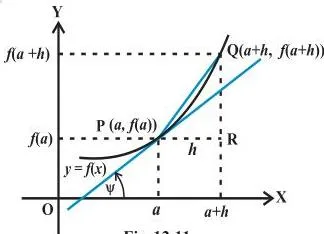
| Slope of the tangent at a point | \( f'(a) = \tan \psi \) |
| Sum or difference rule | \( (u \pm v)’ = u’ \pm v’ \) |
| Product rule (Leibnitz rule) | \( (uv)’ = u’v + uv’ \) |
| Quotient rule (denominator non-zero) | \( \left(\frac{u}{v}\right)’ = \frac{u’v – uv’}{v^2} \) |
| Power rule | \( \frac{d}{dx}(x^n) = n x^{n-1} \) |
| Derivative of a constant | \( \frac{d}{dx}(c) = 0 \) |
| Derivative of sine | \( \frac{d}{dx}(\sin x) = \cos x \) |
| Derivative of cosine | \( \frac{d}{dx}(\cos x) = -\sin x \) |
| Derivative of tangent | \( \frac{d}{dx}(\tan x) = \sec^2 x \) |
| Derivative of cotangent | \( \frac{d}{dx}(\cot x) = -\cosec^2 x \) |
| Derivative of 1 over x (from first principles) | \( \frac{d}{dx}\left(\frac{1}{x}\right) = -\frac{1}{x^2} \) |
| Derivative of a polynomial | \( \frac{d}{dx}(a_n x^n + a_{n-1}x^{n-1} + \cdots + a_1 x + a_0) = n a_n x^{n-1} + (n-1)a_{n-1}x^{n-2} + \cdots + a_1 \) |
All Formulas, Grouped by Topic
Grouped under the same sub-topics as the chapter. Results that are derived in worked examples rather than stated as boxed theorems are labelled ‘derived’. Formulas follow the Rationalised NCERT Class 11 Mathematics textbook; you can verify any expression against the chapter PDF on the official NCERT site.
Limits
As x moves towards a from the left, the values of f may push towards one number; from the right, possibly another. The left hand limit and right hand limit record these two one-sided behaviours:
\[ \lim_{x \to a^-} f(x) \quad \text{(left hand limit)} \qquad \lim_{x \to a^+} f(x) \quad \text{(right hand limit)} \]
The limit of f at a exists exactly when the two one-sided limits exist and are equal:
\[ \lim_{x \to a^-} f(x) = \lim_{x \to a^+} f(x) = l \quad \Rightarrow \quad \lim_{x \to a} f(x) = l \]
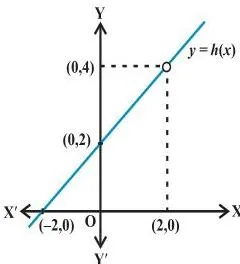
Notice that the limit does not need the function to be defined at a. The graph of \( y = \frac{x^2-4}{x-2} \) below shows a function with a missing point at x = 2 — the limit is still 4.
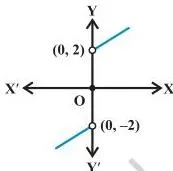
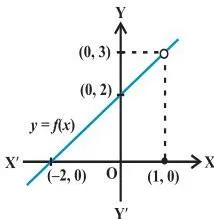
Two defining situations to recognise: when the one-sided limits differ, the limit does not exist (Fig 12.6); and a limit can exist even when it disagrees with the function value (Fig 12.7).
Algebra of Limits
When both limits exist, the limiting process respects the four basic operations (NCERT, p. 228):
\[ \lim_{x \to a}[f(x) \pm g(x)] = \lim_{x \to a} f(x) \pm \lim_{x \to a} g(x) \]
\[ \lim_{x \to a}[f(x) \cdot g(x)] = \lim_{x \to a} f(x) \cdot \lim_{x \to a} g(x) \]
\[ \lim_{x \to a}\frac{f(x)}{g(x)} = \frac{\lim_{x \to a} f(x)}{\lim_{x \to a} g(x)}, \quad \lim_{x \to a} g(x) \neq 0 \]
A constant factor is a special case of the product law:
\[ \lim_{x \to a}[\lambda f(x)] = \lambda \lim_{x \to a} f(x) \]
Limits of Polynomials and Rational Functions
For a polynomial, substitution is enough — the limit equals the value of the polynomial at that point:
\[ \lim_{x \to a} x^n = a^n, \qquad \lim_{x \to a} f(x) = f(a) \]
For a rational function \( f(x) = \frac{g(x)}{h(x)} \) with \( h(x) \neq 0 \), substitute first. If the denominator is non-zero at a, the limit is the quotient of the values:
\[ \lim_{x \to a}\frac{g(x)}{h(x)} = \frac{g(a)}{h(a)}, \quad h(a) \neq 0 \]
A 0/0 result means ‘not yet evaluated’: factor the common factor (x minus a) out of both polynomials, cancel, and substitute again. If the denominator vanishes while the numerator does not, the limit does not exist.
The standard limit below handles the equal-powers pattern in one step (NCERT, p. 233):
\[ \lim_{x \to a}\frac{x^n – a^n}{x – a} = n a^{n-1}, \quad n \text{ a positive integer; also any rational } n \text{ with } a \gt 0 \]
Limits of Trigonometric Functions
The two standard trigonometric limits, with x measured in radians (NCERT, p. 235):
\[ \lim_{x \to 0}\frac{\sin x}{x} = 1, \qquad \lim_{x \to 0}\frac{1 – \cos x}{x} = 0 \]
The first is proved by sandwiching \( \frac{\sin x}{x} \) between \( \cos x \) and 1:
\[ \cos x \lt \frac{\sin x}{x} \lt 1 \quad \text{for } 0 \lt |x| \lt \frac{\pi}{2} \]
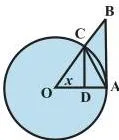
The chain \( \sin x \lt x \lt \tan x \) behind that inequality comes from comparing the areas of the triangle, sector and larger triangle in Fig 12.10; the second limit uses \( 1 – \cos x = 2\sin^2\frac{x}{2} \).
Sandwich theorem: if g is trapped between two functions whose limits agree, its limit is forced to the same value:
\[ f(x) \le g(x) \le h(x) \quad \text{and} \quad \lim_{x \to a} f(x) = \lim_{x \to a} h(x) = l \quad \Rightarrow \quad \lim_{x \to a} g(x) = l \]
Derived from \( \frac{\sin x}{x} = 1 \) by writing \( \tan x = \frac{\sin x}{\cos x} \):
\[ \lim_{x \to 0}\frac{\tan x}{x} = 1 \]
Derivatives
The distance-time curve in Fig 12.1 is the motivating picture: average velocities over shrinking time intervals approach the slope of the tangent — that limiting slope is the derivative.
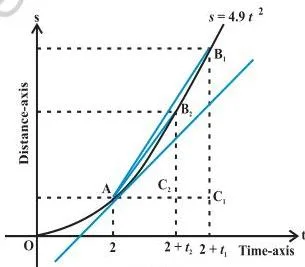
The derivative of f at a point a is the rate of change of f at a, defined as the limit (NCERT, p. 240):
\[ f'(a) = \lim_{h \to 0}\frac{f(a+h) – f(a)}{h} \]
The same limit written at a general point x is the first-principle definition (NCERT, p. 242):
\[ f'(x) = \lim_{h \to 0}\frac{f(x+h) – f(x)}{h} \]
Usual notations: \( f'(x) \), \( \frac{df}{dx} \), \( \frac{dy}{dx} \) when \( y = f(x) \), and \( D(f(x)) \). The geometric meaning: f'(a) is the slope of the tangent at P, so \( f'(a) = \tan \psi \) (NCERT, p. 242).
Algebra of Derivatives
Let \( u = f(x) \) and \( v = g(x) \). The sum, product and quotient rules (NCERT, p. 244):
\[ (u \pm v)’ = u’ \pm v’ \]
\[ (uv)’ = u’v + uv’ \quad \text{(product rule / Leibnitz rule)} \]
\[ \left( \frac{u}{v} \right)’ = \frac{u’v – uv’}{v^2} \quad \text{(quotient rule, } v \neq 0 \text{ at the point)} \]
Derivatives of Standard Functions
Power rule and the polynomial rule (NCERT, p. 245):
\[ \frac{d}{dx}(x^n) = n x^{n-1} \]
\[ \frac{d}{dx}\left( a_n x^n + a_{n-1}x^{n-1} + \cdots + a_1 x + a_0 \right) = n a_n x^{n-1} + (n-1)a_{n-1}x^{n-2} + \cdots + a_1 \]
The standard derivatives collected in the chapter summary (NCERT, p. 255), with the tangent and cotangent results from the worked examples:
\[ \frac{d}{dx}(c) = 0 \quad (c \text{ constant; Example 11}), \qquad \frac{d}{dx}(\sin x) = \cos x, \qquad \frac{d}{dx}(\cos x) = -\sin x \]
\[ \frac{d}{dx}(\tan x) = \sec^2 x \quad \text{(Example 17)}, \qquad \frac{d}{dx}(\cot x) = -\cosec^2 x \quad \text{(Example 21)} \]
\[ \frac{d}{dx}\left( \frac{1}{x} \right) = -\frac{1}{x^2} \quad \text{(Example 12)} \]
What Each Symbol Means
| Symbol | What it means | Unit / nature |
|---|---|---|
| \( x \) | The independent variable of the function | Real number |
| \( a \) | The point that x approaches (in limits) or at which the derivative is evaluated | Real number |
| \( h \) | Small increment in x in the definition of the derivative; h approaches 0 with h not equal to 0 | Real number |
| \( f, g, h, u, v \) | Real-valued functions of x | Real numbers |
| \( l \) | The limiting value that f(x) approaches | Real number |
| \( \lambda \) | A fixed real constant multiplying a function | Real number |
| \( n \) | Exponent in the power limit and the power rule | Positive integer (any real power in the power rule) |
| \( a_0, a_1, \ldots, a_n \) | Coefficients of a polynomial | Real numbers |
| \( f'(x), \frac{dy}{dx}, \frac{d}{dx}(f(x)) \) | Derivative of f with respect to x — the rate of change of f at x | Rate of change (a real number) |
| \( \psi \) | Angle the tangent to the curve y = f(x) makes with the x-axis | Radians |
| \( \sin x, \cos x, \tan x, \cot x, \sec x, \cosec x \) | Trigonometric functions of the angle x | Dimensionless ratios; x in radians |
When to Use Each Formula
| Formula or rule | Use it when |
|---|---|
| \( \lim_{x \to a} f(x) \) with one-sided limits | A question asks whether a limit exists, especially for a piecewise function. The limit exists only when both one-sided limits exist and are equal. |
| Algebra of limits | You want to split a sum, product or quotient into simpler limits. Both limits must exist; the quotient law also needs the denominator limit non-zero. |
| \( \lim_{x \to a} f(x) = f(a) \) | f is a polynomial. Just substitute the point a — no factoring. |
| \( \lim_{x \to a}\frac{g(x)}{h(x)} = \frac{g(a)}{h(a)} \) | f is a rational function and the denominator is non-zero at a. Substitute directly. |
| Factor and cancel | Substitution gives 0/0. Factor (x minus a) out of numerator and denominator, cancel, then substitute again. |
| \( \lim_{x \to a}\frac{x^n – a^n}{x – a} = n a^{n-1} \) | You meet exactly this pattern of equal powers over the difference of bases, or a substitution can create it. n a positive integer; also rational n with a positive. |
| \( \lim_{x \to 0}\frac{\sin x}{x} = 1 \) | A trigonometric limit of the 0/0 type. x must be in radians; rescale so the sine’s angle matches the denominator. |
| \( \lim_{x \to 0}\frac{1 – \cos x}{x} = 0 \) | A 0/0 limit containing \( 1 – \cos x \). Use the identity \( 1 – \cos x = 2\sin^2\frac{x}{2} \). |
| Sandwich theorem | g(x) is trapped between two functions whose limits are equal — then g has that same limit. |
| \( f'(a) = \lim_{h \to 0}\frac{f(a+h)-f(a)}{h} \) | The question says ‘from first principle’, or asks for the derivative at a point using the definition. During the limit, h is not zero. |
| Product rule \( (uv)’ = u’v + uv’ \) | Differentiating a product of two functions. |
| Quotient rule \( \left(\frac{u}{v}\right)’ = \frac{u’v – uv’}{v^2} \) | Differentiating a quotient of two functions; the denominator is non-zero at the point. |
| Power rule and standard derivatives | Differentiating \( x^n \), \( \sin x \), \( \cos x \), \( \tan x \), \( \cot x \) directly, without limits. |
Worked Examples
Example 1: Evaluate the limit of sin 5x over 3x as x tends to 0
Step 1: Substituting x = 0 gives the 0/0 form, so use the standard limit \( \lim_{x \to 0}\frac{\sin x}{x} = 1 \).
The angle here is 5x, so match 5x in the denominator.
\[ \lim_{x \to 0}\frac{\sin 5x}{3x} = \lim_{x \to 0}\left( \frac{5}{3} \cdot \frac{\sin 5x}{5x} \right) \]
Step 2: Pull the constant out using the constant-multiple law and apply the sine limit with the angle 5x (as x tends to 0, 5x also tends to 0).
\[ = \frac{5}{3} \cdot \lim_{x \to 0}\frac{\sin 5x}{5x} = \frac{5}{3} \cdot 1 = \frac{5}{3} \]
Final answer: \( \frac{5}{3} \).
Example 2: Evaluate the limit of (x cubed minus 8) over (x minus 2) as x tends to 2
Step 1: Substituting x = 2 gives (8 minus 8) over (2 minus 2), the 0/0 form.
Recognise the standard pattern with a = 2 and n = 3.
Step 2: Apply the standard limit formula \( \lim_{x \to a}\frac{x^n – a^n}{x – a} = n a^{n-1} \):
\[ \lim_{x \to 2}\frac{x^3 – 8}{x – 2} = 3(2)^{3-1} = 3 \cdot 4 = 12 \]
Step 3 (check by factoring): \( x^3 – 8 = (x-2)(x^2+2x+4) \), so cancel \( x-2 \) (valid because x is not equal to 2 while taking the limit) and substitute:
\[ \lim_{x \to 2}(x^2 + 2x + 4) = 4 + 4 + 4 = 12 \]
Final answer: 12.
Example 3: Find the derivative of f(x) = 4x squared at x = 3 from first principles
Step 1: Write the first-principle definition at a = 3:
\[ f'(3) = \lim_{h \to 0}\frac{f(3+h) – f(3)}{h}, \quad f(3+h) = 4(3+h)^2, \quad f(3) = 36 \]
Step 2: Expand the numerator:
\[ = \lim_{h \to 0}\frac{4(9 + 6h + h^2) – 36}{h} = \lim_{h \to 0}\frac{24h + 4h^2}{h} \]
Step 3: During the limit h is not zero, so cancel h:
\[ = \lim_{h \to 0}(24 + 4h) = 24 \]
Final answer: \( f'(3) = 24 \), the slope of the tangent to \( y = 4x^2 \) at x = 3. Quick check: the power rule gives \( f'(x) = 8x \), so \( f'(3) = 8(3) = 24 \).
For limits and derivatives in any other chapter, the master maths formula index links every formula sheet on the site.
Common Mistakes to Avoid
These are the slips that show up most often when this chapter’s formulas are applied.
| Mistake | Correct rule | How to check your answer |
|---|---|---|
| Assuming the limit must equal the function value at the point. | The limit is decided by values of f near a; f(a) may differ from it or be undefined. | NCERT Illustration 10: f(1) = 0, but the limit at 1 is 3. |
| Using the sine limit with the angle in degrees. | \( \lim_{x \to 0}\frac{\sin x}{x} = 1 \) holds for radians. | At x = 0.1 rad the ratio is about 0.998, close to 1; in degrees the ratio is about 0.017. |
| Stopping at 0/0 and writing ‘does not exist’. | 0/0 means factor and cancel the common factor first; the limit may exist. | \( \frac{x^2-4}{x-2} = x+2 \) for x not equal to 2, so the limit at 2 is 4. |
| Writing \( (uv)’ = u’v’ \). | Product rule: \( (uv)’ = u’v + uv’ \). | Put u = v = x: the rule must give 2x, not 1. |
| Reversing the numerator in the quotient rule. | \( \left(\frac{u}{v}\right)’ = \frac{u’v – uv’}{v^2} \), not the other order. | With u = 1, v = x the rule gives \( -\frac{1}{x^2} \), matching the known derivative of 1 over x. |
| Forgetting the minus sign in the derivative of cos x. | \( \frac{d}{dx}(\cos x) = -\sin x \). | cos x is decreasing near 0, so its slope there is negative. |
Frequently Asked Questions
When does a limit not exist?
The common cases: the left hand limit and right hand limit differ, or one of them is not a finite value. For a rational function, if the denominator vanishes at a while the numerator does not, the limit does not exist. A 0/0 form is not automatically a non-existent limit — factor and cancel first.
Is the limit always equal to the value of the function?
No. The limit is fixed by values of f near a, not at a. It can exist when f(a) is undefined — see the rational function in Fig 12.2 — and it can disagree with the function value: in Fig 12.7, f(1) = 0 while the limit at 1 is 3.
What does ‘from first principle’ mean in derivative questions?
It means using the definition \( f'(x) = \lim_{h \to 0}\frac{f(x+h) – f(x)}{h} \) directly instead of the power, product or quotient rules. You substitute the given function, simplify the quotient, let h tend to 0, and read off the derivative.
Does the power rule work for negative and fractional powers?
The chapter proves \( \frac{d}{dx}(x^n) = n x^{n-1} \) for positive integers and notes the result holds for any real power.
The corresponding limit \( \lim_{x \to a}\frac{x^n – a^n}{x – a} = n a^{n-1} \) also holds for rational n when a is positive — this is how the NCERT example evaluates \( \lim_{x \to 0}\frac{\sqrt{1+x} – 1}{x} \).
Reference: NCERT Class 11 Mathematics textbook, chapter Limits and Derivatives.
Explore Class 11 Maths Formulas
More for this chapter:
Class 11 Maths on LearnCBSE:
Related chapters:
Official source: download the NCERT textbook free from ncert.nic.in.