
Revising Complex Numbers and Quadratic Equations? This sheet covers the complex numbers and quadratic equations class 11 formulas this chapter presents: the standard form \( z = a + ib \), its real and imaginary parts, addition, multiplication, division, powers of \( i \), square roots of negative numbers, the modulus, the conjugate, and the Argand-plane distance picture.
Each formula is grouped exactly as the textbook groups it. Below you get the meaning and type of every symbol, a when-to-use decision table, worked examples with original numbers, and the mistakes students make while applying these formulas. To switch chapters while revising, use the Class 11 maths formulas page or return to the maths formulas index.
Formulas at a Glance
| Purpose | Formula |
|---|---|
| Standard form of a complex number, with its real and imaginary parts | \( z = a + ib,\quad \operatorname{Re} z = a,\quad \operatorname{Im} z = b \) |
| Imaginary unit | \( i = \sqrt{-1},\quad i^2 = -1 \) |
| Equality of two complex numbers | \( a + ib = c + id \iff a = c \quad \text{and}\quad b = d \) |
| Addition | \( (a + ib) + (c + id) = (a + c) + i(b + d) \) |
| Subtraction (derived from \( z_1 – z_2 = z_1 + (-z_2) \)) | \( (a + ib) – (c + id) = (a – c) + i(b – d) \) |
| Multiplication | \( (a + ib)(c + id) = (ac – bd) + i(ad + bc) \) |
| Multiplicative inverse, when \( z \neq 0 \) | \( z^{-1} = \frac{a}{a^2+b^2} + i\frac{-b}{a^2+b^2} \) |
| Division, when \( z_2 \neq 0 \) | \( \frac{z_1}{z_2} = z_1 \cdot \frac{1}{z_2} \) |
| Cycle of powers of \( i \) (any integer \( k \)) | \( i^{4k} = 1,\quad i^{4k+1} = i,\quad i^{4k+2} = -1,\quad i^{4k+3} = -i \) |
| Negative powers of \( i \) | \( i^{-1} = -i,\quad i^{-2} = -1,\quad i^{-3} = i,\quad i^{-4} = 1 \) |
| Square root of a negative real number | \( \sqrt{-a} = \sqrt{a}\,i,\quad a \gt 0 \) |
| Product of square roots (holds when at most one of \( a, b \) is negative) | \( \sqrt{a}\,\sqrt{b} = \sqrt{ab} \) |
| Square expansions | \( (z_1 \pm z_2)^2 = z_1^2 \pm 2z_1z_2 + z_2^2 \) |
| Cube expansions | \( (z_1 \pm z_2)^3 = z_1^3 \pm 3z_1^2z_2 + 3z_1z_2^2 \pm z_2^3 \) |
| Difference of squares | \( z_1^2 – z_2^2 = (z_1 + z_2)(z_1 – z_2) \) |
| Modulus | \( |z| = \sqrt{a^2 + b^2} \) |
| Conjugate | \( \bar{z} = a – ib \) |
| Product with the conjugate | \( z\bar{z} = |z|^2 \) |
| Multiplicative inverse via conjugate, when \( z \neq 0 \) | \( z^{-1} = \frac{\bar{z}}{|z|^2} \) |
| Modulus of a product | \( |z_1 z_2| = |z_1|\,|z_2| \) |
| Modulus of a quotient, when \( |z_2| \neq 0 \) | \( \left|\frac{z_1}{z_2}\right| = \frac{|z_1|}{|z_2|} \) |
| Conjugate of a product | \( \overline{z_1 z_2} = \bar{z}_1\, \bar{z}_2 \) |
| Conjugate of a sum or difference | \( \overline{z_1 \pm z_2} = \bar{z}_1 \pm \bar{z}_2 \) |
| Conjugate of a quotient, when \( z_2 \neq 0 \) | \( \overline{\left(\frac{z_1}{z_2}\right)} = \frac{\bar{z}_1}{\bar{z}_2} \) |
| Distance from the origin in the Argand plane | \( |x + iy| = \sqrt{x^2 + y^2} \) |
| Discriminant of \( ax^2 + bx + c = 0 \) | \( D = b^2 – 4ac \) |
Complex Numbers and Quadratic Equations Class 11 Formulas, Grouped by Topic
The formulas below are grouped under the chapter’s own sub-topics, with the textbook page cited for each group.
Complex Numbers
A complex number is a number of the form \( a + ib \), where \( a \) and \( b \) are real numbers (NCERT, p. 77). The real part is \( \operatorname{Re} z = a \) and the imaginary part is \( \operatorname{Im} z = b \).
\[ z = a + ib,\quad a, b \in \mathbb{R} \]
The symbol \( i \) is defined by \( i = \sqrt{-1} \), so \( i^2 = -1 \). Since the square of every real number is non-negative, \( i \) is not a real number — it solves \( x^2 + 1 = 0 \), the equation the real system cannot solve.
Two complex numbers are equal only when both parts agree (NCERT, p. 77):
\[ a + ib = c + id \iff a = c \quad \text{and}\quad b = d \]
Algebra of Complex Numbers
Addition and subtraction combine real parts together and imaginary parts together (NCERT, p. 78):
\[ (a + ib) + (c + id) = (a + c) + i(b + d) \]
\[ (a + ib) – (c + id) = (a – c) + i(b – d) \]
Multiplication expands like a binomial product, with every \( i^2 \) replaced by \( -1 \) (NCERT, p. 78):
\[ (a + ib)(c + id) = (ac – bd) + i(ad + bc) \]
Every non-zero complex number has a multiplicative inverse (NCERT, p. 78):
\[ z^{-1} = \frac{1}{a + ib} = \frac{a}{a^2 + b^2} + i\frac{-b}{a^2 + b^2},\quad z \neq 0 \]
Division is multiplication by the inverse of the divisor; it is defined only when \( z_2 \neq 0 \) (NCERT, p. 79):
\[ \frac{z_1}{z_2} = z_1 \cdot \frac{1}{z_2},\quad z_2 \neq 0 \]
The operations are closed (sums and products of complex numbers are again complex numbers), commutative and associative; the additive identity is 0, the multiplicative identity is 1, and multiplication distributes over addition (NCERT, p. 78).
The powers of \( i \) repeat in a cycle of length 4 (NCERT, p. 79): for any integer \( k \), \[ i^{4k} = 1,\quad i^{4k+1} = i,\quad i^{4k+2} = -1,\quad i^{4k+3} = -i \]
\[ i^3 = -i,\quad i^4 = 1,\quad i^{-1} = -i,\quad i^{-2} = -1 \]
For a positive real \( a \), the square root of \( -a \) is (NCERT, p. 79):
\[ \sqrt{-a} = \sqrt{a}\,i,\quad a \gt 0 \]
The product rule \( \sqrt{a}\,\sqrt{b} = \sqrt{ab} \) holds when at most one of \( a \) and \( b \) is negative, and also when either is zero. It fails when both are negative — using it there would give \( \sqrt{-1}\,\sqrt{-1} = \sqrt{1} = 1 \), which contradicts \( i^2 = -1 \) (NCERT, p. 80).
Identities
The algebraic identities you know from real numbers hold for all complex numbers \( z_1 \) and \( z_2 \) (NCERT, p. 80):
\[ (z_1 + z_2)^2 = z_1^2 + 2z_1 z_2 + z_2^2 \]
\[ (z_1 – z_2)^2 = z_1^2 – 2z_1 z_2 + z_2^2 \]
\[ (z_1 + z_2)^3 = z_1^3 + 3z_1^2 z_2 + 3z_1 z_2^2 + z_2^3 \]
\[ (z_1 – z_2)^3 = z_1^3 – 3z_1^2 z_2 + 3z_1 z_2^2 – z_2^3 \]
\[ z_1^2 – z_2^2 = (z_1 + z_2)(z_1 – z_2) \]
The Modulus and the Conjugate of a Complex Number
For \( z = a + ib \), the modulus is the non-negative real number (NCERT, p. 81):
\[ |z| = \sqrt{a^2 + b^2} \]
and the conjugate of \( z \) is (NCERT, p. 81):
\[ \bar{z} = a – ib \]
Multiplying a number by its conjugate gives the square of its modulus:
\[ z\bar{z} = |z|^2 \]
so the multiplicative inverse of a non-zero complex number can be written as \[ z^{-1} = \frac{\bar{z}}{|z|^2},\quad z \neq 0 \]
For any two complex numbers \( z_1 \) and \( z_2 \), products and quotients behave simply under modulus and conjugation (NCERT, p. 81):
\[ |z_1 z_2| = |z_1|\,|z_2|,\qquad \left|\frac{z_1}{z_2}\right| = \frac{|z_1|}{|z_2|},\quad |z_2| \neq 0 \]
\[ \overline{z_1 z_2} = \bar{z}_1\, \bar{z}_2,\qquad \overline{z_1 \pm z_2} = \bar{z}_1 \pm \bar{z}_2,\qquad \overline{\left(\frac{z_1}{z_2}\right)} = \frac{\bar{z}_1}{\bar{z}_2},\quad z_2 \neq 0 \]
Argand Plane and Polar Representation
Every complex number \( x + iy \) can be drawn as the point \( P(x, y) \) in the plane; the plane with this labelling is the complex plane or the Argand plane (NCERT, p. 83). The figure below shows six such points, among them \( 2 – 4i \), \( -2 + 3i \), \( i \), \( 2 \), \( -5 – 2i \) and \( 1 – 2i \).
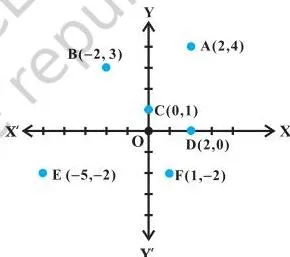
The x-axis carries numbers of the form \( a + i0 \) and is called the real axis; the y-axis carries numbers of the form \( 0 + ib \) and is called the imaginary axis.
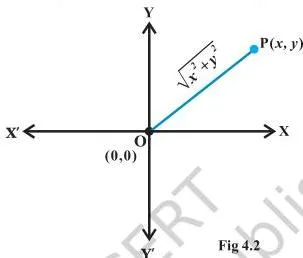
In this plane the modulus is a distance (NCERT, p. 84): the length of \( OP \) in Fig 4.2 is \[ |x + iy| = \sqrt{x^2 + y^2} \]
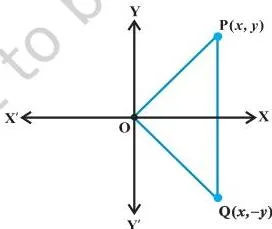
The conjugate also has a geometric meaning: the number \( \bar{z} = x – iy \) sits at the point \( Q(x, -y) \), the mirror image of \( P(x, y) \) in the real axis (NCERT, p. 84).
What Each Symbol Means
Every symbol used in this chapter’s formulas, with its meaning and the kind of quantity it represents.
| Symbol | What it means | Unit / nature |
|---|---|---|
| \( i \) | imaginary unit, \( i = \sqrt{-1} \), so \( i^2 = -1 \) | defined constant (dimensionless) |
| \( z \) | a complex number, written \( z = a + ib \) | complex number |
| \( a \) | real part of \( z \); also any real number used in \( a + ib \) | real number |
| \( b \) | coefficient of \( i \) in \( z \); the imaginary part | real number |
| \( c, d \) | real and imaginary parts of the second complex number \( z_2 = c + id \) | real numbers |
| \( \operatorname{Re} z, \operatorname{Im} z \) | the real part and the imaginary part of \( z \) | real numbers |
| \( z_1, z_2 \) | any two complex numbers used in the operations and laws | complex numbers |
| \( k \) | any integer in the power cycle of \( i \) | integer |
| \( \bar{z} \) | conjugate of \( z \), \( \bar{z} = a – ib \) | complex number |
| \( |z| \) | modulus of \( z \), the distance of the point \( (a, b) \) from the origin | non-negative real number (a length in the Argand plane) |
| \( x, y \) | coordinates of the point \( P(x, y) \) representing \( x + iy \) | real numbers |
| \( P(x, y), O(0, 0) \) | the point representing \( x + iy \), and the origin of the Argand plane | points in the plane |
| \( D \) | discriminant \( D = b^2 – 4ac \) of \( ax^2 + bx + c = 0 \) | real number |
When to Use Each Formula
Reach for each formula in the situation listed below; the condition column is the part students forget.
| Formula | Use it when … | Condition to keep in mind |
|---|---|---|
| \( a + ib = c + id \) | one complex equation contains real unknowns — equate real parts and imaginary parts to get two equations | both sides must first be written as \( a + ib \) |
| Addition / subtraction | combining or simplifying sums and differences of complex numbers | real parts and imaginary parts stay separate |
| Multiplication | expanding a product of two complex numbers | replace every \( i^2 \) by \( -1 \) |
| Multiplicative inverse | you need \( 1/z \) in standard form, for instance before dividing | \( z \neq 0 \) |
| Division | simplifying \( z_1/z_2 \) into \( a + ib \) | \( z_2 \neq 0 \); multiply by \( \bar{z}_2/\bar{z}_2 \) |
| Powers of \( i \) | any power \( i^n \), large or negative | write \( n = 4k + r \); the remainder \( r \) decides the value |
| \( \sqrt{-a} \) | a negative number appears under a square root | convert first: \( \sqrt{-a} = \sqrt{a}\,i \), with \( a \gt 0 \) |
| Identities | expanding squares, cubes or difference of squares with complex numbers | valid for all complex \( z_1, z_2 \) — same as real algebra |
| Modulus \( |z| \) | the size of a complex number, or its distance from the origin | always a non-negative real number |
| Conjugate \( \bar{z} \) | flipping the sign of the imaginary part; real-ising a denominator | only the sign of \( b \) changes |
| \( z\bar{z} = |z|^2 \) | finding a modulus from a product, or clearing a denominator | works for every complex number |
| Modulus laws | modulus of a product or quotient without expanding first | quotient law needs \( |z_2| \neq 0 \) |
| Conjugate laws | conjugate of a product, sum or quotient in one step | quotient law needs \( z_2 \neq 0 \) |
| Discriminant \( D = b^2 – 4ac \) | checking whether \( ax^2 + bx + c = 0 \) has real solutions | \( D \lt 0 \) means no real solution — the case complex numbers exist for |
Exercise map: Exercise 4.1 Q1-Q10 are direct “express in the form \( a + ib \)” drills using the operations and the powers of \( i \); Q11-Q13 ask for the multiplicative inverse; Q14 combines several operations.
The Miscellaneous Exercise is largely proofs built from the modulus and conjugate laws. A full-marks answer always finishes with a clean \( a + ib \) form — never leaving \( i \) in a denominator.
Worked Examples
Each example first names the formula it uses, then substitutes. The numbers are new, so you can redo the working yourself.
Example 1: Multiplication into Standard Form
- Step 1: Select the multiplication formula \( (a + ib)(c + id) = (ac – bd) + i(ad + bc) \).
- Step 2: For \( (3 – 2i)(4 + i) \), read \( a = 3 \), \( b = -2 \), \( c = 4 \), \( d = 1 \) and substitute.
\[ ac – bd = 3(4) – (-2)(1) = 14,\qquad ad + bc = 3(1) + (-2)(4) = -5 \]
\[ (3 – 2i)(4 + i) = 14 + i(-5) = 14 – 5i \]
Final answer: \( 14 – 5i \), in the form \( a + ib \).
Check: expanding directly, \( (3 – 2i)(4 + i) = 12 + 3i – 8i – 2i^2 = 12 – 5i + 2 = 14 – 5i \).
Example 2: Finding Real Unknowns from One Complex Equation
- Step 1: Use the equality rule: \( a + ib = c + id \) only when the real parts match and the imaginary parts match.
- Step 2: In \( (x + y) + i(2x – y) = 5 + i4 \), equate the two parts.
\[ x + y = 5,\qquad 2x – y = 4 \]
Step 3: Solve the pair.
Adding the two equations gives \( 3x = 9 \), so \( x = 3 \); then \( y = 2 \).
Final answer: \( x = 3, \ y = 2 \).
Check: substituting back, \( (3 + 2) + i(2(3) – 2) = 5 + i4 \), which matches the given number.
Example 3: Multiplicative Inverse in the Form a + ib
- Step 1: Select the inverse formula \( z^{-1} = \frac{\bar{z}}{|z|^2} \) for \( z = 1 + 2i \).
- Step 2: Write the conjugate and modulus: \( \bar{z} = 1 – 2i \) and \( |z|^2 = 1^2 + 2^2 = 5 \).
\[ z^{-1} = \frac{1 – 2i}{5} = \frac{1}{5} – \frac{2}{5}i \]
Final answer: \( \frac{1}{5} – \frac{2}{5}i \).
Check: multiplying back, \( (1 + 2i)\left(\frac{1}{5} – \frac{2}{5}i\right) = \frac{1}{5} – \frac{2}{5}i + \frac{2}{5}i – \frac{4}{5}i^2 = \frac{1}{5} + \frac{4}{5} = 1 \), the multiplicative identity.
Division uses the same idea: \( \frac{3 + 2i}{1 – i} = \frac{(3 + 2i)(1 + i)}{(1 – i)(1 + i)} = \frac{1 + 5i}{2} \).
Common Mistakes to Avoid
These are the errors students make while applying this chapter’s formulas. Each row gives the wrong version, the correct rule, and a quick self-check.
| Mistake | Correct rule | How to check your answer |
|---|---|---|
| \( \sqrt{-4}\,\sqrt{-9} = \sqrt{36} = 6 \) | \( \sqrt{-4}\,\sqrt{-9} = (2i)(3i) = 6i^2 = -6 \) | a product of two pure imaginary numbers is a negative real — if you get a positive real, \( i^2 \) was dropped |
| \( (2i)^2 = 2i^2 = -2 \) | \( (2i)^2 = 2^2 i^2 = 4(-1) = -4 \) | square the whole factor: \( (ki)^2 = k^2 i^2 = -k^2 \) |
| \( i^{27} = i \) | \( 27 = 4(6) + 3 \), so \( i^{27} = i^3 = -i \) | divide the exponent by 4; only the remainder 0, 1, 2 or 3 decides the value |
| \( |3 – 4i| = 3 – 4 = -1 \) or \( |3 – 4i| = 3 + 4 = 7 \) | \( |3 – 4i| = \sqrt{3^2 + (-4)^2} = 5 \) | a modulus is a distance, so it can never be negative; squares remove the sign of \( b \) |
| \( \overline{2 – 5i} = -2 + 5i \) | \( \overline{2 – 5i} = 2 + 5i \) | conjugation changes only the sign of the imaginary part — the real part stays as it is |
| \( a + ib = 0 \) means \( a = 0 \) | it means both parts vanish: \( a = 0 \) and \( b = 0 \) | a complex number is zero only when both its real part and its imaginary part are zero |
Frequently Asked Questions
Why Does This Chapter Introduce the Number i?
The equation \( x^2 + 1 = 0 \) has no real solution, because the square of every real number is non-negative. Defining \( i = \sqrt{-1} \) with \( i^2 = -1 \) extends the real numbers to the complex numbers, and \( x = \pm i \) then solves the equation (NCERT, p. 77). This is also what lets a quadratic \( ax^2 + bx + c = 0 \) with \( D = b^2 – 4ac \lt 0 \) be solved.
What Exactly Is the Modulus of a Complex Number?
For \( z = a + ib \), the modulus is \( |z| = \sqrt{a^2 + b^2} \), a non-negative real number. In the Argand plane it is exactly the distance from the origin to the point \( (a, b) \), so it can be zero only when \( a = b = 0 \) (NCERT, p. 81).
Which Expression Do I Multiply By When Dividing Complex Numbers?
Multiply numerator and denominator by the conjugate of the denominator. Since \( z\bar{z} = |z|^2 \), the denominator becomes the real number \( a^2 + b^2 \), and the quotient can be written in the form \( a + ib \) (NCERT, p. 81).
Can I Combine Two Negative Square Roots Under One Root Sign?
No. The rule \( \sqrt{a}\,\sqrt{b} = \sqrt{ab} \) fails when both \( a \) and \( b \) are negative: applying it would give \( \sqrt{-1}\,\sqrt{-1} = \sqrt{1} = 1 \), which contradicts \( i^2 = -1 \). Convert each negative radicand first: \( \sqrt{-a} = \sqrt{a}\,i \) (NCERT, p. 80).
Reference: NCERT Class 11 Mathematics textbook, chapter Complex Numbers and Quadratic Equations. The chapter PDF can be checked against the official NCERT website.
Explore Class 11 Maths Formulas
More for this chapter:
Class 11 Maths on LearnCBSE:
Related chapters: