
This sheet gathers the formulas and rules you need for Linear Inequalities, Class 11 Maths Chapter 5: the standard forms of inequalities in one and two variables, the two algebraic rules for solving them, interval notation and number-line conventions for solution sets, and the word-problem formulas (temperature conversion, IQ, averages, mixtures) used in this chapter.
Each formula is grouped by topic with its symbol meanings, when-to-use guidance, and worked examples on original numbers. Detailed explanations and derivations of these rules live in the Class 11 formulas index; the official NCERT website hosts the Rationalised NCERT Class 11 Mathematics textbook this sheet follows.
Formulas at a Glance
Use this table as a quick index — the same formulas appear again with conditions in the grouped list.
| Purpose (what you are finding) | Formula |
|---|---|
| Standard form of a linear inequality in one variable | \( ax + b \lt 0,\; ax + b \gt 0,\; ax + b \leq 0,\; ax + b \geq 0 \), with \( a \neq 0 \) |
| Standard form of a linear inequality in two variables | \( ax + by \lt c,\; ax + by \gt c,\; ax + by \leq c,\; ax + by \geq c \), with \( a \neq 0,\; b \neq 0 \) |
| Add or subtract the same number on both sides | \( a \lt b \Rightarrow a + c \lt b + c \) and \( a – c \lt b – c \) |
| Multiply or divide both sides by a positive number | \( a \lt b \Rightarrow ac \lt bc \) and \( \frac{a}{c} \lt \frac{b}{c} \), for \( c \gt 0 \) |
| Multiply or divide both sides by a negative number | \( a \lt b \Rightarrow ac \gt bc \) and \( \frac{a}{c} \gt \frac{b}{c} \), for \( c \lt 0 \) (sign reverses) |
| Solution set of \( x \lt a \) or \( x \gt a \) | \( x \lt a \Rightarrow x \in (-\infty, a) \); \( x \gt a \Rightarrow x \in (a, \infty) \) |
| Solution set of \( x \leq a \) or \( x \geq a \) | \( x \leq a \Rightarrow x \in (-\infty, a] \); \( x \geq a \Rightarrow x \in [a, \infty) \) |
| Solution of a double inequality (interval form of the compound result) | \( a \leq x \lt b \Rightarrow x \in [a, b) \) |
| Draw \( x \lt a \) or \( x \gt a \) on a number line | open circle at \( a \), dark line to the left (for \( x \lt a \)) or right (for \( x \gt a \)) |
| Draw \( x \leq a \) or \( x \geq a \) on a number line | dark circle at \( a \), dark line to the left or right |
| Convert Fahrenheit to Celsius | \( C = \frac{5}{9}(F – 32) \) |
| Convert Celsius to Fahrenheit | \( F = \frac{9}{5}C + 32 \) |
| IQ from mental age and chronological age | \( IQ = \frac{MA}{CA} \times 100 \) |
| Average of \( n \) scores at least \( M \) | \( \frac{x_1 + x_2 + \cdots + x_n}{n} \geq M \) |
| Mixture concentration must lie between two percentages | \( \frac{r_1}{100}(x + V) \lt \frac{p_1}{100}x + \frac{p_2}{100}V \lt \frac{r_2}{100}(x + V) \) |
All Formulas, Grouped by Topic
The sub-topics below follow the order of Class 11 Maths Chapter 5. Each block states a formula; the symbols are explained in the next section.
Standard Forms of Linear Inequalities
Two real numbers or two algebraic expressions related by the symbols \( \lt \), \( \gt \), \( \leq \) or \( \geq \) form an inequality (Definition 1, NCERT, p. 1). The general linear forms the chapter uses are:
\[ ax + b \lt 0, \quad ax + b \gt 0, \quad ax + b \leq 0, \quad ax + b \geq 0 \quad (a \neq 0) \]
These are linear inequalities in one variable \( x \). With two variables:
\[ ax + by \lt c, \quad ax + by \gt c, \quad ax + by \leq c, \quad ax + by \geq c \quad (a \neq 0,\; b \neq 0) \]
Inequalities with \( \lt \) or \( \gt \) are strict inequalities; those with \( \leq \) or \( \geq \) are slack inequalities. A statement such as \( 3 \leq x \lt 5 \) is a double inequality — it reads \( x \) is greater than or equal to 3 and less than 5. This chapter develops its solving rules for one-variable inequalities; the two-variable forms appear as standard forms.
Algebraic Solutions of Linear Inequalities in One Variable
Rule 1 — adding or subtracting. Equal numbers may be added to (or subtracted from) both sides of an inequality without affecting its sign (NCERT, p. 3):
\[ a \lt b \Rightarrow a + c \lt b + c \quad \text{and} \quad a – c \lt b – c \]
The same holds with \( \gt \), \( \leq \) and \( \geq \).
Rule 2 — multiplying or dividing. Both sides may be multiplied (or divided) by the same positive number. When both sides are multiplied or divided by a negative number, the sign of the inequality is reversed (NCERT, p. 3):
\[ c \gt 0: \quad a \lt b \Rightarrow ac \lt bc \quad \text{and} \quad \frac{a}{c} \lt \frac{b}{c} \]
\[ c \lt 0: \quad a \lt b \Rightarrow ac \gt bc \quad \text{and} \quad \frac{a}{c} \gt \frac{b}{c} \]
Why the reversal? Multiplying by a negative number reflects the number line about zero. Since \( 3 \gt 2 \) but \( -3 \lt -2 \), the order of the two sides literally flips, so the sign must flip too. The same applies to \( \leq \) and \( \geq \): \( \leq \) becomes \( \geq \), and so on.
Double inequalities. A statement like \( a \leq g(x) \lt b \) is shorthand for two inequalities at once. Solve it by applying the same operation to all three parts, as in the chapter’s worked examples:
\[ -3 \leq 2x – 1 \lt 7 \;\Rightarrow\; -2 \leq 2x \lt 8 \;\Rightarrow\; -1 \leq x \lt 4 \]
Solution Sets and Interval Notation
The values of \( x \) that make an inequality a true statement are its solutions, and the set of all such values is its solution set (NCERT, p. 3). Unless stated otherwise, the chapter solves inequalities in the set of real numbers. The chapter writes solution sets in interval notation:
\[ x \lt a \Rightarrow x \in (-\infty, a), \qquad x \gt a \Rightarrow x \in (a, \infty) \]
\[ x \leq a \Rightarrow x \in (-\infty, a], \qquad x \geq a \Rightarrow x \in [a, \infty) \]
A round bracket excludes its endpoint; a square bracket includes it. Infinity always gets a round bracket because no real number equals \( \infty \). For example, solving \( 2x + 1 \geq 9 \) gives \( x \geq 4 \), written as \( x \in [4, \infty) \). A double inequality \( a \leq x \lt b \) has interval form \( x \in [a, b) \).
Graphical Representation on the Number Line
To draw a solution on the number line (NCERT, p. 11):
- Strict inequality \( x \lt a \) or \( x \gt a \): put an open circle on the number \( a \) and a dark line to the left (for \( x \lt a \)) or right (for \( x \gt a \)).
- Slack inequality \( x \leq a \) or \( x \geq a \): put a dark circle on \( a \) and a dark line to the left or right. The dark circle means \( a \) itself is included.

Figure 5.1 shows the graph from Example 5, where \( 7x + 3 \lt 5x + 9 \) was solved to \( x \lt 3 \) (NCERT, p. 5): the endpoint 3 is an open circle, and the line is dark to its left.

Example 6 solves \( \frac{3x – 4}{2} \geq \frac{x + 1}{4} – 1 \) to \( x \geq 1 \); Fig 5.2 therefore uses a dark circle at 1 with a dark line to the right (NCERT, p. 6). Compare the two figures: same shape, but the endpoint is open for a strict inequality and dark for a slack one.
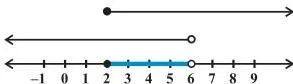
When two inequalities are solved together as a system, the solution is the set of \( x \)-values common to both. In Example 11, \( 3x – 7 \lt 5 + x \) gives \( x \lt 6 \) and \( 11 – 5x \leq 1 \) gives \( x \geq 2 \); the common part is \( 2 \leq x \lt 6 \), shown as the bold segment in Fig 5.3 (NCERT, p. 9).
Word-Problem Formulas
These three formulas from the chapter’s word problems act as ready-made models.
Temperature conversion. Example 12 converts a Celsius range into Fahrenheit using \( C = \frac{5}{9}(F – 32) \) (NCERT, p. 8):
\[ C = \frac{5}{9}(F – 32) \]
The inverse form, given in Miscellaneous Exercise Q11, is:
\[ F = \frac{9}{5}C + 32 \]
IQ formula. Miscellaneous Exercise Q14 defines IQ from mental age and chronological age (NCERT, p. 10):
\[ IQ = \frac{MA}{CA} \times 100 \]
Average condition. “Average of at least \( M \) marks in \( n \) tests” translates to (pattern of Example 7 and Exercises 5.1 Q21-22):
\[ \frac{x_1 + x_2 + \cdots + x_n}{n} \geq M \]
Mixture condition. In acid-mixture problems (Example 13, Miscellaneous Q12-13), the solute in the mixture must lie between two required percentages of the total volume:
\[ \frac{r_1}{100}(x + V) \lt \frac{p_1}{100}x + \frac{p_2}{100}V \lt \frac{r_2}{100}(x + V) \]
What Each Symbol Means
| Symbol | What it means | Unit / nature |
|---|---|---|
| \( x, y \) | variables; a value (or pair of values) that makes the statement true is a solution | real numbers (dimensionless) |
| \( a, b, c \) | fixed constants in the standard forms and rules | real numbers; \( a \neq 0 \), and in two-variable form \( b \neq 0 \) too |
| \( \lt, \gt \) | strict inequality signs | — |
| \( \leq, \geq \) | slack inequality signs | — |
| \( (-\infty, a), (a, \infty) \) | open intervals; the endpoint \( a \) is excluded | sets of real numbers |
| \( (-\infty, a], [a, \infty) \) | intervals closed at \( a \); the endpoint is included | sets of real numbers |
| \( C \) | temperature in degrees Celsius | \( ^{\circ}C \) |
| \( F \) | temperature in degrees Fahrenheit | \( ^{\circ}F \) |
| \( IQ \) | intelligence quotient | dimensionless |
| \( MA \) | mental age | years |
| \( CA \) | chronological age | years |
| \( n \) | number of tests (or terms) in the average | count |
| \( x_1, x_2, \ldots, x_n \) | individual scores in the average | marks |
| \( M \) | required minimum average | marks |
| \( x \) in the mixture formula | litres of the solution being added | litres |
| \( V \) | original volume of solution | litres |
| \( p_1, p_2 \) | concentrations of the added and original solutions | percentage (%) |
| \( r_1, r_2 \) | lower and upper required concentrations of the mixture | percentage (%) |
When to Use Each Formula
Reach for a rule only when its condition is satisfied. The table gives the deciding detail for each formula on this sheet.
| Formula or rule | Use it when… | Condition |
|---|---|---|
| One-variable standard forms | setting up a problem with one unknown, e.g. \( 30x \lt 200 \) for packets of rice | \( a \neq 0 \) |
| Two-variable standard forms | modelling a problem with two unknowns, e.g. \( 40x + 20y \leq 120 \) for registers and pens | \( a \neq 0,\; b \neq 0 \) |
| Rule 1 (add/subtract) | moving constant or variable terms from one side to the other | always valid; the sign never changes |
| Rule 2 (multiply/divide) | isolating \( x \) when its coefficient is a number | divide by the coefficient; reverse the sign only when that coefficient is negative |
| Interval notation | stating the final answer compactly for real \( x \) | strict sign → round bracket; \( \leq / \geq \) → square bracket; \( \infty \) always round |
| Number-line drawing | questions that say “show the graph of the solution on a number line” (Exercise 5.1 Q17-20) | open circle for \( \lt / \gt \); dark circle for \( \leq / \geq \) |
| Double inequality | compound statements such as \( 30 \lt C \lt 35 \) | apply every operation to all three parts together |
| \( C = \frac{5}{9}(F – 32) \), \( F = \frac{9}{5}C + 32 \) | temperature range problems in either unit | convert the whole range as one double inequality |
| \( IQ = \frac{MA}{CA} \times 100 \) | mental-age range problems (Miscellaneous Q14) | multiply the whole inequality by \( CA \) and divide by 100 |
| Average inequality | “minimum marks needed in the next test” problems (Exercise 5.1 Q21-22) | multiply both sides by \( n \) first |
| Mixture double inequality | dilution or concentration problems (Example 13, Miscellaneous Q12-13) | multiply through by 100 (positive — signs unchanged) before simplifying |
How the exercises use these formulas. The NCERT exercises follow a predictable pattern:
- Exercise 5.1 Q1-4: solve a simple inequality and list the solution set for natural numbers, integers, or real numbers.
- Exercise 5.1 Q5-16: purely algebraic solutions for real \( x \) — Rules 1 and 2, clearing fractions by the positive LCM.
- Exercise 5.1 Q17-20: solve and draw the number-line graph (open vs dark circle).
- Exercise 5.1 Q21-26: word problems — averages, consecutive integers, triangle perimeter, board lengths.
- Miscellaneous Exercise Q1-6: double inequalities; Q7-10: systems of inequalities with graphs; Q11-14: temperature, mixture, and IQ ranges.
Worked Examples
Three examples show how the rules combine: a direct solve, a double inequality, and a word problem. The numbers are original so you can work through them yourself.
Worked Example 1: Solve a linear inequality with a negative coefficient
Step 1: Bring the \( x \)-terms to one side.
Subtract \( 6x \) from both sides (Rule 1 — the sign is unchanged).
\[ 4x – 9 – 6x \geq 6x + 5 – 6x \quad \Rightarrow \quad -2x – 9 \geq 5 \]
Step 2: Add 9 to both sides to isolate the \( x \)-term.
\[ -2x \geq 14 \]
Step 3: Divide both sides by \( -2 \).
Since the divisor is negative, the inequality sign is reversed (Rule 2).
\[ x \leq -7 \]
Final answer: \( x \in (-\infty, -7] \).
Check: take \( x = -8 \). LHS \( = 4(-8) – 9 = -41 \), RHS \( = 6(-8) + 5 = -43 \), and \( -41 \geq -43 \) is true — so the reversed direction is correct.
Worked Example 2: Solve a double inequality
Step 1: This is a double inequality — operate on all three parts together.
Add 1 to each part.
\[ -3 + 1 \leq 2x – 1 + 1 \lt 7 + 1 \quad \Rightarrow \quad -2 \leq 2x \lt 8 \]
Step 2: Divide all three parts by the positive number 2; the signs stay as they are.
\[ -1 \leq x \lt 4 \]
Final answer: \( x \in [-1, 4) \).
Check: \( x = -1 \) gives \( -3 \leq -3 \) (true), while \( x = 4 \) gives \( 7 \lt 7 \) (false) — so 4 must stay excluded, as the round bracket shows.
Worked Example 3: Convert a temperature range from Fahrenheit to Celsius
Step 1: A liquid is kept between \( 50^{\circ}F \) and \( 68^{\circ}F \).
Use \( F = \frac{9}{5}C + 32 \) and write the whole range as a double inequality.
\[ 50 \lt \frac{9}{5}C + 32 \lt 68 \]
Step 2: Subtract 32 from all three parts.
\[ 18 \lt \frac{9}{5}C \lt 36 \]
Step 3: Multiply all three parts by \( \frac{5}{9} \) — positive, so signs are unchanged.
\[ 10 \lt C \lt 20 \]
Final answer: the liquid must be kept between \( 10^{\circ}C \) and \( 20^{\circ}C \).
Check: \( C = 10 \) gives \( F = \frac{9}{5}(10) + 32 = 50 \), and \( C = 20 \) gives \( F = 68 \) — the endpoints match the given Fahrenheit limits.
For quick reference across the syllabus, browse the complete chapter-wise sheet collection in the maths formulas list.
Common Mistakes to Avoid
| Mistake | Correct rule | How to check your answer |
|---|---|---|
| Keeping the sign unchanged after dividing by a negative coefficient, e.g. \( -2x \geq 14 \Rightarrow x \geq -7 \) | Dividing by a negative number reverses the sign: \( -2x \geq 14 \Rightarrow x \leq -7 \) | Substitute a value from your solution set into the original inequality — it must make the statement true |
| Reversing the sign when multiplying by a positive number, e.g. when clearing fractions by the LCM | Only a negative multiplier reverses the sign; the LCM is positive, so signs stay | Check one sample value of \( x \) against the original inequality |
| Using an open circle for \( x \leq a \), or a dark circle for \( x \lt a \) | \( \lt, \gt \) → open circle; \( \leq, \geq \) → dark circle | Test the endpoint: \( x = a \) satisfies \( \leq \) but not \( \lt \) |
| Writing \( x \lt 2 \) as \( (-\infty, 2] \) | A strict sign takes a round bracket next to the number: \( (-\infty, 2) \); \( \infty \) always takes a round bracket | Ask: is the endpoint \( x = 2 \) itself a solution? (It is not) |
| Treating a double inequality as two independent jobs | Apply the same operation to all three parts at once | After every step, all three parts must still form a true statement |
| Forgetting that \( x \) may count objects | Word problems often restrict \( x \) to natural numbers or integers (e.g. packets of rice) | List the integers in the interval you found; drop any that make no sense in the situation |
Frequently Asked Questions
Why does the inequality sign reverse when I multiply or divide by a negative number?
Because multiplying by a negative number reflects the number line about zero, which flips the order of every pair of numbers. Since \( 3 \gt 2 \) but \( -3 \lt -2 \), the number that was larger becomes smaller after the reflection. To keep the statement true, \( \lt \) must become \( \gt \) (and \( \leq \) becomes \( \geq \), and so on).
What is the difference between an open circle and a dark circle on a number line?
An open circle means the endpoint is not a solution — \( x \lt 3 \) excludes 3 itself. A dark circle means the endpoint is included — \( x \leq 3 \) includes 3.
The chapter summary states it as: for \( x \lt a \) or \( x \gt a \), put a circle on \( a \) with a dark line to the left or right; for \( x \leq a \) or \( x \geq a \), put a dark circle (NCERT, p. 11).
How do I write a solution set in interval notation?
\( x \lt 2 \) becomes \( (-\infty, 2) \); \( x \geq 8 \) becomes \( [8, \infty) \); a compound result like \( -1 \leq x \lt 4 \) becomes \( [-1, 4) \). Round brackets exclude, square brackets include, and infinity always takes a round bracket.
How do I solve a double inequality?
Apply the same operation to all three parts at once. For \( -3 \leq 2x – 1 \lt 7 \), add 1 to get \( -2 \leq 2x \lt 8 \), then divide by 2 to get \( -1 \leq x \lt 4 \). The answer is \( x \in [-1, 4) \). Never operate on only one or two parts — all three must change together.
Reference: NCERT Class 11 Mathematics textbook, chapter Linear Inequalities.
Explore Class 11 Maths Formulas
More for this chapter:
Class 11 Maths on LearnCBSE:
Related chapters: