
This page collects the conic sections class 11 formulas from NCERT Mathematics Chapter 10. It covers the standard equations of the circle, parabola, ellipse and hyperbola, together with the relations that connect the axes, focus distance, eccentricity and latus rectum of each curve.
Each formula is grouped under the textbook sub-topic it belongs to, with a symbol table, when-to-use guidance and worked examples that use fresh numbers. The derivations and step-by-step explanations are in the Class 11 maths formulas collection; to reach any other chapter, start from the maths formulas index.
Conic Sections Class 11 Formulas at a Glance
| Purpose | Formula |
|---|---|
| Circle with centre \( (h, k) \) and radius \( r \) | \( (x – h)^2 + (y – k)^2 = r^2 \) |
| Circle centred at the origin | \( x^2 + y^2 = r^2 \) |
| Parabola opening right, focus \( (a, 0) \), directrix \( x = -a \) | \( y^2 = 4ax, \ a \gt 0 \) |
| Parabola opening left | \( y^2 = -4ax \) |
| Parabola opening upward | \( x^2 = 4ay \) |
| Parabola opening downward | \( x^2 = -4ay \) |
| Latus rectum of a parabola | \( 4a \) |
| Ellipse with foci on the \( x \)-axis | \( \frac{x^2}{a^2} + \frac{y^2}{b^2} = 1 \) |
| Ellipse with foci on the \( y \)-axis | \( \frac{x^2}{b^2} + \frac{y^2}{a^2} = 1 \) |
| Focus distance from the centre, ellipse (derived from \( a^2 = b^2 + c^2 \)) | \( c = \sqrt{a^2 – b^2} \) |
| Latus rectum of an ellipse | \( \frac{2b^2}{a} \) |
| Hyperbola with transverse axis on the \( x \)-axis | \( \frac{x^2}{a^2} – \frac{y^2}{b^2} = 1 \) |
| Hyperbola with transverse axis on the \( y \)-axis | \( \frac{y^2}{a^2} – \frac{x^2}{b^2} = 1 \) |
| Focus distance from the centre, hyperbola (derived from \( b^2 = c^2 – a^2 \)) | \( c = \sqrt{a^2 + b^2} \) |
| Eccentricity of an ellipse or a hyperbola | \( e = \frac{c}{a} \) |
| Latus rectum of a hyperbola | \( \frac{2b^2}{a} \) |
All Formulas, Grouped by Topic
Sections of a Cone
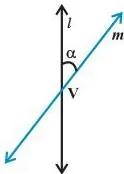
All four conic sections come from cutting a double-napped right circular cone with a plane. If \( \alpha \) is the angle the generator makes with the vertical axis and \( \beta \) is the angle the cutting plane makes with that axis, the section obtained is decided by these conditions:
| Angle of the cutting plane | Section obtained |
|---|---|
| \( \beta = 90^\circ \) | Circle |
| \( \alpha \lt \beta \lt 90^\circ \) | Ellipse |
| \( \beta = \alpha \) | Parabola |
| \( 0 \leq \beta \lt \alpha \) | Hyperbola (the plane cuts both nappes) |
When the plane passes through the vertex instead, the section degenerates: a point for \( \alpha \lt \beta \leq 90^\circ \), a straight line for \( \beta = \alpha \) (the degenerate parabola), and a pair of intersecting straight lines for \( 0 \leq \beta \lt \alpha \) (the degenerate hyperbola).
Circle
A circle is the set of all points at a fixed distance \( r \) (the radius) from a fixed point \( C(h, k) \) (the centre). The standard equation follows directly from the distance formula, \( |CP| = r \) (NCERT, p. 180):
\[ (x – h)^2 + (y – k)^2 = r^2 \]
When the centre is the origin, \( h = k = 0 \), and the equation reduces to:
\[ x^2 + y^2 = r^2 \]
Parabola
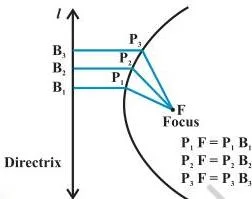
A parabola is the set of points equidistant from a fixed line (the directrix) and a fixed point not on it (the focus). With the vertex at the origin and the axis along a coordinate axis, the four standard equations are (NCERT, p. 184):
\[ y^2 = 4ax, \quad a \gt 0 \]
\[ y^2 = -4ax \]
\[ x^2 = 4ay \]
\[ x^2 = -4ay \]
| Equation | Axis of symmetry | Focus | Directrix | Opens |
|---|---|---|---|---|
| \( y^2 = 4ax \) | \( x \)-axis | \( (a, 0) \) | \( x = -a \) | right |
| \( y^2 = -4ax \) | \( x \)-axis | \( (-a, 0) \) | \( x = a \) | left |
| \( x^2 = 4ay \) | \( y \)-axis | \( (0, a) \) | \( y = -a \) | up |
| \( x^2 = -4ay \) | \( y \)-axis | \( (0, -a) \) | \( y = a \) | down |
The latus rectum of a parabola is the chord through the focus, perpendicular to the axis, with its endpoints on the parabola. Each half equals the distance from the directrix to the focus, \( 2a \), so the full length is (NCERT, p. 185):
\[ \text{Latus rectum of a parabola} = 4a \]
Ellipse
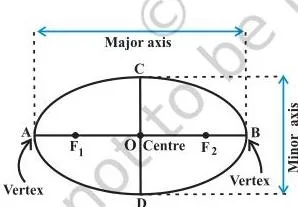
An ellipse is the set of points whose sum of distances from two fixed points (the foci) is constant. With the centre at the origin and the foci on a coordinate axis, the standard equations are:
\[ \frac{x^2}{a^2} + \frac{y^2}{b^2} = 1 \quad \text{(foci on the } x\text{-axis)} \]
\[ \frac{x^2}{b^2} + \frac{y^2}{a^2} = 1 \quad \text{(foci on the } y\text{-axis)} \]
Here \( 2a \) is the major axis, \( 2b \) the minor axis and \( 2c \) the distance between the foci. Putting points at the ends of the two axes into the constant-sum condition gives \( 2a = 2\sqrt{b^2 + c^2} \), hence (NCERT, p. 188):
\[ a^2 = b^2 + c^2, \quad c = \sqrt{a^2 – b^2} \]
The eccentricity is \( e = \frac{c}{a} \), so the focus lies \( ae \) from the centre. The latus rectum of the ellipse has length (NCERT, p. 192):
\[ \text{Latus rectum of an ellipse} = \frac{2b^2}{a} \]
Hyperbola
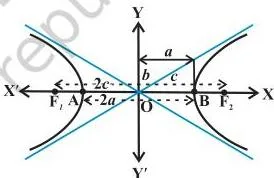
A hyperbola is the set of points for which the difference of the distances from two fixed points (the foci) is constant. The positive term’s denominator in the standard form names the transverse axis:
\[ \frac{x^2}{a^2} – \frac{y^2}{b^2} = 1 \quad \text{(transverse axis on the } x\text{-axis)} \]
\[ \frac{y^2}{a^2} – \frac{x^2}{b^2} = 1 \quad \text{(transverse axis on the } y\text{-axis)} \]
The auxiliary length \( b \) is defined by (NCERT, p. 196), and the standard equation above is the one proved for foci on the \( x \)-axis (NCERT, p. 198):
\[ b = \sqrt{c^2 – a^2}, \quad c^2 = a^2 + b^2 \]
Because \( c \gt a \), the eccentricity of a hyperbola is never less than one:
\[ e = \frac{c}{a} \geq 1 \]
The latus rectum of the hyperbola has the same form as the ellipse’s (NCERT, p. 200):
\[ \text{Latus rectum of a hyperbola} = \frac{2b^2}{a} \]
When \( a = b \), the hyperbola is called an equilateral hyperbola.
What Each Symbol Means
| Symbol | Meaning | Unit / nature |
|---|---|---|
| \( (x, y) \) | A general point on the curve | Coordinates — lengths |
| \( (h, k) \) | Centre of a circle | Coordinates — lengths |
| \( r \) | Radius of a circle | Length |
| \( a \) | Parabola: distance from vertex to focus; ellipse: semi-major axis; hyperbola: semi-transverse axis | Length |
| \( b \) | Ellipse: semi-minor axis; hyperbola: semi-conjugate axis | Length |
| \( c \) | Distance from the centre to a focus (ellipse or hyperbola) | Length |
| \( e \) | Eccentricity, \( e = \frac{c}{a} \) | Dimensionless ratio |
| \( 2a \) | Ellipse: major axis; hyperbola: transverse axis | Length |
| \( 2b \) | Ellipse: minor axis; hyperbola: conjugate axis | Length |
| \( 2c \) | Distance between the two foci | Length |
| \( 4a \) | Latus rectum of a parabola | Length |
| \( \frac{2b^2}{a} \) | Latus rectum of an ellipse or hyperbola | Length |
| \( \alpha \) | Angle between the generator and the axis of the cone | Angle (degrees) |
| \( \beta \) | Angle made by the cutting plane with the axis of the cone | Angle (degrees) |
When to Use Each Formula
- Circle equation \( (x – h)^2 + (y – k)^2 = r^2 \): use whenever you know the centre and radius, or must recover them from a general equation \( x^2 + y^2 + Dx + Ey + F = 0 \) by completing the square.
- Parabola forms \( y^2 = \pm 4ax \), \( x^2 = \pm 4ay \): use when the vertex is at the origin and the axis lies on a coordinate axis. The squared term names the axis (\( y^2 \) → \( x \)-axis, \( x^2 \) → \( y \)-axis), and the sign of the linear term gives the opening direction.
- Ellipse forms: use when the centre is at the origin and the foci lie on a coordinate axis. The larger denominator sits under the variable along the major axis.
- Hyperbola forms: use when the centre is at the origin and the foci lie on a coordinate axis. The positive term’s denominator names the transverse axis.
- Focus–axis relations \( c = \sqrt{a^2 – b^2} \) and \( c = \sqrt{a^2 + b^2} \): use to find the foci once \( a \) and \( b \) are known — the minus sign belongs to the ellipse, the plus sign to the hyperbola.
- Eccentricity \( e = \frac{c}{a} \): use for either conic to measure how far it is from being a circle; for an ellipse \( e \lt 1 \), for a hyperbola \( e \geq 1 \).
- Latus rectum: use \( 4a \) for a parabola and \( \frac{2b^2}{a} \) for an ellipse or hyperbola whenever a question asks for the chord through a focus perpendicular to the axis.
Worked Examples
The three examples below show the most common ways these formulas appear in problems: reading the centre and radius from a circle equation, reading the parameters of a parabola, and building an ellipse equation from given vertices and foci.
Example 1: Find the centre and radius of a circle from its equation
Step 1: Group the \( x \) and \( y \) terms of \( x^2 + y^2 – 8x + 6y – 11 = 0 \) and move the constant to the right side.
\[ (x^2 – 8x) + (y^2 + 6y) = 11 \]
Step 2: Complete the square in each bracket.
For \( x^2 – 8x \) add \( 16 \), and for \( y^2 + 6y \) add \( 9 \); add the same amounts to the right side to keep the equation balanced.
\[ (x – 4)^2 + (y + 3)^2 = 11 + 16 + 9 = 36 \]
Step 3: Compare with \( (x – h)^2 + (y – k)^2 = r^2 \).
Here \( h = 4 \), \( k = -3 \), and \( r^2 = 36 \), so \( r = 6 \).
Final answer: Centre \( (4, -3) \), radius \( 6 \) units.
Example 2: Find the focus, directrix and latus rectum of a parabola
Step 1: The equation \( y^2 = -20x \) contains \( y^2 \), so the axis of symmetry is the \( x \)-axis.
The coefficient of \( x \) is negative, so the parabola opens left and the form is \( y^2 = -4ax \).
- Step 1: Match coefficients: \( 4a = 20 \), so \( a = 5 \).
- Step 2: Read off the parameters for \( y^2 = -4ax \): focus \( (-a, 0) = (-5, 0) \), directrix \( x = a = 5 \), latus rectum \( 4a = 20 \).
Final answer: Focus \( (-5, 0) \), directrix \( x = 5 \), latus rectum \( 20 \) units.
Example 3: Find an ellipse equation from its vertices and foci
- Step 1: The vertices \( (\pm 10, 0) \) lie on the \( x \)-axis, so use \( \frac{x^2}{a^2} + \frac{y^2}{b^2} = 1 \) with \( a = 10 \).
- Step 2: The foci \( (\pm 6, 0) \) give \( c = 6 \).
For an ellipse, substitute into \( c^2 = a^2 – b^2 \) and solve for \( b^2 \).
\[ b^2 = a^2 – c^2 = 100 – 36 = 64 \]
Step 3: Write the standard equation and the remaining quantities.
\[ \frac{x^2}{100} + \frac{y^2}{64} = 1, \quad e = \frac{c}{a} = \frac{3}{5} \]
Final answer: \( \frac{x^2}{100} + \frac{y^2}{64} = 1 \), eccentricity \( \frac{3}{5} \), latus rectum \( \frac{2b^2}{a} = \frac{64}{5} \).
If the same data had described a hyperbola, Step 2 would have used \( c^2 = a^2 + b^2 \) instead of \( c^2 = a^2 – b^2 \) — the sign difference is the whole trap.
Common Mistakes to Avoid
| Mistake | Correct rule | How to check your answer |
|---|---|---|
| Using \( c^2 = a^2 – b^2 \) for a hyperbola | Ellipse: \( c^2 = a^2 – b^2 \) (foci inside, \( c \lt a \)). Hyperbola: \( c^2 = a^2 + b^2 \) (foci outside, \( c \gt a \)). | In your answer, is \( c \) greater than \( a \) for a hyperbola and less than \( a \) for an ellipse? |
| Choosing the wrong ellipse form when the major axis is the \( y \)-axis | The larger denominator lies under the variable along the major axis: for foci on the \( y \)-axis use \( \frac{x^2}{b^2} + \frac{y^2}{a^2} = 1 \). | The vertices must come out as \( (0, \pm a) \) — on the axis you called the major axis. |
| Writing the focus of \( y^2 = -4ax \) as \( (a, 0) \) | \( y^2 = -4ax \) opens left: focus \( (-a, 0) \), directrix \( x = a \). | The focus always lies inside the opening of the parabola. |
| Applying the parabola’s \( 4a \) latus rectum to an ellipse or hyperbola | \( 4a \) belongs only to the parabola; ellipse and hyperbola both use \( \frac{2b^2}{a} \). | Put \( x = c \) into the ellipse equation — the half-chord comes out \( \frac{b^2}{a} \), so the full chord is \( \frac{2b^2}{a} \). |
| Writing \( 9x^2 – 16y^2 = 144 \) straight as \( \frac{x^2}{9} – \frac{y^2}{16} = 1 \) | Divide every term by 144 to reach standard form: \( \frac{x^2}{16} – \frac{y^2}{9} = 1 \). | The right-hand side of a standard conic equation must be exactly 1; if it is not, divide the whole equation by that constant. |
Frequently Asked Questions
How do I identify which conic an equation represents?
Compare the squared terms. Equal coefficients of \( x^2 \) and \( y^2 \) mean a circle (for example \( x^2 + y^2 = 25 \)). Only one squared term means a parabola (\( y^2 = 4ax \) or \( x^2 = 4ay \)). Both squared terms with the same sign but different coefficients mean an ellipse (\( \frac{x^2}{25} + \frac{y^2}{9} = 1 \)). Opposite signs mean a hyperbola (\( \frac{x^2}{25} – \frac{y^2}{9} = 1 \)).
Why is an ellipse’s eccentricity less than 1 but a hyperbola’s at least 1?
Because \( e = \frac{c}{a} \). For an ellipse \( c = \sqrt{a^2 – b^2} \lt a \), so \( e \lt 1 \). For a hyperbola \( c = \sqrt{a^2 + b^2} \gt a \), so \( e \gt 1 \). The whole difference comes from the minus sign versus the plus sign in the focus–axis relation.
What is the latus rectum, and how does its length differ across conics?
The latus rectum is the chord through a focus, perpendicular to the axis, with its endpoints on the curve. Its length is \( 4a \) for a parabola and \( \frac{2b^2}{a} \) for both an ellipse and a hyperbola.
Which parabola form should I use when the vertex is at the origin?
Look at the axis of symmetry. If the parabola is symmetric about the \( x \)-axis, use \( y^2 = \pm 4ax \); if it is symmetric about the \( y \)-axis, use \( x^2 = \pm 4ay \). Then choose the sign of the linear term so that the parabola opens towards the focus.
The formulas above follow the official NCERT Class 11 Mathematics textbook (Chapter 10, Conic Sections).
Reference: NCERT Class 11 Mathematics textbook, chapter Conic Sections.
Explore Class 11 Maths Formulas
More for this chapter:
Class 11 Maths on LearnCBSE:
Related chapters: