
This page collects the Trigonometric Functions Class 11 formulas from NCERT Chapter 3: angle measures in degrees and radians, arc length, the six trigonometric functions, Pythagorean identities, periodicity, compound-angle identities, double- and triple-angle identities, and sum-to-product/product-to-sum forms. Each formula is given with its symbols, unit and the condition under which it applies.
Use the at-a-glance table for a fast lookup, then the grouped formula list and the symbol table. The worked examples show how each formula is selected and substituted; the mistakes table covers the errors students make most often when applying these identities.
This page is part of the Class 11 Maths formulas collection, and chapter sheets are linked from the main formulas index.
Formulas at a Glance
| Purpose | Formula |
|---|---|
| Degree measure to radian measure | \(\text{Radian measure}=\frac{\pi}{180}\times\text{Degree measure}\) |
| Radian measure to degree measure | \(\text{Degree measure}=\frac{180}{\pi}\times\text{Radian measure}\) |
| Arc length, with \(\theta\) in radians | \(l=r\theta\) |
| Cosecant as a reciprocal of sine | \(\csc x=\frac{1}{\sin x}\) |
| Secant as a reciprocal of cosine | \(\sec x=\frac{1}{\cos x}\) |
| Tangent as sine over cosine | \(\tan x=\frac{\sin x}{\cos x}\) |
| Cotangent as cosine over sine | \(\cot x=\frac{\cos x}{\sin x}\) |
| Pythagorean identity 1 | \(\sin^2 x+\cos^2 x=1\) |
| Pythagorean identity 2 | \(1+\tan^2 x=\sec^2 x\) |
| Pythagorean identity 3 | \(1+\cot^2 x=\csc^2 x\) |
| Periodicity of sine | \(\sin(2n\pi+x)=\sin x\) |
| Periodicity of cosine | \(\cos(2n\pi+x)=\cos x\) |
| Sine is an odd function | \(\sin(-x)=-\sin x\) |
| Cosine is an even function | \(\cos(-x)=\cos x\) |
| Cosine of a sum | \(\cos(x+y)=\cos x\cos y-\sin x\sin y\) |
| Cosine of a difference | \(\cos(x-y)=\cos x\cos y+\sin x\sin y\) |
| Sine of a sum | \(\sin(x+y)=\sin x\cos y+\cos x\sin y\) |
| Sine of a difference | \(\sin(x-y)=\sin x\cos y-\cos x\sin y\) |
| Tangent of a sum | \(\tan(x+y)=\frac{\tan x+\tan y}{1-\tan x\tan y}\) |
| Tangent of a difference | \(\tan(x-y)=\frac{\tan x-\tan y}{1+\tan x\tan y}\) |
| Cotangent of a sum | \(\cot(x+y)=\frac{\cot x\cot y-1}{\cot y+\cot x}\) |
| Cotangent of a difference | \(\cot(x-y)=\frac{\cot x\cot y+1}{\cot y-\cot x}\) |
| Cosine double angle, equivalent forms | \(\cos 2x=\cos^2x-\sin^2x=2\cos^2x-1=1-2\sin^2x=\frac{1-\tan^2x}{1+\tan^2x}\) |
| Sine double angle | \(\sin 2x=2\sin x\cos x=\frac{2\tan x}{1+\tan^2x}\) |
| Tangent double angle | \(\tan 2x=\frac{2\tan x}{1-\tan^2x}\) |
| Sine triple angle | \(\sin 3x=3\sin x-4\sin^3x\) |
| Cosine triple angle | \(\cos 3x=4\cos^3x-3\cos x\) |
| Tangent triple angle | \(\tan 3x=\frac{3\tan x-\tan^3x}{1-3\tan^2x}\) |
| Sum of cosines | \(\cos x+\cos y=2\cos\frac{x+y}{2}\cos\frac{x-y}{2}\) |
| Difference of cosines | \(\cos x-\cos y=-2\sin\frac{x+y}{2}\sin\frac{x-y}{2}\) |
| Sum of sines | \(\sin x+\sin y=2\sin\frac{x+y}{2}\cos\frac{x-y}{2}\) |
| Difference of sines | \(\sin x-\sin y=2\cos\frac{x+y}{2}\sin\frac{x-y}{2}\) |
| Product of two cosines as a sum | \(2\cos x\cos y=\cos(x+y)+\cos(x-y)\) |
| Product of two sines as a sum | \(-2\sin x\sin y=\cos(x+y)-\cos(x-y)\) |
| Product sine times cosine | \(2\sin x\cos y=\sin(x+y)+\sin(x-y)\) |
| Product cosine times sine | \(2\cos x\sin y=\sin(x+y)-\sin(x-y)\) |
| Half-angle sine form (from \(\cos 2x\) identity) | \(2\sin^2\frac{x}{2}=1-\cos x\) |
| Half-angle cosine form (from \(\cos 2x\) identity) | \(2\cos^2\frac{x}{2}=1+\cos x\) |
All Formulas, Grouped by Topic
Angles, Arc Length and Radian Measure
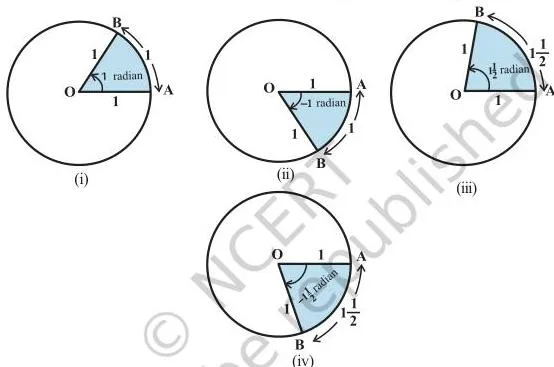
An angle measures the rotation of a ray about its vertex: anticlockwise rotation gives a positive angle and clockwise rotation gives a negative angle. In a circle of radius r, an arc of length l subtending angle \(\theta\) at the centre gives the arc length relation (NCERT, p. 46):
\[\theta=\frac{l}{r}\quad\text{or}\quad l=r\theta.\]
Because one complete revolution is \(2\pi\) radians and \(360^\circ\), we get the conversion relations (NCERT, p. 47):
\[\pi\ \text{radian}=180^\circ,\qquad 1^\circ=\frac{\pi}{180}\ \text{radian},\qquad 1\ \text{radian}=\frac{180^\circ}{\pi}\approx 57^\circ16′.\]
Trigonometric Functions and Basic Identities
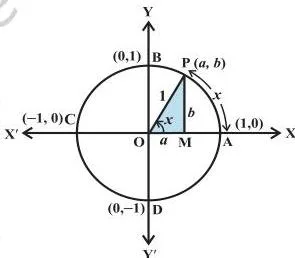
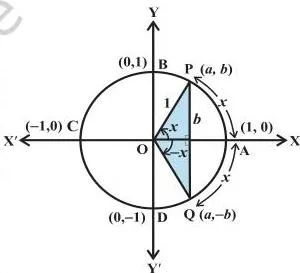
On the unit circle, a point \(P(a,b)\) with angle \(AOP=x\) radians defines \(\cos x=a\) and \(\sin x=b\). Since the point lies on the unit circle, \(a^2+b^2=1\), which gives the basic identity (NCERT, p. 50).
Reciprocal and quotient definitions, with the values of x for which each is defined (NCERT, p. 51):
\[\csc x=\frac{1}{\sin x},\ x\neq n\pi;\qquad \sec x=\frac{1}{\cos x},\ x\neq(2n+1)\frac{\pi}{2};\]\[\tan x=\frac{\sin x}{\cos x},\ x\neq(2n+1)\frac{\pi}{2};\qquad \cot x=\frac{\cos x}{\sin x},\ x\neq n\pi.\]
The three Pythagorean identities follow from the unit circle definition:
\[\sin^2x+\cos^2x=1,\qquad 1+\tan^2x=\sec^2x,\qquad 1+\cot^2x=\csc^2x.\]
Quadrantal values are obtained from the points \((1,0),(0,1),(-1,0),(0,-1)\): \(\sin 0=0,\cos 0=1;\) \(\sin\frac{\pi}{2}=1,\cos\frac{\pi}{2}=0;\) \(\sin\pi=0,\cos\pi=-1;\) \(\sin\frac{3\pi}{2}=-1,\cos\frac{3\pi}{2}=0;\) \(\sin2\pi=0,\cos2\pi=1.\) Standard values from NCERT, p. 51:
| Angle | \(0\) | \(\frac{\pi}{6}\) | \(\frac{\pi}{4}\) | \(\frac{\pi}{3}\) | \(\frac{\pi}{2}\) | \(\pi\) | \(\frac{3\pi}{2}\) | \(2\pi\) |
|---|---|---|---|---|---|---|---|---|
| \(\sin\) | \(0\) | \(\frac{1}{2}\) | \(\frac{1}{\sqrt{2}}\) | \(\frac{\sqrt{3}}{2}\) | \(1\) | \(0\) | \(-1\) | \(0\) |
| \(\cos\) | \(1\) | \(\frac{\sqrt{3}}{2}\) | \(\frac{1}{\sqrt{2}}\) | \(\frac{1}{2}\) | \(0\) | \(-1\) | \(0\) | \(1\) |
| \(\tan\) | \(0\) | \(\frac{1}{\sqrt{3}}\) | \(1\) | \(\sqrt{3}\) | not defined | \(0\) | not defined | \(0\) |
Sign, Domain and Range of Trigonometric Functions
The sign of each function depends on the quadrant in which the terminal side lies (NCERT, p. 52):
| Function | Quadrant I | Quadrant II | Quadrant III | Quadrant IV |
|---|---|---|---|---|
| \(\sin x\) | + | + | – | – |
| \(\cos x\) | + | – | – | + |
| \(\tan x\) | + | – | + | – |
| \(\csc x\) | + | + | – | – |
| \(\sec x\) | + | – | – | + |
| \(\cot x\) | + | – | + | – |
The domain and range facts below tell you which values of x a formula is allowed to take (NCERT, p. 53):
| Function | Domain | Range |
|---|---|---|
| \(\sin x,\ \cos x\) | all real numbers | \([-1,1]\) |
| \(\csc x\) | \(x\neq n\pi\) | \(y\le -1\) or \(y\ge 1\) |
| \(\sec x\) | \(x\neq(2n+1)\frac{\pi}{2}\) | \(y\le -1\) or \(y\ge 1\) |
| \(\tan x\) | \(x\neq(2n+1)\frac{\pi}{2}\) | all real numbers |
| \(\cot x\) | \(x\neq n\pi\) | all real numbers |
Trigonometric Functions of Sum and Difference of Two Angles
The four compound-angle identities are the foundation of this chapter (NCERT, p. 59):
\[\cos(x+y)=\cos x\cos y-\sin x\sin y,\qquad \cos(x-y)=\cos x\cos y+\sin x\sin y,\]\[\sin(x+y)=\sin x\cos y+\cos x\sin y,\qquad \sin(x-y)=\sin x\cos y-\cos x\sin y.\]
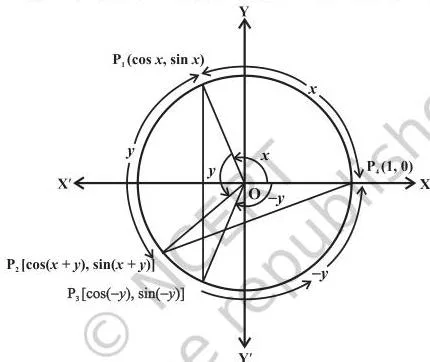
Putting particular values of x gives the co-function and quadrant forms:
\[\cos\left(\frac{\pi}{2}-x\right)=\sin x,\qquad \sin\left(\frac{\pi}{2}-x\right)=\cos x,\]\[\cos\left(\frac{\pi}{2}+x\right)=-\sin x,\qquad \sin\left(\frac{\pi}{2}+x\right)=\cos x,\]\[\cos(\pi-x)=-\cos x,\qquad \sin(\pi-x)=\sin x,\]\[\cos(\pi+x)=-\cos x,\qquad \sin(\pi+x)=-\sin x,\]\[\cos(2\pi-x)=\cos x,\qquad \sin(2\pi-x)=-\sin x.\]
If none of \(x,y,x+y\) is an odd multiple of \(\frac{\pi}{2}\), then (NCERT, p. 60):
\[\tan(x+y)=\frac{\tan x+\tan y}{1-\tan x\tan y},\qquad \tan(x-y)=\frac{\tan x-\tan y}{1+\tan x\tan y}.\]
If none of the angles is a multiple of \(\pi\), then:
\[\cot(x+y)=\frac{\cot x\cot y-1}{\cot y+\cot x},\qquad \cot(x-y)=\frac{\cot x\cot y+1}{\cot y-\cot x}.\]
Double and Triple Angle Identities
Replacing y by x in the compound-angle formulas gives the double-angle identities (NCERT, p. 62):
\[\cos2x=\cos^2x-\sin^2x=2\cos^2x-1=1-2\sin^2x=\frac{1-\tan^2x}{1+\tan^2x},\]\[\sin2x=2\sin x\cos x=\frac{2\tan x}{1+\tan^2x},\qquad \tan2x=\frac{2\tan x}{1-\tan^2x}.\]
The \(\tan\) forms require \(\tan x\) to be defined, and \(\tan2x\) requires \(2x\neq n\pi+\frac{\pi}{2}\). The triple-angle identities are:
\[\sin3x=3\sin x-4\sin^3x,\qquad \cos3x=4\cos^3x-3\cos x,\]\[\tan3x=\frac{3\tan x-\tan^3x}{1-3\tan^2x}.\]
Sum-to-Product and Product-to-Sum Identities
These convert a sum into a product or a product into a sum (NCERT, p. 64):
\[\cos x+\cos y=2\cos\frac{x+y}{2}\cos\frac{x-y}{2},\qquad \cos x-\cos y=-2\sin\frac{x+y}{2}\sin\frac{x-y}{2},\]\[\sin x+\sin y=2\sin\frac{x+y}{2}\cos\frac{x-y}{2},\qquad \sin x-\sin y=2\cos\frac{x+y}{2}\sin\frac{x-y}{2},\]\[2\cos x\cos y=\cos(x+y)+\cos(x-y),\qquad -2\sin x\sin y=\cos(x+y)-\cos(x-y),\]\[2\sin x\cos y=\sin(x+y)+\sin(x-y),\qquad 2\cos x\sin y=\sin(x+y)-\sin(x-y).\]
Half-Angle Forms
Rearranging \(\cos2x=1-2\sin^2x\) and \(\cos2x=2\cos^2x-1\) with \(x\) replaced by \(\frac{x}{2}\) gives:
\[2\sin^2\frac{x}{2}=1-\cos x,\qquad 2\cos^2\frac{x}{2}=1+\cos x.\]
The sign of \(\sin\frac{x}{2}\) and \(\cos\frac{x}{2}\) is fixed by the quadrant in which \(\frac{x}{2}\) lies.
Periodicity and Even-Odd Relations
Since one full turn brings the point back to itself, sine and cosine repeat after \(2\pi\) (NCERT, p. 50):
\[\sin(2n\pi+x)=\sin x,\qquad \cos(2n\pi+x)=\cos x,\quad n\in\mathbf{Z}.\]
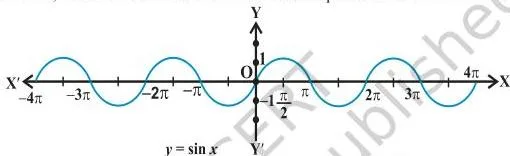
Reflecting a point across the x-axis gives the even-odd relations:
\[\sin(-x)=-\sin x,\qquad \cos(-x)=\cos x.\]
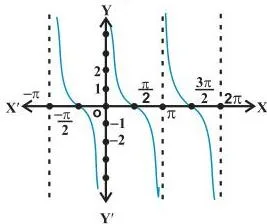
Tangent and cotangent repeat after \(\pi\), since \(\tan(\pi+x)=\tan x\).
What Each Symbol Means
| Symbol | What it means | Unit / nature |
|---|---|---|
| \(\theta\) | angle in radians in the arc-length formula | radian (dimensionless ratio) |
| \(l\) | length of the arc | length (same unit as \(r\)) |
| \(r\) | radius of the circle | length |
| \(x,\ y\) | angles, usually in radians unless a degree sign is shown | radian or degree |
| \(n\) | any integer, \(n\in\mathbf{Z}\) | count (dimensionless) |
| \(\pi\) | constant \(\approx3.14159\) | ratio (dimensionless) |
| \(\sin x,\ \cos x\) | sine and cosine of the angle \(x\) | ratio (dimensionless) |
| \(\tan x,\ \cot x\) | tangent, cotangent of \(x\) | ratio (dimensionless) |
| \(\sec x,\ \csc x\) | secant, cosecant of \(x\) | ratio (dimensionless) |
When to Use Each Formula
| Formula group | Use it when | Condition |
|---|---|---|
| Degree-radian conversion | the angle is in one unit but the formula you want needs the other | none |
| \(l=r\theta\) | you know two of arc length, radius, central angle and need the third | \(\theta\) must be in radians |
| Pythagorean identities | one trig ratio is given and you need another, or while proving an identity | division forms need the relevant function defined |
| Periodicity | the angle is larger than \(2\pi\) (or negative and large) | sine and cosine repeat after \(2\pi\); tangent after \(\pi\) |
| Even-odd relations | a negative angle appears | sine, tangent, cotangent are odd; cosine and secant are even |
| Compound-angle identities | you need the exact value of \(15^\circ,75^\circ,105^\circ\) or similar split angles | tan and cot formulas need their denominators to be non-zero |
| Double and triple angles | the expression contains \(2x\) or \(3x\) and you must expand or compress it | \(1-\tan^2x\neq0\) for \(\tan2x\), and \(\tan x\) defined |
| Sum-to-product | you have \(\sin x+\sin y\) or \(\cos x-\cos y\) and want a product | none |
| Product-to-sum | you have a product such as \(2\cos x\cos y\) and want a sum | none |
| Half-angle forms | you need \(\sin\frac{x}{2}\) or \(\cos\frac{x}{2}\) from \(\cos x\) | choose \(\pm\) sign from the quadrant of \(\frac{x}{2}\) |
Worked Examples
Worked Example 1: Finding the central angle from arc length
Step 1: Choose \(l=r\theta\) because the question gives arc length and radius and asks for the angle.
Step 2: Rearrange to \(\theta=\frac{l}{r}\).
\[\theta=\frac{16.5\ \text{cm}}{11\ \text{cm}}=1.5.\]
Final answer: \(\theta=1.5\) radians.
Worked Example 2: Reducing a large angle using periodicity
Step 1: Write \(\frac{29\pi}{6}\) as \(4\pi+\frac{5\pi}{6}\).
Since \(4\pi=2(2\pi)\), use \(\sin(2n\pi+x)=\sin x\) with \(n=2\).
\[\sin\frac{29\pi}{6}=\sin\left(4\pi+\frac{5\pi}{6}\right)=\sin\frac{5\pi}{6}.\]
Step 2: Use \(\sin(\pi-x)=\sin x\):
\[\sin\frac{5\pi}{6}=\sin\left(\pi-\frac{\pi}{6}\right)=\sin\frac{\pi}{6}=\frac{1}{2}.\]
Final answer: \(\sin\frac{29\pi}{6}=\frac{1}{2}\).
Worked Example 3: Using the tan form of cos 2x
Step 1: Since \(\tan x\) is given, use the alternative form \(\cos2x=\frac{1-\tan^2x}{1+\tan^2x}\).
Step 2: Substitute \(\tan x=\frac{1}{2}\):
\[\cos2x=\frac{1-\frac{1}{4}}{1+\frac{1}{4}}=\frac{\frac{3}{4}}{\frac{5}{4}}=\frac{3}{5}.\]
Final answer: \(\cos2x=\frac{3}{5}\).
Common Mistakes to Avoid
| Mistake | Correct rule | How to check your answer |
|---|---|---|
| Using degrees in \(l=r\theta\) | \(\theta\) must be in radians for this formula | Convert the angle to radians first, then check that \(l\) and \(r\) have the same unit |
| Taking the wrong sign after a square root | \(\sin x=\pm\sqrt{1-\cos^2x}\); choose the sign from the quadrant of \(x\) | Substitute the chosen value back into \(\sin^2x+\cos^2x=1\) and check the quadrant sign |
| Writing \(\cos(x-y)=\cos x\cos y-\sin x\sin y\) | \(\cos(x-y)=\cos x\cos y+\sin x\sin y\) | Put \(y=0\): both sides must give \(\cos x\) |
| Reducing \(\tan x\) by \(2\pi\) only | Tangent repeats after \(\pi\), so \(\tan(\pi+x)=\tan x\) | Plot or recall the graph: \(\tan\frac{4\pi}{3}=\tan\frac{\pi}{3}\) |
Frequently Asked Questions
When should I use radians instead of degrees?
Use radians whenever the formula contains \(\pi\), \(\theta\), or an arc length such as \(l=r\theta\). The conversion is \(180^\circ=\pi\) radians, so \(1^\circ=\frac{\pi}{180}\) radian.
How do I choose the sign when I use \(\sin^2x+\cos^2x=1\)?
Take \(\pm\) while solving, then decide by the quadrant in which the angle lies. For example, if \(x\) is in the third quadrant, both \(\sin x\) and \(\cos x\) are negative.
When do I use the sum-to-product formula instead of the compound-angle formula?
Use \(\sin x+\sin y=2\sin\frac{x+y}{2}\cos\frac{x-y}{2}\) when two sine terms are added or subtracted. Use the compound-angle formula when you have an angle written as a sum, such as \(\sin(45^\circ+30^\circ)\).
What is the period of tan x?
Tangent repeats after \(\pi\), not \(2\pi\), because \(\tan(\pi+x)=\tan x\). Sine and cosine repeat after \(2\pi\).
The formulas above follow the Rationalised NCERT Class 11 Mathematics textbook, Chapter 3 (Trigonometric Functions). You can verify the original chapter on ncert.nic.in.
Reference: NCERT Class 11 Mathematics textbook, chapter Trigonometric Functions.
Explore Class 11 Maths Formulas
More for this chapter:
Class 11 Maths on LearnCBSE:
Related chapters:
Official source: download the NCERT textbook free from ncert.nic.in.