
This sheet covers the formulas and definitions you need from Relations and Functions Class 11 (NCERT Mathematics, Chapter 2): Cartesian products, equality of ordered pairs, relations and their domains and ranges, the condition for a function, the standard real functions with their graphs, and the algebra of real functions.
Each group below lists the formula, what every symbol means, and when to use it. For other chapters, use the Class 11 Maths formulas hub; to browse all formula sheets, start at the formulas index.
Formulas at a Glance
The table below is the quick index. The full conditions sit in the grouped list after it.
| Purpose (what you are finding) | Formula |
|---|---|
| Cartesian product of two sets | \( A \times B = \{(a,b): a \in A, b \in B\} \) |
| Equality of two ordered pairs | \( (a,b)=(c,d) \iff a=c \text{ and } b=d \) |
| Number of elements in a Cartesian product | \( n(A \times B)=pq,\ n(A)=p,\ n(B)=q \) |
| Cartesian product with the empty set | \( A \times \varnothing = \varnothing \) |
| Ordered triple product of a set with itself | \( A \times A \times A = \{(a,b,c): a,b,c \in A\} \) |
| Relation from A to B | \( R \subseteq A \times B \) |
| Domain and range of a relation | \( \text{domain}(R)=\{a:(a,b)\in R\},\ \text{range}(R)=\{b:(a,b)\in R\} \) |
| Number of possible relations from A to B | \( 2^{n(A\times B)}=2^{pq} \) |
| Identity function | \( f(x)=x \) |
| Constant function | \( f(x)=c \) |
| Modulus function | \( f(x)=|x|=x \text{ for } x\ge 0,\ -x \text{ for } x\lt 0 \) |
| Signum function | \( f(x)=1 \text{ if } x\gt 0,\ 0 \text{ if } x=0,\ -1 \text{ if } x\lt 0 \) |
| Greatest integer function | \( f(x)=[x] \) |
| Polynomial function | \( y=a_0+a_1x+a_2x^2+\dots+a_nx^n \) |
| Rational function | \( f(x)=\frac{p(x)}{q(x)},\ q(x)\neq 0 \) |
| Linear function | \( f(x)=mx+c \) |
| Addition of real functions | \( (f+g)(x)=f(x)+g(x) \) |
| Subtraction of real functions | \( (f-g)(x)=f(x)-g(x) \) |
| Multiplication of real functions | \( (fg)(x)=f(x)g(x) \) |
| Multiplication by a scalar | \( (kf)(x)=kf(x) \) |
| Quotient of real functions | \( (f/g)(x)=\frac{f(x)}{g(x)},\ g(x)\neq 0 \) |
All Formulas, Grouped by Topic
Cartesian Product of Sets
The Cartesian product of two non-empty sets A and B is the set of all ordered pairs formed from them (NCERT, p. 1):
\[ A \times B = \{ (a,b): a \in A, b \in B \} \]
If either set is empty, the product is empty: \( A \times \varnothing = \varnothing \).
Two ordered pairs are equal only when both corresponding entries are equal:
\[ (a,b)=(c,d) \iff a=c \text{ and } b=d \]
Order matters. In general \( A \times B \neq B \times A \), though the number of pairs is the same in both products.
If \( n(A)=p \) and \( n(B)=q \), then (NCERT, p. 2):
\[ n(A \times B)=pq \]
An ordered triple comes from three copies of the same set:
\[ A \times A \times A = \{ (a,b,c): a,b,c \in A \} \]
Relations
A relation R from A to B is a subset of \( A \times B \), obtained by stating a relationship between the first and second elements of the ordered pairs (NCERT, p. 5).
The set of all first elements is the domain; the set of all second elements is the range. The whole set B is the codomain, and range is always a subset of the codomain.
\[ R \subseteq A \times B \]\[ \text{domain}(R)=\{ a:(a,b)\in R \},\quad \text{range}(R)=\{ b:(a,b)\in R \} \]
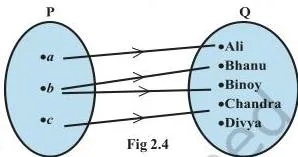
The arrow diagram above shows the relation \( R=\{(a,\text{Ali}),(b,\text{Bhanu}),(b,\text{Binoy}),(c,\text{Chandra})\} \), where the set on the left gives the domain and the targets shown on the right form the range.
The total number of relations from A to B is the number of subsets of \( A \times B \) (NCERT, p. 6):
\[ 2^{n(A\times B)}=2^{pq} \]
Functions
A relation f from A to B is a function if every element of A has one and only one image in B. Equivalently, the domain of f is the whole set A, and no two ordered pairs in f have the same first element (NCERT, p. 7).
\[ f: A \rightarrow B,\quad f(a)=b \]
Here b is called the image of a under f, and a is a preimage of b. A real function is one whose domain and range are both \( \mathbb{R} \) or subsets of \( \mathbb{R} \).
Some Functions and Their Graphs
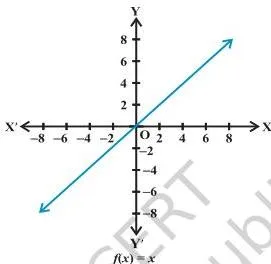
Identity function:
\[ f(x)=x,\quad x \in \mathbb{R} \]
Its domain is \( \mathbb{R} \) and its range is \( \mathbb{R} \). The graph is a straight line through the origin.
Constant function:
\[ f(x)=c,\quad x \in \mathbb{R} \]
Its domain is \( \mathbb{R} \) and its range is the single-element set \( \{c\} \). The graph is a line parallel to the x-axis.
Polynomial function:
\[ y=f(x)=a_0+a_1x+a_2x^2+\dots+a_nx^n \]
Here n is a non-negative integer and \( a_0,a_1,\dots,a_n \in \mathbb{R} \). A function such as \( x^{2/3}+2x \) is not a polynomial because the exponent \( 2/3 \) is not a non-negative integer (NCERT, p. 9).
Rational function:
\[ f(x)=\frac{p(x)}{q(x)},\quad q(x)\neq 0 \]
Both \( p(x) \) and \( q(x) \) are polynomials. The domain is all real numbers except the zeros of \( q(x) \).
Modulus function:
\[ f(x)=|x|=x \text{ for } x\ge 0,\quad -x \text{ for } x\lt 0 \]
So \( |5|=5 \) and \( |-5|=5 \). The modulus function keeps non-negative values.
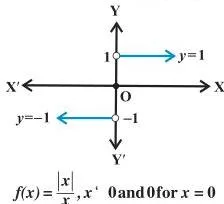
Signum function:
\[ f(x)=1 \text{ if } x\gt 0,\quad 0 \text{ if } x=0,\quad -1 \text{ if } x\lt 0 \]
Its domain is \( \mathbb{R} \) and its range is the set \( \{-1,0,1\} \) (NCERT, p. 13).
Greatest integer function:
\[ f(x)=[x]=\text{the greatest integer } \le x \]
For example, \( [-1]=-1 \), \( [0]=0 \), \( [1]=1 \), and \( [-0.5]=-1 \) because -1 is the greatest integer less than or equal to -0.5.
![Step graph of the greatest integer function f(x) = [x], constant on each unit interval](https://www.learncbse.net/images/relations-and-functions-the-graph-of-the-function-is-shown-in-fig-2-15.webp "Relations and Functions Class 11 Formulas")
Linear function: a function of the form
\[ f(x)=mx+c,\quad x \in \mathbb{R} \]
where m and c are constants. It is the general form of a straight-line graph (NCERT, p. 15).
Algebra of Real Functions
For two real functions \( f:X\rightarrow \mathbb{R} \) and \( g:X\rightarrow \mathbb{R} \) with \( X\subseteq \mathbb{R} \), the following operations are defined for all \( x\in X \) (NCERT, p. 18):
\[ (f+g)(x)=f(x)+g(x) \]\[ (f-g)(x)=f(x)-g(x) \]\[ (fg)(x)=f(x)g(x) \]\[ (kf)(x)=kf(x),\quad k\in\mathbb{R} \]\[ (f/g)(x)=\frac{f(x)}{g(x)},\quad g(x)\neq 0 \]
The quotient formula is valid only where the denominator is not zero; that condition must be written whenever you use it.
What Each Symbol Means
| Symbol | What it means | Unit / nature |
|---|---|---|
| \( A, B, P, Q, X \) | Sets used as domain, codomain or starting sets | Set |
| \( a, b, c, d, x, y \) | Elements of sets | Element |
| \( (a,b) \) | Ordered pair: a first, b second | Paired elements |
| \( A \times B \) | Cartesian product of A and B | Set of ordered pairs |
| \( n(A),\ p \) | Number of elements in set A | Count |
| \( n(B),\ q \) | Number of elements in set B | Count |
| \( R \) | A relation, a subset of \( A\times B \) | Set of ordered pairs |
| \( \text{domain}(R) \) | Set of all first elements of the ordered pairs in R | Set |
| \( \text{range}(R) \) | Set of all second elements of the ordered pairs in R | Set |
| \( f:A\rightarrow B \) | Function from A to B; every element of A has exactly one image | Mapping |
| \( f(x),\ y \) | Image of x under f | Element / real number |
| \( c \) | Constant value | Real number |
| \( m \) | Coefficient of x in a linear function | Real number |
| \( a_0,a_1,\dots,a_n \) | Coefficients of a polynomial | Real numbers |
| \( n \) | Degree bound of a polynomial, a non-negative integer | Non-negative integer |
| \( k \) | Scalar multiplier | Real number |
| \( |x| \) | Modulus of x | Non-negative real number |
| \( [x] \) | Greatest integer less than or equal to x | Integer |
| \( \mathbb{R} \) | Set of all real numbers | Number system |
When to Use Each Formula
| Formula | Use it when… |
|---|---|
| \( A\times B=\{(a,b):a\in A,b\in B\} \) | You need to list all ordered pairs from two sets, or to define a relation on that product. |
| \( n(A\times B)=pq \) | You only need the number of ordered pairs and you know \( n(A) \) and \( n(B) \). |
| \( (a,b)=(c,d) \iff a=c, b=d \) | You are given two equal ordered pairs and must find unknown entries. |
| \( R\subseteq A\times B \) | You are asked whether a given set of pairs is a relation, or to write a relation in roster or set-builder form. |
| \( \text{domain}(R),\text{range}(R) \) | You must find the domain, range or codomain of a relation or function. |
| \( 2^{pq} \) | You are asked for the total number of relations that can be defined from A to B. |
| Function condition: one and only one image | You must decide whether a relation is a function; check that no first element repeats with different second elements. |
| \( f(x)=|x|,\ f(x)=[x] \), signum | You are evaluating or sketching standard piecewise-type functions, especially for negative inputs. |
| Algebra of functions | You have two real functions on the same domain and need \( f+g \), \( f-g \), \( fg \), \( kf \) or \( f/g \). |
Worked Examples
Worked Example 1: Counting ordered pairs and relations
Step 1: Let \( A=\{2,4,6\} \) and \( B=\{1,3,5,7\} \).
Here \( n(A)=3 \) and \( n(B)=4 \).
Step 2: Use \( n(A\times B)=n(A)n(B) \).
\[ n(A\times B)=3\times 4=12 \]
Step 3: Since every subset of \( A\times B \) is a relation from A to B, the number of relations is \( 2^{12}=4096 \).
Final answer: \( A\times B \) has 12 elements and 4096 relations can be defined from A to B.
Worked Example 2: Checking whether a relation is a function
Step 1: Take \( R=\{(1,4),(2,4),(3,6),(4,8)\} \) from \( A=\{1,2,3,4\} \) to \( B=\{2,3,4,5,6,7,8\} \).
Step 2: The definition requires every element of A to have exactly one image.
The first elements are 1, 2, 3 and 4, each appearing once, so no first element has two different images.
Step 3: Domain = first elements \( =\{1,2,3,4\} \); range = second elements \( =\{4,6,8\} \); codomain = B = \( \{2,3,4,5,6,7,8\} \).
Final answer: R is a function, with range \( \{4,6,8\} \subseteq B \).
Worked Example 3: Algebra of real functions
Step 1: Let \( f(x)=x^2 \) and \( g(x)=x+1 \), both defined on \( \mathbb{R} \).
Step 2: Apply the operation formulas pointwise.
\[ (f+g)(x)=x^2+(x+1)=x^2+x+1 \]\[ (f-g)(x)=x^2-(x+1)=x^2-x-1 \]\[ (fg)(x)=x^2(x+1)=x^3+x^2 \]\[ \left(\frac{f}{g}\right)(x)=\frac{x^2}{x+1},\quad x\neq -1 \]
Step 3: The last formula is invalid at \( x=-1 \) because the denominator becomes zero.
Final answer: \( (f+g)(x)=x^2+x+1 \), \( (f-g)(x)=x^2-x-1 \), \( (fg)(x)=x^3+x^2 \), and \( (f/g)(x)=\frac{x^2}{x+1} \) for \( x\neq -1 \).
Practise these same formulas on the exercises at the end of Chapter 2 in the textbook.
Common Mistakes to Avoid
| Mistake | Correct rule | How to check your answer |
|---|---|---|
| Calling every relation a function | A function needs every element of the domain A to have exactly one image in B. | Scan the first elements: if the same first element appears with two different second elements, it is not a function. |
| Writing the range as the whole codomain B | Range is the set of second elements actually used; range is always a subset of the codomain. | List all second elements separately. If some elements of B never appear, they are not in the range. |
| Answering \( pq \) when the question asks for the number of relations | The number of relations is the number of subsets of \( A\times B \), so it is \( 2^{pq} \). | If \( n(A\times B)=6 \), the number of relations is \( 2^6=64 \), not 6. |
| Forgetting the denominator condition in a quotient function | \( (f/g)(x) \) is defined only where \( g(x)\neq 0 \). | Write the forbidden x-values whenever a fraction appears in an answer. |
| Using \( [x]=0 \) for all numbers between -1 and 0 | \( [x] \) is the greatest integer less than or equal to x, so \( [-0.5]=-1 \). | Test a negative non-integer, e.g. \( [-1.2] \): it must be -2, not -1 or 0. |
Frequently Asked Questions
Is every relation a function?
No. A relation is a function only when every element of the domain set has exactly one image. For example, \( \{(1,2),(1,3)\} \) is a relation but not a function, because 1 has two images.
What is the difference between range and codomain?
The codomain is the whole target set B. The range is the set of images that are actually used by the function. Since every image belongs to B, the range is always a subset of the codomain.
What does the formula \( 2^{pq} \) count?
It counts the total number of relations from A to B. Because \( A\times B \) has \( pq \) ordered pairs and every subset of \( A\times B \) is a relation, the number of subsets is \( 2^{pq} \).
How do I evaluate the greatest integer function for negative numbers?
Take the greatest integer that is less than or equal to x. For \( x=-1.2 \), that integer is \( -2 \), so \( [-1.2]=-2 \).
Reference: NCERT Class 11 Mathematics textbook, chapter Relations and Functions. The official textbook is available at ncert.nic.in.
Explore Class 11 Maths Formulas
More for this chapter:
Class 11 Maths on LearnCBSE:
Related chapters:
Official source: download the NCERT textbook free from ncert.nic.in.