This sheet collects the ray optics and optical instruments class 12 formulas you need for quick revision of Chapter 9: reflection by spherical mirrors, refraction and Snell’s law, total internal reflection, refraction at spherical surfaces, thin lenses and lens power, the prism, and the microscope and telescope.
Each formula is grouped by topic with its symbols, units, a when-to-use line, and worked examples using original numbers. For other chapters in the same format, see the Class 12 Physics formula sheets; to find any chapter quickly, use the formula sheet index.
Ray Optics and Optical Instruments Class 12 Formulas at a Glance
| Purpose (what you are finding) | Formula |
|---|---|
| Focal length of a spherical mirror | \( f = \frac{R}{2} \) |
| Mirror equation: image position for a spherical mirror | \( \frac{1}{v} + \frac{1}{u} = \frac{1}{f} \) |
| Mirror magnification | \( m = \frac{h’}{h} = -\frac{v}{u} \) |
| Snell’s law of refraction | \( \frac{\sin i}{\sin r} = n_{21} \) |
| Critical angle, ray going from denser to rarer medium | \( \sin i_c = n_{21} \) |
| Apparent depth when viewing normally into a medium | \( h_1 = \frac{h_2}{n} \) |
| Refraction at a single spherical surface | \( \frac{n_2}{v} – \frac{n_1}{u} = \frac{n_2 – n_1}{R} \) |
| Lens maker’s formula | \( \frac{1}{f} = (n_{21} – 1)\left(\frac{1}{R_1} – \frac{1}{R_2}\right) \) |
| Thin lens formula | \( \frac{1}{v} – \frac{1}{u} = \frac{1}{f} \) |
| Lens magnification | \( m = \frac{h’}{h} = \frac{v}{u} \) |
| Power of a lens | \( P = \frac{1}{f} \) |
| Effective focal length of thin lenses in contact | \( \frac{1}{f} = \frac{1}{f_1} + \frac{1}{f_2} + \dots \) |
| Power of thin lenses in contact | \( P = P_1 + P_2 + \dots \) |
| Total magnification of a lens combination | \( m = m_1 m_2 \dots \) |
| Prism: relation between the two refracted angles | \( r_1 + r_2 = A \) |
| Prism: angle of deviation | \( \delta = i + e – A \) |
| Prism: refractive index at minimum deviation | \( n_{21} = \frac{\sin[(A + D_m)/2]}{\sin(A/2)} \) |
| Thin prism deviation | \( D_m = (n_{21} – 1)A \) |
| Simple microscope, image at the near point | \( m = 1 + \frac{D}{f} \) |
| Simple microscope, image at infinity | \( m = \frac{D}{f} \) |
| Compound microscope, approximate magnifying power | \( m = \frac{L}{f_o} \cdot \frac{D}{f_e} \) |
| Telescope, magnifying power | \( m = \frac{f_o}{f_e} \) |
All Formulas, Grouped by Topic
Reflection by Spherical Mirrors
Every distance below is measured from the pole P of the mirror, following the Cartesian sign convention (NCERT, p. 222): distances in the direction of incident light are positive, distances opposite to it are negative, and heights above the principal axis are positive. The diagram shows the convention in the form used for both mirrors and lenses.
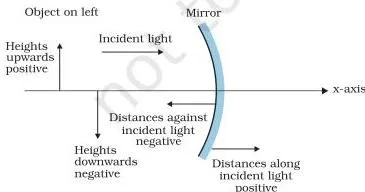
Focal length of a spherical mirror (paraxial rays, NCERT pp. 223–224):
\[ f = \frac{R}{2} \]
Paraxial rays are rays close to the pole making small angles with the principal axis. For a concave mirror the reflected rays actually meet at the focus; for a convex mirror they appear to diverge from it.
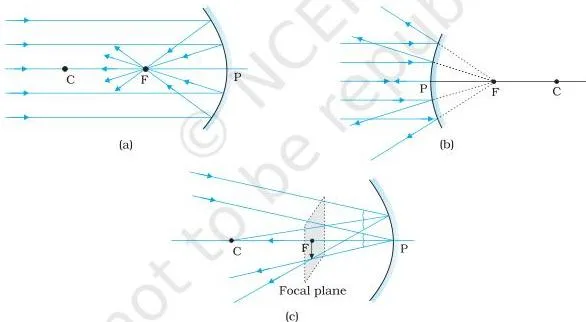
The geometry in Fig. 9.4 is what proves the relation: for a small angle of incidence \( \theta \), the distance \( FD = CD/2 \), which becomes \( f = R/2 \) because \( D \) lies very close to the pole.
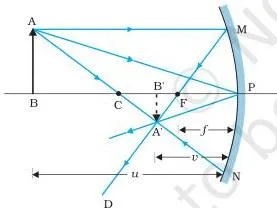
Mirror equation (NCERT, p. 225):
\[ \frac{1}{v} + \frac{1}{u} = \frac{1}{f} \]
It is valid for concave and convex mirrors, and for real and virtual images, provided the sign convention is applied. A rearranged (derived) form used for finding the image distance directly is \( v = \frac{fu}{u – f} \).
Linear magnification by a mirror:
\[ m = \frac{h’}{h} = -\frac{v}{u} \]
A negative \( m \) means the image is real and inverted; a positive \( m \) means it is virtual and erect.
Refraction and Snell’s Law
Snell’s law (NCERT, p. 228):
\[ \frac{\sin i}{\sin r} = n_{21} \]
Here \( n_{21} \) is the refractive index of the second medium with respect to the first. If \( n_{21} \gt 1 \) the refracted ray bends towards the normal; if \( n_{21} \lt 1 \) it bends away from it. The incident ray, refracted ray and normal lie in one plane.
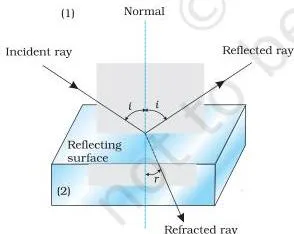
Reversing the pair of media gives \( n_{12} = \frac{1}{n_{21}} \). For normal viewing into a medium, the apparent depth \( h_1 \) is the real depth \( h_2 \) divided by the refractive index of the medium (NCERT, p. 229):
\[ h_1 = \frac{h_2}{n} \]
Total Internal Reflection
When a ray travels from a denser medium 1 to a rarer medium 2, the critical angle \( i_c \) is the angle of incidence for which the angle of refraction is \( 90^\circ \) (NCERT, p. 230):
\[ \sin i_c = n_{21} \qquad \left(n_{21} = \frac{n_{\text{rarer}}}{n_{\text{denser}}} \lt 1\right) \]
Equivalently, \( n_{12} = \frac{1}{\sin i_c} \) for the denser medium relative to the rarer one. For incidence \( i \gt i_c \), Snell’s law cannot be satisfied and the ray is totally reflected with no transmission.
| Substance medium (to air) | Refractive index | Critical angle |
|---|---|---|
| Water | 1.33 | \( 48.75^\circ \) |
| Crown glass | 1.52 | \( 41.14^\circ \) |
| Dense flint glass | 1.62 | \( 37.31^\circ \) |
| Diamond | 2.42 | \( 24.41^\circ \) |
These are the values in NCERT Table 9.1 (p. 230); diamond’s very small critical angle is why it sparkles through repeated internal reflections.
Refraction at a Spherical Surface
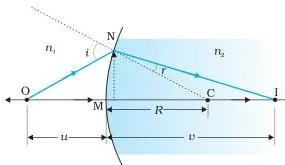
For a single spherical surface of radius \( R \) separating medium \( n_1 \) (incident side) from medium \( n_2 \) (refracted side) (NCERT, p. 233):
\[ \frac{n_2}{v} – \frac{n_1}{u} = \frac{n_2 – n_1}{R} \]
This is the bridge between the plane-interface results and the thin lens formulas, which are obtained by applying it successively at the two surfaces of the lens.
Thin Lenses
Lens maker’s formula (NCERT, p. 234):
\[ \frac{1}{f} = (n_{21} – 1)\left(\frac{1}{R_1} – \frac{1}{R_2}\right) \]
Here \( n_{21} = n_2/n_1 \) is the refractive index of the lens material relative to its surroundings, and \( R_1, R_2 \) carry signs: for a double convex lens \( R_1 \gt 0 \), \( R_2 \lt 0 \), so \( f \) comes out positive. The formula is used to design a lens of desired focal length from chosen radii.
Thin lens formula (NCERT, p. 235):
\[ \frac{1}{v} – \frac{1}{u} = \frac{1}{f} \]
It holds for convex and concave lenses and for real and virtual images, with the sign convention applied.
Linear magnification by a lens:
\[ m = \frac{h’}{h} = \frac{v}{u} \]
Power of a Lens
Power measures how strongly a lens converges or diverges light (NCERT, p. 236):
\[ P = \frac{1}{f} \]
with \( f \) in metres. The SI unit is the dioptre: \( 1\ \text{D} = 1\ \text{m}^{-1} \). A converging (convex) lens has positive power; a diverging (concave) lens has negative power.
Combination of Thin Lenses in Contact
For lenses of focal lengths \( f_1, f_2, f_3, \dots \) in contact, the combination acts like a single lens of focal length \( f \) (NCERT, pp. 237–238):
\[ \frac{1}{f} = \frac{1}{f_1} + \frac{1}{f_2} + \frac{1}{f_3} + \dots \]
In terms of power, \[ P = P_1 + P_2 + P_3 + \dots \]
where the sum is algebraic (convex lenses positive, concave lenses negative). Because the image of one lens is the object of the next, the total magnification is the product:
\[ m = m_1 m_2 m_3 \dots \]
Refraction Through a Prism
For a prism of angle \( A \) (NCERT, p. 239):
\[ r_1 + r_2 = A \qquad \text{and} \qquad \delta = i + e – A \]
where \( r_1, r_2 \) are the angles of refraction at the two faces and \( \delta \) is the total deviation. At the angle of minimum deviation \( D_m \), the refracted ray inside the prism is parallel to the base, giving \( r = A/2 \) and \( i = (A + D_m)/2 \). The refractive index is then (NCERT, p. 240):
\[ n_{21} = \frac{\sin[(A + D_m)/2]}{\sin(A/2)} \]
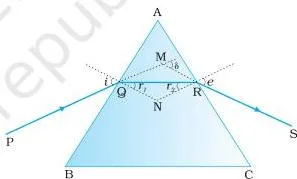
For a thin prism, the sine ratio can be replaced by the angle ratio, giving the small-angle result \( D_m = (n_{21} – 1)A \).
Optical Instruments
Simple microscope (converging lens, \( D = 25\ \text{cm} \), NCERT p. 242):
\[ m = 1 + \frac{D}{f} \quad (\text{image at near point}) \qquad \quad m = \frac{D}{f} \quad (\text{image at infinity}) \]
Compound microscope (objective and eyepiece, final image at infinity) (NCERT, p. 244):
\[ m = \frac{L}{f_o} \cdot \frac{D}{f_e} \]
where \( L \) is the tube length and \( f_o, f_e \) are the focal lengths of the objective and eyepiece. Small \( f_o \) and \( f_e \) give large magnification.
Telescope for distant objects (NCERT, p. 244):
\[ m = \frac{f_o}{f_e} \qquad \text{with tube length} = f_o + f_e \]
What Each Symbol Means
| Symbol | What it means | Unit |
|---|---|---|
| \( u \) | Object distance from the pole / optical centre | m (cm in numericals) |
| \( v \) | Image distance from the pole / optical centre | m (cm in numericals) |
| \( f \) | Focal length | m (cm in numericals) |
| \( R \) | Radius of curvature of a spherical surface | m (cm) |
| \( h \) | Object height | m (cm) |
| \( h’ \) | Image height | m (cm) |
| \( m \) | Linear magnification | dimensionless |
| \( n_1, n_2 \) | Refractive indices of the incident and refracted media | dimensionless |
| \( n_{21} \) | Refractive index of medium 2 relative to medium 1 | dimensionless |
| \( i, r \) | Angle of incidence, angle of refraction | degrees |
| \( i_c \) | Critical angle | degrees |
| \( A \) | Angle of the prism | degrees |
| \( D_m \) | Angle of minimum deviation | degrees |
| \( \delta \) | Angle of deviation | degrees |
| \( P \) | Power of a lens | dioptre (D), \( 1\ \text{D} = 1\ \text{m}^{-1} \) |
| \( D \) | Least distance of distinct vision | 25 cm |
| \( f_o, f_e \) | Focal lengths of objective and eyepiece | m (cm) |
| \( L \) | Tube length of a compound microscope | m (cm) |
| \( h_1, h_2 \) | Apparent depth and real depth | m (cm) |
When to Use Each Formula
| Situation | Formula | Condition |
|---|---|---|
| Find the focal length of a spherical mirror from its radius | \( f = R/2 \) | Paraxial rays |
| Find the image position for a spherical mirror | \( \frac{1}{v} + \frac{1}{u} = \frac{1}{f} \) | Apply the Cartesian sign convention; works for both mirror types and both image types |
| Judge size and nature of a mirror image | \( m = -v/u \) | Negative \( m \) = real and inverted; positive \( m \) = virtual and erect |
| Refraction at a plane interface | \( \frac{\sin i}{\sin r} = n_{21} \) | Any pair of media; independent of angle of incidence |
| Apparent depth / raised-bottom problems | \( h_1 = h_2/n \) | Viewing nearly along the normal |
| Decide whether total internal reflection occurs | \( \sin i_c = n_{21} \) | Denser to rarer medium; TIR when \( i \gt i_c \) |
| Image at a single spherical refracting surface | \( \frac{n_2}{v} – \frac{n_1}{u} = \frac{n_2 – n_1}{R} \) | One curved surface only |
| Design a lens of a desired focal length | Lens maker’s formula | Know \( n_{21} \) and both radii of curvature |
| Image position for a thin lens | \( \frac{1}{v} – \frac{1}{u} = \frac{1}{f} \) | Convex or concave; real or virtual image |
| Power of a lens from focal length | \( P = 1/f \) | \( f \) in metres; convex positive, concave negative |
| Two or more thin lenses touching | \( \frac{1}{f} = \sum \frac{1}{f_i} \), \( P = \sum P_i \), \( m = m_1 m_2 \dots \) | Optical centres coincident; powers add algebraically |
| Prism geometry | \( r_1 + r_2 = A \) | Any prism |
| Deviation by a prism | \( \delta = i + e – A \) | Same \( \delta \) occurs for two values of \( i \) except at minimum deviation |
| Refractive index of a prism material | \( n_{21} = \frac{\sin[(A + D_m)/2]}{\sin(A/2)} \) | Measured \( A \) and \( D_m \) at minimum deviation |
| Simple microscope | \( 1 + D/f \) or \( D/f \) | First for image at near point, second for image at infinity (relaxed eye) |
| Compound microscope | \( m = \frac{L}{f_o} \cdot \frac{D}{f_e} \) | Approximate; small \( f_o \) and \( f_e \) give high magnification |
| Telescope viewing distant objects | \( m = f_o/f_e \) | Normal adjustment, tube length \( f_o + f_e \) |
Worked Examples
Example 1: Object in front of a concave mirror
Step 1: An object is placed 20 cm in front of a concave mirror of focal length 12 cm.
Choose the mirror equation \( \frac{1}{v} + \frac{1}{u} = \frac{1}{f} \).
The mirror is concave, so \( f = -12\ \text{cm} \); the object is opposite to the incident light, so \( u = -20\ \text{cm} \).
Step 2: Substitute and solve for \( v \):
\[ \frac{1}{v} = \frac{1}{f} – \frac{1}{u} = -\frac{1}{12} + \frac{1}{20} = -\frac{1}{30} \]
\[ v = -30\ \text{cm} \]
Step 3: Magnification for a mirror is \( m = -v/u \):
\[ m = -\frac{(-30)}{(-20)} = -1.5 \]
Final answer: The image is 30 cm in front of the mirror (same side as the object). \( m = -1.5 \) means the image is real, inverted and 1.5 times the object size.
Example 2: Working backwards with the lens formula
Step 1: A convex lens of focal length 10 cm produces a virtual, erect image twice the object size.
For a lens, \( m = v/u \).
An erect image gives \( m = +2 \), so \( v = 2u \).
Step 2: Apply the sign convention: a real object has \( u \lt 0 \) and a virtual image is on the same side, so \( v \lt 0 \).
Write \( u = -x \) and \( v = -2x \).
Step 3: Use the thin lens formula \( \frac{1}{v} – \frac{1}{u} = \frac{1}{f} \):
\[ \frac{1}{-2x} – \frac{1}{-x} = \frac{1}{10} \;\Rightarrow\; \frac{1}{x} – \frac{1}{2x} = \frac{1}{10} \;\Rightarrow\; x = 5\ \text{cm} \]
Final answer: The object is 5 cm from the lens, between the optical centre and the focus — the region that gives a virtual, magnified and erect image.
Example 3: Refractive index of a prism at minimum deviation
Step 1: A prism of angle \( 60^\circ \) gives minimum deviation \( 36^\circ \).
At minimum deviation the refracted ray inside the prism is parallel to the base, so use \[ n_{21} = \frac{\sin[(A + D_m)/2]}{\sin(A/2)} \]
Step 2: Substitute \( A = 60^\circ \) and \( D_m = 36^\circ \):
\[ n = \frac{\sin 48^\circ}{\sin 30^\circ} = \frac{0.7431}{0.5} = 1.49 \]
Final answer: The refractive index of the prism material is approximately 1.49 (dimensionless).
Common Mistakes to Avoid
| Mistake | Correct rule | How to check your answer |
|---|---|---|
| Writing the object distance as positive, e.g. \( u = +20\ \text{cm} \) | Under the Cartesian sign convention the object lies opposite to the incident light, so every real object in front of a mirror or lens has \( u \lt 0 \). | A real image formed by a concave mirror must come out with \( v \lt 0 \). If your working gives a positive \( v \) for that case, recheck the sign of \( u \). |
| Using the lens formula as \( \frac{1}{v} + \frac{1}{u} = \frac{1}{f} \) | The lens formula is \( \frac{1}{v} – \frac{1}{u} = \frac{1}{f} \); the plus sign belongs to the mirror equation. | Place an object at \( 2f \) of a convex lens: \( v \) must be \( +2f \). Only the minus form gives that. |
| Taking both \( R_1 \) and \( R_2 \) positive in the lens maker’s formula | For a double convex lens \( R_1 \gt 0 \), \( R_2 \lt 0 \); the signs reverse for a double concave lens. | For a convex glass lens in air, the formula must give \( f \gt 0 \). If it comes out negative, \( R_2 \) has the wrong sign. |
| Writing \( \sin i_c = n \) with the denser medium index, so \( \sin i_c \gt 1 \) | For a denser-to-rarer ray, \( \sin i_c = \frac{n_{\text{rarer}}}{n_{\text{denser}}} \), which is always less than 1. | Water to air: \( \sin i_c = 1/1.33 \) gives \( i_c \approx 48.75^\circ \), matching NCERT Table 9.1. An arcsine error means the ratio was inverted. |
| Putting focal length in centimetres into \( P = 1/f \) | Power needs \( f \) in metres: \( P = \frac{1}{f(\text{m})} \). A 40 cm convex lens has \( P = +2.5\ \text{D} \). | The unit of power is dioptre, \( 1\ \text{D} = 1\ \text{m}^{-1} \). Convert cm to m before taking the reciprocal. |
Frequently Asked Questions
When do I use the mirror equation and when the lens formula?
The mirror equation \( \frac{1}{v} + \frac{1}{u} = \frac{1}{f} \) is for reflection by spherical mirrors. The thin lens formula \( \frac{1}{v} – \frac{1}{u} = \frac{1}{f} \) is for refraction by thin lenses.
The mirror equation comes from the geometry of a single reflection, while the lens formula combines refraction at the two lens surfaces — that is why one has a plus and the other a minus. Apply the sign convention before substituting in either.
What is the sign of the focal length for convex and concave devices?
| Device | Sign of \( f \) |
|---|---|
| Concave mirror | negative |
| Convex mirror | positive |
| Convex (converging) lens | positive |
| Concave (diverging) lens | negative |
For lenses, converging is positive and diverging is negative. For mirrors, the sign follows the side on which the focus lies: the focus of a concave mirror is on the incident side (negative), while that of a convex mirror is behind it (positive).
Why does the magnification formula differ for mirrors and lenses?
Both use \( m = h’/h \). For a mirror \( m = -v/u \), and for a lens \( m = v/u \). The extra minus in the mirror case compensates for \( v \) being negative for a real mirror image but positive for a real lens image.
Both formulas give a negative \( m \) for a real, inverted image and a positive \( m \) for a virtual, erect image.
What is the condition for total internal reflection?
Two conditions must hold together: light must travel from a denser to a rarer medium, and the angle of incidence must exceed the critical angle, \( i \gt i_c \). At \( i = i_c \) the refracted ray grazes the interface; for \( i \gt i_c \) refraction is impossible and the ray is reflected with no transmission.
You can verify the critical-angle values in the official textbook PDF at ncert.nic.in.
Reference: NCERT Class 12 Physics textbook, Chapter 9 – Ray Optics and Optical Instruments.
Explore Class 12 Physics Formulas
More for this chapter:
Class 12 Physics on LearnCBSE:
Related chapters: