
This page collects the motion in a straight line Class 11 formulas from NCERT Chapter 2 of Physics Part I — the equations you plug numbers into. It covers average and instantaneous velocity, average speed, average and instantaneous acceleration, the kinematic equations for uniformly accelerated motion, and their free-fall, stopping-distance and reaction-time forms.
Each formula is grouped by the textbook sub-topic it belongs to, with the meaning and SI unit of every symbol and a line on when to use it. Three worked examples with fresh numbers show the substitution, the sign convention and the answer with its unit.
Equation numbering follows the Rationalised NCERT textbook, available on the official NCERT website. This sheet is part of the Class 11 physics formulas collection.
Motion in a Straight Line Class 11 Formulas at a Glance
This table is the index of the sheet: every formula on this page, in the order the chapter develops them.
| Purpose | Formula |
|---|---|
| Instantaneous velocity at an instant | \(v = \lim_{\Delta t \to 0}\frac{\Delta x}{\Delta t} = \frac{dx}{dt}\) |
| Average velocity over a time interval | \(\bar{v} = \frac{\Delta x}{\Delta t}\) |
| Average speed (total path length per time) | \(\text{average speed} = \frac{\text{total path length}}{\Delta t}\) |
| Average acceleration over a time interval | \(\bar{a} = \frac{\Delta v}{\Delta t}\) |
| Instantaneous acceleration | \(a = \lim_{\Delta t \to 0}\frac{\Delta v}{\Delta t} = \frac{dv}{dt}\) |
| Velocity at time \(t\), constant acceleration | \(v = v_0 + at\) |
| Position at time \(t\), constant acceleration | \(x = x_0 + v_0t + \frac{1}{2}at^2\) |
| Velocity–displacement relation, constant acceleration | \(v^2 = v_0^2 + 2a(x – x_0)\) |
| Displacement using average velocity (constant acceleration only) | \(x = \frac{v_0 + v}{2}t\) |
| Free fall from rest (upward positive) | \(v = -gt;\quad y = -\frac{1}{2}gt^2\) |
| Stopping distance (from the velocity–displacement relation with \(v = 0\)) | \(d_v = \frac{v_0^2}{2|a|}\) |
| Reaction time (from free fall from rest) | \(t_r = \sqrt{\frac{2d}{g}}\) |
| Displacement from a \(v\)-\(t\) graph | area under the \(v\)-\(t\) curve between \(t_1\) and \(t_2\) |
| Velocity or acceleration from a graph | slope of the tangent to the \(x\)-\(t\) or \(v\)-\(t\) curve |
All Formulas, Grouped by Topic
Grouping follows the sub-topics of the chapter. All formulas come from NCERT sections 2.2–2.4.
Instantaneous Velocity and Speed
Average velocity over an interval uses two position readings (NCERT, p. 15):
\[ \bar{v} = \frac{\Delta x}{\Delta t} = \frac{x(t_2) – x(t_1)}{t_2 – t_1} \]
Instantaneous velocity is the limit of the average velocity as the interval shrinks to zero (NCERT, p. 15):
\[ v = \lim_{\Delta t \to 0}\frac{\Delta x}{\Delta t} = \frac{dx}{dt} \]
Average speed uses the total path length, not the displacement. Instantaneous speed is the magnitude of velocity (NCERT, pp. 15, 23):
\[ \text{Average speed} = \frac{\text{total path length}}{\text{time interval}}, \qquad \text{speed} = |v| \]
Over any finite interval (NCERT, p. 15):
\[ \text{Average speed} \geq |\bar{v}| \]
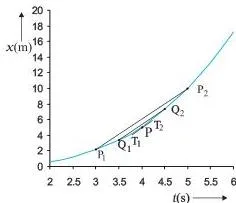
As \(\Delta t \to 0\), the line joining two close points of the position-time curve becomes the tangent at that point, and its slope is \(dx/dt\) (NCERT, p. 15):
Acceleration
Acceleration is the rate of change of velocity with time. Galileo concluded this from studies of falling objects and motion on inclined planes (NCERT, p. 16).
Average acceleration over an interval:
\[ \bar{a} = \frac{v_2 – v_1}{t_2 – t_1} = \frac{\Delta v}{\Delta t} \]
Instantaneous acceleration is the limit of the average acceleration (NCERT, p. 16):
\[ a = \lim_{\Delta t \to 0}\frac{\Delta v}{\Delta t} = \frac{dv}{dt} \]
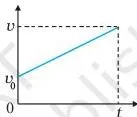
The SI unit of acceleration is \(\text{m s}^{-2}\). On a \(v\)-\(t\) plot, \(\bar{a}\) is the slope of the line joining \((v_1, t_1)\) and \((v_2, t_2)\); \(a\) is the slope of the tangent at an instant (NCERT, p. 16).
If a particle is speeding up, acceleration points along the velocity; if slowing down, it points opposite to the velocity (NCERT, p. 24).
Kinematic Equations for Uniformly Accelerated Motion
These equations connect displacement \(x\), time \(t\), initial velocity \(v_0\), final velocity \(v\) and acceleration \(a\). They hold only while acceleration is constant in magnitude and direction (NCERT, p. 18).
\[ v = v_0 + at \]
\[ x = x_0 + v_0t + \frac{1}{2}at^2 \]
\[ v^2 = v_0^2 + 2a(x – x_0) \]
When the particle is at the origin at \(t = 0\) (\(x_0 = 0\)), the simpler forms follow (NCERT, p. 18):
\[ x = v_0t + \frac{1}{2}at^2, \qquad v^2 = v_0^2 + 2ax \]
Displacement equals average velocity times time. The average is the arithmetic mean of the initial and final velocities — constant acceleration only (NCERT, p. 18):
\[ x = \bar{v}t = \frac{v_0 + v}{2}t, \qquad \bar{v} = \frac{v_0 + v}{2} \]
The textbook derives these by calculus in Example 2.2; the same set follows from the area under the \(v\)-\(t\) graph (NCERT, p. 18).
Free Fall, Stopping Distance and Reaction Time
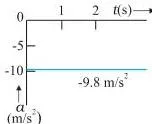
Free fall is motion under gravity alone, with air resistance neglected. Near the Earth’s surface \(g\) is constant, \(9.8\ \text{m s}^{-2}\) (NCERT, p. 20). With upward chosen positive:
\[ a = -g = -9.8\ \text{m s}^{-2} \]
For an object released from rest (\(v_0 = 0\)) at the origin, the equations become (NCERT, p. 20):
\[ v = -gt, \qquad y = -\frac{1}{2}gt^2, \qquad v^2 = -2gy \]
Stopping distance: put \(v = 0\) in \(v^2 = v_0^2 + 2a(x – x_0)\). Since \(a\) is negative during braking, the distance is positive (NCERT, p. 21):
\[ d_v = \frac{-v_0^2}{2a} = \frac{v_0^2}{2|a|} \]
Stopping distance is proportional to the square of the initial speed: doubling \(v_0\) quadruples \(d_v\) for the same deceleration (NCERT, p. 21).
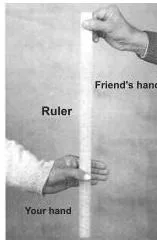
Reaction time from the ruler-drop experiment: the ruler falls from rest, so \(d = \frac{1}{2}gt_r^2\), giving (NCERT, p. 21):
\[ t_r = \sqrt{\frac{2d}{g}} \]
Galileo’s law of odd numbers: a body falling from rest covers distances in successive equal time intervals in the ratio \(1 : 3 : 5 : 7 : \dots\) (NCERT, pp. 20-21).
The free-fall equations above are plotted in Fig. 2.7: acceleration stays constant, velocity falls linearly with time, and distance grows as \(t^2\) (NCERT, p. 20).
The ruler-drop experiment works because the ruler, once released, is in free fall — the distance it falls decides the reaction time (NCERT, p. 21).
Reading Motion from Graphs
Two graph readings carry the formulas (NCERT, pp. 15-17):
- Slope of the tangent on the \(x\)-\(t\) graph at an instant = instantaneous velocity; on the \(v\)-\(t\) graph = instantaneous acceleration.
- Area under the \(v\)-\(t\) curve between two instants = displacement over that interval (NCERT, p. 17).
Shape guide for the standard cases (NCERT, p. 22):
| Motion | \(x\)-\(t\) graph | \(v\)-\(t\) graph |
|---|---|---|
| Uniform motion (\(a = 0\)) | straight line inclined to the time axis | straight line parallel to the time axis |
| Uniformly accelerated motion | parabola | straight line inclined to the time axis |
The area rule is easiest to see for constant velocity \(u\): the \(v\)-\(t\) graph is a horizontal line, the area is the rectangle \(u \times T\), which is exactly the displacement (NCERT, p. 17).
What Each Symbol Means
Symbols use the textbook’s notation. Units are SI; the dimension column lets you check any result quickly.
| Symbol | What it means | Unit | Dimensions |
|---|---|---|---|
| \(x\) | position on the chosen axis at time \(t\) | \(\text{m}\) | \([L]\) |
| \(x_0\) | position at \(t = 0\) | \(\text{m}\) | \([L]\) |
| \(\Delta x\) | displacement, \(x(t_2) – x(t_1)\) | \(\text{m}\) | \([L]\) |
| \(t_1, t_2, \Delta t\) | instants and time interval \(t_2 – t_1\) | \(\text{s}\) | \([T]\) |
| \(\bar{v}\) | average velocity, \(\Delta x / \Delta t\) | \(\text{m s}^{-1}\) | \([L T^{-1}]\) |
| \(v\) | instantaneous velocity, \(dx/dt\) | \(\text{m s}^{-1}\) | \([L T^{-1}]\) |
| \(v_0\) | velocity at \(t = 0\) | \(\text{m s}^{-1}\) | \([L T^{-1}]\) |
| \(\bar{a}\) | average acceleration, \(\Delta v / \Delta t\) | \(\text{m s}^{-2}\) | \([L T^{-2}]\) |
| \(a\) | instantaneous acceleration, \(dv/dt\) | \(\text{m s}^{-2}\) | \([L T^{-2}]\) |
| \(g\) | acceleration due to gravity, \(9.8\ \text{m s}^{-2}\) downward | \(\text{m s}^{-2}\) | \([L T^{-2}]\) |
| \(y\) | vertical position in free fall | \(\text{m}\) | \([L]\) |
| \(d\) | distance fallen by the ruler in the reaction-time experiment | \(\text{m}\) | \([L]\) |
| \(d_v\) | stopping distance of a vehicle | \(\text{m}\) | \([L]\) |
| \(t_r\) | reaction time | \(\text{s}\) | \([T]\) |
| speed | magnitude of velocity; at an instant, \(|v|\) | \(\text{m s}^{-1}\) | \([L T^{-1}]\) |
When to Use Each Motion in a Straight Line Formula
Pick the formula by what you know and what you need. Before substituting, fix the positive direction and write every quantity with its sign (NCERT, p. 24).
| Situation | Formula to use |
|---|---|
| Velocity at one instant, from \(x(t)\) or a position-time graph | \(v = \frac{dx}{dt}\) = slope of the tangent on \(x\)-\(t\) |
| Average velocity over any interval, any motion | \(\bar{v} = \frac{\Delta x}{\Delta t}\) |
| Total distance per time, especially when the path reverses | average speed = total path length ÷ time interval |
| Average acceleration over an interval | \(\bar{a} = \frac{\Delta v}{\Delta t}\) |
| Acceleration at an instant, from \(v(t)\) or a \(v\)-\(t\) graph | \(a = \frac{dv}{dt}\) = slope of the tangent on \(v\)-\(t\) |
| Constant acceleration; time not given and not needed | \(v^2 = v_0^2 + 2a(x – x_0)\) |
| Constant acceleration; need position at a given time | \(x = x_0 + v_0t + \frac{1}{2}at^2\) |
| Constant acceleration; need velocity at a given time | \(v = v_0 + at\) |
| Constant acceleration; \(v_0\), \(v\), \(t\) known and \(a\) not needed | \(x = \frac{v_0 + v}{2}t\) |
| Vertical motion under gravity only, air resistance neglected | free-fall equations with \(a = -g\) (upward positive) |
| Braking or stopping-distance problems | \(d_v = \frac{v_0^2}{2|a|}\), final velocity zero |
| Ruler-drop experiment for reaction time | \(t_r = \sqrt{\frac{2d}{g}}\) |
| Reading displacement off a \(v\)-\(t\) graph | area under the curve between the two instants |
The three kinematic equations connect \(v_0\), \(v\), \(a\), \(t\) and \(x\): choose the one that contains the unknown and omits the quantity you neither have nor need (NCERT, p. 18).
Worked Examples
These three problems use fresh numbers. Numerical exercises of this chapter (for example Exercises 2.5 and 2.6 of the textbook) are direct applications of the same equations.
Worked Example 1: Direct application — velocity and displacement from rest
Problem.
A motorcycle starts from rest and accelerates uniformly at \(3.0\ \text{m s}^{-2}\) along a straight road for \(8.0\ \text{s}\).
Find its velocity and displacement at \(t = 8.0\ \text{s}\).
Step 1 — choose the formula.
Acceleration is constant and the initial velocity is zero: \(v_0 = 0\), \(a = +3.0\ \text{m s}^{-2}\), \(t = 8.0\ \text{s}\).
Use \(v = v_0 + at\).
\[ v = 0 + (3.0)(8.0) = 24\ \text{m s}^{-1} \]
Step 2 — displacement.
The motion starts at the origin, so \(x_0 = 0\).
Use \(x = v_0t + \frac{1}{2}at^2\).
\[ x = 0 + \frac{1}{2}(3.0)(8.0)^2 = 96\ \text{m} \]
Final answer. Velocity \(= 24\ \text{m s}^{-1}\) in the direction of motion; displacement \(= 96\ \text{m}\).
Worked Example 2: Working backwards — retardation and stopping time
Problem.
A car moving at \(36\ \text{m s}^{-1}\) on a straight highway is brought to rest over \(162\ \text{m}\) with uniform retardation.
Find the retardation and the time taken to stop.
Step 1 — choose the formula.
Time is not given, so use the velocity–displacement relation \(v^2 = v_0^2 + 2a(x – x_0)\) with \(v_0 = +36\ \text{m s}^{-1}\), \(v = 0\) and \(x – x_0 = 162\ \text{m}\).
\[ 0 = (36)^2 + 2a(162) \quad \Rightarrow \quad a = -\frac{1296}{324} = -4.0\ \text{m s}^{-2} \]
Step 2 — interpret the sign.
The negative \(a\) means acceleration opposes the motion; the retardation is its magnitude, \(4.0\ \text{m s}^{-2}\).
Step 3 — time.
Use \(v = v_0 + at\):
\[ 0 = 36 + (-4.0)t \quad \Rightarrow \quad t = 9\ \text{s} \]
Final answer. Retardation \(= 4.0\ \text{m s}^{-2}\); stopping time \(= 9\ \text{s}\). Check: \(d_v = v_0^2/(2|a|) = 1296/8 = 162\ \text{m}\), which matches the given distance.
Worked Example 3: The average-velocity form applied to a dropped ball
Problem.
A ball is dropped from rest and reaches the ground after \(4.0\ \text{s}\).
Take \(g = 9.8\ \text{m s}^{-2}\) and neglect air resistance.
Find the speed just before impact and the height of the drop.
Step 1 — choose the sign convention.
Upward positive, so \(a = -g = -9.8\ \text{m s}^{-2}\) and \(v_0 = 0\).
Use \(v = v_0 + at\):
\[ v = 0 + (-9.8)(4.0) = -39.2\ \text{m s}^{-1} \]
Step 2 — the minus sign is direction.
The ball moves downward, so \(v\) is negative; the speed is \(39.2\ \text{m s}^{-1}\).
Step 3 — height with the average-velocity form.
Acceleration is constant, so \(y – y_0 = \frac{v_0 + v}{2}t\):
\[ y – y_0 = \frac{0 + (-39.2)}{2}(4.0) = -78.4\ \text{m} \]
Step 4 — cross-check.
The displacement equation gives the same value: \(y – y_0 = v_0t + \frac{1}{2}at^2 = \frac{1}{2}(-9.8)(4.0)^2 = -78.4\ \text{m}\).
Final answer. Speed just before impact \(= 39.2\ \text{m s}^{-1}\) downward; height of the drop \(= 78.4\ \text{m}\).
Common Mistakes to Avoid
Each row gives the wrong move, the correct rule, and a quick check you can run on your own answer.
| Mistake | Correct rule | How to check your answer |
|---|---|---|
| Applying \(v = v_0 + at\), \(x = v_0t + \frac{1}{2}at^2\) or \(v^2 = v_0^2 + 2ax\) when acceleration changes | The kinematic equations hold only for constant acceleration, constant in magnitude and direction (NCERT, p. 24) | Ask: does \(a\) change during the motion? If yes, use \(\bar{v} = \Delta x/\Delta t\) and \(a = dv/dt\) |
| Taking gravity as \(+9.8\ \text{m s}^{-2}\) while using upward as positive | With upward positive, \(a = -g = -9.8\ \text{m s}^{-2}\) for the whole motion — upward and downward | A dropped object speeds up: \(v\) and \(a\) must have the same sign (both negative here) |
| Using \(x = v_0t + \frac{1}{2}at^2\) when the object starts at \(x_0 \neq 0\) | Use \(x = x_0 + v_0t + \frac{1}{2}at^2\), i.e. replace \(x\) by \(x – x_0\) | At \(t = 0\) the formula must return \(x = x_0\), not \(x = 0\) |
| Treating \(\bar{v} = \frac{v_0 + v}{2}\) as true for any motion | This average is valid only for constant acceleration | Compare with \(\bar{v} = \Delta x/\Delta t\); the two must agree |
| Assuming zero velocity at an instant means zero acceleration (for example, a ball at its highest point) | Zero velocity at one instant does not imply \(a = 0\); at the top of a throw \(a = -g\) still acts | Velocity changes from positive to negative across that instant, so acceleration is non-zero |
| Thinking that doubling the speed doubles the stopping distance | \(d_v = v_0^2/(2|a|)\), so doubling \(v_0\) makes \(d_v\) four times as large | Substitute \(v_0 = 2u\) and \(v_0 = u\) into the formula: 4 versus 1 |
Frequently Asked Questions
When can I use the three kinematic equations of motion?
Only for one-dimensional motion in which the acceleration is constant in magnitude and direction (NCERT, p. 24). The five quantities are algebraic, so fix the positive direction first and substitute with proper signs. If the particle starts at \(x_0 \neq 0\), replace \(x\) by \(x – x_0\).
For non-uniform acceleration, return to the definitions \(\bar{v} = \Delta x/\Delta t\) and \(a = dv/dt\).
Why is the acceleration not zero at the highest point of a vertical throw?
Acceleration is the rate of change of velocity, not the velocity itself. At the top, the velocity is momentarily zero but still changing — from upward to downward — so the acceleration due to gravity continues to act. Zero velocity at an instant does not imply zero acceleration (NCERT, p. 24).
When is average speed equal to the magnitude of average velocity?
When the object travels in one direction without turning back, the total path length equals the magnitude of displacement, so the two averages are equal. If the path reverses, average speed is larger. For instantaneous values, speed is always equal to the magnitude of velocity (NCERT, p. 15).
What do slope and area give on x-t and v-t graphs?
On the \(x\)-\(t\) graph, the slope of the tangent at an instant is the instantaneous velocity. On the \(v\)-\(t\) graph, the slope of the tangent is the instantaneous acceleration, and the area under the curve between two instants is the displacement over that interval (NCERT, p. 17).
If you are moving on to another chapter, the physics formulas index organises these sheets by class and chapter.
Reference: NCERT Class 11 Physics textbook (Rationalised NCERT), chapter Motion in a Straight Line.
Explore Class 11 Physics Formulas
More for this chapter:
Class 11 Physics on LearnCBSE:
Related chapters:
Official source: download the NCERT textbook free from ncert.nic.in.