
Looking for the Laws of Motion Class 11 formulas? This sheet collects the formulas of NCERT Physics Part I Chapter 4 in one scannable reference: momentum, Newton’s three laws, impulse, conservation of momentum, equilibrium of a particle, friction, and circular motion on flat and banked roads.
Each formula is grouped by topic, with the meaning and SI unit of every symbol, a one-line “use this when” guide, and worked examples with original numbers. For more revision formulas across the syllabus, browse the Class 11 physics formulas hub and the physics formulas index.
Formulas at a Glance
Use this index to find the formula you need, then check its symbols and conditions in the sections below.
| Purpose | Formula |
|---|---|
| First law: zero net force implies zero acceleration | \( \mathbf{F}_{\text{net}} = 0 \Rightarrow \mathbf{a} = 0 \) |
| Momentum of a body | \( \mathbf{p} = m\mathbf{v} \) |
| Second law in rate-of-change form | \( \mathbf{F} = \frac{\mathrm{d}\mathbf{p}}{\mathrm{d}t} \) |
| Second law for a fixed mass: net force from acceleration | \( \mathbf{F} = m\mathbf{a} \) |
| Force components along the x, y and z axes | \( F_x = ma_x,\ F_y = ma_y,\ F_z = ma_z \) |
| Impulse from force and time, or from change in momentum | \( \text{Impulse} = \mathbf{F}\,\Delta t = \Delta\mathbf{p} \) |
| Newton’s third law: paired forces | \( \mathbf{F}_{AB} = -\mathbf{F}_{BA} \) |
| Conservation of momentum in a collision | \( \mathbf{p}’_A + \mathbf{p}’_B = \mathbf{p}_A + \mathbf{p}_B \) |
| Equilibrium under two forces | \( \mathbf{F}_1 = -\mathbf{F}_2 \) |
| Equilibrium under three concurrent forces | \( \mathbf{F}_1 + \mathbf{F}_2 + \mathbf{F}_3 = 0 \) |
| Equilibrium, component by component | \( F_{1x}+F_{2x}+F_{3x}=0,\ F_{1y}+F_{2y}+F_{3y}=0,\ F_{1z}+F_{2z}+F_{3z}=0 \) |
| Spring force for a small displacement | \( F = -kx \) |
| Static friction (self-adjusting, up to its limit) | \( f_s \leq \mu_s N \) |
| Maximum static friction at impending motion | \( (f_s)_{\max} = \mu_s N \) |
| Kinetic friction while sliding | \( f_k = \mu_k N \) |
| Weight components on an incline (block at rest) | \( mg\sin\theta = f_s,\ mg\cos\theta = N \) |
| Limiting angle at which a block just slides (derived from incline equilibrium) | \( \tan\theta_{\max} = \mu_s \) |
| Maximum acceleration of a carried body without slipping (derived from the static friction limit with \( N = mg \)) | \( a_{\max} = \mu_s g \) |
| Centripetal force for uniform circular motion | \( f_c = \frac{mv^2}{R} \) |
| Maximum turning speed on a level road (from \( mv^2/R \leq \mu_s N \) and \( N = mg \)) | \( v_{\max} = \sqrt{\mu_s R g} \) |
| Banked road: vertical and horizontal force balance | \( N\cos\theta = mg + f\sin\theta,\ N\sin\theta + f\cos\theta = \frac{mv^2}{R} \) |
| Maximum turning speed on a banked road | \( v_{\max} = \left( Rg\,\frac{\mu_s + \tan\theta}{1 – \mu_s \tan\theta} \right)^{1/2} \) |
| Optimum speed on a banked road, no friction needed (derived by setting \( \mu_s = 0 \)) | \( v_o = \sqrt{Rg \tan\theta} \) |
Laws of Motion Class 11 Formulas, Grouped by Topic
This complete grounded chapter formula inventory groups the formulas below by the NCERT section each one comes from. Equation numbers in brackets follow the textbook.
Newton’s First Law
Newton’s first law states that a body continues in its state of rest or uniform motion unless compelled by an external force to change it. In equation form (NCERT, p. 52):
\[ \mathbf{F}_{\text{net}} = 0 \Rightarrow \mathbf{a} = 0 \]
Rest and uniform linear motion are equivalent: both have zero acceleration and zero net force. If a body is unaccelerated, the net external force on it must be zero.
Momentum and Newton’s Second Law
Momentum is the product of mass and velocity. It is a vector pointing along the velocity (NCERT, p. 54):
\[ \mathbf{p} = m\mathbf{v} \quad (4.1) \]
Newton’s second law states that the rate of change of momentum equals the applied force. For a body of fixed mass this becomes the familiar force–acceleration relation (NCERT, p. 54):
\[ \mathbf{F} = \frac{\mathrm{d}\mathbf{p}}{\mathrm{d}t} = m\mathbf{a} \quad (4.5) \]
The constant of proportionality is chosen as \( k = 1 \) in SI units, which defines the newton: \( 1\ \text{N} = 1\ \text{kg m s}^{-2} \). Because the law is a vector relation, it holds independently along each axis (NCERT, p. 55):
\[ F_x = ma_x,\qquad F_y = ma_y,\qquad F_z = ma_z \quad (4.6) \]
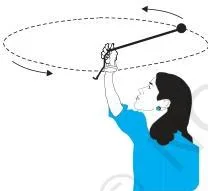
Because momentum is a vector, a force is needed to change its direction even when its magnitude stays constant. The stone whirled on a string in the diagram below is the classic example: the string provides the sideways force that keeps turning the momentum vector.
Impulse
Impulse is the product of force and time, and it equals the change in momentum (NCERT, p. 56):
\[ \text{Impulse} = \mathbf{F}\,\Delta t = \Delta\mathbf{p} \quad (4.7) \]
Impulse is measured in \( \text{N s} \), the same as momentum. The relation is useful when a large force acts for a very short time, as in a collision.
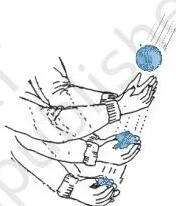
The diagram below shows why impulse matters in practice: a cricketer draws his hands back while catching, which increases the stopping time and therefore reduces the average force for the same change in momentum.
Newton’s Third Law
Newton’s third law: forces always occur in pairs. The force on body A by body B is equal and opposite to the force on body B by body A (NCERT, p. 57):
\[ \mathbf{F}_{AB} = -\mathbf{F}_{BA} \quad (4.8) \]
The two forces act on different bodies at the same instant, so they never cancel each other when you apply the second law to a single body. There is no cause–effect order: either force may be called the action.
Conservation of Momentum
In an isolated system (no external force), the total momentum stays unchanged. For a collision between two bodies A and B (NCERT, p. 58):
\[ \mathbf{p}’_A + \mathbf{p}’_B = \mathbf{p}_A + \mathbf{p}_B \quad (4.9) \]
This is the law of conservation of momentum, and it follows directly from the second and third laws. It holds whether the collision is elastic or inelastic; an elastic collision adds the extra condition that kinetic energy is also conserved.
Equilibrium of a Particle
A particle is in equilibrium when the net external force on it is zero. Under two forces (NCERT, p. 59):
\[ \mathbf{F}_1 = -\mathbf{F}_2 \quad (4.10) \]
Under three concurrent forces, the vector sum must vanish:
\[ \mathbf{F}_1 + \mathbf{F}_2 + \mathbf{F}_3 = 0 \quad (4.11) \]
Equivalently, the components in each direction separately add to zero (NCERT, p. 59):
\[ F_{1x}+F_{2x}+F_{3x}=0,\qquad F_{1y}+F_{2y}+F_{3y}=0,\qquad F_{1z}+F_{2z}+F_{3z}=0 \quad (4.12) \]
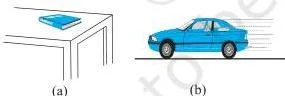
The first diagram below shows the two situations covered by the first law: a body at rest and a body moving uniformly both have zero net force (NCERT, p. 53). The second shows the standard three-force equilibrium problem: two rope tensions and an applied horizontal force act at one point, and their vector sum is zero.

Common Forces in Mechanics
For a spring compressed or extended by a small displacement \( x \) from its unstretched length, the restoring force is proportional to and opposite to the displacement (NCERT, p. 60):
\[ F = -kx \]
Here \( k \) is the spring’s force constant. The same restoring-force idea underlies tension: an inextensible string of negligible mass carries a constant tension \( T \) throughout its length.
Friction
Static friction is self-adjusting: it opposes impending motion and grows with the applied force up to a maximum (NCERT, p. 61):
\[ f_s \leq \mu_s N \quad (4.14) \]
At the limit of impending motion, the maximum static friction is:
\[ (f_s)_{\max} = \mu_s N \quad (4.13) \]
Once sliding begins, the friction force drops to the kinetic value (NCERT, p. 61):
\[ f_k = \mu_k N \quad (4.15) \]
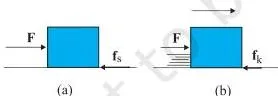
Both laws are empirical, both are independent of the area of contact, and \( \mu_k \) is found to be less than \( \mu_s \). The figure below contrasts the two situations: static friction holding a body just before it moves, and kinetic friction acting while it slides.
Friction on an Incline
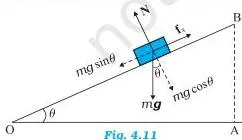
For a block at rest on an inclined plane, resolve the weight along and perpendicular to the plane (NCERT, p. 62):
\[ mg\sin\theta = f_s, \qquad mg\cos\theta = N \]
As the angle increases, the block just begins to slide at the limiting angle \( \theta_{\max} \):
\[ \tan\theta_{\max} = \mu_s \qquad \text{or} \qquad \theta_{\max} = \tan^{-1}\mu_s \]
The limiting angle depends only on \( \mu_s \), not on the mass of the block. The diagram below shows the three forces acting in this situation.
Static friction also sets the maximum acceleration a body can have without slipping on an accelerating surface, such as a box on a train floor. With \( N = mg \), the condition \( f_s \leq \mu_s N \) gives:
\[ a_{\max} = \mu_s g \]
Circular Motion
A body moving in a circle of radius \( R \) with constant speed \( v \) has acceleration \( v^2/R \) towards the centre, so the required force is (NCERT, pp. 63–64):
\[ f_c = \frac{mv^2}{R} \quad (4.16) \]
Centripetal force is not a new kind of force: it is the name given to whatever real force (tension, friction, gravity) points towards the centre of the circle.
Circular Motion on a Level Road
On a flat road the vertical forces balance, \( N = mg \), and the frictional force alone must supply the centripetal force. Using \( mv^2/R \leq \mu_s N \), the maximum speed without slipping is (NCERT, p. 63):
\[ v_{\max} = \sqrt{\mu_s R g} \quad (4.18) \]
This result is independent of the mass of the vehicle; it depends only on \( \mu_s \), the radius \( R \), and \( g \).
Circular Motion on a Banked Road
On a banked road, the horizontal component of the normal reaction also contributes to the centripetal force. Resolving vertically and horizontally, with friction at its limit \( f = \mu_s N \) (NCERT, p. 64):
\[ N\cos\theta = mg + f\sin\theta, \qquad N\sin\theta + f\cos\theta = \frac{mv^2}{R} \quad (4.19) \]
Combining these equations gives the maximum permissible speed:
\[ v_{\max} = \left( Rg\,\frac{\mu_s + \tan\theta}{1 – \mu_s \tan\theta} \right)^{1/2} \quad (4.21) \]
This formula requires \( 1 – \mu_s \tan\theta \gt 0 \). Setting \( \mu_s = 0 \) gives the optimum speed, at which friction is not needed at all to provide the centripetal force (NCERT, p. 64):
\[ v_o = (Rg\tan\theta)^{1/2} \quad (4.22) \]
For speeds below \( v_o \), friction acts up the slope. A car can be parked on the bank only if \( \tan\theta \leq \mu_s \).
What Each Symbol Means
The table gives the meaning, SI unit and dimensions of every symbol used on this page. Units and dimensions follow the NCERT summary table for the chapter (NCERT, p. 67).
| Symbol | What it means | SI unit | Dimensions |
|---|---|---|---|
| \( \mathbf{F}_{\text{net}} \) | net external force on a body | N | \( [\text{MLT}^{-2}] \) |
| \( \mathbf{p} \) | momentum of a body (vector, same direction as velocity) | \( \text{kg m s}^{-1} \) or \( \text{N s} \) | \( [\text{MLT}^{-1}] \) |
| \( m \) | mass of the body | kg | \( [\text{M}] \) |
| \( \mathbf{v} \) | velocity | \( \text{m s}^{-1} \) | \( [\text{LT}^{-1}] \) |
| \( \mathbf{a} \) | acceleration | \( \text{m s}^{-2} \) | \( [\text{LT}^{-2}] \) |
| \( \mathbf{F} \) | net external force | N (\( = \text{kg m s}^{-2} \)) | \( [\text{MLT}^{-2}] \) |
| \( \mathbf{F}_{AB} \) | force on body A by body B | N | \( [\text{MLT}^{-2}] \) |
| \( \Delta\mathbf{p} \) | change in momentum | \( \text{kg m s}^{-1} \) | \( [\text{MLT}^{-1}] \) |
| \( \Delta t \) | time interval for which the force acts | s | \( [\text{T}] \) |
| \( f_s \) | static friction | N | \( [\text{MLT}^{-2}] \) |
| \( (f_s)_{\max} \) | maximum static friction at impending motion | N | \( [\text{MLT}^{-2}] \) |
| \( f_k \) | kinetic (sliding) friction | N | \( [\text{MLT}^{-2}] \) |
| \( \mu_s \) | coefficient of static friction | dimensionless | — |
| \( \mu_k \) | coefficient of kinetic friction | dimensionless | — |
| \( N \) | normal reaction (force perpendicular to the surfaces in contact) | N | \( [\text{MLT}^{-2}] \) |
| \( k \) | force constant of a spring | \( \text{N m}^{-1} \) | \( [\text{MT}^{-2}] \) |
| \( x \) | displacement of the spring from its unstretched length | m | \( [\text{L}] \) |
| \( T \) | tension in a string | N | \( [\text{MLT}^{-2}] \) |
| \( R \) | radius of the circular path | m | \( [\text{L}] \) |
| \( v \) | speed of the body in circular motion | \( \text{m s}^{-1} \) | \( [\text{LT}^{-1}] \) |
| \( f_c \) | centripetal force | N | \( [\text{MLT}^{-2}] \) |
| \( \theta \) | angle of incline or banking angle | degree or radian | dimensionless |
| \( v_{\max} \) | maximum turning speed without slipping | \( \text{m s}^{-1} \) | \( [\text{LT}^{-1}] \) |
| \( v_o \) | optimum speed on a banked road (no friction needed) | \( \text{m s}^{-1} \) | \( [\text{LT}^{-1}] \) |
| \( g \) | acceleration due to gravity | \( \text{m s}^{-2} \) | \( [\text{LT}^{-2}] \) |
When to Use Each Formula
The table below names the situation in which each formula is used, with the condition that must hold before you substitute.
| Situation | Formula |
|---|---|
| You know the net force on a body is zero, and you need the acceleration | \( \mathbf{F}_{\text{net}} = 0 \Rightarrow \mathbf{a} = 0 \) |
| You need momentum from mass and velocity | \( \mathbf{p} = m\mathbf{v} \) |
| A fixed mass is under a known net force; find the force or the acceleration | \( \mathbf{F} = m\mathbf{a} \) |
| The velocity (or mass) is changing; find force from the rate of change of momentum | \( \mathbf{F} = \frac{\mathrm{d}\mathbf{p}}{\mathrm{d}t} \) |
| Forces act at an angle to the axes; resolve into components | \( F_x = ma_x,\ F_y = ma_y,\ F_z = ma_z \) |
| A large force acts for a very short time (hitting, catching, bouncing) | \( \text{Impulse} = \mathbf{F}\,\Delta t = \Delta\mathbf{p} \) |
| You need to pair up the forces between two bodies | \( \mathbf{F}_{AB} = -\mathbf{F}_{BA} \) |
| Collision, explosion or recoil in an isolated system (no external force) | \( \mathbf{p}’_A + \mathbf{p}’_B = \mathbf{p}_A + \mathbf{p}_B \) |
| A body is at rest or in uniform motion; find an unknown force | \( \mathbf{F}_1 = -\mathbf{F}_2 \) |
| A point where three forces meet is in equilibrium | \( \mathbf{F}_1 + \mathbf{F}_2 + \mathbf{F}_3 = 0 \) |
| A spring or elastic support is compressed or extended by a small amount | \( F = -kx \) |
| A body is at rest but an applied force is growing; friction opposes it up to the limit | \( f_s \leq \mu_s N \), with maximum \( (f_s)_{\max} = \mu_s N \) |
| A body is already sliding relative to the surface in contact | \( f_k = \mu_k N \) |
| A block is just about to slide down an inclined plane | \( \tan\theta_{\max} = \mu_s \) |
| A vehicle floor accelerates a body it carries; find the maximum acceleration before slipping (requires \( N = mg \)) | \( a_{\max} = \mu_s g \) |
| Any uniform circular motion: find the inward (centripetal) force required | \( f_c = \frac{mv^2}{R} \) |
| A car turns on a flat road; friction alone supplies the centripetal force | \( v_{\max} = \sqrt{\mu_s R g} \) |
| A car turns on a banked road; the bank raises the safe speed (provided \( 1 – \mu_s \tan\theta \gt 0 \)) | \( v_{\max} = \left( Rg\,\frac{\mu_s + \tan\theta}{1 – \mu_s \tan\theta} \right)^{1/2} \) |
| A banked road: find the speed at which the tyres need no friction | \( v_o = \sqrt{Rg \tan\theta} \) |
Worked Examples
Three original problems showing how the formulas are selected and applied. For practice, the NCERT chapter exercises use the same relations: Q4.5–4.10 are direct numerical applications of the second law and impulse, Q4.17–4.19 involve conservation of momentum and impulse, and Q4.21–4.22 test circular motion (NCERT, pp. 69–70).
Example 1: Finding acceleration from a net force
Step 1: A 14 kg crate is pushed across a floor with a net horizontal force of 42 N.
Choose \( \mathbf{F} = m\mathbf{a} \) because the mass is fixed and the net force is known.
Step 2: Rearrange and substitute with units:
\[ a = \frac{F}{m} = \frac{42\ \text{N}}{14\ \text{kg}} = 3.0\ \text{m s}^{-2} \]
Final answer: The crate accelerates at \( 3.0\ \text{m s}^{-2} \) in the direction of the net force.
Example 2: Impulse and average force during a bounce
Step 1: A 0.12 kg ball moving at \( 9\ \text{m s}^{-1} \) strikes a wall and rebounds at \( 6\ \text{m s}^{-1} \) in the opposite direction.
Choose \( \text{Impulse} = \Delta\mathbf{p} = m(\mathbf{v}_f – \mathbf{v}_i) \).
Step 2: Take the rebound direction as positive, so \( v_i = -9\ \text{m s}^{-1} \) and \( v_f = +6\ \text{m s}^{-1} \):
\[ \Delta p = 0.12\ \text{kg} \times (6 – (-9))\ \text{m s}^{-1} = 1.8\ \text{N s} \]
Step 3: If contact lasts \( 0.03\ \text{s} \), the average force is \( F = \Delta p / \Delta t \):
\[ F_{\text{avg}} = \frac{1.8\ \text{N s}}{0.03\ \text{s}} = 60\ \text{N} \]
Final answer: Impulse on the ball is \( 1.8\ \text{N s} \) in the rebound direction, and the average force during contact is \( 60\ \text{N} \) in that same direction.
Example 3: Optimum speed on a banked curve
Step 1: A circular track has a curve of radius \( 90\ \text{m} \) banked at \( 15^\circ \).
Find the speed at which no sideways friction acts.
Choose \( v_o = \sqrt{Rg\tan\theta} \).
Step 2: Substitute \( R = 90\ \text{m} \), \( g = 9.8\ \text{m s}^{-2} \), \( \tan 15^\circ \approx 0.268 \):
\[ v_o = \sqrt{90 \times 9.8 \times 0.268} \approx \sqrt{236.4} \approx 15.4\ \text{m s}^{-1} \]
Final answer: The optimum speed is about \( 15\ \text{m s}^{-1} \) (roughly 55 km/h). Below this speed friction acts up the slope; above it, use the full banked-road formula, in which friction adds to the centripetal force.
Common Mistakes to Avoid
These are the errors students make most often while applying the formulas of this chapter.
| Mistake | Correct rule | How to check your answer |
|---|---|---|
| Adding the action–reaction pair and saying “the forces cancel”, so the body cannot move. | \( \mathbf{F}_{AB} \) acts on A and \( \mathbf{F}_{BA} \) acts on B — different bodies. They cancel only when both bodies are inside one system. | Ask “which body is each force acting on?” If they act on different bodies, they form a third-law pair — never add them for one body. |
| Writing \( f_s = \mu_s N \) in every static case. | Static friction is self-adjusting: \( f_s \leq \mu_s N \). Equality holds only when the body is just about to slide. | Is the body at rest under a smaller applied force? Then \( f_s \) equals that applied force, not \( \mu_s N \). |
| Using \( \mu_s \) after slipping has started. | Once relative motion begins, kinetic friction acts: \( f_k = \mu_k N \), and \( \mu_k \lt \mu_s \). | Is the surface sliding under the body? Then the friction force is \( \mu_k N \), which is smaller. |
| Writing \( N = mg \) for a body in an accelerated lift. | \( N = mg \) holds only in equilibrium. In general apply \( F_{\text{net}} = ma \): with upward positive, \( N – mg = ma \). | Check the acceleration’s direction: if the lift accelerates upward, \( N = m(g + a) \), which is \( \gt mg \). |
| Treating \( mv^2/R \) as a separate outward force (“centrifugal force”) acting on the body. | Centripetal force is the name for the real inward force (tension, friction, gravity) that produces the acceleration \( v^2/R \). | Name the physical agency: for a stone on a string it is tension; for a car on a flat turn it is friction. |
| Using \( v_{\max} = \sqrt{\mu_s R g} \) for a banked road. | That is the flat-road formula. On a bank, use \( v_{\max} = \left( Rg\,\frac{\mu_s + \tan\theta}{1 – \mu_s \tan\theta} \right)^{1/2} \), which is larger. | Is the road surface angled? If the diagram shows a banked road, the formula must contain \( \theta \). |
| Concluding that \( v = 0 \) at an instant means \( F = 0 \) (or \( a = 0 \)). | A body momentarily at rest can still have a net force — a ball at the top of its flight has \( v = 0 \) but \( F = mg \). | Look at the forces, not the speed: the first law links zero net force to zero acceleration, never to zero velocity. |
Frequently Asked Questions
Is momentum a vector? What are its units?
Yes. Momentum is \( \mathbf{p} = m\mathbf{v} \), so it points along the velocity. Its SI unit is \( \text{kg m s}^{-1} \), which is the same as \( \text{N s} \).
Why does a cricketer draw his hands back while catching a fast ball?
The impulse needed to stop the ball, \( \Delta p \), is fixed by its change in momentum. Drawing the hands back increases the stopping time \( \Delta t \), so the average force \( F = \Delta p / \Delta t \) becomes smaller.
Does conservation of momentum hold for inelastic collisions?
Yes. Total momentum is conserved in any collision in an isolated system, whether elastic or inelastic. An elastic collision has the extra condition that kinetic energy is also conserved.
What does banking a road achieve?
Banking tilts the normal reaction so that its horizontal component helps supply the centripetal force. At the optimum speed \( v_o = \sqrt{Rg\tan\theta} \), friction is not needed at all, which reduces tyre wear.
All formulas on this page follow the Rationalised NCERT Class 11 Physics Part I textbook, Chapter 4. The official chapter text is available on the NCERT website.
Reference: NCERT Class 11 Physics textbook, chapter Laws of Motion.
Explore Class 11 Physics Formulas
More for this chapter:
Class 11 Physics on LearnCBSE:
Related chapters:
Official source: download the NCERT textbook free from ncert.nic.in.