This page collects the Kinetic Theory Class 11 formulas from the NCERT Physics Part II textbook, chapter 12.
It covers the ideal gas equation and the gas laws, the pressure of an ideal gas in terms of molecular motion, the kinetic interpretation of temperature and rms speed, the law of equipartition of energy, molar specific heats of gases and solids, and the mean free path.
Every formula is grouped under the textbook sub-topic it belongs to, with the meaning and SI unit of each symbol, a line on when to use it, and worked examples with original numbers.
This sheet is part of the Class 11 Physics formulas collection; use it for quick lookup during revision.
Kinetic Theory Class 11 Formulas at a Glance
| Purpose (what you are finding) | Formula |
|---|---|
| Ideal gas equation linking pressure, volume and amount | \( PV = \mu RT = k_B N T \) |
| Number of moles from mass or molecule count | \( \mu = \frac{M}{M_0} = \frac{N}{N_A} \) |
| Ideal gas law when density is given | \( P = \frac{\rho RT}{M_0} \) |
| Avogadro’s hypothesis (equal volumes, equal molecule counts) | \( \frac{P_1V_1}{N_1T_1} = \frac{P_2V_2}{N_2T_2} = k_B \) |
| Boyle’s law — pressure against volume at fixed temperature | \( PV = \text{constant} \) |
| Charles’ law — volume against temperature at fixed pressure | \( V \propto T \) |
| Dalton’s law — pressure of a mixture of gases | \( P = P_1 + P_2 + \dots \), with \( P_i = \frac{\mu_i RT}{V} \) |
| Pressure of an ideal gas from molecular motion | \( P = \frac{1}{3} n m \overline{v^2} \) |
| Pressure in terms of total translational kinetic energy | \( PV = \frac{2}{3} E \) |
| Average translational kinetic energy per molecule | \( \frac{1}{2} m \overline{v^2} = \frac{3}{2} k_B T \) |
| Total translational kinetic energy of \( N \) molecules | \( E = \frac{3}{2} k_B N T \) |
| Root mean square speed (molecular-mass form) | \( v_{\text{rms}} = \sqrt{\frac{3k_B T}{m}} \) |
| Root mean square speed using molar mass (derived form) | \( v_{\text{rms}} = \sqrt{\frac{3RT}{M_0}} \) |
| Equipartition energy per mode | \( \frac{1}{2}k_B T \) per quadratic term; \( k_B T \) per vibrational mode |
| Monatomic gas specific heats | \( C_v = \frac{3}{2}R, \; C_p = \frac{5}{2}R, \; \gamma = \frac{5}{3} \) |
| Rigid diatomic gas specific heats | \( C_v = \frac{5}{2}R, \; C_p = \frac{7}{2}R, \; \gamma = \frac{7}{5} \) |
| Diatomic gas with vibration | \( C_v = \frac{7}{2}R, \; C_p = \frac{9}{2}R, \; \gamma = \frac{9}{7} \) |
| Polyatomic gas with \( f \) vibrational modes | \( C_v = (3+f)R, \; C_p = (4+f)R, \; \gamma = \frac{4+f}{3+f} \) |
| Specific heat relation valid for any ideal gas | \( C_p – C_v = R \) |
| Molar specific heat of a solid | \( C = 3R \) |
| Mean free path | \( l = \frac{1}{\sqrt{2}\,\pi n d^2} \) |
| Mean time between collisions | \( \tau = \frac{1}{n\pi\langle v\rangle d^2} \) |
All Formulas, Grouped by Topic
The formulas below follow the order and sub-topics of the NCERT chapter. They assume the ideal-gas picture: molecules in random motion, elastic collisions, and negligible inter-molecular forces except during collisions. You can cross-check every equation against the official chapter PDF on the NCERT site.
Behaviour of Gases
A gas that satisfies \( PV = \mu RT \) exactly at all pressures and temperatures is defined as an ideal gas. Real gases approach this behaviour at low pressures and high temperatures (NCERT, p. 247):
\[ PV = \mu RT = k_B N T \]
The number of moles \( \mu \) connects the mass of the sample and the molecule count (NCERT, p. 247):
\[ \mu = \frac{M}{M_0} = \frac{N}{N_A} \]
When the mass density \( \rho \) is given instead of the amount of gas, the same equation takes the form \[ P = \frac{\rho RT}{M_0} \]
Avogadro’s hypothesis follows from the constancy of \( k_B \): equal volumes of all gases at the same temperature and pressure contain the same number of molecules.
\[ \frac{P_1V_1}{N_1T_1} = \frac{P_2V_2}{N_2T_2} = k_B \]
Fixing different variables in the ideal gas equation reproduces the gas laws (NCERT, pp. 247–248). Boyle’s law: for a fixed amount of gas at constant temperature, \[ PV = \text{constant} \]
Charles’ law: at fixed pressure, \[ V \propto T \]
For a mixture of non-reactive ideal gases, each gas contributes its own partial pressure, and the total pressure is the sum — Dalton’s law of partial pressures (NCERT, p. 248):
\[ P = P_1 + P_2 + \dots, \quad P_i = \frac{\mu_i RT}{V} \]
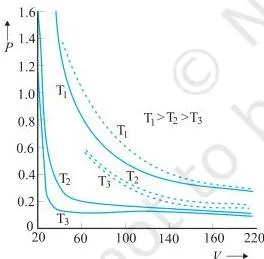
The curves in Fig. 12.2 show why Boyle’s law is an approximation: the solid experimental curves overlap the dotted ideal curves best at low pressures, which is exactly the regime where a gas behaves ideally.
The constants you will substitute in numericals: \( R = 8.314\ \text{J mol}^{-1}\text{K}^{-1} \), \( k_B = \frac{R}{N_A} = 1.38 \times 10^{-23}\ \text{J K}^{-1} \), \( N_A = 6.02 \times 10^{23}\ \text{mol}^{-1} \) (NCERT, p. 247).
Pressure of an Ideal Gas
Pressure is momentum transferred per unit time per unit area. In an elastic collision with a wall, only the velocity component normal to the wall reverses, so each collision delivers momentum \( 2mv_x \) to the wall (NCERT, p. 250):
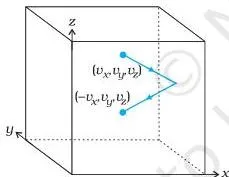
Summing over all molecules and using isotropy — no direction is preferred, so \( \overline{v_x^2} = \overline{v_y^2} = \overline{v_z^2} \) — gives the pressure of an ideal gas:
\[ P = \frac{1}{3} n m \overline{v^2} \]
\[ \overline{v_x^2} = \overline{v_y^2} = \overline{v_z^2} = \frac{1}{3}\overline{v^2} \]
Multiplying by volume and writing \( N = nV \), with \( E \) the total translational kinetic energy of all \( N \) molecules, gives the pressure–energy relation:
\[ PV = \frac{2}{3}E, \quad E = N\left(\frac{1}{2}m\overline{v^2}\right) \]
The shape of the vessel does not enter the result — the derivation works for any infinitesimal planar area, and Pascal’s law spreads the pressure through the gas (NCERT, p. 250).
Kinetic Interpretation of Temperature
Combining \( PV = \frac{2}{3}E \) with the ideal gas equation \( PV = k_B N T \) gives the kinetic interpretation of temperature (NCERT, p. 251):
\[ \frac{1}{2}m\overline{v^2} = \frac{3}{2}k_B T \]
\[ E = \frac{3}{2}k_B N T \]
The average translational kinetic energy per molecule depends only on the absolute temperature — not on pressure, volume, or the nature of the gas. At the same temperature, lighter molecules move faster.
The square root of the mean squared speed is the rms speed:
\[ v_{\text{rms}} = \sqrt{\overline{v^2}} = \sqrt{\frac{3k_B T}{m}} \]
Since \( m = \frac{M_0}{N_A} \) and \( k_B = \frac{R}{N_A} \), the molar-mass form follows:
\[ v_{\text{rms}} = \sqrt{\frac{3RT}{M_0}} \]
Law of Equipartition of Energy
In thermal equilibrium at temperature \( T \), every quadratic (squared) term in the energy of a molecule carries an average energy \( \frac{1}{2}k_B T \). This is the law of equipartition of energy (NCERT, p. 253).
For a molecule free to move in space, the translational energy has three such terms:
\[ \langle \varepsilon_t \rangle = \left\langle \frac{1}{2}mv_x^2 \right\rangle + \left\langle \frac{1}{2}mv_y^2 \right\rangle + \left\langle \frac{1}{2}mv_z^2 \right\rangle = \frac{3}{2}k_B T \]
Each translational and rotational degree of freedom contributes \( \frac{1}{2}k_B T \). A vibrational mode contains two quadratic terms — kinetic and potential — so it contributes \( k_B T \) (NCERT, p. 253).
Specific Heat Capacities
Degrees of freedom decide the internal energy per mole:
- Monatomic gas: 3 translational → \( U = \frac{3}{2}RT \)
- Diatomic gas (rigid rotator): 3 translational + 2 rotational → \( U = \frac{5}{2}RT \)
- Diatomic gas with vibration: add one vibrational mode → \( U = \frac{7}{2}RT \)
- Polyatomic gas: 3 translational + 3 rotational + \( f \) vibrational modes → \( U = (3+f)RT \)
Differentiating \( U \) gives \( C_v \), and adding \( R \) gives \( C_p \). For every ideal gas, \( C_p – C_v = R \) (NCERT, p. 254).
Monatomic:
\[ C_v = \frac{3}{2}R, \quad C_p = \frac{5}{2}R, \quad \gamma = \frac{5}{3} \]
Rigid diatomic:
\[ C_v = \frac{5}{2}R, \quad C_p = \frac{7}{2}R, \quad \gamma = \frac{7}{5} \]
Diatomic with vibration:
\[ C_v = \frac{7}{2}R, \quad C_p = \frac{9}{2}R, \quad \gamma = \frac{9}{7} \]
Polyatomic (with \( f \) vibrational modes):
\[ C_v = (3+f)R, \quad C_p = (4+f)R, \quad \gamma = \frac{4+f}{3+f} \]
For a solid, the volume change on heating is negligible, so \( \Delta Q = \Delta U \) and (NCERT, p. 255):
\[ C = \frac{\Delta Q}{\Delta T} = \frac{\Delta U}{\Delta T} = 3R \]
The predicted values below (NCERT, p. 254, Table 12.1) agree with the measured specific heats of several gases at ordinary temperatures. The triatomic row assumes 3 translational + 3 rotational degrees of freedom with no vibration.
| Nature of gas | \( C_v \) (J mol⁻¹ K⁻¹) | \( C_p \) (J mol⁻¹ K⁻¹) | \( \gamma \) |
|---|---|---|---|
| Monatomic | 12.5 | 20.8 | 1.67 |
| Diatomic | 20.8 | 29.1 | 1.40 |
| Triatomic | 24.93 | 33.24 | 1.33 |
Mean Free Path
Molecules collide so often that they cannot travel in straight lines. The mean free path \( l \) is the average distance a molecule travels between two successive collisions (NCERT, p. 255):
\[ l = \frac{1}{\sqrt{2}\,\pi n d^2} \]

The molecule of diameter \( d \) sweeps a cylinder of cross-sectional area \( \pi d^2 \) and length \( \langle v \rangle \Delta t \). The simpler model, which treats the other molecules as stationary, gives the collision time and the uncorrected mean free path:
\[ \tau = \frac{1}{n\pi\langle v\rangle d^2}, \quad l = \langle v\rangle \tau = \frac{1}{n\pi d^2} \]
The \( \sqrt{2} \) appears because all molecules move: the collision rate is set by the average relative velocity, which exceeds the average speed by a factor of \( \sqrt{2} \) (NCERT, p. 255).
What Each Symbol Means
| Symbol | What it means | SI unit / nature |
|---|---|---|
| \( P \) | pressure of the gas | \( \text{N m}^{-2} \) (pascal) |
| \( V \) | volume of the gas | \( \text{m}^3 \) |
| \( T \) | absolute temperature | kelvin (K) |
| \( \mu \) | number of moles of gas | mol |
| \( M \) | mass of the gas sample | kg |
| \( M_0 \) | molar mass | \( \text{kg mol}^{-1} \); questions often give g/mol — convert |
| \( N \) | number of molecules in the sample | count (dimensionless) |
| \( N_A \) | Avogadro constant, \( 6.02 \times 10^{23} \) | \( \text{mol}^{-1} \) |
| \( R \) | universal gas constant, \( 8.314 \) | \( \text{J mol}^{-1}\text{K}^{-1} \) |
| \( k_B \) | Boltzmann constant, \( 1.38 \times 10^{-23} \) | \( \text{J K}^{-1} \) |
| \( n \) | number density, \( N/V \) | \( \text{m}^{-3} \) |
| \( \rho \) | mass density of the gas | \( \text{kg m}^{-3} \) |
| \( m \) | mass of one molecule | kg |
| \( \overline{v^2} \) | mean of the squared molecular speed | \( \text{m}^2\text{s}^{-2} \) |
| \( v_{\text{rms}} \) | root mean square speed, \( \sqrt{\overline{v^2}} \) | \( \text{m s}^{-1} \) |
| \( \langle v \rangle \) | mean (average) molecular speed | \( \text{m s}^{-1} \) |
| \( v_x, v_y, v_z \) | components of molecular velocity | \( \text{m s}^{-1} \) |
| \( E \) | total translational kinetic energy of the gas | J |
| \( \varepsilon_t \) | translational kinetic energy of one molecule | J |
| \( d \) | molecular diameter | m |
| \( l \) | mean free path | m |
| \( \tau \) | mean time between two successive collisions | s |
| \( C_v \) | molar specific heat at constant volume | \( \text{J mol}^{-1}\text{K}^{-1} \) |
| \( C_p \) | molar specific heat at constant pressure | \( \text{J mol}^{-1}\text{K}^{-1} \) |
| \( \gamma \) | ratio \( C_p/C_v \) | dimensionless |
| \( U \) | internal energy of one mole of gas | \( \text{J mol}^{-1} \) |
| \( f \) | number of vibrational modes of a polyatomic molecule | count (dimensionless) |
When to Use Each Formula
Reach for the formula that matches the quantity the question gives you. Conditions matter: the gas laws and molecular formulas below assume ideal behaviour, which is closest to reality at low pressure and high temperature.
| Formula | Reach for it when… | Condition |
|---|---|---|
| \( PV = \mu RT = k_BNT \) | you know three of \( P, V, T \), amount and want the fourth | gas is approximately ideal; \( T \) in kelvin |
| \( P = \frac{\rho RT}{M_0} \) | density of the gas is given instead of amount | same ideal-gas condition |
| \( PV = \text{constant} \) | the same sample changes volume or pressure at one temperature | \( \mu \) and \( T \) fixed (Boyle) |
| \( V \propto T \) | the same sample changes temperature at one pressure | \( P \) and \( \mu \) fixed (Charles) |
| \( P = P_1 + P_2 + \dots \) | a vessel holds two or more non-reactive gases | each gas ideal; all share the same \( V \) and \( T \) |
| \( P = \frac{1}{3}nm\overline{v^2} \) | pressure is asked in terms of molecular quantities | ideal gas; elastic collisions |
| \( \frac{1}{2}m\overline{v^2} = \frac{3}{2}k_BT \) | average kinetic energy per molecule, or comparing two gases at the same temperature | thermal equilibrium; any gas |
| \( v_{\text{rms}} = \sqrt{\frac{3k_BT}{m}} \) | molecular speed from molecular mass; ratio of speeds of two gases | \( T \) in kelvin; use \( \sqrt{3RT/M_0} \) when molar mass is given |
| \( \frac{1}{2}k_BT \) per mode | predicting internal energy or specific heat from degrees of freedom | equipartition law; classical behaviour |
| \( C_v, C_p, \gamma \) sets | heat needed for a temperature change: \( Q = \mu C_v\Delta T \) (constant volume) or \( Q = \mu C_p\Delta T \) (constant pressure) | pick the set matching the gas type |
| \( C = 3R \) | molar specific heat of a solid at ordinary temperature | \( \Delta V \) negligible, so \( C \approx C_v \) |
| \( l = \frac{1}{\sqrt{2}\,\pi n d^2} \) | average distance between collisions; why diffusion is slow | dilute gas; \( d \) is the molecular diameter |
Worked Examples
The three examples below use original numbers so you can follow the method without copying values. For formula sheets of every other chapter, browse the physics formulas index.
Example 1: rms speed of oxygen molecules
Find the root mean square speed of oxygen molecules at \( 327^\circ\text{C} \). Molar mass of \( O_2 = 32\ \text{g mol}^{-1} \), \( R = 8.31\ \text{J mol}^{-1}\text{K}^{-1} \).
- Step 1: Convert the temperature to kelvin and select the molar-mass form of the rms speed formula: \( T = 327 + 273 = 600\ \text{K} \) and \( v_{\text{rms}} = \sqrt{3RT/M_0} \), because the molar mass is given rather than the mass of one molecule.
- Step 2: Convert the molar mass to SI so that it matches \( R \): \( M_0 = 32\ \text{g mol}^{-1} = 0.032\ \text{kg mol}^{-1} \).
\[ v_{\text{rms}} = \sqrt{\frac{3 \times 8.31 \times 600}{0.032}} = \sqrt{\frac{14\,958}{0.032}} \]
\[ = \sqrt{467\,437.5} \approx 684\ \text{m s}^{-1} \]
Final answer: \( v_{\text{rms}} \approx 684\ \text{m s}^{-1} \).
Example 2: temperature from average kinetic energy
At what temperature does a gas molecule have an average translational kinetic energy of \( 9.66 \times 10^{-21}\ \text{J} \)? (\( k_B = 1.38 \times 10^{-23}\ \text{J K}^{-1} \))
- Step 1: Use the per-molecule kinetic energy formula \( E_{\text{mol}} = \frac{3}{2}k_BT \) and solve for \( T \): \( T = \frac{2E_{\text{mol}}}{3k_B} \).
- Step 2: Substitute the values; the joule units cancel correctly.
\[ T = \frac{2 \times 9.66 \times 10^{-21}}{3 \times 1.38 \times 10^{-23}} \]
Step 3: Notice \( 9.66 = 7 \times 1.38 \), so the constants cancel cleanly:
\[ T = \frac{14}{3} \times 10^2 = 466.7\ \text{K} \]
Final answer: \( T \approx 467\ \text{K} \), about \( 194^\circ\text{C} \).
Example 3: mean free path of oxygen at STP
Estimate the mean free path of oxygen at STP if the number density is \( 2.7 \times 10^{25}\ \text{m}^{-3} \) and the molecular diameter is \( 3.0 \times 10^{-10}\ \text{m} \).
Step 1: Use \( l = \frac{1}{\sqrt{2}\,\pi n d^2} \) with the diameter given directly.
Unit check: \( 1/(\text{m}^{-3} \times \text{m}^2) = \text{m} \).
\[ l = \frac{1}{\sqrt{2} \times 3.142 \times (2.7 \times 10^{25}) \times (3.0 \times 10^{-10})^2} \]
\[ = \frac{1}{1.414 \times 3.142 \times 2.7 \times 9.0 \times 10^5} = \frac{1}{1.08 \times 10^7} \]
\[ = 9.3 \times 10^{-8}\ \text{m} \]
Step 3: Sanity check the scale: \( l/d = (9.3 \times 10^{-8})/(3.0 \times 10^{-10}) \approx 310 \), so the mean free path is about 300 molecular diameters — the right order of magnitude for a gas at STP.
Final answer: \( l \approx 9.3 \times 10^{-8}\ \text{m} \).
Common Mistakes to Avoid
These are the errors students make while applying this chapter’s formulas. Each row gives the correction and a quick check for the answer.
| Mistake | Correct rule | How to check your answer |
|---|---|---|
| Using the number of moles in \( P = nk_BT \) | \( n \) in this formula is number density (molecules per \( \text{m}^3 \)); use \( PV = \mu RT \) when you have moles | \( n \) in \( \text{m}^{-3} \) makes \( nk_BT \) come out in pascals |
| Plugging the molecular radius into the mean free path formula | The formula needs the diameter: \( d = 2r \) | \( l \) should come out roughly \( 10^2 \) to \( 10^3 \) times \( d \) |
| Substituting a Celsius temperature directly | Always convert: \( T(\text{K}) = T(^\circ\text{C}) + 273 \) | \( v_{\text{rms}} \) at \( 27^\circ\text{C} \) must use \( T = 300\ \text{K} \) |
| Mixing up \( R \) and \( k_B \) | \( R \) is per mole (\( 8.314\ \text{J mol}^{-1}\text{K}^{-1} \)); \( k_B \) is per molecule (\( 1.38 \times 10^{-23}\ \text{J K}^{-1} \)); \( R = N_Ak_B \) | If an energy comes out a factor of \( 6 \times 10^{23} \) off, you swapped them |
| Treating \( \overline{v^2} \) as \( (\overline{v})^2 \) | \( v_{\text{rms}} = \sqrt{\overline{v^2}} \) — root of the mean of squares, not the mean speed | rms speed is never smaller than the mean speed |
| Using per-molecule energy where total energy belongs | \( \frac{3}{2}k_BT \) is per molecule; the total translational energy of the sample is \( \frac{3}{2}k_BNT \) | In \( PV = \frac{2}{3}E \), \( E \) is the total for all \( N \) molecules |
Frequently Asked Questions
Why are molecular speeds so high but diffusion so slow?
A molecule in air at room temperature has an rms speed of the order of 500 m/s — comparable to the speed of sound (NCERT, p. 251). But it collides constantly and travels only a mean free path (about \( 10^{-7} \) m) between collisions, and each collision randomises its direction.
The net drift across a room is therefore slow even though the instantaneous speeds are high.
Is \( P = \frac{1}{3}nm\overline{v^2} \) exact for real gases?
It is derived for an ideal gas: elastic collisions, negligible molecular size, and no forces between molecules except during a collision (NCERT, p. 250). Real gases obey it approximately, and the approximation improves at low pressures and high temperatures, where molecules are far apart.
Why is \( C_v \) of a rigid diatomic gas \( \frac{5}{2}R \) instead of \( \frac{3}{2}R \)?
A diatomic molecule like \( O_2 \) or \( N_2 \) has three translational and two rotational degrees of freedom. Equipartition assigns \( \frac{1}{2}k_BT \) to each, giving \( U = \frac{5}{2}RT \) per mole and \( C_v = \frac{5}{2}R \) (NCERT, p. 254). If vibration becomes active, one vibrational mode adds \( k_BT \), taking \( C_v \) to \( \frac{7}{2}R \).
Where does the \( \sqrt{2} \) in the mean free path formula come from?
The simple derivation treats all other molecules as stationary. Since they actually move, the collision rate is fixed by the average relative velocity between molecules, which is \( \sqrt{2} \) times the average speed — hence \( l = 1/(\sqrt{2}\,\pi n d^2) \) (NCERT, p. 255).
Reference: NCERT Class 11 Physics textbook, chapter Kinetic Theory.
Explore Class 11 Physics Formulas
More for this chapter:
Class 11 Physics on LearnCBSE:
Related chapters: