
This page collects the Thermal Properties of Matter Class 11 formulas you need for quick revision: temperature-scale conversions, the ideal-gas equation, thermal expansion, heat capacity, calorimetry, latent heat, conduction, radiation and Newton’s law of cooling. Every formula on this page comes from the NCERT Class 11 Physics Part II textbook, chapter 10 (“Thermal Properties of Matter”).
Each formula is grouped by topic, with the meaning and SI unit of every symbol, a when-to-use line, and worked examples with original numbers. For the other chapters, browse the Class 11 physics formulas hub. You can verify any equation against the official NCERT textbook PDF on ncert.nic.in.
Formulas at a Glance
The whole chapter on one screen. Conditions for the derived forms are given in the sections below.
| Purpose (what you are finding) | Formula |
|---|---|
| Convert between Fahrenheit and Celsius temperatures | \( \frac{t_F – 32}{180} = \frac{t_C}{100} \) |
| Convert Celsius to Fahrenheit (summary form) | \( t_F = \frac{9}{5}t_C + 32 \) |
| Convert Celsius temperature to absolute (Kelvin) temperature | \( T = t_C + 273.15 \) |
| Ideal-gas equation for \(\mu\) moles of gas | \( PV = \mu RT \) |
| Boyle’s law: gas at constant temperature | \( PV = \text{constant} \) |
| Charles’ law: gas at constant pressure | \( \frac{V}{T} = \text{constant} \) |
| Fractional change in length on heating (linear expansion) | \( \frac{\Delta l}{l} = \alpha_l \Delta T \) |
| Final length of a rod after a temperature change | \( L_2 = L_1\left[1 + \alpha_l\left(T_2 – T_1\right)\right] \) |
| Fractional change in area (derived from linear expansion, Example 10.1) | \( \frac{\Delta A}{A} = 2\alpha_l \Delta T \) |
| Fractional change in volume (volume expansion) | \( \frac{\Delta V}{V} = \alpha_v \Delta T \) |
| Volume expansion coefficient of an ideal gas at constant pressure (derived from \(PV = \mu RT\)) | \( \alpha_v = \frac{1}{T} \) |
| Relation between volume and linear expansion coefficients | \( \alpha_v = 3\alpha_l \) |
| Thermal stress in a rod prevented from expanding | \( \frac{\Delta F}{A} = Y\alpha_l \Delta T \) |
| Heat capacity of a body | \( S = \frac{\Delta Q}{\Delta T} \) |
| Specific heat capacity | \( s = \frac{1}{m}\frac{\Delta Q}{\Delta T} \) |
| Molar specific heat capacity | \( C = \frac{1}{\mu}\frac{\Delta Q}{\Delta T} \) |
| Heat needed for a phase change (latent heat) | \( Q = mL \) |
| Rate of heat flow by conduction through a bar | \( H = KA\frac{T_C – T_D}{L} \) |
| Steady junction temperature of two rods in series, equal length and area (Example 10.7) | \( T_0 = \frac{K_1 T_1 + K_2 T_2}{K_1 + K_2} \) |
| Equivalent thermal conductivity of two rods in series, equal length and area (Example 10.7) | \( K’ = \frac{2K_1 K_2}{K_1 + K_2} \) |
| Wien’s displacement law: wavelength of peak emission | \( \lambda_m T = 2.9 \times 10^{-3}\ \text{m K} \) |
| Power radiated by a body (Stefan-Boltzmann law) | \( H = Ae\sigma T^4 \) |
| Net radiant power lost to surroundings | \( H = e\sigma A\left(T^4 – T_s^4\right) \) |
| Newton’s law of cooling (rate of heat loss) | \( -\frac{\mathrm{d}Q}{\mathrm{d}t} = k\left(T_2 – T_1\right) \) |
| Temperature of a cooling body as a function of time (integrated form) | \( T_2 = T_1 + C’e^{-Kt} \) |
| Approximate cooling rate over a small interval (Example 10.8) | \( \frac{\Delta T}{t} = K\left(T_{\text{avg}} – T_1\right) \) |
All Thermal Properties of Matter Class 11 Formulas, Grouped by Topic
Equation numbers (10.1), (10.2), … match the numbering used in the NCERT chapter.
Temperature Scales
Heat is the form of energy transferred between two systems, or between a system and its surroundings, by virtue of a temperature difference. Its SI unit is the joule (J); temperature is measured in kelvin (K), with \( ^\circ\text{C} \) in common use (NCERT, p. 203).
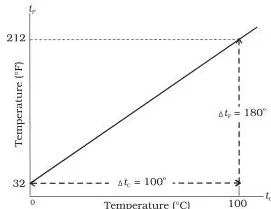
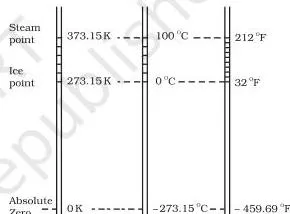
The ice point and steam point of pure water fix the two scales: \( 0\ ^\circ\text{C} = 32\ ^\circ\text{F} \) and \( 100\ ^\circ\text{C} = 212\ ^\circ\text{F} \). Because 180 Fahrenheit divisions span the same interval as 100 Celsius divisions, the conversion is (NCERT, p. 204):
\[ \frac{t_F – 32}{180} = \frac{t_C}{100} \]
Rearranged, this is the summary form \( t_F = \frac{9}{5}t_C + 32 \). The ratio \(180/100 = 9/5\) is exactly the ratio of the number of scale divisions, which is why the slope of the graph below is \(9/5\).
Absolute Temperature and the Ideal-Gas Equation
Extrapolating the constant-volume gas thermometer data shows that pressure would reach zero at \( -273.15\ ^\circ\text{C} \). This is absolute zero, the origin of the Kelvin scale (NCERT, p. 204):
\[ T = t_C + 273.15 \]
The kelvin and the Celsius degree are the same size, so the two scales differ only in their zero. The ideal-gas equation combines Boyle’s law (\(PV = \text{constant}\) at constant \(T\)) and Charles’ law (\(V/T = \text{constant}\) at constant \(P\)) into one relation (NCERT, p. 204):
\[ PV = \mu RT,\qquad R = 8.31\ \text{J mol}^{-1}\text{K}^{-1} \]
Here \(\mu\) is the number of moles and \(R\) is the universal gas constant. Holding volume constant gives \(P \propto T\), which is how a constant-volume gas thermometer reads temperature.
Thermal Expansion
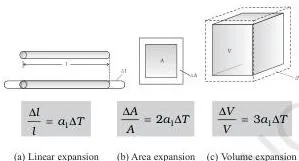
For a long rod and a small temperature change, the fractional change in length is directly proportional to \(\Delta T\) (NCERT, p. 205):
\[ \frac{\Delta l}{l} = \alpha_l \Delta T \]
The constant \(\alpha_l\) is the coefficient of linear expansion, a property of the material with unit \( \text{K}^{-1} \). The equivalent length form, used when you need the actual new length (as in NCERT Example 10.2), is:
\[ L_2 = L_1\left[1 + \alpha_l\left(T_2 – T_1\right)\right] \]
Following the same idea, the fractional change in area of a sheet is \( \frac{\Delta A}{A} = 2\alpha_l \Delta T \) (derived in Example 10.1 by neglecting the tiny \((\Delta l)^2\) term), and the coefficient of volume expansion is defined by (NCERT, p. 205):
\[ \alpha_v = \left(\frac{\Delta V}{V}\right)\frac{1}{\Delta T} \]
For an ideal gas at constant pressure, the ideal-gas equation gives \(\alpha_v = 1/T\) (NCERT, p. 206) — much larger than for solids and liquids. For a solid cube expanding equally in all directions, neglecting \((\Delta l)^2\) and \((\Delta l)^3\) gives the simple connection (NCERT, pp. 207–208):
\[ \alpha_v = 3\alpha_l \]
If a rod is held rigidly so it cannot expand, the expansion is converted into strain. The resulting thermal stress is (NCERT, pp. 207–208):
\[ \frac{\Delta F}{A} = Y\alpha_l \Delta T \]
where \(Y\) is Young’s modulus. This is the “why” behind the NCERT example of two steel rails bending when their ends are fixed.
One exception to remember: water contracts when heated from \(0\ ^\circ\text{C}\) to \(4\ ^\circ\text{C}\), so water has its maximum density at \(4\ ^\circ\text{C}\) (NCERT, p. 206). This is why lakes freeze at the surface first.
Specific Heat Capacity
Heat capacity is defined for a whole body, while specific heat capacity is per unit mass (NCERT, p. 208):
\[ S = \frac{\Delta Q}{\Delta T},\qquad s = \frac{1}{m}\frac{\Delta Q}{\Delta T},\qquad C = \frac{1}{\mu}\frac{\Delta Q}{\Delta T} \]
The units make the distinction clear: \(S\) in \( \text{J K}^{-1} \), \(s\) in \( \text{J kg}^{-1}\text{K}^{-1} \), and molar specific heat \(C\) in \( \text{J mol}^{-1}\text{K}^{-1} \). The definition is per unit mass because equal heat supplied to equal masses of different substances produces different temperature rises.
For gases, two versions are distinguished: \(C_p\) at constant pressure and \(C_v\) at constant volume.
Calorimetry
Calorimetry applies conservation of heat in an isolated system: heat lost by the hotter parts equals heat gained by the colder parts (NCERT, pp. 209–210). For two bodies mixing, \[ m_1 s_1\left(T_1 – T_f\right) = m_2 s_2\left(T_f – T_2\right) \]
If a calorimeter (or beaker) also changes temperature, add its own \(m_c s_c \Delta T\) term on the gaining side, exactly as in NCERT Example 10.3. The sign convention is built into the formula: the hot body drops from \(T_1\) to \(T_f\), the cold body rises from \(T_2\) to \(T_f\).
Change of State and Latent Heat
During a change of state the temperature stays constant while heat is absorbed or released. The heat per unit mass exchanged during the change is the latent heat (NCERT, p. 213):
\[ Q = mL \]
For water at 1 atm, \(L_f = 3.33 \times 10^5\ \text{J kg}^{-1}\) (fusion) and \(L_v = 22.6 \times 10^5\ \text{J kg}^{-1}\) (vaporisation). Note that \(\Delta T = 0\) during the change, so the \(ms\Delta T\) formula does not apply there.
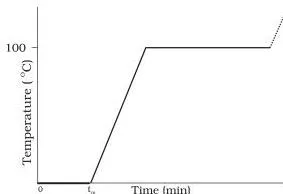
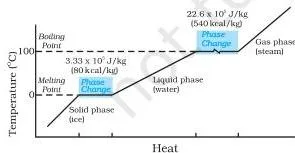
The two graphs above show why multi-step heating problems need one term per segment. To heat ice at \(-12\ ^\circ\text{C}\) to steam at \(100\ ^\circ\text{C}\) (as in NCERT Example 10.5), add four terms:
- Warm the ice: \(Q_1 = m s_{\text{ice}} \Delta T\) from \(-12\ ^\circ\text{C}\) to \(0\ ^\circ\text{C}\).
- Melt the ice at \(0\ ^\circ\text{C}\): \(Q_2 = mL_f\).
- Warm the water: \(Q_3 = m s_w \Delta T\) from \(0\ ^\circ\text{C}\) to \(100\ ^\circ\text{C}\).
- Vaporise the water at \(100\ ^\circ\text{C}\): \(Q_4 = mL_v\).
The triple point of water, where solid, liquid and vapour coexist, is \(273.16\ \text{K}\) and \(6.11 \times 10^{-3}\ \text{Pa}\) (NCERT, p. 212).
Heat Transfer by Conduction
In steady state, the rate of heat flow (heat current) through an insulated bar of length \(L\) and uniform area \(A\) with its ends at \(T_C\) and \(T_D\) is (NCERT, p. 215):
\[ H = KA\frac{T_C – T_D}{L} \]
\(K\) is the thermal conductivity in \( \text{W m}^{-1}\text{K}^{-1} \). Metals conduct far better than gases: from NCERT Table 10.6, silver is \(406\), copper \(385\), while air is only \(0.024\ \text{W m}^{-1}\text{K}^{-1}\). The formula says heat flows faster through a larger area and a steeper temperature gradient \((T_C – T_D)/L\).
For two rods of equal length and equal cross-section joined end to end, the steady- state junction temperature and equivalent conductivity follow from equating the heat current in the two rods (derived in NCERT Example 10.7, pp. 216–217). These forms are only valid under those equal-length, equal-area conditions:
\[ T_0 = \frac{K_1 T_1 + K_2 T_2}{K_1 + K_2},\qquad K’ = \frac{2K_1 K_2}{K_1 + K_2} \]
\[ H = \frac{K’A\left(T_1 – T_2\right)}{2L} \]
Thermal Radiation
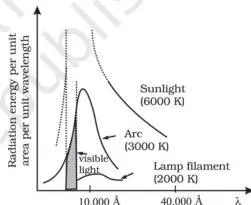
A blackbody emits a continuous spectrum. The wavelength \(\lambda_m\) of maximum emission shifts to shorter values as temperature rises, according to Wien’s displacement law (NCERT, p. 218):
\[ \lambda_m T = 2.9 \times 10^{-3}\ \text{m K} \]
This is why a heated iron piece glows dull red, then yellow, then white: the peak moves from longer to shorter wavelengths as \(T\) increases. The total power radiated by a perfect radiator was found experimentally by Stefan and proved theoretically by Boltzmann (NCERT, p. 219):
\[ H = A\sigma T^4,\qquad \sigma = 5.67 \times 10^{-8}\ \text{W m}^{-2}\text{K}^{-4} \]
Most bodies radiate only a fraction of this; the dimensionless factor \(e\) is the emissivity (\(e = 1\) for a perfect radiator). Including emissivity and the surroundings at temperature \(T_s\):
\[ H = Ae\sigma T^4,\qquad H = e\sigma A\left(T^4 – T_s^4\right) \]
\[ \lambda_m T = 2.9 \times 10^{-3}\ \text{m K} \]
Newton’s Law of Cooling
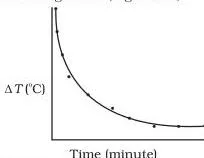
For a body at \(T_2\) in surroundings at \(T_1\), the rate of heat loss is proportional to the excess temperature (NCERT, p. 220):
\[ -\frac{\mathrm{d}Q}{\mathrm{d}t} = k\left(T_2 – T_1\right) \]
The law holds for a small temperature difference; \(k\) depends on the area and nature of the surface. Since the heat lost by a body of mass \(m\) and specific heat \(s\) is \(\mathrm{d}Q = ms\,\mathrm{d}T_2\), the temperature obeys \( \frac{\mathrm{d}T_2}{T_2 – T_1} = -K\,\mathrm{d}t \) with \(K = k/(ms)\). Integrating (NCERT, p. 221):
\[ \log_e\left(T_2 – T_1\right) = -Kt + c,\qquad T_2 = T_1 + C’e^{-Kt} \]
So the graph of \(\log_e(T_2 – T_1)\) against time is a straight line with a negative slope. For numerical problems over a short interval, the approximation used in NCERT Example 10.8 is:
\[ \frac{\text{change in temperature}}{\text{time}} = K\left(T_{\text{avg}} – T_1\right) \]
What Each Symbol Means
Where a unit does not apply, the quantity’s nature is stated.
| Symbol | What it means | SI unit |
|---|---|---|
| \( t_C \) | Celsius temperature | \( ^\circ\text{C} \) |
| \( t_F \) | Fahrenheit temperature | \( ^\circ\text{F} \) |
| \( T \) | Absolute (Kelvin) temperature | K |
| \( \Delta T \) | Change in temperature | K (same number as in \( ^\circ\text{C} \)) |
| \( P \) | Pressure of the gas | Pa |
| \( V \) | Volume of the gas | \( \text{m}^3 \) |
| \( \mu \) | Number of moles | mol |
| \( R \) | Universal gas constant \(= 8.31\) | \( \text{J mol}^{-1}\text{K}^{-1} \) |
| \( l,\ \Delta l \) | Original length; change in length | m |
| \( \alpha_l \) | Coefficient of linear expansion | \( \text{K}^{-1} \) |
| \( \alpha_v \) | Coefficient of volume expansion | \( \text{K}^{-1} \) |
| \( A,\ \Delta A \) | Area; change in area | \( \text{m}^2 \) |
| \( V,\ \Delta V \) | Volume; change in volume | \( \text{m}^3 \) |
| \( Y \) | Young’s modulus of the material | Pa (\( \text{N m}^{-2} \)) |
| \( \Delta F/A \) | Thermal stress (force per unit area) | Pa (\( \text{N m}^{-2} \)) |
| \( \Delta Q \) | Heat absorbed or given out | J |
| \( S \) | Heat capacity of a body | \( \text{J K}^{-1} \) |
| \( s \) | Specific heat capacity | \( \text{J kg}^{-1}\text{K}^{-1} \) |
| \( C \) | Molar specific heat capacity | \( \text{J mol}^{-1}\text{K}^{-1} \) |
| \( m \) | Mass of the substance | kg |
| \( L,\ L_f,\ L_v \) | Latent heat; latent heat of fusion; latent heat of vaporisation | \( \text{J kg}^{-1} \) |
| \( H \) | Heat current (rate of heat flow) | W (\( \text{J s}^{-1} \)) |
| \( K \) | Thermal conductivity (in the conduction formula) | \( \text{W m}^{-1}\text{K}^{-1} \) |
| \( K’ \) | Equivalent thermal conductivity of rods in series | \( \text{W m}^{-1}\text{K}^{-1} \) |
| \( T_C,\ T_D \) | Temperatures of the hot and cold ends of a conducting bar | K |
| \( T_0 \) | Steady junction temperature of two bars in series | K |
| \( \lambda_m \) | Wavelength at which emitted energy is maximum | m |
| \( \sigma \) | Stefan-Boltzmann constant \(= 5.67 \times 10^{-8}\) | \( \text{W m}^{-2}\text{K}^{-4} \) |
| \( e \) | Emissivity of the surface | dimensionless (\(0\) to \(1\)); \(e = 1\) for a perfect radiator |
| \( T_s \) | Temperature of the surroundings | K |
| \( k \) | Constant in Newton’s law (depends on area and nature of surface) | \( \text{W K}^{-1} \) |
| \( K \) | Cooling constant \(K = k/(ms)\) in the integrated cooling law | \( \text{s}^{-1} \) |
| \( C’ \) | Constant of integration in the cooling law | K |
| \( t \) | Time | s (minutes in practical problems) |
Careful: the letter \(K\) is used for two different quantities in this chapter — thermal conductivity (\( \text{W m}^{-1}\text{K}^{-1} \)) in conduction, and the cooling constant \(K = k/(ms)\) (\( \text{s}^{-1} \)) in Newton’s law. The units tell you which one a formula needs.
When to Use Each Formula
| Formula | Use it when… | Condition |
|---|---|---|
| Temperature conversions (Eq. 10.1) | a reading is given in one scale and you need the other | use \(t_F = \frac{9}{5}t_C + 32\) for a quick check |
| \( T = t_C + 273.15 \) | a formula needs absolute temperature (gas law, radiation) | never use it on a temperature difference |
| \( PV = \mu RT \) | a gas’s pressure, volume, temperature and amount are related | low-density gas; \(T\) in kelvin |
| \( \frac{\Delta l}{l} = \alpha_l \Delta T \), \( L_2 = L_1[1 + \alpha_l \Delta T] \) | a rod, tape, rail or ring changes length on heating or cooling | small \(\Delta T\); \(\alpha_l\) from tables |
| \( \frac{\Delta A}{A} = 2\alpha_l \Delta T \) | the area of a solid sheet (including a hole in it) expands | isotropic solid |
| \( \frac{\Delta V}{V} = \alpha_v \Delta T \) | the volume of a solid or liquid changes | \(\alpha_v\) from tables; small \(\Delta T\) |
| \( \alpha_v = 3\alpha_l \) | you have \(\alpha_l\) and need \(\alpha_v\) (or vice versa) | isotropic solid; not for liquids or gases |
| \( \alpha_v = 1/T \) | volume expansion of an ideal gas at constant pressure | constant pressure; ideal gas |
| \( \Delta F/A = Y\alpha_l \Delta T \) | a rod is held rigidly and cannot expand or contract | ends fixed; the stress is compressive |
| \( \Delta Q = ms\Delta T \) | heating or cooling without a phase change; calorimetry problems | no change of state |
| \( Q = mL \) | melting, freezing, vaporisation or condensation at constant temperature | temperature is constant during the change |
| \( H = KA\frac{T_C – T_D}{L} \) | steady heat flow through a slab or bar; find \(H\), \(K\), or a junction temperature | steady state; sides insulated |
| \( \lambda_m T = 2.9 \times 10^{-3}\ \text{m K} \) | estimate the temperature of a star, filament or hot body from its peak wavelength | \(T\) in kelvin |
| \( H = e\sigma A T^4 \), \( H = e\sigma A(T^4 – T_s^4) \) | power radiated, or net radiant power lost to surroundings | absolute temperatures in kelvin |
| Newton’s law of cooling | a hot body cools in cooler surroundings | small temperature difference; average form only for a small drop in a short interval |
Worked Examples
Worked Example 1: New length of a heated rod (linear expansion)
Step 1: Select the formula.
The rod expands freely, so use \( L_2 = L_1\left[1 + \alpha_l\left(T_2 – T_1\right)\right] \).
Step 2: Identify the data.
\(L_1 = 1.500\ \text{m}\), \(T_1 = 20\ ^\circ\text{C}\), \(T_2 = 120\ ^\circ\text{C}\), \(\alpha_l = 2.5 \times 10^{-5}\ \text{K}^{-1}\) (aluminium).
Step 3: Compute the temperature change.
\(\Delta T = 120 – 20 = 100\ ^\circ\text{C} = 100\ \text{K}\) — the number is the same in both scales because the unit size is identical.
\[ L_2 = 1.500\left[1 + \left(2.5 \times 10^{-5}\right)(100)\right] = 1.500\left[1 + 2.5 \times 10^{-3}\right] \]
\[ L_2 = 1.500 \times 1.0025 = 1.50375\ \text{m} \]
Final answer: \(L_2 = 1.504\ \text{m}\) (extension \(3.75\ \text{mm}\)).
Worked Example 2: Junction temperature and heat current of two rods in series (conduction)
Step 1: Select the formula.
A copper rod (\(K_1 = 385\ \text{W m}^{-1}\text{K}^{-1}\)) and a steel rod (\(K_2 = 50.2\ \text{W m}^{-1}\text{K}^{-1}\)), each \(0.10\ \text{m}\) long with area \(A = 2.0 \times 10^{-4}\ \text{m}^2\), are joined end to end.
Free ends are kept at \(T_1 = 373\ \text{K}\) and \(T_2 = 273\ \text{K}\).
Since lengths and areas are equal, use the Example 10.7 forms.
Step 2: Junction temperature.
\[ T_0 = \frac{K_1 T_1 + K_2 T_2}{K_1 + K_2} = \frac{385(373) + 50.2(273)}{385 + 50.2} = \frac{157309.6}{435.2} = 361.5\ \text{K} \]
Step 3: Equivalent conductivity and heat current.
\[ K’ = \frac{2K_1 K_2}{K_1 + K_2} = \frac{2 \times 385 \times 50.2}{435.2} = 88.8\ \text{W m}^{-1}\text{K}^{-1} \]
\[ H = \frac{K’A\left(T_1 – T_2\right)}{2L} = \frac{88.8\left(2.0 \times 10^{-4}\right)(100)}{0.20} = 8.9\ \text{W} \]
Final answer: junction temperature \(\approx 3.6 \times 10^2\ \text{K}\), heat current \(\approx 8.9\ \text{W}\). Check: copper (the better conductor) takes only about \(11.5\ \text{K}\) of the drop, steel about \(88.5\ \text{K}\).
Worked Example 3: Cooling time using Newton’s law of cooling (approximate form)
Step 1: Select the formula.
The interval is short and the excess temperature is small, so use \( \frac{\Delta T}{t} = K\left(T_{\text{avg}} – T_1\right) \).
Step 2: First interval.
A mug cools from \(62\ ^\circ\text{C}\) to \(58\ ^\circ\text{C}\) in \(5\ \text{min}\) in a room at \(20\ ^\circ\text{C}\).
Average temperature \(= 60\ ^\circ\text{C}\), excess \(= 60 – 20 = 40\ ^\circ\text{C}\).
\[ \frac{4}{5} = K(40) \Rightarrow K = 0.02\ \text{min}^{-1} \]
Step 3: Second interval.
From \(42\ ^\circ\text{C}\) to \(40\ ^\circ\text{C}\), average \(= 41\ ^\circ\text{C}\), excess \(= 21\ ^\circ\text{C}\).
\(K\) is unchanged because the surface is the same.
\[ \frac{2}{t} = 0.02(21) = 0.42 \Rightarrow t = \frac{2}{0.42} = 4.76\ \text{min} \]
Final answer: about \(4.8\ \text{min}\) (\(\approx 285\ \text{s}\)).
Common Mistakes to Avoid
| Mistake | Correct rule | How to check your answer |
|---|---|---|
| Using \( ^\circ\text{C} \) as the temperature in \(H = e\sigma A T^4\) or \(\lambda_m T\). | Convert to kelvin first: \(T = t_C + 273.15\). The \(T^4\) term and Wien’s constant are defined for absolute temperature. | If you skipped the conversion, the same body would appear to radiate hundreds of times less power — a physically absurd result. |
| Adding \(273.15\) to a temperature difference \(\Delta T\). | The kelvin and Celsius degrees are the same size, so \(\Delta T\) is numerically identical in both scales. Add \(273.15\) only to a single reading. | Compute \(\Delta l = l\alpha_l \Delta T\) with \(\Delta T\) in \( ^\circ\text{C} \) and again in K — you must get the same answer. |
| Applying \(\alpha_v = 3\alpha_l\) to liquids or gases. | The relation comes from a solid cube expanding equally in all directions. Liquids have no \(\alpha_l\), and an ideal gas at constant pressure has \(\alpha_v = 1/T\). | Ask: does this substance have a well-defined \(\alpha_l\)? If not, do not use \(3\alpha_l\). |
| Stopping after melting in an ice-to-steam problem (using only \(mL_f\)). | Split the process into segments: warm the ice, melt it, warm the water, vaporise it, and add the four \(Q\) terms as in Example 10.5. | Trace each segment on the temperature-versus-heat graph (Fig. 10.12); every flat region contributes one \(mL\) term. |
| Using the average-temperature approximation of Newton’s law when the drop in temperature is large. | The law holds only for a small excess temperature, and the interval form \(\frac{\Delta T}{t} = K(T_{\text{avg}} – T_1)\) needs a small drop during the interval. | The average temperature of the interval should stay close to the body’s actual temperature throughout. |
Frequently Asked Questions
Why is a temperature difference the same number in Celsius and in kelvin?
Because the kelvin and the Celsius degree are the same size — the two scales differ only in where zero sits (\(0\ \text{K} = -273.15\ ^\circ\text{C}\)). So \(\Delta T = 1\ ^\circ\text{C} = 1\ \text{K}\) and no conversion factor is needed for a difference.
Add \(273.15\) only when a formula needs an absolute reading \(T\) from \(t_C\), such as in the gas law or the radiation laws.
What is the difference between heat capacity, specific heat capacity and molar specific heat capacity?
Heat capacity \(S = \Delta Q/\Delta T\) belongs to the whole body and has unit \( \text{J K}^{-1} \). Specific heat capacity \(s = S/m\) is per unit mass (\( \text{J kg}^{-1}\text{K}^{-1} \)), and molar specific heat capacity \(C = S/\mu\) is per mole (\( \text{J mol}^{-1}\text{K}^{-1} \)). The unit tells you which one you are using.
In calorimetry, remember to include the calorimeter’s own heat capacity on the gaining side.
When is Newton’s law of cooling valid?
When the excess temperature of the body over the surroundings is small. Under that condition the combined loss by conduction, convection and radiation is approximately proportional to the excess temperature.
The exponential form \(T_2 = T_1 + C’e^{-Kt}\) is the exact solution of this approximate law, and the average-temperature form is for a small drop in a short interval, as in NCERT Example 10.8.
Why does temperature stay constant while ice melts or water boils even though heat keeps being added?
Because the heat is used to change the state, not to raise the temperature — that heat is the latent heat \(Q = mL\) (\(3.33 \times 10^5\ \text{J kg}^{-1}\) to melt ice, \(22.6 \times 10^5\ \text{J kg}^{-1}\) to vaporise water, NCERT p. 213).
During the change, the solid and liquid (or liquid and vapour) coexist in thermal equilibrium at a fixed temperature; only after the change is complete does further heat raise the temperature again.
For formulas of other chapters, see the full physics formulas index.
Reference: NCERT Class 11 Physics textbook, chapter Thermal Properties of Matter.
Explore Class 11 Physics Formulas
More for this chapter:
Class 11 Physics on LearnCBSE:
Related chapters: