
This page collects the work, energy and power class 11 formulas you need for revision: the scalar (dot) product, work done by constant and variable forces, kinetic energy, potential energy, the work–energy theorem, conservation of mechanical energy, spring energy, power, and collisions.
Every formula is grouped by topic, with the meaning and SI unit of each symbol, a line on when to use it, and worked examples with original numbers. The formulas follow the Rationalised NCERT Class 11 Physics textbook, whose official PDF is at ncert.nic.in.
For the detailed derivations and explanations, this chapter’s notes are linked from the Class 11 Physics formulas hub. Use the Physics formulas index to jump to formula sheets for other chapters and classes.
Work, Energy and Power Class 11 Formulas at a Glance
Find what you want to calculate in the left column, then take the formula. Symbol meanings are below, and the conditions for each formula are in “When to Use Each Formula”.
| Purpose | Formula |
|---|---|
| Scalar product of two vectors | \( \mathbf{A}\cdot\mathbf{B} = AB\cos\theta \) |
| Scalar product using components | \( \mathbf{A}\cdot\mathbf{B} = A_xB_x + A_yB_y + A_zB_z \) |
| Magnitude from the dot product | \( A = \sqrt{\mathbf{A}\cdot\mathbf{A}} = \sqrt{A_x^2 + A_y^2 + A_z^2} \) |
| Dot products of unit vectors | \( \hat{\mathbf{i}}\cdot\hat{\mathbf{i}} = 1 \), \( \hat{\mathbf{i}}\cdot\hat{\mathbf{j}} = 0 \) |
| Work done by a constant force | \( W = \mathbf{F}\cdot\mathbf{d} = Fd\cos\theta \) |
| Kinetic energy of a moving body | \( K = \frac{1}{2}mv^2 \) |
| Work–energy theorem | \( K_f – K_i = W \) |
| Work done by a variable force | \( W = \int_{x_i}^{x_f} F(x)\,dx \) |
| Gravitational potential energy | \( V(h) = mgh \) |
| Force from a potential energy function | \( F(x) = -\frac{dV}{dx} \) |
| Conservation of mechanical energy | \( K_i + V(x_i) = K_f + V(x_f) \) |
| Speed of a freely falling body (from mechanical energy conservation) | \( v_f = \sqrt{2gH} \) |
| Spring force (Hooke’s law) | \( F_s = -kx \) |
| Elastic potential energy of a spring | \( V(x) = \frac{1}{2}kx^2 \) |
| Work done by a spring force | \( W_s = \frac{1}{2}kx_i^2 – \frac{1}{2}kx_f^2 \) |
| Maximum speed of a spring–block system | \( v_m = \sqrt{\frac{k}{m}}\,x_m \) |
| Mechanical energy with non-conservative forces | \( E_f – E_i = W_{nc} \) |
| Average power | \( P_{av} = \frac{W}{t} \) |
| Instantaneous power | \( P = \frac{dW}{dt} = \mathbf{F}\cdot\mathbf{v} \) |
| Final speed in a completely inelastic collision | \( v_f = \frac{m_1}{m_1 + m_2}v_{1i} \) |
| Kinetic energy lost in a completely inelastic collision | \( \Delta K = \frac{1}{2}\frac{m_1m_2}{m_1 + m_2}v_{1i}^2 \) |
| Elastic collision in one dimension (target at rest) | \( v_{1f} = \frac{m_1 – m_2}{m_1 + m_2}v_{1i} \), \( v_{2f} = \frac{2m_1}{m_1 + m_2}v_{1i} \) |
| Equal-mass elastic collision (derived from the 1-D formulas) | \( v_{1f} = 0 \), \( v_{2f} = v_{1i} \) |
| Elastic collision in two dimensions (target at rest) | \( m_1v_{1i} = m_1v_{1f}\cos\theta_1 + m_2v_{2f}\cos\theta_2 \); \( 0 = m_1v_{1f}\sin\theta_1 – m_2v_{2f}\sin\theta_2 \) |
Conversion factors you may need: \( 1\ \text{erg} = 10^{-7}\ \text{J} \), \( 1\ \text{eV} = 1.6\times10^{-19}\ \text{J} \), \( 1\ \text{cal} = 4.186\ \text{J} \), \( 1\ \text{kWh} = 3.6\times10^6\ \text{J} \) (NCERT, p. 74), and \( 1\ \text{hp} = 746\ \text{W} \) (NCERT, p. 83).
All Formulas, Grouped by Topic
Each group follows one sub-topic of the chapter. The worked examples at the end show the formulas in action.
The Scalar Product
The dot product turns two vectors into a scalar. It is the mathematical tool behind the definition of work (NCERT, p. 72).
\[ \mathbf{A}\cdot\mathbf{B} = AB\cos\theta \]
\[ \mathbf{A}\cdot\mathbf{B} = A_xB_x + A_yB_y + A_zB_z \]
\[ \mathbf{A}\cdot\mathbf{A} = A^2 = A_x^2 + A_y^2 + A_z^2 \]
The unit vectors \( \hat{\mathbf{i}}, \hat{\mathbf{j}}, \hat{\mathbf{k}} \) are mutually perpendicular, so the dot product of any one with itself is 1 and with any other is 0. If \( \mathbf{A}\cdot\mathbf{B} = 0 \), the two vectors are perpendicular.
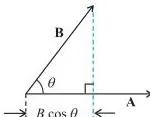
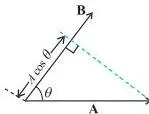
The two figures show the same product twice: the magnitude of one vector times the component of the other along it.
Work and the Work–Energy Theorem
Work is done by a force on a body over a displacement. Only the component of the force along the displacement does work (NCERT, p. 74).
\[ W = \mathbf{F}\cdot\mathbf{d} = Fd\cos\theta \]
Work is positive when \( \theta \) is between \( 0^\circ \) and \( 90^\circ \), negative when \( \theta \) is between \( 90^\circ \) and \( 180^\circ \), and zero when \( \theta = 90^\circ \).
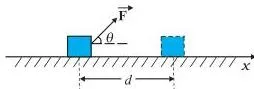
In Fig. 5.2 the displacement is along the \( x \)-axis; the component of \( \mathbf{F} \) in that direction, \( F\cos\theta \), is what appears in the work formula.
Kinetic energy is the energy of motion (NCERT, p. 75):
\[ K = \frac{1}{2}mv^2 \]
The work–energy theorem states that the change in kinetic energy of a particle equals the work done on it by the net force:
\[ K_f – K_i = W \]
Work and energy have the same dimensions, \( [\mathrm{ML}^2\mathrm{T}^{-2}] \), and the SI unit is the joule (J).
Work Done by a Variable Force
When the force changes with position, add up \( F(x)\Delta x \) over small displacements. The limiting sum is an integral equal to the area under the \( F(x) \) versus \( x \) curve (NCERT, p. 76):
\[ W = \int_{x_i}^{x_f} F(x)\,dx \]
The work–energy theorem holds for this case too:
\[ K_f – K_i = \int_{x_i}^{x_f} F(x)\,dx = W \]
Potential Energy and Conservation of Mechanical Energy
Potential energy is stored energy by virtue of position or configuration. Near the earth’s surface, treating \( g \) as constant (NCERT, p. 78):
\[ V(h) = mgh \]
The force can be recovered from the potential energy function as its negative derivative:
\[ F(x) = -\frac{dV}{dx} \]
When only conservative forces do work, the total mechanical energy is conserved (NCERT, p. 79):
\[ K_i + V(x_i) = K_f + V(x_f) \]
For a body dropped from height \( H \), this gives the speed \( v_f = \sqrt{2gH} \) at ground level and \( v_h^2 = 2g(H – h) \) at height \( h \).
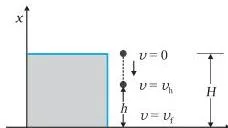
At the top the energy is purely potential; at height \( h \) it is split between potential and kinetic; at ground level it is purely kinetic.
Potential Energy of a Spring
The spring force is conservative and obeys Hooke’s law (NCERT, p. 80):
\[ F_s = -kx \]
\[ V(x) = \frac{1}{2}kx^2 \]
Work done by the spring force depends only on the end points (NCERT, p. 81):
\[ W_s = \frac{1}{2}kx_i^2 – \frac{1}{2}kx_f^2 \]
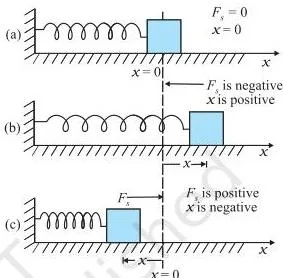
The shaded triangle in Fig. 5.7(d) is the work done by the spring force — negative, because the spring force opposes the displacement. For a block released from an extension \( x_m \), mechanical energy conservation gives the speed at any position \( x \), and the maximum speed occurs at equilibrium, \( x = 0 \):
\[ \frac{1}{2}kx_m^2 = \frac{1}{2}kx^2 + \frac{1}{2}mv^2 \qquad \Rightarrow \qquad v_m = \sqrt{\frac{k}{m}}\,x_m \]
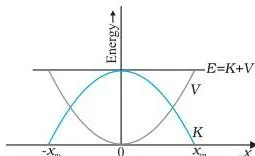
The two parabolic curves in Fig. 5.8 are complementary: as \( K \) increases, \( V \) decreases, and the sum stays constant.
When a non-conservative force such as friction also does work, mechanical energy is not conserved. The change in total mechanical energy equals the work done by the non-conservative forces:
\[ E_f – E_i = W_{nc} \]
Power
Power is the time rate at which work is done or energy is transferred (NCERT, p. 83).
\[ P_{av} = \frac{W}{t} \]
\[ P = \frac{dW}{dt} \]
For a force \( \mathbf{F} \) acting on a body moving with velocity \( \mathbf{v} \):
\[ P = \mathbf{F}\cdot\mathbf{v} \]
The SI unit is the watt (W), equal to \( 1\ \text{J/s} \). Useful conversions: \( 1\ \text{hp} = 746\ \text{W} \) and \( 1\ \text{kWh} = 3.6\times10^6\ \text{J} \) — kWh is a unit of energy, not of power.
Collisions
In every collision, total linear momentum is conserved; kinetic energy is conserved only in an elastic collision, and only after the collision is over (NCERT, p. 84).
For a completely inelastic collision in one dimension, the two bodies move together after impact (NCERT, p. 85):
\[ v_f = \frac{m_1}{m_1 + m_2}v_{1i} \]
The kinetic energy lost in the process is:
\[ \Delta K = \frac{1}{2}\frac{m_1m_2}{m_1 + m_2}v_{1i}^2 \]
For an elastic collision in one dimension, with body 2 initially at rest (NCERT, p. 85):
\[ v_{1f} = \frac{m_1 – m_2}{m_1 + m_2}v_{1i} \qquad v_{2f} = \frac{2m_1}{m_1 + m_2}v_{1i} \]
Two special cases are worth remembering. If \( m_1 = m_2 \), then \( v_{1f} = 0 \) and \( v_{2f} = v_{1i} \): the first body stops and the second leaves with the original speed. If \( m_2 \gg m_1 \), then \( v_{1f} \approx -v_{1i} \) and \( v_{2f} \approx 0 \): the heavy body is undisturbed and the light body reverses its velocity.
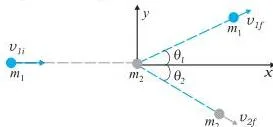
Fig. 5.10 defines the angles \( \theta_1 \) and \( \theta_2 \) used in the two-dimensional equations below (NCERT, p. 86):
\[ m_1v_{1i} = m_1v_{1f}\cos\theta_1 + m_2v_{2f}\cos\theta_2 \]
\[ 0 = m_1v_{1f}\sin\theta_1 – m_2v_{2f}\sin\theta_2 \]
If the collision is elastic, kinetic energy conservation supplies a third equation. The two momentum equations have four unknowns, so one more quantity — usually \( \theta_1 \) — must be known for the problem to be solvable.
What Each Symbol Means
Every symbol used above, with its SI unit. Dimensions in square brackets help you check an answer.
| Symbol | What it means | Unit |
|---|---|---|
| \( \mathbf{A}, \mathbf{B} \) | Any two vectors whose dot product is taken (force, displacement, velocity, …) | Depends on the vector |
| \( \theta \) | Angle between the two vectors, or between force and displacement | rad (dimensionless) |
| \( W \) | Work done by a force | J (\( [\mathrm{ML}^2\mathrm{T}^{-2}] \)) |
| \( K \) | Kinetic energy of a moving body | J |
| \( V(h), V(x) \) | Potential energy at height \( h \) or position \( x \) | J |
| \( E \) | Total mechanical energy, \( E = K + V \) | J |
| \( m \) | Mass of the body | kg |
| \( u, v \) | Initial and final speeds in the derivation of \( K_f – K_i = W \) | m/s |
| \( v_i, v_f \) | Initial and final speeds of a body | m/s |
| \( \mathbf{F} \) | Force acting on the body | N |
| \( \mathbf{d} \) | Displacement of the body | m |
| \( F(x) \) | Force as a function of position | N |
| \( x_i, x_f \) | Initial and final positions | m |
| \( g \) | Acceleration due to gravity near the earth’s surface (treated as constant) | \( \text{m/s}^2 \) |
| \( h, H \) | Height above the chosen reference level | m |
| \( k \) | Spring constant (stiffness of the spring) | N/m |
| \( x \) | Extension or compression of the spring from equilibrium | m |
| \( x_m \) | Maximum extension or compression of the spring | m |
| \( v_m \) | Maximum speed of the block in a spring–block system | m/s |
| \( P, P_{av} \) | Instantaneous power and average power | W (\( [\mathrm{ML}^2\mathrm{T}^{-3}] \)) |
| \( t \) | Time taken | s |
| \( m_1, m_2 \) | Masses of the two colliding bodies | kg |
| \( v_{1i} \) | Initial speed of the moving body; body 2 is at rest | m/s |
| \( v_{1f}, v_{2f} \) | Final speeds of bodies 1 and 2 after the collision | m/s |
| \( \theta_1, \theta_2 \) | Angles made by the final velocities with the initial direction of motion | rad (dimensionless) |
| \( W_{nc} \) | Work done by non-conservative forces (for example friction) | J |
When to Use Each Formula
Choose the formula by the situation, not by the symbols you happen to have.
| Formula | Use it when… |
|---|---|
| \( \mathbf{A}\cdot\mathbf{B} = AB\cos\theta \) | You need the component of one vector along another, or the angle between two vectors. |
| \( W = Fd\cos\theta \) | The force is constant and you know the displacement and the angle between them. |
| \( K = \frac{1}{2}mv^2 \) | You need the energy of a body due to its motion. |
| \( K_f – K_i = W \) | You know initial and final speeds and want the net work, or a speed from the net work. Works even when the force is unknown. |
| \( W = \int_{x_i}^{x_f}F(x)\,dx \) | The force varies with position; the integral equals the area under the \( F(x) \) versus \( x \) graph. |
| \( V(h) = mgh \) | Height changes near the earth’s surface, where \( g \) is effectively constant. |
| \( F(x) = -\frac{dV}{dx} \) | You have a potential energy function and want the force it produces. |
| \( K_i + V_i = K_f + V_f \) | Only conservative forces do work — no friction, no air resistance. |
| \( F_s = -kx \) | A spring is stretched or compressed; the minus sign shows the force opposes the displacement. |
| \( V = \frac{1}{2}kx^2 \) | You need the energy stored in a spring at extension or compression \( x \). |
| \( v_m = \sqrt{\frac{k}{m}}\,x_m \) | A spring–block system is released from \( x_m \); the speed is maximum at \( x = 0 \). |
| \( E_f – E_i = W_{nc} \) | Friction or another non-conservative force does work; mechanical energy changes by \( W_{nc} \). |
| \( P_{av} = \frac{W}{t} \), \( P = \mathbf{F}\cdot\mathbf{v} \) | You want the rate of doing work. For constant force and velocity, \( P = Fv\cos\theta \). |
| \( v_f = \frac{m_1}{m_1 + m_2}v_{1i} \) | Two bodies stick together after a head-on collision (completely inelastic). |
| \( v_{1f} = \frac{m_1 – m_2}{m_1 + m_2}v_{1i} \), \( v_{2f} = \frac{2m_1}{m_1 + m_2}v_{1i} \) | Elastic head-on collision with body 2 initially at rest; both momentum and kinetic energy are conserved. |
| Two-dimensional collision equations | A glancing collision in which the bodies move off at angles; one angle must be given to solve. |
Worked Examples
Three examples with original numbers, covering the most common ways these formulas appear in problems.
Example 1: Work by a force at an angle
Step 1: A 10 kg box is pulled 4.0 m along a horizontal floor by a rope that makes \( 60^\circ \) with the floor.
The tension is 50 N and the friction is 20 N.
The work by tension uses the angle between force and displacement, \( \theta = 60^\circ \).
\[ W_T = Fd\cos\theta = 50 \times 4.0 \times \cos 60^\circ = 50 \times 4.0 \times 0.50 = 100\ \text{J} \]
Step 2: Friction opposes the motion, so \( \theta = 180^\circ \).
\[ W_f = fd\cos 180^\circ = -20 \times 4.0 = -80\ \text{J} \]
Step 3: Net work is the sum of the work done by each force.
\[ W_{net} = 100 + (-80) = 20\ \text{J} \]
Step 4: Apply the work–energy theorem.
The box starts from rest, so \( K_i = 0 \).
\[ \frac{1}{2}mv^2 = 20 \quad \Rightarrow \quad v = \sqrt{\frac{2 \times 20}{10}} = 2.0\ \text{m/s} \]
Final answer: \( W_T = 100\ \text{J} \), \( W_f = -80\ \text{J} \), \( W_{net} = 20\ \text{J} \), and the box reaches \( 2.0\ \text{m/s} \).
Example 2: Finding work from the work–energy theorem
Step 1: A 0.50 kg puck on rough ice is given an initial speed of 6.0 m/s and stops after sliding 4.5 m.
Friction is the only force doing work, so the work–energy theorem gives its work directly from the speeds.
\[ W = K_f – K_i = 0 – \frac{1}{2}(0.50)(6.0)^2 = -9.0\ \text{J} \]
Step 2: Friction and displacement point in opposite directions, \( \theta = 180^\circ \), so \( W = -fd \).
Solve for the friction force.
\[ -9.0 = -f \times 4.5 \quad \Rightarrow \quad f = 2.0\ \text{N} \]
Final answer: Work done by friction is \( -9.0\ \text{J} \) and the friction force is \( 2.0\ \text{N} \).
Example 3: Energy conversion in a spring–block system
Step 1: A 0.40 kg block on a smooth surface is attached to a spring of constant \( k = 250\ \text{N/m} \).
The spring is compressed \( 8.0\ \text{cm} = 0.080\ \text{m} \) and the block is released.
At maximum speed the block is at \( x = 0 \), where all the energy is kinetic.
\[ \frac{1}{2}mv_m^2 = \frac{1}{2}kx_m^2 \quad \Rightarrow \quad v_m = \sqrt{\frac{k}{m}}\,x_m = \sqrt{\frac{250}{0.40}} \times 0.080 = 25 \times 0.080 = 2.0\ \text{m/s} \]
Step 2: When the spring is still extended \( 4.0\ \text{cm} = 0.040\ \text{m} \), part of the energy remains in the spring:
\[ \frac{1}{2}mv^2 = \frac{1}{2}k(x_m^2 – x^2) \quad \Rightarrow \quad v = \sqrt{\frac{k}{m}(x_m^2 – x^2)} \]
\[ v = \sqrt{625 \times (0.0064 – 0.0016)} = \sqrt{625 \times 0.0048} = \sqrt{3.0} = 1.7\ \text{m/s} \]
Final answer: Maximum speed \( 2.0\ \text{m/s} \); speed when the spring is extended \( 4.0\ \text{cm} \) is \( 1.7\ \text{m/s} \).
For practice on the textbook’s own questions, work through the exercises at the end of the chapter; the chapter’s NCERT solutions are linked from the Class 11 Physics formulas hub.
Common Mistakes to Avoid
These errors are specific to applying this chapter’s formulas, with a quick check for each.
| Mistake | Correct rule | How to check your answer |
|---|---|---|
| Writing \( W = Fd \) and dropping \( \cos\theta \) when force and displacement are not parallel. | Always use \( W = Fd\cos\theta \), with \( \theta \) the angle between force and displacement. | If \( \theta = 90^\circ \), work must be zero — gravity does no work on a block moving along a horizontal floor. |
| Confusing work done by the spring with energy stored in the spring. | The spring force does work \( W_s = -\frac{1}{2}kx^2 \) while being stretched; the stored potential energy is \( V = +\frac{1}{2}kx^2 \). | For a conservative force, work done equals the drop in potential energy: \( W_s = V_i – V_f \). |
| Using conservation of mechanical energy when friction acts. | Mechanical energy is conserved only if the forces doing work are conservative. With friction, use \( E_f – E_i = W_{nc} \). | If friction is present, \( W_{nc} \) must come out negative — total mechanical energy decreases. |
| Applying the elastic collision formulas when the target is not at rest. | \( v_{1f} = \frac{m_1 – m_2}{m_1 + m_2}v_{1i} \) and \( v_{2f} = \frac{2m_1}{m_1 + m_2}v_{1i} \) assume body 2 is initially at rest. | Check the equal-mass case: \( m_1 = m_2 \) must give \( v_{1f} = 0 \) and \( v_{2f} = v_{1i} \). |
| Treating kilowatt-hour as a unit of power. | \( 1\ \text{kWh} = 1\ \text{kW} \times 1\ \text{h} = 3.6\times10^6\ \text{J} \) — kWh is a unit of energy. | Electricity bills charge for energy consumed; power multiplied by time always gives energy. |
Frequently Asked Questions
When is the work done by a force zero?
Work is zero in three situations (NCERT, p. 74): the displacement is zero (a weightlifter holding a load still does no work on it), the force is zero, or the force is perpendicular to the displacement — then \( \cos 90^\circ = 0 \). Gravity does no work on a block sliding on a smooth horizontal table for this last reason.
Is mechanical energy conserved when friction acts?
No. Friction is a non-conservative force, so \( K + V \) is not constant. The correct statement is \( E_f – E_i = W_{nc} \), which is why a block sliding on a rough floor ends with less mechanical energy than it started with.
Is kinetic energy conserved while bodies are in contact during an elastic collision?
No. Kinetic energy conservation in an elastic collision applies after the collision is over; during the contact time the bodies deform and their kinetic energy is not constant. Total linear momentum, however, is conserved at every instant (NCERT, p. 88).
How can the work–energy theorem find work done by an unknown force?
Because \( K_f – K_i = W \) connects the net work to speeds alone, you can find the work done by a force whose exact nature you do not know. The textbook applies this to a raindrop: the change in kinetic energy minus the work by gravity gives the work done by the resistive force (NCERT, Example 5.2).
Reference: NCERT Class 11 Physics Part I textbook, chapter Work, Energy and Power.
Explore Class 11 Physics Formulas
More for this chapter:
Class 11 Physics on LearnCBSE:
Related chapters: