This formula sheet covers the key equations for Oscillations, the Class 11 Physics chapter on periodic and simple harmonic motion. You will find the formulas for period, frequency, displacement, velocity, acceleration, force, energy, and the simple pendulum — all with their symbols, SI units, and when to use them.
Each formula is grouped by topic, with symbol meanings, usage guidance, and original worked examples. For detailed explanations and derivations, visit the Oscillations Class 11 notes.
Formulas at a Glance
| Purpose (what you are finding) | Formula (MathJax) |
|---|---|
| Frequency from period | \(\nu = 1/T\) |
| Angular frequency from period or frequency | \(\omega = 2\pi/T = 2\pi\nu\) |
| Displacement in SHM | \(x(t) = A \cos(\omega t + \phi)\) |
| Velocity in SHM | \(v(t) = -\omega A \sin(\omega t + \phi)\) |
| Acceleration in SHM | \(a(t) = -\omega^2 A \cos(\omega t + \phi) = -\omega^2 x(t)\) |
| Force law (restoring force) | \(F = -k x\) |
| Angular frequency from spring constant and mass | \(\omega = \sqrt{k/m}\) |
| Period of a spring–mass system | \(T = 2\pi \sqrt{m/k}\) |
| Kinetic energy in SHM | \(K = \frac{1}{2} m v^2 = \frac{1}{2} k A^2 \sin^2(\omega t + \phi)\) |
| Potential energy in SHM | \(U = \frac{1}{2} k x^2 = \frac{1}{2} k A^2 \cos^2(\omega t + \phi)\) |
| Total mechanical energy in SHM | \(E = K + U = \frac{1}{2} k A^2\) |
| Period of a simple pendulum (small angles) | \(T = 2\pi \sqrt{L/g}\) |
All Formulas, Grouped by Topic
Period and Frequency
For any periodic motion, the relationship between period \(T\) and frequency \(\nu\) is:
\[ \nu = \frac{1}{T} \quad \text{(SI unit of frequency: hertz, Hz)} \]
The angular frequency \(\omega\) is related to \(T\) and \(\nu\) by:
\[ \omega = \frac{2\pi}{T} = 2\pi\nu \quad \text{(SI unit: rad/s)} \]
Simple Harmonic Motion (SHM) – Displacement, Velocity, Acceleration
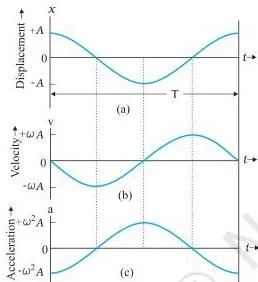
Displacement of a particle in SHM, with amplitude \(A\), angular frequency \(\omega\), and phase constant \(\phi\):
\[ x(t) = A \cos(\omega t + \phi) \]
Velocity of the particle:
\[ v(t) = -\omega A \sin(\omega t + \phi) \]
Acceleration of the particle:
\[ a(t) = -\omega^2 A \cos(\omega t + \phi) = -\omega^2 x(t) \]
The plots of displacement, velocity and acceleration (for \(\phi = 0\)) are shown below. Notice the phase differences: velocity leads displacement by \(\pi/2\), acceleration leads by \(\pi\).
Force Law for SHM
The restoring force is proportional to displacement and opposite in direction:
\[ F = -k x \]
where the force constant \(k = m\omega^2\). Hence the angular frequency and period for a spring–mass system are:
\[ \omega = \sqrt{\frac{k}{m}} \]
\[ T = 2\pi \sqrt{\frac{m}{k}} \]
Energy in SHM
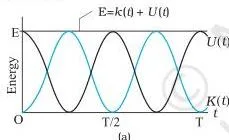
Kinetic energy:
\[ K = \frac{1}{2} m v^2 = \frac{1}{2} k A^2 \sin^2(\omega t + \phi) \]
Potential energy (with reference zero at mean position):
\[ U = \frac{1}{2} k x^2 = \frac{1}{2} k A^2 \cos^2(\omega t + \phi) \]
Total mechanical energy remains constant:
\[ E = K + U = \frac{1}{2} k A^2 \]
Simple Pendulum (Small Oscillations)
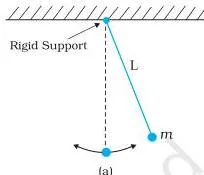
For small angular displacements (\(\theta \lesssim 20^\circ\)), the motion is approximately simple harmonic. The restoring torque is provided by the tangential component of gravity. The period is:
\[ T = 2\pi \sqrt{\frac{L}{g}} \]
where \(L\) is the length of the pendulum and \(g\) is the acceleration due to gravity. The formula is valid only when \(\sin\theta \approx \theta\) (angles in radians).
What Each Symbol Means
| Symbol | Meaning | SI Unit |
|---|---|---|
| \(T\) | Period (time for one complete oscillation) | s |
| \(\nu\) | Frequency (number of oscillations per second) | Hz (s⁻¹) |
| \(\omega\) | Angular frequency | rad/s |
| \(A\) | Amplitude (maximum displacement from mean position) | m |
| \(x(t)\) | Displacement from mean position at time \(t\) | m |
| \(t\) | Time | s |
| \(\phi\) | Phase constant (initial phase at \(t = 0\)) | rad (dimensionless) |
| \(v(t)\) | Velocity at time \(t\) | m/s |
| \(a(t)\) | Acceleration at time \(t\) | m/s² |
| \(m\) | Mass of the oscillating particle | kg |
| \(k\) | Force constant (spring constant) | N/m |
| \(F\) | Restoring force | N |
| \(K\) | Kinetic energy | J |
| \(U\) | Potential energy | J |
| \(E\) | Total mechanical energy | J |
| \(L\) | Length of simple pendulum | m |
| \(g\) | Acceleration due to gravity | m/s² |
| \(\theta\) | Angular displacement of pendulum from vertical | rad (dimensionless) |
When to Use Each Formula
- Period–frequency relations: Use \(\nu = 1/T\) and \(\omega = 2\pi/T\) to convert between time and frequency descriptions. Always check that the motion is periodic.
- Displacement \(x(t) = A\cos(\omega t + \phi)\): Use to find the position at any time \(t\) if you know amplitude, angular frequency, and initial conditions. The argument \(\omega t + \phi\) must be in radians.
- Velocity \(v(t) = -\omega A \sin(\omega t + \phi)\): Use to find instantaneous speed. Maximum speed is \(\omega A\) (when \(x = 0\)).
- Acceleration \(a(t) = -\omega^2 x(t)\): Use to find acceleration directly from displacement. The negative sign shows it is always directed toward the mean position. Maximum acceleration is \(\omega^2 A\).
- Force law \(F = -kx\): Use to show that a motion is SHM if the restoring force is proportional to displacement. The constant \(k = m\omega^2\).
- Spring–mass period \(T = 2\pi\sqrt{m/k}\): Use when a mass oscillates on a single spring obeying Hooke’s law. Valid for any amplitude as long as the spring is elastic.
- Energy formulas: Use \(E = \frac{1}{2}kA^2\) to find total energy from amplitude. Use \(K = \frac{1}{2}k(A^2 – x^2)\) (derived from the given forms) to find kinetic energy at a given displacement. The total energy is constant (no damping).
- Simple pendulum period \(T = 2\pi\sqrt{L/g}\): Use only for small angular displacements (\(\theta \lesssim 20^\circ\)). The pendulum’s mass does not affect the period.
Worked Examples
Example 1: Spring–mass system — total energy and maximum speed
A block of mass 0.50 kg is attached to a spring of spring constant 200 N/m and pulled to a distance of 0.080 m from equilibrium. The block is released from rest on a frictionless surface.
Step 1: Identify the quantities. \(m = 0.50\ \text{kg}\), \(k = 200\ \text{N/m}\), \(A = 0.080\ \text{m}\).
Step 2: Total energy \(E = \frac{1}{2} k A^2\).
\[ E = \frac{1}{2} \times 200 \times (0.080)^2 = \frac{1}{2} \times 200 \times 0.0064 = 0.64\ \text{J} \]
Step 3: Maximum speed occurs when \(x = 0\), so \(K_{\text{max}} = E = \frac{1}{2} m v_{\text{max}}^2\).
\[ v_{\text{max}} = \sqrt{\frac{2E}{m}} = \sqrt{\frac{2 \times 0.64}{0.50}} = \sqrt{2.56} = 1.6\ \text{m/s} \]
Final answer: Total energy = 0.64 J, maximum speed = 1.6 m/s.
Example 2: Simple pendulum on Earth and on the Moon
A simple pendulum has a length of 1.2 m. Find its period on Earth (\(g = 9.8\ \text{m/s}^2\)) and on the Moon (\(g = 1.6\ \text{m/s}^2\)).
Step 1: Formula \(T = 2\pi \sqrt{L/g}\).
Step 2: On Earth: \(T = 2\pi \sqrt{1.2 / 9.8} = 2\pi \sqrt{0.12245} = 2\pi \times 0.350 = 2.20\ \text{s}\).
Step 3: On Moon: \(T = 2\pi \sqrt{1.2 / 1.6} = 2\pi \sqrt{0.75} = 2\pi \times 0.866 = 5.44\ \text{s}\).
Final answer: Period on Earth = 2.20 s, on Moon = 5.44 s.
Example 3: Finding velocity and acceleration from displacement equation
A particle moves according to \(x(t) = 2.0 \cos(3.0 t + 0.5)\) (SI units). Find the displacement, velocity, and acceleration at \(t = 2.0\) s.
Step 1: Identify \(A = 2.0\ \text{m}\), \(\omega = 3.0\ \text{rad/s}\), \(\phi = 0.5\ \text{rad}\).
Step 2: Displacement: \(x = 2.0 \cos(3.0 \times 2.0 + 0.5) = 2.0 \cos(6.5)\).
\(\cos(6.5) = 0.9766\), so \(x = 2.0 \times 0.9766 = 1.95\ \text{m}\).
Step 3: Velocity: \(v = -\omega A \sin(\omega t + \phi) = -3.0 \times 2.0 \times \sin(6.5)\).
\(\sin(6.5) = 0.2151\), so \(v = -6.0 \times 0.2151 = -1.29\ \text{m/s}\).
Step 4: Acceleration: \(a = -\omega^2 x = -(3.0)^2 \times 1.95 = -9.0 \times 1.95 = -17.6\ \text{m/s}^2\).
Final answer: \(x = 1.95\ \text{m}\), \(v = -1.29\ \text{m/s}\), \(a = -17.6\ \text{m/s}^2\) (directed toward mean position).
Common Mistakes to Avoid
| Mistake | Correct Rule | How to Check Your Answer |
|---|---|---|
| Using degrees in the argument of sine/cosine in SHM formulas. | Always use radians for \(\omega t\), \(\phi\), and the phase \((\omega t + \phi)\). | If your calculator is in degree mode, convert: 1 rad ≈ 57.3°. Better: keep calculator in radian mode for SHM. |
| Forgetting the negative sign in velocity and acceleration formulas. | Velocity: \(v = -\omega A \sin(\omega t + \phi)\); acceleration: \(a = -\omega^2 x\). The negative sign indicates direction opposite to displacement. | At \(t = 0\), if \(x = A\) and \(\phi = 0\), then \(v = 0\) and \(a = -\omega^2 A\) (toward centre). Check that the sign matches the direction of restoring force. |
| Confusing period \(T\) with angular frequency \(\omega\). | \(T = 2\pi/\omega\), not \(T = \omega/2\pi\). | If \(\omega = 2\pi\), then \(T = 1\ \)s. If you get \(T = 4\pi^2\), you have inverted the relation. |
| Applying the simple pendulum formula \(T = 2\pi\sqrt{L/g}\) for large angles. | It is valid only for small angular displacements (\(\theta \lesssim 20^\circ\) or about 0.35 rad). For larger angles, the motion is not simple harmonic and the period is longer. | If the problem states “small oscillations” or “θ small”, you can use it. Otherwise, the formula does not apply. |
| Using \(E = \frac{1}{2}kA^2\) as if it were kinetic energy at the mean position. | Total energy is constant; at \(x = 0\), \(U = 0\) and \(K = E\). At \(x = A\), \(K = 0\) and \(U = E\). | Calculate \(E\) from amplitude; then at any \(x\), \(K = E – \frac{1}{2}kx^2\). |
Frequently Asked Questions
What is the difference between periodic motion and simple harmonic motion?
Periodic motion repeats after a fixed time interval. Simple harmonic motion (SHM) is a specific type of periodic motion where the displacement is a sinusoidal function of time and the restoring force is proportional to displacement (Hooke’s law). All SHM is periodic, but not all periodic motion is SHM (e.g., circular motion is periodic but not SHM).
Does the period of SHM depend on amplitude?
No. For an ideal spring–mass system or a simple pendulum with small angles, the period is independent of amplitude. This property is called isochronism. However, for real pendulums at large amplitudes, the period does increase slightly.
Why is \(\sin\theta\) replaced by \(\theta\) in the simple pendulum derivation?
For small angles (\(\theta\) in radians), \(\sin\theta \approx \theta\). This approximation makes the differential equation linear and the motion simple harmonic. The error is less than 1% for \(\theta \lesssim 15^\circ\).
How do I find the phase constant \(\phi\) from initial conditions?
Use \(x(0) = A \cos\phi\) and \(v(0) = -\omega A \sin\phi\). Divide the second by the first (after multiplying by \(-1/\omega\)) to get \(\tan\phi = -v(0)/(\omega x(0))\). Then choose the quadrant correctly so that \(\cos\phi\) matches the sign of \(x(0)\).
Reference: NCERT Class 11 Physics textbook, chapter Oscillations.
Explore Class 11 Physics Formulas
More for this chapter:
Class 11 Physics on LearnCBSE:
Related chapters:
Official source: download the NCERT textbook free from ncert.nic.in.