This formula sheet collects the progressive wave class 11 formulas from NCERT Physics Part II, Chapter 14 (Waves): the displacement relation \( y(x,t) = a\sin(kx – \omega t + \phi) \), wavelength, angular wave number, period, frequency, wave speed, superposition, reflection, standing waves and beats. Each formula is grouped by textbook sub-topic with the meaning, unit and validity condition of every symbol.
Use the summary table for a fast lookup, then the grouped list for context. For the derivations and full explanations behind these relations, browse the Class 11 Physics formula sheets; the main physics formulas index links every class and chapter. This page is the quick-reference version – it lists formulas, it does not reteach the chapter.
Formulas at a Glance
| Purpose (what you are finding) | Formula |
|---|---|
| Displacement of a progressive wave travelling in the +x direction | \( y(x,t) = a\sin(kx – \omega t + \phi) \) |
| Displacement of a progressive wave travelling in the -x direction | \( y(x,t) = a\sin(kx + \omega t + \phi) \) |
| Equivalent sine-cosine form of the displacement relation | \( y(x,t) = A\sin(kx – \omega t) + B\cos(kx – \omega t) \) |
| Amplitude and initial phase in terms of A and B | \( a = \sqrt{A^2 + B^2}, \quad \phi = \tan^{-1}\left(\frac{B}{A}\right) \) |
| Displacement in a longitudinal progressive wave | \( s(x,t) = a\sin(kx – \omega t + \phi) \) |
| Wavelength from angular wave number, or k from wavelength | \( \lambda = \frac{2\pi}{k} \) |
| Period from angular frequency | \( T = \frac{2\pi}{\omega} \) |
| Frequency from period and angular frequency | \( \nu = \frac{1}{T} = \frac{\omega}{2\pi} \) |
| Speed of any progressive wave | \( v = \frac{\omega}{k} = \frac{\lambda}{T} = \lambda\nu \) |
| Wavelength when speed and frequency are known (derived from \( v = \lambda\nu \)) | \( \lambda = \frac{v}{\nu} \) |
| Speed of a transverse wave on a stretched string | \( v = \sqrt{\frac{T}{\mu}} \) |
| Speed of a longitudinal wave in a fluid | \( v = \sqrt{\frac{B}{\rho}} \) |
| Speed of a longitudinal wave in a solid bar | \( v = \sqrt{\frac{Y}{\rho}} \) |
| Newton’s formula for speed of sound in a gas | \( v = \sqrt{\frac{P}{\rho}} \) |
| Laplace-corrected speed of sound in a gas | \( v = \sqrt{\frac{\gamma P}{\rho}} \) |
| Bulk modulus of the medium (used in sound-speed formulas) | \( B = -\frac{\Delta P}{\Delta V / V} \) |
| Principle of superposition of two waves | \( y(x,t) = y_1(x,t) + y_2(x,t) \) |
| Superposition of n waves | \( y = \sum_{i=1}^{n} f_i(x – vt) \) |
| Resultant of two identical waves differing in phase by \( \phi \) | \( y = 2a\cos\left(\frac{\phi}{2}\right)\sin\left(kx – \omega t + \frac{\phi}{2}\right) \) |
| Amplitude of the resultant in interference | \( A(\phi) = 2a\cos\left(\frac{\phi}{2}\right) \) |
| Reflected wave at a rigid boundary (phase change of \( \pi \)) | \( y_r(x,t) = -a\sin(kx + \omega t) \) |
| Reflected wave at an open boundary (no phase change) | \( y_r(x,t) = a\sin(kx + \omega t) \) |
| Standing wave from two identical waves travelling in opposite directions | \( y(x,t) = 2a\sin kx\cos\omega t \) |
| Positions of nodes and antinodes in a standing wave | \( x = \frac{n\lambda}{2}; \quad x = \left(n + \frac{1}{2}\right)\frac{\lambda}{2} \) |
| Normal modes of a string fixed at both ends | \( \nu_n = \frac{nv}{2L}, \quad n = 1, 2, 3, \dots \) |
| Normal modes of a pipe closed at one end | \( \nu_n = \left(n + \frac{1}{2}\right)\frac{v}{2L}, \quad n = 0, 1, 2, \dots \) |
| Resultant displacement in beats at a fixed location | \( s = 2a\cos\left(\frac{\omega_1 – \omega_2}{2}t\right)\cos\left(\frac{\omega_1 + \omega_2}{2}t\right) \) |
| Beat frequency of two close frequencies | \( \nu_{\text{beat}} = |\nu_1 – \nu_2| \) |
All Formulas, Grouped by Topic
The groups below follow the textbook sub-topic names of NCERT Chapter 14. Each equation carries the condition under which it is valid.
Displacement Relation in a Progressive Wave
For a transverse sinusoidal wave, \( y \) is the displacement of a medium particle from its equilibrium position at position \( x \) and time \( t \) (NCERT, p. 282):
\[ y(x,t) = a\sin(kx – \omega t + \phi) \]
The argument \( (kx – \omega t + \phi) \) is the phase of the wave; \( \phi \) is the phase at \( x = 0 \) and \( t = 0 \), called the initial phase angle. Because \( \sin\theta + \text{constant} \) can be rewritten, the same wave can be written as a sine plus cosine combination (NCERT, p. 282):
\[ y(x,t) = A\sin(kx – \omega t) + B\cos(kx – \omega t) \]
\[ a = \sqrt{A^2 + B^2}, \qquad \phi = \tan^{-1}\left(\frac{B}{A}\right) \]
For a wave travelling in the negative x-direction, the plus sign is used (NCERT, p. 282):
\[ y(x,t) = a\sin(kx + \omega t + \phi) \]
For a longitudinal wave, the displacement is along the direction of propagation; the same relation holds with \( y \) replaced by \( s \) (NCERT, p. 284):
\[ s(x,t) = a\sin(kx – \omega t + \phi) \]
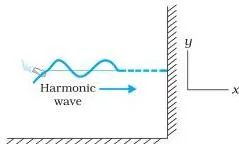
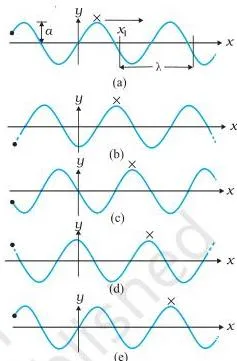
Figure 14.3 shows why this is a transverse wave: the string elements oscillate perpendicular to the direction in which the wave pattern moves. Figure 14.6 shows the same wave at successive instants – the cross on the crest moves right as the wave progresses, while a particle at a fixed location only oscillates about its mean position.
Wavelength and Angular Wave Number
The wavelength \( \lambda \) is the minimum distance between two points having the same phase, for example two consecutive crests. Taking \( t = 0 \) in the displacement relation gives \( y = a\sin kx \), and the sine function repeats after \( 2\pi \) (NCERT, p. 283):
\[ \lambda = \frac{2\pi}{k} \quad \text{or} \quad k = \frac{2\pi}{\lambda} \]
The quantity \( k \) is the angular wave number or propagation constant, with SI unit rad m⁻¹, usually written simply as m⁻¹ because the radian is dimensionless.
Period, Angular Frequency and Frequency
The period \( T \) is the time a particle of the medium takes to complete one full oscillation. Since the sine function repeats after \( 2\pi \), \( \omega T = 2\pi \) (NCERT, p. 284):
\[ T = \frac{2\pi}{\omega} \]
\[ \nu = \frac{1}{T} = \frac{\omega}{2\pi} \]
Here \( \omega \) is the angular frequency (rad s⁻¹) and \( \nu \) is the frequency in hertz. In a wave of given frequency, every particle oscillates with the same period \( T \), but particles at different positions have different phases.
Speed of a Travelling Wave
Follow any point of fixed phase, for example a crest. Keeping \( kx – \omega t \) constant and differentiating gives \( dx/dt = \omega/k \). In one period the pattern moves a distance of one wavelength (NCERT, p. 285):
\[ v = \frac{\omega}{k} = \frac{\lambda}{T} = \lambda\nu \]
This relation holds for every progressive wave, transverse or longitudinal. Rearranging gives the wavelength when speed and frequency are known:
\[ \lambda = \frac{v}{\nu} \]
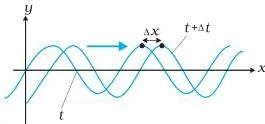
Figure 14.8 shows why the speed is the speed of a fixed phase point: every crest moves by \( \Delta x \) in time \( \Delta t \), so the entire pattern shifts together.
Speed of a Transverse Wave on a Stretched String
For a stretched string, the tension \( T \) provides the restoring force and the linear mass density \( \mu \) provides the inertia. The result is (NCERT, p. 286):
\[ v = \sqrt{\frac{T}{\mu}} \]
Note that this speed depends only on the medium (the string), not on frequency or wavelength. The source fixes the frequency \( \nu \), and \( \lambda = v/\nu \) then fixes the wavelength.
Speed of a Longitudinal Wave (Speed of Sound)
For longitudinal waves, the restoring force comes from the bulk modulus of the medium. The bulk modulus is defined as (NCERT, p. 286):
\[ B = -\frac{\Delta P}{\Delta V / V} \]
The general speed of a longitudinal wave in a fluid is (NCERT, p. 286):
\[ v = \sqrt{\frac{B}{\rho}} \]
For a solid bar under longitudinal strain, Young’s modulus \( Y \) replaces \( B \) (NCERT, p. 286):
\[ v = \sqrt{\frac{Y}{\rho}} \]
For an ideal gas, Newton assumed isothermal compression, for which \( B = P \), giving (NCERT, p. 287):
\[ v = \sqrt{\frac{P}{\rho}} \]
Newton’s formula gives about 280 m s⁻¹ for air at STP, about 15% below the measured value of 331 m s⁻¹. Laplace pointed out that sound compressions are adiabatic, so \( B_{\text{ad}} = \gamma P \), and the corrected speed is (NCERT, p. 288):
\[ v = \sqrt{\frac{\gamma P}{\rho}} \]
For air, \( \gamma = 7/5 \), and this gives about 331.3 m s⁻¹ at STP, matching the experimental value.
The Principle of Superposition of Waves
When two waves overlap, each moves as if the other were not present; the net displacement is the algebraic sum of the individual displacements (NCERT, p. 288):
\[ y(x,t) = y_1(x,t) + y_2(x,t) \]
For \( n \) waves, the resultant waveform is:
\[ y = \sum_{i=1}^{n} f_i(x – vt) \]
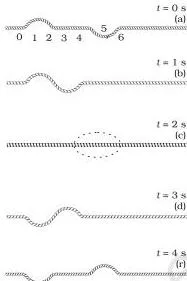
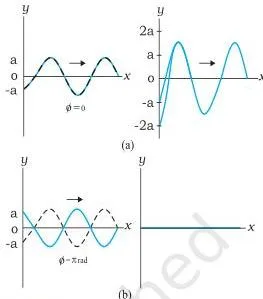
Figure 14.9 demonstrates superposition: the two opposite pulses cancel exactly while they overlap, then continue unchanged. For two harmonic waves with the same amplitude \( a \), the same \( \omega \) and \( k \) (same wavelength), travelling in the same direction and differing only in phase \( \phi \), superposition gives (NCERT, p. 289):
\[ y = 2a\cos\left(\frac{\phi}{2}\right)\sin\left(kx – \omega t + \frac{\phi}{2}\right) \]
The resultant is a wave of the same frequency and wavelength, with amplitude depending on the phase difference:
\[ A(\phi) = 2a\cos\left(\frac{\phi}{2}\right) \]
For \( \phi = 0 \) the waves are in phase and the amplitude is \( 2a \) (constructive interference). For \( \phi = \pi \) the waves are completely out of phase and the displacement is zero everywhere (destructive interference).
Reflection of Waves
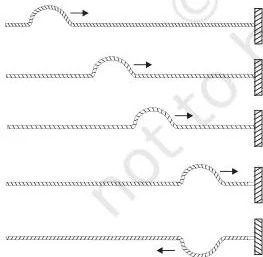
At a rigid boundary the displacement must remain zero at all times, so the reflected wave must cancel the incident wave; this requires a phase change of \( \pi \) (NCERT, p. 290). For an incident wave \( y_i = a\sin(kx – \omega t) \):
\[ y_r(x,t) = -a\sin(kx + \omega t) \quad \text{(rigid boundary)} \]
At an open boundary there is no phase change (NCERT, p. 290):
\[ y_r(x,t) = a\sin(kx + \omega t) \quad \text{(open boundary)} \]
Standing Waves and Normal Modes
Two identical waves of the same amplitude and wavelength travelling in opposite directions superpose to form a standing wave (NCERT, p. 291):
\[ y(x,t) = 2a\sin kx\cos\omega t \]
Here \( kx \) and \( \omega t \) appear separately, so the pattern does not move. The amplitude \( 2a\sin kx \) varies from point to point. Points of zero amplitude are nodes; points of maximum amplitude are antinodes:
\[ x = \frac{n\lambda}{2} \quad \text{(nodes)}, \qquad x = \left(n + \frac{1}{2}\right)\frac{\lambda}{2} \quad \text{(antinodes)} \]
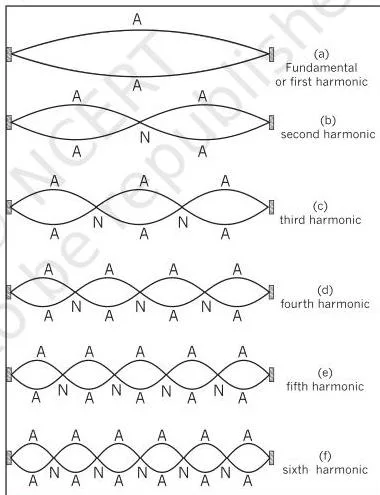
Consecutive nodes, and consecutive antinodes, are separated by \( \lambda/2 \). For a string of length \( L \) fixed at both ends, the ends must be nodes, so \( L = n\lambda/2 \). The allowed wavelengths and frequencies, called normal modes, are (NCERT, p. 291-292):
\[ \lambda_n = \frac{2L}{n}, \qquad \nu_n = \frac{nv}{2L}, \quad n = 1, 2, 3, \dots \]
The mode \( n = 1 \) is the fundamental or first harmonic, \( n = 2 \) the second harmonic, and so on. For a pipe closed at one end and open at the other, the closed end is a node and the open end an antinode (NCERT, p. 292):
\[ \lambda_n = \frac{2L}{n + 1/2}, \qquad \nu_n = \left(n + \frac{1}{2}\right)\frac{v}{2L}, \quad n = 0, 1, 2, \dots \]
The fundamental of a closed pipe is \( v/4L \), and only the odd harmonics \( 3v/4L, 5v/4L, \dots \) appear. A pipe open at both ends has an antinode at each end and supports all harmonics, with the same formula as the string: \( \nu_n = nv/2L \).
Beats
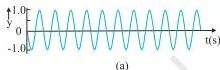
When two sound waves of slightly different frequencies reach the same point, the loudness waxes and wanes. For equal amplitudes, taking \( x = 0 \), the resultant displacement is (NCERT, p. 294-295):
\[ s = 2a\cos\left(\frac{\omega_1 – \omega_2}{2}t\right)\cos\left(\frac{\omega_1 + \omega_2}{2}t\right) \]
One factor oscillates at the average frequency while the other slowly changes the amplitude. The beat frequency is the difference of the two frequencies:
\[ \nu_{\text{beat}} = |\nu_1 – \nu_2| \]
What Each Symbol Means
| Symbol | What it means | Unit / nature |
|---|---|---|
| \( y(x,t) \) | Displacement of a medium particle from its equilibrium position | m |
| \( s(x,t) \) | Displacement of an element in a longitudinal wave, along the direction of propagation | m |
| \( a \) | Amplitude, maximum magnitude of displacement | m |
| \( A, B \) | Coefficients of the sine and cosine terms in the equivalent form of the wave | m |
| \( \phi \) | Initial phase angle, the phase at \( x = 0 \) and \( t = 0 \) | rad |
| \( kx – \omega t + \phi \) | Phase of the wave at position \( x \) and time \( t \) | rad |
| \( k \) | Angular wave number or propagation constant, \( k = 2\pi/\lambda \) | rad m⁻¹ (often written m⁻¹) |
| \( \omega \) | Angular frequency, \( \omega = 2\pi/T \) | rad s⁻¹ |
| \( \lambda \) | Wavelength, distance between two consecutive points of the same phase | m |
| \( T \) | Time period of one complete oscillation | s |
| \( \nu \) | Frequency, number of oscillations per second | Hz (s⁻¹) |
| \( v \) | Speed of the wave | m s⁻¹ |
| \( x \) | Position along the direction of propagation | m |
| \( t \) | Time | s |
| \( \mu \) | Linear mass density, mass per unit length of the string | kg m⁻¹ |
| \( T \) (string) | Tension in the stretched string | N |
| \( B \) | Bulk modulus of the medium | Pa (N m⁻²) |
| \( \rho \) | Mass density of the medium | kg m⁻³ |
| \( Y \) | Young’s modulus of the material of a solid bar | Pa |
| \( \gamma \) | Ratio of specific heats, \( C_p/C_v \) | dimensionless |
| \( P \) | Pressure of the gas | Pa |
| \( \Delta P \) | Change in pressure | Pa |
| \( \Delta V / V \) | Volumetric strain | dimensionless |
| \( L \) | Length of the string or air column | m |
| \( n \) | Mode number | count (dimensionless integer) |
| \( \nu_{\text{beat}} \) | Beat frequency | Hz |
When to Use Each Formula
| Situation | Formula to use | Condition |
|---|---|---|
| You are given a wave equation and need amplitude, wavelength, frequency, speed or displacement at a point | Compare with \( y = a\sin(kx – \omega t + \phi) \) and read off \( a, k, \omega, \phi \) | The wave must be sinusoidal and written in the standard form |
| Decide the direction of travel of a progressive wave | \( kx – \omega t \) (minus) means +x; \( kx + \omega t \) (plus) means -x | Applies to travelling waves, not standing waves |
| Wavelength from angular wave number | \( \lambda = 2\pi/k \) | \( k \) in rad m⁻¹ or m⁻¹ |
| Period and frequency from angular frequency | \( T = 2\pi/\omega; \; \nu = 1/T \) | \( \omega \) in rad s⁻¹ |
| Relate speed, wavelength and frequency of any progressive wave | \( v = \omega/k = \lambda/T = \lambda\nu \) | Valid for transverse and longitudinal waves |
| Find wavelength when speed and source frequency are known | \( \lambda = v/\nu \) | Speed is fixed by the medium, frequency by the source |
| Transverse wave on a stretched string | \( v = \sqrt{T/\mu} \) | \( T \) in N, \( \mu \) in kg m⁻¹ |
| Sound in a fluid or a solid bar | \( v = \sqrt{B/\rho} \) (fluid); \( v = \sqrt{Y/\rho} \) (solid bar) | Longitudinal waves in the medium |
| Speed of sound in a gas | \( v = \sqrt{\gamma P/\rho} \) (Laplace correction) | Ideal gas; use \( \gamma = C_p/C_v \) of the gas |
| Two or more waves arriving in the same region | \( y = y_1 + y_2 \) | Waves overlap in the medium |
| Two equal waves of the same frequency differing in phase | \( y = 2a\cos(\phi/2)\sin(kx – \omega t + \phi/2) \) | Same \( a, \omega, k \), same direction; \( \phi \) in radians |
| Reflection at a boundary | Rigid boundary: \( y_r = -a\sin(kx + \omega t) \); open boundary: \( y_r = a\sin(kx + \omega t) \) | Rigid wall or open end respectively |
| Standing waves and normal modes of a string or pipe | String: \( \nu_n = nv/2L \); closed-open pipe: \( \nu_n = (n+1/2)v/2L \) | Use the stated integer ranges for \( n \) |
| Two sources of nearly equal frequency | \( \nu_{\text{beat}} = |\nu_1 – \nu_2| \) | \( |\nu_1 – \nu_2| \) small compared with \( \nu_1 \) and \( \nu_2 \) |
Worked Examples
Worked Example 1: Read all wave parameters from a displacement relation
The equation \( y = 0.02\sin(60x – 180t) \) describes a wave on a string, with SI units. Compare it term by term with \( y = a\sin(kx – \omega t) \): \( a = 0.02 \) m, \( k = 60 \) rad m⁻¹, \( \omega = 180 \) rad s⁻¹.
Step 1: The sign in front of \( \omega t \) is minus, so the wave travels in the +x direction.
Step 2: Wavelength: \( \lambda = 2\pi/k = 2\pi/60 = 0.105 \) m.
Step 3: Period: \( T = 2\pi/\omega = 2\pi/180 = 0.0349 \) s.
Step 4: Frequency: \( \nu = 1/T = 28.6 \) Hz, which also equals \( \omega/2\pi \).
Step 5: Speed: \( v = \omega/k = 180/60 = 3.0 \) m s⁻¹.
Check: \( v = \lambda\nu = 0.105 \times 28.6 = 3.0 \) m s⁻¹.
Final answer: amplitude \( a = 0.02 \) m, wavelength \( \lambda = 0.105 \) m, period \( T = 0.0349 \) s, frequency \( \nu = 28.6 \) Hz, speed \( v = 3.0 \) m s⁻¹, direction +x.
Worked Example 2: Resultant amplitude when two waves differ in phase
Two identical waves, each of amplitude \( 0.040 \) m, with the same frequency and wavelength, travel in the same direction with a phase difference of \( \pi/3 \) rad (60°).
Step 1: Select \( A(\phi) = 2a\cos(\phi/2) \), which applies because the waves have equal amplitude, frequency and wavelength.
Step 2: Keep the phase in radians: \( \phi = \pi/3 \), so \( \phi/2 = \pi/6 = 30° \).
Substitution gives \( A = 2 \times 0.040 \times \cos(\pi/6) = 0.080 \times \sqrt{3}/2 \).
\[ A = 0.0693 \ \text{m} \]
Step 3: Check the limits: \( \phi = 0 \) gives \( 2a = 0.080 \) m and \( \phi = \pi \) gives 0.
The value 0.0693 m lies between, as it must.
Final answer: resultant amplitude \( 0.069 \) m (6.9 cm); the resultant wave has the same frequency and wavelength, with a phase shift of \( \phi/2 = \pi/6 \).
Worked Example 3: Wave speed on a string and wavelength from the source frequency
A string is 2.0 m long and has a mass of \( 6.0 \times 10^{-3} \) kg. Its tension is 120 N. Find the speed of a transverse wave, and the wavelength produced by a source of frequency 100 Hz.
Step 1: Linear mass density: \( \mu = m/L = 6.0 \times 10^{-3}/2.0 = 3.0 \times 10^{-3} \) kg m⁻¹.
Step 2: Speed: \( v = \sqrt{T/\mu} = \sqrt{120/3.0 \times 10^{-3}} = \sqrt{40000} = 200 \) m s⁻¹.
Step 3: Wavelength: \( \lambda = v/\nu = 200/100 = 2.0 \) m.
Step 4: Check: \( v = \lambda\nu = 2.0 \times 100 = 200 \) m s⁻¹, consistent.
Final answer: wave speed \( v = 200 \) m s⁻¹, wavelength \( \lambda = 2.0 \) m.
Common Mistakes to Avoid
| Mistake | Correct rule | How to check your answer |
|---|---|---|
| Treating \( y = a\sin(kx + \omega t) \) as a wave moving in the +x direction | Minus sign before \( \omega t \) means +x; plus sign means -x | Keep \( kx – \omega t \) constant: as \( t \) increases, \( x \) must increase, which is +x |
| Writing \( v = k/\omega \) when finding wave speed | Always \( v = \omega/k \) | Units: \( \omega/k \) gives (rad s⁻¹)/(rad m⁻¹) = m s⁻¹; \( k/\omega \) gives m⁻¹ s, which is wrong |
| Substituting degrees for radians in the phase | With \( \omega \) in rad s⁻¹ and \( t \) in s, the argument \( \omega t \) is in radians | \( \phi = \pi/3 \) rad = 60°, so \( \cos(\phi/2) = \cos(\pi/6) = \cos 30° \); use the units consistently |
| Taking beat frequency as the average of two frequencies | Beat frequency is the difference: \( \nu_{\text{beat}} = |\nu_1 – \nu_2| \) | Two forks at 256 Hz and 260 Hz must give 4 beats per second, not 258 |
| Using \( \nu_n = nv/2L \) for a pipe closed at one end | Closed pipe: \( \nu_n = (n+1/2)v/2L \), so only odd harmonics appear; fundamental is \( v/4L \) | If the fundamental of a closed pipe came out as \( v/2L \), you used the wrong mode formula |
| Writing consecutive nodes as \( \lambda \) apart | Consecutive nodes, and consecutive antinodes, are \( \lambda/2 \) apart; a node and the next antinode are \( \lambda/4 \) apart | Nodes on a string fixed at both ends are at \( x = 0, \lambda/2, \lambda, \dots \), so the spacing is \( \lambda/2 \) |
Frequently Asked Questions
What exactly is the phase, and what is the initial phase?
The phase is the whole argument \( kx – \omega t + \phi \). It determines the displacement at any position and time. The initial phase \( \phi \) is the value of the phase at \( x = 0 \) and \( t = 0 \) (NCERT, p. 283). By choosing the origin of position and time suitably, \( \phi \) can often be set to zero.
How do I tell the direction of a progressive wave from its equation?
If the argument is \( kx – \omega t \) or \( kx – \omega t + \phi \), the wave travels in the +x direction. If the argument is \( kx + \omega t \), it travels in the -x direction. To keep the phase constant as \( t \) increases, \( x \) must increase in the first case and decrease in the second.
Why does wave speed depend on the medium and not on frequency?
For a stretched string, \( v = \sqrt{T/\mu} \); for sound in a gas, \( v = \sqrt{\gamma P/\rho} \); for a fluid, \( v = \sqrt{B/\rho} \). These contain only medium properties and tension. The source determines the frequency, the medium determines the speed, and \( \lambda = v/\nu \) then fixes the wavelength (NCERT, p. 286).
When do I use Newton’s formula and when Laplace’s?
Newton’s formula \( v = \sqrt{P/\rho} \) assumes isothermal pressure changes and gives about 280 m s⁻¹ in air at STP, about 15% below the measured value. Laplace’s correction treats the changes as adiabatic, giving \( v = \sqrt{\gamma P/\rho} \), which gives about 331.3 m s⁻¹ at STP and agrees with experiment (NCERT, p. 288).
In numericals on sound in a gas, use the Laplace form unless the question specifically asks for Newton’s formula.
Reference: NCERT Class 11 Physics Part II textbook, chapter Displacement Relation in a Progressive Wave. All formulas and page citations follow the Rationalised NCERT text; the official PDF is available at ncert.nic.in.
Explore Class 11 Physics Formulas
Class 11 Physics on LearnCBSE:
Related chapters:
Official source: download the NCERT textbook free from ncert.nic.in.