
This page collects the Mechanical Properties of Solids Class 11 formulas from NCERT Physics Part II, Chapter 8: stress and strain, Hooke’s law, Young’s modulus, shear modulus, bulk modulus, Poisson’s ratio, elastic potential energy in a stretched wire, and the design formulas used in applications such as crane ropes and beams.
Each formula is grouped by the textbook sub-topic it belongs to, with the meaning and SI unit of every symbol, a when-to-use note, and three worked examples with original numbers. For the full set of chapters, see the Class 11 Physics formulas hub. The formulas follow the Rationalised NCERT textbook; the official chapter PDF is available at ncert.nic.in.
Formulas at a Glance
| Purpose | Formula |
|---|---|
| Stress from force and area | \( \sigma = \frac{F}{A} \) |
| Longitudinal strain (length change) | \( \frac{\Delta L}{L} \) |
| Shearing strain (shape change, small angles) | \( \frac{\Delta x}{L} = \tan\theta \approx \theta \) |
| Volume strain (hydraulic compression) | \( \frac{\Delta V}{V} \) |
| Hooke’s law (small deformations) | \( \text{stress} = k \times \text{strain} \) |
| Young’s modulus | \( Y = \frac{\sigma}{\varepsilon} = \frac{FL}{A\,\Delta L} \) |
| Shear modulus (modulus of rigidity) | \( G = \frac{F/A}{\Delta x/L} = \frac{F}{A\theta} \) |
| Shearing stress from shear modulus | \( \sigma_s = G\theta \) |
| Bulk modulus | \( B = -\frac{p}{\Delta V/V} \) |
| Compressibility (reciprocal of bulk modulus) | \( k = \frac{1}{B} = -\frac{1}{\Delta p}\,\frac{\Delta V}{V} \) |
| Poisson’s ratio | \( \frac{\Delta d/d}{\Delta L/L} \) |
| Elastic potential energy per unit volume | \( u = \frac{1}{2}\sigma\varepsilon \) |
| Total elastic potential energy of a stretched wire | \( W = \frac{1}{2}Y\left(\frac{l}{L}\right)^2 AL \) |
| Minimum rope area (from yield strength) | \( A \geq \frac{Mg}{\sigma_y} \) |
| Sag of a beam loaded at the centre | \( \delta = \frac{Wl^3}{4bd^3Y} \) |
| Maximum mountain height (derived from the elastic limit) | \( h = \frac{\sigma}{\rho g} \) |
All Formulas, Grouped by Topic
Stress and Strain
Stress is the restoring force per unit area developed in a deformed body. When a force \( F \) acts normal to a cross-section of area \( A \) (NCERT, p. 169):
\[ \sigma = \frac{F}{A} \]
The SI unit of stress is \( \text{N m}^{-2} \) or pascal (Pa), and its dimensional formula is [ML⁻¹T⁻²].
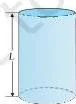
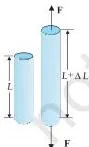
The figure above shows a cylinder stretched by two equal forces applied normal to its cross-section. The change in length \( \Delta L \) relative to the original length \( L \) is the longitudinal strain (NCERT, p. 169):
\[ \text{Longitudinal strain} = \frac{\Delta L}{L} \]
When equal and opposite forces act parallel to the cross-section, the opposite faces displace relative to each other by \( \Delta x \), and the body changes shape without changing volume (NCERT, p. 169):
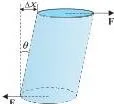
\[ \text{Shearing strain} = \frac{\Delta x}{L} = \tan\theta \]
For small angles, \( \tan\theta \approx \theta \), so shearing strain is approximately \( \theta \).
Under uniform fluid pressure, a solid sphere is compressed on all sides; its volume decreases but its shape does not change (NCERT, p. 169):
\[ \text{Volume strain} = \frac{\Delta V}{V} \]
Strain is a ratio of a change in dimension to the original dimension, so it has no units and no dimensional formula.
Hooke’s Law
For small deformations, stress is proportional to strain (NCERT, p. 170):
\[ \text{stress} \propto \text{strain}, \qquad \text{stress} = k \times \text{strain} \]
Here \( k \) is the modulus of elasticity. Hooke’s law holds only in the linear region of the stress-strain curve; a class of solids called elastomers (for example rubber) does not obey it.
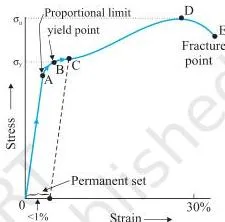
The stress-strain curve above shows the linear region OA where Hooke’s law is obeyed, the yield point B with its yield strength \( \sigma_y \), the ultimate tensile strength at D, and fracture at E (NCERT, p. 170).
Young’s Modulus
Young’s modulus is the ratio of tensile (or compressive) stress to longitudinal strain (NCERT, p. 170):
\[ Y = \frac{\sigma}{\varepsilon} = \frac{F/A}{\Delta L/L} = \frac{FL}{A\,\Delta L} \]
Since strain is dimensionless, Young’s modulus has the same unit as stress: \( \text{N m}^{-2} \) or Pa. It applies to solids only.
Shear Modulus
The shear modulus, or modulus of rigidity, is the ratio of shearing stress to shearing strain (NCERT, p. 173):
\[ G = \frac{F/A}{\Delta x/L} = \frac{FL}{A\,\Delta x} \]
Using the small-angle form of shearing strain:
\[ G = \frac{F}{A\,\theta} \]
The shearing stress can also be written as (NCERT, p. 173):
\[ \sigma_s = G\,\theta \]
Shear modulus applies to solids only. For most materials, \( G \approx Y/3 \).
Bulk Modulus
Bulk modulus is the ratio of hydraulic stress to volume strain (NCERT, p. 173):
\[ B = -\frac{p}{\Delta V/V} \]
The negative sign appears because an increase in pressure decreases the volume: \( \Delta V \) is negative when \( p \) is positive, so \( B \) stays positive. Bulk modulus applies to solids, liquids and gases.
Compressibility is the reciprocal of bulk modulus (NCERT, p. 173):
\[ k = \frac{1}{B} = -\frac{1}{\Delta p}\,\frac{\Delta V}{V} \]
Poisson’s Ratio
Within the elastic limit, lateral strain is directly proportional to longitudinal strain. Poisson’s ratio is the ratio of the two (NCERT, p. 174):
\[ \text{Poisson’s ratio} = \frac{\Delta d/d}{\Delta L/L} \]
It is a pure number with no dimensions or units. For steels the value lies between 0.28 and 0.30; for aluminium alloys it is about 0.33.
Elastic Potential Energy in a Stretched Wire
Work done in stretching a wire is stored as elastic potential energy. The energy per unit volume is (NCERT, p. 174):
\[ u = \frac{1}{2}\,\sigma\,\varepsilon \]
The total energy stored in a wire of original length \( L \) and area \( A \), elongated by \( l \), is:
\[ W = \frac{1}{2}\,Y\left(\frac{l}{L}\right)^2 AL = \frac{1}{2} \times \text{stress} \times \text{strain} \times \text{volume} \]
This follows from integrating \( F\,dl \) from \( l = 0 \) to \( l = l \); the derivation is in the textbook (NCERT, p. 174).
Applications of Elastic Behaviour
To keep a rope or cable within its elastic limit while lifting a load, its area of cross-section must satisfy (NCERT, p. 175):
\[ A \geq \frac{W}{\sigma_y} = \frac{Mg}{\sigma_y} \]
A beam of length \( l \), breadth \( b \) and depth \( d \), supported at the ends and loaded at the centre by a load \( W \), sags by (NCERT, p. 175):
\[ \delta = \frac{W l^3}{4 b d^3 Y} \]
Since \( \delta \) is proportional to \( d^{-3} \) but only to \( b^{-1} \), increasing the depth reduces bending far more than increasing the breadth.
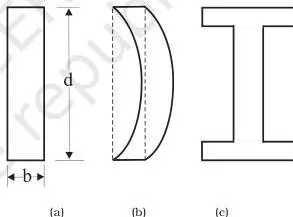
The cross-sections above explain the I-shape used in construction: it provides depth to resist bending without the weight of a solid bar, and avoids the buckling shown in (b).
Maximum height of a mountain (derived form): the shear stress at the base of a mountain of height \( h \) is approximately \( h\rho g \). Equating it to the elastic limit of rock gives (NCERT, p. 176):
\[ h = \frac{\sigma}{\rho g} \]
With \( \sigma = 30 \times 10^7\ \text{N m}^{-2} \) and \( \rho = 3 \times 10^3\ \text{kg m}^{-3} \), this gives \( h \approx 10\ \text{km} \).
What Each Symbol Means
| Symbol | What it means | Unit |
|---|---|---|
| \( \sigma \) | Stress (tensile, compressive or hydraulic) | \( \text{N m}^{-2} \) (Pa) |
| \( F \) | Magnitude of the applied force | N |
| \( A \) | Area of cross-section | \( \text{m}^2 \) |
| \( \varepsilon \) | Longitudinal strain | dimensionless |
| \( \Delta L \) | Change in length | m |
| \( L \) | Original length | m |
| \( \Delta x \) | Relative displacement of opposite faces (shear) | m |
| \( \theta \) | Angular displacement (shear angle) | rad (dimensionless) |
| \( \Delta V \) | Change in volume | \( \text{m}^3 \) |
| \( V \) | Original volume | \( \text{m}^3 \) |
| \( k \) | Modulus of elasticity (Hooke’s law constant) | \( \text{N m}^{-2} \) (Pa) |
| \( Y \) | Young’s modulus | \( \text{N m}^{-2} \) (Pa) |
| \( G \) | Shear modulus (modulus of rigidity) | \( \text{N m}^{-2} \) (Pa) |
| \( \sigma_s \) | Shearing stress | \( \text{N m}^{-2} \) (Pa) |
| \( B \) | Bulk modulus | \( \text{N m}^{-2} \) (Pa) |
| \( p \) | Pressure (hydraulic stress) | \( \text{N m}^{-2} \) (Pa) |
| \( \Delta p \) | Change in pressure | \( \text{N m}^{-2} \) (Pa) |
| \( k \) (compressibility) | Reciprocal of bulk modulus | \( \text{m}^2\,\text{N}^{-1} \) (Pa⁻¹) |
| \( d \) | Original diameter of the wire (Poisson’s ratio) | m |
| \( \Delta d \) | Change in diameter of the wire | m |
| \( u \) | Elastic potential energy per unit volume | \( \text{J m}^{-3} \) |
| \( W \) | Work done / elastic potential energy stored | J |
| \( \sigma_y \) | Yield strength of the material | \( \text{N m}^{-2} \) (Pa) |
| \( M \) | Mass supported | kg |
| \( g \) | Acceleration due to gravity | \( \text{m s}^{-2} \) |
| \( \delta \) | Sag (deflection) of the beam | m |
| \( l \) | Length of the beam (span) | m |
| \( b \) | Breadth of the beam | m |
| \( d \) | Depth of the beam (sag formula) | m |
| \( \rho \) | Density of the material | \( \text{kg m}^{-3} \) |
| \( h \) | Height (for example of a mountain) | m |
Note: the chapter uses \( k \) for two different quantities — the modulus of elasticity in Hooke’s law and compressibility. The symbol \( d \) is also used twice: the diameter of a wire in Poisson’s ratio and the depth of a beam in the sag formula. Identify each by context.
When to Use Each Formula
Reach for the formula that matches the type of deformation in the question.
| Formula | Use it when… | Valid for |
|---|---|---|
| \( \sigma = F/A \) | A force acts perpendicular to a cross-section and you need the stress | Tensile or compressive loading |
| \( \Delta L/L \) | A wire or rod is stretched or compressed along its length | Small deformations |
| \( \Delta x/L = \tan\theta \) | Forces act parallel to opposite faces and the body changes shape, not volume | Solids only |
| \( \Delta V/V \) | A body is compressed uniformly from all sides by a fluid | Solids, liquids, gases |
| \( \text{stress} = k \times \text{strain} \) | Relating stress and strain for small deformations | Linear region of the stress-strain curve only |
| \( Y = FL/(A\,\Delta L) \) | Finding elongation, force or stress of a stretched or compressed wire or rod | Within elastic limit; solids only |
| \( G = F/(A\theta) \) | A tangential force displaces one face of a solid relative to the opposite face | Solids only |
| \( B = -p/(\Delta V/V) \) | Finding volume change under uniform pressure (hydraulic compression) | Solids, liquids, gases |
| \( k = 1/B \) | Comparing how compressible different materials are | Solids, liquids, gases |
| Poisson’s ratio \( (\Delta d/d)/(\Delta L/L) \) | A stretched wire’s diameter also changes; find the lateral contraction | Within elastic limit |
| \( u = \frac{1}{2}\sigma\varepsilon \) | Energy stored per unit volume in a stretched wire | Within elastic limit |
| \( A \geq Mg/\sigma_y \) | Minimum cross-section of a rope or cable so it does not deform permanently | Load within elastic limit |
| \( \delta = Wl^3/(4bd^3Y) \) | Sag of a beam supported at both ends and loaded at the centre | Small deflection |
Worked Examples
Three examples showing how to select the right modulus, substitute values, and check units.
Example 1: Elongation of a steel wire (Young’s modulus)
- Step 1: The wire is stretched along its length, so use Young’s modulus rearranged as \( \Delta L = \frac{FL}{AY} \).
- Step 2: Substitute \( F = 200\ \text{N} \), \( L = 2.0\ \text{m} \), \( A = 1.0 \times 10^{-5}\ \text{m}^2 \), \( Y = 2.0 \times 10^{11}\ \text{N m}^{-2} \):
\[ \Delta L = \frac{200 \times 2.0}{1.0 \times 10^{-5} \times 2.0 \times 10^{11}} = \frac{400}{2.0 \times 10^6} = 2.0 \times 10^{-4}\ \text{m} \]
Final answer: \( \Delta L = 2.0 \times 10^{-4}\ \text{m} = 0.20\ \text{mm} \).
Example 2: Minimum area of a crane rope (yield strength)
- Step 1: The rope must not exceed the yield strength, so use \( A \geq \frac{Mg}{\sigma_y} \).
- Step 2: Substitute \( M = 4000\ \text{kg} \), \( g = 9.8\ \text{m s}^{-2} \), \( \sigma_y = 2.5 \times 10^8\ \text{N m}^{-2} \) (steel, NCERT Table 8.1, p. 171):
\[ A \geq \frac{4000 \times 9.8}{2.5 \times 10^8} = \frac{3.92 \times 10^4}{2.5 \times 10^8} = 1.57 \times 10^{-4}\ \text{m}^2 \]
Final answer: \( A \geq 1.6 \times 10^{-4}\ \text{m}^2 \). A rope with this or a larger cross-section stays within the elastic limit.
Example 3: Fractional compression of water (bulk modulus)
Step 1: The water is under hydraulic stress from all sides, so use \( B = -\frac{p}{\Delta V/V} \).
Taking magnitudes, \( \frac{\Delta V}{V} = \frac{p}{B} \).
Step 2: Substitute \( p = 4.4 \times 10^7\ \text{N m}^{-2} \), \( B = 2.2 \times 10^9\ \text{N m}^{-2} \):
\[ \frac{\Delta V}{V} = \frac{4.4 \times 10^7}{2.2 \times 10^9} = 2.0 \times 10^{-2} = 2.0\% \]
Final answer: The fractional compression is \( 2.0 \times 10^{-2} \), i.e. 2.0%.
Common Mistakes to Avoid
Watch for these errors while substituting into the formulas.
| Mistake | Correct rule | How to check your answer |
|---|---|---|
| Writing stress as \( F \) instead of \( F/A \) | Stress is the restoring force per unit area: \( \sigma = F/A \) | Stress must come out in \( \text{N m}^{-2} \) (Pa), never in N |
| Dropping the minus sign in \( B = -p/(\Delta V/V) \) | Pressure increase makes volume decrease, so \( \Delta V \) is negative; the minus sign keeps \( B \) positive | Bulk modulus must come out positive |
| Using diameter instead of radius in \( A = \pi r^2 \) | For a circular cross-section, \( A = \pi r^2 = \pi(d/2)^2 \) | Area must come out in \( \text{m}^2 \); halve the diameter first |
| Plugging cm or mm lengths directly into \( Y = FL/(A\,\Delta L) \) | Convert every length to metres before substituting | \( \Delta L \) comes out in m; convert to mm only at the end |
| Using Young’s modulus for a shear problem | \( Y \) is for length change (force perpendicular to the face); \( G \) is for shape change (force parallel to the face) | If the force is parallel to the face, use \( G = F/(A\theta) \) |
Frequently Asked Questions
Why is there a negative sign in the bulk modulus formula?
When pressure increases, volume decreases, so \( \Delta V \) is negative for a positive \( p \). The negative sign in \( B = -p/(\Delta V/V) \) makes the bulk modulus a positive quantity for a system in equilibrium (NCERT, p. 173).
Which elastic moduli apply to liquids and gases?
Bulk modulus applies to solids, liquids and gases. Young’s modulus and shear modulus apply only to solids, because only solids have definite lengths and shapes (NCERT, p. 177).
Is a material that stretches more more elastic?
No. In daily life we may think so, but a material that stretches less for a given load is more elastic. Steel is more elastic than copper, brass and aluminium because a larger force is needed to produce the same strain in it (NCERT, p. 171).
Does strain have a unit?
No. Strain is the ratio of a change in dimension to the original dimension, so it has no units and no dimensional formula (NCERT, p. 169).
For more revision sheets across Class 11, browse the Physics formulas collection.
Reference: NCERT Class 11 Physics textbook, chapter Mechanical Properties of Solids.
Explore Class 11 Physics Formulas
More for this chapter:
Class 11 Physics on LearnCBSE:
Related chapters: