
This page gathers the Mechanical Properties of Fluids Class 11 formulas from NCERT Physics Part II, Chapter 9 — pressure and density, how pressure varies with depth, Pascal’s law and hydraulic machines, the equation of continuity, Bernoulli’s principle and speed of efflux, viscosity and Stokes’ law, and surface tension in drops, bubbles and capillary tubes.
Every symbol is listed with its meaning and SI unit, so you can use the sheet as a quick check while solving problems.
The formulas are grouped by topic, each with a one-line note on when to use it and the conditions that make it valid. After the formula list you will find three worked examples with original numbers and a table of chapter-specific mistakes to avoid. For the detailed explanations and derivations, browse the Class 11 Physics formulas collection.
Formulas at a Glance
| Purpose | Formula |
|---|---|
| Average pressure: normal force per unit area | \( P_{\text{av}} = \frac{F}{A} \) |
| Density of a fluid | \( \rho = \frac{m}{V} \) |
| Absolute pressure at depth \( h \) in a liquid open to the atmosphere | \( P = P_a + \rho g h \) |
| Gauge pressure at depth \( h \) | \( P – P_a = \rho g h \) |
| Atmospheric pressure from a barometer column | \( P_a = \rho g h \) |
| Force multiplication in a hydraulic lift (Pascal’s law) | \( F_2 = \frac{A_2}{A_1} F_1 \) |
| Piston displacement in a hydraulic lift (derived from incompressibility) | \( A_1 L_1 = A_2 L_2 \) |
| Equation of continuity for an incompressible fluid | \( A v = \text{constant} \) |
| Mass conservation for any flow (density may vary) | \( \rho A v = \text{constant} \) |
| Bernoulli’s principle along a streamline | \( P + \frac{1}{2}\rho v^2 + \rho g h = \text{constant} \) |
| Pressure difference between two points at the same height (from Bernoulli) | \( P_1 – P_2 = \frac{1}{2}\rho (v_2^2 – v_1^2) \) |
| Speed of efflux from a pressurised tank | \( v_1 = \sqrt{2gh + \frac{2(P – P_a)}{\rho}} \) |
| Speed of efflux from a tank open to the atmosphere (Torricelli’s law) | \( v_1 = \sqrt{2gh} \) |
| Coefficient of viscosity from shear stress and strain rate | \( \eta = \frac{F l}{v A} \) |
| Viscous drag on a sphere (Stokes’ law) | \( F = 6\pi\eta a v \) |
| Terminal velocity of a sphere falling through a fluid | \( v_t = \frac{2 a^2 (\rho – \sigma) g}{9 \eta} \) |
| Surface tension of a film (two surfaces) | \( S = \frac{F}{2l} \) |
| Surface tension of a liquid–air interface by the plate method | \( S_{\text{la}} = \frac{mg}{2l} \) |
| Equilibrium of interfacial tensions at the contact line | \( S_{\text{la}} \cos\theta + S_{\text{sl}} = S_{\text{sa}} \) |
| Excess pressure inside a liquid drop (one interface) | \( P_1 – P_0 = \frac{2S}{r} \) |
| Excess pressure inside a soap bubble (two interfaces) | \( P_1 – P_0 = \frac{4S}{r} \) |
| Capillary rise (or fall) of a liquid in a narrow tube | \( h = \frac{2S\cos\theta}{\rho g a} \) |
All Formulas, Grouped by Topic
The groups below follow the order of the NCERT sections, so you can jump straight to the part you are revising.
Pressure and Density
Average pressure is the normal force acting per unit area (NCERT, p. 182):
\[ P_{\text{av}} = \frac{F}{A} \]
In the limit of a very small area, this defines the pressure at a point:
\[ P = \lim_{\Delta A \to 0} \frac{\Delta F}{\Delta A} \]
Only the component of the force normal to the area enters the definition — that is why pressure is a scalar. Density is mass per unit volume:
\[ \rho = \frac{m}{V} \]
The relative density of a substance is the ratio of its density to the density of water at \( 4^\circ \text{C} \); it is dimensionless. Useful pressure conversions from the chapter:
- \( 1\ \text{atm} = 1.013 \times 10^5\ \text{Pa} \)
- \( 1\ \text{bar} = 10^5\ \text{Pa} \)
- \( 1\ \text{torr} = 1\ \text{mm of Hg} = 133\ \text{Pa} \)
Variation of Pressure with Depth
The pressure difference between two points separated by a vertical height \( h \) in a fluid at rest is (NCERT, p. 183):
\[ P_2 – P_1 = \rho g h \]
If the surface is open to the atmosphere, the absolute pressure at depth \( h \) is:
\[ P = P_a + \rho g h \]
The excess over atmospheric pressure — the gauge pressure — is \( P – P_a = \rho g h \). The base area of the column cancels out, so pressure depends only on the vertical depth, not on the shape or cross-section of the container.
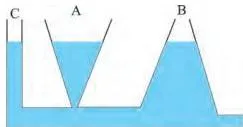
The hydrostatic paradox in the figure above makes the point concrete: the three vessels hold different amounts of water, yet the liquid level — and therefore the pressure at the bottom — is the same in all three.
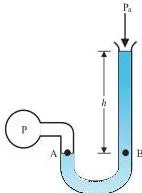
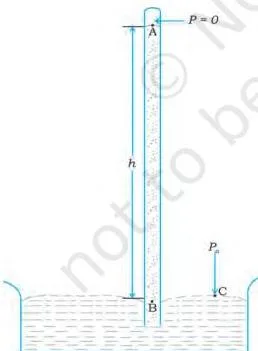
Two instruments read these pressures directly. A mercury barometer balances atmospheric pressure against a column \( P_a = \rho g h \) (NCERT, p. 184); an open tube manometer measures the gauge pressure through the height difference between its two arms.
Pascal’s Law and Hydraulic Machines
Pascal’s law states that pressure in a fluid at rest is the same at all points at the same height, and that a change in pressure applied to an enclosed fluid is transmitted undiminished to every point of the fluid and to the walls of the vessel (NCERT, p. 186).
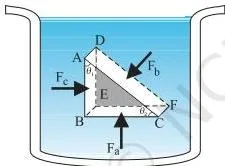
The proof uses a tiny right-angled prism of fluid at rest. Since each face experiences only normal forces and the prism is in equilibrium, the pressures on the three faces come out equal: \( P_a = P_b = P_c \).
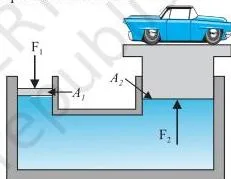
In a hydraulic lift, pressure \( P = F_1/A_1 \) on a small piston is transmitted undiminished to a larger piston of area \( A_2 \), giving:
\[ F_2 = \frac{A_2}{A_1} F_1 \]
The factor \( A_2/A_1 \) is the mechanical advantage. Because liquids are almost incompressible, the volume pushed by one piston equals the volume moved by the other:
\[ A_1 L_1 = A_2 L_2 \]
Streamline Flow and Equation of Continuity
In steady flow the mass of fluid crossing any cross-section per second is the same, so along a pipe:
\[ \rho A v = \text{constant} \]
This is conservation of mass. For an incompressible fluid the density is constant and the equation reduces to the equation of continuity (NCERT, p. 187):
\[ A v = \text{constant} \]
The product \( Av \) is the volume flux (flow rate). At a narrower cross-section the streamlines crowd together and the speed rises; at a wider section the speed falls.
Bernoulli’s Principle
For steady flow of an incompressible, non-viscous fluid along a streamline, the sum of pressure, kinetic energy per unit volume and potential energy per unit volume is constant (NCERT, p. 188):
\[ P + \frac{1}{2}\rho v^2 + \rho g h = \text{constant} \]
In two-point form:
\[ P_1 + \frac{1}{2}\rho v_1^2 + \rho g h_1 = P_2 + \frac{1}{2}\rho v_2^2 + \rho g h_2 \]
For two points at the same height the \( \rho g h \) terms cancel, giving the derived level-flow form used in lift problems:
\[ P_1 – P_2 = \frac{1}{2}\rho (v_2^2 – v_1^2) \]
If the fluid is at rest, Bernoulli’s equation reduces to \( P_1 + \rho g h_1 = P_2 + \rho g h_2 \), which is the same as the hydrostatic relation \( P_2 – P_1 = \rho g h \).
Speed of Efflux: Torricelli’s Law
For a tank with a small hole, the speed of efflux depends on the pressure above the liquid (NCERT, p. 189):
\[ v_1 = \sqrt{2gh + \frac{2(P – P_a)}{\rho}} \]
When the tank is open to the atmosphere, \( P = P_a \) and this becomes Torricelli’s law:
\[ v_1 = \sqrt{2gh} \]
This is exactly the speed a body gains in free fall through height \( h \). The result assumes the tank area is much larger than the hole area, \( A_2 \gg A_1 \), so the liquid surface falls very slowly.
Viscosity
Viscosity is the internal friction between layers of a fluid in relative motion. The coefficient of viscosity is the ratio of shearing stress to strain rate (NCERT, p. 191):
\[ \eta = \frac{F/A}{v/l} = \frac{F l}{v A} \]
Here \( l \) is the thickness of the liquid layer between the moving and the fixed surface. The unit of \( \eta \) is \( \text{Pa s} \) (poiseuille). Viscosity of liquids decreases with temperature; viscosity of gases increases with temperature.
Stokes’ Law
A sphere of radius \( a \) moving with speed \( v \) through a fluid of viscosity \( \eta \) experiences a retarding viscous drag (NCERT, p. 193):
\[ F = 6\pi\eta a v \]
When a sphere falls through a fluid, it accelerates until the viscous drag plus the buoyant force balances gravity. From then on it falls with constant terminal velocity:
\[ v_t = \frac{2 a^2 (\rho – \sigma) g}{9 \eta} \]
Here \( \rho \) is the density of the sphere and \( \sigma \) the density of the fluid. Note that \( v_t \) depends on the square of the radius.
Surface Tension and Angle of Contact
Surface tension is the force per unit length acting in the plane of the interface, and is numerically equal to the surface energy per unit area. For a film held by a bar of length \( l \), the factor 2 appears because the film has two surfaces:
\[ S = \frac{F}{2l} \]
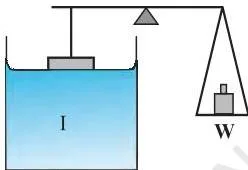
In the plate method, a liquid film pulls a flat plate down and the extra weight needed to free it measures the liquid–air surface tension (NCERT, p. 195):
\[ S_{\text{la}} = \frac{mg}{2l} \]
The angle of contact \( \theta \) is the angle between the tangent to the liquid surface at the point of contact and the solid surface, measured inside the liquid. At the contact line the three interfacial tensions are in equilibrium (NCERT, p. 196):
\[ S_{\text{la}} \cos\theta + S_{\text{sl}} = S_{\text{sa}} \]
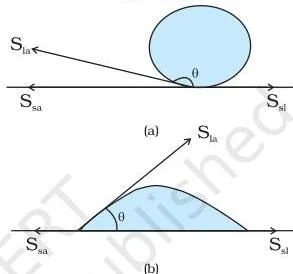
If \( \theta \) is obtuse, the liquid does not wet the solid (mercury on glass, water on a waxy surface); if \( \theta \) is acute, it wets (water on clean glass). Like viscosity, surface tension of a liquid usually falls with temperature.
Drops and Bubbles
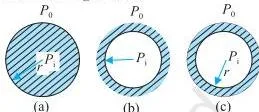
A curved liquid surface supports a pressure difference. For a spherical drop there is one liquid–air surface:
\[ P_1 – P_0 = \frac{2S}{r} \]
A soap bubble has two surfaces, so the excess pressure is double:
\[ P_1 – P_0 = \frac{4S}{r} \]
An air bubble inside a liquid has only one liquid–air surface, so it also obeys \( 2S/r \). This excess pressure is why small drops and bubbles are spherical — a sphere has the least surface area for a given volume, hence the least surface energy (NCERT, p. 197).
Capillary Rise
For a capillary tube of radius \( a \), the pressure difference across the curved meniscus is \( (2S/a)\cos\theta \), and balancing it against the hydrostatic pressure of the column gives the capillary rise (NCERT, p. 197):
\[ h = \frac{2S\cos\theta}{\rho g a} \]
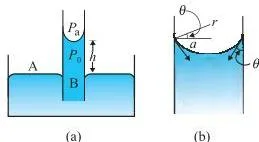
Water wets glass, so \( \cos\theta \) is positive and the liquid rises. For mercury, \( \theta \) is obtuse, \( \cos\theta \) is negative, and the same formula predicts a fall of the level in the capillary.
What Each Symbol Means
The table below gives the meaning and SI unit of every symbol used on this sheet.
| Symbol | What it means | SI unit |
|---|---|---|
| \( P \), \( P_{\text{av}} \) | Pressure; average pressure (normal force per unit area) | \( \text{N m}^{-2} \) = pascal (Pa) |
| \( F \) | Magnitude of the normal force on a surface | N |
| \( A \) | Area of the surface | \( \text{m}^2 \) |
| \( \rho \) | Density of the fluid (mass per unit volume) | \( \text{kg m}^{-3} \) |
| \( m \) | Mass | kg |
| \( V \) | Volume | \( \text{m}^3 \) |
| \( P_a \) (also \( P_s \)) | Atmospheric pressure at sea level, \( 1.013 \times 10^5 \text{ Pa} \) | Pa |
| \( P – P_a \) | Gauge pressure (excess over atmospheric) | Pa |
| \( h \) | Depth below a liquid surface, or height of a liquid column | m |
| \( g \) | Acceleration due to gravity | \( \text{m s}^{-2} \) |
| \( v \) | Flow speed (or speed of a moving layer/sphere) | \( \text{m s}^{-1} \) |
| \( \eta \) | Coefficient of viscosity | \( \text{Pa s} \) (poiseuille) |
| \( l \) | In \( \eta = Fl/(vA) \): thickness of the liquid layer between the plates. In \( S = F/2l \): length of the film or plate edge | m |
| \( a \) | Radius of a sphere (Stokes’ law) or radius of a capillary tube | m |
| \( \sigma \) | Density of the fluid through which a sphere falls | \( \text{kg m}^{-3} \) |
| \( v_t \) | Terminal velocity (constant speed of fall) | \( \text{m s}^{-1} \) |
| \( S \), \( S_{\text{la}} \) | Surface tension: force per unit length, or surface energy per unit area | \( \text{N m}^{-1} \) |
| \( S_{\text{sl}} \), \( S_{\text{sa}} \) | Solid–liquid and solid–air interfacial tensions | \( \text{N m}^{-1} \) |
| \( \theta \) | Angle of contact between the liquid surface and the solid surface | degree (°); \( \cos\theta \) is dimensionless |
| \( r \) | Radius of a drop or bubble | m |
| \( P_1 – P_0 \) | Excess pressure inside a curved surface (inside minus outside) | Pa |
| \( L_1, L_2 \) | Distances moved by the small and large pistons of a hydraulic lift | m |
When to Use Each Formula
| Formula | Reach for it when… | Condition that must hold |
|---|---|---|
| \( P_{\text{av}} = F/A \) | A force presses on a known area and you need the average pressure — a heel on the floor, a plank on the chest | Use the component of the force normal to the area |
| \( P = P_a + \rho g h \), \( P – P_a = \rho g h \) | Pressure at a depth in a liquid: add \( P_a \) for absolute pressure, omit it for gauge pressure | Liquid at rest with nearly constant density (liquids are largely incompressible) |
| \( P_a = \rho g h \) | A barometer or manometer gives the pressure as a column height | The column is at rest and its density is known |
| \( F_2 = \frac{A_2}{A_1} F_1 \) | Hydraulic lift or hydraulic brakes: force on one piston from the other | Pressure transmitted undiminished through the liquid |
| \( A_1 L_1 = A_2 L_2 \) | Find how far the other piston moves when one is pushed | Incompressible liquid; volumes displaced are equal |
| \( Av = \text{constant} \) | Speed at different cross-sections of a pipe, e.g. a hose and its nozzle | Incompressible fluid in steady flow |
| \( \rho Av = \text{constant} \) | Pipe flow of a gas where density changes along the tube | Steady flow; mass is conserved |
| Bernoulli’s equation | Relating pressure, speed and height at two points on the same streamline | Steady flow, incompressible fluid, negligible viscosity; not for turbulent flow |
| \( v_1 = \sqrt{2gh + \frac{2(P – P_a)}{\rho}} \) | Efflux from a pressurised tank (rocket propulsion) | Hole area much smaller than tank area, \( A_2 \gg A_1 \) |
| \( v_1 = \sqrt{2gh} \) | Efflux from a tank open to the atmosphere | Tank open to air; speed equals free-fall speed |
| \( \eta = \frac{Fl}{vA} \) | Find viscosity from a measured shear force, area and layer thickness | Laminar flow; \( l \) is the film thickness between the plates |
| \( F = 6\pi\eta a v \), \( v_t = \frac{2a^2(\rho-\sigma)g}{9\eta} \) | Drag on a small sphere moving slowly; terminal speed of a falling sphere or raindrop | Slow, laminar motion; \( v_t \) applies when net force on the sphere is zero |
| \( S = \frac{F}{2l} \), \( S_{\text{la}} = \frac{mg}{2l} \) | Surface tension from a film force or from the plate method | Factor 2 because a film has two surfaces |
| \( P_1 – P_0 = \frac{2S}{r} \) or \( \frac{4S}{r} \) | Excess pressure in a drop, an air bubble in a liquid, or a soap bubble | Use \( 2S/r \) for one interface, \( 4S/r \) for a soap bubble’s two interfaces |
| \( h = \frac{2S\cos\theta}{\rho g a} \) | Rise or fall of liquid in a capillary tube | \( \theta \) acute → rise; \( \theta \) obtuse → depression (mercury) |
Worked Examples
The three examples below show the formula being chosen, the substitution with units, and the final answer. More formula sheets for other chapters are collected in the Physics formulas index.
Worked Example 1: Absolute and gauge pressure at depth
Step 1: Choose the formula.
At depth \( h \) in a liquid open to the atmosphere, gauge pressure is \( P – P_a = \rho g h \) and absolute pressure is \( P = P_a + \rho g h \).
Take \( P_a = 1.013 \times 10^5 \text{ Pa} \).
Step 2: Substitute \( \rho = 1.03 \times 10^3\ \text{kg m}^{-3} \), \( g = 9.8\ \text{m s}^{-2} \), \( h = 300\ \text{m} \).
\[ P – P_a = \rho g h = (1.03 \times 10^3)(9.8)(300) = 3.03 \times 10^6\ \text{Pa} \]
\[ P = P_a + \rho g h = 1.013 \times 10^5 + 3.03 \times 10^6 = 3.13 \times 10^6\ \text{Pa} \]
Step 3: Force on a window uses the gauge pressure, because the air inside the submarine is at atmospheric pressure.
Window radius \( r = 0.20\ \text{m} \), so \( A = \pi r^2 = \pi(0.20)^2 = 0.126\ \text{m}^2 \).
\[ F = (P – P_a) A = (3.03 \times 10^6)(0.126) = 3.8 \times 10^5\ \text{N} \]
Final answer: gauge pressure \( 3.03 \times 10^6\ \text{Pa} \), absolute pressure \( 3.13 \times 10^6\ \text{Pa} \), force on the window \( 3.8 \times 10^5\ \text{N} \).
Worked Example 2: Equation of continuity in a narrowing pipe
Step 1: Water is incompressible, so use \( A_1 v_1 = A_2 v_2 \).
Since the pipe radius changes, write the areas in terms of radii: \( v_2 = v_1 (r_1/r_2)^2 \).
Step 2: Substitute \( v_1 = 2.0\ \text{m s}^{-1} \), \( r_1 = 4.0\ \text{cm} = 0.040\ \text{m} \), \( r_2 = 1.6\ \text{cm} = 0.016\ \text{m} \).
\[ v_2 = 2.0 \times \left(\frac{0.040}{0.016}\right)^2 = 2.0 \times 6.25 = 12.5\ \text{m s}^{-1} \]
Step 3: The volume flow rate is the same at every section: \( Q = A_1 v_1 \).
\[ Q = \pi(0.040)^2(2.0) = 1.0 \times 10^{-2}\ \text{m}^3\ \text{s}^{-1} \]
Final answer: speed in the nozzle \( 12.5\ \text{m s}^{-1} \), flow rate \( 1.0 \times 10^{-2}\ \text{m}^3\ \text{s}^{-1} \).
Worked Example 3: Capillary rise of water
Step 1: Use \( h = \frac{2S\cos\theta}{\rho g a} \).
Water wets glass, so take \( \theta = 0^\circ \) and \( \cos\theta = 1 \).
Step 2: Substitute \( S = 0.073\ \text{N m}^{-1} \), \( a = 0.25\ \text{mm} = 2.5 \times 10^{-4}\ \text{m} \), \( \rho = 1.0 \times 10^3\ \text{kg m}^{-3} \), \( g = 9.8\ \text{m s}^{-2} \).
\[ h = \frac{2(0.073)(1)}{(1.0 \times 10^3)(9.8)(2.5 \times 10^{-4})} = \frac{0.146}{2.45} = 0.0596\ \text{m} \approx 6.0\ \text{cm} \]
Final answer: water rises about \( 6.0\ \text{cm} \) in the tube. For mercury, \( \cos\theta \) is negative and the same formula gives a depression instead of a rise.
Common Mistakes to Avoid
| Mistake | Correct rule | How to check your answer |
|---|---|---|
| Using absolute pressure where gauge pressure is needed, or vice versa | Gauge is \( P – P_a = \rho g h \); absolute is \( P = P_a + \rho g h \). A submerged window whose interior is at atmospheric pressure feels the gauge pressure | At 10 m of water, gauge pressure is about \( 10^5\ \text{Pa} \) (1 atm). If your value is \( 10^6\ \text{Pa} \) at 10 m, you have mis-scoped the depth |
| Writing \( 4S/r \) for a drop or \( 2S/r \) for a soap bubble | A drop has one liquid–air surface → \( 2S/r \); a soap bubble has two surfaces → \( 4S/r \); an air bubble in a liquid has one surface → \( 2S/r \) | For the same radius and liquid, the bubble needs double the excess pressure of the drop |
| Applying \( Av = \text{constant} \) to a compressible fluid | The general mass conservation statement is \( \rho Av = \text{constant} \); \( Av \) is constant only when density does not change | If the fluid is a gas whose density changes along the pipe, keep \( \rho \) in the product |
| Substituting the diameter instead of the radius in Stokes’ law or capillary rise | \( a \) is always the radius of the sphere or tube. In \( v_t \) the radius is squared | If the radius doubles, terminal velocity becomes four times; check that \( a \) is half the diameter |
| Confusing the two meanings of \( l \) in \( \eta = Fl/(vA) \) | Here \( l \) is the thickness of the liquid film between the two plates, not the length of the plate or block | Film thicknesses are of order mm. A metre-scale \( l \) would give a viscosity \( 10^3 \) times too large |
| Quoting Bernoulli without its conditions | It holds for steady flow of an incompressible, non-viscous fluid along a streamline; viscosity converts kinetic energy to heat | Ask: is the flow steady, is \( \rho \) constant, is viscosity negligible? If not, state that the equation is only approximate |
Frequently Asked Questions
Is pressure really a scalar if it is force divided by area?
Yes. Only the component of the force normal to the area enters the definition, and the force exerted by a fluid at rest on any surface is normal to that surface whatever its orientation. No direction can be assigned to pressure, so it is a scalar (NCERT, p. 183).
Why does a soap bubble need more excess pressure than a drop of the same radius?
A drop has one liquid–air surface, so the excess pressure is \( 2S/r \). A soap bubble has two surfaces — an outer and an inner film surface — and each contributes \( S \) per unit length, giving \( 4S/r \). That is why you have to blow a little harder to start a bubble.
When can Bernoulli’s equation not be used?
When the fluid is viscous (internal friction converts kinetic energy to heat), when the flow is turbulent or non-steady, or when the fluid is compressible. For a low-viscosity incompressible fluid in steady flow it is a good approximation (NCERT, p. 188).
Why does water rise in a capillary tube while mercury falls?
Water wets glass, so the angle of contact is acute and the meniscus is concave. The pressure just below the meniscus is then lower than atmospheric, so outside pressure pushes the water up.
Mercury has an obtuse angle of contact, making \( \cos\theta \) negative; the same formula \( h = 2S\cos\theta/(\rho g a) \) then gives a depression instead of a rise (NCERT, p. 197).
Reference: NCERT Class 11 Physics textbook, chapter Mechanical Properties of Fluids. Verify any figure against the chapter PDF on NCERT’s textbook portal.
Explore Class 11 Physics Formulas
More for this chapter:
Class 11 Physics on LearnCBSE:
Related chapters: