
This page is the quick-reference gravitation class 11 formulas sheet for NCERT Physics Part I, Chapter 7. It covers Newton’s universal law of gravitation, Kepler’s three laws, the acceleration due to gravity at the Earth’s surface, at a height above it and at a depth below it, gravitational potential energy, escape speed, and the speed, period and energy of Earth satellites.
Every formula is grouped by the chapter’s own sub-topics, with a symbol table giving SI units, a when-to-use guide, three worked examples using original numbers, and the mistakes students most often make while applying these relations.
For the derivations behind these results, start from the Class 11 physics formulas collection; the physics formulas index lists formula sheets for every class and chapter.
Formulas at a Glance
Every row below is a reusable result from this chapter. The same formulas appear grouped by topic further down, with conditions and symbol meanings.
| Purpose (what you are finding) | Formula |
|---|---|
| Gravitational force between two point masses | \( F = G\frac{m_1 m_2}{r^2} \) |
| Resultant force when several masses pull on one mass | \( \mathbf{F}_R = \sum_{i=1}^{n} \mathbf{F}_i \) |
| Acceleration due to gravity on the Earth’s surface | \( g = \frac{GM_E}{R_E^2} \) |
| Acceleration due to gravity at a height \( h \) above the surface (exact) | \( g(h) = \frac{GM_E}{(R_E+h)^2} \) |
| Acceleration due to gravity at a small height \( h \) | \( g(h) \approx g\left(1 – \frac{2h}{R_E}\right) \) |
| Acceleration due to gravity at a depth \( d \) below the surface | \( g(d) = g\left(1 – \frac{d}{R_E}\right) \) |
| Gravitational potential energy of two masses | \( U = -\frac{Gm_1 m_2}{r} \) |
| Gravitational potential (potential energy per unit mass) | \( V = -\frac{GM}{r} \) |
| Escape speed from the surface | \( v_e = \sqrt{\frac{2GM_E}{R_E}} = \sqrt{2gR_E} \) |
| Orbital speed at radius \( R_E + h \) | \( v = \sqrt{\frac{GM_E}{R_E+h}} \) |
| Time period of a circular orbit | \( T = \frac{2\pi (R_E+h)^{3/2}}{\sqrt{GM_E}} \) |
| Kepler’s law of periods (planet or satellite) | \( T^2 = \frac{4\pi^2}{GM}R^3 \) |
| Period of a satellite skimming the surface | \( T_0 = 2\pi\sqrt{\frac{R_E}{g}} \) |
| Kinetic energy of an orbiting satellite | \( K = \frac{GmM_E}{2(R_E+h)} \) |
| Potential energy of an orbiting satellite | \( U = -\frac{GmM_E}{R_E+h} \) |
| Total energy of an orbiting satellite | \( E = -\frac{GmM_E}{2(R_E+h)} \) |
| Areal velocity (equal areas in equal times) | \( \frac{\Delta A}{\Delta t} = \frac{L}{2m} \) |
| Mechanical energy of a body of mass \( m \) moving with speed \( v \) at distance \( r \) | \( E = \frac{1}{2}mv^2 – \frac{GMm}{r} \) |
All Formulas, Grouped by Topic
Kepler’s Laws
Kepler’s three laws describe planetary motion around the Sun (NCERT, p. 129):
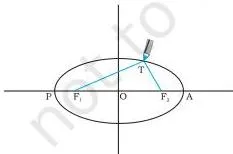
- Law of orbits: all planets move in elliptical orbits with the Sun at one focus.
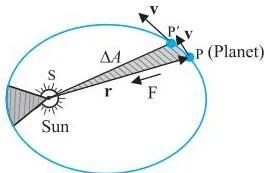
- Law of areas: the line joining a planet to the Sun sweeps equal areas in equal time intervals. It follows from angular momentum conservation, since gravity is a central force:
\[ \frac{\Delta A}{\Delta t} = \frac{L}{2m} \]
- Law of periods: the square of the period is proportional to the cube of the semi-major axis. For a circular orbit of radius \( R \) around the Sun of mass \( M_s \):
\[ T^2 = \left(\frac{4\pi^2}{GM_s}\right) R^3 \]
For an elliptical orbit, replace \( R \) by the semi-major axis \( a \). The figure below marks the perihelion P (closest point) and aphelion A (farthest point); the semi-major axis is half the distance AP.
Kepler’s second law is shown in Fig. 7.2: the shaded sector \( \Delta A \) is the area swept in a small time \( \Delta t \). Because the gravitational force always points along the Sun-planet line, it exerts no torque, so \( L \) and therefore the areal velocity stay constant.
Universal Law of Gravitation
Every body attracts every other body with a force proportional to the product of their masses and inversely proportional to the square of the distance between them (NCERT, p. 130):
\[ F = G\frac{m_1 m_2}{r^2} \]
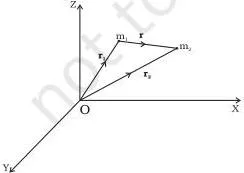
In vector form, with \( \hat{\mathbf{r}} \) the unit vector from \( m_1 \) to \( m_2 \):
\[ \mathbf{F} = -G\frac{m_1 m_2}{r^2}\hat{\mathbf{r}} \]
As Fig. 7.3 shows, \( \mathbf{r} = \mathbf{r}_2 – \mathbf{r}_1 \) points from \( m_1 \) to \( m_2 \), and the minus sign marks attraction: the force on \( m_2 \) points toward \( m_1 \).
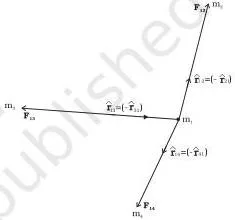
When several masses act on one mass, the resultant force is the vector sum of the individual forces (NCERT, p. 130):
\[ \mathbf{F}_R = \mathbf{F}_1 + \mathbf{F}_2 + \cdots + \mathbf{F}_n = \sum_{i=1}^{n} \mathbf{F}_i \]
Two shell results (NCERT, p. 131) make the law usable for extended bodies like the Earth:
- Outside a uniform hollow spherical shell, the force is the same as if the whole mass of the shell were concentrated at its centre.
- Inside a uniform hollow spherical shell, the net gravitational force is zero.
The second result is why a point inside the Earth feels the pull of only the sphere of matter below it.
The Gravitational Constant
The constant \( G \) is universal and was first measured by Cavendish in 1798 (NCERT, p. 132):
\[ G = 6.67 \times 10^{-11}\ \text{N m}^2\ \text{kg}^{-2} \]
In Cavendish’s experiment, the gravitational torque on a suspended bar is balanced by the restoring torque of the twisted wire:
\[ G\frac{Mm}{d^2}L = \tau\theta \]
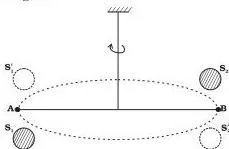
Acceleration Due to Gravity of the Earth
At the surface, setting the gravitational force equal to \( mg \) gives (NCERT, p. 133):
\[ g = \frac{GM_E}{R_E^2} \]
Rearranged, \( M_E = gR_E^2/G \). Since \( g \) and \( R_E \) are measurable, Cavendish’s measurement of \( G \) effectively lets us “weigh the Earth”.
Acceleration Due to Gravity Below and Above the Surface
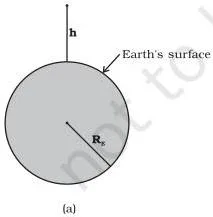
At a height \( h \) above the surface, the distance from the Earth’s centre is \( R_E + h \):
\[ g(h) = \frac{GM_E}{(R_E+h)^2} \quad \text{(exact, valid for any height above)} \]
For small heights, \( h \ll R_E \), the binomial expansion gives (NCERT, p. 133):
\[ g(h) \approx g\left(1 – \frac{2h}{R_E}\right) \]
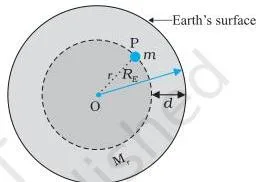
At a depth \( d \) below the surface, only the sphere of radius \( R_E – d \) pulls, so with uniform density (NCERT, p. 134):
\[ g(d) = g\left(1 – \frac{d}{R_E}\right) \]
So \( g \) is maximum on the surface and decreases whether you go up or down. The two figures below show the geometry of each case.
Gravitational Potential Energy
Taking the zero of potential energy at infinity, two masses separated by \( r \) have (NCERT, p. 135):
\[ U = -\frac{Gm_1 m_2}{r} \]
The gravitational potential at a point is the potential energy of a unit mass placed there:
\[ V = -\frac{GM}{r} \]
The work done in moving a mass \( m \) from \( r_1 \) to \( r_2 \) away from the Earth is the change in this potential energy:
\[ W_{12} = -GM_E m\left(\frac{1}{r_2} – \frac{1}{r_1}\right) \]
Near the surface this reduces to the familiar \( mgh \). The total mechanical energy of a body of mass \( m \) moving with speed \( v \) at distance \( r \) from a massive body \( M \) is constant (NCERT, pp. 140–141):
\[ E = \frac{1}{2}mv^2 – \frac{GMm}{r} \]
Escape Speed
The minimum speed needed from the surface so that the body just reaches infinity (NCERT, p. 136):
\[ v_e = \sqrt{\frac{2GM_E}{R_E}} = \sqrt{2gR_E} \]
Numerically, \( v_e = 11.2\ \text{km s}^{-1} \) for the Earth. The same formula with the Moon’s \( g \) and radius gives 2.3 km/s, about five times smaller — which is why the Moon cannot hold an atmosphere.
Earth Satellites
For a circular orbit at radius \( R_E + h \), the gravitational force supplies the required centripetal force (NCERT, p. 138):
\[ v = \sqrt{\frac{GM_E}{R_E+h}} \]
Just above the surface, \( h = 0 \), so \( v^2 = gR_E \). The time period of the orbit is:
\[ T = \frac{2\pi(R_E+h)^{3/2}}{\sqrt{GM_E}} \]
Squaring gives Kepler’s law of periods applied to satellites:
\[ T^2 = k(R_E+h)^3, \quad k = \frac{4\pi^2}{GM_E} \]
For a satellite very close to the surface:
\[ T_0 = 2\pi\sqrt{\frac{R_E}{g}} \approx 85\ \text{minutes} \]
Energy of an Orbiting Satellite
For a circular orbit of radius \( R_E + h \), with potential energy zero at infinity (NCERT, p. 140):
\[ K = \frac{GmM_E}{2(R_E+h)}, \quad U = -\frac{GmM_E}{R_E+h}, \quad E = K + U = -\frac{GmM_E}{2(R_E+h)} \]
So for every circular orbit, \( E = -K \) and \( U = 2E \). The general result for a circular orbit of radius \( a \) about a fixed mass \( M \) (NCERT, p. 140):
\[ E = -\frac{GMm}{2a}, \quad K = \frac{GMm}{2a}, \quad U = -\frac{GMm}{a} \]
A negative total energy means the satellite is bound — it cannot drift to infinity on its own.
Gravitational Quantities and Their Dimensions
The chapter’s summary table lists the standard gravitational quantities with their units and dimensions (NCERT, p. 141).
| Physical quantity | Symbol | Expression / value | SI unit | Dimensions |
|---|---|---|---|---|
| Gravitational constant | \( G \) | \( 6.67 \times 10^{-11} \) | \( \text{N m}^2\ \text{kg}^{-2} \) | \( [M^{-1}L^3T^{-2}] \) |
| Gravitational potential energy | \( U \) | \( -\frac{GMm}{r} \) (scalar) | \( \text{J} \) | \( [ML^2T^{-2}] \) |
| Gravitational potential | \( V \) | \( -\frac{GM}{r} \) (scalar) | \( \text{J kg}^{-1} \) | \( [L^2T^{-2}] \) |
| Gravitational intensity (field) | \( \mathbf{g} \) | \( -\frac{GM}{r^2}\hat{\mathbf{r}} \) (vector) | \( \text{m s}^{-2} \) | \( [LT^{-2}] \) |
What Each Symbol Means
| Symbol | What it means | SI unit |
|---|---|---|
| \( F \) | magnitude of the gravitational force | \( \text{N} \) |
| \( G \) | universal gravitational constant, \( 6.67 \times 10^{-11} \) | \( \text{N m}^2\ \text{kg}^{-2} \) |
| \( m_1, m_2 \) | masses of the two attracting bodies | \( \text{kg} \) |
| \( M_E \) | mass of the Earth (\( \approx 6.0 \times 10^{24}\) kg) | \( \text{kg} \) |
| \( R_E \) | radius of the Earth (\( \approx 6.4 \times 10^6\) m) | \( \text{m} \) |
| \( r \) | distance between the centres of the two masses | \( \text{m} \) |
| \( h \) | height above the Earth’s surface | \( \text{m} \) |
| \( d \) | depth below the Earth’s surface | \( \text{m} \) |
| \( g \) | acceleration due to gravity at the surface (\( 9.8\ \text{m s}^{-2}\)) | \( \text{m s}^{-2} \) |
| \( g(h), g(d) \) | acceleration due to gravity at height \( h \) / depth \( d \) | \( \text{m s}^{-2} \) |
| \( U \) | gravitational potential energy | \( \text{J} \) |
| \( V \) | gravitational potential (potential energy per unit mass) | \( \text{J kg}^{-1} \) |
| \( v \) | orbital speed of a satellite | \( \text{m s}^{-1} \) |
| \( v_e \) | escape speed (\( 11.2\ \text{km s}^{-1}\) on Earth) | \( \text{m s}^{-1} \) |
| \( T \) | time period of one revolution | \( \text{s} \) (years for planets) |
| \( T_0 \) | period of a satellite very close to the surface (\( \approx 85\) min) | \( \text{s} \) |
| \( a \) | semi-major axis of an elliptical orbit | \( \text{m} \) |
| \( L \) | angular momentum of the orbiting body | \( \text{kg m}^2\ \text{s}^{-1} \) |
| \( \Delta A/\Delta t \) | areal velocity (area swept out per unit time) | \( \text{m}^2\ \text{s}^{-1} \) |
| \( K, E \) | kinetic energy, total mechanical energy | \( \text{J} \) |
When to Use Each Formula
| Formula | Reach for it when… | Condition that must hold |
|---|---|---|
| \( F = Gm_1m_2/r^2 \) | two point masses attract, or one body sits outside a spherical body | \( r \) is the centre-to-centre distance; for the Earth, \( r = R_E + h \) |
| \( \mathbf{F}_R = \sum \mathbf{F}_i \) | several masses act on one mass (superposition) | add forces as vectors, never as scalar sums |
| \( g = GM_E/R_E^2 \) | surface-gravity problems, or finding \( M_E = gR_E^2/G \) | body at \( r = R_E \) |
| \( g(h) = GM_E/(R_E+h)^2 \) | any height above the surface, e.g. satellite altitudes | always valid outside the Earth |
| \( g(h) \approx g(1-2h/R_E) \) | small heights where \( h \ll R_E \) | breaks down when \( h \) is comparable to \( R_E \) |
| \( g(d) = g(1-d/R_E) \) | body inside the Earth — mines, boreholes | Earth treated as a uniform-density sphere |
| \( U = -Gm_1m_2/r \) | potential energy of a two-mass system at any separation | zero of potential chosen at infinity; use \( mgh \) only for \( h \ll R_E \) |
| \( V = -GM/r \) | potential per unit mass at a point | scalar — superpose it for many masses |
| \( v_e = \sqrt{2GM/R} = \sqrt{2gR} \) | minimum speed to escape from a planet, or checking whether a body can escape | independent of mass and direction; depends on launch height |
| \( v = \sqrt{GM_E/(R_E+h)} \) | speed of a satellite in a circular orbit | circular orbit only; set centripetal force equal to gravitational force |
| \( T = 2\pi(R_E+h)^{3/2}/\sqrt{GM_E} \) | period of a circular orbit; also \( T^2 = k(R_E+h)^3 \) | for elliptical orbits replace \( R \) by semi-major axis \( a \) |
| \( T_0 = 2\pi\sqrt{R_E/g} \) | satellite just above the surface | \( h \approx 0 \); about 85 minutes for the Earth |
| \( K, U, E \) of a satellite | energy of a circular orbit, or energy needed to change orbits | for circular orbits, \( E = -K \) and \( U = 2E \) |
The chapter’s exercises map onto these results as follows — pick the formula first, then substitute.
| NCERT exercise | What it involves | Formula to reach for |
|---|---|---|
| 7.3, 7.5, 7.14 | orbital size vs period (planets, galaxy) | Kepler’s law of periods, \( T^2 \propto a^3 \) |
| 7.4, 7.13 | mass of a planet or the Sun from a moon’s orbit | \( T^2 = 4\pi^2 R^3/(GM) \), rearranged |
| 7.7 | does escape speed depend on mass, location, direction? | \( v_e = \sqrt{2gR_E} \) — no mass, no direction |
| 7.12 | point where the pulls of Sun and Earth cancel | equate \( GMm/r^2 \) for the two bodies |
| 7.15 | weight at a height equal to half the Earth’s radius | exact \( g(h) = GM_E/(R_E+h)^2 \); not the small-\( h \) approximation |
| 7.16 | weight halfway down to the centre | \( g(d) = g(1-d/R_E) \) |
| 7.17, 7.18 | rocket rising then falling; body thrown above escape speed | conservation of \( E = \frac{1}{2}mv^2 – GMm/r \) |
| 7.19 | energy to pull a satellite out of Earth’s influence | total energy \( E = -GmM_E/[2(R_E+h)] \) |
| 7.21 | force and potential at the midpoint of two spheres | superposition + \( V = -GM/r \) |
Worked Examples
Worked Example 1: Force between two heavy spheres
Step 1: Choose the formula.
Two solid spheres attract as point masses, so use \( F = Gm_1m_2/r^2 \) with \( r \) measured centre to centre.
Step 2: Substitute \( m_1 = 600\ \text{kg} \), \( m_2 = 900\ \text{kg} \), \( r = 2.0\ \text{m} \), \( G = 6.67 \times 10^{-11}\ \text{N m}^2\ \text{kg}^{-2} \):
\[ F = \frac{6.67 \times 10^{-11} \times 600 \times 900}{(2.0)^2} = \frac{6.67 \times 10^{-11} \times 5.4 \times 10^5}{4} = 9.0 \times 10^{-6}\ \text{N} \]
Final answer: \( F = 9.0 \times 10^{-6}\ \text{N} \), attractive, along the line joining the centres. The force is tiny because \( G \) is so small — gravity becomes noticeable only when at least one mass is enormous.
Worked Example 2: Finding the mass of a planet from its moon’s orbit
Step 1: Choose the formula.
A moon in a circular orbit obeys Kepler’s law of periods, \( T^2 = 4\pi^2 R^3/(GM) \).
Rearrange for the planet’s mass:
\[ M = \frac{4\pi^2 R^3}{G T^2} \]
Step 2: Substitute \( R = 2.0 \times 10^8\ \text{m} \), \( T = 1.5 \times 10^5\ \text{s} \), \( G = 6.67 \times 10^{-11}\ \text{N m}^2\ \text{kg}^{-2} \):
\[ M = \frac{4\pi^2 (2.0 \times 10^8)^3}{6.67 \times 10^{-11} \times (1.5 \times 10^5)^2} = \frac{3.16 \times 10^{26}}{1.50} = 2.1 \times 10^{26}\ \text{kg} \]
Final answer: \( M \approx 2.1 \times 10^{26}\ \text{kg} \). This is the same “weighing” technique used to estimate the mass of the Earth from the Moon’s orbit.
Worked Example 3: Energy of a satellite in orbit
Step 1: Choose the formula.
A satellite of mass \( m \) in a circular orbit at radius \( r = R_E + h \) has total energy \( E = -GmM_E/(2r) \).
Here \( h = R_E \), so \( r = 2R_E \), and \( GM_E = gR_E^2 \):
\[ E = -\frac{GM_E m}{2(2R_E)} = -\frac{g m R_E}{4} = -\frac{9.8 \times 500 \times 6.4 \times 10^6}{4} = -7.84 \times 10^9\ \text{J} \]
Step 2: Use the orbit relations \( K = -E \) and \( U = 2E \) for a circular orbit:
\[ K = +7.84 \times 10^9\ \text{J}, \quad U = -1.57 \times 10^{10}\ \text{J} \]
Final answer: \( E = -7.84 \times 10^9\ \text{J} \), \( K = +7.84 \times 10^9\ \text{J} \), \( U = -1.57 \times 10^{10}\ \text{J} \). The negative total energy confirms the satellite is bound to the Earth.
Common Mistakes to Avoid
| Mistake | Correct rule | How to check your answer |
|---|---|---|
| Using the height \( h \) as the distance in \( F = GmM_E/r^2 \) or in orbital speed | The distance from the Earth’s centre is always \( r = R_E + h \), never \( h \) alone | Put \( h = 0 \): you must recover \( g = GM_E/R_E^2 \) and \( v^2 = gR_E \) |
| Confusing \( G \) with \( g \) | \( G = 6.67 \times 10^{-11}\ \text{N m}^2\ \text{kg}^{-2} \) is universal; \( g \approx 9.8\ \text{m s}^{-2} \) is local | Units decide: \( G \) carries \( \text{kg}^{-2} \), \( g \) is an acceleration |
| Writing gravitational potential energy as positive | \( U = -Gm_1m_2/r \), with \( U \to 0 \) only at infinity | A bound system must have \( E \lt 0 \); a positive \( E \) would mean escape |
| Using \( g(h) \approx g(1-2h/R_E) \) where \( h \) is not tiny | The approximation needs \( h \ll R_E \); otherwise use \( g(h) = GM_E/(R_E+h)^2 \) | Try \( h = R_E \): exact gives \( g/4 \), the approximation gives \( -g \), which is impossible |
| Applying the inverse-square law inside the Earth | Inside, \( g(d) = g(1-d/R_E) \) (uniform-density model); only the sphere below the point pulls | At \( d = R_E \) (the centre), \( g = 0 \) |
| Thinking escape speed depends on the mass or direction of the projectile | \( v_e = \sqrt{2gR_E} \) contains no mass and no direction | Every object needs the same \( 11.2\ \text{km s}^{-1} \) from the Earth’s surface |
Frequently Asked Questions
Why is \( g \) maximum at the Earth’s surface?
Because \( g \) falls in both directions. Going up, the distance from the Earth’s centre grows, so \( g(h) = GM_E/(R_E+h)^2 \) shrinks. Going down, only the sphere of radius \( R_E – d \) pulls, so \( g(d) \) falls linearly.
The chapter states it directly: the acceleration due to Earth’s gravity is maximum on its surface, decreasing whether you go up or down (NCERT, p. 134).
Why is the total energy of a satellite negative?
With the zero of potential energy at infinity, the satellite’s potential energy is negative and twice the kinetic energy in magnitude: \( U = -2K \). Hence \( E = K + U = -GMm/[2(R_E+h)] \) is negative. A negative total energy means a bound orbit — the satellite cannot escape to infinity unless energy is added to it.
Positive or zero total energy would mean escape.
Does escape speed depend on the mass of the body or the direction of launch?
No. \( v_e = \sqrt{2GM/R} = \sqrt{2gR} \) contains neither the body’s mass nor its launch direction, so every object needs the same 11.2 km/s from the Earth’s surface. It does depend on the height of launch — replace \( R \) by \( R + h \) — and on which planet you are leaving.
Why does an astronaut feel weightless in an orbiting satellite?
Not because gravity is weak there. The astronaut and the satellite are both in free fall toward the Earth with the same acceleration, so nothing pushes back on the astronaut — the apparent weight (normal reaction) is zero. That is what weightlessness in orbit really means (NCERT, p. 142).
Verify any expression against the official NCERT Class 11 Physics Part I PDF, available from the NCERT website. All formulas above follow the Rationalised NCERT textbook, Chapter 7: Gravitation.
Reference: NCERT Class 11 Physics textbook, chapter Gravitation.
Explore Class 11 Physics Formulas
More for this chapter:
Class 11 Physics on LearnCBSE:
Related chapters: