
These inverse trigonometric functions class 12 notes compress Chapter 2 of the NCERT Mathematics Part I textbook into revision-ready form: the principal value branches, domains and ranges of all six inverse functions, the properties with their domain conditions, and the two techniques that decide most exam marks — finding principal values and simplifying expressions by substitution.
Work through the sections in order, then use the quick revision summary the night before the exam. Every definition and formula here follows the rationalised NCERT book, which you can verify on the official NCERT portal.
For the rest of the syllabus, start from our class 12 mathematics notes hub or the complete class 12 notes collection.
Inverse Trigonometric Functions Class 12 Notes: Why Domains Must Be Restricted
An inverse \( f^{-1} \) exists only when \( f \) is one-one (every output comes from exactly one input) and onto (every output is actually reached) — together called bijective. This condition comes from Chapter 1; if it feels shaky, recap it in our relations and functions notes.
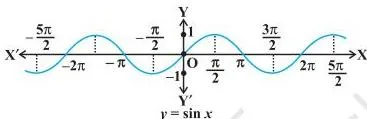
Trigonometric functions fail the one-one test over their natural domains. Sine and cosine repeat after \( 2\pi \); tangent and cotangent repeat after \( \pi \). For example, \( \sin x = \frac{1}{2} \) has infinitely many solutions in \( \mathbf{R} \), so sine cannot have an inverse until its domain is restricted (NCERT, p.1).
The fix is to cut each function down to an interval where it is one-one and still covers its full output range. For sine, the interval \( \left[-\frac{\pi}{2}, \frac{\pi}{2}\right] \) works: on it, sine rises from -1 to 1, taking every value exactly once (NCERT, p.2).
Each acceptable interval gives a different branch of the inverse. The interval chosen by convention is the principal value branch; for sine it is \( \left[-\frac{\pi}{2}, \frac{\pi}{2}\right] \), which is what the symbol \( \sin^{-1} \) means unless another branch is stated (NCERT, p.2).
Why this chapter matters: inverse trigonometric functions define many integrals in calculus, and the textbook notes that their concepts are used in science and engineering (NCERT, p.1). You will meet them again in our continuity and differentiability notes.
Principal Value Branches: Domains and Ranges of All Six Functions
The table below is the chapter in one screen — every question tests one row of it. It matches the textbook’s table (NCERT, p.8–9), repeated in the chapter summary (NCERT, p.15).
| Function | Domain | Principal value branch (range) | Point excluded, and why |
|---|---|---|---|
| \( \sin^{-1} \) | \( [-1, 1] \) | \( \left[-\frac{\pi}{2}, \frac{\pi}{2}\right] \) | None — sine is one-one on the whole closed interval. |
| \( \cos^{-1} \) | \( [-1, 1] \) | \( [0, \pi] \) | None — cosine is one-one on [0, π]. |
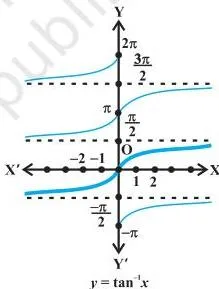
| \( \tan^{-1} \) | \( \mathbf{R} \) | \( \left(-\frac{\pi}{2}, \frac{\pi}{2}\right) \) | Endpoints excluded — tan is not defined at \( \pm\frac{\pi}{2} \), so the interval is open. |
| \( \cot^{-1} \) | \( \mathbf{R} \) | \( (0, \pi) \) | Endpoints excluded — cot is not defined at 0 and π (multiples of π). |
| \( \sec^{-1} \) | \( \mathbf{R} – (-1, 1) \) | \( [0, \pi] – \left\{\frac{\pi}{2}\right\} \) | \( \frac{\pi}{2} \) removed — sec is not defined where cos = 0. Domain drops \( (-1, 1) \) because sec never outputs values between -1 and 1. |
| \( \cosec^{-1} \) | \( \mathbf{R} – (-1, 1) \) | \( \left[-\frac{\pi}{2}, \frac{\pi}{2}\right] – \{0\} \) | 0 removed — cosec is not defined where sin = 0. Domain drops \( (-1, 1) \) because \( |\cosec x| \geq 1 \). |
Notice the pattern in the ranges: \( \sec^{-1} \) and \( \cosec^{-1} \) borrow the ranges of their reciprocal partners \( \cos^{-1} \) and \( \sin^{-1} \), then delete the single point where the partner equals zero. Column four is what students skip — the excluded point is always where the original trig function is undefined.
Memory device: recall all six ranges in one minute
- Sin and Tan swing about zero: \( \sin^{-1} \) uses \( \left[-\frac{\pi}{2}, \frac{\pi}{2}\right] \) and \( \tan^{-1} \) uses \( \left(-\frac{\pi}{2}, \frac{\pi}{2}\right) \).
- Co-sine and Co-tan start at zero: \( \cos^{-1} \) uses \( [0, \pi] \) and \( \cot^{-1} \) uses \( (0, \pi) \).
- Reciprocals borrow and delete: \( \sec^{-1} \) keeps cos’s range but removes \( \frac{\pi}{2} \) (where cos = 0); \( \cosec^{-1} \) keeps sin’s range but removes 0 (where sin = 0).
The hook: cos and cot both open from 0 to π; sin and tan both sit symmetrically about 0.
Reading the graphs
Fig 2.1(i) below is the graph of y = sin x. The curve repeats endlessly, which is why unrestricted sine can have no inverse — the restricted interval is what makes each output appear once (NCERT, p.3).
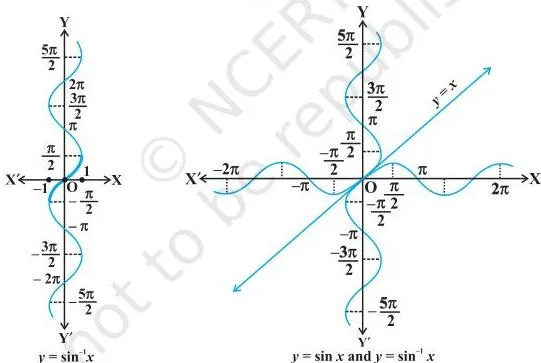
Fig 2.2(i) is the graph of y = cos x. On [0, π] the curve falls steadily from 1 to -1 and hits every output exactly once — that one-one behaviour is why cos⁻¹ answers with angles in [0, π] (NCERT, p.4).
![Graph of y = cos x on the restricted interval [0, π], falling steadily from 1 to -1 so that every output occurs exactly once and the inverse cosine becomes well defined](https://www.learncbse.net/images/inverse-trigonometric-functions-fig-2-2-i.webp "Inverse Trigonometric Functions Class 12 Notes")
Fig 2.5(i) is the graph of y = tan x. The vertical asymptotes at odd multiples of π/2 stop the curve from ever reaching ±π/2, which is why tan⁻¹’s range is the open interval (−π/2, π/2) (NCERT, p.7).
Finally, the mirror property: if (a, b) lies on y = sin x, then (b, a) lies on y = sin⁻¹x. Every inverse graph is the reflection of the original graph across the line y = x (NCERT, p.3).
Clearing the Notation Confusion: arcsin Is Not a Reciprocal
The mistake: reading \( \sin^{-1}x \) as “1 divided by sin x”.
Why it is wrong: in \( \sin^{-1}x \), the -1 is an inverse-function symbol, not an exponent. The textbook pins it down in a note: \( \sin^{-1}x \) is not \( (\sin x)^{-1} \); the latter is genuinely the reciprocal, \( \frac{1}{\sin x} \) (NCERT, p.9).
The symbol is read “arc sine”, and it answers the question: which angle in the principal branch has sine equal to x?
Concrete contrast: \( \sin^{-1}\left(\frac{1}{2}\right) = \frac{\pi}{6} \) — an angle. But \( \left(\sin\frac{1}{2}\right)^{-1} = \cosec\frac{1}{2} \) is a plain reciprocal, a ratio with no angle meaning.
Why this error costs marks: objective questions routinely offer \( \frac{1}{\sin x} \) as a distractor for \( \sin^{-1}x \); the chapter summary repeats the warning on purpose (NCERT, p.15).
Definitions you must know
| Term | Meaning | Example |
|---|---|---|
| Branch | The inverse obtained by restricting the original function to one chosen interval. | Restricting sin to \( \left[\frac{\pi}{2}, \frac{3\pi}{2}\right] \) gives a different branch of \( \sin^{-1} \) than the principal one (NCERT, p.2). |
| Principal value branch | The standard interval chosen as the range of the inverse; used whenever no branch is mentioned. | \( \left[-\frac{\pi}{2}, \frac{\pi}{2}\right] \) is the principal branch of \( \sin^{-1} \) (NCERT, p.2). |
| Principal value | The value of the inverse function that lies in the principal branch range. | Principal value of \( \sin^{-1}\left(\frac{1}{2}\right) \) is \( \frac{\pi}{6} \) (NCERT, p.9). |
| Inverse trigonometric function | The function that returns the angle in the principal branch with a given trigonometric ratio. | \( \cos^{-1}x \) returns the angle in [0, π] whose cosine is x. |
Properties of Inverse Trigonometric Functions (with Domain Conditions)
Every identity below carries a condition. The textbook states that these results are valid within the principal value branches and only where both sides are defined (NCERT, p.10). Using an identity outside its condition is invalid — respecting that single rule prevents most errors in this chapter.
| Identity | Condition | Why the condition matters |
|---|---|---|
| \( \sin(\sin^{-1}x) = x \) | \( x \in [-1, 1] \) | \( \sin^{-1} \) accepts only inputs in [−1, 1]. |
| \( \sin^{-1}(\sin x) = x \) | \( x \in \left[-\frac{\pi}{2}, \frac{\pi}{2}\right] \) | \( \sin^{-1} \) always answers with an angle in this interval, so x must already be there. |
| \( \sin^{-1}\left(2x\sqrt{1-x^2}\right) = 2\sin^{-1}x \) | \( -\frac{1}{\sqrt{2}} \leq x \leq \frac{1}{\sqrt{2}} \) | With x = sin θ, the expansion needs 2θ to stay inside the principal sine branch. |
| \( \sin^{-1}\left(2x\sqrt{1-x^2}\right) = 2\cos^{-1}x \) | \( \frac{1}{\sqrt{2}} \leq x \leq 1 \) | On this interval \( 2\cos^{-1}x \) lands inside \( \left[-\frac{\pi}{2}, \frac{\pi}{2}\right] \), so the same expansion changes form. |
| \( 3\sin^{-1}x = \sin^{-1}(3x – 4x^3) \) | \( x \in \left[-\frac{1}{2}, \frac{1}{2}\right] \) | 3θ stays in the principal branch only when θ is in \( \left[-\frac{\pi}{6}, \frac{\pi}{6}\right] \). |
| \( 3\cos^{-1}x = \cos^{-1}(4x^3 – 3x) \) | \( x \in \left[\frac{1}{2}, 1\right] \) | 3θ stays in [0, π] only when θ is in \( \left[0, \frac{\pi}{3}\right] \). |
| \( \cot^{-1}\left(\frac{1}{\sqrt{x^2-1}}\right) = \sec^{-1}x \) | \( x \gt 1 \) | The root is real only for \( |x| \geq 1 \); the substitution x = sec θ covers \( x \gt 1 \). |
Rows 3 and 4 are the double-angle formula run backwards. Set x = sin θ; then \( 2x\sqrt{1-x^2} = 2\sin\theta\cos\theta = \sin 2\theta \), and \( \sin^{-1}(\sin 2\theta) = 2\theta = 2\sin^{-1}x \) (NCERT, p.11). The condition on x keeps 2θ inside the principal branch — that is the whole reason it exists.
Row 7 comes from the substitution x = sec θ: then \( \sqrt{x^2-1} = \tan\theta \) and \( \cot^{-1}(\cot\theta) = \theta = \sec^{-1}x \) (NCERT, p.12).
Finding Principal Values: A Step-by-Step Method
Method: let the inverse expression equal y, convert it into a direct trigonometric equation, solve for the basic angle, then adjust the sign so the angle lies inside the principal branch. That final angle is the principal value.
- Write \( y = \sin^{-1}(\text{number}) \) (or cos, tan, cot, …).
- Convert: \( \sin y = \text{number} \).
- Solve for the acute angle that gives the positive value.
- Fix the sign so y lies inside the principal range.
- State the principal value in radians.
Worked example 1: a negative sine argument
Problem: find the principal value of \( \sin^{-1}\left(-\frac{\sqrt{3}}{2}\right) \).
Step 1: Let \( y = \sin^{-1}\left(-\frac{\sqrt{3}}{2}\right) \).
Then \( \sin y = -\frac{\sqrt{3}}{2} \).
- Step 1: \( \sin\frac{\pi}{3} = \frac{\sqrt{3}}{2} \), so \( \sin\left(-\frac{\pi}{3}\right) = -\frac{\sqrt{3}}{2} \).
- Step 2: The principal branch of \( \sin^{-1} \) is \( \left[-\frac{\pi}{2}, \frac{\pi}{2}\right] \), and \( -\frac{\pi}{3} \) lies in it.
Final answer: principal value \( = -\frac{\pi}{3} \).
Worked example 2: a negative cotangent argument
Problem: find the principal value of \( \cot^{-1}(-1) \).
Step 1: Let \( y = \cot^{-1}(-1) \).
Then \( \cot y = -1 \).
- Step 1: \( \cot\frac{\pi}{4} = 1 \), and cotangent is negative in the second quadrant: \( \cot\left(\pi – \frac{\pi}{4}\right) = \cot\frac{3\pi}{4} = -1 \).
- Step 2: The principal branch of \( \cot^{-1} \) is \( (0, \pi) \), and \( \frac{3\pi}{4} \) lies in it.
The tempting answer \( -\frac{\pi}{4} \) is rejected because it is outside \( (0, \pi) \).
Final answer: principal value \( = \frac{3\pi}{4} \).
The negative-argument rule: the sign of the answer is fixed by the branch, not by habit.
- \( \sin^{-1} \) of a negative number lies in \( \left[-\frac{\pi}{2}, 0\right] \).
- \( \tan^{-1} \) of a negative number lies in \( \left(-\frac{\pi}{2}, 0\right) \).
- \( \cos^{-1} \) of a negative number lies in \( \left(\frac{\pi}{2}, \pi\right] \).
- \( \cot^{-1} \) of a negative number lies in \( \left(\frac{\pi}{2}, \pi\right) \).
The clash is the trap: sin and tan put the negative answer below 0, while cos and cot push it above \( \frac{\pi}{2} \). Writing an angle without checking the branch is where marks are lost.
Simplifying Inverse Trig Expressions by Substitution
Method: when the expression inside the inverse is algebraic, choose a trigonometric substitution that turns it into a known identity, simplify, then convert back to x.
The standard toolkit from the textbook: \( x = \sin\theta \) or \( x = \cos\theta \) for forms with \( \sqrt{1-x^2} \), and \( x = \sec\theta \) for forms with \( \sqrt{x^2-1} \) (NCERT, p.11–12).
Worked example 3: substitution turns algebra into an angle
Problem: simplify \( \tan^{-1}\left(\frac{x}{\sqrt{a^2-x^2}}\right) \), where \( |x| \lt a \).
Step 1: Put \( x = a\sin\theta \).
Since \( |x| \lt a \), \( \frac{x}{a} \in (-1, 1) \), so \( \theta = \sin^{-1}\frac{x}{a} \) is defined.
- Step 1: \( \sqrt{a^2 – x^2} = \sqrt{a^2 – a^2\sin^2\theta} = a\cos\theta \) (positive, because \( \theta \) lies in \( \left(-\frac{\pi}{2}, \frac{\pi}{2}\right) \)).
- Step 2: The expression becomes \( \tan^{-1}\left(\frac{a\sin\theta}{a\cos\theta}\right) = \tan^{-1}(\tan\theta) = \theta \).
Final answer: \( \tan^{-1}\left(\frac{x}{\sqrt{a^2-x^2}}\right) = \sin^{-1}\frac{x}{a} \), for \( |x| \lt a \).
The condition \( |x| \lt a \) does two jobs: it keeps \( a^2 – x^2 \gt 0 \) so the square root is real, and it keeps \( \frac{x}{a} \) inside the domain of \( \sin^{-1} \). Writing the condition with the answer is part of a complete solution.
This is the pattern of Exercise 2.2 Q6. The substitution step is the credited step — show it explicitly, never skip to the answer.
The Branch Adjustment Trick: When the Angle Falls Outside the Principal Range
The trap: \( \sin^{-1}(\sin x) = x \) only when \( x \in \left[-\frac{\pi}{2}, \frac{\pi}{2}\right] \). Outside that interval the cancellation silently fails.
The textbook’s Example 6 shows the repair: \( \sin^{-1}\left(\sin\frac{3\pi}{5}\right) \) is not \( \frac{3\pi}{5} \); instead \( \sin\frac{3\pi}{5} = \sin\left(\pi – \frac{3\pi}{5}\right) = \sin\frac{2\pi}{5} \), and \( \frac{2\pi}{5} \) lies in the principal range, so the answer is \( \frac{2\pi}{5} \) (NCERT, p.13).
Worked example 4: when the angle leaves the principal range
Problem: find \( \sin^{-1}\left(\sin\frac{5\pi}{4}\right) \).
- Step 1: \( \frac{5\pi}{4} \notin \left[-\frac{\pi}{2}, \frac{\pi}{2}\right] \), so the cancellation rule cannot be used directly.
- Step 2: Subtract one full period: \( \sin\frac{5\pi}{4} = \sin\left(\frac{5\pi}{4} – 2\pi\right) = \sin\left(-\frac{3\pi}{4}\right) \).
- Step 3: \( -\frac{3\pi}{4} \) is still outside the branch, so use the negative-angle rule: \( \sin\left(-\frac{3\pi}{4}\right) = -\sin\frac{3\pi}{4} = -\frac{\sqrt{2}}{2} \).
- Step 4: \( -\frac{\sqrt{2}}{2} = \sin\left(-\frac{\pi}{4}\right) \), and \( -\frac{\pi}{4} \in \left[-\frac{\pi}{2}, \frac{\pi}{2}\right] \).
Final answer: \( \sin^{-1}\left(\sin\frac{5\pi}{4}\right) = -\frac{\pi}{4} \).
General strategy:
- Check first: is the inner angle inside the principal branch? If yes, cancel directly.
- If not, rewrite the trig value using periodicity or the identities \( \sin(\pi – x) = \sin x \), \( \sin(-x) = -\sin x \).
- Repeat until the angle lands inside the principal branch, then cancel.
Exercise 2.2 Q10–11 and Miscellaneous Exercise Q1–2 test exactly this skill with sin, tan and cos.
Common Mistakes in Inverse Trigonometry
These five slips account for nearly every mark lost in this chapter. Each row gives the correction and a self-check.
| Mistake | Correct rule | How to check your answer |
|---|---|---|
| \( \sin^{-1}x = \frac{1}{\sin x} \) | \( \sin^{-1}x \) is the angle whose sine is x; \( \frac{1}{\sin x} = \cosec x \) is a reciprocal (NCERT, p.9). | Ask: does my answer represent an angle? |
| \( \cot^{-1}(-1) = -\frac{\pi}{4} \) | Range of \( \cot^{-1} \) is \( (0, \pi) \), so the principal value is \( \frac{3\pi}{4} \). | Is the answer between 0 and π? |
| \( \sin^{-1}\left(\sin\frac{3\pi}{5}\right) = \frac{3\pi}{5} \) | Answer is \( \frac{2\pi}{5} \), because \( \frac{3\pi}{5} \) is outside the principal branch and \( \sin\frac{3\pi}{5} = \sin\frac{2\pi}{5} \) (NCERT, p.13). | Is the inner angle in \( \left[-\frac{\pi}{2}, \frac{\pi}{2}\right] \)? |
| Range of \( \cos^{-1} \) is \( \left[-\frac{\pi}{2}, \frac{\pi}{2}\right] \) | Range is \( [0, \pi] \); cosine is one-one on [0, π], not on the sine interval (NCERT, p.4). | A principal value of cos⁻¹ is never negative. |
| \( \sin^{-1}\left(2x\sqrt{1-x^2}\right) = 2\sin^{-1}x \) for every x | Valid only for \( -\frac{1}{\sqrt{2}} \leq x \leq \frac{1}{\sqrt{2}} \); for \( \frac{1}{\sqrt{2}} \leq x \leq 1 \) it equals \( 2\cos^{-1}x \) (NCERT, p.11). | Quote the interval next to the identity. |
Exam Notes: What the Examiner Looks For
- Principal value questions (Exercise 2.1 Q1–10 pattern) are the most common short-answer form. The final angle placed inside the correct principal branch is what earns the credit — write “principal value = …” explicitly.
- Negative arguments are the classic mark-loser: \( \sin^{-1} \) and \( \tan^{-1} \) answer with negative angles below 0; \( \cos^{-1} \) and \( \cot^{-1} \) answer with positive angles above \( \frac{\pi}{2} \).
- Simplification questions (Exercise 2.2 Q3–7 pattern): the substitution (\( x = \sin\theta \), \( x = \cos\theta \), \( x = \sec\theta \)) is the credited step — show it, never skip to the answer.
- Proof questions (Exercise 2.2 Q1–2, Miscellaneous Exercise Q3–10): quote the domain condition with the identity; a property used outside its interval is invalid (NCERT, p.10).
- Branch-adjustment questions (Exercise 2.2 Q10–11, Miscellaneous Exercise Q1–2): the identity that moves the angle into the principal range earns the credit (NCERT, p.13).
- Objective questions (Exercise 2.1 Q13–14, Exercise 2.2 Q13–15): the notation trap \( \sin^{-1}x \neq (\sin x)^{-1} \) is the standard distractor; the Summary repeats the warning for exactly that reason (NCERT, p.15).
Quick Revision Summary
The principal-branch table in the second section is the whole chapter in one screen. Around it, keep these six facts:
- Notation: \( \sin^{-1}x \) is an angle (arc sine), never \( \frac{1}{\sin x} \) (NCERT, p.9).
- Cancellation: \( \sin(\sin^{-1}x) = x \) on [−1, 1]; \( \sin^{-1}(\sin x) = x \) only on \( \left[-\frac{\pi}{2}, \frac{\pi}{2}\right] \); the pattern repeats for the other five functions (NCERT, p.10).
- Double angle: \( \sin^{-1}\left(2x\sqrt{1-x^2}\right) = 2\sin^{-1}x \) on \( -\frac{1}{\sqrt{2}} \leq x \leq \frac{1}{\sqrt{2}} \), and \( = 2\cos^{-1}x \) on \( \frac{1}{\sqrt{2}} \leq x \leq 1 \) (NCERT, p.11).
- Triple angle: \( 3\sin^{-1}x = \sin^{-1}(3x-4x^3) \) on \( \left[-\frac{1}{2}, \frac{1}{2}\right] \); \( 3\cos^{-1}x = \cos^{-1}(4x^3-3x) \) on \( \left[\frac{1}{2}, 1\right] \) (NCERT, p.12).
- Substitution toolkit: x = sin θ, x = cos θ, x = sec θ convert algebraic forms into identities whose inverse is a single angle (NCERT, p.11–12).
- Branch adjustment: if the inner angle is outside the principal range, rewrite with periodicity or \( \sin(\pi – x) = \sin x \) until it lands inside, then cancel (NCERT, p.13).
In calculus these functions define many integrals, and they are used across science and engineering (NCERT, p.1). When the story continues, our continuity and differentiability notes carry it forward; the next chapter starts with our matrices notes. For every subject and class, browse the CBSE notes index.
Frequently Asked Questions
Why is sin⁻¹x not equal to 1/sin x?
The -1 in \( \sin^{-1}x \) is an inverse-function symbol, not a power. \( \sin^{-1}x \) asks “which angle in the principal branch has sine equal to x?” and answers with an angle; \( \frac{1}{\sin x} \) is the reciprocal \( \cosec x \), a ratio. For instance, \( \sin^{-1}\left(\frac{1}{2}\right) = \frac{\pi}{6} \), while \( \left(\sin\frac{1}{2}\right)^{-1} \) has no angle meaning (NCERT, p.9).
What is the principal value branch and why does it matter?
The principal value branch is the standard interval chosen as the range of an inverse trigonometric function — \( \left[-\frac{\pi}{2}, \frac{\pi}{2}\right] \) for \( \sin^{-1} \), \( [0, \pi] \) for \( \cos^{-1} \), and so on. It matters because every inverse trig function must return a single angle, and the branch decides which one.
Whenever no branch is mentioned, the principal value branch is meant, and the value lying in its range is the principal value (NCERT, p.2, p.9).
How do I find sin⁻¹(sin x) when x is outside the principal range?
You cannot cancel directly. Rewrite \( \sin x \) using identities until the angle lands inside \( \left[-\frac{\pi}{2}, \frac{\pi}{2}\right] \) — use \( \sin(\pi – x) = \sin x \), periodicity, or negative-angle rules. The textbook’s example: \( \sin^{-1}\left(\sin\frac{3\pi}{5}\right) = \sin^{-1}\left(\sin\frac{2\pi}{5}\right) = \frac{2\pi}{5} \) (NCERT, p.13).
A fully worked case with \( \frac{5\pi}{4} \) appears in the branch adjustment section above.
Why is the range of cos⁻¹x [0, π] and not [−π/2, π/2]?
Because the inverse’s range is the interval on which the original function is one-one. Cosine is not one-one on \( \left[-\frac{\pi}{2}, \frac{\pi}{2}\right] \) — its values rise and then fall, repeating outputs. On \( [0, \pi] \) it falls steadily from 1 to -1, hitting every output exactly once, so \( \cos^{-1} \) uses \( [0, \pi] \) (NCERT, p.3–4).
What is the domain of sec⁻¹x and cosec⁻¹x?
Both have domain \( \mathbf{R} – (-1, 1) \): every real number except values strictly between -1 and 1, because sec and cosec only output values of magnitude at least 1. Their principal ranges are \( [0, \pi] – \left\{\frac{\pi}{2}\right\} \) for \( \sec^{-1} \) and \( \left[-\frac{\pi}{2}, \frac{\pi}{2}\right] – \{0\} \) for \( \cosec^{-1} \), each with the point removed where the reciprocal function is undefined (NCERT, p.5–6).
How do I simplify expressions like tan⁻¹(x/√(a²−x²))?
Use a substitution that converts the algebraic form into a trigonometric identity: put \( x = a\sin\theta \). Then \( \sqrt{a^2-x^2} = a\cos\theta \), the fraction becomes \( \tan\theta \), and \( \tan^{-1}(\tan\theta) = \theta = \sin^{-1}\frac{x}{a} \), valid for \( |x| \lt a \).
The substitution step is the credited step — the full working appears in the substitution section above (pattern from NCERT, p.11–12).
Reference: NCERT Class 12 Mathematics Part I textbook, chapter 2, Inverse Trigonometric Functions.
Explore Class 12 Mathematics Notes
More for this chapter:
Class 12 Mathematics on LearnCBSE:
Related chapters: