
These electrochemistry class 12 notes condense Unit 2 of the NCERT Chemistry textbook into a revision-ready form: cells and electrode potentials, the Nernst equation, conductance and Kohlrausch law, Faraday’s laws of electrolysis, batteries, fuel cells, and corrosion — each with formulas, units, and worked numerics. Use them as your night-before chapter map, then test yourself on the formula sheet and the common-mistakes table.
The whole chapter rests on one idea (NCERT, p. 1): spontaneous redox reactions release chemical energy that a galvanic cell converts into electricity, and electrical energy can in turn drive non-spontaneous reactions in an electrolytic cell. Everything else — Nernst, Faraday, batteries, rusting — is that idea applied.
For the current academic session as per the rationalised NCERT syllabus for Class 12 Chemistry (Part I), this is Unit 2.
What Electrochemistry Class 12 Covers: The Chapter Map
The chapter builds in a strict logical order. Each idea feeds the next, so revise in this sequence:
- Spontaneous redox reaction (e.g. \( \text{Zn} + \text{Cu}^{2+} \rightarrow \text{Zn}^{2+} + \text{Cu} \)) — the energy source.
- Galvanic cell — the device that converts that chemical energy into electrical work.
- Electrode potential and the standard hydrogen electrode (SHE) — the scale on which every half-cell is measured.
- Nernst equation — how the cell potential changes when concentrations are not 1 M.
- Equilibrium constant and Gibbs energy — \( E^\circ \) connects to \( K_c \) and \( \Delta_r G^\circ \), the thermodynamic pay-off.
- Conductance of solutions — resistivity, conductivity, molar conductivity.
- Kohlrausch law — the tool that finds limiting molar conductivity of weak electrolytes.
- Electrolysis and Faraday’s laws — the quantitative side: \( Q = It \), \( 1\text{F} = 96487\ \text{C mol}^{-1} \).
- Batteries and fuel cells — commercial galvanic cells.
- Corrosion — rusting as an unintentional electrochemical cell.
Two closing notes in the textbook (p. 28) are favourite one-mark questions: corrosion is an electrochemical phenomenon, and the Hydrogen Economy (producing \( \text{H}_2 \) by water electrolysis and burning it in fuel cells) is an electrochemical application that produces only water.
Galvanic Cells: Turning Spontaneous Redox into Electricity
A galvanic (voltaic) cell converts the chemical energy of a spontaneous redox reaction into electrical energy (NCERT, p. 3). The classic case is the Daniell cell:
\[ \text{Zn(s)} + \text{Cu}^{2+}(\text{aq}) \rightarrow \text{Zn}^{2+}(\text{aq}) + \text{Cu(s)}, \quad E_{\text{cell}} = 1.1\ \text{V} \]
at unit concentrations of both ions. The reaction splits into two half-cells (redox couples): zinc is oxidised, copper ions are reduced.
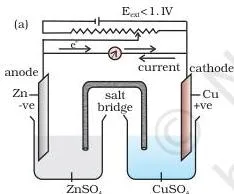
The names and signs matter:
- Anode — where oxidation happens. In a galvanic cell it is the negative electrode (electrons are produced here).
- Cathode — where reduction happens. In a galvanic cell it is the positive electrode.
- Salt bridge — connects the two half-cells internally to complete the circuit.
Cell representation convention (NCERT, p. 3): anode on the left, cathode on the right; a single vertical line separates metal from its ion, a double vertical line (\( \parallel \)) marks the salt bridge. The emf is always written as \[ E_{\text{cell}} = E_{\text{right}} – E_{\text{left}} \]
Worked illustration, the Cu–Ag cell (reaction \( \text{Cu(s)} + 2\text{Ag}^+ \rightarrow \text{Cu}^{2+} + 2\text{Ag} \)):
\[ \text{Cu(s)} \mid \text{Cu}^{2+}(\text{aq}) \parallel \text{Ag}^+(\text{aq}) \mid \text{Ag(s)}, \quad E_{\text{cell}} = E_{\text{Ag}^+|\text{Ag}} – E_{\text{Cu}^{2+}|\text{Cu}} \]
If you apply an external voltage \( E_{\text{ext}} \) to a galvanic cell (Fig. 2.2), three things can happen:
- \( E_{\text{ext}} \lt 1.1\ \text{V} \): electrons still flow Zn → Cu; zinc dissolves at the anode, copper deposits at the cathode.
- \( E_{\text{ext}} = 1.1\ \text{V} \): no current, no reaction.
- \( E_{\text{ext}} \gt 1.1\ \text{V} \): the reaction reverses — zinc deposits, copper dissolves, and the cell now works as an electrolytic cell (NCERT, p. 2).
Standard Electrode Potential and the Hydrogen Reference
You can never measure the potential of a single electrode; only the difference between two electrodes (the cell emf) is measurable (NCERT, p. 4). So chemists defined a reference: the standard hydrogen electrode (SHE).
- Construction: a platinum electrode coated with platinum black, dipping in acidic solution, with pure \( \text{H}_2 \) gas bubbled through it.
- Conditions: \( \text{H}_2 \) at 1 bar, \( \text{H}^+ \) at 1 M.
- Assigned potential: zero at all temperatures, for \( \text{H}^+(\text{aq}) + \text{e}^- \rightarrow \tfrac{1}{2}\text{H}_2(\text{g}) \).
Measured against SHE as the left (anode) half-cell:
\[ \text{Pt}|\text{H}_2(1\ \text{bar})|\text{H}^+(1\ \text{M}) \parallel \text{Cu}^{2+}(1\ \text{M})|\text{Cu} \quad \Rightarrow \quad E^\circ = +0.34\ \text{V} \]
\[ \text{Pt}|\text{H}_2(1\ \text{bar})|\text{H}^+(1\ \text{M}) \parallel \text{Zn}^{2+}(1\ \text{M})|\text{Zn} \quad \Rightarrow \quad E^\circ = -0.76\ \text{V} \]
What the sign means (NCERT, p. 5): a positive \( E^\circ \) means the ion is reduced more easily than \( \text{H}^+ \); a negative \( E^\circ \) means the metal is a stronger reducing agent than \( \text{H}_2 \). For the Daniell cell this gives:
\[ E^\circ_{\text{cell}} = E^\circ_R – E^\circ_L = 0.34\ \text{V} – (-0.76\ \text{V}) = 1.10\ \text{V} \]
Key facts from Table 2.1 (standard electrode potentials at 298 K, NCERT p. 7):
- \( \text{F}_2 \) is the strongest oxidising agent (\( \text{F}_2 + 2\text{e}^- \rightarrow 2\text{F}^- \), \( E^\circ = +2.87\ \text{V} \)); its reduced form \( \text{F}^- \) is the weakest reducing agent.
- Li is the strongest reducing agent (\( \text{Li}^+ + \text{e}^- \rightarrow \text{Li} \), \( E^\circ = -3.05\ \text{V} \)).
- Moving down the table, oxidising power decreases and reducing power of the reduced forms increases.
Exam consequence: Cu does not dissolve in HCl because \( \text{H}^+ \) cannot oxidise it, but it does dissolve in nitric acid, where the nitrate ion (not \( \text{H}^+ \)) does the oxidising (NCERT, p. 5).
Nernst Equation: Cell Potential at Any Concentration
The Nernst equation gives the electrode potential when concentrations are not unity. For an electrode reaction \( \text{M}^{n+} + n\text{e}^- \rightarrow \text{M} \), with the solid metal’s concentration taken as 1 (NCERT, p. 6):
\[ E_{(\text{M}^{n+}/\text{M})} = E^\circ_{(\text{M}^{n+}/\text{M})} – \frac{RT}{nF} \ln \frac{1}{[\text{M}^{n+}]} \quad \text{(Eq. 2.8)} \]
where \( R = 8.314\ \text{J K}^{-1}\ \text{mol}^{-1} \), \( T \) is temperature in kelvin, \( n \) is the number of electrons, and \( F = 96487\ \text{C mol}^{-1} \).
For a general cell reaction \( a\text{A} + b\text{B} \rightarrow c\text{C} + d\text{D} \) (Eq. 2.13):
\[ E_{\text{cell}} = E^\circ_{\text{cell}} – \frac{RT}{nF} \ln Q, \quad Q = \frac{[\text{C}]^c [\text{D}]^d}{[\text{A}]^a [\text{B}]^b} \]
At 298 K, converting \( \ln \) to \( \log_{10} \), this becomes the form used in nearly every numerical:
\[ E_{\text{cell}} = E^\circ_{\text{cell}} – \frac{0.059}{n} \log Q \]
Why the same \( n \) for both half-reactions? Consider \( \text{Ni(s)} \mid \text{Ni}^{2+} \parallel \text{Ag}^+ \mid \text{Ag} \). The cell reaction is \( \text{Ni(s)} + 2\text{Ag}^+ \rightarrow \text{Ni}^{2+} + 2\text{Ag(s)} \), so \( n = 2 \) and the silver term is squared in \( Q = [\text{Ni}^{2+}]/[\text{Ag}^+]^2 \) (NCERT, p. 8).
The concentration of the oxidised form at the cathode appears in the denominator’s favour: \( E_{\text{cell}} \) increases when \( [\text{Cu}^{2+}] \) rises or \( [\text{Zn}^{2+}] \) falls (NCERT, p. 8).
From Cell Potential to Equilibrium Constant and Gibbs Energy
As a galvanic cell runs, \( [\text{Zn}^{2+}] \) rises, \( [\text{Cu}^{2+}] \) falls, and the voltage drops. At equilibrium the voltmeter reads zero: \( E_{\text{cell}} = 0 \). Setting \( E_{\text{cell}} = 0 \) in the Nernst equation gives the bridge to equilibrium (Eq. 2.14):
\[ E^\circ_{\text{cell}} = \frac{0.059}{n} \log K_c \quad \text{at 298 K} \]
For the Daniell cell: \( \log K_c = (1.1 \times 2)/0.059 = 37.3 \), so \( K_c \approx 2 \times 10^{37} \) (NCERT, p. 9). A \( K_c \) this large means the reaction effectively goes to completion.
The cell emf and Gibbs energy are linked by the electrical work done (Eqs. 2.15–2.16):
\[ \Delta_r G = -nFE_{\text{cell}}, \qquad \Delta_r G^\circ = -nFE^\circ_{\text{cell}} \]
Intensive vs extensive (NCERT, p. 10): \( E_{\text{cell}} \) is intensive — it does not depend on how much reaction runs. \( \Delta_r G \) is extensive: if you double the reaction, \( \Delta_r G \) doubles (from \( -2FE \) to \( -4FE \)) but the emf stays the same. For the Daniell cell, \( \Delta_r G^\circ = -2 \times 1.1 \times 96487 = -212.27\ \text{kJ mol}^{-1} \).
A negative value confirms the reaction is spontaneous.
Conductivity and Molar Conductivity of Ionic Solutions
Resistance of a conductor depends on its geometry: \( R = \rho \frac{l}{A} \) (Eq. 2.17). The chapter then defines four linked quantities (NCERT, pp. 11, 14):
- Resistivity \( \rho \) — resistance of a 1 m × 1 m² block; unit \( \Omega\ \text{m} \) (also \( \Omega\ \text{cm} \)).
- Conductance \( G = 1/R \) — unit siemens, S.
- Conductivity \( \kappa = 1/\rho = \frac{G^*}{R} \) — unit S m\(^{-1}\) (often S cm\(^{-1}\); \( 1\ \text{S cm}^{-1} = 100\ \text{S m}^{-1} \)).
- Molar conductivity \( \Lambda_m = \frac{\kappa}{c} \) — conductance of a solution containing one mole of electrolyte between electrodes 1 cm apart; unit S m\(^2\) mol\(^{-1}\) or S cm\(^2\) mol\(^{-1}\). When \( \kappa \) is in S cm\(^{-1}\) and concentration in mol L\(^{-1}\):
\[ \Lambda_m\ (\text{S cm}^2\ \text{mol}^{-1}) = \frac{\kappa\ (\text{S cm}^{-1}) \times 1000\ (\text{cm}^3\ \text{L}^{-1})}{\text{molarity}\ (\text{mol L}^{-1})} \]
Electronic vs electrolytic conductance (p. 11): metals conduct by electrons — composition unchanged, conductivity decreases with temperature. Solutions conduct by ions — their conductivity increases with temperature and depends on the nature, size and solvation of ions, solvent viscosity, and concentration.
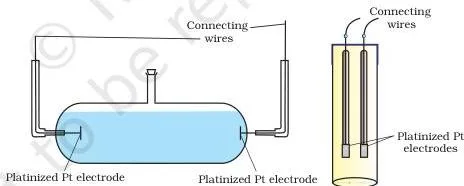
How conductivity is measured (p. 13): an AC source is used because DC would change the solution’s composition by electrolysis. The cell constant \( G^* = l/A \) is found by measuring the resistance of a KCl solution of known conductivity (Table 2.3: 0.1 M KCl has \( \kappa = 1.29\ \text{S m}^{-1} \) at 298 K), then \( \kappa = G^*/R \) for any unknown solution.
The resistance itself is measured on a Wheatstone bridge with an audio-frequency oscillator and a headphone detector (Fig. 2.5).
Kohlrausch Law and the Behaviour of Weak Electrolytes
Strong electrolytes (e.g. KCl) obey a straight-line law at low concentration (Eq. 2.23):
\[ \Lambda_m = \Lambda_m^\circ – A\sqrt{c} \]
A plot of \( \Lambda_m \) against \( \sqrt{c} \) is a straight line; the intercept at \( \sqrt{c} = 0 \) gives \( \Lambda_m^\circ \). For KCl, \( \Lambda_m^\circ \approx 150.0\ \text{S cm}^2\ \text{mol}^{-1} \) (NCERT, p. 18).
Weak electrolytes (e.g. acetic acid) behave differently: \( \Lambda_m \) rises steeply at low concentration because dilution increases the degree of dissociation, so the curve cannot be extrapolated to zero. To rescue them, Kohlrausch stated the law of independent migration of ions (Eq. 2.25): at infinite dilution, ions migrate independently, so \[ \Lambda_m^\circ = \nu_+ \lambda_+^\circ + \nu_- \lambda_-^\circ \]
where \( \nu \) counts the ions produced per formula unit. Examples (Table 2.4, p. 19): \( \lambda^\circ(\text{H}^+) = 349.6 \), \( \lambda^\circ(\text{OH}^-) = 199.1 \), \( \lambda^\circ(\text{Ca}^{2+}) = 119.0 \), \( \lambda^\circ(\text{Cl}^-) = 76.3\ \text{S cm}^2\ \text{mol}^{-1} \). Note that H\(^+\) and OH\(^-\) move fastest.
Applications (p. 20):
- Calculate \( \Lambda_m^\circ \) of a weak electrolyte: for acetic acid, \( \Lambda_m^\circ(\text{HAc}) = \Lambda_m^\circ(\text{HCl}) + \Lambda_m^\circ(\text{NaAc}) – \Lambda_m^\circ(\text{NaCl}) = 425.9 + 91.0 – 126.4 = 390.5\ \text{S cm}^2\ \text{mol}^{-1} \).
- Degree of dissociation: \( \alpha = \Lambda_m / \Lambda_m^\circ \) (Eq. 2.26).
- Dissociation constant: \( K_a = \frac{c\alpha^2}{1-\alpha} \) (Eq. 2.27).
Electrolysis and Faraday’s Laws of Electrolysis
An electrolytic cell uses an external voltage to force a non-spontaneous reaction (NCERT, p. 21). Faraday’s laws, published 1833–34, quantify it:
- First law: the amount of chemical reaction at an electrode is proportional to the quantity of electricity passed.
- Second law: the masses of different substances liberated by the same quantity of electricity are proportional to their chemical equivalent weights.
\[ Q = It \]
\( Q \) in coulombs, \( I \) in amperes, \( t \) in seconds. The Faraday, \( F \), is the charge on one mole of electrons:
\[ F = N_A \times e = 6.02 \times 10^{23}\ \text{mol}^{-1} \times 1.6021 \times 10^{-19}\ \text{C} = 96487\ \text{C mol}^{-1}\ (\approx 96500) \]
The stoichiometry decides the charge needed: \( \text{Mg}^{2+} + 2\text{e}^- \rightarrow \text{Mg} \) needs 2F per mole, while \( \text{Al}^{3+} + 3\text{e}^- \rightarrow \text{Al} \) needs 3F per mole. On the industrial scale, currents near 50,000 A are used — about 0.518 F per second. The same idea powers copper purification: impure copper is the anode, pure copper deposits at the cathode.
Products of Electrolysis: Predicting the Winner
When several ions compete at an electrode, use their standard potentials (NCERT, p. 23):
- At the cathode: the reduction with the higher (less negative) \( E^\circ \) is preferred.
- At the anode: the oxidation with the lower \( E^\circ \) is preferred.
- Overpotential — extra voltage needed because some processes are kinetically slow — can override these predictions.
The two textbook cases you must know:
- Molten NaCl (only Na\(^+\) and Cl\(^-\) present): products are Na metal and Cl\(_2\) gas.
- Aqueous NaCl: products are H\(_2\), Cl\(_2\) and NaOH. At the cathode, \( \text{H}^+ (E^\circ = 0.00\ \text{V}) \) beats \( \text{Na}^+ (E^\circ = -2.71\ \text{V}) \). At the anode, water (1.23 V) should beat Cl\(^-\) (1.36 V), but the overpotential of oxygen is high, so Cl\(_2\) is produced instead.
Also note: electrolysing dilute \( \text{H}_2\text{SO}_4 \) gives O\(_2\) at the anode, but concentrated \( \text{H}_2\text{SO}_4 \) gives peroxodisulphate, \( 2\text{SO}_4^{2-} \rightarrow \text{S}_2\text{O}_8^{2-} + 2\text{e}^- \) (\( E^\circ = 1.96\ \text{V} \)). Finally, reactive electrodes participate in the reaction (Cu in CuSO\(_4\) dissolves at the anode), while inert electrodes (Pt, Au) only supply or remove electrons.
Batteries and Fuel Cells: Galvanic Cells in Practice
A battery is simply a galvanic cell made light, compact, and steady in voltage (NCERT, p. 24). Three families appear in exams:
| Battery type | Class | Anode / Cathode | Electrolyte | Voltage & key point |
|---|---|---|---|---|
| Dry cell (Leclanché) | Primary (one use) | Zn container / graphite rod with MnO\(_2\) and carbon | Moist paste of NH\(_4\)Cl and ZnCl\(_2\) | ≈ 1.5 V; Mn goes from +4 to +3 state; NH\(_3\) forms \([\text{Zn(NH}_3)_4]^{2+}\) |
| Mercury cell | Primary | Zn–Hg amalgam / HgO paste with carbon | Paste of KOH and ZnO | ≈ 1.35 V; voltage stays constant because no solution ion changes concentration |
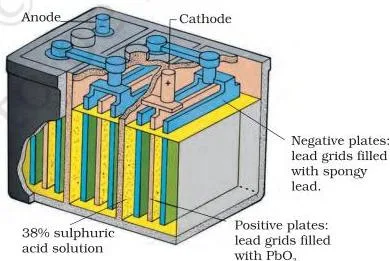
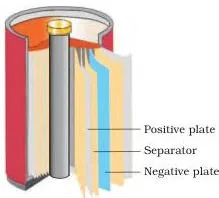
| Lead storage battery | Secondary (rechargeable) | Pb / grid packed with PbO\(_2\) | 38% H\(_2\)SO\(_4\) | Reversible; on charging PbSO\(_4\) converts back to Pb and PbO\(_2\) |
| Ni–Cd cell | Secondary | Cd / Ni(OH)\(_3\) | Moist KOH or NaOH | Longer life than lead cell, more expensive; overall: Cd + 2Ni(OH)\(_3\) → CdO + 2Ni(OH)\(_2\) + H\(_2\)O |
Key equations for the lead battery while discharging:
\[ \text{Pb(s)} + \text{PbO}_2(\text{s}) + 2\text{H}_2\text{SO}_4 \rightarrow 2\text{PbSO}_4(\text{s}) + 2\text{H}_2\text{O(l)} \]
Fuel cells are galvanic cells fed continuously with fuel. The \( \text{H}_2\text{–O}_2 \) fuel cell (Fig. 2.12) powered the Apollo space programme; its product water was even added to the astronauts’ drinking supply (NCERT, p. 26):
\[ \text{Cathode: } \text{O}_2 + 2\text{H}_2\text{O} + 4\text{e}^- \rightarrow 4\text{OH}^- \qquad \text{Anode: } 2\text{H}_2 + 4\text{OH}^- \rightarrow 4\text{H}_2\text{O} + 4\text{e}^- \]
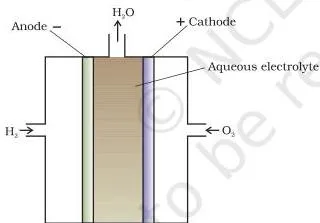
Efficiency is the exam fact: fuel cells convert chemical energy with about 70% efficiency, against about 40% for thermal plants — and they are pollution-free.
Corrosion: Rusting as an Electrochemical Cell
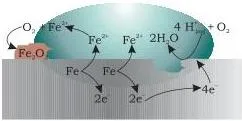
Corrosion is a galvanic cell working on a single metal object (NCERT, p. 27). At one spot (the anode), iron is oxidised; at another spot (the cathode), oxygen is reduced. Electrons travel through the metal itself.
\[ \text{Anode (oxidation): } 2\text{Fe(s)} \rightarrow 2\text{Fe}^{2+} + 4\text{e}^-, \quad E^\circ = -0.44\ \text{V} \]
\[ \text{Cathode (reduction): } \text{O}_2 + 4\text{H}^+ + 4\text{e}^- \rightarrow 2\text{H}_2\text{O}, \quad E^\circ = +1.23\ \text{V} \]
\[ \text{Overall: } 2\text{Fe} + \text{O}_2 + 4\text{H}^+ \rightarrow 2\text{Fe}^{2+} + 2\text{H}_2\text{O}, \quad E^\circ_{\text{cell}} = 1.67\ \text{V} \]
The \( \text{H}^+ \) comes from carbonic acid, \( \text{H}_2\text{CO}_3 \), formed when CO\(_2\) from the air dissolves in water. The ferrous ions are then oxidised further by atmospheric oxygen to hydrated ferric oxide, \( \text{Fe}_2\text{O}_3 \cdot x\text{H}_2\text{O} \) — rust.
Prevention methods the exam expects: surface coatings (paint or chemicals such as bisphenol), covering with another metal (Sn, Zn), and sacrificial electrodes — a more active metal like Mg or Zn that corrodes itself and saves the object.
Key Definitions at a Glance
| Term | Student-friendly meaning | Concrete example |
|---|---|---|
| Galvanic cell | Converts chemical energy of a spontaneous redox reaction into electrical energy | Daniell cell, 1.1 V (p. 2) |
| Electrolytic cell | Uses external electrical energy to drive a non-spontaneous reaction | Electrolysis of molten NaCl (p. 21) |
| Electrode potential | Potential difference between an electrode and its electrolyte at equilibrium | \( E(\text{Cu}^{2+}/\text{Cu}) \) (p. 3) |
| Standard electrode potential | Electrode potential when all species are at unit concentration, measured vs SHE | \( E^\circ(\text{Zn}^{2+}/\text{Zn}) = -0.76\ \text{V} \) (p. 4) |
| Cell potential / emf | Difference of reduction potentials of cathode and anode; emf when no current flows | \( E_{\text{cell}} = E_{\text{right}} – E_{\text{left}} \) (p. 3) |
| Salt bridge | Internal ionic connection between two half-cells | \( \parallel \) in cell notation (p. 3) |
| Nernst equation | Relates electrode/cell potential to ion concentrations | \( E = E^\circ – \frac{0.059}{n}\log Q \) (p. 6, 8) |
| Resistivity \( \rho \) | Resistance of a 1 m × 1 m² block of material | Unit \( \Omega\ \text{m} \) (p. 11) |
| Conductivity \( \kappa \) | Inverse of resistivity; conductance of unit cube of solution | Unit S m\(^{-1}\) (p. 11) |
| Molar conductivity \( \Lambda_m \) | Conductance of solution containing one mole of electrolyte between electrodes 1 cm apart | \( \Lambda_m = \kappa/c \) (p. 14, 16) |
| Limiting molar conductivity \( \Lambda_m^\circ \) | Molar conductivity at infinite dilution (zero concentration) | KCl: 150.0 S cm² mol⁻¹ (p. 18) |
| Cell constant \( G^* \) | \( l/A \) of a conductivity cell; found using KCl of known \( \kappa \) | \( G^* = \kappa R \) (p. 13) |
| Faraday \( F \) | Charge on one mole of electrons | 96,487 C mol⁻¹ (p. 21) |
| Overpotential | Extra voltage needed when a feasible electrode process is kinetically slow | Oxygen overpotential lets Cl⁻ oxidise in brine (p. 23) |
| Primary / secondary battery | Used once and discarded / rechargeable by reversing current | Dry cell / lead storage battery (p. 24–25) |
| Fuel cell | Galvanic cell fed continuously with fuel; converts combustion energy to electricity | H\(_2\)–O\(_2\) cell, ~70% efficient (p. 26) |
Electrochemistry Formula Sheet
| Topic | Formula | Symbols and units |
|---|---|---|
| Cell potential | \( E_{\text{cell}} = E_{\text{right}} – E_{\text{left}} \) | \( E \) in volts |
| Nernst equation (general) | \( E = E^\circ – \frac{RT}{nF} \ln Q \) | \( R = 8.314\ \text{J K}^{-1}\text{mol}^{-1} \), \( F = 96487\ \text{C mol}^{-1} \), \( T \) in K |
| Nernst equation (298 K) | \( E_{\text{cell}} = E^\circ_{\text{cell}} – \frac{0.059}{n} \log Q \) | \( n \) = electrons transferred |
| Equilibrium constant | \( E^\circ_{\text{cell}} = \frac{0.059}{n} \log K_c \) (298 K) | \( K_c \) dimensionless |
| Gibbs energy | \( \Delta_r G = -nFE_{\text{cell}} \), \( \Delta_r G^\circ = -nFE^\circ_{\text{cell}} \) | \( \Delta_r G \) in J mol⁻¹ |
| Resistance / resistivity | \( R = \rho l/A \) | \( \rho \) in \( \Omega\ \text{m} \) |
| Conductance / conductivity | \( G = 1/R \), \( \kappa = G^*/R = 1/\rho \) | \( G \) in S, \( \kappa \) in S m⁻¹ |
| Molar conductivity | \( \Lambda_m = \kappa/c \) | \( c \) in mol m⁻³ → S m² mol⁻¹; use ×1000 cm³ L⁻¹ for mol L⁻¹ |
| Strong electrolyte | \( \Lambda_m = \Lambda_m^\circ – A\sqrt{c} \) | straight-line plot, intercept = \( \Lambda_m^\circ \) |
| Kohlrausch law | \( \Lambda_m^\circ = \nu_+\lambda_+^\circ + \nu_-\lambda_-^\circ \) | count the ions per formula unit |
| Degree of dissociation | \( \alpha = \Lambda_m/\Lambda_m^\circ \) | unitless |
| Dissociation constant | \( K_a = \frac{c\alpha^2}{1-\alpha} \) | \( c \) in mol L⁻¹ |
| Electrolysis | \( Q = It \), \( 1\text{F} = 96487\ \text{C mol}^{-1} \) | \( Q \) in C, \( I \) in A, \( t \) in s |
Worked Examples: Step-by-Step with Original Numbers
Example 1 — Nernst equation (cell emf at non-standard concentrations)
Method: write the cell reaction, identify \( n \), build \( Q \) with correct exponents, then substitute into the 298 K Nernst form.
Problem: for the cell \( \text{Zn(s)} \mid \text{Zn}^{2+}(0.250\ \text{M}) \parallel \text{Cu}^{2+}(0.015\ \text{M}) \mid \text{Cu(s)} \), with \( E^\circ_{\text{cell}} = 1.10\ \text{V} \), find the emf at 298 K.
Step 1: Write the cell reaction.
\( \text{Zn(s)} + \text{Cu}^{2+}(\text{aq}) \rightarrow \text{Zn}^{2+}(\text{aq}) + \text{Cu(s)} \), so \( n = 2 \) and \( Q = [\text{Zn}^{2+}]/[\text{Cu}^{2+}] \).
Step 2: Substitute into \( E_{\text{cell}} = E^\circ_{\text{cell}} – \frac{0.059}{n}\log Q \).
\[ E = 1.10 – \frac{0.059}{2} \log \frac{0.250}{0.015} \]
Step 3: Simplify.
\( \frac{0.250}{0.015} = 16.7 \), \( \log 16.7 = 1.22 \).
\[ E = 1.10 – (0.0295)(1.22) = 1.10 – 0.036 = 1.064\ \text{V} \]
Final answer: \( E_{\text{cell}} = 1.064\ \text{V} \). Note the emf is above 1.10 V because \( [\text{Cu}^{2+}] \lt [\text{Zn}^{2+}] \) pulls the reaction forward.
Example 2 — Kohlrausch law (limiting molar conductivity of a 2:1 salt)
Method: sum the ionic contributions, multiplying each by the number of ions produced per formula unit.
Problem: given \( \lambda^\circ(\text{Mg}^{2+}) = 106.0 \) and \( \lambda^\circ(\text{Cl}^-) = 76.3\ \text{S cm}^2\ \text{mol}^{-1} \), calculate \( \Lambda_m^\circ \) for MgCl\(_2\).
- Step 1: One formula unit of MgCl\(_2\) gives 1 Mg\(^{2+}\) and 2 Cl\(^-\).
- Step 2: Apply \( \Lambda_m^\circ = \nu_+\lambda_+^\circ + \nu_-\lambda_-^\circ \).
\[ \Lambda_m^\circ(\text{MgCl}_2) = 106.0 + 2(76.3) = 106.0 + 152.6 = 258.6\ \text{S cm}^2\ \text{mol}^{-1} \]
Final answer: \( \Lambda_m^\circ(\text{MgCl}_2) = 258.6\ \text{S cm}^2\ \text{mol}^{-1} \). The factor of 2 on the chloride term is the mark most commonly dropped.
Example 3 — Faraday’s first law (mass deposited)
Method: find the charge, convert it to moles of electrons, then to moles and mass of metal using the half-reaction stoichiometry.
Problem: a current of 2.0 A is passed through CuSO\(_4\) solution for 30 minutes. What mass of copper deposits at the cathode? (Atomic mass Cu = 63.5 g mol⁻¹.)
- Step 1: Convert time to seconds: \( t = 30 \times 60 = 1800\ \text{s} \).
- Step 2: Charge passed: \( Q = It = 2.0\ \text{A} \times 1800\ \text{s} = 3600\ \text{C} \).
- Step 3: Moles of electrons: \( \frac{3600}{96500} = 0.0373\ \text{mol e}^- \).
- Step 4: Half-reaction \( \text{Cu}^{2+} + 2\text{e}^- \rightarrow \text{Cu} \): moles Cu = \( 0.0373/2 = 0.0187\ \text{mol} \).
- Step 5: Mass = \( 0.0187 \times 63.5 = 1.18\ \text{g} \).
Final answer: \( 1.18\ \text{g} \) of copper is deposited.
Common Mistakes Students Make in Electrochemistry
| Mistake | Correct rule | How to check your answer |
|---|---|---|
| Writing \( E = E^\circ + \frac{0.059}{n}\log Q \) | \( E = E^\circ – \frac{0.059}{n}\log Q \) — the Nernst term is always subtracted for the cell reaction as written | At \( Q = 1 \), \( \log Q = 0 \) and \( E = E^\circ \); any other sign fails this test |
| Using \( n = 1 \) for \( \text{Cu}^{2+} + 2\text{e}^- \rightarrow \text{Cu} \) | \( n = 2 \) — the number of electrons in the balanced half-reaction | Count the electrons in the half-reaction, not the charge on the ion |
| \( \Lambda_m^\circ(\text{CaCl}_2) = \lambda^\circ(\text{Ca}^{2+}) + \lambda^\circ(\text{Cl}^-) \) | Add \( 2\lambda^\circ(\text{Cl}^-) \): CaCl\(_2\) gives two chloride ions | Write the dissociation equation first: CaCl\(_2\) → Ca\(^{2+}\) + 2Cl\(^-\) |
| “The anode is always negative” | In a galvanic cell the anode is negative; in an electrolytic cell it is positive. Oxidation happens at the anode in both | Ask: is the cell producing electricity (galvanic) or consuming it (electrolytic)? |
| Mixing units in \( \Lambda_m = \kappa/c \) | If \( \kappa \) is in S cm⁻¹ and \( c \) in mol L⁻¹, multiply by 1000 cm³ L⁻¹ before dividing | Final unit must be S cm² mol⁻¹; if you get S cm⁻¹ mol⁻¹ you skipped the factor |
Exam Notes: What Examiners Look For
- Nernst numericals are the chapter’s most tested skill. Writing the 298 K form \( E = E^\circ – \frac{0.059}{n}\log Q \) correctly, choosing \( n \) from the balanced reaction, and using \( Q = [\text{products}]/[\text{reactants}] \) with correct exponents earns the method marks.
- In \( E^\circ_{\text{cell}} = E^\circ_{\text{cathode}} – E^\circ_{\text{anode}} \), identifying which electrode is which before substituting is where partial credit is given — label them in the cell diagram first.
- Kohlrausch law is the standard route to \( \Lambda_m^\circ \) of weak electrolytes; the \( 2\lambda^\circ(\text{Cl}^-) \) factor is a frequent trap, as is reading the wrong ion values from Table 2.4.
- Products-of-electrolysis questions test the competition at each electrode — \( \text{H}^+ \) vs \( \text{Na}^+ \) at the cathode, \( \text{Cl}^- \) vs water at the anode — plus the role of overpotential. State the \( E^\circ \) values you compare; that is the evidence for your choice.
- In conductance problems, show the 1000 cm³ L⁻¹ conversion explicitly. Skipping it is the most common way full marks are lost even when the arithmetic is right.
10-Minute Revision Summary
- Galvanic cell: spontaneous redox → electricity. Electrolytic cell: electricity → non-spontaneous redox.
- Anode = oxidation (negative in galvanic, positive in electrolytic); cathode = reduction. “An ox” — anode is oxidation.
- \( E^\circ_{\text{cell}} = E^\circ_{\text{cathode}} – E^\circ_{\text{anode}} \); SHE = 0 V; \( E^{\circ} \) measured at 1 M, 1 bar.
- Nernst (298 K): \( E = E^\circ – \frac{0.059}{n}\log Q \).
- Thermodynamics: \( \Delta_r G^\circ = -nFE^\circ = -RT\ln K_c \); at equilibrium \( E = 0 \).
- Conductance: \( \kappa \) decreases on dilution, \( \Lambda_m \) increases; \( \Lambda_m = \kappa/c \).
- Kohlrausch: \( \Lambda_m^\circ = \nu_+\lambda_+^\circ + \nu_-\lambda_-^\circ \); \( \alpha = \Lambda_m/\Lambda_m^\circ \).
- Faraday: \( Q = It \); \( 1\text{F} = 96500\ \text{C} \).
- Batteries: dry cell 1.5 V, mercury 1.35 V, lead-acid rechargeable, Ni–Cd rechargeable; fuel cell ~70% vs thermal ~40%.
- Corrosion = electrochemical cell with anodic and cathodic spots; prevent with paint, metal coatings, sacrificial anodes.
Frequently Asked Questions
Why does copper not dissolve in dilute hydrochloric acid but dissolve in nitric acid?
Because the oxidising agent is different. \( \text{H}^+ \) has \( E^\circ = 0.00\ \text{V} \), below \( E^\circ(\text{Cu}^{2+}/\text{Cu}) = +0.34\ \text{V} \), so hydrogen ions cannot oxidise copper metal (NCERT, p. 5).
Nitric acid contains nitrate ions, which are strong oxidising agents (\( \text{NO}_3^- + 4\text{H}^+ + 3\text{e}^- \rightarrow \text{NO} + 2\text{H}_2\text{O} \), \( E^\circ = 0.97\ \text{V} \)) — nitrate oxidises the copper, not \( \text{H}^+ \).
How do I decide the value of n in the Nernst equation?
\( n \) is the number of electrons transferred in the balanced redox reaction — it must be the same number in both half-reactions (NCERT, p. 8). For \( \text{Cu}^{2+} + 2\text{e}^- \rightarrow \text{Cu} \), \( n = 2 \); for \( \text{Ag}^+ + \text{e}^- \rightarrow \text{Ag} \), \( n = 1 \).
In a full cell, balance both half-reactions first and read \( n \) off either — for \( \text{Ni} + 2\text{Ag}^+ \rightarrow \text{Ni}^{2+} + 2\text{Ag} \), \( n = 2 \), which is why \( [\text{Ag}^+] \) appears squared in \( Q \).
Why does the Nernst equation use ion concentrations and not the solid metal?
Because the activity of a pure solid or pure liquid is taken as unity (NCERT, p. 6). In \( E = E^\circ – \frac{RT}{nF}\ln\frac{[\text{M}]}{[\text{M}^{n+}]} \), the solid M term equals 1, so \( \ln 1 = 0 \) and it drops out. Only dissolved ions (and gases, as partial pressures) change the potential.
Is the anode always negative, and what is the difference between galvanic and electrolytic cells?
| Feature | Galvanic cell | Electrolytic cell |
|---|---|---|
| Energy change | Chemical → electrical | Electrical → chemical |
| Reaction | Spontaneous | Non-spontaneous |
| Anode sign | Negative | Positive |
| Cathode sign | Positive | Negative |
| Electron flow | Anode → cathode (external circuit) | Same direction, but driven by the external supply |
| Example | Daniell cell, batteries | Electrolysis of brine, copper refining |
Oxidation happens at the anode in both cell types — only the sign convention flips because the external source forces the polarity in an electrolytic cell.
How do we find the limiting molar conductivity of a weak electrolyte like acetic acid when it cannot be measured directly?
By Kohlrausch’s law of independent migration of ions: add the known limiting ionic conductivities. For acetic acid, \( \Lambda_m^\circ(\text{HAc}) = \lambda^\circ(\text{H}^+) + \lambda^\circ(\text{CH}_3\text{COO}^-) \), which can be evaluated as \( \Lambda_m^\circ(\text{HCl}) + \Lambda_m^\circ(\text{NaAc}) – \Lambda_m^\circ(\text{NaCl}) = 425.9 + 91.0 – 126.4 = 390.5\ \text{S cm}^2\ \text{mol}^{-1} \) (NCERT, p. 20).
Extrapolation fails for weak electrolytes because their curves bend steeply at low concentration.
For more chapter context, see the Class 12 Chemistry notes hub, the Class 12 revision notes index, and the full CBSE notes library. Electrochemistry’s Nernst and conductance ideas connect forward to Solutions and Chemical Kinetics. The authoritative source for every equation above is the official NCERT portal, which hosts the Class 12 Chemistry Part I textbook.
Reference: NCERT Class 12 Chemistry textbook, chapter Electrochemistry.
Explore Class 12 Chemistry Notes
More for this chapter:
Class 12 Chemistry on LearnCBSE:
Related chapters: