
This is the NCERT Class 12 Biotechnology textbook, Chapter 9 — Stem Cell Culture and Organ Culture — maintained for the current academic session. The chapter runs 22 printed pages and covers how stem cells are defined, classified and put to use, and how organ culture rebuilds whole three-dimensional tissue structures outside the body.
The official chapter PDF from NCERT is linked below; the rest of the page teaches what the chapter contains, in the book’s own section order.
The official Stem Cell Culture and Organ Culture Class 12 chapter PDF (official NCERT Biotechnology) is published on the NCERT textbook portal, exactly as printed in the book — open it when you want the full chapter text, its original figures and its complete exercise set together in one file.
| What the chapter holds | Count | Where it is used |
|---|---|---|
| Printed pages | 22 | |
| Sections in the chapter | 11 | |
| Figures with NCERT captions | 8 | |
| Exercise questions | 19 | answered in our NCERT Solutions |
| Official NCERT PDF | Download the chapter PDF | the chapter exactly as NCERT publishes it |
Chapter at a Glance
The table below is the contents list of the official chapter file — how many pages it runs, how many sections and figures it holds, and what kind of questions it ends with. Use it to know what you are dealing with before you start.
| What the chapter contains | Count |
|---|---|
| Printed pages in the official PDF | 22 |
| Numbered sections (9.1 to 9.2.6) | 11 |
| Text length (approximate) | 6,200 words |
| Figures | 8 |
| Worked examples | 0 |
| Formulas and equations | 0 |
| Exercise questions | 19 |
Stem Cell Culture and Organ Culture Class 12: What the Chapter Covers
This guided tour shows where each idea lives inside the chapter, so you can read it in order or jump straight to the section you need. The book itself is built in two clean halves.
First half — Stem Cell Culture (§9.1). The chapter opens with the zygote-to-embryo idea: fertilisation forms a zygote, which divides into two, four and eight cells, and those daughter cells specialise into muscle, skin, liver, heart and other cell types. Some cells stay immature, and these immature, unspecialised cells are the stem cells the chapter is about.
A timeline box (Box 1) records the history of the field, from the first stem cells isolated from blood to modern regenerative medicine.
- §9.1.1 classifies stem cells twice — by source (embryonic, fetal, adult) and by potency (totipotent, pluripotent, multipotent, unipotent);
- §9.1.2 explains the characteristics of stem cells, mainly plasticity — the ability of a tissue-specific stem cell to become a cell type of a different tissue;
- §9.1.3 lists the applications (neurological, skin, heart, immunity, diabetes and more) and the open research challenges, with Box 2 giving the laboratory protocol for maintaining feeder cells.
Second half — Organ Culture (§9.2). This part starts from a limitation: ordinary cell culture keeps cells alive but loses the architectural complexity of real tissue. Organ culture tries to keep the organ’s structure and function together. The book then walks through its characteristics (§9.2.1), growth and differentiation plus the three culture types (§9.2.2), applications (§9.2.4), limitations (§9.2.5) and future prospects (§9.2.6).
The chapter ends with a SUMMARY of its own key points and EXERCISES — descriptive questions first, then objective questions, then assertion-reason questions. There are no worked examples and no formulas anywhere in the chapter, which shapes how you should revise it (see the exam section below).
Key Concepts: Stem Cells and How They Are Classified
This section is the foundation of the chapter: if you can define a stem cell and place every type into its two classification systems, most of the chapter is done. The book classifies stem cells twice — once by where they come from and once by what they can become.
What makes a cell a stem cell
A stem cell is a non-specialised (unspecialised) cell with two defining properties: self-renewal — the ability to copy itself through mitotic cell division without losing its stem nature — and potency — the potential to differentiate into a wide range of specialised cell types. These two properties together are what the chapter keeps returning to.
In humans, stem cells are found in the umbilical cord, placenta, inner cell mass of the early embryo, a few fetal tissues and some adult organs.
The book also lists what stem cells can be used for: developing new cells in the lab to replace damaged tissues or organs, studying the causes of genetic defects and diseases, and testing new drug molecules.
Adult stem cells keep the body’s tissues repaired by replacing damaged or dying cells, and they maintain this cellular homeostasis for a mammal’s whole lifetime.
Classification by source
By source, the chapter gives three groups — embryonic, fetal and adult stem cells — and the comparison between them is a favourite exam table.
- Embryonic stem cells come from the inner cell mass (epiblast) of the blastocyst, about five days into development. They are pluripotent — able to form all three germ layers (ectoderm, mesoderm, endoderm) — self-renewing, with a stable diploid chromosome set, and they keep the characteristics of embryo founder cells even after extensive handling. They are the most promising for clinical use because they can become any tissue of the body, but their use is limited by technical safety concerns and an ethical dilemma.
- Fetal stem cells come from the fetus — the embryo is called a fetus from the eighth week of development. Fetal blood is a rich source of haematopoietic stem cells (the book writes the abbreviation HSG once; the standard term is HSC), which proliferate more rapidly than those from cord blood or adult bone marrow. Once harvested, a fetal stem cell line can live indefinitely in the laboratory.
- Adult stem cells are more precisely called somatic stem cells, because they can come from children or the umbilical cord — not from adults only. They are undifferentiated, mostly multipotent cells found in mature body tissues, the umbilical cord and the placenta after birth. Their main job is to preserve and repair the tissue they live in, and their highest frequency is in the bone marrow. They were once thought to be fixed to one lineage, but are now known to show plasticity.
The two adult stem cell lines the book names are worth separating:
- Haematopoietic stem cells (HSCs) — formed in the bone marrow, they give rise to the blood cells: red blood cells, monocytes, neutrophils, acidophils, basophils, lymphocytes and platelets.
- Mesenchymal stem cells (MSCs) — found in bone marrow, adipose tissue and the umbilical cord; they self-renew, show multi-lineage differentiation and are extremely proliferative. They make and repair skeletal tissues such as cartilage, bone and fat, and are used in tissue engineering because they avoid allo-rejection and keep genetic stability.
Classification by potency
By potency, the chapter ranks stem cells from strongest to weakest. The four classes are the single most-tested idea in this chapter, so memorise the table.
| Potency class | What it can form | What it cannot form | Example |
|---|---|---|---|
| Totipotent (toti = whole) | The embryo, the extra-embryonic membranes, and all post-embryonic tissues and organs — a complete functional organism | — (it is the most versatile class) | The zygote; all cells of the early embryo up to the eight-cell stage |
| Pluripotent (pluri = several) | Almost all cell types of the embryo — all three germ layers | Extra-embryonic support tissues (placenta, yolk sac), so no complete organism | Inner cell mass of the blastocyst; embryonic stem cells |
| Multipotent (multi = many) | A closely related family of cells within one lineage | Cells outside its own lineage | HSCs (all blood cells); neural stem cells (neurons, oligodendrocytes, astrocytes) |
| Unipotent (uni = one) | Only cells of its own type, plus self-renewal | Any other cell type | Epidermal stem cells; muscle and endothelial stem cells |
Memory aid: from strongest to weakest — Toti > Pluri > Multi > Uni. Remember that totipotent and pluripotent cells belong to embryonic life, while multipotent and unipotent cells are the adult (somatic) stem cells found after birth. The chapter summarises all of this visually in Fig 9.1 (see the Figure Walkthrough below).
Key Concepts: Stem Cell Behaviour, Uses and Limits
Before any application, understand the honest state of the field: most stem cell treatments are still experimental and costly, and bone marrow transplantation is the one established exception. This section covers the biology behind the claims (plasticity), the diseases being targeted, and what still blocks routine clinical use.
Plasticity: how a stem cell changes its fate
Plasticity is the presumed ability of tissue-specific adult stem cells to take on the fate of cell types different from the tissue they came from.
It needs the responding cells to be competent and the microenvironment to give the right cues — not every bone marrow cell can become a neuron or hepatocyte, and even competent cells will not switch unless the environment is inductive. The chapter names six alternative pathways:
- Transdetermination — a stem cell programmed for certain lineages switches to another stem cell and produces that precursor’s cell types; its potential is redirected.
- Transdifferentiation — a differentiated cell takes on the phenotype of another differentiated cell.
- Dedifferentiation — adult stem cells revert to the master cells they originated from, which can then form other cell types; common in lower vertebrates, rare in mammals.
- Heterogeneity — the most accepted explanation; the apparent plasticity comes from a mixed population, so clonal level purity is the gold standard for proving plasticity, judged by surface markers.
- Pleiotropy — plasticity between two cells of the same germ layer explained by clonal level impurity.
- Fusion — an alternative mechanism proposed for plasticity in adult stem cells.
The book prints the first two as trans-determination and trans-differentiation; the unhyphenated spellings above are the standard forms and both are accepted.
Applications of stem cells
Each application pair is worth memorising — the disease plus the cell type being investigated:
- Neurological diseases — ALS (loss of motor neurons) is being studied with bone marrow stem cells and induced pluripotent stem cells (iPSCs); spinal cord injury is treated experimentally by regenerating nerve cells and triggering severed nerve fibres to grow; in the eye, transplanted retinal pigment epithelial cells derived from embryonic and retinal stem cells improved vision.
- Wound healing or skin replacement — keratinocyte stem cells live in the hair follicle; after plucking a hair, these cells are cultured into a skin equivalent close to the patient’s own skin, with less rejection and lower inflammation than conventional skin grafts.
- Cardiovascular diseases — research aims to re-establish the lost function of heart tissue and blood vessels after ischemia and heart muscle injury.
- Auto-immune disorders — conditions where the immune system overreacts and attacks the body’s own healthy tissues.
- Type 1 diabetes — the immune system destroys insulin-producing pancreatic beta cells; treatment using cells derived from haematopoietic stem cells is being explored.
- Multiple sclerosis — the myelin sheath of neurons is damaged; bone marrow and neural stem cells are being investigated to regenerate properly myelinated neurons.
- Arthritis — stem cells can differentiate into chondrocytes (cartilage-making cells), offering a better alternative to drugs that only reduce pain and inflammation.
- Drug screening — pharmaceutical industries use stem cells as disease models: cardiomyocytes from human embryonic stem cells for cardiac disease, and stem-cell-derived neuronal cells for neuronal disorders.
Stem cell research challenges
- Immunological rejection — the recipient’s immune system rejects transplanted stem cells; immunosuppressive treatment then makes the patient prone to microbial infections. Induced pluripotent stem cells made from the recipient’s own cells partly solve this.
- Stem cell behaviour — embryonic stem cells divide indefinitely and might induce tumour growth.
- Safety — stem cells are prone to microbial infection, which can cause infectious diseases in recipients.
Box 2 sits inside this section as the chapter’s laboratory protocol — how to maintain mouse embryonic fibroblast feeder cells. It is walked through image by image in the Figure Walkthrough below.
Key Concepts: Organ Culture and How It Works
The problem organ culture solves: cell culture keeps isolated cells alive, but the in vivo structural complexity of a real tissue is missing. Modern approaches — three-dimensional (3D) cultures, organs-on-a-chip and organoids — try to mimic the tissue microenvironment.
Organ culture develops a part of an organ, or the whole organ, from tissue culture techniques while preserving the anatomical relationship and physiological functions of its tissue components.
Success demands extreme care: tissues must not be damaged during handling, must reach the laboratory within minutes of collection, and are analysed by immunochemistry, autoradiography and histology.
The two defining characteristics
Structural integrity. Organ cultures have no vascular system, so their size is limited by diffusion and their polarity may suffer. Some proliferation happens only on the outer cell layers; the cells stay unified as a single unit, and cell-to-cell communication via adhesion is greatly preserved.
Nutrient and gas exchange. Without blood vessels, nutrients and gases diffuse in from the periphery, and this diffusion rate caps the size of the tissue. The centre of a large mass can die — this is the source of central necrosis. High oxygen concentration is often used, but carries an oxygen-toxicity risk. Tissues are therefore kept at a gas–liquid interface:
- if the liquid layer is optimal, the tissue keeps a spherical geometry;
- if the liquid is too shallow, surface tension makes the tissue outgrow and flatten;
- if the liquid is too deep, gas exchange is compromised.
A hydrophobic surface minimises outgrowth, and hyperbaric or enhanced pure oxygen improves oxygen permeation.
Growth, differentiation and the three types
Growth means increase in cell number; differentiation means change in function. Most organ cultures do not grow — they proliferate only on outer layers because of physical limits, and soluble growth factors are supplied to promote differentiation. The chapter gives three culture types in §9.2.2 and Box 3, plus organoids:
- Whole embryo culture — Spratt (1950s) cultured chick embryos by preparing a medium on a watchglass placed on moist absorbent cotton wool in a petridish; eggs were incubated at 38°C for 40–42 hours, the shell sterilised with 70% ethanol, and the blastoderm placed on the sterile pad and incubated at 37.5°C for further development. Its purpose was to study the effect of metabolic inhibitors on the developing embryo in vitro.
- Histotypic culture — one characterised cell line grown at high density with suitable soluble factors and extracellular matrix. Examples: vascular endothelial cells forming capillary tubules in a collagen matrix, and cellulose sponges coated with collagen that cells infiltrate to form glandular structures.
- Organotypic culture — cells of different lineages co-cultured to create a tissue-like structure, the easiest way to maintain two cell types together. The chapter’s example: co-culturing fibroblast and epithelial clones from the mammary gland lets the epithelial cells differentiate and produce milk proteins in the right hormonal environment.
- Organoids — self-organised 3D tissue cultures derived from stem cells (growth factors and collagen included). Example: an artificial liver surgically implanted into the peritoneal cavity of a rat. Organoids may one day replace diseased organs or deliver genetically altered cells into a patient’s body.
Applications, limitations and future prospects
- Applications (§9.2.4): cultured organs built from the patient’s own stem cells could substitute for transplantable organs without immunosuppressive drugs; organ culture lets you study a tissue’s actual behaviour in vitro and compare it with the same organ in vivo; it suits hormone studies — the mouse mammary gland is the most commonly cultured organ.
- Limitations (§9.2.5): organ cultures cannot proliferate, so a fresh organ is needed for every experiment; reproducibility is low and variation high (geometry, handling, sampling and cell-proportion differences); they are challenging and expensive to prepare; and only integrated tissue behaviour can be examined — not isolated cells.
- Future prospects (§9.2.6): adapt 2D assay protocols to 3D conditions using multicellular spheroids, scaffold hydrogels, organoids, organs-on-chips, hanging drop, microfluidics, magnetic levitation, microtissues and 3D bioprinting.
If the basics of cell culture are shaky, our animal cell culture notes cover the groundwork this chapter builds on.
Figure Walkthrough: The Stem Cell Diagram and the Feeder-Cell Protocol
The chapter’s eight figures are one classification diagram and the seven images of the Box 2 lab protocol. Working through the images is the fastest way to fix the classification and the protocol in your memory.
Fig 9.1 — Various type of stem cells
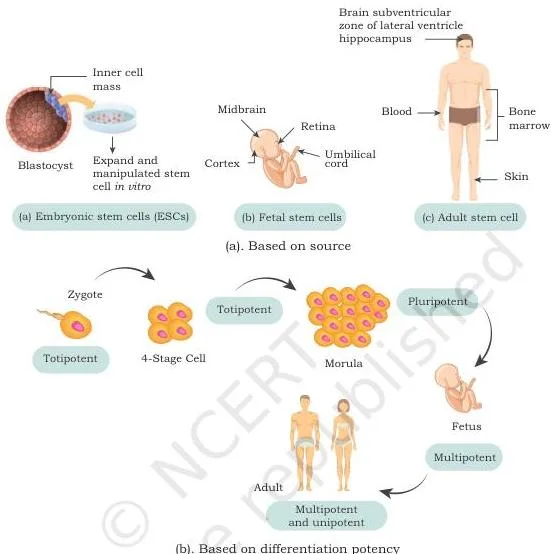
This diagram sits at the start of §9.1.1 and is the chapter’s classification map. The section text tells you exactly what it shows: stem cells classified by source (embryonic, fetal, adult) and by potency (totipotent, pluripotent, multipotent, unipotent).
Read it as one picture containing both systems — the source route on the left, the potency ladder on the right — and test yourself by covering the labels and naming each type in your head.
Box 2 in pictures — maintaining mouse embryonic fibroblasts
The seven images below are the steps of the Box 2 protocol, in order. The caption of Box 2 expands its abbreviations: MEFs = Mouse Embryonic Fibroblasts, PBS = Phosphate Buffer Saline, MMC = Macromolecular Crowding, EDTA = Ethylenediamine tetraacetic acid. The flow in plain words: break the cell sheet apart, plate, treat, wash, harvest, freeze.

The first step breaks the cell sheet apart: trypsin, with EDTA as a helper, digests the connections between cells so the culture becomes single cells that can be handled and counted. A culture of feeder cells has to start from a uniform suspension.

Step two plates the cells at a controlled density: \(8 \times 10^4\) to \(1.1 \times 10^5\) cells per cm\(^2\). The density matters because feeder layers need to cover the dish evenly to support the stem cells that will later be added on top.

Step three simply gives the cells time to settle and attach to the dish: 2.0 to 3.0 hours at the body temperature of 37°C. This converts the suspended cells into an attached layer ready for treatment.

Step four is the chemical treatment: MMC is added to the medium at 10 mg/mL and the dishes are incubated for 0.5 to 3.5 hours at 37°C. The MMC treatment is what turns the dividing fibroblasts into a stable, growth-arrested feeder layer.

Step five removes the treatment: the medium containing MMC, along with any cells that did not attach, is aspirated quickly and discarded. Only the healthy attached feeder cells should remain.

Step six cleans the culture: five washes with PBS (Phosphate Buffer Saline) rinse away every trace of the MMC medium. Leftover MMC would keep acting on the cells, so the wash series is the safety step of the protocol.
Step eight harvests the cells: they are transferred into a tube and centrifuged, which packs them into a pellet at the bottom.
The protocol then closes with a step the book gives in text only — the harvested cells are digested again with trypsin/EDTA (step 7 in the book’s list, shown between the PBS washes and this tube transfer) and finally cryopreserved for later use, frozen so they can be thawed as needed.
Definitions: The Terms to Know
The glossary below collects the terms this chapter expects you to use in answers. Each meaning is one line so you can scan it before writing a descriptive answer.
| Term | One-line meaning |
|---|---|
| Stem cell | An unspecialised cell with self-renewal (mitotic division without losing stemness) and potency to differentiate into specialised cell types. |
| Self-renewal | The ability of a stem cell to divide and produce more stem cells like itself. |
| Potency | The range of cell types a stem cell can differentiate into. |
| Totipotent | Able to form the embryo, extra-embryonic membranes and a complete organism (e.g. zygote, cells up to the eight-cell stage). |
| Pluripotent | Able to form almost all embryonic cell types but not the placenta or yolk sac (e.g. inner cell mass, embryonic stem cells). |
| Multipotent | Able to form a closely related family of cells within one lineage (e.g. HSCs → blood cells). |
| Unipotent | Able to produce only its own cell type, while still self-renewing (e.g. epidermal stem cells). |
| Embryonic stem cell | A self-reproducing, pluripotent cell from the inner cell mass or epiblast of the blastocyst. |
| Fetal stem cell | A cell from a fetus (after the eighth week) that divides and provides progenitor cells; fetal blood is rich in haematopoietic stem cells. |
| Adult (somatic) stem cell | An undifferentiated cell found in mature tissues, children, umbilical cord and placenta after birth; maintains and repairs its tissue. |
| Haematopoietic stem cell (HSC) | Bone-marrow stem cell that forms all blood cell types — RBCs, monocytes, neutrophils, acidophils, basophils, lymphocytes and platelets. |
| Mesenchymal stem cell (MSC) | Self-renewing, multi-lineage cell from bone marrow, adipose tissue or umbilical cord; makes and repairs skeletal tissues. |
| Plasticity | The presumed ability of a tissue-specific adult stem cell to take on the fate of cell types from a different tissue. |
| Transdetermination | A stem cell’s potential is redirected to a different stem cell lineage. |
| Transdifferentiation | A differentiated cell takes on the phenotype of another differentiated cell. |
| Dedifferentiation | Adult stem cells revert to master cells which can then form other cell types; common in lower vertebrates, rare in mammals. |
| Organ culture | Developing part of an organ or the whole organ by tissue culture while preserving its anatomical relationship and physiological functions. |
| Histotypic culture | One characterised cell line grown at high density with soluble factors and extracellular matrix (e.g. capillary tubules in collagen). |
| Organotypic culture | Co-culture of cells of different lineages to form a tissue-like structure (e.g. mammary gland fibroblast + epithelial cells making milk proteins). |
| Organoid | A self-organised 3D tissue culture derived from stem cells, e.g. an artificial liver. |
Common Mistakes Students Make in This Chapter
The confusions below are the ones this chapter’s wording actively sets up — name them before they cost you marks. Each row gives the mistake, the correct rule, and a quick way to check yourself.
| Mistake | Correct rule | How to check your answer |
|---|---|---|
| Thinking adult stem cells come only from adults | The book calls them somatic stem cells — they are found in children, the umbilical cord and placenta after birth, and mature tissues. | If a source says “from adults only”, the statement is wrong; the name is “adult” but the sources are wider. |
| Confusing totipotent with pluripotent on the placenta point | Toti = embryo + extra-embryonic membranes + complete organism. Pluri = all three germ layers but no placenta or yolk sac. | Ask: can it form a placenta? Yes → totipotent; no → pluripotent. |
| Missing that totipotency ends at the eight-cell stage | All early embryo cells are totipotent only up to the eight-cell stage; the blastocyst’s inner cell mass becomes pluripotent. | Mention the eight-cell limit whenever you contrast toti and pluri. |
| Treating all adult stem cells as identical | HSCs form blood cells; MSCs form and repair skeletal and connective tissues (cartilage, bone, fat). | Match the cell type to the tissue: blood → HSC, bone/cartilage/fat → MSC. |
| Accepting the reason in Exercise Q19 — “stem cells do not exhibit cellular potency” | Potency is a defining property of stem cells, alongside self-renewal. The reason is false; the assertion is true, so the answer is (c). | If a statement denies potency to stem cells, reject it — the very definition includes it. |
| Treating organ culture like cell culture | Organ cultures cannot proliferate — a fresh organ is needed for every experiment, and only integrated tissue behaviour can be examined. | If an answer implies organ cultures can be passaged or maintained indefinitely, it is wrong. |
How to Use This Chapter for Exams
The exercise set has a clear shape: descriptive questions, then objective questions, then assertion-reason questions. Since the chapter contains no worked examples and no formulas, revision means mastering definitions, distinctions and lists — and the distinction questions are fastest answered as tables.
Method by question type.
- “Differentiate” questions (Q2, Q3) — write a three-row or three-column table: potency classes for Q2, embryonic versus adult for Q3. Use the exact categories from §9.1.1 and you automatically hit the examiner’s points.
- Organ culture questions (Q6, Q7) — Q6 is the definition from §9.2 (a part or whole organ developed by tissue culture, preserving anatomy and physiology); Q7 is the two characteristics from §9.2.1 (structural integrity; nutrient and gas exchange).
- Objective questions — the book’s own text settles them. Q14: HSC is the book’s named example of a multipotent cell, so the answer is (c). Q16: the chapter discusses both spinal cord injury and Type 1 diabetes as stem cell targets, so the answer is (c) both. Q17: bone marrow, umbilical cord blood and adipose tissue are all named sources, so the answer is (d) all of these. The rest: Q12 (b) multicellular organisms, Q13 (c) potency, Q15 (c) a cell that can divide and give rise to specialised cells.
- Assertion-reason questions — judge the reason on its own before the assertion. Q18: both are true and the reason (embryonic stem cells are pluripotent) correctly explains the assertion (they give rise to different cell types), so (a). Q19: the reason claims stem cells “do not exhibit cellular potency” — false, since potency is a defining stem cell property — so the answer is (c) assertion true, reason false.
Exercise-to-section mapping. Use this map to jump from any question to the passage that answers it.
| Questions | Type | Where the answer lives |
|---|---|---|
| Q1 | Descriptive | §9.1 — stem cell definition and the properties self-renewal and potency |
| Q2 | Descriptive | §9.1.1 — the potency classes totipotent, pluripotent, multipotent |
| Q3 | Descriptive | §9.1.1 — classification by source, embryonic versus adult |
| Q4 | Descriptive | §9.1.3 — applications including diseases and drug screening |
| Q5 | Descriptive | The chapter prints no explicit monitoring-parameter list; the closest passages are Box 2’s protocol conditions (density, incubation times, washes) and the safety challenges |
| Q6 | Descriptive | §9.2 — organ culture definition |
| Q7 | Descriptive | §9.2.1 — structural integrity and nutrient/gas exchange |
| Q8 | Descriptive | §9.2.2 — whole embryo, histotypic and organotypic culture |
| Q9 | Descriptive | §9.2 and §9.2.4 — advantages over cell culture |
| Q10 | Descriptive | §9.2.4 — applications (organ substitute, in vitro behaviour, hormone studies) |
| Q11 | Descriptive | §9.2.1 (hydrophobic surface), §9.2.2 and Box 3 — watchglass and cotton wool, collagen matrix, cellulose sponges, filter well inserts, perfused capillaries |
| Q12–Q17 | Objective | §9.1.1 (presence, potency, multipotent, sources) and the applications in §9.1.3 |
| Q18 | Assertion-reason | §9.1.1 — embryonic stem cells are pluripotent |
| Q19 | Assertion-reason | §9.1 — stem cell definition includes both self-renewal and potency |
A full-mark descriptive answer in this chapter names the defining property, gives one example or distinction, and states the practical limit (safety, ethics, no proliferation) where the question touches it. Note that textbook contents and the examinable syllabus are not always identical — check the current official syllabus.
Chapter Summary for Quick Revision
This condensed list restates the chapter’s own SUMMARY in shorter form — read it the night before the exam, then fill any gap by opening the matching section.
- Stem cells are unspecialised cells with two properties: self-renewal and potency (differentiation into diverse specialised types).
- By potency: totipotent (all cell types plus extra-embryonic membranes), pluripotent (almost all embryonic cell types except placenta and yolk sac), multipotent (one related family of cells), unipotent (its own cell type only). Toti and pluri belong to embryonic life; multi and uni are the adult or somatic stem cells.
- By source: embryonic (inner cell mass of the blastocyst), fetal (after the eighth week) and adult or somatic (mature tissues, umbilical cord and placenta after birth).
- Stem cells can potentially treat cancer, Type 1 diabetes mellitus, Parkinson’s disease, cardiac diseases and neurological disorders, among others.
- Organ culture develops part of an organ or the whole organ from tissue culture techniques; its greatest advantage is recreating the whole three-dimensional structure of the organ.
- Its characteristics are structural integrity, nutrient and gas exchange, and growth and differentiation; its types are whole embryo, histotypic and organotypic culture.
- Organ culture helps study the actual behaviour of a tissue in vitro and compare it with in vivo, and supports developmental biology and tissue-interaction studies.
Related Resources
This listing is maintained for the 2026-27 academic session using the NCERT textbook information available to us. NCERT remains the authority for confirming the latest edition.
For the full Class 12 Biotechnology book, return to the Class 12 Biotechnology book page, and for every subject at this level use the Class 12 hub. The NCERT books directory lists the complete set of class and subject pages. Once you finish tissue culture, the next stage of the book is covered in our bioprocessing and biomanufacturing notes.
Sources and Data Verification
Four points, plainly, so a parent or teacher can verify this page:
- The page describes the NCERT Class 12 Biotechnology textbook, Chapter 9 (Stem Cell Culture and Organ Culture), official edition published on ncert.nic.in.
- It covers this one chapter only — not other chapters of the book, and not other subjects.
- Counts such as the number of figures and exercises describe this chapter’s file as published by NCERT.
- NCERT settles textbooks, editions and PDFs; CBSE settles the curriculum, syllabus and examinations.
FAQs
What is the difference between totipotent and pluripotent stem cells?
The difference is the extra-embryonic membranes. A totipotent cell (like the zygote, up to the eight-cell stage) can form the embryo, the placenta and yolk sac, and a complete organism.
A pluripotent cell (like the inner cell mass of the blastocyst) can form almost all embryonic cell types — all three germ layers — but cannot form the placenta or yolk sac, so it cannot give rise to a complete organism on its own.
Are adult stem cells found only in adults?
No. The book says adult stem cells are more precisely called somatic stem cells, because they can come from children or the umbilical cord, not from adults only. They are also present in the placenta after birth and in mature body tissues, with their highest frequency in the bone marrow.
Why can organ cultures not grow beyond a small size?
Because organ cultures have no vascular system. Nutrients and gases must diffuse in from the periphery, and the diffusion rate limits how large the tissue mass can become. As a result, the central part of a larger tissue can undergo necrosis.
Keeping the tissue at the correct gas–liquid interface — not too shallow, not too deep — is how the chapter says this is managed.
What is the difference between histotypic and organotypic culture?
Histotypic culture grows one characterised cell line at high density with soluble factors and extracellular matrix — for example, vascular endothelial cells forming capillary tubules in a collagen matrix.
Organotypic culture co-cultures cells of different lineages to build a tissue-like structure — for example, mammary gland fibroblast and epithelial clones together, where the epithelial cells produce milk proteins in the right hormonal environment.
What are the main challenges that stem cell therapy still faces?
Three, from the chapter: immunological rejection (the recipient’s immune system rejects the transplant, and immunosuppressive drugs make the patient prone to infections), stem cell behaviour (embryonic stem cells divide indefinitely and may induce tumour growth), and safety (stem cells are prone to microbial contamination and infection).
Induced pluripotent stem cells made from the recipient’s own cells are one partial answer to the rejection problem.
Reference: NCERT Class 12 Biotechnology textbook, chapter 9, official edition on ncert.nic.in.
Explore Class 12 Biotechnology Books
Related chapters: